China Solar Module Manufacturing Equipment Market Snapshot
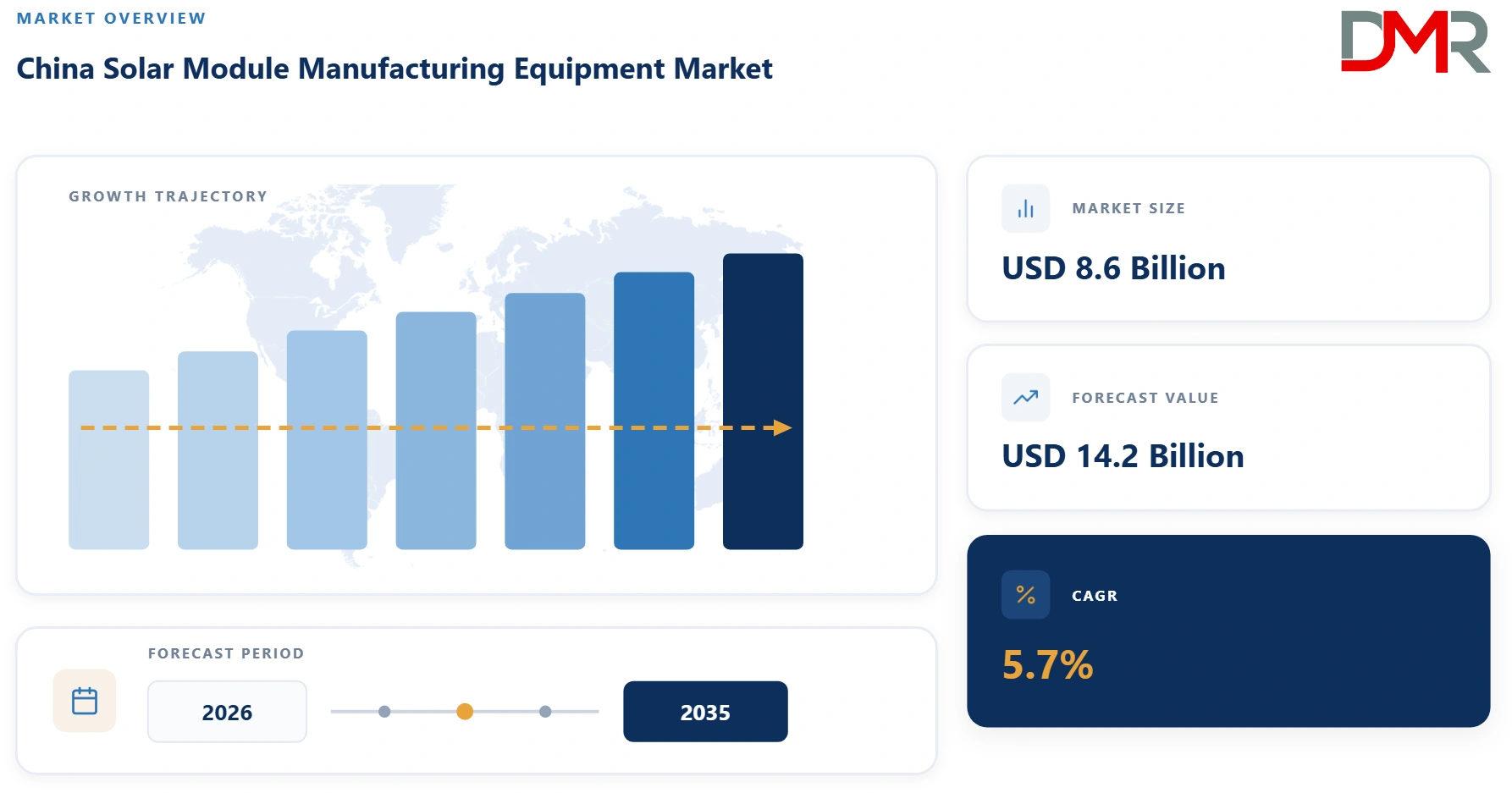
- China Solar Module Manufacturing Equipment Market Size in 2026: USD 8.6 Billion
- China Solar Module Manufacturing Equipment Market Size in 2035: USD 14.2 Billion
- China CAGR from 2026 to 2035: 5.7%
- Cell Manufacturing Equipment is the leading equipment type segment in 2026: 44.8%
- TOPCon is the leading technology segment in 2026: 46.3%
- Utility-Scale Solar Manufacturing is the leading application segment in 2026: 61.8%
- Integrated Solar Manufacturers is the leading end user segment in 2026: 68.4%
What is the China Solar Module Manufacturing Equipment Market and its Market Size?
The China Solar Module Manufacturing Equipment Market is projected to be valued at USD 8.6 Billion in 2026 and is projected to reach USD 14.2 Billion by 2035, expanding at a CAGR of 5.7% during the forecast period.
ℹ
To learn more about this report –
Download Your Free Sample Report Here
Growth is being propelled by China's position as the world's dominant solar manufacturing hub accounting for the substantial majority of global wafer, cell, and module production capacity, continued rapid technology transition from legacy PERC cell architecture toward higher-efficiency TOPCon, heterojunction, and back-contact cell technologies requiring corresponding equipment upgrades and replacement investment, and sustained domestic Chinese solar installation demand alongside continued export-oriented manufacturing capacity serving global renewable energy deployment. The maturing of next-generation cell technology manufacturing equipment supporting TOPCon and heterojunction production at increasing scale and improving cost efficiency, growing equipment manufacturer investment in automation and precision manufacturing technology addressing the increasingly exacting tolerances required for higher-efficiency cell architectures, and continued Chinese equipment manufacturer technology leadership supporting both domestic capacity expansion and growing equipment export to solar manufacturers establishing production capacity in other countries are reshaping the market from a PERC-technology-dominated equipment base into an increasingly diversified, next-generation technology-focused manufacturing equipment industry. Investment is accelerating as Chinese solar manufacturers and equipment companies navigate significant industry overcapacity and margin pressure while continuing to invest in the next-generation cell technology transition.
Use Cases
- TOPCon Cell Production Line Equipment for Efficiency Upgrade Investment: Chinese solar cell manufacturers invest in specialized diffusion furnace, PECVD, and other TOPCon-specific manufacturing equipment to transition production capacity from legacy PERC technology toward higher-efficiency TOPCon cell architecture, addressing continued industry-wide efficiency improvement competition.
- Heterojunction (HJT) Manufacturing Equipment for Premium Efficiency Product Lines: Leading Chinese solar manufacturers invest in specialized heterojunction cell manufacturing equipment, including low-temperature deposition systems, to produce premium, higher-efficiency HJT solar cells targeting both domestic and international markets willing to pay premium pricing for superior performance characteristics.
- Automated Module Assembly Equipment for Large-Scale Manufacturing Facilities: Large-scale Chinese module manufacturers invest in automated stringing, tabbing, and lamination equipment supporting high-volume, high-throughput module assembly operations serving both domestic installation demand and substantial export markets.
- Equipment Export to International Solar Manufacturing Capacity Expansion: Chinese solar manufacturing equipment companies increasingly export production equipment to solar manufacturers establishing new production capacity in Southeast Asia, the Middle East, and other regions, leveraging China's established technology leadership in solar manufacturing equipment design and production.
Key Takeaways
- Market Size: The China Solar Module Manufacturing Equipment Market is anticipated to be valued at USD 8.6 Billion in 2026 and is forecast to reach USD 14.2 Billion by 2035, expanding at a CAGR of 5.7%.
- Growth Outlook: Market expansion is sustained by China's dominant global solar manufacturing position, continued rapid cell technology transition toward higher-efficiency architectures, and sustained domestic and export-oriented manufacturing capacity investment.
- Primary Growth Drivers: China's position as the world's dominant solar manufacturing hub, continued technology transition from PERC toward TOPCon and heterojunction cell architectures, sustained domestic and global solar installation demand, and growing equipment export to international solar manufacturing capacity are supporting continued market growth.
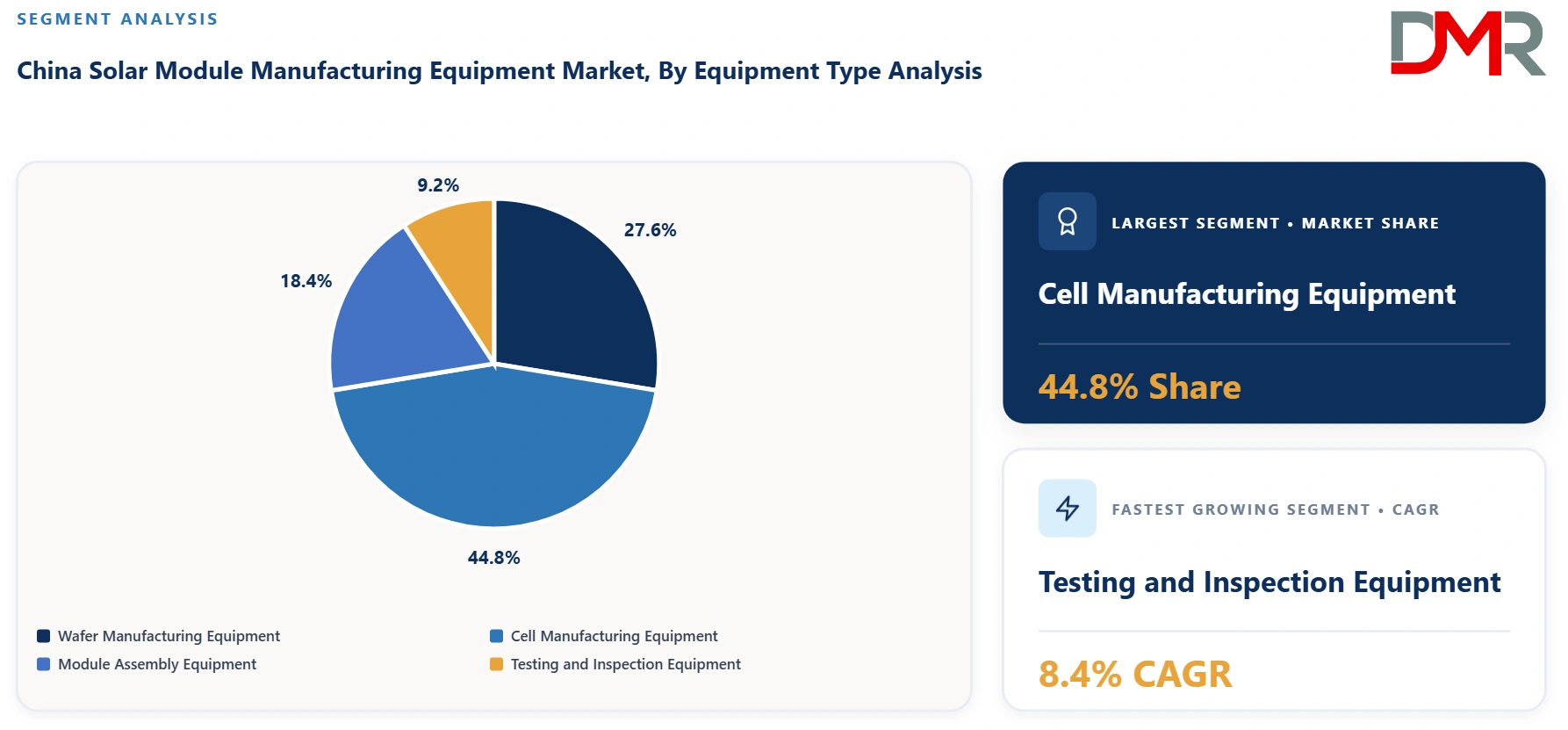
- By Equipment Type Analysis: Cell Manufacturing Equipment is projected to lead the equipment type segment with a 44.8% share in 2026, reflecting substantial investment in next-generation cell technology production lines. Testing and Inspection Equipment is the fastest-growing equipment type segment at 8.4% CAGR, driven by increasingly exacting quality control requirements for higher-efficiency cell technologies.
- By Technology Analysis: TOPCon is expected to dominate with a 46.3% share in 2026, reflecting its position as the leading next-generation cell technology capturing the majority of new manufacturing capacity investment. Heterojunction (HJT) is the fastest-growing technology segment at 11.6% CAGR, driven by continued premium efficiency product line investment among leading manufacturers.
- By Application Analysis: Utility-Scale Solar Manufacturing is poised to lead with a 61.8% share in 2026, reflecting the scale of global utility-scale solar deployment demand for Chinese-manufactured modules. Distributed/Rooftop Solar Manufacturing is the fastest-growing application segment at 6.9% CAGR, driven by continued growth in both domestic and international distributed solar installation demand.
- By End User Analysis: Integrated Solar Manufacturers are projected to dominate with a 68.4% share in 2026, reflecting the scale of China's vertically integrated wafer-to-module solar manufacturing companies. Equipment Leasing/Contract Manufacturers is the fastest-growing end user segment at 7.8% CAGR, driven by growing flexible manufacturing capacity arrangements amid industry overcapacity conditions.
Key Drivers in the China Solar Module Manufacturing Equipment Market
China's Position as the World's Dominant Solar Manufacturing Hub
China accounts for the substantial majority of global solar wafer, cell, and module manufacturing capacity, reflecting decades of sustained government industrial policy support, manufacturing scale advantages, and deep domestic supply chain integration spanning polysilicon production through finished module assembly. This dominant global manufacturing position generates enormous underlying equipment demand, as Chinese solar manufacturers continue to represent the primary global market for solar manufacturing equipment investment, encompassing both capacity expansion and the continuous technology upgrade investment required to maintain competitive cell efficiency and cost positioning.
Continued Technology Transition from PERC Toward TOPCon and Heterojunction Cell Architectures
The Chinese solar manufacturing industry continues to undergo substantial technology transition away from legacy PERC cell architecture toward higher-efficiency TOPCon, heterojunction, and back-contact cell technologies, driven by intense industry-wide competition on cell efficiency and cost-per-watt metrics. This technology transition requires substantial equipment investment as manufacturers upgrade or replace PERC-specific production equipment with technology-specific equipment supporting these next-generation cell architectures, representing one of the most significant and sustained equipment demand drivers within the current Chinese solar manufacturing industry cycle.
Restraints in the China Solar Module Manufacturing Equipment Market
Severe Industry-Wide Manufacturing Overcapacity and Margin Pressure
The Chinese solar manufacturing industry continues to experience severe manufacturing overcapacity relative to global demand growth, driven by years of aggressive capacity expansion across wafer, cell, and module production, resulting in substantial industry-wide margin pressure and financial stress among numerous solar manufacturing companies. This overcapacity environment represents a significant restraint on the China Solar Module Manufacturing Equipment Market, as financially stressed manufacturers may delay or cancel planned equipment investment, and industry-wide consolidation and capacity rationalization can reduce overall equipment demand even as technology transition continues driving replacement investment.
Growth Opportunities in the China Solar Module Manufacturing Equipment Market
Next-Generation Cell Technology Equipment Innovation Supporting Continued Efficiency Gains
Continued global solar industry competition on cell efficiency improvement presents a sustained opportunity for equipment manufacturers developing next-generation production technology supporting emerging cell architectures beyond current TOPCon and heterojunction technology, including tandem cell and other advanced technology categories under industry development. Equipment companies capable of developing production technology supporting continued efficiency improvement can capture premium positioning as leading manufacturers continue prioritizing technology leadership despite broader industry overcapacity challenges.
International Equipment Export Supporting Global Solar Manufacturing Capacity Diversification
Growing international interest in diversifying solar manufacturing capacity beyond China, driven by trade policy considerations and supply chain resilience objectives in markets including the United States, India, and Southeast Asia, presents an opportunity for Chinese solar manufacturing equipment companies to expand equipment export supporting this international capacity diversification trend. Chinese equipment companies possessing established technology leadership and manufacturing scale can capture significant international equipment demand even as this trend paradoxically reduces the pace of new domestic Chinese manufacturing capacity growth.
Trends in the China Solar Module Manufacturing Equipment Market
Continued Consolidation Among Chinese Solar Manufacturers Amid Overcapacity Conditions
The Chinese solar manufacturing industry continues to experience consolidation pressure as severe overcapacity conditions drive financial stress and, in some cases, exit among smaller and less technologically competitive manufacturers, while larger, better-capitalized companies continue investing in next-generation technology capacity. This consolidation trend is concentrating equipment demand among a smaller number of larger, technology-leading manufacturers capable of sustaining continued capital investment despite challenging industry-wide financial conditions.
Growing Equipment Manufacturer Investment in Automation and Precision Manufacturing Technology
Chinese solar manufacturing equipment companies continue to invest in improved automation and precision manufacturing technology addressing the increasingly exacting tolerances and process control requirements associated with higher-efficiency cell technologies such as TOPCon and heterojunction architectures. This technology investment trend reflects both the technical demands of next-generation cell manufacturing and Chinese equipment companies' efforts to maintain technology leadership supporting both domestic and growing international equipment sales.
Research Scope and Analysis
The China Solar Module Manufacturing Equipment Market is segmented by equipment type, technology, application, and end user, covering wafer, cell, and module assembly equipment, PERC, TOPCon, heterojunction, and back-contact cell technologies, and utility-scale and distributed solar manufacturing applications.
ℹ
To learn more about this report –
Download Your Free Sample Report Here
By Equipment Type Analysis
Cell Manufacturing Equipment is projected to dominate the China Solar Module Manufacturing Equipment Market with 44.8% share in 2026, reflecting substantial and sustained investment in next-generation cell technology production lines including diffusion furnaces, PECVD systems, and screen printing equipment supporting TOPCon and heterojunction cell manufacturing. Testing and Inspection Equipment is expected to register the highest CAGR of 8.4% during 2026-2035, driven by increasingly exacting quality control and process monitoring requirements associated with higher-efficiency cell technology manufacturing.
By Technology Analysis
TOPCon is anticipated to dominate the China Solar Module Manufacturing Equipment Market by technology, accounting for 46.3% share in 2026, reflecting its position as the leading next-generation cell technology that has captured the substantial majority of new Chinese manufacturing capacity investment in recent years. Heterojunction (HJT) is projected to register the highest CAGR of 11.6% between 2026 and 2035, driven by continued premium efficiency product line investment among leading manufacturers targeting higher-value market segments both domestically and internationally.
By Application Analysis
Utility-Scale Solar Manufacturing is projected to lead the China Solar Module Manufacturing Equipment Market with an estimated 61.8% share in 2026, reflecting the substantial scale of global utility-scale solar deployment demand served by Chinese-manufactured modules across both domestic and international markets. Distributed/Rooftop Solar Manufacturing is expected to register the fastest CAGR of 6.9% through 2035, driven by continued growth in both domestic Chinese and broader international distributed solar installation demand.
By End User Analysis
Integrated Solar Manufacturers are projected to dominate the China Solar Module Manufacturing Equipment Market with 68.4% share in 2026, reflecting the substantial scale of China's vertically integrated wafer-to-module solar manufacturing companies representing the majority of the industry's production capacity and equipment investment. Equipment Leasing/Contract Manufacturers is expected to register the fastest CAGR of 7.8% through 2035, driven by growing flexible manufacturing capacity arrangements as the industry navigates overcapacity conditions and seeks more capital-efficient production models.
The China Solar Module Manufacturing Equipment Market Report is segmented based on the following:
By Equipment Type
- Wafer Manufacturing Equipment
- Cell Manufacturing Equipment
- Diffusion Furnaces
- PECVD Systems
- Screen Printing Equipment
- Others
- Module Assembly Equipment
- Stringing and Tabbing Machines
- Laminators
- Framing Equipment
- Others
- Testing and Inspection Equipment
By Technology
- PERC
- TOPCon
- HJT (Heterojunction)
- Back Contact (BC/IBC)
- Others
By Application
- Utility-Scale Solar Manufacturing
- Distributed/Rooftop Solar Manufacturing
- Others
By End User
- Integrated Solar Manufacturers
- Cell and Module Specialty Manufacturers
- Equipment Leasing/Contract Manufacturers
Technology Analysis
Technology development is central to the trajectory of the China Solar Module Manufacturing Equipment Market as equipment companies invest in next-generation TOPCon and heterojunction production technology, advanced automation and robotics supporting increasingly precise manufacturing tolerances, and emerging tandem cell manufacturing technology positioning for the industry's next major efficiency improvement cycle. Growing use of AI-enhanced process control and quality monitoring is supporting improved yield rates and reduced defect rates across increasingly complex cell manufacturing processes. Opportunities are expanding for companies developing manufacturing equipment supporting emerging tandem and other next-generation cell technologies beyond current TOPCon and heterojunction architectures, as well as automation technology addressing labor cost considerations and precision manufacturing requirements. However, the substantial capital investment required for continued technology transition amid severe industry overcapacity and margin pressure creates significant financial risk considerations for both equipment manufacturers and solar manufacturing customers.
Investment and White Space Analysis
Investment opportunities in the China Solar Module Manufacturing Equipment Market are expanding alongside China's dominant global solar manufacturing position and continued cell technology transition, even as the broader industry navigates severe overcapacity challenges. Significant white space exists in next-generation cell technology equipment innovation supporting continued efficiency gains beyond current TOPCon and heterojunction technology, international equipment export supporting global manufacturing capacity diversification, and automation technology addressing precision manufacturing requirements for advanced cell architectures. Companies with strong next-generation technology development capability, established relationships with China's leading, better-capitalized solar manufacturers, and growing international equipment export capability are positioned to capture premium, longer-duration growth opportunities. However, severe industry-wide manufacturing overcapacity and margin pressure can delay or cancel planned equipment investment among financially stressed manufacturers, constraining overall market growth pace despite continued underlying technology transition demand.
Competitive Landscape
The China Solar Module Manufacturing Equipment Market is moderately consolidated and highly competitive, comprising large diversified Chinese solar manufacturing equipment companies with substantial domestic market share, specialized equipment manufacturers focused on specific production process categories, and international equipment companies competing for both domestic Chinese and growing international export opportunities. Competition centers on next-generation cell technology equipment capability, established relationships with China's leading integrated solar manufacturers, manufacturing precision and automation technology, and growing international equipment export and technical support capability. Large diversified Chinese equipment companies benefit from substantial domestic market scale and deep integration with China's solar manufacturing industry, while specialized equipment manufacturers compete through deep technical expertise in specific production process categories such as PECVD or diffusion furnace technology. Companies increasingly differentiate through next-generation technology capability and international export positioning rather than domestic equipment supply alone.
Some of the prominent players in the China Solar Module Manufacturing Equipment Market are:
- Wuxi Autowell Technology Co., Ltd.
- Yingkou Jinchen Machinery Co., Ltd.
- Suzhou SC-Solar Equipment Co., Ltd.
- Suzhou HORAD New Energy Equipment Co., Ltd.
- Wuxi Lead Intelligent Equipment Co., Ltd.
- Shenzhen S.C New Energy Technology Corporation
- Suzhou Maxwell Technologies Co., Ltd.
- Wuhan Sunic New Energy Technology Co., Ltd.
- YiLi PV Tech Ltd.
- Ooitech Co., Ltd.
- Qinhuangdao Zenithsolar Technological Co., Ltd.
- Qinhuangdao Shuogu Intelligent Technology Co., Ltd.
- Qinhuangdao Boostsolar Photovoltaic Equipment Co., Ltd.
- Qinhuangdao Radiant Automation Equipment Co., Ltd.
- Nantong REOO Technology Co., Ltd.
- Wuxi Bluemann Import and Export Co., Ltd.
- Zhuhai Gmee Solar Equipment Co., Ltd.
- Hangzhou ConfirmWare Technology Co., Ltd.
- Shenzhen Honghaixin Electromechanical Equipment Co., Ltd.
- Suzhou Hongruida New Energy Equipment Co., Ltd.
- Ningxia XN Automation Equipment Co., Ltd.
- Shanghai Buge Electromechanical Equipment Co., Ltd.
- Shanghai Senco Technology Co., Ltd.
- Shanghai Sunyoung Biz-Solution Co., Ltd.
- Suzhou Autoway System Co., Ltd.
- Hebei Yiheng Technology Co., Ltd.
- Changzhou Yuanguang Automation Equipment Co., Ltd.
- Zhuhai Lianlai Technology Co., Ltd.
- Wuhan DR Laser Technology Corp., Ltd.
- Jiangsu J.S. Machine Group Co., Ltd.
- CETC Electronics Equipment Group Co., Ltd.
- China Electronics Technology Group Corporation No. 48 Research Institute
- Double 100 Industrial Automation Co., Ltd.
- Boyang Energy Equipment Co., Ltd.
- Linzhou Guangyuan New Material Technology Co., Ltd.
- Suzhou Shengcheng Solar Equipment Co., Ltd.
- Wuxi Suntech Automation Equipment Co., Ltd.
- Jiangsu Huasheng Intelligent Equipment Co., Ltd.
- Suzhou Shengtuo Intelligent Equipment Co., Ltd.
- Changzhou Fuxianda Electromechanical Equipment Co., Ltd.
- Other Key Players
Recent Developments
- September 2026: Wuxi Autowell Technology launched new screen-printing equipment for copper and silver-coated copper pastes, targeting TOPCon, BC, and next-generation solar cell production.
- July 2026: Autowell showcased silver-free 0BB stringers, multi-cut stringing equipment, TOPCon-to-BC upgrade solutions, and digital-twin-enabled intelligent manufacturing systems at The smarter E 2026.
- June 2026: SC Solar launched its iLink Module Laminator and Optipure Clear Layer Laminator, incorporating modular production architecture, AI-assisted recognition, and real-time lamination monitoring.
- June 2026: Wuxi Autowell introduced a 1.3 GW intelligent HJT module encapsulation production line integrating 0BB stringing, automated layup, AGV automation, and energy-efficient lamination.
Report Details
| Report Characteristics |
| Market Size (2026) |
USD 8.6 Bn |
| Forecast Value (2035) |
USD 14.2 Bn |
| CAGR (2026–2035) |
5.7% |
| Historical Data |
2021 – 2025 |
| Forecast Data |
2026 – 2035 |
| Base Year |
2025 |
| Segments Covered |
By Equipment Type, By Technology, By Application, and By End User |
| Country Coverage |
China |
Frequently Asked Questions
How big is the China Solar Module Manufacturing Equipment Market?
▾ The China Solar Module Manufacturing Equipment Market is poised to be valued at USD 8.6 Billion in 2026 and is projected to reach USD 14.2 Billion by 2035, reflecting China's dominant global solar manufacturing position and continued cell technology transition investment.
What is the CAGR of the China Solar Module Manufacturing Equipment Market from 2026 to 2035?
▾ The market is projected to expand at a compound annual growth rate (CAGR) of 5.7% between 2026 and 2035, supported by continued technology transition toward higher-efficiency cell architectures, sustained global solar demand, and growing international equipment export.
What factors are driving the growth of the China Solar Module Manufacturing Equipment Market?
▾ Growth is driven by China's position as the world's dominant solar manufacturing hub, continued technology transition from PERC toward TOPCon and heterojunction cell architectures, sustained domestic and global solar installation demand, and growing equipment export to international solar manufacturing capacity.
What are the major trends in the China Solar Module Manufacturing Equipment Market?
▾ Major trends include continued consolidation among Chinese solar manufacturers amid overcapacity conditions, growing equipment manufacturer investment in automation and precision manufacturing technology, and rising development of next-generation cell technology beyond current TOPCon and heterojunction architectures.
Who are the key players in the China Solar Module Manufacturing Equipment Market?
▾ Key market participants include LONGi Green Energy Technology, JA Solar Technology, Trina Solar, JinkoSolar Holding, and Jiangsu Leadmicro Nano-Equipment Technology, among other integrated solar manufacturers and specialized equipment companies.
How is the China Solar Module Manufacturing Equipment Market segmented?
▾ The market is segmented by equipment type, technology, application, and end user, with demand analysis concentrated across Jiangsu, Zhejiang, Jiangxi, and Yunnan provinces.