Market Snapshot
- Market Size (2026): USD 96.8 Mn
- Forecast Value (2035): USD 356.9 Mn
- CAGR (2026-2035): 15.6%
- Leading Equipment Type: Crushing & Shredding Equipment with approximately 24.8% of 2026 revenue
- Leading Technology: Mechanical Recycling with approximately 48.6%
- Leading Application: Crystalline Silicon Module Recycling with approximately 76.3%
What is China Solar Module Recycling Equipment Market and its Market Size?
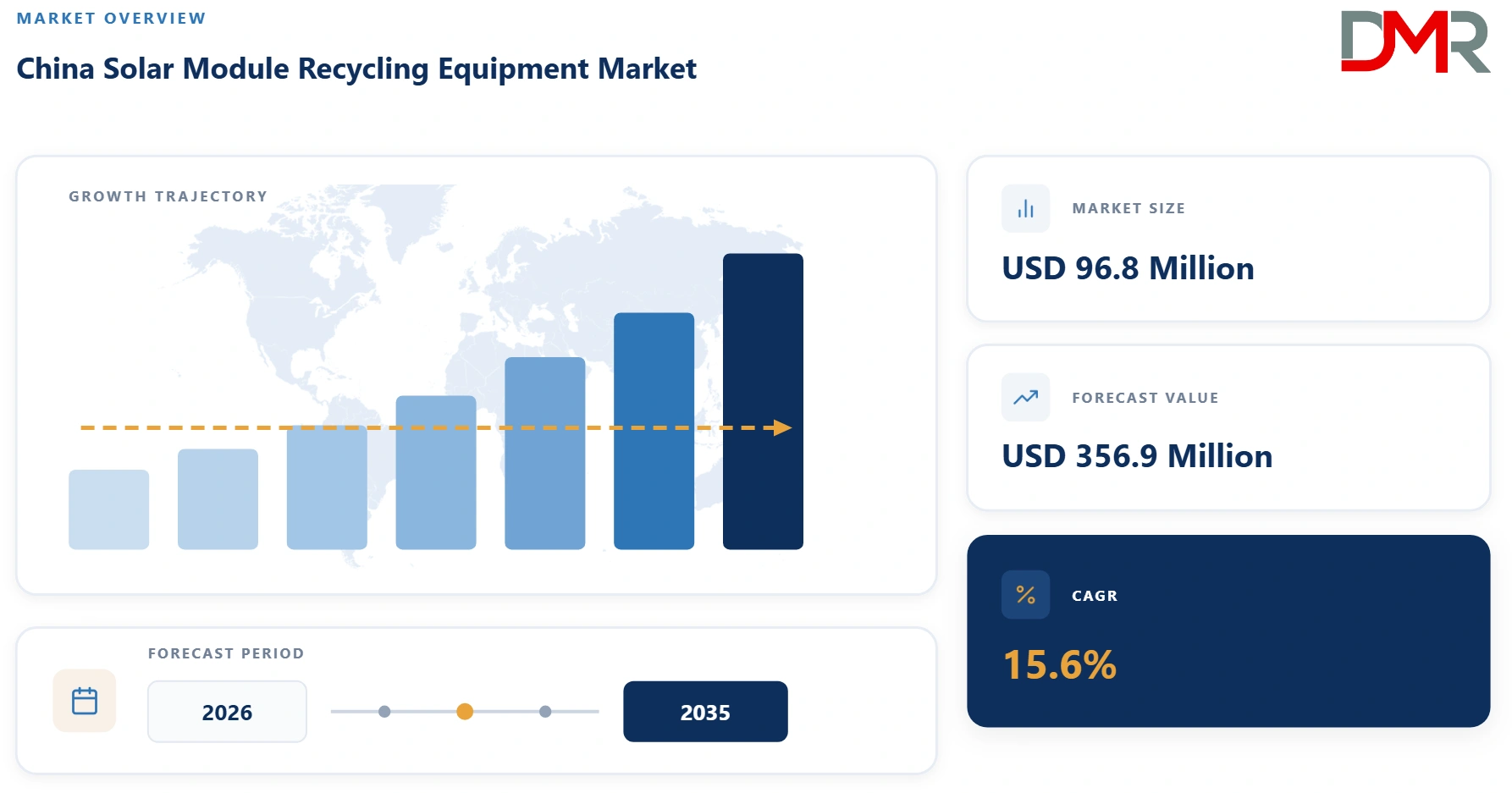
The China Solar Module Recycling Equipment Market size is estimated to reach USD 96.8 Mn in 2026 and is further anticipated to reach USD 356.9 Mn by 2035, at a CAGR of 15.6%.
ℹ
To learn more about this report –
Download Your Free Sample Report Here
Solar module recycling equipment comprises machinery and processing systems used to dismantle, separate, recover, and refine materials from end-of-life, damaged, rejected, or manufacturing-scrap photovoltaic modules. Typical equipment includes frame and junction-box removal machines, glass separators, delamination units, shredders, crushers, sieves, magnetic and eddy-current separators, thermal treatment systems, chemical recovery systems, dust collection, and material purification equipment.
China is entering an important phase in photovoltaic circularity because its very large installed solar base will create increasing volumes of retired modules over the coming years. Recycling equipment suppliers are therefore moving from small pilot systems toward higher-throughput automated lines capable of recovering aluminum, glass, copper, silver, silicon, polymers, and other materials at higher purity.
The market is also influenced by manufacturing scrap from China's large PV manufacturing industry. Broken cells, rejected modules, glass defects, production offcuts, and damaged products generate recyclable material before modules reach end of life. This provides recycling companies with a nearer-term feedstock stream while retirement volumes gradually increase.
Technology development is shifting from basic crushing and bulk material separation toward controlled delamination, high-purity glass recovery, silver and copper extraction, silicon purification, and closed-loop reuse. Equipment buyers increasingly evaluate recovery rate, material purity, throughput, energy use, emissions control, automation, labor requirements, and compatibility with newer glass-glass and bifacial module structures.
Use Cases
- End-of-Life Module Recycling: Automated lines dismantle retired modules and recover glass, aluminum, copper, silicon, silver-bearing fractions, and polymer materials.
- Manufacturing Scrap Recovery: PV factories process rejected modules, broken cells, glass scrap, and production waste to recover usable materials and reduce disposal cost.
- High-Value Material Recovery: Thermal and chemical systems target silicon, silver, copper, and other higher-value materials after mechanical separation.
- Mobile & Regional Recycling: Modular or mobile equipment supports distributed processing closer to large solar bases, reducing logistics requirements for bulky waste modules.
Key Takeaways
- Market Size: The market is estimated at USD 96.8 Mn in 2026 and projected to reach USD 356.9 Mn by 2035.
- Equipment Type: Crushing & Shredding Equipment leads with approximately 24.8% of 2026 revenue.
- Technology: Mechanical Recycling accounts for around 48.6% of 2026 revenue due to broad use in dismantling and bulk material recovery.
- Process Stage: Pre-Treatment & Dismantling holds about 22.7% of 2026 revenue.
- Application: Crystalline Silicon Module Recycling represents approximately 76.3% of demand.
- Policy Direction: China's recycling system is moving toward a more mature full-process framework by 2030, increasing long-term demand for industrial recycling capacity.
How AI/Gen AI is Transforming the China Solar Module Recycling Equipment Market?
AI is being applied to material identification, robotic dismantling, quality inspection, process control, and sorting. Computer vision can identify module type, frame configuration, junction-box location, glass condition, and contamination before processing. Machine-learning models can also adjust shredding, separation, and sorting parameters according to material composition and optimize throughput, energy use, and recovery purity.
Generative AI can support operators by summarizing equipment alarms, retrieving maintenance procedures, preparing batch reports, and helping engineers compare process settings. It can also assist with production planning when recycling facilities handle mixed module types. Human review remains important because chemical recovery, thermal treatment, dust control, and machinery safety require validated operating procedures.
Key Drivers in the China Solar Module Recycling Equipment Market
Growing Future Volume of Retired PV Modules
China has built the world's largest photovoltaic installed base, which creates a substantial long-term pipeline of modules that will eventually reach end of life. Early utility-scale projects, damaged modules, repowering activity, and manufacturing rejects are already creating recycling feedstock. As retirement volumes rise, manual dismantling will not provide the throughput or material recovery required at scale. Automated equipment will therefore be necessary to process large module volumes safely and economically.
Policy Support for Renewable Equipment Recycling
China has increasingly emphasized recycling of retired solar and wind equipment as part of circular-economy and resource-efficiency policy. Government direction supports the development of recycling mechanisms, standards, specialized enterprises, and industry clusters. This reduces uncertainty for recycling investors and encourages equipment manufacturers to commercialize dedicated PV recycling lines instead of treating solar modules as general electronic or construction waste.
Restraints in the China Solar Module Recycling Equipment Market
Limited Near-Term End-of-Life Feedstock
Although future PV waste volumes are very large, many of China's installed modules are still within their operating life. Recycling facilities can therefore face uneven feedstock availability in the near term, especially outside large manufacturing clusters or early solar-development regions. Low utilization can weaken returns on expensive automated lines and increase the importance of manufacturing scrap, damaged modules, and regional collection networks.
Low Value of Bulk Recovered Materials
Glass and aluminum represent a large share of module mass but may generate limited revenue relative to collection, transport, dismantling, and processing cost. Economic viability therefore depends increasingly on recovering higher-value silicon, silver, copper, and reusable glass fractions. Achieving high purity often requires more complex thermal, chemical, or advanced separation equipment, increasing capital and operating costs.
Growth Opportunities in the China Solar Module Recycling Equipment Market
High-Purity Silicon and Silver Recovery
Traditional recycling often focuses on bulk aluminum and glass recovery, but higher-value economics can be achieved by recovering purified silicon and silver-bearing materials. Equipment suppliers that combine precise delamination, controlled thermal treatment, chemical separation, filtration, and purification can support closed-loop reuse in PV manufacturing and other high-value applications.
Automated Lines for Glass-Glass and Bifacial Modules
Newer module generations increasingly use glass-glass structures, bifacial cells, larger formats, and different encapsulation materials. Recycling equipment must adapt to these designs. Suppliers that develop flexible automated dismantling and delamination lines capable of processing multiple module architectures can address a broader installed base and reduce the need for separate processing systems.
Trends in the China Solar Module Recycling Equipment Market
Shift from Crushing to High-Value Recycling
The industry is moving beyond simple crushing and bulk separation toward recovery of higher-purity glass, silicon, silver, copper, and reusable materials. This requires more precise dismantling, delamination, sorting, and refining equipment. Recycling economics increasingly depend on recovered-material value rather than disposal-volume reduction alone.
Growth of Modular and Automated Recycling Lines
Equipment manufacturers are developing modular production lines that combine frame removal, glass separation, shredding, material classification, dust control, and metal recovery. Modular systems allow recyclers to expand capacity gradually and configure equipment according to feedstock type. Automation also reduces labor requirements and improves consistency across large processing volumes.
Research Scope and Analysis
The study evaluates the China solar module recycling equipment market by equipment type, technology, process stage, application, and end user, with segment leadership and growth assessed across the 2026-2035 forecast period.
ℹ
To learn more about this report –
Download Your Free Sample Report Here
By Equipment Type
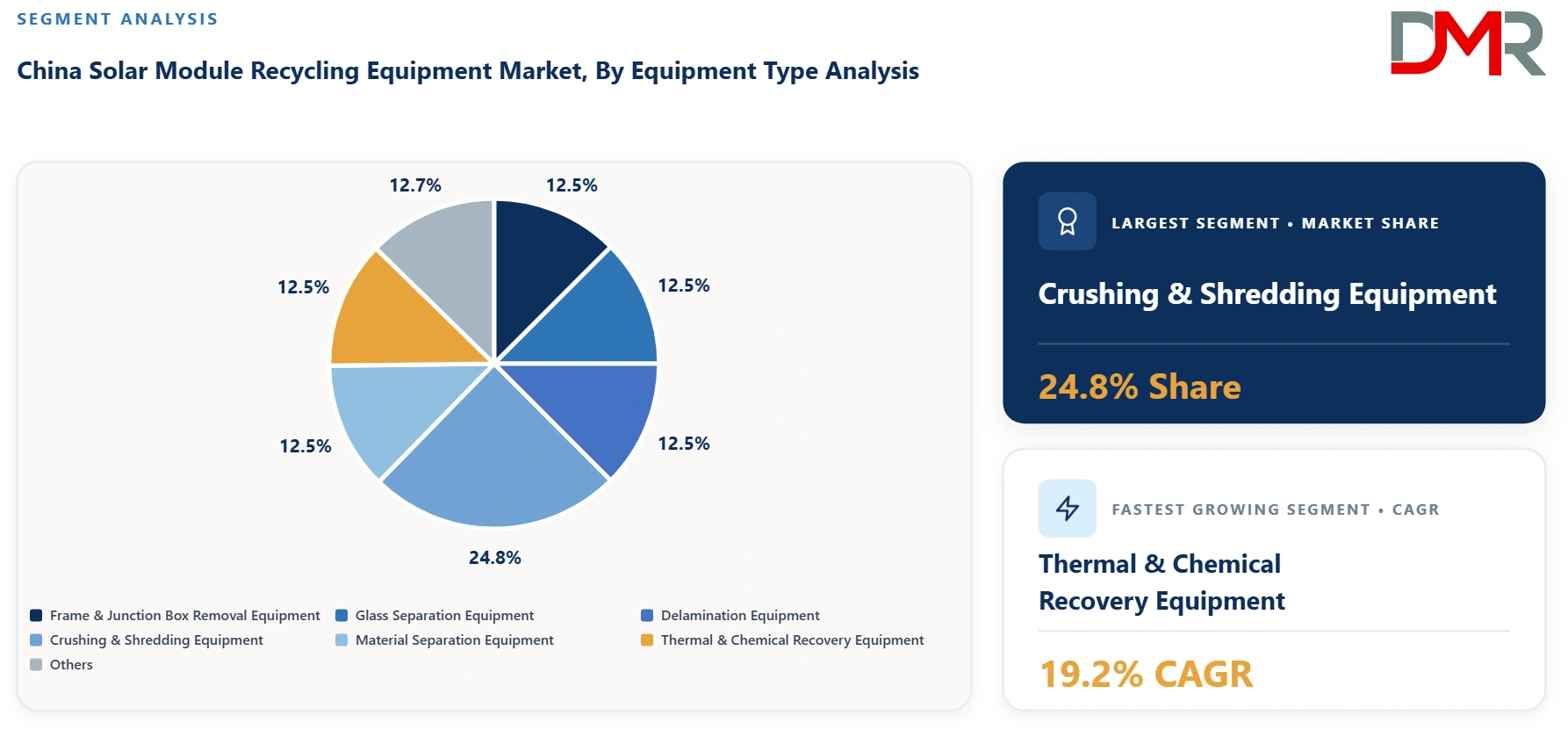
Crushing & Shredding Equipment is estimated to lead the equipment type segment with around 24.8% of 2026 revenue. Its position reflects broad use across current recycling lines and strong compatibility with crystalline silicon module waste. Buyers prioritize throughput, recovery rate, material purity, automation, emissions control, energy efficiency, and operating cost. Growth, however, is concentrated in Thermal & Chemical Recovery Equipment, which is projected to expand at a CAGR of 19.2% between 2026 and 2035.
By Technology
Mechanical Recycling is estimated to lead the technology segment with around 48.6% of 2026 revenue. Its position reflects broad use across current recycling lines and strong compatibility with crystalline silicon module waste. Buyers prioritize throughput, recovery rate, material purity, automation, emissions control, energy efficiency, and operating cost. Growth, however, is concentrated in Hybrid Recycling, which is projected to expand at a CAGR of 20.1% between 2026 and 2035.
By Process Stage
Pre-Treatment & Dismantling is estimated to lead the process stage segment with around 22.7% of 2026 revenue. Its position reflects broad use across current recycling lines and strong compatibility with crystalline silicon module waste. Buyers prioritize throughput, recovery rate, material purity, automation, emissions control, energy efficiency, and operating cost. Growth, however, is concentrated in Silicon Recovery, which is projected to expand at a CAGR of 19.4% between 2026 and 2035.
By Application
Crystalline Silicon Module Recycling is estimated to lead the application segment with around 76.3% of 2026 revenue. Its position reflects broad use across current recycling lines and strong compatibility with crystalline silicon module waste. Buyers prioritize throughput, recovery rate, material purity, automation, emissions control, energy efficiency, and operating cost. Growth, however, is concentrated in Glass-Glass Module Recycling, which is projected to expand at a CAGR of 18.7% between 2026 and 2035.
By End User
Third-Party Recycling Companies is estimated to lead the end user segment with around 31.9% of 2026 revenue. Its position reflects broad use across current recycling lines and strong compatibility with crystalline silicon module waste. Buyers prioritize throughput, recovery rate, material purity, automation, emissions control, energy efficiency, and operating cost. Growth, however, is concentrated in PV Module Manufacturers, which is projected to expand at a CAGR of 17.8% between 2026 and 2035.
The China Solar Module Recycling Equipment Market Report is Segmented Based on the Following
By Equipment Type
- Frame & Junction Box Removal Equipment
- Glass Separation Equipment
- Delamination Equipment
- Crushing & Shredding Equipment
- Material Separation Equipment
- Thermal & Chemical Recovery Equipment
- Others
By Technology
- Mechanical Recycling
- Thermal Recycling
- Chemical Recycling
- Laser-Assisted Recycling
- Hybrid Recycling
- Others
By Process Stage
- Pre-Treatment & Dismantling
- Delamination
- Crushing & Size Reduction
- Glass Recovery
- Metal Recovery
- Silicon Recovery
- Others
By Application
- Crystalline Silicon Module Recycling
- Thin-Film Module Recycling
- Bifacial Module Recycling
- Glass-Glass Module Recycling
- Damaged & Rejected Module Recycling
- Manufacturing Scrap Recycling
- Others
By End User
- PV Module Manufacturers
- Third-Party Recycling Companies
- Waste Management Companies
- Solar Project Owners & Operators
- Material Recovery Companies
- Government & Municipal Recycling Agencies
- Others
Regulatory Landscape
China's solar module recycling environment is being shaped by broader circular-economy, renewable-equipment recycling, solid-waste, and resource-recovery policies. National initiatives have encouraged establishment of mechanisms for decommissioned wind and photovoltaic equipment, improved standards and specifications, stronger responsibility among equipment owners and manufacturers, and development of specialized third-party recycling companies. The policy direction is toward a more mature full-process recycling system by 2030. Equipment suppliers therefore need to address resource recovery, emissions control, worker safety, waste handling, and traceability alongside throughput and economics.
Technology Analysis
Technology is evolving across mechanical, thermal, chemical, and hybrid recycling routes. Mechanical systems remove frames and junction boxes, separate glass, crush laminate fractions, classify particle sizes, and recover metals. Thermal systems soften or remove encapsulants and support cell separation, while chemical processes can recover silicon, silver, copper, and other materials at higher purity. Hybrid lines combine multiple routes to improve recovery value. Newer equipment uses computer vision, robotic dismantling, automatic feeding, closed dust collection, solvent recovery, and process monitoring to reduce labor and improve consistency.
Competitive Landscape
The China solar module recycling equipment market includes recycling machinery manufacturers, environmental equipment companies, PV recycling specialists, sorting technology suppliers, shredder manufacturers, and photovoltaic companies developing circular-economy capabilities. Domestic equipment suppliers compete strongly on price, customization, modular line design, local service, and integration of mechanical separation processes. Specialist PV recyclers are developing higher-value technologies for silicon and metal recovery. International machinery companies contribute advanced shredding, sorting, and material-separation systems. Competition is increasingly moving toward complete lines that combine dismantling, delamination, separation, purification, dust control, and digital process management.
Some of the Prominent Players in the China Solar Module Recycling Equipment Market Are:
- RESOLAR
- Henan SUNY Group
- Henan Honest Heavy Machinery Co., Ltd.
- Henan Recycling Technology Co., Ltd.
- Gongyi Jinlong Heng Ji Heavy Industry Machinery Co., Ltd.
- Henan Doing Environmental Protection Technology Co., Ltd.
- Zhengzhou Zhengyang Machinery Equipment Co., Ltd.
- Zhengzhou Shuliy Machinery Co., Ltd.
- Zhengzhou Yuxi Machinery Equipment Co., Ltd.
- Henan Forchen Machinery Co., Ltd.
- Jiangxi Mingxin Metallurgy Equipment Co., Ltd.
- Zhengzhou Sure Origin Environmental Protection Technology Co., Ltd.
- Genox Recycling Tech Co., Ltd.
- ENERPAT Group
- WANROOETECH
- Harden Machinery Ltd.
- Wiscon Envirotech Inc.
- Guangzhou 3E Machinery Co., Ltd.
- Changshu Shouyu Machinery Co., Ltd.
- Zhangjiagang Sevenstars Machinery Co., Ltd.
- ANDRITZ
- SSI Shredding Systems, Inc.
- Vecoplan AG
- BHS-Sonthofen GmbH
- Erdwich Zerkleinerungs-Systeme GmbH
- Stokkermill Recycling Machinery
- SICON GmbH
- TOMRA Sorting GmbH
- Steinert GmbH
- MTB Recycling
- LONGi Green Energy Technology Co., Ltd.
- JinkoSolar Holding Co., Ltd.
- Trina Solar Co., Ltd.
- JA Solar Technology Co., Ltd.
- Risen Energy Co., Ltd.
- Tongwei Co., Ltd.
- Canadian Solar Inc.
- GCL System Integration Technology Co., Ltd.
- Astronergy
- Veolia
- Other Key Players
Recent Developments
- In September 2025, IEA PVPS published an updated review of PV module recycling, highlighting China's national incentive-driven recycling initiatives and the need for higher-value, lower-cost recycling capacity.
- In February 2025, the China Green Supply Chain Alliance released the 2024 ECOPV photovoltaic recycling white paper, covering recycling equipment companies, technical routes, trade-in policy impacts, and industrialization progress.
- In 2025, RESOLAR continued developing high-value recycling technologies focused on green dismantling and regenerated high-purity silicon recovery from retired photovoltaic modules.
- In 2025, Chinese recycling equipment suppliers expanded modular PV panel recycling lines capable of removing frames and junction boxes and separating glass, metals, silicon-rich fractions, and plastics.
- In 2025, equipment commercialization increasingly shifted toward automated integrated lines rather than standalone shredders, with greater emphasis on dust collection, material purity, and continuous operation.
- In 2024-2025, industry activity increasingly focused on closed-loop reuse of recovered glass, silicon, silver, copper, and aluminum as China's future PV retirement volumes became a more prominent circular-economy priority.
Report Details
| Report Characteristics |
| Market Size (2026) |
USD 96.8 Mn |
| Forecast Value (2035) |
USD 356.9 Mn |
| CAGR (2026–2035) |
15.6% |
| Historical Data |
2021 – 2025 |
| Forecast Data |
2026 – 2035 |
| Base Year |
2025 |
| Segments Covered |
By Equipment Type, By Technology, By Process Stage, By Application, By End User |
| Geographic Coverage |
China |
Frequently Asked Questions
How big is the China Solar Module Recycling Equipment Market?
▾ The China Solar Module Recycling Equipment Market size is estimated to reach USD 96.8 Mn in 2026 and is projected to reach USD 356.9 Mn by 2035, growing at a CAGR of 15.6%.
What is the growth rate of the China Solar Module Recycling Equipment Market?
▾ The market is expected to expand at a CAGR of 15.6% from 2026 to 2035.
Which equipment type holds the largest share in the China Solar Module Recycling Equipment Market?
▾ Crushing & Shredding Equipment leads with approximately 24.8% of 2026 revenue.
Who are the key players in the China Solar Module Recycling Equipment Market?
▾ Prominent participants include RESOLAR, Henan SUNY Group, Henan Honest Heavy Machinery, Genox Recycling Tech, ENERPAT Group, and other recycling equipment suppliers.
Which technology leads the China Solar Module Recycling Equipment Market?
▾ Mechanical Recycling accounts for approximately 48.6% of 2026 revenue because it is widely used for dismantling, size reduction, glass separation, and bulk material recovery.
Which segment is growing fastest in the China Solar Module Recycling Equipment Market?
▾ Hybrid Recycling is projected to expand at approximately 20.1% CAGR through 2035 as recyclers combine mechanical, thermal, and chemical processes to improve recovery value.
What are the major growth drivers in the China Solar Module Recycling Equipment Market?
▾ Growth is driven by rising future PV retirement volumes, manufacturing scrap, policy support for renewable-equipment recycling, higher-value silicon and silver recovery, and increasing investment in automated recycling lines.