Market Snapshot
- Market Size (2026): USD 277.6 Mn
- Forecast Value (2035): USD 881.6 Mn
- CAGR (2026-2035): 13.7%
- Leading Product Type (2026): Railed Cleaning Robots, around 36.8%
- Leading Cleaning Technology (2026): Dry Brush Cleaning, around 61.7%
- Key Players: Sunpure Intelligent Technology Co., Ltd., Beijing Multifit Electrical Technology Co., Ltd., Sunlink (Xiamen) New Energy Technology Co., Ltd., and Others
What is China Solar PV Cleaning Robot Market and its Market Size?
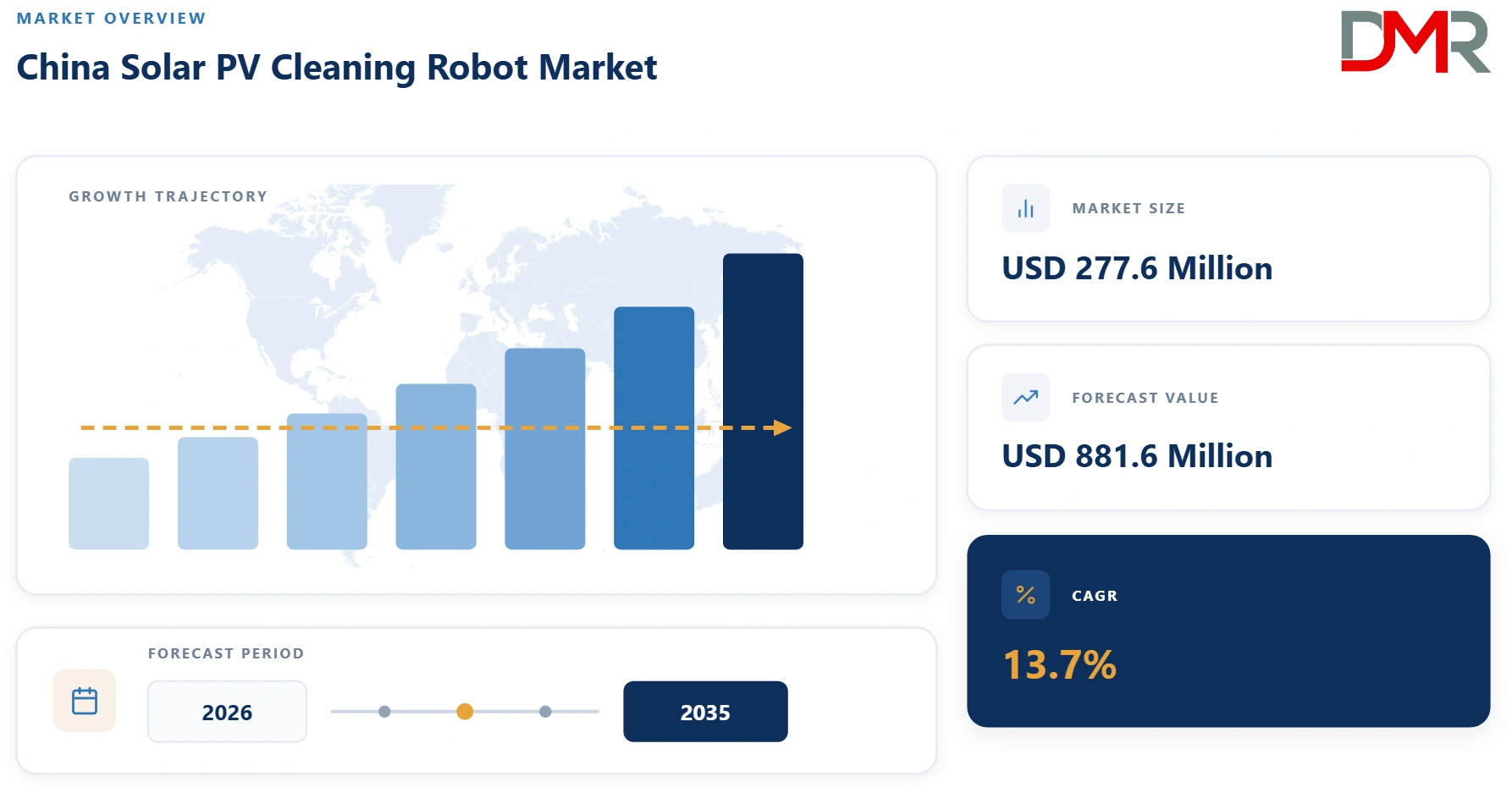
The China Solar PV Cleaning Robot Market size is estimated to reach USD 277.6 Mn in 2026 and is further anticipated to reach USD 881.6 Mn by 2035, at a CAGR of 13.7%.
ℹ
To learn more about this report –
Download Your Free Sample Report Here
Solar PV cleaning robots are automated or semi-automated machines designed to remove dust, sand, ash, pollen, bird droppings, and other surface contamination from photovoltaic modules. Systems may operate on dedicated rails, travel directly across module rows, use articulated arms, rely on autonomous shuttle vehicles, or function as portable robotic units. The technology is used to preserve irradiance transmission, reduce soiling losses, limit manual labor, and support consistent maintenance across large and distributed solar installations.
China's exceptionally large solar fleet creates a substantial addressable base for automated cleaning. Utility-scale projects in northern and western provinces are frequently exposed to dust, desert conditions, industrial particulates, and water constraints. Cleaning robots can reduce dependence on manual crews and support more frequent cleaning cycles without materially increasing water consumption. The value proposition is especially strong where plant scale, labor availability, site remoteness, or water scarcity make conventional washing costly.
The market is evolving from simple row-mounted brushes toward integrated robotic O&M systems that combine autonomous navigation, remote scheduling, environmental sensing, fleet management, cloud monitoring, predictive maintenance, and performance analytics. Railed systems remain common for standardized utility-scale layouts, while trackless and articulated-arm platforms are gaining attention for irregular plants, distributed projects, complex terrain, and existing sites that were not designed around cleaning robots.
Procurement decisions depend on cleaning efficiency, module compatibility, brush pressure, rail or tracker integration, anti-fall protection, weather resistance, operating temperature, battery life, autonomous docking, remote monitoring, installation cost, and maintenance requirements. As modules become larger and tracker architectures change, vendors must continuously adapt mechanical interfaces and control systems to avoid frame damage, glass abrasion, cable interference, and cleaning gaps.
Use Cases
- Desert Utility-Scale Solar: Autonomous dry-cleaning robots remove dust and sand from large ground-mounted plants where frequent washing would consume substantial water and labor.
- Tracker-Based Solar Plants: Railed and shuttle-based robots operate across single-axis tracker rows, coordinating with tracker positions and nighttime maintenance windows.
- Distributed Rooftop Solar: Portable, trackless, and articulated robotic systems clean commercial and industrial rooftops where fixed rail infrastructure may be impractical.
- Performance Recovery Programs: O&M teams deploy robotic cleaning when soiling analytics or plant performance data indicate material energy losses across specific blocks or seasons.
Key Takeaways
- Market Size & Share: The market is estimated at USD 277.6 Mn in 2026 and projected to reach USD 881.6 Mn by 2035.
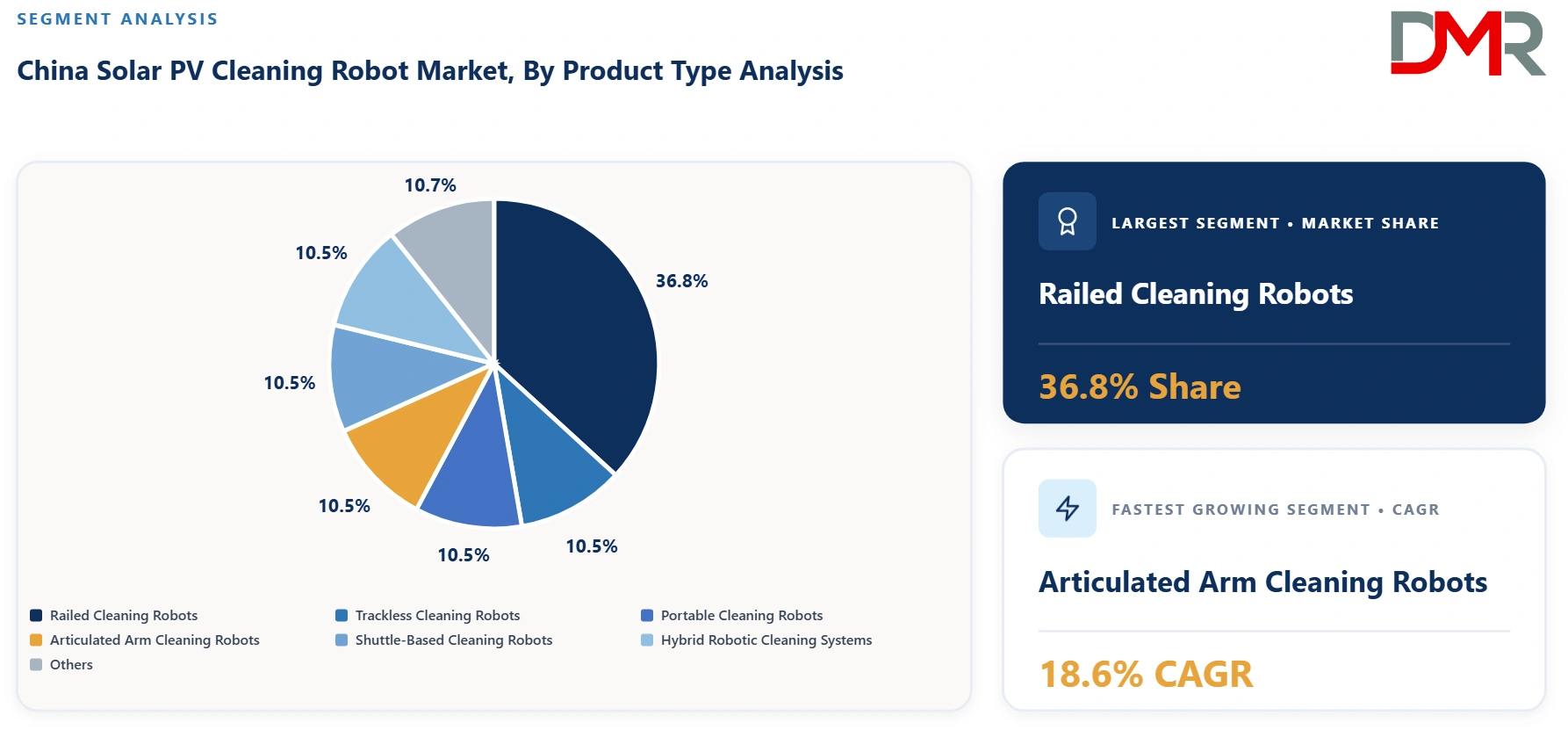
- Product Type Analysis: Railed Cleaning Robots lead with approximately 36.8% of 2026 revenue, supported by standardized utility-scale deployment.
- Cleaning Technology Analysis: Dry Brush Cleaning accounts for about 61.7% of revenue due to water conservation and suitability for arid environments.
- Operation Mode Analysis: Fully Autonomous systems hold around 63.9% of revenue as project owners seek unattended nighttime cleaning.
- Application Analysis: Utility-Scale Solar Power Plants represent approximately 58.6% of demand due to plant size and recurring soiling-management requirements.
- Commercial Catalyst: China's solar generation capacity reached about 1.29 TW by the end of July 2026, creating a very large installed base for robotic O&M.
How AI/Gen AI is Transforming the China Solar PV Cleaning Robot Market?
AI is becoming more important in navigation, cleaning scheduling, obstacle detection, fleet coordination, fault diagnosis, and soiling-based maintenance decisions. Computer vision and sensor fusion can help robots detect row edges, module gaps, obstructions, abnormal vibration, or mechanical misalignment. Analytics platforms can combine weather, irradiance, soiling, plant output, and robot operating data to determine when cleaning is economically justified rather than relying on fixed schedules.
Generative AI can support service technicians and fleet operators by summarizing robot fault logs, recommending validated maintenance procedures, drafting service reports, and retrieving product documentation. It may also assist with site configuration by converting plant layout information into preliminary deployment plans. Human engineering review remains necessary because incorrect cleaning paths, pressure settings, or docking instructions can damage modules or create safety risks.
- Soiling-Aware Scheduling: AI evaluates weather, dust, and output-loss data to prioritize cleaning where the energy-recovery benefit is highest.
- Autonomous Navigation: Computer vision and sensors improve row detection, obstacle avoidance, docking, and route completion.
- Predictive Maintenance: Robot current draw, motor temperature, vibration, and fault histories are analyzed to identify components approaching failure.
- Fleet Optimization: Cloud software coordinates large robot fleets, cleaning windows, charging cycles, and maintenance tasks across utility-scale projects.
Key Drivers in the China Solar PV Cleaning Robot Market
Rapid Expansion of China's Solar Installed Base
China's solar generation fleet has reached terawatt scale and continues to expand. A larger installed base directly increases the number of modules exposed to dust, sand, industrial particulates, and seasonal contamination. Utility-scale projects often span very large areas, making frequent manual cleaning labor-intensive and operationally complex. Automated cleaning robots allow owners to increase cleaning frequency, reduce labor dependence, and target soiling losses without committing large volumes of water. Continued construction in arid northern and western regions further strengthens the case for dry-cleaning automation because dust exposure is high and water availability can be constrained.
Rising Focus on Energy Yield and O&M Efficiency
As solar tariffs and project returns become more competitive, asset owners place greater emphasis on preserving annual energy yield and reducing operating cost. Soiling can lower module output and create uneven performance across strings or blocks. Robotic systems make it possible to standardize cleaning quality and execute maintenance at night without interrupting production. Remote fleet management also reduces the need for large on-site cleaning teams. These advantages are increasingly relevant for state-owned utilities, independent power producers, and O&M companies managing multi-gigawatt portfolios where even small percentage improvements in recovered generation can translate into meaningful revenue.
Restraints in the China Solar PV Cleaning Robot Market
High Upfront Installation and Integration Cost
Robotic cleaning systems require investment in robots, rails or docking stations, charging infrastructure, communications, control software, spare parts, and installation engineering. Retrofitting existing plants can be more expensive if row geometry, cable routing, tracker design, module spacing, or terrain were not designed for robotic access. Some projects may find manual or vehicle-based cleaning more economical where soiling is light or labor costs remain low. Buyers therefore require a clear payback model based on energy recovery, cleaning frequency, labor savings, water savings, and expected robot lifetime before approving large fleet deployments.
Mechanical Compatibility and Site Complexity
PV plants vary widely in module dimensions, frame profiles, row lengths, tilt angles, tracker designs, terrain, drainage structures, and maintenance access. A robot that performs well on standardized rows may struggle with gaps, height differences, irregular arrays, frameless modules, or complex rooftop layouts. Excessive brush pressure or poor alignment can damage module surfaces and frames. This creates engineering and commissioning requirements that limit one-size-fits-all deployment. Vendors must support different mechanical interfaces and ensure robots can operate safely across high wind, dust, snow, humidity, salinity, and temperature conditions.
Growth Opportunities in the China Solar PV Cleaning Robot Market
Trackless and Articulated Robots for Existing Plants
A large portion of China's operating solar fleet was built without dedicated robotic-cleaning infrastructure. Trackless, portable, and articulated-arm robots can address this retrofit opportunity because they require less fixed hardware and can adapt to irregular plant layouts. These systems are particularly relevant for distributed solar, commercial rooftops, complex terrain, and older utility-scale sites. Vendors that reduce deployment time and eliminate major structural modifications can expand the serviceable market beyond newly designed plants. Flexible robots also create rental, cleaning-as-a-service, and shared-fleet business models for owners that do not want to purchase dedicated equipment.
Integrated Smart O&M Platforms
Cleaning robots can create greater value when connected with plant-performance systems, weather data, soiling sensors, SCADA, digital twins, and maintenance platforms. Integrated software can estimate the energy lost to soiling, determine when cleaning is financially justified, dispatch robots automatically, and verify post-cleaning performance recovery. This creates opportunities for recurring software revenue and portfolio-level fleet management rather than one-time hardware sales. Vendors that combine reliable robotics with cloud analytics, remote diagnostics, and predictive maintenance can differentiate from basic mechanical cleaning equipment and become part of broader intelligent solar O&M ecosystems.
Trends in the China Solar PV Cleaning Robot Market
Shift Toward Water-Free Autonomous Cleaning
Dry brush systems are gaining preference in large arid and semi-arid solar projects because they can reduce water consumption and support frequent nighttime cleaning. Autonomous platforms are designed to operate without on-site crews, return to charging positions, resume interrupted cleaning, and report completion status remotely. Better brush materials, pressure control, weather sealing, and anti-corrosion design are improving long-term reliability. The combination of water savings and labor reduction is particularly attractive in desert solar bases, where conventional washing can require extensive logistics and water infrastructure.
Broader Robot Portfolios for Multiple PV Layouts
Vendors are expanding beyond a single fixed-rail design toward product families that include railed, trackless, shuttle-based, articulated, and portable robots. This reflects the growing diversity of PV projects, including fixed-tilt, tracker, rooftop, distributed, agrivoltaic, and irregular retrofit installations. Flexible product portfolios allow suppliers to address both new and existing plants while reducing dependence on a single mounting architecture. The trend also encourages closer collaboration among module manufacturers, tracker suppliers, robot vendors, and EPC companies to ensure mechanical compatibility before project construction.
Research Scope and Analysis
The study evaluates the China solar PV cleaning robot market by product type, cleaning technology, operation mode, application, and end user, with segment leadership and growth assessed across the 2026-2035 forecast period.
ℹ
To learn more about this report –
Download Your Free Sample Report Here
By Product Type
Railed Cleaning Robots is estimated to lead the product type segment with around 36.8% of 2026 revenue. Its position reflects suitability for large solar portfolios, recurring cleaning requirements, and established deployment practices. Buyers prioritize reliability, module compatibility, low maintenance, remote monitoring, cleaning effectiveness, and total lifecycle economics. Growth, however, is concentrated in Articulated Arm Cleaning Robots, which is projected to expand at a CAGR of 18.6% between 2026 and 2035. Expansion is supported by larger installed solar capacity, rising O&M automation, water-saving requirements, more complex PV layouts, and increased use of AI-enabled robotic fleet management.
By Cleaning Technology
Dry Brush Cleaning is estimated to lead the cleaning technology segment with around 61.7% of 2026 revenue. Its position reflects suitability for large solar portfolios, recurring cleaning requirements, and established deployment practices. Buyers prioritize reliability, module compatibility, low maintenance, remote monitoring, cleaning effectiveness, and total lifecycle economics. Growth, however, is concentrated in Hybrid Cleaning, which is projected to expand at a CAGR of 16.4% between 2026 and 2035. Expansion is supported by larger installed solar capacity, rising O&M automation, water-saving requirements, more complex PV layouts, and increased use of AI-enabled robotic fleet management.
By Operation Mode
Fully Autonomous is estimated to lead the operation mode segment with around 63.9% of 2026 revenue. Its position reflects suitability for large solar portfolios, recurring cleaning requirements, and established deployment practices. Buyers prioritize reliability, module compatibility, low maintenance, remote monitoring, cleaning effectiveness, and total lifecycle economics. Growth, however, is concentrated in Fully Autonomous, which is projected to expand at a CAGR of 15.8% between 2026 and 2035. Expansion is supported by larger installed solar capacity, rising O&M automation, water-saving requirements, more complex PV layouts, and increased use of AI-enabled robotic fleet management.
By Application
Utility-Scale Solar Power Plants is estimated to lead the application segment with around 58.6% of 2026 revenue. Its position reflects suitability for large solar portfolios, recurring cleaning requirements, and established deployment practices. Buyers prioritize reliability, module compatibility, low maintenance, remote monitoring, cleaning effectiveness, and total lifecycle economics. Growth, however, is concentrated in Distributed Rooftop Solar, which is projected to expand at a CAGR of 17.2% between 2026 and 2035. Expansion is supported by larger installed solar capacity, rising O&M automation, water-saving requirements, more complex PV layouts, and increased use of AI-enabled robotic fleet management.
By End User
Independent Power Producers is estimated to lead the end user segment with around 32.4% of 2026 revenue. Its position reflects suitability for large solar portfolios, recurring cleaning requirements, and established deployment practices. Buyers prioritize reliability, module compatibility, low maintenance, remote monitoring, cleaning effectiveness, and total lifecycle economics. Growth, however, is concentrated in O&M Service Providers, which is projected to expand at a CAGR of 15.6% between 2026 and 2035. Expansion is supported by larger installed solar capacity, rising O&M automation, water-saving requirements, more complex PV layouts, and increased use of AI-enabled robotic fleet management.
The China Solar PV Cleaning Robot Market Report is Segmented Based on the Following
By Product Type
- Railed Cleaning Robots
- Trackless Cleaning Robots
- Portable Cleaning Robots
- Articulated Arm Cleaning Robots
- Shuttle-Based Cleaning Robots
- Hybrid Robotic Cleaning Systems
- Others
By Cleaning Technology
- Dry Brush Cleaning
- Wet Cleaning
- Air-Blowing Cleaning
- Electrostatic Cleaning
- Hybrid Cleaning
- Others
By Operation Mode
- Fully Autonomous
- Semi-Autonomous
- Remote-Controlled
- Manual-Assisted Robotic
- Others
By Application
- Utility-Scale Solar Power Plants
- Commercial & Industrial Solar
- Distributed Rooftop Solar
- Agrivoltaic Installations
- Desert & Arid Solar Projects
- Floating & Specialty PV Sites
- Others
By End User
- Independent Power Producers
- Solar Project Developers
- O&M Service Providers
- EPC Contractors
- Utilities & State-Owned Enterprises
- Commercial & Industrial Asset Owners
- Others
Regulatory Landscape
China's solar PV cleaning robot market is influenced by broader photovoltaic power-plant safety, equipment reliability, electrical protection, machinery safety, and O&M requirements rather than a single mandatory national cleaning-robot regime. Robotic systems deployed on operating plants must avoid electrical hazards, module damage, fire risk, and interference with trackers or structural components. Industry development is also being shaped by product specifications and application guidance developed by robotics suppliers, testing organizations, module companies, and mounting-system providers. Domestic vendors have participated in drafting specifications for PV dry-cleaning robots, which supports more consistent approaches to mechanical compatibility, reliability, environmental protection, and performance verification.
Technology Analysis
Technology is advancing toward fully autonomous, connected, low-maintenance robots capable of operating across large solar fleets. Core hardware includes drive motors, brush assemblies, batteries, rails or mobility systems, docking and charging components, position sensors, communication modules, and environmental protection. Software manages route planning, scheduling, fleet status, alarms, and remote diagnostics. Newer platforms incorporate wireless charging, autonomous docking, edge computing, cloud management, and algorithms that adapt cleaning intensity to site conditions. Trackless and articulated designs are widening addressable applications by reducing dependence on fixed rails, while AI-assisted soiling analytics improve the timing and economic efficiency of cleaning cycles.
Competitive Landscape
The China solar PV cleaning robot market includes domestic specialist robotics suppliers, international autonomous-cleaning companies, PV equipment manufacturers, drone and automation firms, and O&M technology providers. Chinese suppliers have advantages in local manufacturing, engineering customization, module and tracker ecosystem relationships, and service responsiveness. International providers contribute established autonomous-cleaning experience, cloud software, and large utility-scale reference projects. Competition is shifting from robot hardware alone toward complete lifecycle solutions covering project design, compatibility assessment, installation, fleet management, maintenance, remote diagnostics, and performance verification. Scale, reliability, climate resistance, cleaning efficiency, and the ability to support multiple PV architectures are becoming key selection criteria.
Some of the Prominent Players in the China Solar PV Cleaning Robot Market Are:
- Sunpure Intelligent Technology Co., Ltd.
- Beijing Multifit Electrical Technology Co., Ltd.
- Sunlink (Xiamen) New Energy Technology Co., Ltd.
- IFBOT Technology
- Sol-Bright Technology Co., Ltd.
- Shanghai Beffo Technology Co., Ltd.
- Acoh (Xiamen) Technology Co., Ltd.
- Monster Robot
- Nanjing Tianchuang Electronic Technology Co., Ltd.
- Airobotics Solar
- Ecoppia
- SolarCleano
- Airtouch Solar
- HyCLEANER GmbH
- SunBrush mobil GmbH
- AX Solar Robot
- Washpanel
- Serbot AG
- Taypro
- Greenleap Robotics
- Aegeus Technologies
- Vayu Solar
- HekaBot
- Leopard Dust
- Premier Solar Cleaning, LLC
- Kärcher
- Shenzhen Inovance Technology Co., Ltd.
- Sungrow Power Supply Co., Ltd.
- LONGi Green Energy Technology Co., Ltd.
- Trina Solar Co., Ltd.
- JA Solar Technology Co., Ltd.
- JinkoSolar Holding Co., Ltd.
- China Energy Engineering Corporation
- PowerChina
- China Huaneng Group
- China Three Gorges Renewables
- State Power Investment Corporation
- China General Nuclear Power Group
- China Datang Corporation
- China Huadian Corporation
- Other Key Players
Recent Developments
- In October 2025, Sunpure launched its Jupiter articulated-arm PV cleaning robot in Hefei, targeting irregular plant layouts and retrofit applications. The first ten units were prepared for project deployment.
- In June 2025, Sunpure and ecosystem partners released a PV cleaning robot application white paper focused on coordination among modules, mounting systems, and robotic cleaning equipment.
- In June 2025, Sunpure presented its broader PV robotics portfolio at SNEC 2025 in Shanghai, highlighting integrated robotic solutions for solar construction and O&M.
- In 2025, Sunpure reported continued expansion of its international PV robotics footprint and local service network, demonstrating increased commercialization of China-developed cleaning robot platforms.
- In 2026, China's solar generation capacity reached approximately 1.29 TW by the end of July, materially expanding the installed base requiring long-term cleaning and maintenance.
- In 2026, domestic PV cleaning robot suppliers continued broadening product portfolios across railed, trackless, shuttle-based, and portable systems to address both centralized and distributed solar plants.
Report Details
| Report Characteristics |
| Market Size (2026) |
USD 277.6 Mn |
| Forecast Value (2035) |
USD 881.6 Mn |
| CAGR (2026–2035) |
13.7% |
| Historical Data |
2021 – 2025 |
| Forecast Data |
2026 – 2035 |
| Base Year |
2025 |
| Segments Covered |
By Product Type, By Cleaning Technology, By Operation Mode, By Application, By End User |
| Geographic Coverage |
China |
Frequently Asked Questions
How big is the China Solar PV Cleaning Robot Market?
▾ The China Solar PV Cleaning Robot Market size is estimated to reach USD 277.6 Mn in 2026 and is projected to reach USD 881.6 Mn by 2035, growing at a CAGR of 13.7%.
What is the growth rate of the China Solar PV Cleaning Robot Market?
▾ The market is expected to expand at a CAGR of 13.7% from 2026 to 2035, supported by China's expanding solar fleet, O&M automation, water-saving requirements, and rising use of autonomous robotic systems.
Which product type holds the largest share in the China Solar PV Cleaning Robot Market?
▾ The Railed Cleaning Robots segment leads the market with approximately 36.8% of 2026 revenue because it is widely suited to standardized utility-scale module rows and repeated unattended cleaning.
Who are the key players in the China Solar PV Cleaning Robot Market?
▾ Prominent participants include Sunpure Intelligent Technology Co., Ltd., Beijing Multifit Electrical Technology Co., Ltd., Sunlink (Xiamen) New Energy Technology Co., Ltd., IFBOT Technology, Ecoppia, and other robotics suppliers.
Which application is leading the China Solar PV Cleaning Robot Market?
▾ Utility-Scale Solar Power Plants account for approximately 58.6% of 2026 revenue due to their large module counts, recurring soiling exposure, and stronger economics for automated cleaning.
Which segment is expanding fastest in the China Solar PV Cleaning Robot Market?
▾ Articulated Arm Cleaning Robots are projected to record the highest product-type growth, with an estimated CAGR of 18.6% through 2035 as suppliers address irregular layouts and retrofit projects.
What are the major growth drivers in the China Solar PV Cleaning Robot Market?
▾ Growth is driven by China's terawatt-scale solar installed base, desert solar development, water conservation, labor reduction, higher O&M efficiency requirements, autonomous fleet management, and demand for more consistent module cleanliness.