Market Snapshot
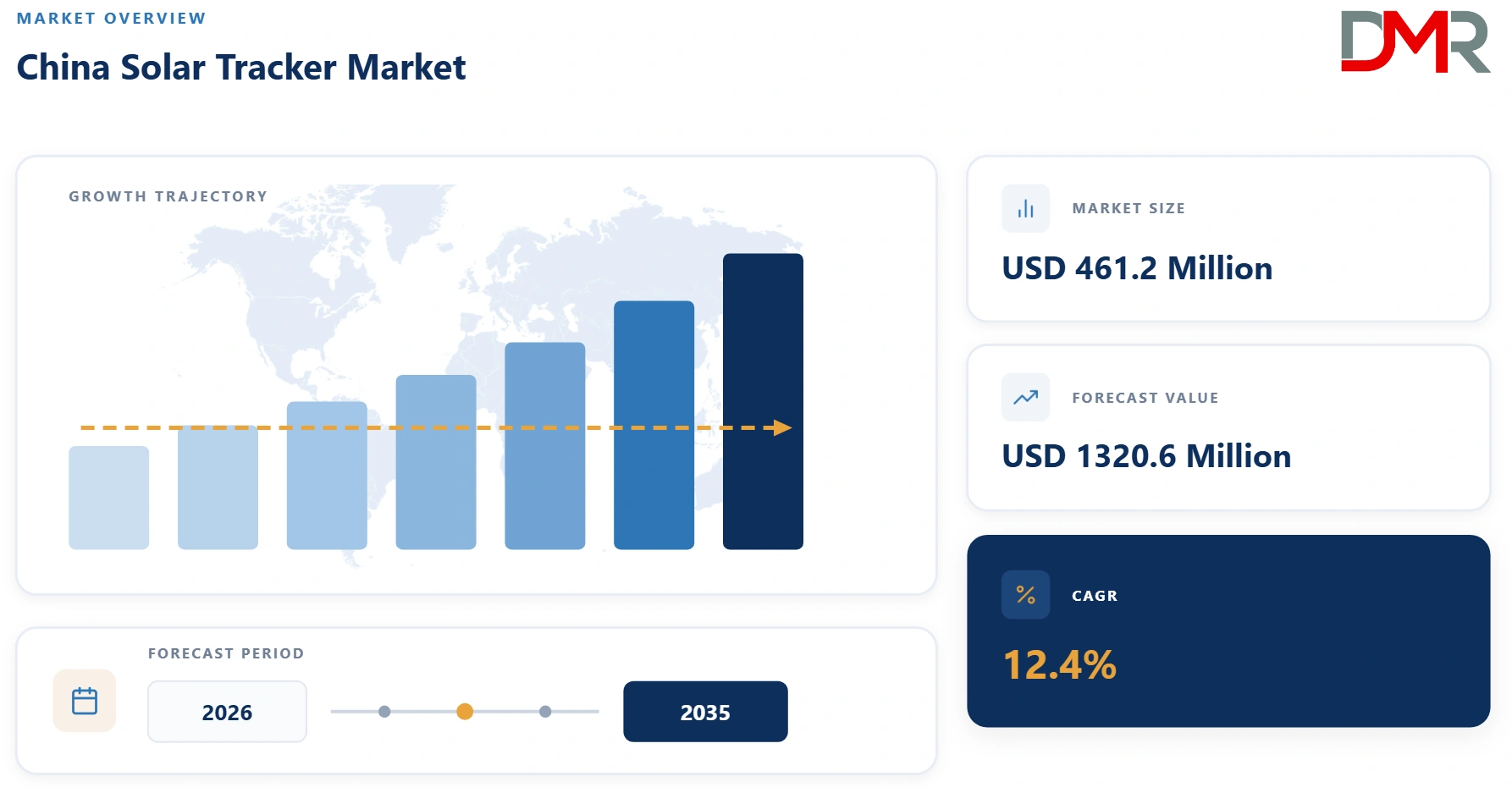
- Market Size (2026): Revenue is estimated at USD 461.2 Mn.
- Forecast Value (2035): The market is projected to reach USD 1320.6 Mn by 2035.
- CAGR (2026-2035): 12.4%.
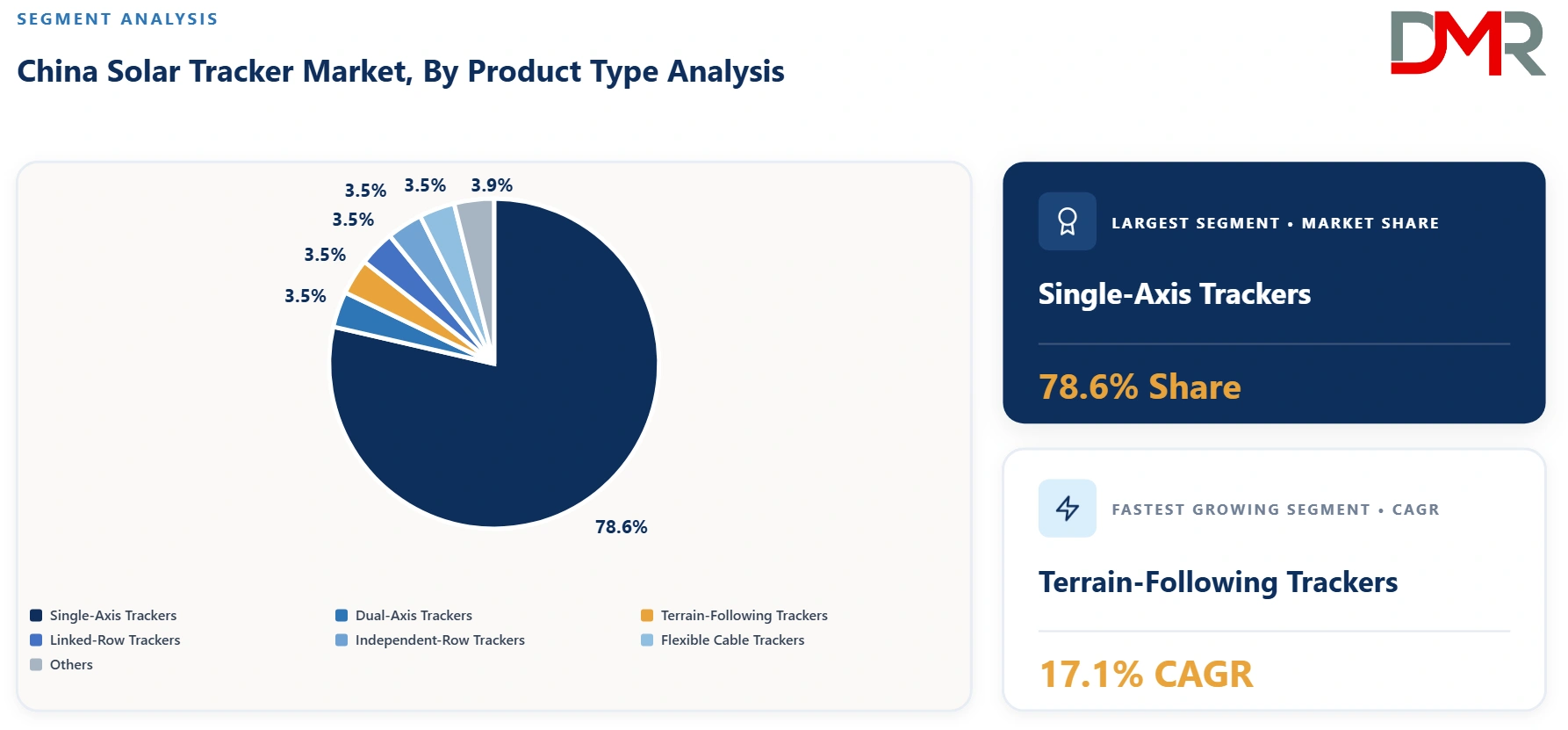
- Leading Product Type: Single-Axis Trackers hold approximately 78.6% of 2026 revenue.
- Leading Technology: 1P Trackers account for roughly 55.8% of 2026 revenue.
- Market Maturity: High Growth.
What is China Solar Tracker Market and its Market Size?
The China Solar Tracker Market size is estimated to reach USD 461.2 Mn in 2026 and is further anticipated to reach USD 1320.6 Mn by 2035, at a CAGR of 12.4%.
ℹ
To learn more about this report –
Download Your Free Sample Report Here
Solar trackers are structural and electromechanical systems that rotate photovoltaic modules to follow the sun and increase incident solar irradiance over the day. Major components include torque tubes, piles, bearings, slew or linear drives, motors, controllers, communication units, sensors, damping systems, and software. Tracker platforms are mainly deployed in utility-scale solar plants where additional energy yield can justify the higher structural and control-system cost compared with fixed-tilt mounting.
China has a large utility-scale solar pipeline and extensive deployment across desert, Gobi, agricultural, mountainous, and industrial locations. Tracker adoption is supported by the need to improve energy yield, maximize land productivity, support bifacial modules, and lower levelized electricity cost. However, adoption varies by region because wind, snow, soil, terrain, land-use rules, and project economics strongly influence whether tracking or fixed-tilt systems are preferred.
The market is shifting toward independent-row 1P architectures, multi-point drive systems, terrain-following designs, intelligent backtracking, extreme-weather stow strategies, and software-based control. These developments reduce grading requirements, improve module compatibility, strengthen wind resistance, and optimize generation under complex terrain and shading conditions. Suppliers are also integrating trackers with automated construction, cleaning robots, digital O&M, and plant-level controls.
China's tracker supplier base has become increasingly export-oriented. Leading domestic manufacturers compete on structural engineering, wind-tunnel testing, bankability, local steel sourcing, intelligent controls, project customization, and overseas service networks. The domestic market remains important as large state-owned power groups continue building utility-scale solar bases and new technical standards strengthen safety and performance requirements.
Use Cases
- Desert & Gobi Solar Bases: Single-axis trackers improve daily energy capture across large high-irradiance sites while intelligent stow strategies address wind and sand conditions.
- Agrivoltaic Projects: Elevated or adaptive trackers regulate module angle to balance electricity generation with agricultural access, crop light requirements, and equipment movement.
- Mountainous Solar Plants: Terrain-following trackers reduce cut-and-fill work and enable solar deployment on irregular slopes that would be costly to grade for conventional structures.
- Bifacial Module Optimization: Smart backtracking and row-spacing algorithms improve rear-side irradiance and reduce self-shading across large bifacial PV arrays.
Key Takeaways
- Market Size: The market is estimated at USD 461.2 Mn in 2026 and is projected to reach USD 1320.6 Mn by 2035.
- Product Type: Single-Axis Trackers lead with about 78.6% of 2026 revenue.
- Drive System: Multi-Point Drive systems account for approximately 41.7% of 2026 revenue.
- Technology: 1P Trackers hold roughly 55.8% of revenue, while AI-Enabled Smart Trackers are projected to grow at 18.4% CAGR.
- Application: Utility-Scale Solar Plants represent approximately 62.9% of demand.
- Standards: China published GB/T 47516-2026 for solar tracker safety, with implementation scheduled for November 1, 2026.
How AI/Gen AI is Transforming the China Solar Tracker Market?
AI is increasingly used to optimize tracker angle, backtracking, wind response, row-level generation, terrain adaptation, and maintenance. Smart algorithms can combine irradiance, weather, slope, row shading, module characteristics, and power data to determine the most productive tracker position rather than relying only on astronomical sun position. Machine-learning models can also identify abnormal motor current, actuator behavior, controller faults, and row misalignment before a failure causes prolonged generation loss.
Generative AI can support engineering and O&M teams by summarizing fault logs, retrieving installation and maintenance procedures, preparing service reports, and assisting with project-specific configuration documentation. It may also help engineers compare tracker layouts across terrain and climate scenarios. Human validation remains necessary because structural safety, wind loading, electrical controls, and emergency stow strategies require deterministic engineering decisions and certified design inputs.
Key Drivers in the China Solar Tracker Market
Large Utility-Scale Solar Development
China continues to add large volumes of utility-scale photovoltaic capacity, particularly through desert, Gobi, and renewable-energy base projects. These projects favor technologies that improve generation per installed module and land area. Trackers can raise daily energy capture by following the sun and can enhance bifacial module utilization when row geometry and backtracking are optimized. Large project sizes also create economies of scale that make tracker installation, control systems, and maintenance more economical. Continued investment by state-owned power groups and major developers therefore provides a broad demand base for tracker suppliers.
Increasing Demand for Higher Energy Yield
Solar project economics are increasingly focused on maximizing annual generation and lowering levelized electricity cost. Trackers can deliver additional yield compared with fixed-tilt structures, especially in high direct-normal-irradiance regions. As module prices decline, the relative importance of balance-of-system design and energy-yield optimization increases. Developers are therefore evaluating tracker systems not only on initial cost but on lifetime gain, wind resilience, terrain adaptation, maintenance requirements, and compatibility with bifacial modules. This supports demand for smart controls and optimized mechanical designs.
Restraints in the China Solar Tracker Market
Higher Structural and O&M Complexity
Trackers use moving mechanical and electrical components that increase installation, commissioning, and maintenance complexity compared with fixed-tilt structures. Motors, bearings, drive systems, controllers, communication devices, and dampers can fail if not properly designed for wind, dust, temperature, corrosion, or snow. Project owners must also maintain spare parts and trained technicians. These lifecycle considerations can reduce tracker attractiveness at sites where the additional energy yield is modest or where access for maintenance is difficult.
Wind, Terrain, and Site-Specific Constraints
China's solar projects span typhoon-prone coastal areas, high-wind deserts, snowy northern regions, agricultural land, soft soils, and mountainous terrain. These conditions require site-specific structural analysis, wind-tunnel testing, pile design, and stow strategies. Poorly matched tracker systems can experience torsional instability, structural damage, excessive mechanical movement, or uneven row operation. This makes project engineering more demanding and can favor fixed-tilt systems in locations where tracker benefits do not justify added structural risk or grading complexity.
Growth Opportunities in the China Solar Tracker Market
Terrain-Following Trackers for Complex Land
As easy-to-develop flat land becomes more constrained, project developers are increasingly evaluating hilly, undulating, agricultural, and irregular sites. Terrain-following trackers can reduce grading, earthwork, drainage disturbance, and foundation complexity while allowing rows to adapt to natural contours. This can lower civil cost and shorten construction schedules. Suppliers that combine flexible mechanical architecture with terrain-aware design software can address projects that were previously considered unsuitable for conventional tracking systems.
Integrated Tracker Plus Digital O&M Solutions
Tracker suppliers are expanding from structural hardware into controls, analytics, automated installation, cleaning robots, and digital maintenance. Connected tracker platforms can monitor row position, motor current, controller status, weather inputs, and fault conditions across thousands of rows. When integrated with plant performance systems, software can optimize backtracking and identify underperforming tracker blocks. This creates opportunities for recurring software, monitoring, diagnostics, and lifecycle service revenue in addition to equipment sales.
Trends in the China Solar Tracker Market
Shift Toward 1P and Multi-Point Drive Architectures
Independent-row 1P trackers are increasingly preferred because they offer strong module compatibility, reduced row-to-row mechanical coupling, and better adaptation to irregular layouts. Multi-point synchronized drive systems improve torsional stability and distribute mechanical loads along the row, which is valuable for longer rows and high-wind locations. Suppliers are refining drive spacing, damping, torque-tube geometry, and control logic to increase stability while keeping steel consumption competitive.
Stronger Safety and Standardization Requirements
China is formalizing technical and safety requirements for tracker systems. GB/T 29320-2024 established technical requirements for tracking systems used in photovoltaic power stations, while GB/T 47516-2026 adds dedicated solar tracker safety requirements. These standards increase attention to structural integrity, control safety, environmental durability, and verification. Standardization is likely to support more consistent procurement specifications and raise the importance of testing, certification, wind engineering, and documented reliability.
Research Scope and Analysis
The study evaluates the China solar tracker market by product type, drive system, technology, application, and end user, with segment leadership and growth assessed across the 2026-2035 forecast period.
ℹ
To learn more about this report –
Download Your Free Sample Report Here
By Product Type
Single-Axis Trackers is estimated to lead the product type segment with around 78.6% of 2026 revenue. Its position reflects broad utility-scale adoption, engineering familiarity, and compatibility with large photovoltaic projects. Buyers prioritize energy-yield gain, structural reliability, wind resistance, terrain adaptability, module compatibility, installation speed, and lifecycle cost. Growth, however, is concentrated in Terrain-Following Trackers, which is projected to expand at a CAGR of 17.1% between 2026 and 2035. Expansion is supported by more complex project sites, smarter control systems, bifacial optimization, and stronger demand for high-yield utility-scale solar.
By Drive System
Multi-Point Drive is estimated to lead the drive system segment with around 41.7% of 2026 revenue. Its position reflects broad utility-scale adoption, engineering familiarity, and compatibility with large photovoltaic projects. Buyers prioritize energy-yield gain, structural reliability, wind resistance, terrain adaptability, module compatibility, installation speed, and lifecycle cost. Growth, however, is concentrated in Cable-Driven System, which is projected to expand at a CAGR of 16.2% between 2026 and 2035. Expansion is supported by more complex project sites, smarter control systems, bifacial optimization, and stronger demand for high-yield utility-scale solar.
By Technology
1P Trackers is estimated to lead the technology segment with around 55.8% of 2026 revenue. Its position reflects broad utility-scale adoption, engineering familiarity, and compatibility with large photovoltaic projects. Buyers prioritize energy-yield gain, structural reliability, wind resistance, terrain adaptability, module compatibility, installation speed, and lifecycle cost. Growth, however, is concentrated in AI-Enabled Smart Trackers, which is projected to expand at a CAGR of 18.4% between 2026 and 2035. Expansion is supported by more complex project sites, smarter control systems, bifacial optimization, and stronger demand for high-yield utility-scale solar.
By Application
Utility-Scale Solar Plants is estimated to lead the application segment with around 62.9% of 2026 revenue. Its position reflects broad utility-scale adoption, engineering familiarity, and compatibility with large photovoltaic projects. Buyers prioritize energy-yield gain, structural reliability, wind resistance, terrain adaptability, module compatibility, installation speed, and lifecycle cost. Growth, however, is concentrated in Mountainous & Uneven Terrain Projects, which is projected to expand at a CAGR of 17.6% between 2026 and 2035. Expansion is supported by more complex project sites, smarter control systems, bifacial optimization, and stronger demand for high-yield utility-scale solar.
By End User
State-Owned Power Utilities is estimated to lead the end user segment with around 34.5% of 2026 revenue. Its position reflects broad utility-scale adoption, engineering familiarity, and compatibility with large photovoltaic projects. Buyers prioritize energy-yield gain, structural reliability, wind resistance, terrain adaptability, module compatibility, installation speed, and lifecycle cost. Growth, however, is concentrated in Independent Power Producers, which is projected to expand at a CAGR of 14.9% between 2026 and 2035. Expansion is supported by more complex project sites, smarter control systems, bifacial optimization, and stronger demand for high-yield utility-scale solar.
The China Solar Tracker Market Report is Segmented Based on the Following
By Product Type
- Single-Axis Trackers
- Dual-Axis Trackers
- Terrain-Following Trackers
- Linked-Row Trackers
- Independent-Row Trackers
- Flexible Cable Trackers
- Others
By Drive System
- Single-Point Drive
- Multi-Point Drive
- Slew Drive
- Linear Actuator Drive
- Cable-Driven System
- Others
By Technology
- 1P Trackers
- 2P Trackers
- AI-Enabled Smart Trackers
- Bifacial-Optimized Trackers
- Wind-Resistant Trackers
- Agrivoltaic Tracking Systems
- Others
By Application
- Utility-Scale Solar Plants
- Desert & Gobi Solar Bases
- Agrivoltaic Projects
- Commercial & Industrial Solar
- Mountainous & Uneven Terrain Projects
- Floating & Specialty PV
- Others
By End User
- Independent Power Producers
- State-Owned Power Utilities
- Solar Project Developers
- EPC Contractors
- Industrial & Commercial Asset Owners
- Government & Public Infrastructure
- Others
Regulatory Landscape
China's solar tracker regulatory environment is increasingly defined by dedicated national technical and safety standards. GB/T 29320-2024, Technical requirements for solar tracking system of photovoltaic power station, is currently in force. In April 2026, authorities published GB/T 47516-2026, Safety requirements of solar tracker, with implementation scheduled for November 1, 2026. These standards strengthen expectations around structural safety, control systems, environmental resistance, operating reliability, and project verification. Large developers also apply project-specific requirements covering wind-tunnel analysis, pile testing, corrosion, extreme-weather stow logic, communication reliability, and compatibility with modules and site conditions.
Technology Analysis
Tracker technology is advancing toward smarter, more terrain-adaptive, and structurally resilient systems. Leading platforms use 1P independent-row architectures, synchronized multi-point drives, advanced damping, wireless communication, autonomous control boxes, and algorithmic backtracking. Terrain-following designs reduce grading and allow installation across slopes and irregular contours. Wind-engineering improvements include multi-point restraint, aerodynamic stow positions, dynamic response analysis, and site-specific wind-tunnel testing. Software increasingly integrates weather forecasting, irradiance, topography, bifacial response, and plant data to optimize row position and improve energy yield. Tracker suppliers are also adding automated installation and maintenance technologies to reduce lifecycle labor.
Competitive Landscape
The China solar tracker market includes large domestic tracker manufacturers, mounting-system specialists, integrated module and tracker suppliers, steel-structure companies, international tracker vendors, EPC contractors, and state-owned power developers. Domestic suppliers compete strongly on engineering customization, steel sourcing, project scale, terrain solutions, intelligent controls, local service, and export capability. International vendors contribute established tracker platforms and extensive operating references. Competition is increasingly influenced by bankability, wind-tunnel validation, safety certification, terrain adaptability, module compatibility, intelligent controls, and lifecycle service. Leading Chinese suppliers are expanding beyond trackers into fixed structures, cleaning robots, automated construction, and digital O&M ecosystems.
Some of the Prominent Players in the China Solar Tracker Market Are:
- Arctech Solar Holding Co., Ltd.
- TrinaTracker
- Antaisolar
- Jiangsu Guoqiang Singsun Energy Co., Ltd.
- Powerway Renewable Energy Co., Ltd.
- Clenergy Technology Co., Ltd.
- Xiamen Grace Solar New Energy Technology Co., Ltd.
- Xiamen Kseng Metal Tech Co., Ltd.
- Xiamen Mibet Energy Co., Ltd.
- Akcome Metals Technology (Suzhou) Co., Ltd.
- Shanghai Chiko Solar Technology Co., Ltd.
- Xiamen Huge Energy Stock Co., Ltd.
- Goomax Energy
- Versolsolar Hangzhou Co., Ltd.
- Aeroson Technology Co., Ltd.
- Nextracker Inc.
- Array Technologies, Inc.
- GameChange Solar
- PV Hardware
- Soltec Power Holdings
- FTC Solar, Inc.
- Valmont Solar
- Schletter Group
- Zimmermann PV-Stahlbau GmbH
- Ideematec Deutschland GmbH
- Convert Italia S.p.A.
- MecaSolar
- Solar FlexRack
- OMCO Solar
- Gonvarri Solar Steel
- China Energy Engineering Corporation
- PowerChina
- State Power Investment Corporation
- China Huaneng Group
- China Three Gorges Renewables
- China Datang Corporation
- China Huadian Corporation
- China General Nuclear Power Group
- LONGi Green Energy Technology Co., Ltd.
- Sungrow Power Supply Co., Ltd.
- Other Key Players
Recent Developments
- In June 2026, Arctech presented its SkyLine II all-terrain intelligent tracker at SNEC 2026 in Shanghai and announced more than 3 GW of project orders and partnerships during the event.
- In June 2026, industry data reported that tracker shipments reached roughly 134 GWdc in 2025, with Arctech remaining among the five largest suppliers by shipment volume.
- In April 2026, China published GB/T 47516-2026, Safety requirements of solar tracker, with implementation scheduled for November 1, 2026.
- In 2025, Arctech reported tracker shipments of approximately 16 GW and a 12.1% share of worldwide tracker shipments, supporting the export strength of China-based tracker manufacturers.
- In 2025, Arctech continued commercialization of its Tracker+ model, integrating tracker hardware with cleaning robots, automated installation, controls, and other solar-plant technologies.
- In 2025, TrinaTracker continued promoting intelligent control, smart algorithms, and 1P tracker architectures for large photovoltaic projects and complex terrain applications.
Report Details
| Report Characteristics |
| Market Size (2026) |
USD 461.2 Mn |
| Forecast Value (2035) |
USD 1320.6 Mn |
| CAGR (2026–2035) |
12.4% |
| Historical Data |
2021 – 2025 |
| Forecast Data |
2026 – 2035 |
| Base Year |
2025 |
| Segments Covered |
By Product Type, By Drive System, By Technology, By Application, By End User |
| Geographic Coverage |
China |
Frequently Asked Questions
How big is the China Solar Tracker Market?
▾ The China Solar Tracker Market size is estimated to reach USD 461.2 Mn in 2026 and is projected to reach USD 1320.6 Mn by 2035, growing at a CAGR of 12.4%.
What is the growth rate of the China Solar Tracker Market?
▾ The market is expected to expand at a CAGR of 12.4% from 2026 to 2035, supported by utility-scale solar expansion, bifacial modules, intelligent controls, and terrain-adaptive tracker designs.
Which product type holds the largest share in the China Solar Tracker Market?
▾ Single-Axis Trackers lead the market with approximately 78.6% of 2026 revenue due to their broad utility-scale use and favorable balance between energy gain, structural cost, and operating simplicity.
Who are the key players in the China Solar Tracker Market?
▾ Prominent participants include Arctech Solar Holding Co., Ltd., TrinaTracker, Antaisolar, Jiangsu Guoqiang Singsun Energy Co., Ltd., Powerway Renewable Energy, and other domestic and international suppliers.
Which application is leading the China Solar Tracker Market?
▾ Utility-Scale Solar Plants account for approximately 62.9% of 2026 revenue because tracker economics are strongest across large, standardized projects with high annual energy output.
Which segment is expanding fastest in the China Solar Tracker Market?
▾ AI-Enabled Smart Trackers are projected to record one of the fastest technology growth rates, at an estimated CAGR of 18.4% through 2035.
What are the major growth drivers in the China Solar Tracker Market?
▾ Growth is driven by large utility-scale solar development, higher energy-yield requirements, bifacial module adoption, terrain-following designs, smart backtracking, stronger safety standards, and expansion of desert and Gobi solar bases.