Global Chinese Language Education for K–12 Market Snapshot
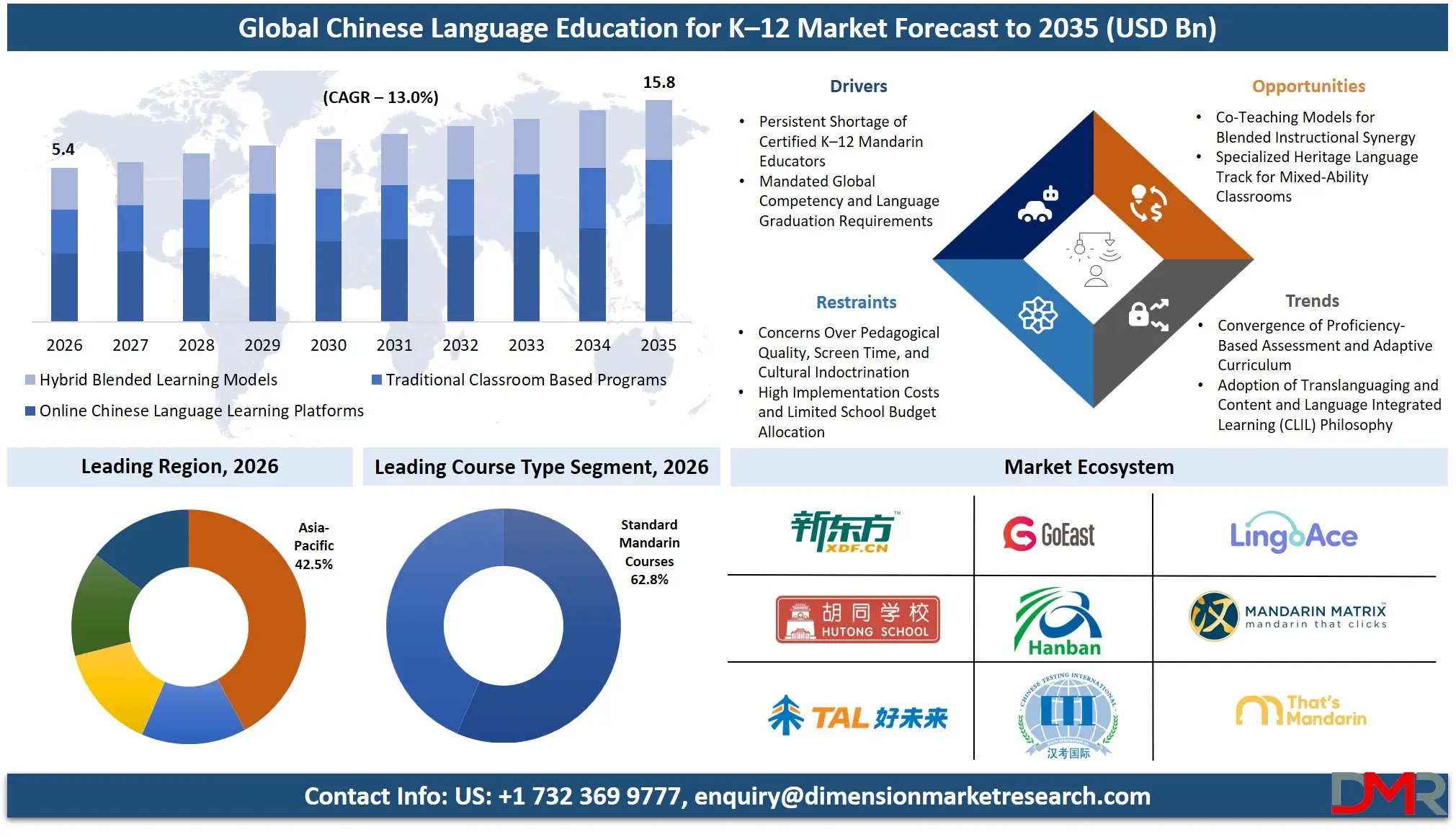
- Global Market Size in 2026: USD 5.4 Billion
- Global Market Size in 2035: USD 15.8 Billion
- Global CAGR from 2026 to 2035: 13.0%
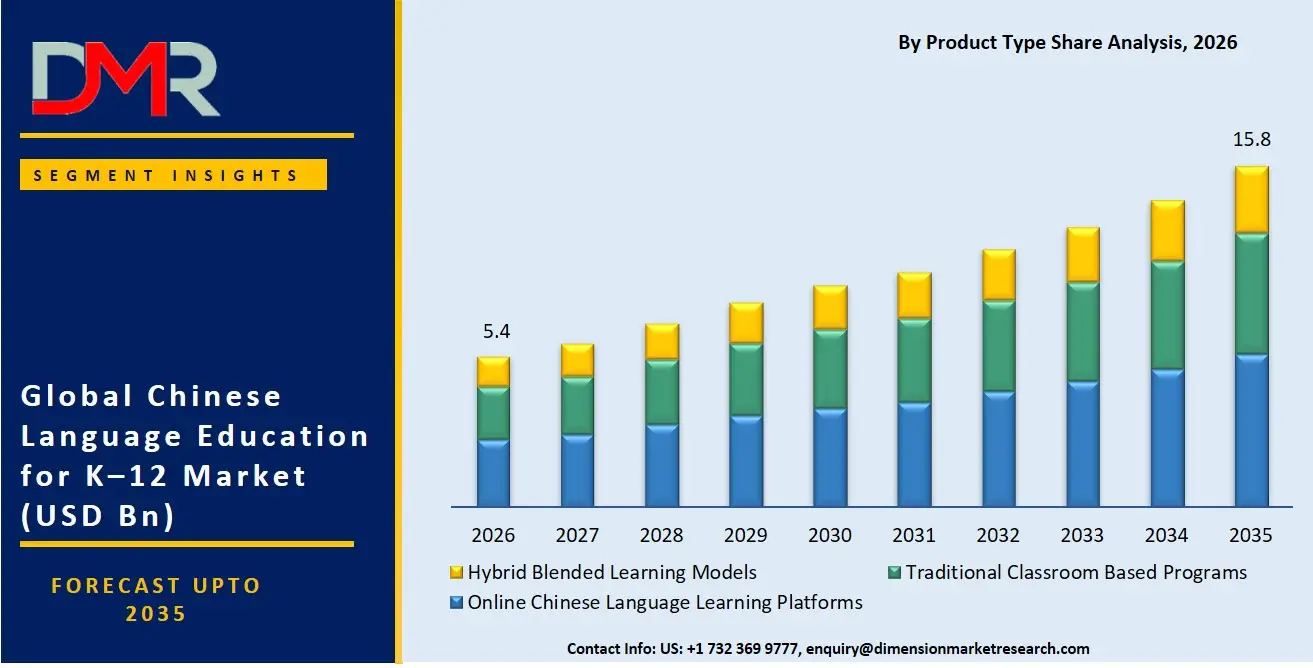
- Online Chinese Language Learning Platforms is the leading product type segment in 2026: 42.5%
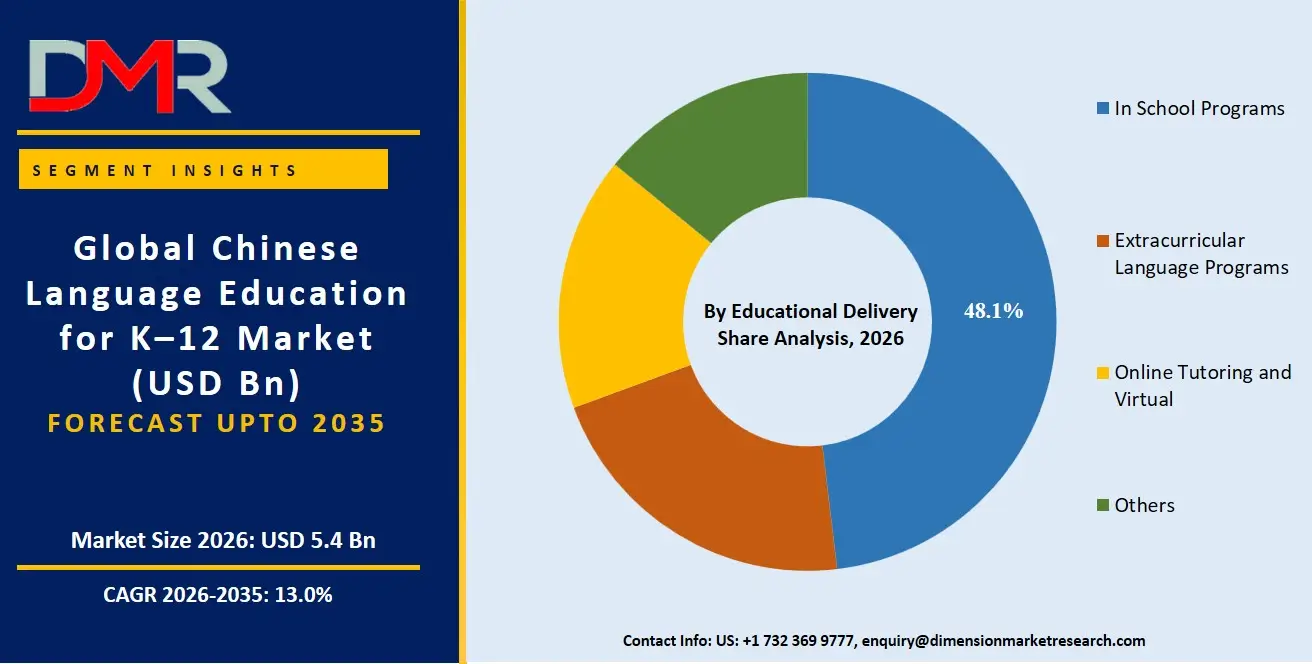
- In-School Programs is the leading educational delivery segment in 2026: 48.1%
- Standard Mandarin Courses is the leading course type segment in 2026: 62.8%
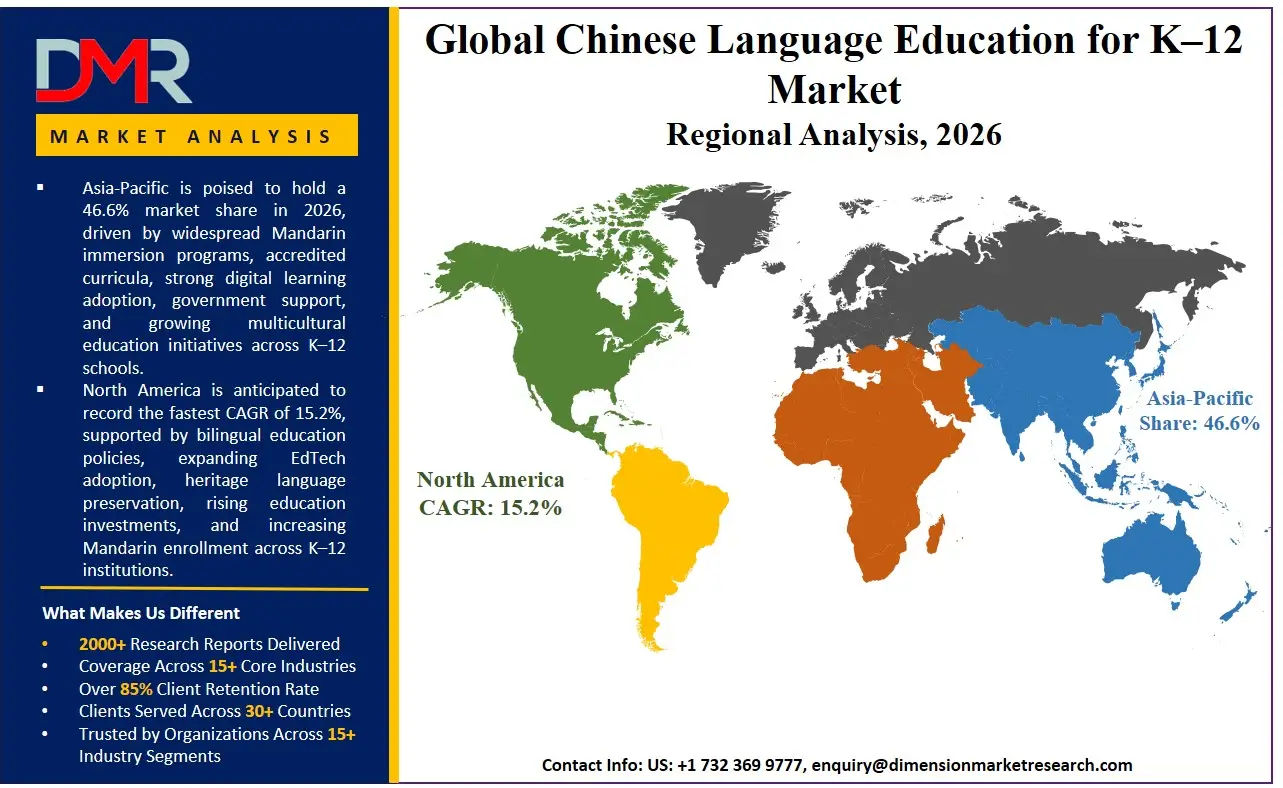
- APAC is the leading region in 2026: 46.6%
- North America is the second-leading region in 2026: 26.8%
What is the Global Chinese Language Education for K–12 Market and its Market Size?
Chinese language education for the K–12 market is a specialized academic discipline providing structured Mandarin acquisition programs for kindergarten through 12th-grade students. It integrates a comprehensive ecosystem of pedagogical tools, including immersive classroom curricula, AI-driven language learning platforms, adaptive speech recognition engines, and cultural competency modules to validate critical learning parameters such as tonal accuracy, character recognition fluency, conversational proficiency, and HSK (Hanyu Shuiping Kaoshi) readiness. School districts, private international academies, and parents seeking cognitive and future economic advantages for their children depend on these programs to ensure global competence, meet foreign language accreditation standards, and build a durable foundation for cross-cultural communication.
ℹ
To learn more about this report –
Download Your Free Sample Report Here
The Global Chinese Language Education for K–12 Market is projected to be valued at USD 5.4 billion in 2026 and is forecast to reach USD 15.8 billion by 2035, expanding at a CAGR of 13.0% during the forecast period. Growth is being driven by China's deepening global economic influence, a widespread recognition of Mandarin's cognitive benefits for young learners, the mainstream adoption of gamified and AI-native EdTech, and government-led multilingualism initiatives in nations like the UK, US, and Australia. Investment is accelerating as educational stakeholders move beyond rote memorization toward proficiency-based, outcome-oriented bilingual and dual-language immersion models.
Use Cases
- Continuous Language Proficiency Benchmarking for Immersion Schools: K–12 institutions with one-way and two-way dual-language immersion programs use integrated platforms for real-time progress tracking, correlating data from speech analysis software, digital character writing tools, and formative assessments to identify at-risk learners and personalize intervention strategies before fluency gaps widen.
- Personalized Lexical Acquisition and Tonal Correction: Individual learners and tutors deploy AI-powered language learning platforms for 24/7 conversational practice and pronunciation refinement. Upon detecting a learner's persistent tonal error or character recall failure, an adaptive spaced repetition system autonomously adjusts the lesson sequence, isolating problematic phonemes and providing targeted drills to compress the path to Intermediate-Low proficiency.
- Curriculum Mapping and Accreditation Compliance: School boards and international school accreditation bodies (such as CIS or WASC) utilize structured curriculum frameworks to map learner outcomes to internationally recognized standards like the ACTFL Proficiency Guidelines or the Common European Framework of Reference (CEFR).
- Supply Chain and Cultural Program Vetting: Educational content aggregators and school districts leverage curriculum consulting services to vet third-party cultural enrichment providers. Specialists analyze source materials for pedagogical soundness and cultural authenticity, detecting potential stereotyping or developmental inappropriateness, enabling curriculum directors to rapidly approve safe, high-quality immersive experiences.
Key Takeaways
- Market Size: The Global Chinese Language Education for K–12 Market is anticipated to be valued at USD 5.4 billion in 2026 and is forecast to reach USD 15.8 billion by 2035, expanding at a CAGR of 13.0%.
- Growth Outlook: Market expansion is supported by the institutionalization of K–12 Mandarin programs, the dissolving boundaries between in-classroom and at-home learning, hyperscale adoption of mobile-first education, the rise of generative AI tutoring agents, and a growing parental mandate for cost-effective, outcome-driven global language acquisition over monolingual complacency.
- Primary Growth Drivers: An overwhelming volume of undifferentiated language content causing learner fatigue, the immense complexity of mastering a logographic writing system without guided feedback, strict college admission mandates for foreign language credits, and the inability of non-native-speaking parents to support at-home practice are accelerating global investment in structured and AI-augmented Mandarin solutions.
- By Product Type Analysis: Online Chinese Language Learning Platforms are projected to lead the product segment with a dominant 42.5% share in 2026, driven by the non-negotiable requirement for accessible, interactive, and scalable instruction that provides immediate pronunciation feedback and character stroke-order validation, bypassing the limitations of static textbooks.
- By Educational Delivery Analysis: In-School Programs are expected to dominate the delivery segment with a 48.1% share in 2026, supported by the massive proliferation of publicly funded Confucius Classrooms and privately endowed international immersion academies providing deep, sustained teacher-student engagement and peer-to-peer conversational practice.
- By Course Type Analysis: Standard Mandarin Courses are anticipated to dominate with a 62.8% share in 2026, driven by the foundational need for sequential language acquisition frameworks that structure a learner's journey from novice tonal differentiation and basic radical recognition to complex sentence construction and narrative competency.
- Regional Analysis: The Asia Pacific region is projected to lead with a 46.6% share in 2026, driven by its geographic and cultural proximity, heritage language maintenance imperatives, and deeply integrated national bilingual policies that position Mandarin as a core economic asset from primary school onwards. North America holds the second-largest share at 26.8%.
How AI/Gen AI is Transforming the Chinese Language Education for K–12 Market?
Artificial intelligence is fundamentally transforming K–12 Mandarin education by enabling intelligent error diagnosis and predictive fluency modeling across vast linguistic datasets. Machine learning algorithms dynamically benchmark an individual learner's "interlanguage" phonetic profile, distinguish between developmental errors and L1-transfer fossilization in real-time, and predict which tonal pairs or character sets a student is most likely to confuse next. Generative AI tutors are being integrated into ed-tech platforms, allowing young learners to engage in unscripted, context-aware dialogue, while automatically generated, level-appropriate illustrated stories create a low-affective-filter environment that significantly reduces learning anxiety and increases voluntary reading time.
The next frontier involves agentic AI workflows that orchestrate a closed-loop, adaptive learning ecosystem autonomously. In this paradigm, an AI speech engine detects a subtle, persistent diphthong mispronunciation, instantly instructs the adaptive learning system to generate a micro-lesson contrasting the minimal pair, and then correlates the acoustic deviation with the student's known heritage language background to perform root-cause error analysis. This capability compresses the tonal mastery timeline from months to weeks. However, for these AI models to be trusted with autonomous curriculum pacing decisions, they require strict governance on culturally authentic, age-appropriate training data derived from expert pedagogical annotations and native-speaker audio corpora to prevent the reinforcement of non-standard "learner-ese" dialects.
Key Drivers in the Global Chinese Language Education for K–12 Market
Persistent Shortage of Certified K–12 Mandarin Educators
The acute global deficit of certified instructors with K–12 licensure and native-level Mandarin proficiency is a primary market driver. School districts, particularly in rural or low-funding regions of North America and Europe, struggle to recruit, train, and retain qualified language acquisition specialists capable of delivering proficiency-based instruction. This talent vacuum directly fuels demand for virtual classroom platforms and live interactive online tutoring that provide immediate access to accredited, pedagogically trained teachers from native-speaking countries. The growing focus on oracy and biliteracy requires nuanced human feedback on pronunciation and cultural context that cannot be fully automated, making the "expertise-as-a-service" model essential for districts that cannot compete for specialized faculty.
Mandated Global Competency and Language Graduation Requirements
A rising tide of national education strategies and college admission prerequisites is compelling K–12 systems to formalize world language offerings. Policy frameworks like the UK Department for Education's Mandarin Excellence Programme and the US Department of Defense's STARTALK initiative are allocating substantial funding to seed and sustain Mandarin pipelines. Furthermore, a growing number of university systems are viewing demonstrated character literacy and HSK certification as potent differentiators in competitive admissions. This structural demand transforms Chinese language education from a niche extracurricular enrichment activity into a core academic necessity, directly propelling investment in standardized curricula and summative proficiency tests.
Restraints in the Global Chinese Language Education for K–12 Market
Concerns Over Pedagogical Quality, Screen Time, and Cultural Indoctrination
The central function of a language program is its access to a young learner's developing cognitive and sociocultural worldview. Entrusting this formative instruction to gamified apps or a third-party online provider introduces significant concerns over unregulated screen time, the pedagogical shallowness of "edutainment" apps that prioritize in-app purchases over measurable proficiency gains, and perceived geopolitical risks of cultural indoctrination through state-linked language programs. School boards in geopolitically sensitive regions may resist integrating externally controlled digital platforms into their firewall-protected networks, fearing a loss of curriculum control and the creation of a new supply chain risk where the education provider's own data privacy policy becomes a student safety vector. This governance friction can delay or block adoption, particularly in K–6 public school contexts.
Growth Opportunities in the Global Chinese Language Education for K–12 Market
Co-Teaching Models for Blended Instructional Synergy
A significant growth opportunity lies in co-teaching models that integrate a local, non-fluent classroom facilitator with a remote, native-level virtual Mandarin instructor. This approach addresses the acute "teacher shortage" restraint by providing a live, high-fidelity language model for authentic phonetic input and cultural insight, while retaining an in-person educator for classroom management and individualized support. This model is particularly attractive to middle schools and rural districts wanting to augment their existing foreign language exploratory (FLEX) programs without hiring a full-time Mandarin specialist. It creates a sticky, recurring revenue relationship built on a pedagogical partnership rather than pure software licensing.
Specialized Heritage Language Track for Mixed-Ability Classrooms
The profound bifurcation in K–12 Mandarin classes between absolute beginners and heritage speakers with high oral fluency but zero character literacy creates a massive, underserved opportunity. Generic curricula collapse under this bimodal skill distribution. Providers who develop a dual-track curriculum—offering a rigorous literacy acceleration path for heritage speakers (focused on radical-based character etymology and formal register) alongside a communicative, activity-based path for L2 learners—can unlock a high-value segment. This specialized instructional design, integrated with a single classroom management dashboard, solves a critical pain point for immersion and international school heads.
Trends in the Global Chinese Language Education for K–12 Market
Convergence of Proficiency-Based Assessment and Adaptive Curriculum
The market is witnessing a convergence of proficiency testing preparation and daily learning into a unified, outcome-focused instructional stack. Rather than simply generating vocabulary drills, modern platforms contractually guarantee specific ACTFL proficiency sub-level gains or HSK pass rates. This trend is driving providers to tightly integrate speech recognition, adaptive character writing modules, and AI-driven personalized review into their instructional core. The focus is shifting from monitoring time-on-task to actively validating communicative competence. This convergence simplifies vendor management for school districts and delivers a more integrated learner experience, where a diagnostic speaking test directly triggers a personalized remedial unit on aspect markers.
Adoption of a Translanguaging and CLIL Philosophy
A forward-looking trend is the integration of Content and Language Integrated Learning (CLIL) into the K–12 Mandarin lifecycle. Service providers and curriculum designers are evolving beyond teaching Chinese as a discrete subject to using Mandarin as the medium of instruction for math, science, and art. This involves continuous professional development for STEM teachers and automated scripted lesson plans that validate whether academic concepts are being acquired alongside the second language. By providing this holistic, dual-objective instruction alongside language-only tracking, program providers position themselves as strategic partners for whole-school bilingual accreditation, capable of validating transdisciplinary linguistic fluency, not just vocabulary recall.
Research Scope and Analysis
The Global Chinese Language Education for K–12 Market is segmented by product type, educational delivery, and course type. Product types include traditional classroom-based programs, online platforms (sub-segmented into self-paced apps, live interactive platforms, and AI-powered platforms), and hybrid blended learning models. The study evaluates delivery across in-school programs, extracurricular programs, and online tutoring, and analyzes adoption across standard Mandarin courses and Chinese for Specific Purposes (CSP) for key learner demographics.
ℹ
To learn more about this report –
Download Your Free Sample Report Here
By Product Type Analysis
Online Chinese Language Learning Platforms are poised to dominate the Global K–12 Chinese Education Market with a 42.5% market share in 2026, underpinned by the core value proposition of accessible, on-demand, and adaptive language exposure that transcends geographic and socioeconomic barriers. These platforms, particularly Live Interactive Learning Platforms, are essential for providing the high-volume comprehensible input and corrective feedback necessary for achieving a low foreign accent early.
ℹ
To learn more about this report –
Download Your Free Sample Report Here
Hybrid Blended Learning Models hold the second-highest share, driven by the critical need to fuse the engagement of face-to-face cultural immersion with the efficiency of AI-driven personalized practice in a "flipped classroom" model. AI-Powered Language Learning Platforms are projected to record a strong CAGR, as parents and schools increasingly demand intelligent tutoring systems that autonomously manage lexical acquisition, tonal calibration, and stroke-order instruction to shrink the time-to-proficiency.
By Educational Delivery Analysis
In-School Programs are anticipated to dominate the market with a 48.1% share in 2026, as the structured school day remains the most equitable and scalable vehicle for delivering sustained, longitudinal language sequences. Deep integration through public, private, and international school curricula is foundational to mainstreaming Mandarin acquisition. Online Tutoring and Virtual Classes account for the second-highest share, owing to the necessity of bridging the in-school instruction gap with high-dosage, one-to-one tutoring that targets individual interlanguage fossilization patterns. Extracurricular Language Programs, including weekend heritage schools and summer immersion camps, are anticipated to expand at the highest CAGR, supported by the rapid growth of culturally focused, experiential learning that builds intrinsic motivation and functional oracy outside the pressure of formal graded environments.
By Course Type Analysis
Standard Mandarin Courses are projected to lead with a 62.8% market share in 2026, due to the universal, sequential scaffolding required to navigate a logographic tonal language from absolute beginner to independent user. These courses structure a learner's progression from foundational pinyin and basic radicals through intermediate grammatical patterns and advanced academic discourse. Chinese for Specific Purposes (CSP) is expected to register the highest CAGR, driven by a growing recognition among parents and educators that language learning must be directly relevant to a student's future academic and professional trajectory. This is particularly acute in Business Chinese for young entrepreneurs and HSK Test Preparation, reflecting an intense, pragmatic focus on certifying competence for college admissions and scholarship eligibility through demonstrably benchmarked credentials.
The Global Chinese Language Education for K–12 Market Report is segmented on the basis of the following:
By Product Type
- Online Chinese Language Learning Platforms
- Self Paced Learning Apps
- Live Interactive Learning Platforms
- AI Powered Language Learning Platforms
- Traditional Classroom Based Programs
- Hybrid Blended Learning Models
By Educational Delivery
- In School Programs
- Public Schools
- Private Schools
- International Schools
- Extracurricular Language Programs
- After School Language Centers
- Weekend Language Schools
- Summer and Winter Language Camps
- Online Tutoring and Virtual Classes
- One to One Tutoring
- Small Group Classes
- Virtual Classroom Programs
- Others
By Course Type
- Standard Mandarin Courses
- Beginner Level
- Intermediate Level
- Advanced Level
- Chinese for Specific Purposes (CSP)
- Business Chinese
- Chinese for Cultural Studies
- Chinese for Academic Preparation
- Chinese Proficiency Test Preparation (HSK)
Regional Analysis
APAC is the Leading Region in the Global K–12 Chinese Education Market
The Asia Pacific region is poised to lead the Global K–12 Chinese Education Market with an estimated 46.6% revenue share in 2026. The region's dominance is anchored by a dense concentration of heritage learners, deep-seated national bilingual policies in countries like Singapore, and the gravitational pull of China's economy for intra-Asian trade.
ℹ
To learn more about this report –
Download Your Free Sample Report Here
Intensive parental investment in academic enrichment, a massive installed base of mobile-first digital learners, and the presence of the most innovative, well-funded EdTech giants solidify its position as the primary global hub for advanced Mandarin language acquisition ecosystems.
North America is the Fastest-Growing Region in the Global K–12 Chinese Education Market
North America is projected to register the fastest CAGR of 15.2% through 2035, driven by a booming engine for K–12 language immersion expansion across the United States and Canada. Massive federal and state-level investment in critical language programs, a widespread grassroots parental demand for cognitive and career-advancing educational experiences, and a dire shortage of certified K–12 Mandarin teachers necessitate rapid adoption of blended and virtual instructional solutions. Accelerating university admissions mandates, government-led language flagship initiatives, and the expansion of Mandarin as a core subject in elite private and charter schools further fuel demand for specialized CSP and HSK preparation services.
The Europe K–12 Chinese Education Market
The Europe K–12 Chinese Education Market is estimated to be valued at USD 832.1 million in 2026 at a CAGR of 11.2%. Europe represents a sophisticated regional market, distinguished by its stringent data privacy regulations under GDPR and a strong multilingual ethos that normalizes early second and third language acquisition. The region's powerhouse private and international school sector, particularly in the UK, Switzerland, and Germany, is a significant growth engine, requiring specialized bilingual curricula that embed Mandarin into the International Baccalaureate (IB) and national A-Level frameworks, ensuring academic parity with European languages.
Latin America K–12 Chinese Education Market
The Latin America K–12 Chinese Education Market is expanding steadily as the region undergoes rapid deepening of Sino-Latin American trade and infrastructure investment, making Mandarin a high-utility asset for future economic mobility. Brazil and Mexico lead regional adoption, driven by their growing private education sectors, new scholarship programs for study in China, and a sharp increase in professional demand for bilingual business talent. The prohibitive cost and scarcity of in-country native speakers make the online live tutoring model highly attractive. International EdTech firms partnering with local private school networks for culturally adapted, Portuguese and Spanish-mediated beginner modules represent a key pathway to capturing this nascent market.
Middle East and Africa K–12 Chinese Education Market
The Middle East and Africa K–12 Chinese Education Market is developing alongside massive Belt and Road Initiative (BRI) projects, economic diversification initiatives in the Gulf states, and the modernization of educational infrastructure across Africa. Saudi Arabia and the UAE are the primary investment hubs, driven by formal agreements to integrate Mandarin into national public school curricula, necessitating comprehensive instructional materials, teacher training, and AI-enabled self-study platforms. South Africa leads on the African continent with its network of Confucius Institutes. The growing appetite for academic preparation and non-oil GDP career paths is spurring demand for standardized HSK preparation and Business Chinese camps.
Major Countries Analysis
The US K–12 Chinese Education Market
ℹ
To learn more about this report –
Download Your Free Sample Report Here
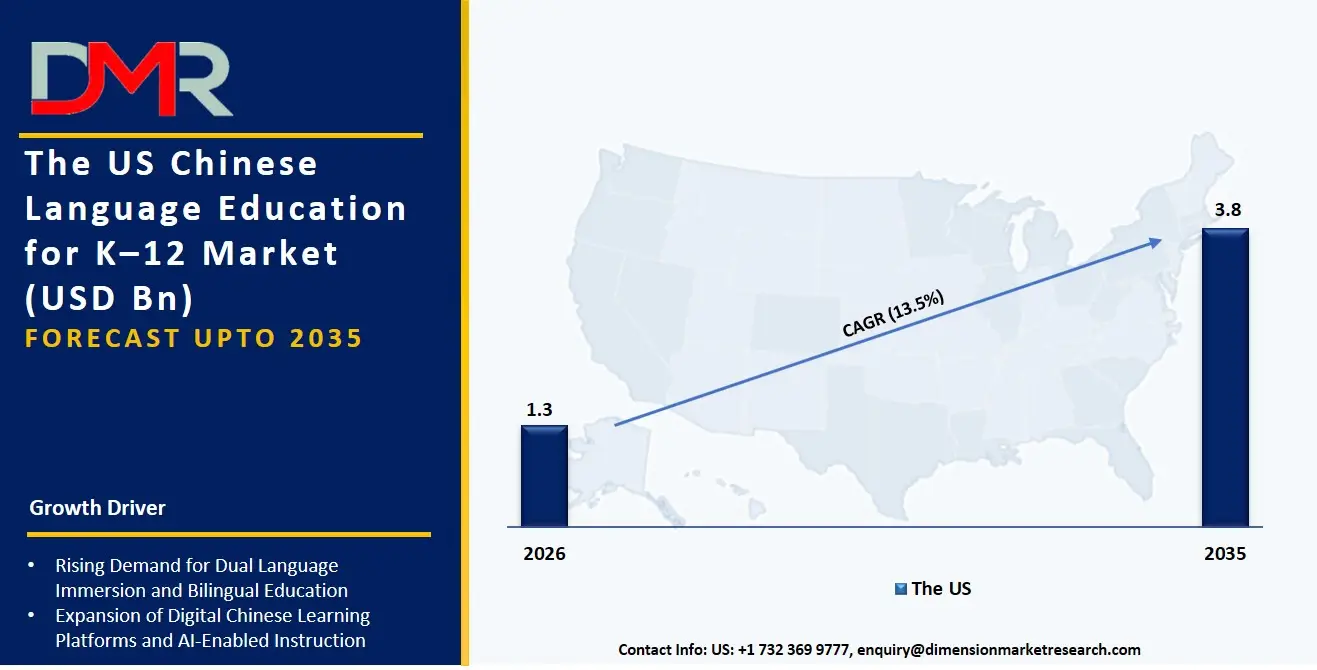
The United States K–12 Chinese Education Market is projected to be valued at USD 1.3 billion in 2026 and is expected to reach USD 3.8 billion by 2035, registering a CAGR of approximately 13.5% from 2026 to 2035. This robust trajectory reflects the U.S.'s position as the largest English-speaking market for Mandarin, fueled by the federal STARTALK and FLAGS programs, a network of over 300 dual-language immersion schools, and a societal push for global citizenship. Growth is catalyzed by the critical shortage of locally credentialed Mandarin teachers, making virtual reality (VR) immersion platforms and AI conversational agents a defining driver of equitable access to high-fidelity language input.
Japan K–12 Chinese Education Market
The Japan K–12 Chinese Education Market is valued at USD 420.0 million in 2026 and is forecast to reach USD 1.0 billion by 2035, expanding at a CAGR of approximately 10.8% between 2026 and 2035. Market development is heavily influenced by Japan's profound historical kanji connection, which provides a unique cognitive advantage in character acquisition, and the government's push for trilingual proficiency. The country's deep economic integration with China demands meticulous instruction in formal business register and written communication for future professionals. A strong cultural preference for structured, high-touch tutoring from trusted local providers is driving sustained, quality-focused adoption of hybrid blended learning that links shared logographic roots to modern Mandarin.
Saudi Arabia K–12 Chinese Education Market
The Saudi Arabia K–12 Chinese Education Market is estimated at USD 110.0 million in 2026 and is projected to reach USD 340.0 million by 2035, expanding at a CAGR of 13.2%. Hyper-growth is directly tied to the Vision 2030 framework and the historic 2019 national mandate to introduce Chinese language at all K–12 levels. This greenfield national initiative requires comprehensive curriculum localization, massive teacher training cohorts, and AI-driven platforms to support self-directed learning in a context with a limited native-speaker base. The market presents significant opportunities for international EdTech providers who establish in-country data sovereignty and partner with the Ministry of Education to deliver culturally aligned, sovereignty-respecting pedagogical solutions for young female and male learners.
Regulatory and Policy Landscape
The policy landscape is the primary, non-negotiable catalyst for K–12 Mandarin investment. In the US, the National Security Language Initiative and STARTALK grants mandate the building of a pipeline of advanced Mandarin speakers, channeling federal funding into measurable proficiency outcomes. The UK's Mandarin Excellence Programme, with its target of 5,000 fluent school leavers by 2020, set a precedent for systemic, government-backed Mandarin uptake. The UAE's nationwide integration model serves as a blueprint for Gulf states. These global frameworks collectively transform Mandarin education from an optional extracurricular into a state-funded strategic imperative, de-risking provider investments and guaranteeing long-term curricular integration and procurement cycles.
Investment and White Space Analysis
The strongest investment opportunities lie in AI-native voice analytics platforms that fuse pronunciation, fluency, and lexical range scoring into a single, child-safe interface that reduces parental anxiety over progress. Significant white space exists in developing culturally resonant, gamified character writing apps for heritage learners aged 5-8 that connect radical etymology to visual mnemonics. Providers can differentiate through "co-teaching" digital platforms that seamlessly integrate a live, China-based instructor with a U.S.-based lead teacher's lesson plan, and by offering "Global Competence as a Service" that combines virtual exchange, Model UN in Mandarin, and project-based CLIL summits. Emerging growth areas include specialized CSP modules for future-facing industries (AI, green energy) and dedicated Mandarin-with-dyslexia support systems that leverage multisensory character instruction techniques.
By Region
North America
Europe
- Germany
- The U.K.
- France
- Italy
- Russia
- Spain
- Benelux
- Nordic
- Rest of Europe
Asia-Pacific
- China
- Japan
- South Korea
- India
- ANZ
- ASEAN
- Rest of Asia-Pacific
Latin America
- Brazil
- Mexico
- Argentina
- Colombia
- Rest of Latin America
Middle East & Africa
- Saudi Arabia
- UAE
- South Africa
- Israel
- Egypt
- Rest of MEA
Competitive Landscape
The Global K–12 Chinese Education Market features a dynamic landscape ranging from pure-play language learning app developers to global education conglomerates with integrated school management services portfolios. At the high end, consumer EdTech firms like LingoAce, VIPKid Global, and Duolingo compete on the depth of their AI-driven personalization, the engagement of their gamified curriculum, and the efficacy of their speech evaluation algorithms. This tier competes intensely on demonstrable proficiency gains per instructional hour. The competitive field broadens significantly in the institutional domain, where curriculum publishers like Better Chinese, Cheng & Tsui, and CLCD, alongside service providers like Mandarin Matrix and Level Chinese, differentiate on deep vertical pedagogical expertise, blended learning models, and the human capital of their certified teacher networks. Strategic differentiation increasingly hinges on providing a unified platform that fuses standards-based, ACTFL-aligned OPI (Oral Proficiency Interview) preparation with hands-on cultural coaching, supported by transparent efficacy reports and guaranteed academic outcomes, not just engagement metrics.
Some of the prominent players in the Global Chinese Language Education for K–12 Market are:
- New Oriental Education & Technology Group Inc.
- TAL Education Group
- Hanban International Education
- Mandarin Matrix
- That's Mandarin
- LingoAce
- GoEast Mandarin
- Hutong School
- CLI Chinese
- Keats School
- Beijing Language and Culture University Press
- Chinese Testing International Co. Ltd.
- Better Chinese LLC
- Cheng & Tsui Company
- Mandarin House
- PandaTree
- NihaoCafe
- eChineseLearning
- iTalki
- Preply
- Berlitz Corporation
- EF Education First
- Pearson plc
- Sanako Corporation
- Rosetta Stone Ltd.
- Duolingo Inc.
- HSK Academy
- DigMandarin
- WuKong Education
- LTL Language School
- Other Key Players
Recent Developments
- In February 2026, LingoAce launched ACE Academy, expanding its K–12 education portfolio beyond Mandarin to include Mathematics and English Language Arts through AI-enhanced online and offline learning.
- In September 2025, Duolingo unveiled major product updates at Duocon 2025, introducing new AI-powered learning features and enhancements designed to improve speaking practice and real-world language proficiency across its language courses, including Mandarin.
- In April 2025, Duolingo launched 148 new language courses, making Mandarin and six other major languages available across all 28 supported interface languages. The expansion was powered by generative AI to accelerate course development and improve learner access worldwide.
- In February 2025, Berlitz introduced MyBerlitz Speaking Tutor, an AI-powered speaking practice tool that complements live instructor-led language learning with personalized conversational practice, supporting learners across multiple languages including Mandarin Chinese.
Report Details
| Report Characteristics |
| Market Size (2026) |
USD 5.4 Bn |
| Forecast Value (2035) |
USD 15.8 Bn |
| CAGR (2026–2035) |
13.0% |
| The US Market Size (2026) |
USD 1.3 Bn |
| Historical Data |
2021 – 2025 |
| Forecast Data |
2027 – 2035 |
| Base Year |
2025 |
| Estimate Year |
2026 |
| Segments Covered |
By Product Type, By Educational Delivery, By Course Type |
| Regional Coverage |
North America – The US and Canada; Europe – Germany, The UK, France, Russia, Spain, Italy, Benelux, Nordic, & Rest of Europe; Asia-Pacific – China, Japan, South Korea, India, ANZ, ASEAN, Rest of APAC; Latin America – Brazil, Mexico, Argentina, Colombia, Rest of Latin America; Middle East & Africa – Saudi Arabia, UAE, South Africa, Turkey, Egypt, Israel, & Rest of MEA |
Frequently Asked Questions
How big is the Global Chinese Language Education for K–12 Market?
▾ The Global K–12 Chinese Language Education Market is valued at USD 5.4 billion in 2026 and is projected to reach USD 15.8 billion by 2035, reflecting strong global demand for structured Mandarin literacy, online immersion, and measurable proficiency outcomes.
What is the CAGR of the Global K–12 Chinese Education Market from 2026 to 2035?
▾ The market is projected to expand at a compound annual growth rate (CAGR) of 13.0% between 2026 and 2035, supported by sustained investment in blended learning models and AI tutoring to counter a critical teacher shortage and meet global competency mandates.
What factors are driving the growth of the Global K–12 Chinese Education Market?
▾ Growth is driven by an unrelenting surge in demand for early dual-language immersion, a global shortage of certified K–12 Mandarin instructors, mandatory compliance with national language education policies, and the normalization of virtual instruction that necessitates adaptive speech recognition and live cultural exchange.
What are the major trends in the Global K–12 Chinese Education Market?
▾ Major trends include the convergence of adaptive curriculum and proficiency benchmarking, the integration of generative AI for unscripted conversational practice, a shift toward CLIL-based translanguaging pedagogies, and the rapid rise of specialized heritage learner tracks for mixed-ability international classrooms.
Which region held the largest share of the Global K–12 Chinese Education Market in 2026?
▾ Asia Pacific is expected to lead the global market with a 46.6% share in 2026, supported by deep cultural and geographic proximity, heritage language maintenance needs, and government-mandated bilingual policies that institutionalize Mandarin from early primary grades.
Which region is expected to grow the fastest in the Global K–12 Chinese Education Market?
▾ North America is expected to record the fastest growth at a 15.2% CAGR through 2035, driven by a rapidly expanding base of immersion schools, an acute Mandarin teacher shortage, and federally funded critical language initiatives that prioritize proficiency-oriented instruction.
Who are the key players in the Global K–12 Chinese Education Market?
▾ Key market participants include VIPKid Global, LingoAce, Duolingo, Rosetta Stone (IXL Learning), Mandarin Matrix, Better Chinese, Cheng & Tsui, Level Chinese, and various other global EdTech and specialized curriculum publishing firms.
How is the Global K–12 Chinese Education Market segmented?
▾ The market is segmented by product type, educational delivery, and course type, with regional analysis covering North America, Europe, Asia Pacific, Latin America, and the Middle East and Africa.