What is the Circular Chemistry Platform Market Size?
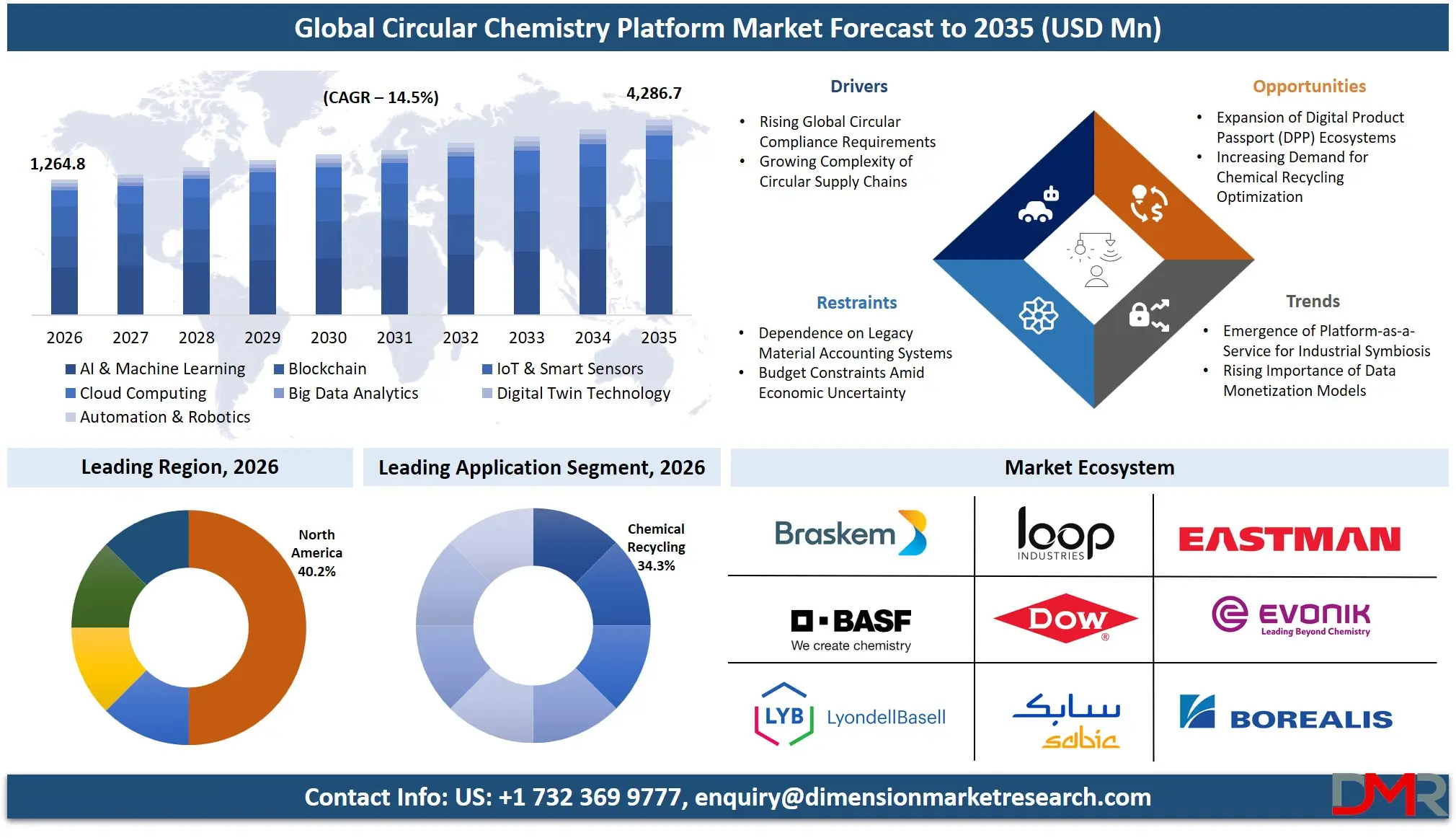
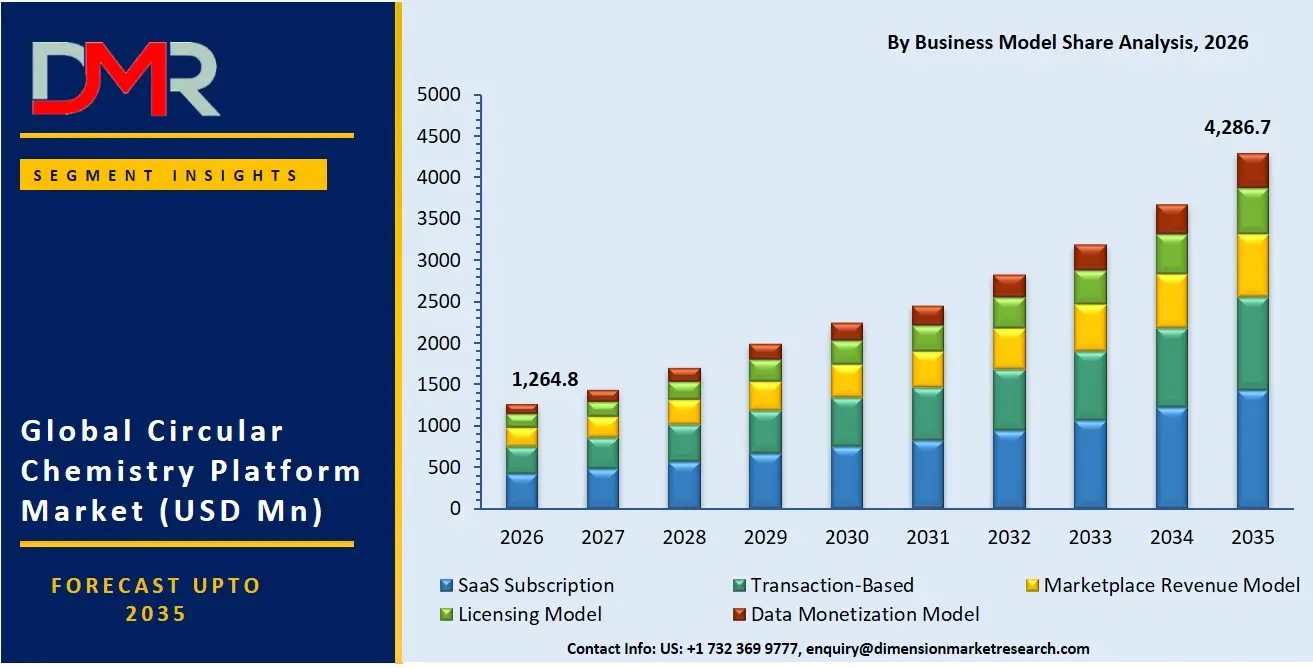
The Global Circular Chemistry Platform Market is expected to reach a value of USD 1,264.8 million in 2026, and it is further anticipated to reach USD 4,286.7 million by 2035, growing at a CAGR of 14.5% during the forecast period.
ℹ
To learn more about this report –
Download Your Free Sample Report Here
The circular chemistry platform market has been growing at a high rate with chemical enterprises accelerating the transition from linear "take-make-dispose" models to closed-loop, resource-efficient systems. Recycling & recovery platforms, waste-to-chemicals platforms, chemical exchange marketplaces, industrial symbiosis platforms, circular supply chain platforms, reverse logistics platforms help organisations to track, trade and transform chemical feedstocks and waste streams.
Specialized digital platforms are becoming more and more essential in the face of growing pressure to meet extended producer responsibility (EPR) requirements, achieve net-zero carbon goals, and ensure stable supply chains for raw materials with volatile availability. Large chemical conglomerates are the most common: SaaS (subscription) or transactional models are still most popular as they are easily scalable and integrate with existing ERP systems. Industries that need traceable, verifiable, and auditable circular material flows are key players, such as chemicals & petrochemicals, packaging, automotive and electronics.
ℹ
To learn more about this report –
Download Your Free Sample Report Here
The US Circular Chemistry Platform Market
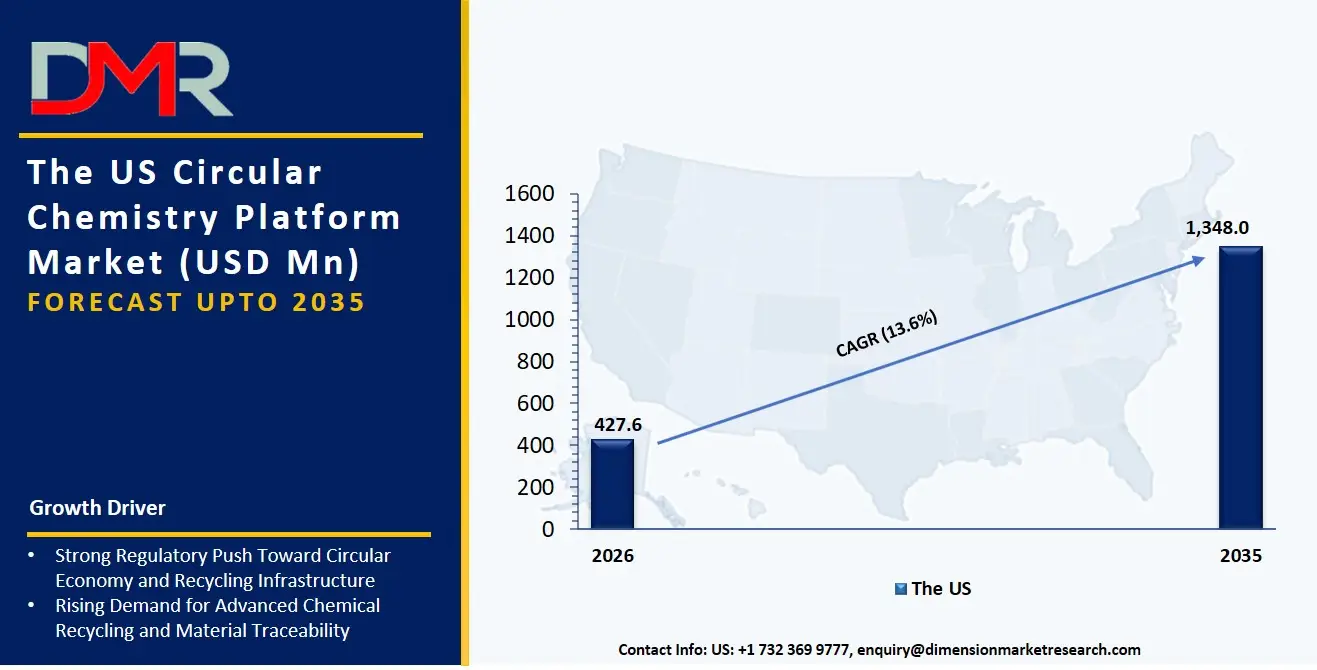
The US Circular Chemistry Platform Market is projected to reach USD 427.6 million in 2026 at a compound annual growth rate of 13.6% over its forecast period by 2035.
The US continues to be the largest and most developed market in circular chemistry platforms due to active sustainability commitments from Fortune 500 chemical manufacturers and the growing distribution of advanced recycling facilities. One of the characteristics of the market has been the high demand for Waste-to-Chemicals Platforms, in which organizations seek to convert post-consumer plastics into virgin-grade monomers. Moreover, AI & Machine Learning and Digital Twin Technology are driving the need for Circular Carbon Tracking & ESG Reporting capabilities to substantiate Scope 3 emission reductions and circular content claims.
ℹ
To learn more about this report –
Download Your Free Sample Report Here
The Europe Circular Chemistry Platform Market
The Europe Circular Chemistry Platform Market is estimated to be valued at USD 398.1 million in 2026 and is expected to experience high growth due to various regulations, such as the EU Circular Economy Action Plan, and the upcoming Digital Product Passport (DPP) mandate. These regulations increase the need for the deployment of Blockchain-based Supply Chain Traceability and Industrial Symbiosis Platforms. Additionally, Circular Supply Chain Platforms are seeing accelerated growth in the region, with automotive and packaging companies in Germany and France seeking a way to reconcile recycled content requirements with cost-effective sourcing. Moreover, efforts like the Circular Plastics Alliance are pushing platform providers to develop dedicated Reverse Logistics Platforms to guarantee quality and interoperability of waste streams in chemical value chains across Europe.
The Japan Circular Chemistry Platform Market
The Japan Circular Chemistry Platform Market is projected to be valued at USD 152.6 million in 2026 at a CAGR of 12.1% in the forecasted period. It is also expected to be a period of strong growth, as Japanese companies seek to overcome the challenges of resource shortages and import restrictions on waste through "Circular DX" (Digital Transformation). Recycling & Recovery Platforms and Waste-to-Chemicals Platforms make up a large part of the spending as large conglomerates digitize material flow accounting off manual spreadsheets to cloud-based systems. Extensive integration of IoT & Smart Sensors in local markets to connect traditional sorting plants with new chemical recycling plants is also very much required to create a niche in Resource Recovery and Circular Manufacturing applications.
Key Takeaways
- Market Size & Forecast: The Global Circular Chemistry Platform market is projected to reach USD 1,264.8 million in 2026, expanding dramatically to USD 4,286.7 million by 2035, driven by the need for mandatory ESG reporting and the uncertainty of virgin fossil-based feedstocks.
- Growth Rate & Outlook: Global market growth is expected at a CAGR of 14.5% will be fuelled by the lack of in-house digital circularity knowledge and the increasing complexity of multi-stakeholder recycling value chains and chemical mass balance accounting.
- Primary Growth Drivers: The general transition to circular business models, the necessity for Chemical Exchange Markets to steer clear of landfill charges and to make sure secondary raw materials are secured, and chemical integration in Big Data Analytics with specific platform features for real-time waste stream matching.
- Key Market Trends: Major trends are the emergence of industry specific circular platforms (e.g. automotive plastics, electronic waste), the adoption of Blockchain to verify recycled content automatically as part of Supply Chain Traceability and the shift to Data Monetization Models where platform operators sell anonymised waste flow intelligence.
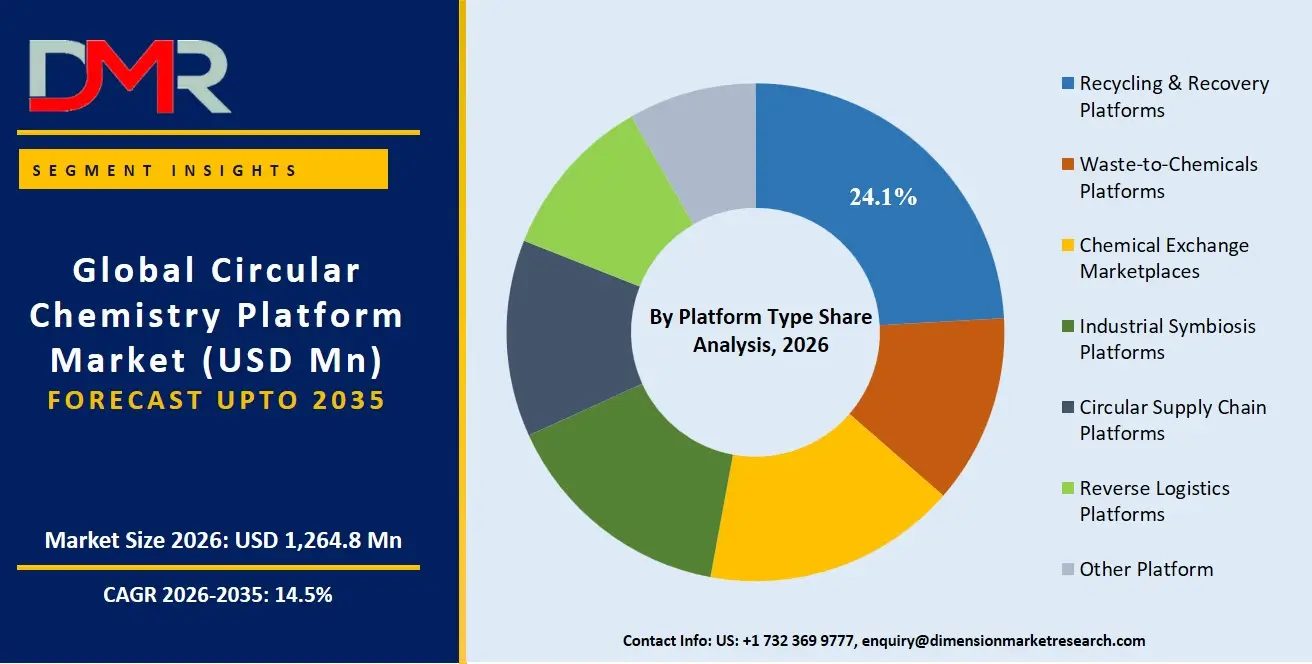
- By Platform Type Analysis: Recycling & Recovery Platforms are expected to dominate enterprise discussions as it is under immediate pressure of regulations and material value recovery. There is an increasing demand for seamless Reverse Logistics Platforms (RLP) linking waste generators and chemical recyclers, and professional platform services are increasingly expected to develop such platforms.
- By Application Analysis: Chemical Recycling and Supply Chain Traceability are the most profitable applications, as they have the highest requirement for recycled content compliance. Carbon Tracking & ESG Reporting is the fastest growing segment with brand owners requiring auditable circular carbon metrics.
- Regional Leadership: North America is poised to dominate this market with 40.2% of the market share in 2026 Chemical Recycling and Supply Chain Traceability are the most profitable applications, as they have the highest requirement for recycled content compliance. Carbon Tracking & ESG Reporting is the fastest growing segment with brand owners requiring auditable circular carbon metrics.
What is the Circular Chemistry Platform?
Circular Chemistry Platforms provide a range of specialised, digital and technology-enabled solutions provided by third party platform providers, systems integrators and software vendors to support chemical companies, waste managers and brand owners throughout the circular material lifecycle. Unlike traditional chemical production systems, these platforms are about the how of circularity tracking, exchanging, and transforming the materials. These include Recycling & Recovery Platforms that help manage the intake of post-consumer feedstocks, Waste-to-Chemicals Platforms that digitize pyrolysis or gasification processes, Chemical Exchange Marketplaces that allow for trading of recycled monomers, and Industrial Symbiosis Platforms that connect one facility's waste with another facility's input. More than 60% of large chemical companies are developing and testing circular projects, and digital platforms are required to make circular investments turn into concrete brand values and regulatory compliance, through mass balance bookkeeping, chain of custody verification, and environmental impact accounting.
Use Cases
- Post-Consumer Plastic-to-Monomer Tracking in Packaging: Packaging producers trace PET bottle waste through the sorting, washing and depolymerization process using Recycling & Recovery Platforms and Blockchain technology, to verify claims of recycled content for food contact packaging requirements.
- Automotive Shredder Residue Valorization: Automotive shredder companies are implementing Waste-to-Chemicals Platforms and Chemical Exchange Marketplaces to digitise the process of converting mixed auto shredder residue to pyrolysis oil that is sold to chemical firms as an alternative to naphtha.
- Industrial Symbiosis in Electronics Manufacturing: Electronics manufacturers are disposing of hazardous waste sulfuric acid from semiconductor etching by connecting with metal refiners recovering copper and gold through the industrial symbiosis platforms by integrating AI & machine learning.
- Digital Product Passport for Pharmaceuticals: Pharmaceutical companies leverage circular supply chain platforms and IoT & smart sensors to monitor solvent recovery rates for each of the contract manufacturing organisations and report circularity in real-time to EcoVadis and CDP.
How AI is Transforming the Circular Chemistry Platform Market?
The circular chemistry platform market is being reshaped by the transformative impact of AI, which streamlines waste stream characterization and boosts operational matching efficiency. AI-powered computer vision systems are able to automatically classify polymer types and contaminates from camera data, significantly reducing the cost of manual sorting and quality of feedstock for chemical recyclers in Recycling & Recovery Platforms. In the meantime, AI capabilities within Chemical Exchange Marketplaces empower businesses to forecast waste quantities, dynamically price 2nd raw materials and suggest logistics optimizations to enhance circular economy financial viability.
The AI is also the central theme for governance and ESG transformation projects. For Carbon Tracking & ESG Reporting, intelligent emission factor agents constantly cross-check chemical conversion processes and suggest allocation methods (mass balance or free attribution) to ensure organisations remain compliant with frameworks like the GHG Protocol and EU's PEF (Product Environmental Footprint). Furthermore, generative AI assistants are augmenting Circular Manufacturing applications by simulating process modifications and modelling optimal feedstock mix, before deployments of production resources, with virgin and recycled content.
Market Dynamics
Key Drivers in the Global Circular Chemistry Platform Market
Rising Global Circular Compliance Requirements
With changing circular economy laws such as EU Packaging and Packaging Waste Regulation (PPWR) and Ecodesign for Sustainable Products Regulation (ESPR), as well as US state-level Extended Producer Responsibility (EPR) legislation, organizations globally are under pressure to deliver on their compliance. These frameworks need reliable mass balance accounting, chain-of-custody verification and real-time sustainability reporting that spreadsheets and old tracking systems can't effectively handle. With regulations being tighter, companies are turning to specialized circular chemistry platforms to streamline compliance processes, enhance audit preparedness, and boost transparency throughout material lifecycles. There is a growing need for platforms that can interconnect recycled-content verification, ESG reporting, and digital traceability in complex industrial systems.
Growing Complexity of Circular Supply Chains
Multiple stakeholders are involved in modern recycling and circular manufacturing ecosystems, such as waste collectors, waste sorting facilities and pre-processors, logistics service providers, and chemical recyclers. Having these interconnected value chains and trying to manage them through disjointed systems introduces risk for double-counting, traceability and data inconsistencies, and also operational inefficiencies. Consequently, companies are fast speeding up their investments in blockchain supply chain traceability platforms to ensure secure, transparent and verifiable material tracking. These platforms facilitate the interaction between stakeholders and increase the transparency around recycled feedstocks, flows and sustainability performance. The global need for coordinated resource recovery and for closed-loop manufacturing is a key catalyst for the uptake of advanced circular chemistry platforms.
Restraints in the Global Circular Chemistry Platform Market
Dependence on Legacy Material Accounting Systems
Many chemical and manufacturing companies still use legacy ERP and material accounting systems that were originally built to work with linear manufacturing processes using virgin raw materials. These systems are not flexible enough to include the management of recycled content allocation, co-product accounting, substitution tracking and circular material banking. The migration from traditional infrastructure to innovative circular chemistry platforms involves significant data transfer, process redesign, testing and training of personnel. Organizations are also wary of possible operational disruptions, compliance risks, and audit complications during implementation. The reluctance of legacy systems that are deeply rooted in the industry is still affecting the platform adoption rate in various industrial sectors.
Budget Constraints Amid Economic Uncertainty
The broader economic environment is becoming more volatile, inflationary, and corporate spending is coming under greater control, meaning organisations are paying closer attention to investments in digital sustainability initiatives. Subscription fees, software integration costs, and platform management fees are now considered a cost/benefit analysis against short-term financial returns. This means that many businesses are only adopting in small scale pilots to immediately reduce waste or to save landfill costs instead of enterprise-wide circular platforms. Those metrics are beginning to get clear and are connected with regulatory requirements, operational efficiency and carbon reduction before companies are willing to adopt long-term digital transformation solutions, which represents a temporary obstacle to the market's expansion.
Growth Opportunities in the Global Circular Chemistry Platform Market
Expansion of Digital Product Passport (DPP) Ecosystems
The increasing adoption of Digital Product Passport is a significant opportunity for circular chemistry platform providers. By 2030, DPPs are likely to be required by industry regulations, such as the EU Ecodesign for Sustainable Products Regulation (ESPR) for sectors like plastics, textiles, electronics, automotive batteries and consumer goods. These passports are needed to document sustainability data, recycled content verification, material origin, and detailed lifecycle data. Progressive platform providers that bring together blockchain, cloud computing, and big data analytics technologies are poised to assist organizations develop scalable and interoperable DPP ecosystems. The growing worldwide focus on product transparency and traceable circular supply chains will further drive the demand for enhanced passport management solutions.
Increasing Demand for Chemical Recycling Optimization
Chemical recycling facilities are expanding rapidly, and there is a high demand for platforms that can help them to optimize and be more efficient in their operations. To avoid costly and time-consuming physical process changes, chemical recyclers are increasingly turning to digital twin technology, smart sensors connected to the IoT, and AI-driven analytics to simulate pyrolysis conditions, the behavior of contaminants, and the yield of the materials being processed. These cutting-edge features assist operators in cutting back on R&D time, capital risk, increasing feedstock utilization and maximizing recycling productivity. The number of circular chemistry ecosystems in the world is growing, and the need for integrated digital optimization platforms is projected to increase significantly as industrial scale chemical recycling becomes more commercially viable.
Trends in the Global Circular Chemistry Platform Market
Emergence of Platform-as-a-Service for Industrial Symbiosis
Industrial symbiosis platforms have grown beyond a waste exchange directory system to increasingly become digital ecosystems powered by AI algorithms to match waste streams with potential industrial feedstock users. Companies are more and more embracing solutions, called Platform-as-a-Service (PaaS), that automatically detect waste-to-resource opportunities that are geographically viable within the manufacturing clusters. These advanced platforms enhance resource efficiency, lower disposal expenses and facilitate joint circular economy activities among industrial parties. AI-driven matchmaking, predictive analytics and real-time tracking of material availability, are turning industrial symbiosis into a scalable and data-driven business model which is speeding up adoption across manufacturing, chemicals and heavy industrial sectors.
Rising Importance of Data Monetization Models
Environmental and circularity-related data is becoming a valuable commercial asset in the circular economy system. Platform owners have been increasingly moving away from traditional SaaS subscription and transaction revenue to data monetization. Waste availability, pricing of recycled material, carbon intensity and circularity benchmarks data are being aggregated and anonymized and sold to investors, consultants, insurers, regulators and organisations focused on sustainability for market information and prediction. Data monetisation is becoming a major trend in the global market, as this change allows platform providers to monetise their circular chemistry data and generate new income streams.
Research Scope and Analysis
The global circular chemistry platform market is driven by rising adoption of recycling & recovery platforms, AI-powered resource management, SaaS-based business models, and chemical recycling applications. Growing sustainability regulations and increasing demand from chemicals & petrochemicals industries are further accelerating market expansion globally.
ℹ
To learn more about this report –
Download Your Free Sample Report Here
By Platform Type Analysis
Recycling & Recovery Platforms are projected to dominate the platform type segment as they are the base infrastructure of the circular chemistry ecosystem. Propelled by the trend toward material recovery and re-use, industries in the chemicals, plastics, packaging, and manufacturing sectors are increasingly seeking ways to cut down on landfill usage and meet sustainability requirements. These platforms allow companies to gather, classify, treat and re-use waste materials in production processes, while at the same time facilitating traceability and efficiency. Adoption is further bolstered by investments in chemical recycling technologies, AI waste analytics, and closed-loop resource systems. Recycling and recovery platforms are a preferred choice for large businesses as they directly align with ESG goals, carbon reduction strategies, and recycled content commitments. Moreover, government incentives, extended producer responsibility (EPR) regulations, and the increasing demand for secondary raw materials are further driving the deployment, making recycling and recovery platforms the top segment in the global circular chemistry platform market.
By Technology Analysis
The technology segment is poised to be led by AI & Machine Learning, which play a pivotal role in waste sorting, predictive resource management, material identification, and circular supply chain intelligence. AI-powered analytics is becoming a key enabler in the circular chemistry industry to optimize recycling processes, predict material flows, automate sustainability reporting, and facilitate better decision-making within industrial ecosystems. Companies can use machine learning algorithms to determine which feedstocks can be recycled, to minimise contamination and to optimise resource recovery along with decreasing operational costs. The technology is also popular in carbon tracking, lifecycle assessment and in the management of the digital product passport. The increasing adoption of AI in conjunction with IoT sensors and cloud platforms further enhances real-time monitoring and automation in circular manufacturing systems. AI and machine learning continue to drive the technology adoption for the circular chemistry platform market globally, as industries look for scalable solutions that provide data.
By Business Model Analysis
SaaS Subscription is the anticipated to be the leading business model segment as businesses are increasingly turning to scalable, cloud-based and cost-effective digital platforms to power their circular economy efforts. SaaS versions enable businesses to leverage recycling analytics, supply chain traceability, ESG reporting and waste management platforms without significant capital investment. The subscription-based model enables quick deployment, automatic software updates, remote access, and seamless integration with enterprise systems. SaaS is especially popular among small and medium-sized enterprises (SMEs) for its ability to reduce the complexity of operations and minimize capital expenditure. Moreover, recurring revenue models bring stability to the earnings of the platform providers and ensure a loyal customer base. SaaS subscriptions are the most prevalent business model for the global circular chemistry platform market, due to the flexibility and scalability they provide, and as their implementation in circular chemistry demands constant monitoring, compliance and real-time data analytics.
By Application Analysis
Chemical Recycling is expected to be the dominant application segment as many parts of the world are increasingly undertaking initiatives to recycle plastic and industrial waste into useful chemical feedstocks. Advanced recycling technologies, including pyrolysis, depolymerisation and solvent recycling, are being developed and heavily invested in by industry to help facilitate a circular manufacturing approach and lower the use of virgin raw materials. In chemical recycling systems, tracking raw material origins, optimizing processes, monitoring emissions, and coordinating supply chains are key considerations, and these are effectively managed through circular chemistry platforms. Adoption is being driven by strong regulatory pressure to reduce plastic waste and ensure that recycled content targets are met in the packaging, automotive and consumer goods sectors. Moreover, increasing collaboration between chemical manufacturers, recyclers and technology providers is bringing commercial scale recycling to the rest of the world. All these factors combined make chemical recycling the largest application segment for the global circular chemistry platform market.
By End-User Analysis
Chemicals & Petrochemicals are poised to lead the end-user segment as the industry is under tremendous pressure to cut down carbon emissions, make efficient use of resources and adjust towards sustainable production systems. Circular chemistry platforms support chemical manufacturers by streamlining waste recovery and facilitating the incorporation of recycled feedstocks, monitoring material flows and assisting with regulatory changes. Increasing investments in chemical recycling technologies, circular raw material sourcing and digital sustainability management systems are driving large-scale adoption. AI-powered circular platforms are also helping the petrochemical industry to improve its operational efficiency and drive closed-loop manufacturing efforts. The advanced capabilities for traceability and lifecycle monitoring are also in high demand in the sector due to the complex global supply chains. Furthermore, partnerships between chemical manufacturers, recyclers, and sustainability technology providers are boosting the digital transformation process, thereby further cementing the market position of the chemicals and petrochemicals industry in the global circular chemistry platform market.
The Global Circular Chemistry Platform Market Report is segmented on the basis of the following:
By Platform Type
- Recycling & Recovery Platforms
- Waste-to-Chemicals Platforms
- Chemical Exchange Marketplaces
- Industrial Symbiosis Platforms
- Circular Supply Chain Platforms
- Reverse Logistics Platforms
- Other Platform
By Technology
- AI & Machine Learning
- Blockchain
- IoT & Smart Sensors
- Cloud Computing
- Big Data Analytics
- Digital Twin Technology
- Automation & Robotics
By Business Model
- SaaS Subscription
- Transaction-Based
- Marketplace Revenue Model
- Licensing Model
- Data Monetization Model
By Application
- Chemical Recycling
- Waste Management
- Resource Recovery
- Product Lifecycle Management
- Carbon Tracking & ESG Reporting
- Supply Chain Traceability
- Sustainable Procurement
- Circular Manufacturing
By End-User
- Chemicals & Petrochemicals
- Packaging
- Automotive
- Electronics & Semiconductors
- Pharmaceuticals
- Food & Beverage
- Construction
- Other End-User
Regional Analysis
Leading Region by Market Share
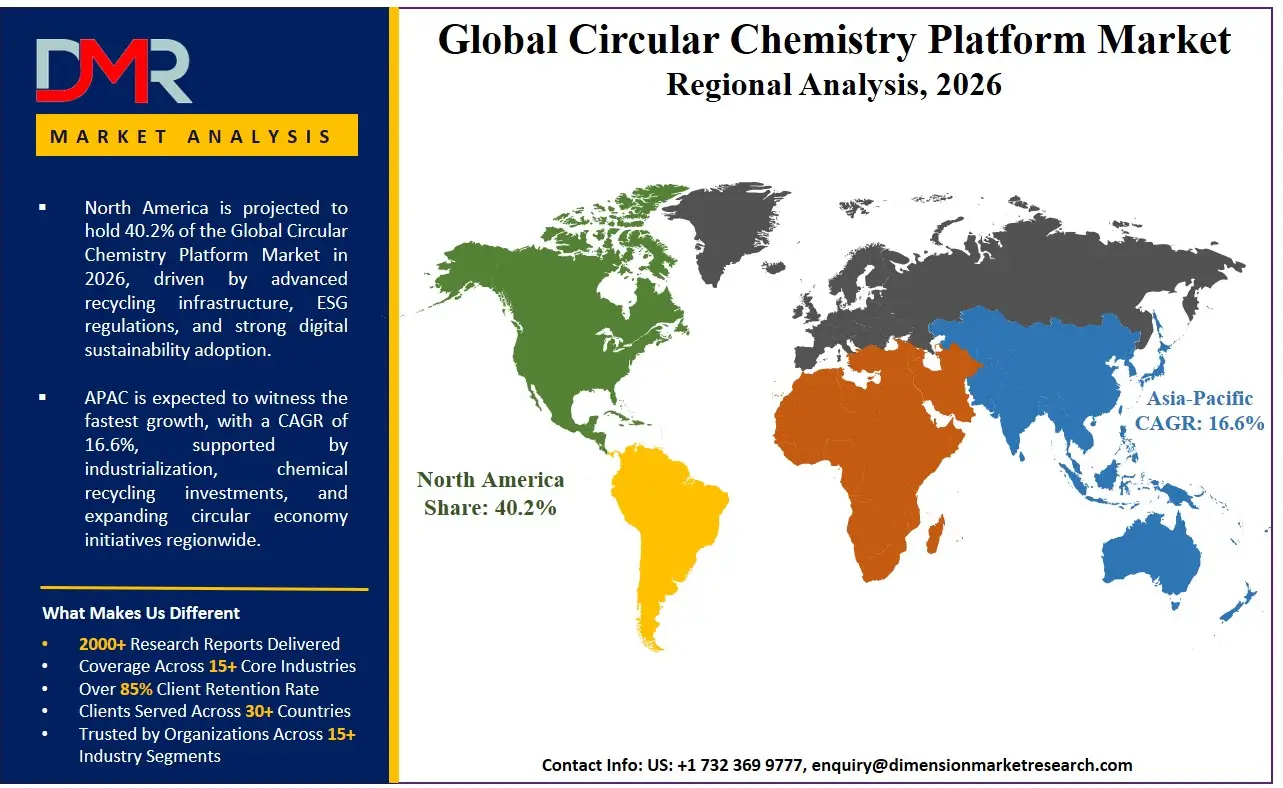
North America is poised to dominate the global circular chemistry platform market, holding 40.2% of the market share by the end of 2026. The United States has the largest share because it has an unmatched concentration of investments in advanced recycling facilities, such as pyrolysis and depolymerization plants, as well as aggressive commitments to circularity by Fortune 500 chemical and packaging companies. The area also has an existing network of platform integrators, boutique sustainability software companies and many data scientists and circular economy engineers. The increased investment in enterprise plastic circularity, battery material recovery, and the overall shift away from manual waste tracking systems fuel the ongoing demand for recycling platforms and carbon tracking tools. Furthermore, an optimistic VC landscape constantly invests in emerging circular chemistry startups with the expectation of these companies providing the necessary platform expertise for rapid development and audit compliance.
ℹ
To learn more about this report –
Download Your Free Sample Report Here
Fastest-Growing Regional Market
Asia-Pacific is projected to see the fastest growth in the circular chemistry platform market, fueled by the adoption of circular economy policies in China, India, Japan, and Southeast Asia, with a strong push from government-led initiatives to promote a circular economy, including import bans on plastic waste and investments in national recycling infrastructure. The rapid rate of economic expansion, the growth of the middle class and their consumption habits, and the dynamic growth of chemical manufacturing requires established conglomerates and state agencies to replace unproductive linear waste management practices. These large organisations are seeking to change to more circular operating models and demand Waste-to-Chemicals Platforms and Reverse Logistics Platforms. There is also a huge shortage of circularity data talent in the region, and platform implementation and integration services are outsourced to fill the skills gap.
By Region
North America
Europe
- Germany
- The U.K.
- France
- Italy
- Russia
- Spain
- Benelux
- Nordic
- Rest of Europe
Asia-Pacific
- China
- Japan
- South Korea
- India
- ANZ
- ASEAN
- Rest of Asia-Pacific
Latin America
- Brazil
- Mexico
- Argentina
- Colombia
- Rest of Latin America
Middle East & Africa
- Saudi Arabia
- UAE
- South Africa
- Israel
- Egypt
- Rest of MEA
Competitive Landscape
The competitive environment of global circular chemistry platforms has become highly dynamic with a heterogeneous array of multinational software platform providers, professional service divisions of large chemical distributors, and niche circular economy consultancies. The key to success will be profound strategic alliances with waste management firms, chemical recyclers, and brand owner coalitions because they will open necessary co-selling opportunities and early access to waste feedstocks. The movement toward market consolidation is rapidly progressing, with traditional environmental software companies acquiring waste-to-chemicals and blockchain traceability specialists to stay relevant. Proprietary intellectual property, including automated mass balance engines and industry-specific circularity KPIs, is becoming a more important basis of competitive differentiation than just generic dashboarding.
Some of the prominent players in the Global Circular Chemistry Platform Market are:
- BASF
- Dow
- SABIC
- LyondellBasell
- Covestro
- Evonik Industries
- Eastman Chemical Company
- Braskem
- Borealis
- Neste
- Veolia
- Loop Industries
- Carbios
- INEOS
- Mitsubishi Chemical Group
- SAP
- Circularise
- Rubicon Technologies
- Rheaply
- Circular.co
- Other Key Players
Recent Developments
- January 2026: SAP announced a major expansion of its GreenToken blockchain platform, a professional services initiative to assist clients in the packaging and automotive industries to create proprietary mass balance models through its Supply Chain Traceability and Carbon Tracking & ESG Reporting capabilities.
- November 2025: Circularise strengthened its collaboration with multiple chemical recyclers and introduced a specific practice combining Blockchain and Big Data Analytics aimed at supporting packaging and electronics clients in moving from manual declarations to auditable digital product passports.
- October 2025: Topolytics acquired a European waste visualization platform to further its Waste-to-Chemicals Platforms and Reverse Logistics Platforms solutions for sovereign waste data facilities, supporting complicated requirements of government and municipal customers in waste flow reporting.
Report Details
| Report Characteristics |
| Market Size (2026) |
USD 1,264.8 Mn |
| Forecast Value (2035) |
USD 4,286.7 Mn |
| CAGR (2026–2035) |
14.5% |
| The US Market Size (2026) |
USD 427.6 Mn |
| Historical Data |
2021 – 2025 |
| Forecast Data |
2027 – 2035 |
| Base Year |
2025 |
| Estimate Year |
2026 |
| Segments Covered |
By Platform Type, By Technology, By Business Model, By Application, and By End-User |
| Regional Coverage |
North America – The US and Canada; Europe – Germany, The UK, France, Russia, Spain, Italy, Benelux, Nordic, & Rest of Europe; Asia-Pacific – China, Japan, South Korea, India, ANZ, ASEAN, Rest of APAC; Latin America – Brazil, Mexico, Argentina, Colombia, Rest of Latin America; Middle East & Africa – Saudi Arabia, UAE, South Africa, Turkey, Egypt, Israel, & Rest of MEA |
Frequently Asked Questions
How big is the Global Circular Chemistry Platform Market?
▾ The Global Circular Chemistry Platform market is poised to be valued at USD 1,264.8 million in 2026 and is projected to reach USD 4,286.7 million by 2035, driven by the universal need for specialized digital tools in chemical recycling, waste stream matching, and ESG compliance.
What is the CAGR of the Global Circular Chemistry Platform Market from 2026 to 2035?
▾ The market is expected to grow at a CAGR of 14.5% from 2026 to 2035, reflecting the accelerating complexity of multi-stakeholder circular value chains and the persistent shortage of internal digital circularity talent.
What factors are driving the growth of the Global Circular Chemistry Platform Market?
▾ Key drivers include the global circular compliance gap (EPR, DPP), the imperative to digitize chemical recycling feedstocks, the management complexity of industrial symbiosis networks, and the surge in demand for Carbon Tracking & ESG Reporting amid evolving climate disclosure laws.
Which region held the largest share of the Circular Chemistry Platform Market in 2026?
▾ North America is poised to dominate this market with 40.2% of the market share in 2026, driven by a mature advanced recycling ecosystem and aggressive enterprise investment in Recycling & Recovery Platforms and Supply Chain Traceability capabilities.
Which region is expected to grow the fastest in the Circular Chemistry Platform Market?
▾ The Asia-Pacific region is expected to grow the fastest, fueled by rapid circular economy policy rollouts in China, India, and Japan, where Waste-to-Chemicals Platforms are critical for transitioning large chemical conglomerates away from imported waste dependency.
What are the major trends in the Global Circular Chemistry Platform Market?
▾ Major trends include the integration of AI into waste sorting workflows, the rise of Data Monetization Models for circular intelligence, the demand for industry-specific platforms (e.g., automotive plastics, battery recycling), and the focus on Digital Twin Technology for chemical recycling yield optimization.
Who are the key players in the Global Circular Chemistry Platform Market?
▾ Key players include enterprise software providers like SAP, blockchain-native platforms like Circularise, chemical exchange marketplaces like Wastehub, industrial symbiosis specialists like Rheaply, and the digital sustainability divisions of chemical majors like BASF.
How is the Global Circular Chemistry Platform Market segmented?
▾ The market is segmented by Platform Type (Recycling & Recovery, Waste-to-Chemicals, Chemical Exchange, Industrial Symbiosis, Circular Supply Chain, Reverse Logistics), Technology (AI/ML, Blockchain, IoT, Cloud, Big Data, Digital Twin, Automation), Business Model (SaaS, Transaction, Marketplace, Licensing, Data Monetization), Application (Chemical Recycling, Waste Management, Resource Recovery, PLM, Carbon Tracking, Traceability, Sustainable Procurement, Circular Manufacturing), and End-User (Chemicals, Packaging, Automotive, Electronics, Pharma, Food & Beverage, Construction).