What is the Clean Energy Technology Market Size?
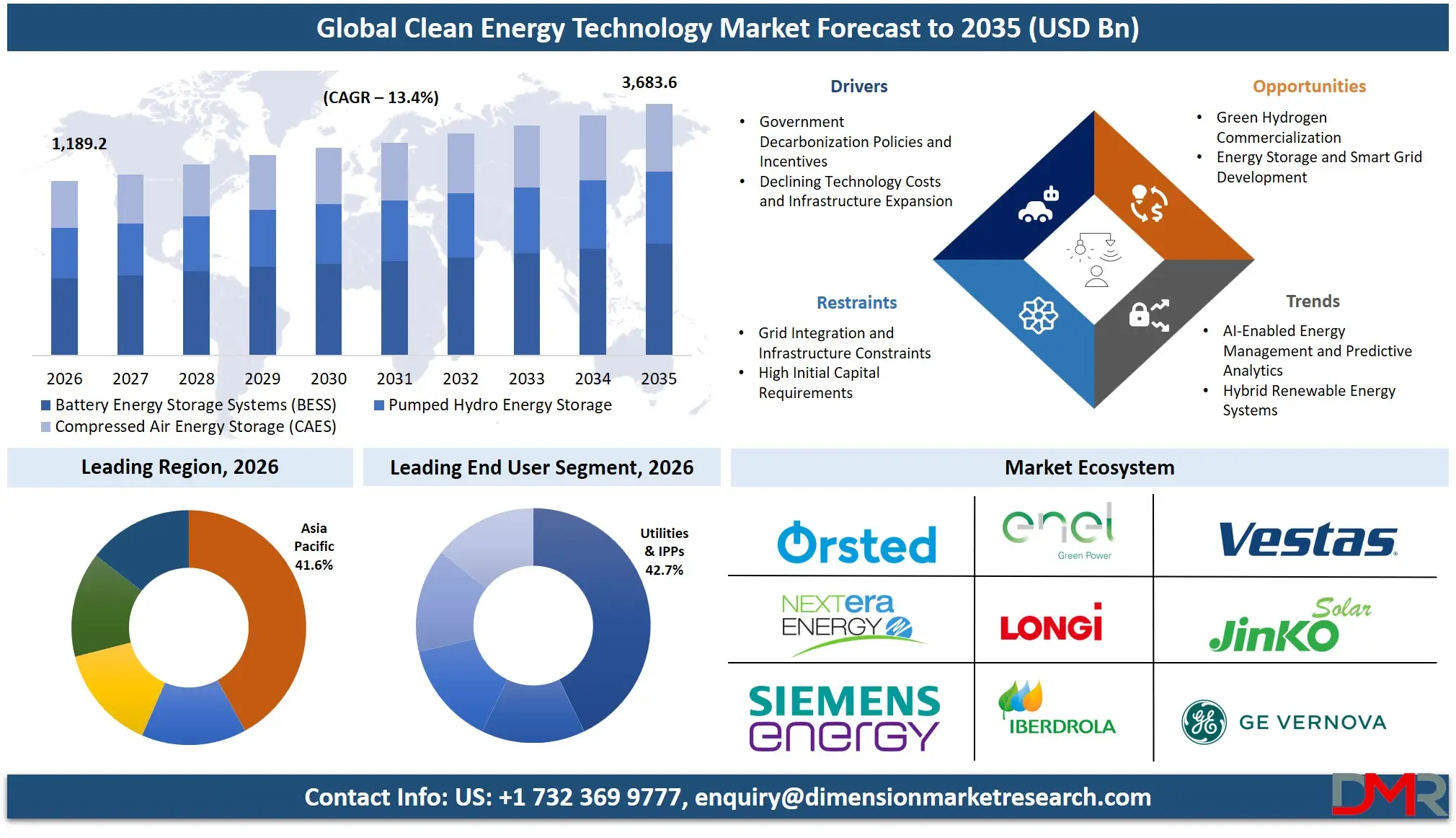
The Clean Energy Technology Market size is expected to be USD 1,189.2 billion in 2026 and increase at a compound annual growth rate of 13.4% to USD 3,683.6 billion in 2035 due to precision medicine and personalized therapy market expansion.
ℹ
To learn more about this report –
Download Your Free Sample Report Here
Clean Energy Technology Market refers to a broad category of innovations that include technologies and systems for producing, storing, distributing, and using energy without causing harm to the environment. These technologies comprise various renewable energy sources, including solar PV, CSP (concentrated solar power), wind energy, hydroelectric power, bioenergy, geothermal technologies, hydrogen energy, and energy storage systems. The clean energy technologies are extremely important for decreasing greenhouse gas emissions and energy insecurity and implementing global decarbonization targets. Electrification, digital energy management, smart grids, energy storage solutions, and green hydrogen development are currently revolutionizing this sector. The rapid cost reduction of renewable energy technologies, supportive policies of the authorities, and increasing sustainability efforts of enterprises are driving the market growth. Global renewable power capacity is forecasted to grow up to 4,600 GW between 2025 and 2030.
The US Clean Energy Technology Market
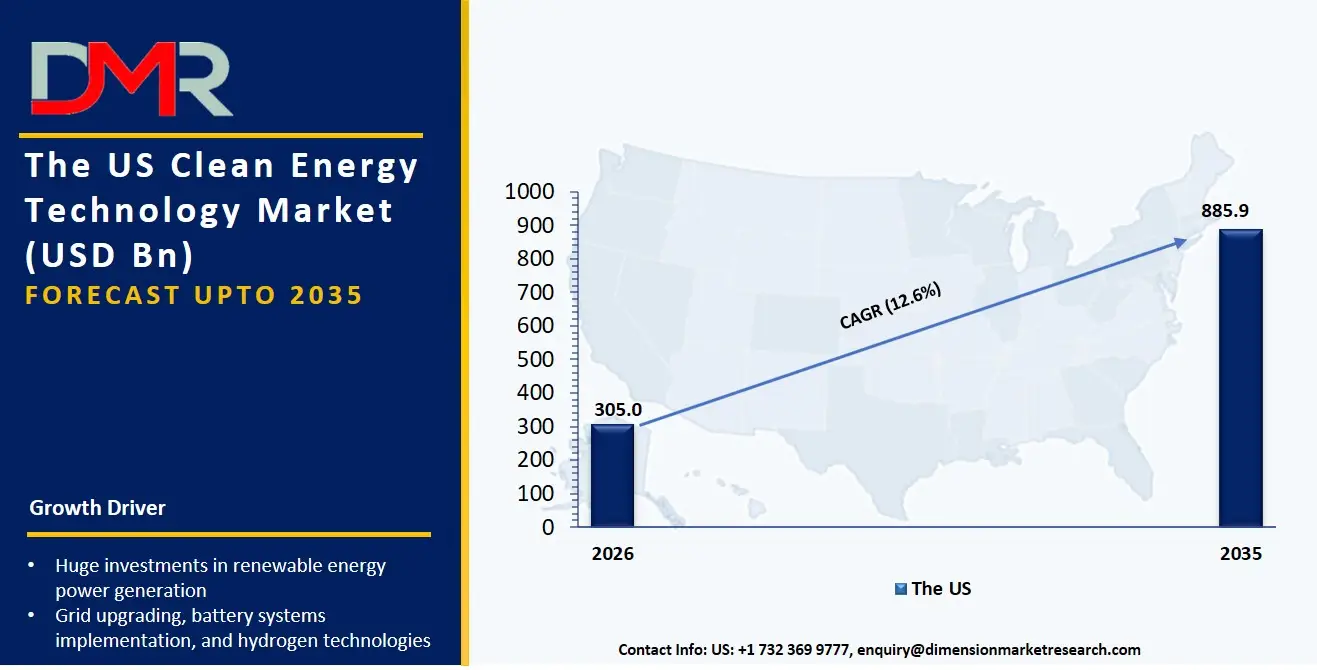
The US Clean Energy Technology Market size is estimated to be USD 30.5.0 billion in 2026 and is expected to increase at a CAGR of 12.6% over the forecast period.
ℹ
To learn more about this report –
Download Your Free Sample Report Here
The United States is still one of the biggest clean energy technologies markets because of huge investments in renewable energy power generation, grid upgrading, battery systems implementation, and hydrogen technologies. Government incentives, tax credits, and renewable portfolio standards at state level play a significant role in the development of the market. Utility scale solar and storage projects prevail among new additions to the market, while offshore wind and green hydrogen projects receive growing investments. High level of scientific research, dynamic venture capital market, and corporate renewable power purchasing programs help in driving the market.
Europe Clean Energy Technology Market
The Europe Clean Energy Technology Market size is estimated to be USD 273.8 billion in 2026 and is expected to increase at a CAGR of 12.0% over the forecast period.
Europe stands out as a very mature market for clean energy technologies as a result of its stringent policies on climate change. The European Green Deal, carbon reduction goals, and renewable energy directives keep fueling the adoption of such technologies in member countries. Technologies like offshore wind, solar energy, green hydrogen, and battery storage have attracted many investments. Decarbonization of industry and construction of energy infrastructure in the region improve its prospects for growth. Europe is also ahead in renewable energy integration, smart grids, and sustainable finance mechanisms.
Japan Clean Energy Technology Market
The market size of Japan Clean Energy Technology will be USD 95.1 billion in 2026 and at a CAGR of 11.9% in the forecast period.
The Japan market for clean energy technology is growing due to investments being made in solar, offshore wind, hydrogen energy systems, and energy efficient infrastructure. Government programs aimed at promoting carbon neutrality and energy security have boosted the use of the technology. The nation leads the world in hydrogen energy technology development, fuel cell technology and battery technology development. Increased demand for electricity, upgrade of the old energy system infrastructure, and increased need for energy resilience after natural disasters are some of the factors that are driving the market.
Key Takeaways
- Market Size & Forecast: The Clean Energy Technology Market size is projected to reach USD 1,189.2 billion in 2026 and is anticipated to have a value of USD 3,683.6 billion in 2035.
- Growth Rate & Outlook: The Clean Energy Technology Market size is set to grow at a compound annual growth rate of 13.4% during the forecast period of 2026 to 2035.
- Primary Growth Drivers: Some of the major growth drivers in the market are Clean Energy Decarbonization Policies & Incentives by Governments and more.
- Key Market Trends: Some of the major trends in the market are Incorporation of Energy Management through AI-Driven Predictive Analytics and more.
- By Application Type: Power Generation segment is anticipated to get the majority share of the Clean Energy Technology Market in 2026.
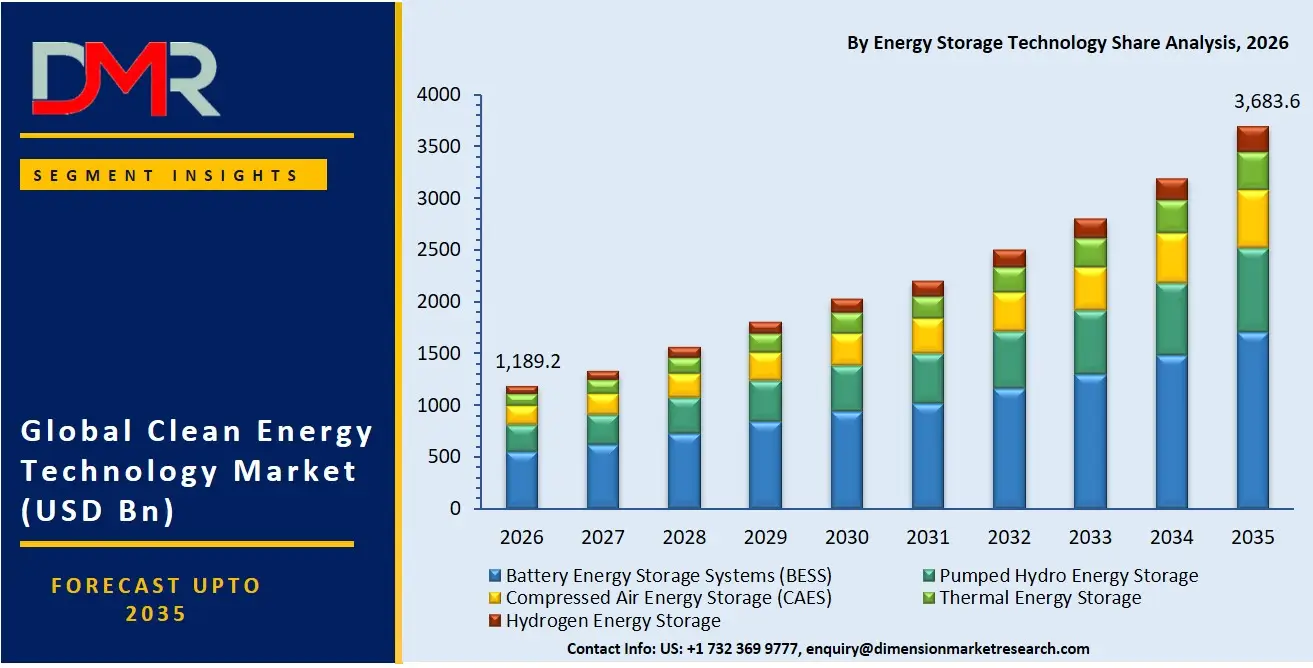
- By Energy Storage Technology Type: BESS is expected to get the largest revenue share in 2026 in the Clean Energy Technology Market.
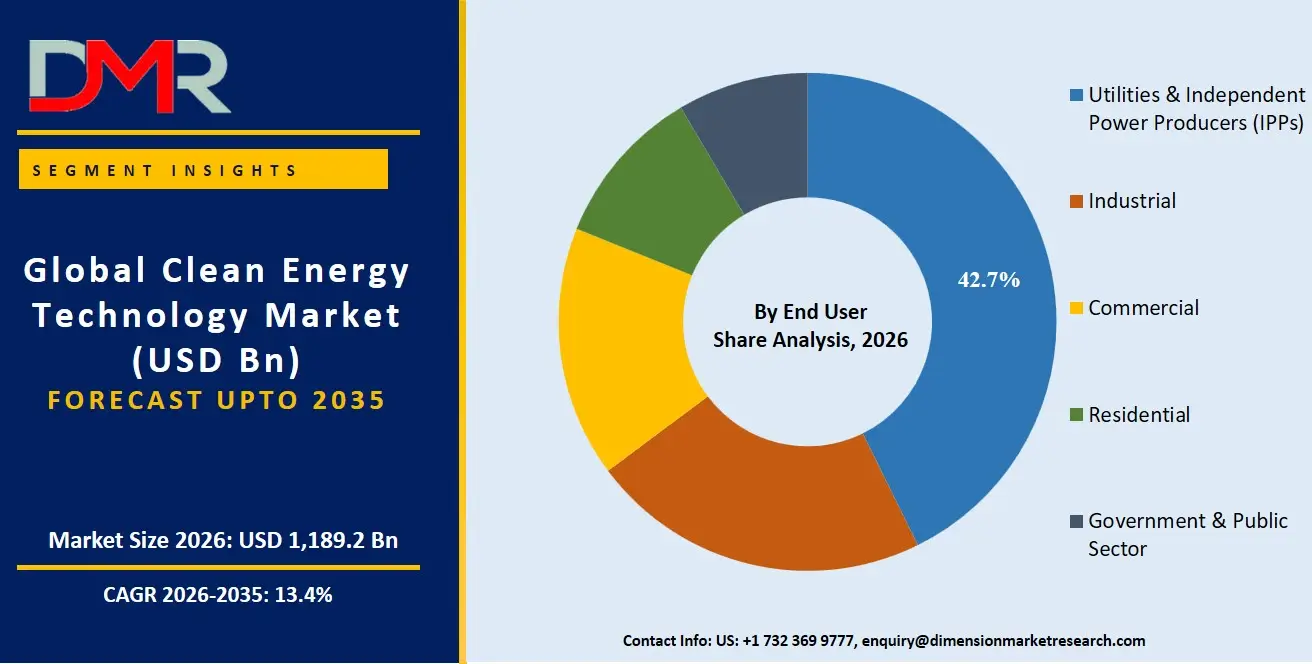
- By End User Type: Utilities & IPPs segment is expected to get the largest revenue share in 2026 in the Clean Energy Technology Market.
- Regional Leadership: Asia Pacific is set to lead the Clean Energy Technology Market with an estimated 41.6% share in 2026.
What is the Clean Energy Technology?
Clean energy technology involves the application of modern technologies and techniques that make use of renewable energy sources such as solar, wind, hydro, geothermal, and green hydrogen to produce energy. They involve the production of energy with minimal emissions of carbon dioxide or greenhouse gases and with high efficiency compared to conventional energy sources such as oil, natural gas, and coal.
Use Cases
- Renewable Electricity Production: Renewable energy technologies make it possible to produce large amounts of electricity using renewable energy sources like solar, wind, hydroelectric, geothermal, and biomass power. They are utilized by utilities and independent electricity producers for the purpose of reducing greenhouse gas emissions, diversifying sources of energy, and meeting renewable energy targets while ensuring long-term energy affordability.
- Energy Storage and Grid Infrastructure: Energy storage technologies such as advanced batteries and storage systems together with smart grids and energy management systems enhance reliability and flexibility of energy grids. They assist in balancing variable renewable energy production, providing energy security, reducing energy losses during transmission, and facilitating electrification processes.
- Mobility and Sustainable Transport: Electric cars, hydrogen fuel cell-powered cars, and renewable energy-powered vehicle charging infrastructures use sustainable energy technologies to decrease reliance on fossil fuels. They are widely used by governments and companies to reach transport decarbonization targets.
- Industrial Decarbonization: Heavy industries use green hydrogen, renewable electricity, and efficient energy technologies to decrease carbon dioxide emissions within manufacturing, chemical industry, steel production, and other industries.
How AI Is Transforming the Clean Energy Technology Market
Artificial Intelligence is revolutionizing renewable energy technology through applications like predictive maintenance, generation forecasting, demand response management, and energy optimization. AI technologies process large amounts of data coming from renewable energy sources to improve efficiency and reliability. The use of artificial intelligence is becoming common in utilities that have to handle renewable energy networks and maintain grid stability.
The use of artificial intelligence speeds up innovation in batteries management, smart grid management, and energy trading platforms. AI makes it possible to optimize battery usage, predict power consumption, and make decisions about energy distribution. This helps improve user experience and lower cost of operation.
Market Dynamic
Driving Factors in the Clean Energy Technology Market
Clean Energy Decarbonization Policies & Incentives by Governments
There are a variety of clean energy decarbonization policies implemented by governments around the world to promote the uptake of clean energy through carbon reduction goals, renewable energy standards, tax credits, subsidies, and other funding initiatives. They incentivize investment in the areas of solar power, wind power, hydrogen power, and energy storage systems.
Restraints in the Clean Energy Technology Market
Grid Integration and Network Limitations
Renewable energy expansion tends to outpace the ability of the current grid network infrastructure. Issues associated with such expansion include transmission limits, network congestion, intermittency of electricity production, and interconnection limitations. The upgrading of grids is an expensive process that calls for a great deal of regulation. Such limitations may affect project implementation and integration efficiency.
Opportunities in the Clean Energy Technology Market
Commercialization of Green Hydrogen
The use of green hydrogen, which can be manufactured through the use of electricity generated from renewable energy sources and electrolysis, provides several opportunities when it comes to decarbonizing difficult to reduce sectors such as heavy industries, aviation, maritime transport, and the chemical sector. The increasing investment in green hydrogen technologies is making it cheaper to produce.
Trends in the Clean Energy Technology Market
Energy Management through AI-Driven Predictive Analytics
AI technologies are bringing about an innovative approach to the management of clean energy. Artificial intelligence enables effective forecasting, predictive maintenance, and intelligent energy management using algorithms that analyze vast amounts of data to ensure efficient renewable energy production and energy consumption. Predictive analytics leads to lower costs, higher efficiencies, and minimal downtime.
Research Scope and Analysis
In this study, the global market for clean energy technologies is studied through the analysis of factors driving, restraining, and impacting the growth of the market, along with new trends emerging in the market. Advancements in technology in areas such as renewable energy, energy storage, smart grids, and green hydrogen technologies have been analyzed to determine future growth opportunities in the market.
ℹ
To learn more about this report –
Download Your Free Sample Report Here
By Technology Analysis
Solar Energy is set to retain its dominance within the technology segments, holding a forecast market share of 34.8% in 2026 on account of falling photovoltaic module prices, massive utility scale deployments, and favorable policies in many countries. Solar PV installations will be dominant owing to their scalability, low installation costs, and quick project execution. Hydrogen technologies are the fast-growing segment on the back of decarbonization programs and national hydrogen roadmaps. There are still considerable investments in offshore wind and green hydrogen plants, although the geothermal and bioenergy segments have retained their niche position.
By Energy Storage Technology Analysis
Battery Energy Storage Systems (BESS) are expected to capture about 46.2% of the market share in 2026, accounting for the largest market among all energy storage types. The reason why lithium-ion batteries dominate is efficiency, low cost, and capability for renewable integration.
ℹ
To learn more about this report –
Download Your Free Sample Report Here
Fast growth in utility energy storage and electric vehicles' infrastructure will further contribute to the dominance of battery storage. Sodium-ion batteries are considered to be the fastest-growing segment owing to material abundance and competitiveness in terms of price.
By Application Analysis
Power Generation is projected to contribute around 38.5% to the market share in 2026, driven by significant investment in renewable power generation infrastructure across the globe. The Utilities and Independent Power Producers are constantly developing solar, wind, hydro, and bio energy power plants to meet rising demands for electricity and sustainability goals. Industrial Decarbonization is forecasted to emerge as the fastest growing application segment owing to industrial adoption of green hydrogen, renewable power purchase, and efficient energy technology solutions.
By End User Analysis
Utilities and IPPs are likely to lead the market and hold around 42.7% market share by 2026. Their leading position is based on the development of large-scale renewable energy plants, grid infrastructure investments, and power purchasing agreements. Utilities form the core of energy transition and renewable integration programs. The Industrial segment is anticipated to demonstrate the highest CAGR due to the increasing adoption of renewable energy generation, hydrogen solutions, and energy efficiency programs on the part of manufacturers.
The Clean Energy Technology Market Report is segmented on the basis of the following:
By Technology
- Solar Energy
- Photovoltaic (PV)
- Concentrated Solar Power (CSP)
- Wind Energy
- Onshore Wind
- Offshore Wind
- Hydropower
- Bioenergy
- Biomass Power
- Biofuels
- Biogas & Waste-to-Energy
- Geothermal Energy
- Hydrogen Technologies
- Green Hydrogen
- Blue Hydrogen
By Energy Storage Technology
- Battery Energy Storage Systems (BESS)
- Lithium-ion Batteries
- Sodium-ion Batteries
- Flow Batteries
- Pumped Hydro Energy Storage
- Compressed Air Energy Storage (CAES)
- Thermal Energy Storage
- Hydrogen Energy Storage
By Application
- Power Generation
- Energy Storage
- Transportation & Mobility
- Industrial Decarbonization
- Buildings & Infrastructure
- Grid Modernization
By End User
- Utilities & Independent Power Producers (IPPs)
- Industrial
- Commercial
- Residential
- Government & Public Sector
Regional Analysis
Leading Region in the Clean Energy Technology Market
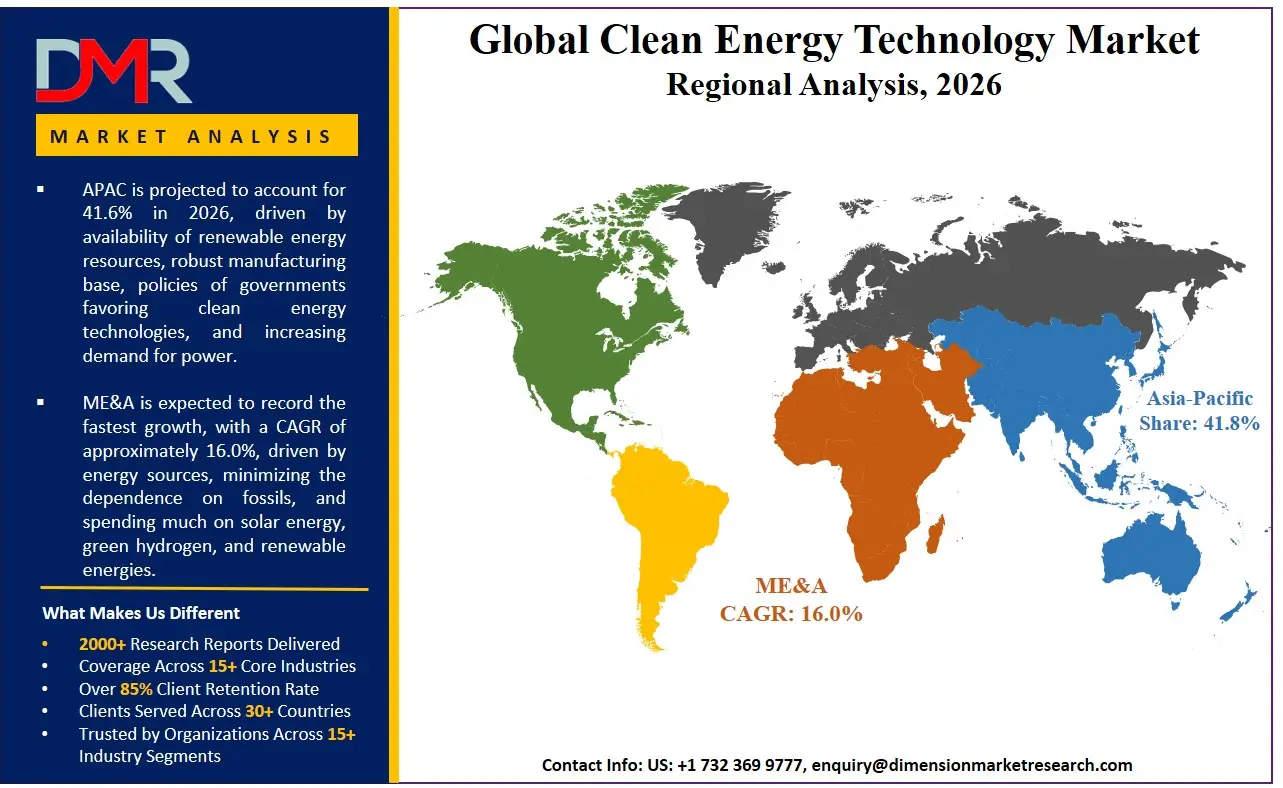
The Asia Pacific region is estimated to capture a market share of around 41.6% of the global Clean Energy Technology Market in 2026 and hence will dominate the regional markets. This is due to factors including the availability of renewable energy resources, robust manufacturing base, policies of governments favoring clean energy technologies, and increasing demand for power in this region. China, India, Japan, South Korea, and Australia are still actively investing in solar, wind, battery, and hydrogen energy technologies.
ℹ
To learn more about this report –
Download Your Free Sample Report Here
Fastest Growing Region in the Clean Energy Technology Market
It is expected that the region of Middle East & Africa will be one of the fastest growing markets for clean technology energy. Governments in the region have been diversifying their energy sources, minimizing the dependence on fossils, and spending much on solar energy, green hydrogen, and renewable energies. The presence of plentiful sunshine, better regulations, and foreign investments provides an environment conducive for the growth of the sector. There have been efforts by many nations in establishing hubs for hydrogen exports and renewable energy corridors, in addition to infrastructural improvements.
By Region
North America
Europe
- Germany
- The U.K.
- France
- Italy
- Russia
- Spain
- Benelux
- Nordic
- Rest of Europe
Asia-Pacific
- China
- Japan
- South Korea
- India
- ANZ
- ASEAN
- Rest of Asia-Pacific
Latin America
- Brazil
- Mexico
- Argentina
- Colombia
- Rest of Latin America
Middle East & Africa
- Saudi Arabia
- UAE
- South Africa
- Israel
- Egypt
- Rest of MEA
Competitive Landscape
The Clean Energy Technology Market can be described as a highly competitive market due to innovations, efficiency, execution capabilities, and financing in place. There is a strong emphasis made on R&D activities, partnership strategies, vertical integration, and international expansion to build competitive positioning. Barriers to entry include high costs and regulatory compliance, whereas competitive advantages arise from effective supply chain operations and intellectual property rights. More and more companies are investing in advanced energy storage systems, hydrogen technologies, digital energy systems, and integrated renewable energy solutions.
Some of the prominent players in the global Clean Energy Technology are:
- NextEra Energy
- Ørsted
- Iberdrola
- Enel Green Power
- Vestas Wind Systems
- Siemens Energy
- GE Vernova
- Goldwind
- LONGi Green Energy Technology
- JinkoSolar
- Trina Solar
- Canadian Solar
- First Solar
- SunPower
- Tesla
- BYD
- Other Key Players
Recent Developments
- In June 2026, CleanMax and Meta have taken forward their collaboration in developing renewable energy by signing a deal for building a total of 837MW of wind and solar energy projects in India. Spread over the states of Rajasthan and Karnataka, these projects would help take the overall renewable energy portfolio of both companies above 900MW. According to the deal, CleanMax would develop and manage these projects, whereas Meta would buy the environmental credits earned from the projects.
- In June 2026, 3Degrees introduced 3Degrees Meridian, which is an all-encompassing platform intended to assist organizations in managing their objectives for carbon-free electricity and in maximizing EACs (energy attribute certificates) portfolios. The platform combines information about the organization's demand for energy with knowledge about the sources of clean energy. Through the improved process of portfolio management, certificate management, retirements, and reporting for audits, 3Degrees Meridian is supposed to enhance efficiency and mitigate risks.
- In May 2026, Apple announced fresh sustainability projects in India which include the development of renewable energy, reduction of plastic waste and green entrepreneurship projects. Under this project, Apple is working with CleanMax to facilitate the creation of renewable energy. The sustainability projects are in line with Apple's overall mission of being a carbon-neutral company.
Report Details
| Report Characteristics |
| Market Size (2026) |
USD 1,189.2 Bn |
| Forecast Value (2035) |
USD 3,693.6 Bn |
| CAGR (2026–2035) |
13.4% |
| Historical Period |
2021 – 2025 |
| Forecast Period |
2027 – 2035 |
| Base Year |
2025 |
| Estimate Year |
2026 |
| Segments Covered |
By Technology, By Energy Storage Technology, By Application, By End User |
| Regional Coverage |
North America – The US and Canada; Europe – Germany, The UK, France, Russia, Spain, Italy, Benelux, Nordic, & Rest of Europe; Asia-Pacific – China, Japan, South Korea, India, ANZ, ASEAN, Rest of APAC; Latin America – Brazil, Mexico, Argentina, Colombia, Rest of Latin America; Middle East & Africa – Saudi Arabia, UAE, South Africa, Turkey, Egypt, Israel, & Rest of MEA |
Frequently Asked Questions
How big is the Clean Energy Technology Market?
▾ The Clean Energy Technology Market size is expected to reach USD 1,189.2 billion by 2026 and is projected to reach USD 3,683.6 billion by the end of 2035.
What is the CAGR of the Clean Energy Technology Market from 2026 to 2035?
▾ The market is growing at a CAGR of 13.4 percent over the forecasted period.
What factors are driving the growth of the Clean Energy Technology Market?
▾ Clean Energy Decarbonization Policies & Incentives by Governments, and more are the factors driving the growth of the Clean Energy Technology Market.
What are the major trends in the Clean Energy Technology Market?
▾ Energy Management through AI-Driven Predictive Analytics, and more are some of the major trends in the market.
Who are the key players in the Clean Energy Technology Market?
▾ Some of the key players in the Clean Energy Technology Market include Siemens, Enel, GE, and more
How is the Clean Energy Technology Market segmented?
▾ The Clean Energy Technology Market is segmented by technology, energy storage technology, application, end user.
Which region held the largest share of the Clean Energy Technology Market in 2026?
▾ Asia Pacific is set to lead the Clean Energy Technology Market with an estimated 41.6% share in 2026.
Which region is expected to grow the fastest in the Clean Energy Technology Market?
▾ ME&A is the fastest-growing region in the Clean Energy Technology Market during the forecast period.