What is the Clinical Data Analytics Market Size?
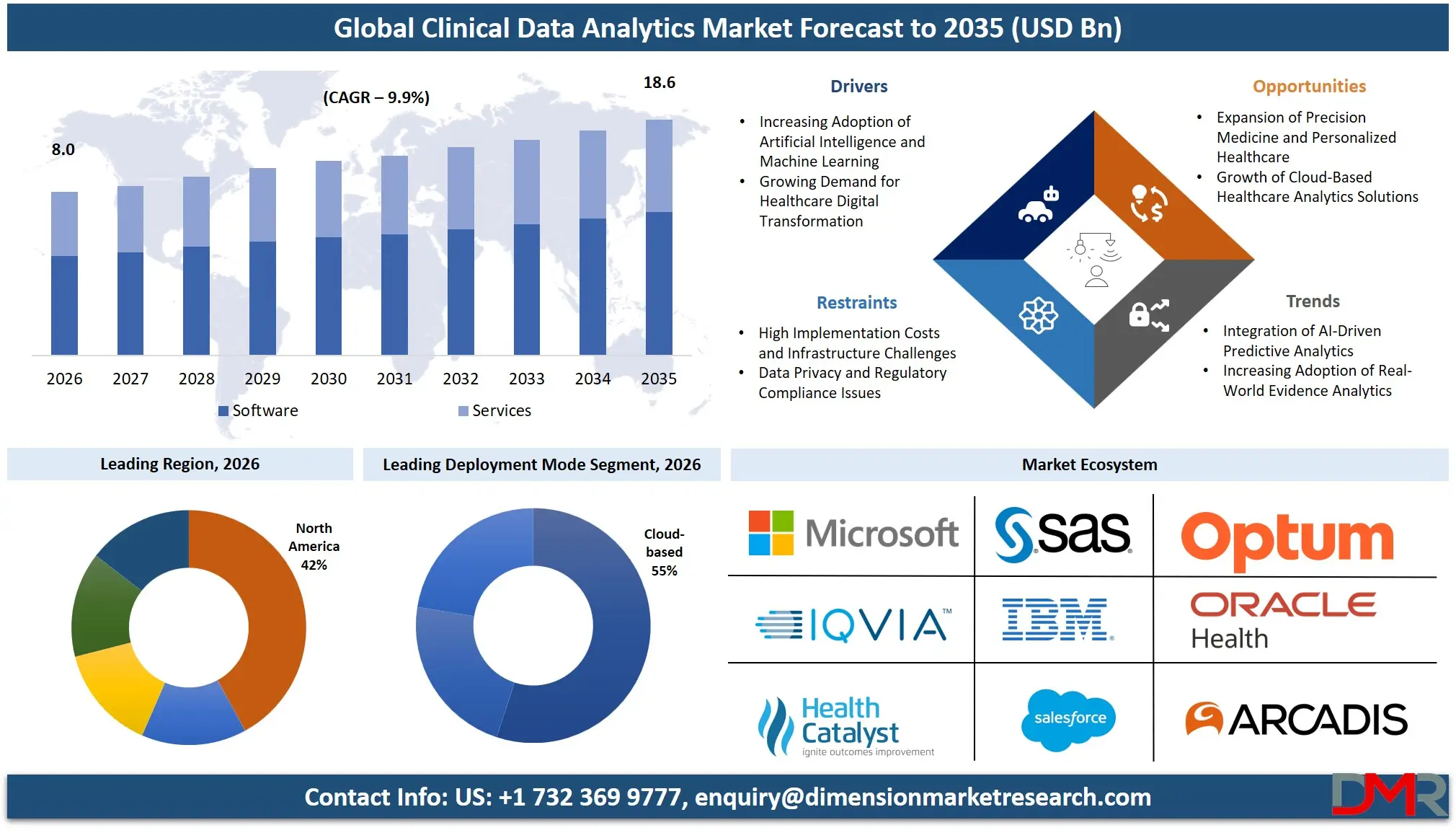
The Clinical Data Analytics Market size is expected to be USD 8.0 billion in 2026 and increase at a compound annual growth rate of 9.9% to USD 18.6 billion in 2035 due to increasing adoption of artificial intelligence and machine learning.
ℹ
To learn more about this report –
Download Your Free Sample Report Here
The Clinical Data Analytics market refers to the use of advanced analytical technologies, software platforms, and data-driven solutions to collect, integrate, analyze, and interpret clinical information generated from healthcare systems, clinical trials, electronic health records, and patient monitoring platforms. The market includes analytics software, professional services, managed services, and cloud-based solutions that support healthcare decision-making. Growing adoption of artificial intelligence, machine learning, real-world evidence analytics, precision medicine, and digital healthcare transformation is accelerating market growth. Increasing clinical trial complexity, demand for improved patient outcomes, regulatory compliance requirements, and healthcare cost optimization are further shaping the expansion of this market globally.
The US Clinical Data Analytics Market
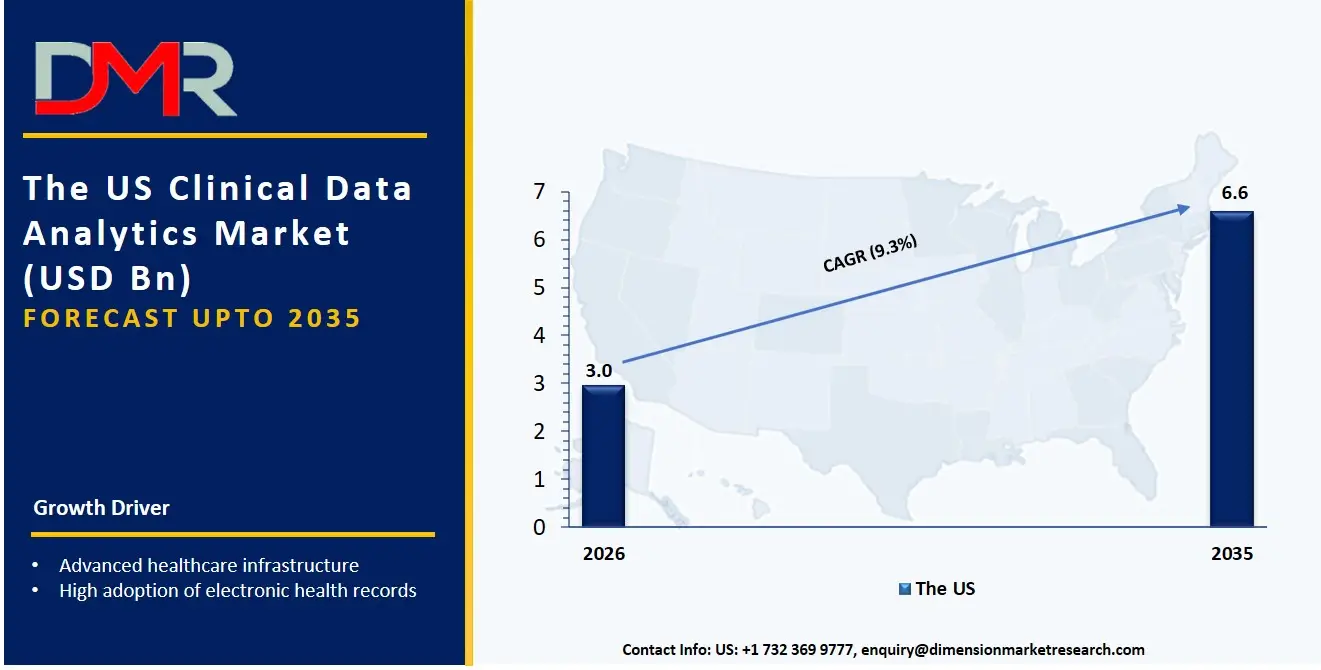
The US Clinical Data Analytics Market size is estimated to be USD 3.0 billion in 2026 and is expected to increase at a CAGR of 9.3% over the forecast period.
ℹ
To learn more about this report –
Download Your Free Sample Report Here
The US clinical data analytics market is expected to maintain a leading position due to advanced healthcare infrastructure, high adoption of electronic health records, strong pharmaceutical research activity, and increasing investment in artificial intelligence-driven healthcare solutions. The presence of major healthcare technology providers, pharmaceutical companies, and research organizations supports innovation. Government initiatives promoting healthcare digitization, interoperability standards, and value-based care models are encouraging adoption. Regulatory frameworks supporting data security and clinical research modernization are also influencing market expansion. Growing demand for precision medicine, real-world evidence generation, and improved clinical trial efficiency continues to drive the US market.
Europe Clinical Data Analytics Market
The Europe Clinical Data Analytics Market size is estimated to be USD 1.8 billion in 2026 and is expected to increase at a CAGR of 9.5% over the forecast period.
The European clinical data analytics market is expanding due to increasing healthcare digitalization, supportive regulatory frameworks, and investments in advanced medical research. Policies such as the European Green Deal and broader European digital health initiatives are encouraging sustainable healthcare transformation and data-driven decision-making. Countries including Germany, the UK, France, and Switzerland are adopting analytics platforms across hospitals, pharmaceutical companies, and research institutions. Growing emphasis on personalized medicine, healthcare interoperability, and clinical trial optimization is accelerating adoption. However, strict data privacy regulations, including GDPR requirements, influence technology implementation strategies and encourage secure analytics solutions.
Japan Clinical Data Analytics Market
The market size of Japan Clinical Data Analytics will be USD 400 million in 2026 and at a CAGR of 10.0% in the forecast period.
Japan's clinical data analytics market is developing rapidly due to an aging population, rising healthcare demand, and government initiatives supporting digital healthcare transformation. Increasing adoption of artificial intelligence, medical data platforms, and advanced research analytics is improving healthcare delivery. The country's strong pharmaceutical sector and focus on innovative treatments are contributing to market growth. Urbanization, technological advancement, and investments in precision medicine are creating opportunities for analytics providers. Challenges related to healthcare data standardization and privacy management remain, but government-backed digital health programs are expected to support long-term adoption.
Key Takeaways
- Market Size & Forecast: The Clinical Data Analytics Market size is projected to reach USD 8.0 billion in 2026 and is anticipated to have a value of USD 18.6 billion in 2035.
- Growth Rate & Outlook: The Clinical Data Analytics Market size is set to grow at a compound annual growth rate of 9.9% during the forecast period of 2026 to 2035.
- Primary Growth Drivers: Some of the major growth drivers in the market are Increasing Adoption of AI for Faster Drug Development and more.
- Key Market Trends: Some of the major trends in the market are Increasing Adoption of Real-World Evidence Analytics and more.
- By Component Type: Software segment is anticipated to get the majority share of the Clinical Data Analytics Market in 2026.
- By Deployment Mode Type: Cloud-based is expected to get the largest revenue share in 2026 in the Clinical Data Analytics Market.
- By End User Type: Pharmaceutical & Biotechnology Companies is expected to get the largest revenue share in 2026 in the Clinical Data Analytics Market.
- Regional Leadership: North America is set to lead the Clinical Data Analytics Market with an estimated 42.0% share in 2026.
What is the Clinical Data Analytics?
Clinical data analytics involves the systematic examination of healthcare-related data, including patient records, laboratory results, genomic information, clinical trial data, and treatment outcomes, using statistical methods, artificial intelligence, machine learning, and visualization tools. These technologies help healthcare organizations identify patterns, predict outcomes, improve diagnosis, optimize treatment strategies, and support evidence-based medical decisions. Clinical data analytics combines data management, data integration, predictive modeling, and reporting capabilities to enhance healthcare research, operational efficiency, and personalized patient care.
Use Cases
- Clinical Trial Analytics: Clinical data analytics improves clinical trial efficiency by enabling researchers to analyze patient recruitment patterns, trial performance, safety outcomes, and treatment effectiveness. Advanced analytics tools help pharmaceutical companies reduce trial timelines, identify suitable patient populations, and improve regulatory submission processes. AI-based models are increasingly used to predict trial success and optimize research strategies.
- Population Health Analytics: Population health analytics enables healthcare providers to evaluate large-scale patient data to identify disease patterns, healthcare risks, and treatment gaps. These solutions support preventive care programs, improve resource allocation, and help organizations manage chronic diseases. Healthcare systems use analytics platforms to improve patient outcomes while reducing unnecessary healthcare expenditure.
- Precision Medicine & Genomic Analytics: Clinical data analytics supports precision medicine by combining genomic, clinical, and lifestyle data to develop personalized treatment approaches. These analytics solutions help identify patient-specific responses to therapies and improve drug development. Increasing adoption of genomic technologies and targeted therapies is strengthening demand for advanced analytics platforms.
- Clinical Decision Support Analytics: Clinical decision support analytics assists healthcare professionals by providing data-driven recommendations for diagnosis and treatment planning. These systems analyze patient histories, medical guidelines, and clinical evidence to improve decision accuracy. Integration of AI-powered analytics is enhancing real-time decision-making capabilities across hospitals and healthcare organizations.
How AI Is Transforming the Clinical Data Analytics Market
Artificial intelligence is significantly transforming the clinical data analytics market by improving data processing, predictive modeling, and healthcare decision-making capabilities. AI technologies enable healthcare organizations to analyze large volumes of structured and unstructured clinical data, identify disease patterns, predict patient risks, and support personalized treatment approaches. Machine learning algorithms are helping pharmaceutical companies optimize clinical trials by improving patient recruitment, monitoring trial outcomes, and reducing research timelines.
AI-powered analytics platforms are also enhancing operational efficiency by automating data collection, reporting, and compliance processes. Natural language processing enables extraction of insights from medical records, research documents, and clinical notes. AI integration is improving diagnostic accuracy, supporting real-time clinical decisions, and enabling healthcare providers to deliver more efficient and patient-centric care.
Market Dynamic
Driving Factors in the Clinical Data Analytics Market
Increasing Adoption of Artificial Intelligence and Machine Learning
The growing integration of artificial intelligence and machine learning technologies is a major factor driving clinical data analytics market growth. AI-powered platforms enable predictive analytics, automated data interpretation, disease risk identification, and improved clinical decision-making. Healthcare organizations are increasingly adopting AI solutions to manage complex medical datasets, improve operational efficiency, and deliver personalized treatments. The ability of AI analytics to analyze large volumes of structured and unstructured clinical information is transforming healthcare research and patient management. Continuous advancements in algorithms, cloud computing, and healthcare data infrastructure are further strengthening market adoption.
Restraints in the Clinical Data Analytics Market
High Implementation Costs and Infrastructure Challenges
High costs associated with implementing clinical data analytics platforms remain a major challenge for market growth. Healthcare organizations require significant investments in software, cloud infrastructure, cybersecurity, and skilled professionals to deploy analytics solutions effectively. Smaller healthcare providers may face financial limitations that restrict adoption. Additionally, integrating analytics platforms with existing healthcare systems can be complex due to differences in data formats and legacy infrastructure. These challenges may slow adoption, particularly in developing regions where healthcare technology investments are limited.
Opportunities in the Clinical Data Analytics Market
Growth of Cloud-Based Healthcare Analytics Solutions
The rising adoption of cloud-based analytics platforms represents a major opportunity in the clinical data analytics market. Cloud solutions provide scalability, cost efficiency, and easier access to advanced analytical tools for healthcare organizations. They enable real-time data processing, remote collaboration, and integration with multiple healthcare systems. Increasing preference for flexible digital healthcare infrastructure and reduced dependency on physical IT systems is encouraging organizations to transition toward cloud-based analytics solutions.
Trends in the Clinical Data Analytics Market
Increasing Adoption of Real-World Evidence Analytics
The growing use of real-world evidence analytics is reshaping clinical research and healthcare decision-making. Pharmaceutical companies and regulators are increasingly using real-world patient data from electronic health records, registries, and healthcare databases to evaluate treatment effectiveness. This trend supports faster regulatory decisions, improved drug development strategies, and better understanding of patient outcomes. The expansion of digital health technologies is further increasing the availability of real-world clinical data.
Research Scope and Analysis
The research scope of the Clinical Data Analytics market covers the evaluation of market components, deployment models, applications, and end-user adoption patterns. The analysis examines technological advancements, regional growth trends, competitive strategies, market drivers, restraints, opportunities, and emerging innovations influencing healthcare analytics adoption and future market expansion.
ℹ
To learn more about this report –
Download Your Free Sample Report Here
By Component Analysis
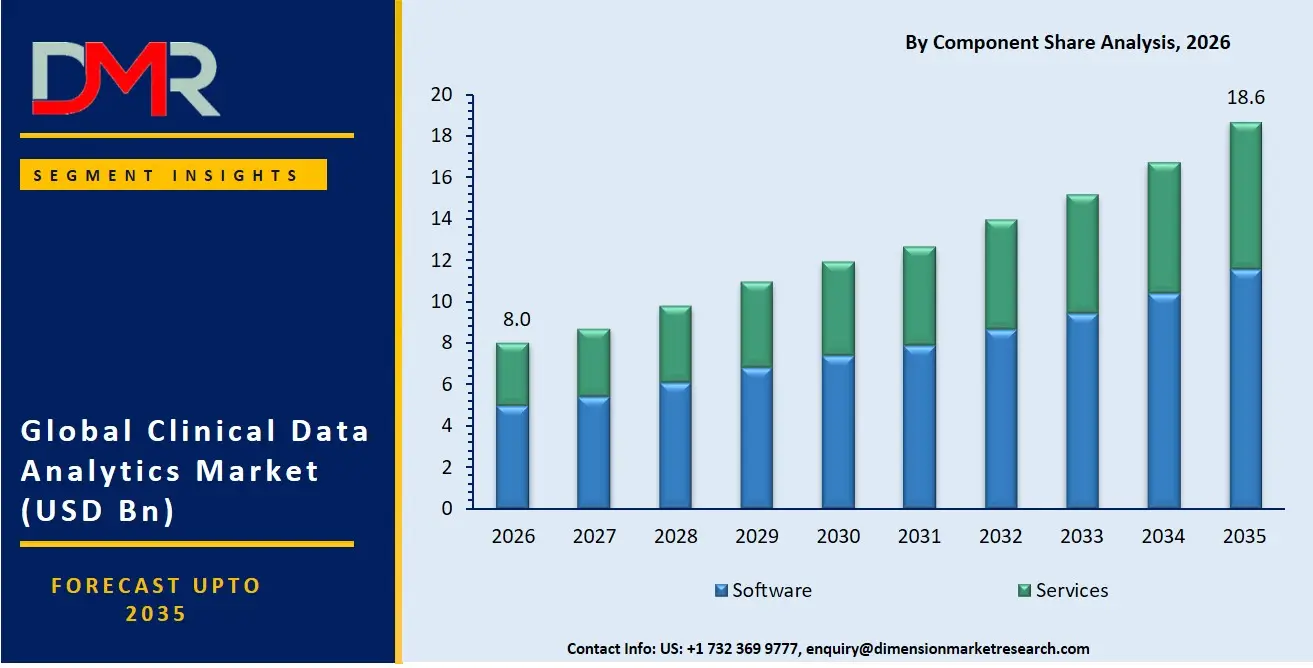
The Clinical Data Analytics market by component is segmented into software and services, including professional services and managed services. In 2026, the software segment is estimated to hold the leading market share of approximately 62%, driven by increasing adoption of analytics platforms, AI-powered healthcare solutions, and cloud-based clinical data management systems.
ℹ
To learn more about this report –
Download Your Free Sample Report Here
Healthcare providers and pharmaceutical companies are investing heavily in software solutions to improve clinical decision-making, optimize research activities, and manage large-scale healthcare datasets. The services segment is expected to be the fastest-growing category due to rising demand for implementation, consulting, integration, maintenance, and managed analytics support. As organizations face challenges related to data complexity and technology deployment, service providers are becoming essential for successful analytics adoption.
By Deployment Mode Analysis
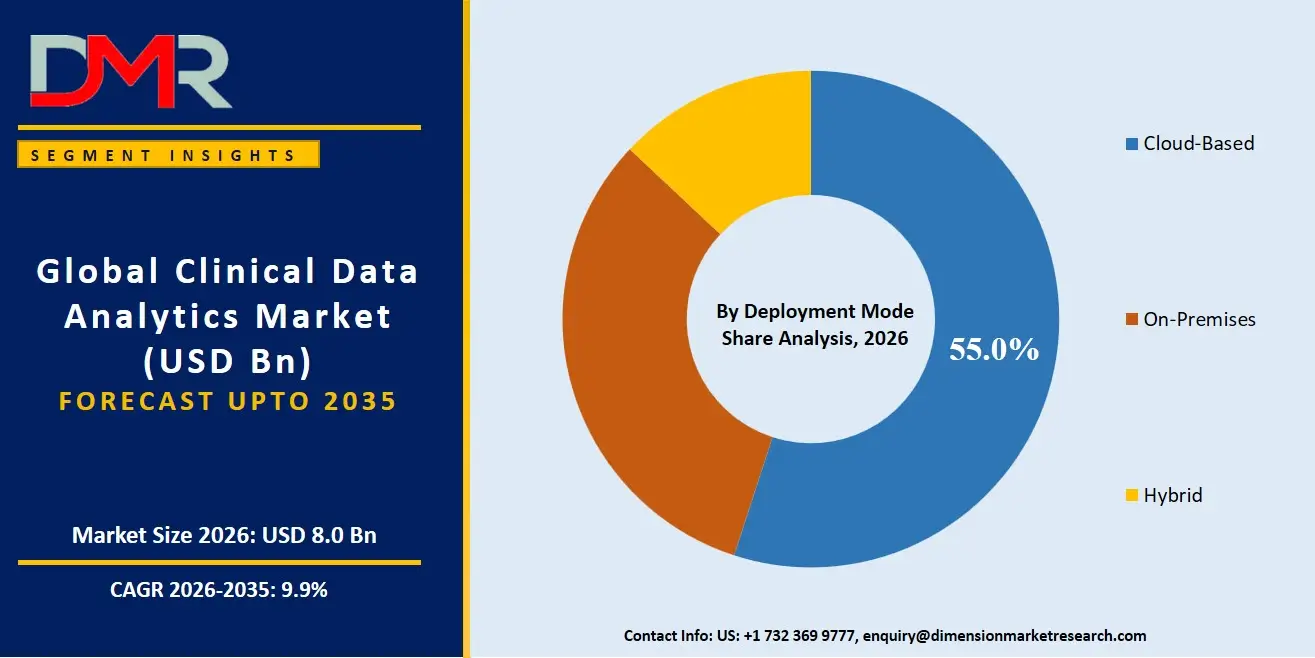
The Clinical Data Analytics market by deployment mode is categorized into cloud-based, on-premises, and hybrid solutions. The cloud-based segment is projected to dominate in 2026 with an estimated market share of approximately 55%, supported by scalability, cost efficiency, remote accessibility, and increasing digital transformation initiatives across healthcare organizations. Cloud platforms allow healthcare providers and research institutions to process large clinical datasets without significant infrastructure investments. The hybrid deployment model is expected to witness the fastest growth due to its ability to combine cloud flexibility with on-premises security and regulatory compliance. Healthcare organizations handling sensitive patient information are increasingly adopting hybrid approaches to maintain data control while benefiting from advanced analytics capabilities.
By Application Analysis
The Clinical Data Analytics market by application includes clinical trial analytics, population health analytics, precision medicine and genomic analytics, clinical decision support analytics, pharmacovigilance and drug safety analytics, quality and performance analytics, and others. In 2026, clinical trial analytics is estimated to represent the largest share of approximately 28%, driven by increasing clinical research activities, pharmaceutical investments, and the need to improve trial efficiency. The precision medicine and genomic analytics segment is expected to be the fastest-growing application due to rising adoption of genomic technologies, personalized therapies, and AI-based treatment recommendations. Growing demand for targeted therapies and data-driven healthcare approaches is accelerating the use of advanced analytics in precision medicine applications.
By End User Analysis
The Clinical Data Analytics market by end user is segmented into hospitals and health systems, pharmaceutical and biotechnology companies, contract research organizations (CROs), academic and research institutes, government and public health organizations, and others. Pharmaceutical and biotechnology companies are expected to lead the market in 2026 with an estimated share of approximately 35%, supported by increasing clinical trial investments, drug discovery activities, and regulatory requirements for evidence-based research. Hospitals and health systems are expected to be the fastest-growing segment due to increasing adoption of digital healthcare systems, electronic health records, and value-based care models. Healthcare providers are increasingly using analytics solutions to improve patient outcomes, reduce costs, and enhance operational efficiency.
The Clinical Data Analytics Market Report is segmented on the basis of the following:
By Component
- Software
- Services
- Professional Services
- Managed Services
By Deployment Mode
- Cloud-Based
- On-Premises
- Hybrid
By Application
- Clinical Trial Analytics
- Population Health Analytics
- Precision Medicine & Genomic Analytics
- Clinical Decision Support Analytics
- Pharmacovigilance & Drug Safety Analytics
- Quality & Performance Analytics
- Others
By End User
- Hospitals & Health Systems
- Pharmaceutical & Biotechnology Companies
- Contract Research Organizations (CROs)
- Academic & Research Institutes
- Government & Public Health Organizations
- Others
Regional Analysis
Leading Region in the Clinical Data Analytics Market
ℹ
To learn more about this report –
Download Your Free Sample Report Here
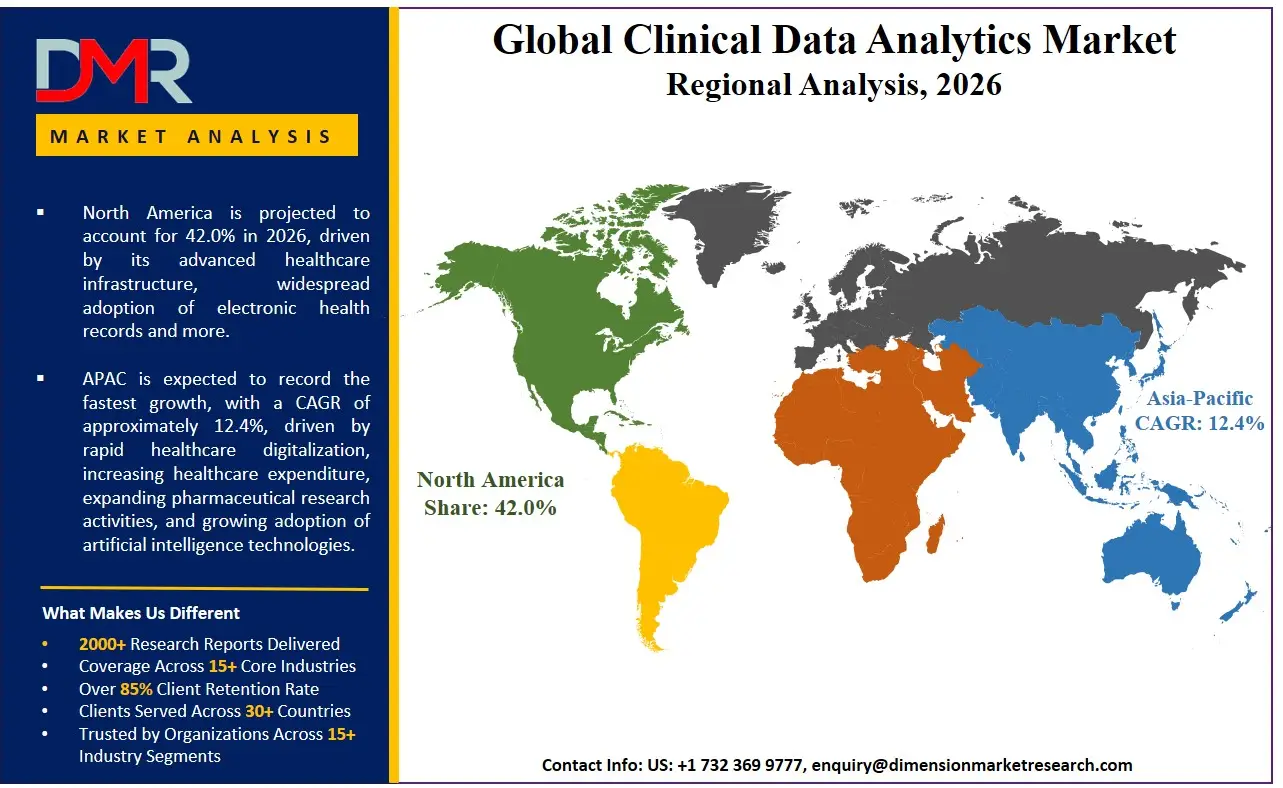
North America is expected to remain the leading region in the Clinical Data Analytics market, accounting for an estimated 42% market share in 2026. The region's dominance is supported by advanced healthcare infrastructure, widespread adoption of electronic health records, strong presence of pharmaceutical and biotechnology industries, and significant investments in artificial intelligence-based healthcare technologies. The US healthcare system is increasingly adopting analytics solutions to improve clinical outcomes, reduce costs, and support value-based care models. Government initiatives promoting healthcare digitization, interoperability, and data security standards are encouraging adoption. Strong research capabilities, high healthcare spending, and continuous innovation in precision medicine and clinical research further strengthen North America's position.
Fastest Growing Region in the Clinical Data Analytics Market
Asia-Pacific is projected to be the fastest-growing region in the Clinical Data Analytics market due to rapid healthcare digitalization, increasing healthcare expenditure, expanding pharmaceutical research activities, and growing adoption of artificial intelligence technologies. Countries such as China, India, Japan, and South Korea are investing in healthcare modernization and advanced analytics infrastructure. Rising demand for personalized medicine, increasing clinical trial activities, and government initiatives supporting digital health transformation are accelerating market growth. The region's large patient population and increasing adoption of electronic healthcare systems provide significant opportunities for analytics providers. Growing collaborations between technology companies, healthcare organizations, and research institutions are expected to further drive regional expansion.
By Region
North America
Europe
- Germany
- The U.K.
- France
- Italy
- Russia
- Spain
- Benelux
- Nordic
- Rest of Europe
Asia-Pacific
- China
- Japan
- South Korea
- India
- ANZ
- ASEAN
- Rest of Asia-Pacific
Latin America
- Brazil
- Mexico
- Argentina
- Colombia
- Rest of Latin America
Middle East & Africa
- Saudi Arabia
- UAE
- South Africa
- Israel
- Egypt
- Rest of MEA
Competitive Landscape
The Clinical Data Analytics market is characterized by strong competition driven by technological innovation, strategic partnerships, product development, and investments in artificial intelligence capabilities. Market participants focus on improving analytics accuracy, expanding cloud-based solutions, enhancing interoperability, and developing scalable platforms to strengthen their competitive position. Companies are increasingly investing in research and development to introduce advanced predictive analytics, automation capabilities, and real-world evidence solutions. Partnerships between healthcare providers, technology firms, and research organizations are becoming common strategies to expand market reach. High entry barriers include regulatory compliance requirements, data security challenges, and the need for specialized healthcare analytics expertise.
Some of the prominent players in the global Clinical Data Analytics are:
- Oracle Health
- IQVIA
- Optum
- SAS Institute
- IBM
- Microsoft
- Oracle
- Salesforce
- Health Catalyst
- Veradigm
- Cotiviti
- Arcadia
- Innovaccer
- Komodo Health
- Flatiron Health
- Tempus AI
- TriNetX
- Medidata Solutions
- Veeva Systems
- Clario
- Other Key Players
Recent Developments
- In May 2025, IQVIA continued strengthening its clinical analytics capabilities by integrating advanced data technologies into its healthcare research and clinical trial solutions. The company focused on improving clinical trial efficiency, patient data analysis, and real-world evidence generation. The initiative supported pharmaceutical and biotechnology organizations in accelerating drug development processes and improving research decision-making. IQVIA's technology expansion reflected the growing need for advanced analytics platforms capable of managing complex clinical datasets. The development demonstrated the increasing role of data-driven approaches in clinical research, regulatory processes, and healthcare innovation as organizations seek faster and more efficient pathways for medical advancements.
- In March 2025, Oracle expanded its healthcare technology portfolio by advancing its cloud-based healthcare data management and analytics capabilities. The company focused on improving healthcare organizations' ability to integrate clinical information, streamline workflows, and generate actionable insights from healthcare data. The enhanced solutions supported hospitals, research organizations, and healthcare providers in managing complex datasets while improving operational efficiency. Oracle's continued investment in healthcare cloud infrastructure highlighted the increasing demand for secure, scalable, and interoperable analytics platforms. The development aligned with industry trends toward digital transformation, artificial intelligence adoption, and real-time healthcare analytics for better clinical and business outcomes.
- In January 2025, Microsoft strengthened its healthcare technology strategy by expanding artificial intelligence-driven healthcare analytics capabilities through its cloud and AI ecosystem. The company continued developing solutions focused on improving clinical workflows, healthcare data management, and decision-support capabilities. These initiatives aimed to help healthcare organizations process complex medical information more efficiently while improving operational performance. Microsoft's healthcare-focused AI investments emphasized secure data handling, interoperability, and scalable cloud-based analytics infrastructure. The expansion reflects the growing importance of AI-powered clinical data analytics in improving healthcare delivery, accelerating research processes, and enabling more personalized patient care across healthcare systems globally.
Report Details
| Report Characteristics |
| Market Size (2026) |
USD 8.0 Bn |
| Forecast Value (2035) |
USD 18.6 Bn |
| CAGR (2026–2035) |
9.9% |
| Historical Period |
2021 – 2025 |
| Forecast Period |
2027 – 2035 |
| Base Year |
2025 |
| Estimate Year |
2026 |
| Segments Covered |
By Component, By Deployment Mode, By Application, By End User |
| Regional Coverage |
North America – The US and Canada; Europe – Germany, The UK, France, Russia, Spain, Italy, Benelux, Nordic, & Rest of Europe; Asia-Pacific – China, Japan, South Korea, India, ANZ, ASEAN, Rest of APAC; Latin America – Brazil, Mexico, Argentina, Colombia, Rest of Latin America; Middle East & Africa – Saudi Arabia, UAE, South Africa, Turkey, Egypt, Israel, & Rest of MEA |
Frequently Asked Questions
How big is the Clinical Data Analytics Market?
▾ The Clinical Data Analytics Market size is expected to reach USD 8.0 billion by 2026 and is projected to reach USD 18.6 billion by the end of 2035.
What is the CAGR of the Clinical Data Analytics Market from 2026 to 2035?
▾ The market is growing at a CAGR of 9.9 percent over the forecasted period.
What factors are driving the growth of the Clinical Data Analytics Market?
▾ Increasing Adoption of Artificial Intelligence and Machine Learning, and more are the factors driving the growth of the Clinical Data Analytics Market.
What are the major trends in the Clinical Data Analytics Market?
▾ Increasing Adoption of Real-World Evidence Analytics, and more are some of the major trends in the market.
Who are the key players in the Clinical Data Analytics Market?
▾ Some of the key players in the Clinical Data Analytics Market include Oracle, IQVIA, IBM, and more
How is the Clinical Data Analytics Market segmented?
▾ The Clinical Data Analytics Market is segmented by component, deployment mode, application, end user.
Which region held the largest share of the Clinical Data Analytics Market in 2026?
▾ North America is set to lead the Clinical Data Analytics Market with an estimated 42.0% share in 2026.
Which region is expected to grow the fastest in the Clinical Data Analytics Market?
▾ Asia Pacific is the fastest-growing region in the Clinical Data Analytics Market during the forecast period.