What is the Global Clinical Decision Support Systems Market Size?
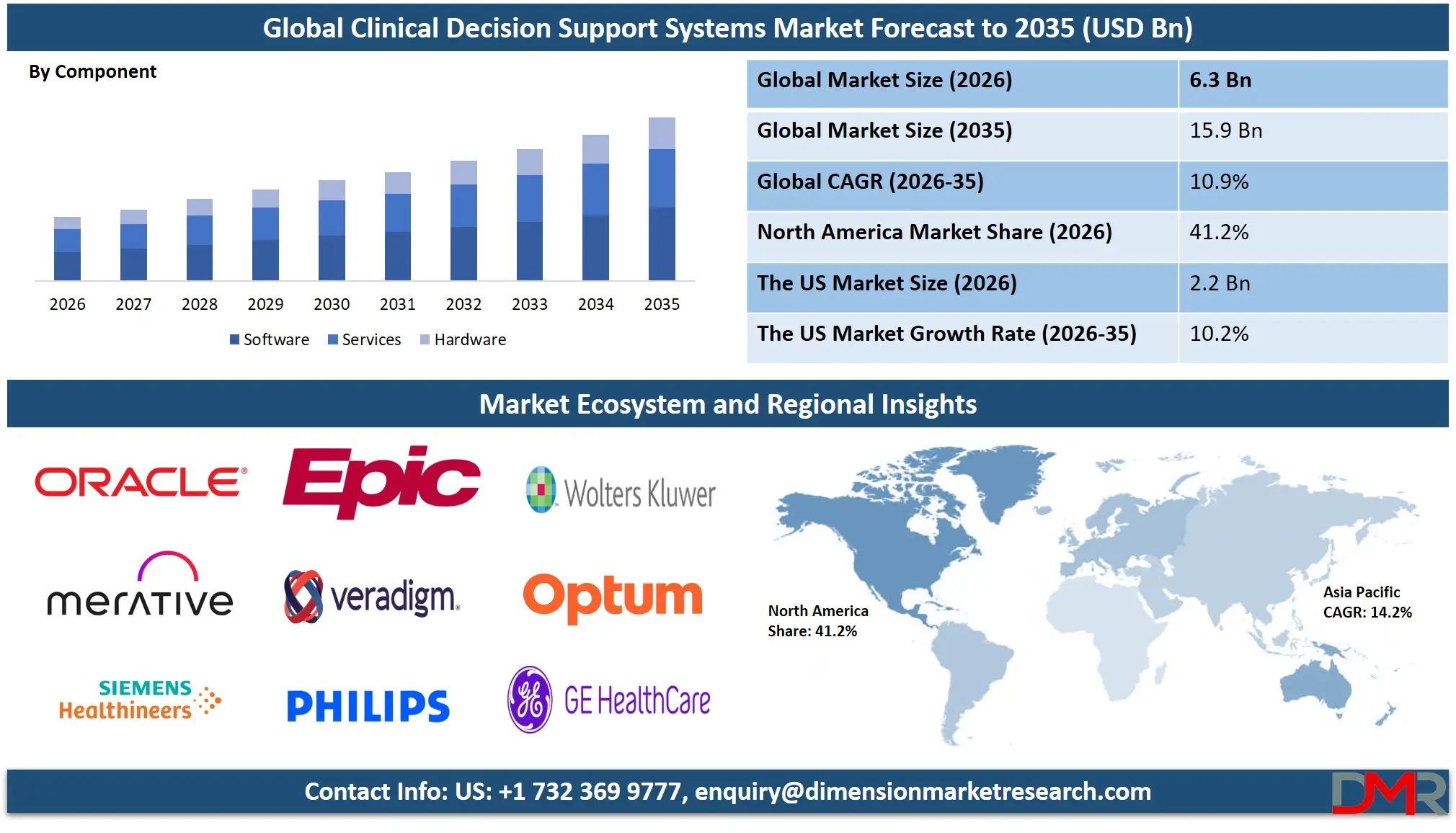
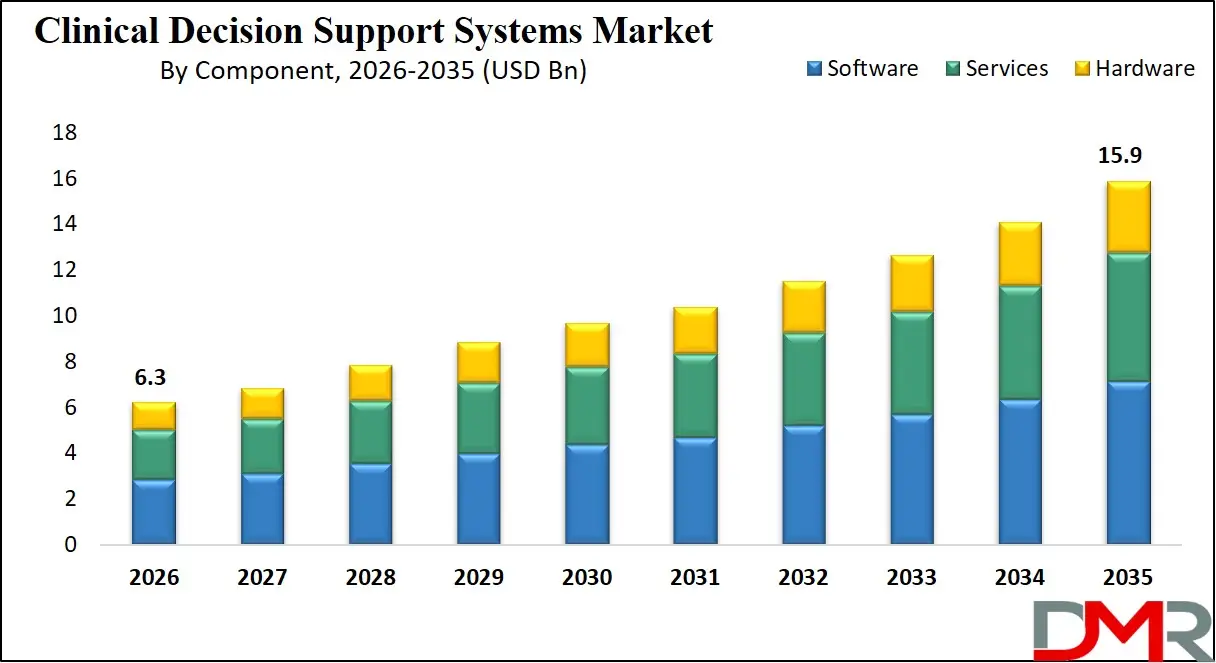
The Global Clinical Decision Support Systems Market size is estimated at USD 6.3 billion in 2026 and is expected to reach USD 15.9 billion by 2035, expanding at a CAGR of 10.9%, owing to the developments in AI-driven clinical algorithms, real-time patient data analytics, evidence-based guideline integration, and interoperable health IT infrastructures.
ℹ
To learn more about this report –
Download Your Free Sample Report Here
The Clinical Decision Support Systems (CDSS) Market has been growing at an incremental rate, given the increasing utilization of machine learning in diagnostics, national mandates for reducing medical errors, and the necessity to invest in both government and commercial capital for intelligent clinical workflow automation in hospitals and ambulatory settings worldwide. It also covers such new technologies as real-time medication safety checks, predictive clinical alerts, automated guideline updates, and interoperability frameworks used in CDSS deployment projects.
Modernization is a significant investment that health systems, payers, and health IT vendors are pursuing to allow efficient data exchange, reduce the risk of clinical decision variability, and increase patient safety per dollar spent. The move towards automation, predictive scaling of alert logic, and smart workload splitting (initial triage on CDSS + final clinical review) is increasing adoption. Moreover, the need to operationalize national patient safety strategies and the importance of sustainable evidence-based care are driving digital changes in clinical informatics, and CDSS has become an essential part of the future intelligent healthcare economy on a global scale.
ℹ
To learn more about this report –
Download Your Free Sample Report Here
The US Clinical Decision Support Systems Market
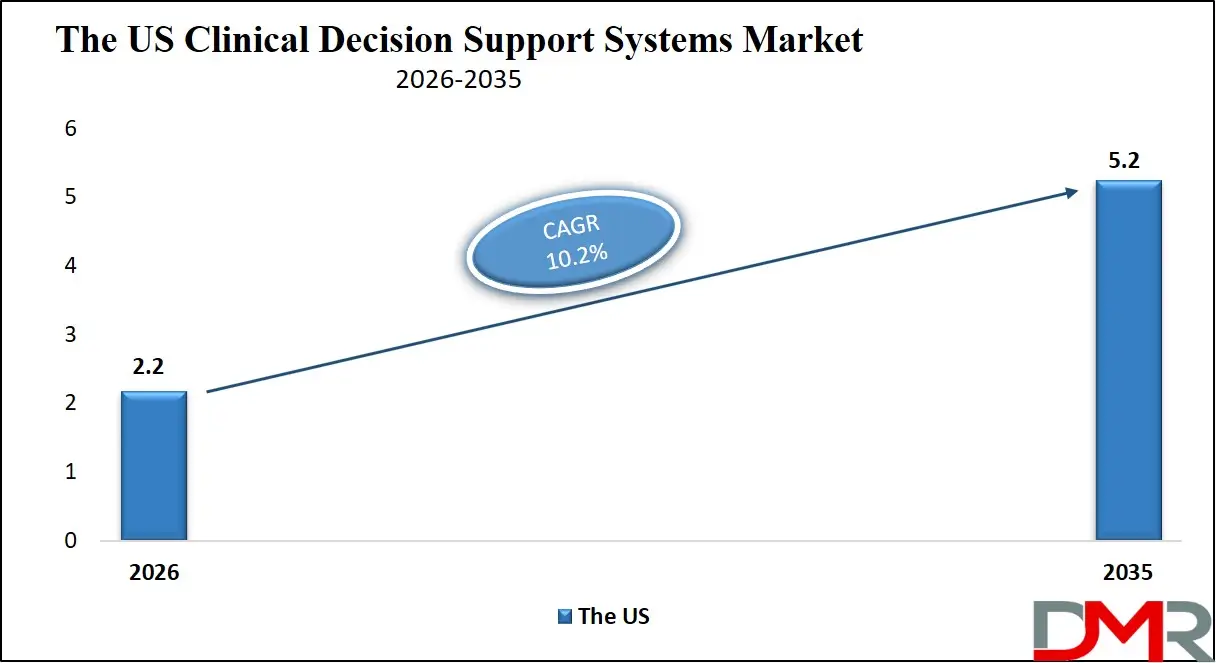
The US Clinical Decision Support Systems Market is estimated to grow to USD 2.2 billion in 2026 with a compound annual growth rate of 10.2% during the forecast period.
ℹ
To learn more about this report –
Download Your Free Sample Report Here
In the US, the CDSS market is motivated by commercial health IT vendors (e.g., Epic, Cerner, Meditech), national patient safety programs (e.g., CMS quality measures, ONC certification criteria), and the necessity of moving beyond generic EMR alerts with more specialized, context-aware clinical decision support solutions. Increasing investment is underway in autonomous clinical event detection, predictive models of alert fatigue using real-time usage telemetry, and real-time system performance monitoring for clinical logic latency. Federal funding programs, including the 21st Century Cures Act and the CMS Promoting Interoperability Program, encourage adoption. The hospital and ambulatory care segments dominate, and health informatics tools enhance the performance of CDSS design and simulation. Key players are focusing on system interoperability and supply chain partnerships to raise clinical data density and workflow reliability. The regulatory frameworks that promote clinical AI safety and verifiable model assurance also facilitate the adoption of digital clinical logic monitoring, and the need to have real-time clinical event data and automated failover response further determines the growth of markets.
Europe Clinical Decision Support Systems Market
The Europe Clinical Decision Support Systems Market is estimated to be valued at USD 1.7 billion in 2026, witnessing growth at a CAGR of 10.5%, during the forecast period.
Europe has a mature CDSS market, and this has a significant influence on the regulatory requirements and regional policies such as the EU Medical Device Regulation (MDR), the European Health Data Space, and national digital health programs (e.g., France's Health Data Hub and Germany's Digital Healthcare Act). Countries are also striving for smart clinical decision modularization to harmonize hospital and ambulatory workload requirements and interoperability of the cross-border health data supply chain. Advanced technologies, like real-time clinical logic engines and high-reliability alert systems with built-in predictive algorithms for alert fatigue, drive innovation. Public-private partnerships and harmonization of clinical decision support standards facilitate adoption. Technologies like real-time clinical workload balancing and smart contract-based data sharing are commonly practiced as research-centric programs, and Europe is a frontrunner in terms of the digital transformation of safe and efficient CDSS.
Japan Clinical Decision Support Systems Market
The Japan Clinical Decision Support Systems Market is projected to be valued at USD 320.2 million in 2026, progressing at a CAGR of 11.6%, during the period spanning from 2026 to 2035.
Japan boasts a mature CDSS market supported by high-performance clinical informatics, diagnostic imaging integration technology, and a wide network of robotic healthcare AI innovations. Automation, precision, and clinical integrity are the priorities in the country and are achieved by predictive clinical logic wear models and intelligent power management systems for CDSS assets. Growth is stimulated by government actions under the Society 5.0 initiative and constant investment in digital health infrastructure. The high volume of aging population care, chronic disease management, and hospital automation requires efficient CDSS for real-time evidence-based inference. The difficulties are high validation costs for new clinical logic architectures and integration with legacy HIS, yet the prospects are in exporting developed clinical decision support technologies to Asian and Pacific markets.
Key Takeaways
- Market Size & Forecast: The Global CDSS Market is estimated to be valued at USD 6.3 billion in 2026 and is expected to grow to USD 15.9 billion by 2035.
- Growth Rate & Outlook: The market is expected to witness growth at a compound annual growth rate of 10.9% in the forecast period.
- Primary Growth Drivers: Technological progress in machine learning-based clinical alerts and real-time evidence-based inference, regulatory requirements for patient safety and error reduction, and hospital deployment of intelligent clinical decision support are some of the key drivers of growth in the market.
- Key Market Trends: The use of predictive alert fatigue management, real-time clinical logic optimization, and transition to cloud-based CDSS telemetry and fleet management systems are some of the primary market trends.
- By Product Type: The EHR-Integrated CDSS segment is anticipated to get the majority share of the CDSS market in 2026.
- By Intelligence Model: The knowledge-based CDSS segment is expected to occupy the largest revenue share in 2026 in the CDSS market.
- By Application: The medication management segment is expected to get the largest revenue share in 2026 in the CDSS market.
- Regional Leadership: North America is predicted to dominate the market with an estimated 41.2% share in 2026, with high healthcare IT spend and patient safety investment.
What is a Clinical Decision Support System (CDSS)?
A clinical decision support system (CDSS) is a specialized health IT application that mimics evidence-based clinical reasoning to assist healthcare professionals in diagnosis, treatment planning, medication management, and real-time patient safety monitoring. It employs rules-based logic, machine learning algorithms, clinical guidelines, and real-time patient data integration to provide high-accuracy alerts and extreme workflow efficiency. The contemporary systems have real-time telemetry, FHIR-based interoperability, and AI-assisted alert management to ensure transparency, efficiency, and clinical reliability. These CDSS are capable of supporting efficient clinical workflow, sustainable evidence-based care operations, and help direct the funds of hospital, government, and research stakeholders towards scalable, long-period health IT infrastructure. They also facilitate accountability by making sure that clinical performance data is quantified, tracked, and in line with global patient safety objectives.
Use Cases
- Medication Safety & Allergy Checks: CDSS supports real-time drug-drug interaction alerts, allergy checks, and dosing guidance with sub-second latency, reducing adverse drug events by orders of magnitude compared to manual review.
- Alert Fatigue Prediction Modeling (Workflow Risk): Clinical information, including cumulative alert volume per physician and override rates, is modeled to provide workflow adjustments and continue safe operation without disruption to maintain operational stability and clinician trust.
- Real-Time Diagnostic Support: Hospital deployments are employing knowledge-based and machine learning CDSS accelerators to perform on-device differential diagnosis, imaging suggestion, and anomaly detection with quantifiable and proven accuracy.
- Population Health & Government Programs: More efficient CDSS contribute to the success of chronic disease management, preventive care reminders, and smart clinical surveillance, facilitate national health adoption, contribute to deployment reliability, and help implement policies, such as the clinical AI governance policy and patient safety policy.
How AI Is Transforming the Global Clinical Decision Support Systems Market?
Artificial intelligence is transforming CDSS by enabling predictive modeling of alert fatigue behavior, automatic identification of anomalies in clinical logic performance data, and real-time optimization of alert thresholds per clinical context. Telemetry and patient data can be analyzed with AI algorithms to determine any degradation or performance drift and scale-optimize clinical outcomes. This saves time, is verifiable and cheaper than manual data analysis.
Moreover, AI enhances clinical assurance through offering adaptive clinical event-based scheduling, anticipating workflow threats to clinical decision logic, and intelligent prioritization of CDSS module health monitoring. It is also involved in reducing the cost of baseline testing and ongoing performance tracking, allowing hospital IT operators to reduce the cost and physical footprint of on-prem test campaigns and improve the reliability of CDSS workloads and their financial returns.
Market Dynamics
Key Drivers of the Global Clinical Decision Support Systems Market
Rapid developments in Machine Learning and Real-Time Clinical Inference
The market is being pushed by a fast uptake of AI-driven clinical alerts, high-efficiency clinical logic processing units, FHIR-based interoperability, and real-time telemetry analytics. These technologies will allow monitoring of the health of CDSS modules in real-time, identify performance anomalies early, predict alert fatigue, and simplify the process of clinical validation. Consequently, operational uptime and clinical inference efficiency are highly enhanced as well as minimizing the expenses of manual telemetry analysis. The growth of machine learning models for diagnostics, in particular, is also accelerating the need for intelligent CDSS, as hospital operators are more inclined towards automation and workflow optimization based on clinical event data.
Growing Focus on Patient Safety Regulation and Sustainable Healthcare
The world is becoming more and more involved in policies of clinical AI safety, with governments and international bodies proposing healthcare efficiency policies, like the EU MDR's clinical evidence provisions and the US Executive Order on AI in Healthcare. These structures are driving a high demand for efficient CDSS that can be used to perform ultra-low-latency clinical inference and continuous learning. In parallel, global initiatives such as the WHO Global Patient Safety Action Plan are encouraging the adoption of evidence-based decision support architectures. The increasing calls for transparency in AI clinical usage and error reduction are also enhancing the necessity of verifiable and safe CDSS in both public and private healthcare systems.
Restraints in the Global Clinical Decision Support Systems Market
High Costs of Integration and Clinical Validation
CDSS are costly and time-consuming to develop, requiring extensive validation in clinical environments, testing of clinical logic reliability, and long-term performance analysis of emerging components. Additionally, regulatory restrictions and data privacy laws (e.g., HIPAA, GDPR) further increase development complexity and cost. These factors create barriers for new entrants, extend deployment timelines, and increase upfront capital requirements.
Limited Standardization Across EHR and Clinical Workflows
The industry continues to rely on multiple CDSS architectures, including standalone, EHR-integrated, CPOE-integrated, and fully integrated systems. However, the lack of standardized clinical interfaces beyond platforms like FHIR and HL7 remains a key challenge. CDSS lack universal plug-and-play standards compared to traditional EHR modules, making integration complex and limiting interoperability of clinical logic models.
Growth Opportunities in the Global Clinical Decision Support Systems Market
Expansion of Emerging Health IT Programs
Developing healthcare markets such as Brazil, Indonesia, Nigeria, the UAE, and Vietnam are investing in digital health infrastructure and advanced clinical decision support capabilities. These regions present strong growth potential due to increasing demand for automated clinical safety, diagnostic support, and medication management applications. With limited legacy HIS infrastructure, they provide opportunities for the deployment of modern CDSS optimized for ambulatory and hospital environments.
Rising Demand for Cloud-Based CDSS Deployment
The increased requirement for advanced CDSS is being generated by the growth of telemedicine, remote patient monitoring, and real-time clinical AI applications. These technologies play a vital role in virtual care platforms, ambulatory clinics, and hospital-at-home programs. With the rising importance of sub-second clinical alert latency as a major industry concern, cloud-based CDSS inference capabilities are likely to be fundamental to future healthcare IT infrastructure.
Global Clinical Decision Support Systems Market Trends
Predictive Alert Fatigue Monitoring and Clinical Analytics
CDSS are being monitored and clinical logic anomalies are detected in real time, and alert override patterns are predicted using on-system learning. The use of digital twin models and machine learning algorithms is enhancing clinical workflow scheduling, system lifespan, and deployment reliability. This shift is transforming CDSS management from manual alert review to a fully automated, continuously optimized system monitoring.
Cloud-Based Telemetry and Fleet Management Systems
Cloud computing and digital twin technologies are taking centre stage in the operations of CDSS clusters. These platforms enable real-time storage and analysis of clinical performance data, centralized fleet management, and remote monitoring of CDSS module health. Cloud-based systems enhance transparency, lower on-prem infrastructure expenses, and provide quicker responses to workflow changes across clinical nodes, as experienced by operators of large hospital CDSS fleets.
Research Scope and Analysis
By Product Type Analysis
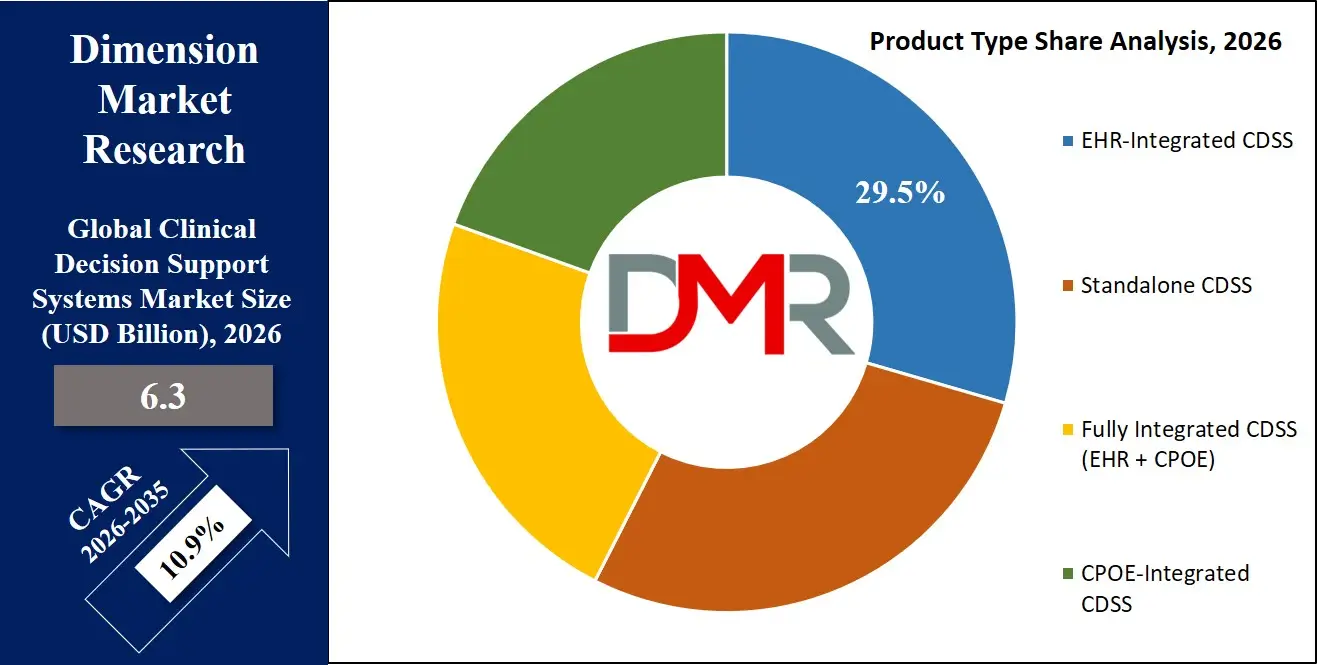
The EHR-Integrated CDSS segment is expected to remain the largest in 2026, accounting for about 29.5% of the global CDSS market, driven by its dominant use in large-scale clinical deployment, seamless EMR workflow integration, and flexibility across diverse clinical frameworks where real-time patient data access and software ecosystem maturity are essential.
ℹ
To learn more about this report –
Download Your Free Sample Report Here
Meanwhile, the Fully Integrated CDSS (EHR + CPOE) segment is witnessing strong growth, driven by rising demand for comprehensive clinical decision support in large hospitals, where both ordering and documentation integration is critical. Adoption is further supported by AI-based alert throttling, real-time efficiency diagnostics, and modular configurations that integrate multiple clinical logic types for improved workflow flexibility and clinician satisfaction.
By Component Analysis
The software segment is expected to dominate in 2026, accounting for approximately 49.9% share, driven by the central role of clinical logic engines in executing evidence-based decision support. The services segment forms the second-largest category, as CDSS heavily rely on implementation, integration, and maintenance services. The hardware segment is smaller, driven by dedicated clinical workstations and on-premise servers for large hospital deployments.
By Deployment Mode Analysis
The on-premise systems segment is expected to dominate with approximately 62.8% market share in 2026, driven by the critical need for data control, low-latency processing, and regulatory compliance in large hospitals and health systems. CDSS excel at on-premise scenarios due to their ability to integrate with internal EHRs, delivering sub-second response times while maintaining patient data within firewalls. The cloud-based systems segment, while smaller, is witnessing steady growth, driven by ambulatory clinics, telemedicine platforms, and smaller healthcare providers where lower upfront costs and scalability are required. The fusion of on-premise and cloud deployment models, with federated learning across clinical nodes, has the fastest development.
By Intelligence Model Analysis
The Knowledge-Based CDSS segment is expected to dominate with approximately 61.2% market share in the year 2026, owing to its critical role in hosting evidence-based clinical rules, low-latency alerts, and guideline-driven operations. Commercial and public health systems are shifting to higher-performance knowledge-based designs in order to have greater clinical accuracy and improve patient safety. Knowledge-based solutions are adaptable, making it easy to deploy and integrate with existing EHRs. Non-knowledge-based (machine learning) CDSS architectures are still used, though, in places where pattern recognition is required (e.g., imaging, genomics). The multi-intelligence usage with knowledge-based and ML-based systems simultaneously has the quickest development, and CDSS portfolios are more flexible to different clinical contexts.
By System Function Type Analysis
The diagnostic support systems segment is expected to hold the largest share in 2026, accounting for approximately 54.7% of the market, driven by the critical need for accurate differential diagnosis, imaging decision support, and laboratory result interpretation. Meanwhile, the therapeutic support systems segment is witnessing the fastest growth, driven by the ability to recommend treatment plans, monitor drug dosing, and guide chronic disease management directly in clinical workflows.
By Interactivity Level Analysis
The Active CDSS segment is expected to dominate with approximately 73.5% market share in 2026, owing to its critical role in providing real-time, interruptive alerts for medication safety, drug-allergy checks, and clinical guideline adherence at the point of care. Active systems automatically generate alerts, forcing clinicians' attention to potential errors, which is essential for high-acuity hospital environments. The Passive CDSS segment, while smaller, remains relevant for non-disruptive, on-demand access to clinical reference tools and retrospective data mining. The fastest-growing sub-segment within passive CDSS is AI-powered clinical recommendation engines that provide just-in-time, non-interruptive suggestions. The multi-interactivity usage with active alerting and passive reference systems simultaneously has the quickest development, making CDSS portfolios more flexible to different clinical workflow contexts and physician preference levels.
By Application Analysis
The medication management segment is predicted to have the highest share of around 35.8% in 2026, hosting knowledge-based and machine learning CDSS for real-time drug safety checks, allergy alerts, and dosing guidance. The clinical guidelines & protocol management segment enables evidence-based care pathway adherence. The clinical reminders segment is witnessing strong growth for preventive care alerts and chronic disease follow-up. The fastest growing area is diagnostic support for complex cases. The fusion of CDSS function integration and clinical workflow scheduling is generating smarter healthcare IT markets.
By End-User Analysis
The hospitals segment represents the largest end-user in 2026, accounting for approximately 58.4% share, driven by complex clinical environments requiring real-time decision support. Ambulatory care centers form the second-largest segment, utilizing CDSS for outpatient medication management and preventive care. The fastest-growing area is diagnostic & imaging centers for radiology and pathology decision support. Pharmaceutical & research institutes are emerging for clinical trial safety monitoring and drug development.
The Global Clinical Decision Support Systems Market Report is segmented based on the following:
By Product Type
- Standalone CDSS
- EHR-Integrated CDSS
- CPOE-Integrated CDSS
- Fully Integrated CDSS (EHR + CPOE)
By Component
- Software
- Services
- Hardware
By Deployment Mode
- On-Premise Systems
- Cloud-Based Systems
By Intelligence Model
- Knowledge-Based CDSS
- Non-Knowledge-Based CDSS
By System Function Type
- Diagnostic Support Systems
- Therapeutic Support Systems
By Interactivity Level
By Application
- Medication Management
- Clinical Guidelines & Protocol Management
- Clinical Reminders
- Others
By End-User
- Hospitals
- Ambulatory Care Centers
- Diagnostic & Imaging Centers
- Pharmaceutical & Research Institutes
- Other Healthcare Providers
Regional Analysis
Leading Region in the Clinical Decision Support Systems Market
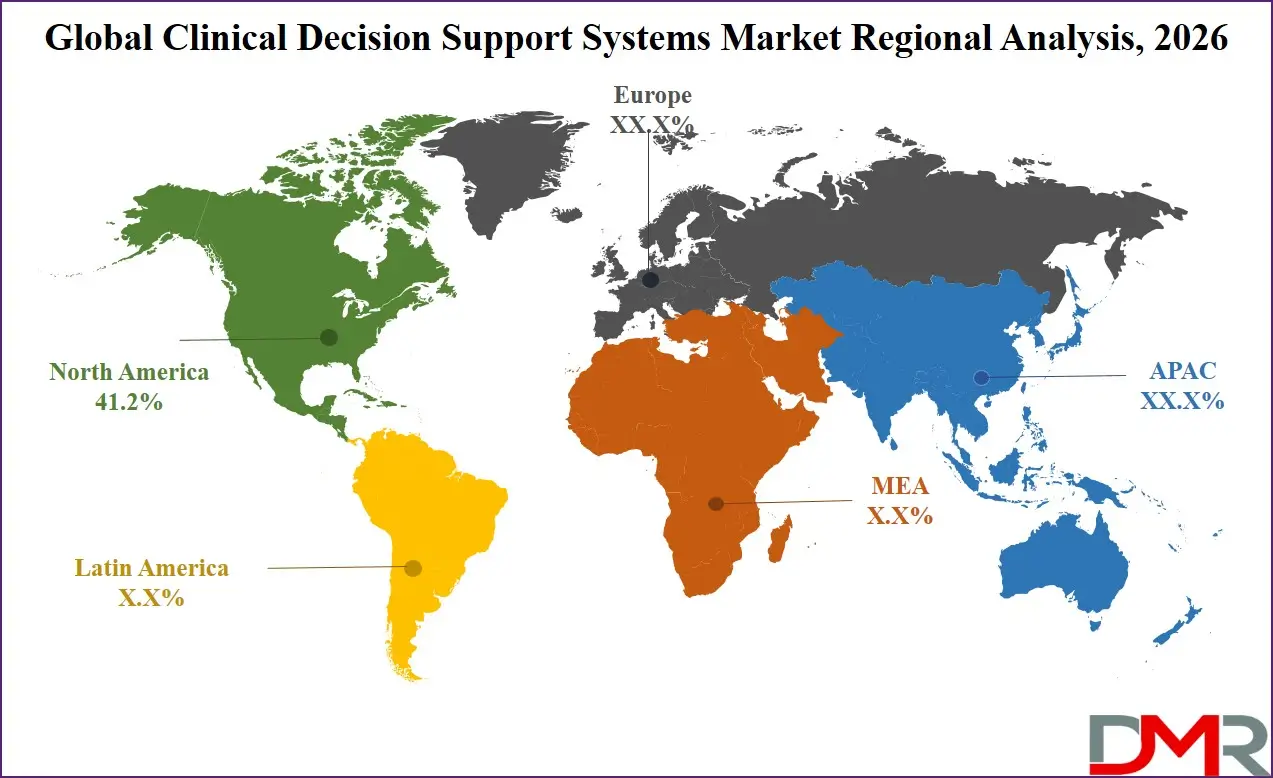
It is projected that North America will take the lead in the global CDSS market (by value), covering a market share of about 41.2% in the year 2026. The region's dominance is driven by strong hospital IT workload cadence (US-based CMS programs), high CDSS software prices relative to other regions, a mature health IT supply chain for advanced interoperability and high-speed clinical data exchange, and the presence of key EHR vendors and health informatics labs. The widespread adoption of advanced knowledge-based and machine learning CDSS for medication safety, diagnostic support, and government patient safety programs further strengthens North America's leading position in the market. Additionally, continuous investments in AI-enabled clinical logic monitoring and interoperability capabilities are further reinforcing regional technological leadership.
ℹ
To learn more about this report –
Download Your Free Sample Report Here
Fastest-Growing Region in the Clinical Decision Support Systems Market
Asia-Pacific is the fastest-growing region, supported by strong digital health deployment targets (China, India, Japan), increasing healthcare IT sovereignty initiatives, rising investments in domestic CDSS capabilities, and growing adoption of telemedicine systems. The region benefits from well-established healthcare IT manufacturing capacity, increasing commercial participation, and alignment with national digital health roadmaps. Countries across the region are actively deploying CDSS to enhance clinical safety-per-dollar and strengthen digital health infrastructure. Growing emphasis on CDSS R&D and structured clinical logic development further accelerates market expansion in the region. Moreover, increasing government support and commercial health IT commitments are expected to sustain high growth momentum.
By Region
North America
Europe
- Germany
- The U.K.
- France
- Italy
- Russia
- Spain
- Benelux
- Nordic
- Rest of Europe
Asia-Pacific
- China
- Japan
- South Korea
- India
- ANZ
- ASEAN
- Rest of Asia-Pacific
Latin America
- Brazil
- Mexico
- Argentina
- Colombia
- Rest of Latin America
Middle East & Africa
- Saudi Arabia
- UAE
- South Africa
- Israel
- Egypt
- Rest of MEA
Competitive Landscape
The CDSS market is very competitive, with innovation and strategic alliances being the order of the day. In order to achieve a competitive advantage, companies and research labs are oriented towards the creation of new advanced clinical logic architectures (e.g., machine learning-based, real-time event-driven), AI-powered clinical telemetry, and digital twin-enabled health monitoring platforms. There are high barriers to entry because of capital-intensive clinical validation infrastructure, technical clinical informatics know-how, and the need for software ecosystem maturity and healthcare supply chain certifications.
Strategic approaches in the market to increase market presence include partnerships with EHR vendors, mergers between CDSS designers and system integrators, and long-term CDSS support contracts with hospital and ambulatory operators. Moreover, research and development in advanced interoperability frameworks and event-driven clinical software frameworks are important factors in staying competitive and meeting the changing needs of the healthcare industry.
Some of the prominent players in the Global Clinical Decision Support Systems Market are:
- Oracle Corporation
- Epic Systems Corporation
- Wolters Kluwer N.V.
- Merative L.P.
- Veradigm Inc.
- Optum, Inc.
- Koninklijke Philips N.V.
- Siemens Healthineers AG
- GE HealthCare Technologies Inc.
- McKesson Corporation
- athenahealth, Inc.
- Medical Information Technology, Inc.
- NextGen Healthcare, Inc.
- Elsevier B.V.
- Agfa-Gevaert NV
- eClinicalWorks, LLC
- EBSCO Information Services
- Zynx Health, Incorporated
- First Databank, Inc.
- Premier, Inc.
- Other Key Players
Recent Developments
- September 2025: Wolters Kluwer launched UpToDate Expert AI, a generative AI-powered clinical decision support solution designed to provide clinicians with fast, evidence-based answers at the point of care, marking a major advancement in AI-integrated CDSS platforms.
- July 2025: Wellsheet launched a multidisciplinary AI copilot for clinical decision support, designed to reduce charting burden and enhance decision-making efficiency within EHR-integrated workflows.
- March 2025: Elsevier announced expanded EHR integration of its ClinicalKey AI platform with Epic systems, enabling seamless access to AI-powered clinical decision support within physician workflows.
Report Details
| Report Characteristics |
| Market Size (2026) |
USD 6.3 Bn |
| Forecast Value (2035) |
USD 15.9 Bn |
| CAGR (2026–2035) |
10.9% |
| The US Market Size (2026) |
USD 2.2 Bn |
| Historical Period |
2021 – 2025 |
| Forecast Period |
2027 – 2035 |
| Base Year |
2025 |
| Estimated Year |
2026 |
| Segments Covered |
By Product Type (Standalone CDSS, EHR-Integrated CDSS, CPOE-Integrated CDSS, Fully Integrated CDSS), By Component (Software, Services, Hardware), By Deployment Mode (On-Premise Systems, Cloud-Based Systems), By Intelligence Model (Knowledge-Based CDSS, Non-Knowledge-Based CDSS), By System Function Type (Diagnostic Support Systems, Therapeutic Support Systems), By Interactivity Level (Active CDSS, Passive CDSS), By Application (Medication Management, Clinical Guidelines & Protocol Management, Clinical Reminders, Others), By End-User (Hospitals, Ambulatory Care Centers, Diagnostic & Imaging Centers, Pharmaceutical & Research Institutes, Other Healthcare Providers) |
| Regional Coverage |
North America – The US and Canada; Europe – Germany, The UK, France, Russia, Spain, Italy, Benelux, Nordic, & Rest of Europe; Asia-Pacific – China, Japan, South Korea, India, ANZ, ASEAN, Rest of APAC; Latin America – Brazil, Mexico, Argentina, Colombia, Rest of Latin America; Middle East & Africa – Saudi Arabia, UAE, South Africa, Turkey, Egypt, Israel, & Rest of MEA |
Frequently Asked Questions
How big is the Global Clinical Decision Support Systems Market?
▾ The Global Clinical Decision Support Systems Market size is estimated to have a value of USD 6.3 billion in 2026 and is expected to reach USD 15.9 billion by the end of 2035.
What is the CAGR of the Global Clinical Decision Support Systems Market from 2026 to 2035?
▾ The market is growing at a CAGR of 10.9% over the forecasted period.
What factors are driving the growth of the Global Clinical Decision Support Systems Market?
▾ Technological advancements in machine learning-based clinical alerts and real-time evidence-based inference, regulatory mandates for patient safety and error reduction, and government funding for national clinical informatics infrastructure are the factors driving the growth of the CDSS market, globally.
What are the major trends in the Global Clinical Decision Support Systems Market?
▾ Adoption of predictive alert fatigue management and real-time clinical logic monitoring, and a shift toward cloud-based CDSS telemetry and fleet management platforms are the major trends in the market.
Which region held the largest share of the Global Clinical Decision Support Systems Market in 2026?
▾ North America is expected to account for the largest market share in 2026, with a share of about 41.2%.
Which region is expected to grow the fastest in the Global Clinical Decision Support Systems Market?
▾ Asia Pacific is the fastest-growing region in the market during the forecast period.
Who are the key players in the Global Clinical Decision Support Systems Market?
▾ Some of the major key players in the Global CDSS Market are Epic Systems Corporation, Wolters Kluwer N.V., Philips Healthcare, Siemens Healthineers AG, Veradigm Inc., and many others.
How is the Global Clinical Decision Support Systems Market segmented?
▾ The market is segmented by product type, component, deployment mode, intelligence model, system function type, interactivity level, application, and end-user.