Market Snapshot
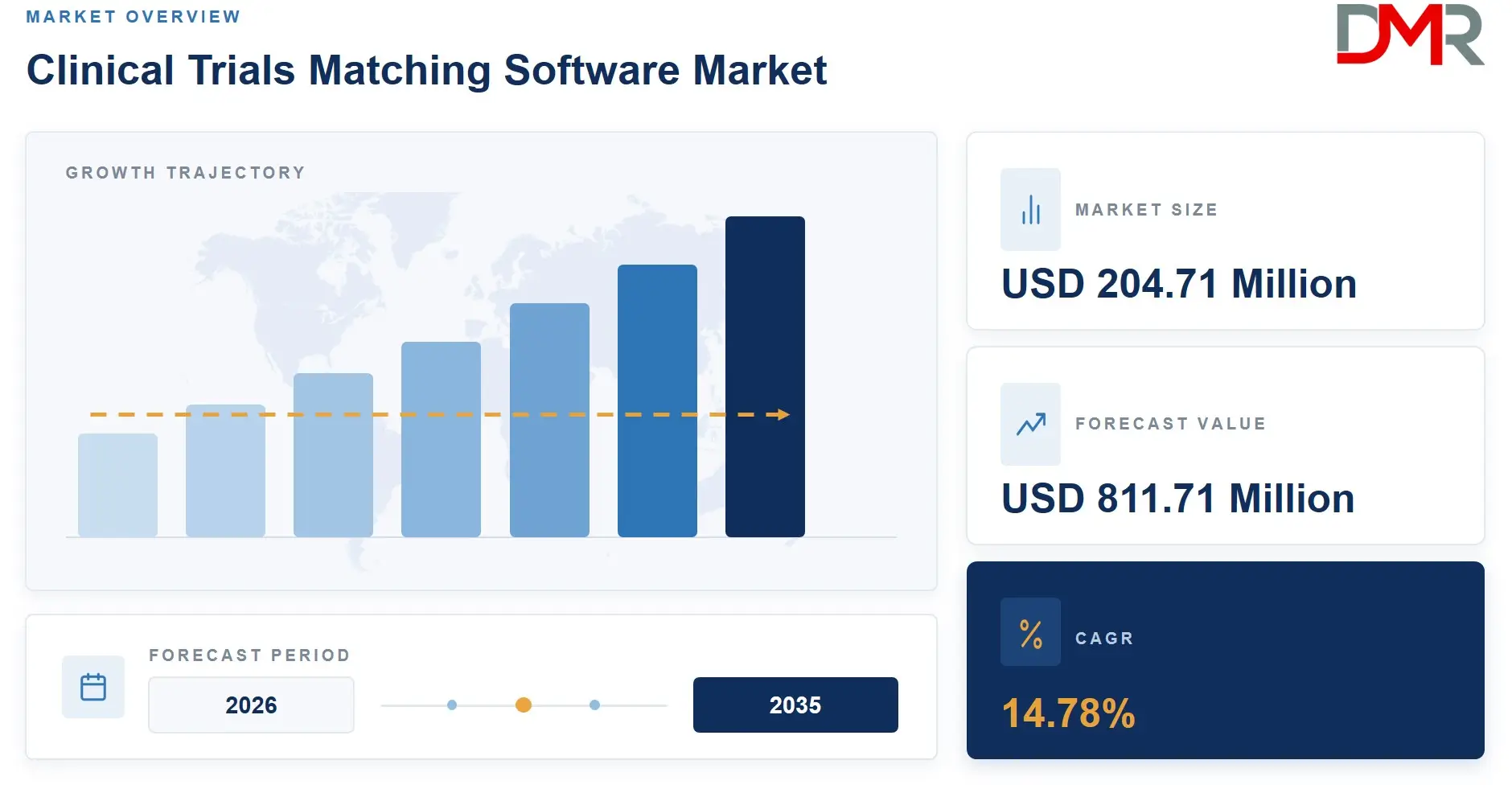
- The Global Clinical Trials Matching Software Market was valued at USD 204.71 Million in 2025 and is projected to reach USD 811.71 Million by 2035, at a CAGR of 14.78%.
- By Deployment Mode, Cloud-Based led with a 68.60% share in 2025.
- By Application, Patient Recruitment and Pre-Screening held the largest share at 38.55% in 2025.
- By End User, Pharmaceutical and Biotechnology Companies dominated with a 46.45% share in 2025.
- By Technology, Artificial Intelligence led with a 41.88% share in 2025.
- North America held the largest regional share at 42.95%.
- Asia-Pacific is the fastest-growing region across the forecast period.
Market Overview
Clinical trials matching software encompasses platforms, algorithms, and SaaS tools that automate the identification of eligible patients for investigational studies. The scope includes AI-based eligibility screening engines, patient-to-protocol matching systems, site selection tools, and recruitment analytics layers. Drug discovery software, electronic data capture systems, and generic patient registry tools without protocol-matching capability fall outside Clinical Trials Matching Software Market 's boundaries.
The market sits at the intersection of clinical research operations and health data infrastructure. Sponsor organizations and contract research organizations use these platforms to cut screen-fail rates, compress first-patient-in timelines, and satisfy regulatory expectations for diverse trial cohorts. In March 2025, Tempus AI acquired Deep 6 AI, adding over 750 provider site locations and more than 30 million patients to its matching network, illustrating how clinical data scale now defines competitive positioning in this space.
Predictive analytics embedded in modern matching platforms achieve approximately 85% accuracy in trial outcome modeling, as reported by ScienceDirect. That capability shifts these tools from passive recruitment aids into active decision-support assets for protocol design and portfolio planning. Pharmaceutical and biotechnology companies investing in these platforms gain visibility into enrollment risk weeks before traditional monitoring systems would surface the problem.
Market Size and Forecast
The Global Clinical Trials Matching Software Market size is estimated at USD 234.94 Million in 2026 from USD 204.71 Million in 2025, and is projected to reach USD 811.71 Million by 2035, exhibiting a CAGR of 14.78% during the forecast period.
Proof-of-performance data anchors the forecast trajectory. A multimodal LLM-powered matching pipeline achieved a criterion-level accuracy of 93% on the n2c2 2018 cohort selection dataset, as reported by Nature, and replicated 87% accuracy across 485 patients drawn from 30 sites against 36 diverse trials in real-world conditions. Results at that precision level convert risk-averse procurement committees from pilot approvals to enterprise contracts, widening the addressable commercial base faster than revenue projections captured at study inception.
ℹ
To learn more about this report –
Download Your Free Sample Report Here
Broader AI integration across clinical development is reported by ScienceDirect to accelerate trial timelines by 30–50% and reduce costs by as much as 40%. Those operational gains underpin sponsor willingness to fund recurring SaaS subscriptions rather than one-time consulting engagements. In March 2026, Thermo Fisher Scientific completed its USD 8.875 Billion acquisition of Clario, a move that signals platform consolidation and reinforces long-term demand for integrated digital trial infrastructure across the forecast window.
Deployment Mode Analysis
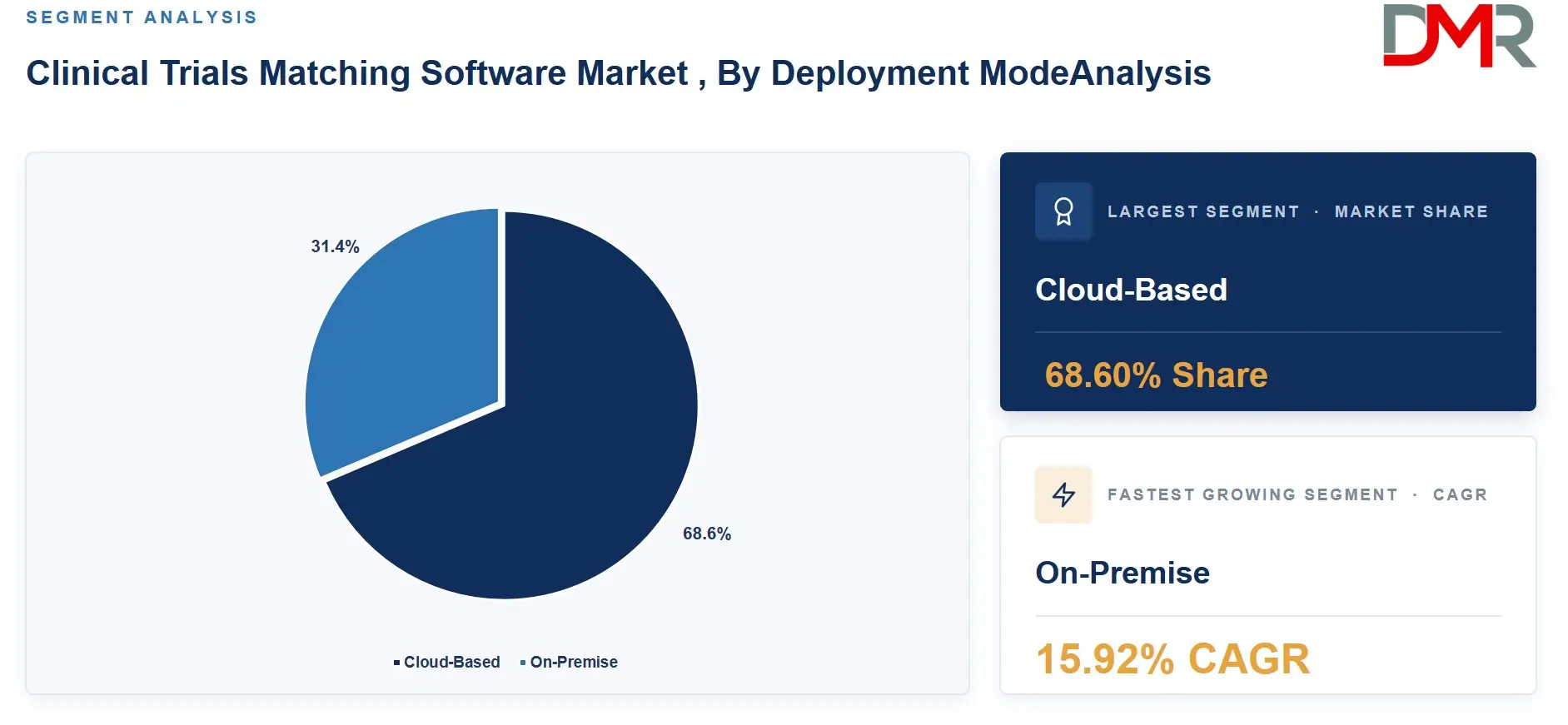
Cloud-Based led the deployment mode segment with a 68.60% share in 2026.
Cloud-based platforms dominate because sponsors and CROs require multi-site access, real-time data synchronization, and elastic compute for parsing large EHR repositories against complex eligibility criteria. Pharmaphorum data shows that AI review time per patient record dropped from approximately 40 minutes with manual methods to just over a minute in cloud-hosted ChatGPT-assisted workflows, a compression that validates the operational case for cloud deployment at enterprise scale.
ℹ
To learn more about this report –
Download Your Free Sample Report Here
On-Premise deployment, while a secondary share holder, is the fastest-growing sub-segment. Academic medical centers and hospital systems managing sensitive patient cohorts under strict data residency regulations are driving that recovery. Vendors offering hybrid architectures that compute on-premise but aggregate insights in the cloud are best positioned to capture both sides of this divide.
Application Analysis
With a 38.55% share in 2026, Patient Recruitment and Pre-Screening outpaced all other application categories.
Patient Recruitment and Pre-Screening commands the largest share because enrollment failure is the single most expensive failure mode in clinical development. Paradigm Health data confirms that an AI-native platform increased the number of patients surfaced by 32%, yielding twice as many deemed potentially eligible after human review. Sponsors converting that funnel improvement into contracted enrollment commitments anchor recurring revenue for matching software vendors.
Site Selection and Activation is the fastest-growing application. Sponsors frustrated by persistent site underperformance are investing in software that scores sites on historical enrollment yield and patient pool depth before activation decisions are made. Trial Feasibility Assessment, Protocol Matching and Eligibility Screening, and Patient Engagement and Retention Support together constitute a workflow continuum that vendors bundle to expand per-customer contract value beyond the initial recruitment use case.
End User Analysis
Pharmaceutical and Biotechnology Companies accounted for 46.45% of end user demand in 2026, the highest of any category.
Pharmaceutical and biotechnology companies set the demand baseline because they bear the full financial risk of delayed enrollment. Complex biomarker-driven oncology and rare disease protocols with narrow eligibility windows require algorithmic matching precision that manual site coordinators cannot deliver consistently. These buyers also fund the longest and most complex contracts, anchoring platform revenues across multi-year development programs.
Contract Research Organizations are the fastest-growing end user segment. CROs managing diversified trial portfolios across sponsors gain competitive advantage when a shared matching platform improves enrollment KPIs across all accounts simultaneously. Medical Device Companies, Hospitals and Health Systems, and the Others category collectively represent a broadening buyer base as digital trial infrastructure moves from pharmaceutical-exclusive into community care settings.
Technology Analysis
Artificial Intelligence captured 41.88% of the technology segment in 2026, ahead of all rivals.
AI's share reflects its role as the foundational layer for eligibility parsing, patient scoring, and real-time EHR interrogation. No competing technology category delivers equivalent throughput or accuracy across free-text clinical documentation at scale. AI is the capability that converts static patient databases into dynamic enrollment pipelines.
Natural Language Processing is the fastest-growing technology sub-segment, driven by deployment of LLM-based systems that parse unstructured clinical notes and physician narratives into machine-readable eligibility attributes. Machine Learning, Big Data Analytics, and other emerging categories support the AI layer by providing predictive modeling, cohort stratification, and outcome simulation capabilities that extend matching software into protocol optimization territory.
Key Market Segments
By Deployment Mode
By Application
- Patient Recruitment and Pre-Screening
- Site Selection and Activation
- Trial Feasibility Assessment
- Protocol Matching and Eligibility Screening
- Patient Engagement and Retention Support
By End User
- Pharmaceutical and Biotechnology Companies
- Contract Research Organizations
- Medical Device Companies
- Hospitals and Health Systems
- Others
By Technology
- Artificial Intelligence
- Natural Language Processing
- Machine Learning
- Big Data Analytics
- Others
Regional Analysis
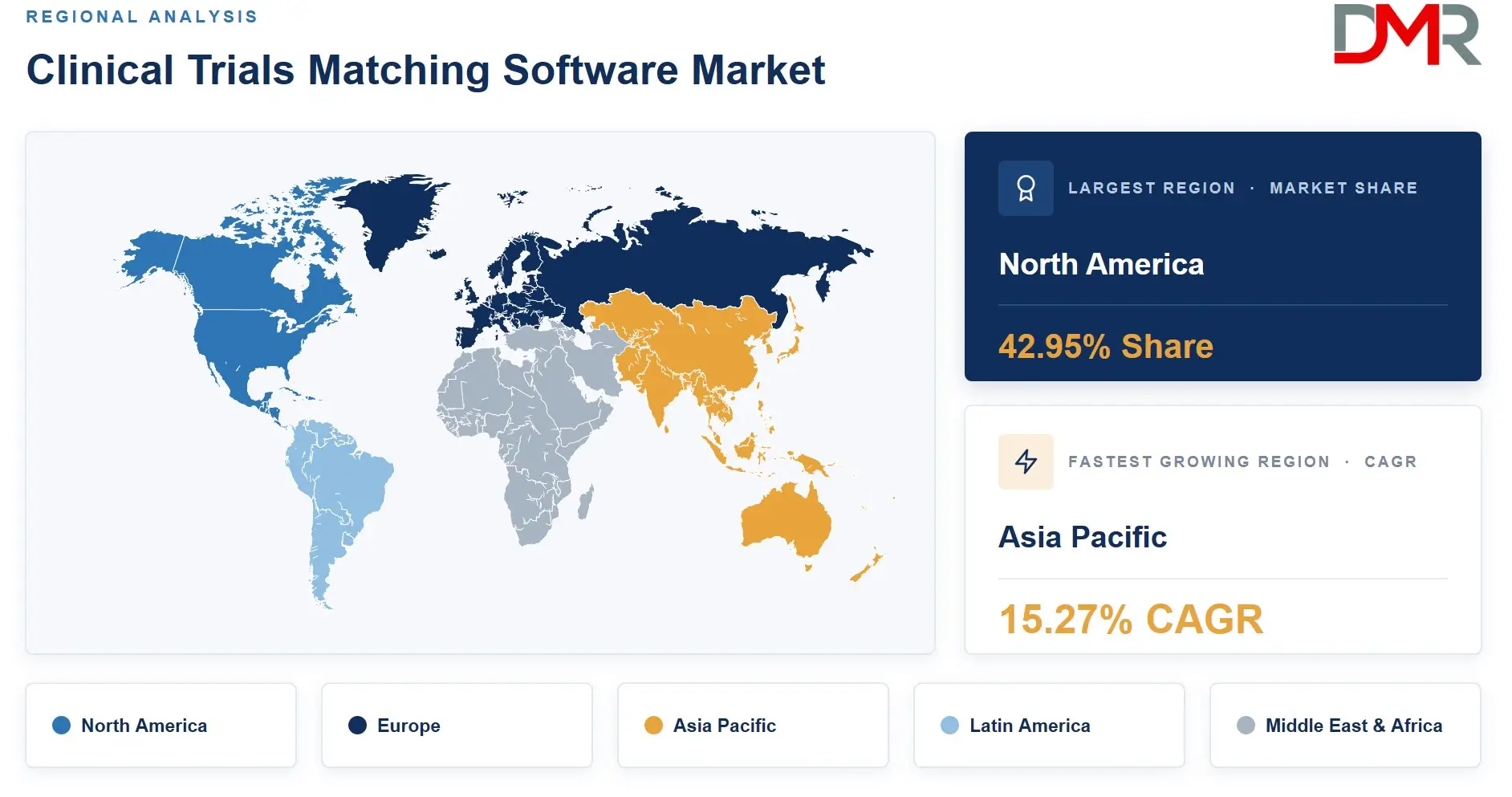
North America led all regions with a 42.95% share in 2026, equivalent to approximately USD 87.92 Million.
North America's lead reflects a convergence of concentrated pharmaceutical R&D spend, mature EHR infrastructure enabling data interoperability, and a dense network of academic research centers that serve as anchor customers. Per-patient screening costs using AI tools have dropped to as low as $0.02 to $0.03 with ChatGPT 3.5, as reported by Pharmaphorum, making adoption economically rational even for community hospital sites previously priced out of digital matching solutions.
ℹ
To learn more about this report –
Download Your Free Sample Report Here
Asia-Pacific is the fastest-growing region. Regulatory harmonization efforts in Japan, South Korea, and China are opening new investigational site networks to global sponsors, creating fresh demand for matching platforms calibrated to local patient data formats. Europe benefits from GDPR-compliant cloud architectures that match its data governance requirements, while Latin America and the Middle East and Africa represent emerging adoption zones where cost-efficient SaaS deployment models are beginning to attract mid-tier CRO buyers.
Key Regions and Countries
North America
Europe
- Germany
- France
- The UK
- Spain
- Italy
- Rest of Europe
Asia Pacific
- China
- Japan
- South Korea
- India
- Australia
- Rest of APAC
Latin America
- Brazil
- Mexico
- Rest of Latin America
Middle East & Africa
- GCC
- South Africa
- Rest of MEA
Market Dynamics
AI Accuracy and EHR Integration Drive Sponsor Adoption
AI-powered clinical trial matching systems have demonstrated up to 92% accuracy in eligibility determination, as reported by ASCO, compressing the gap between algorithmic and physician-level screening that previously justified manual review workflows. TrialGPT reached 87.3% criterion-level accuracy across 184 patients with more than 18,000 trial annotations, nearly matching the 88.7%–90.0% accuracy of human experts, according to Coherent Solutions. That parity gives sponsors the confidence to automate first-pass screening and redeploy clinical research coordinator capacity to higher-value activities.
Enterprise EHR integration extends the reach of matching platforms from dedicated research centers into routine clinical workflows. TrialGPT reduced real-life screening time by 42.6%, as confirmed by Coherent Solutions. In 2025, IQVIA acquired Whiz and moved to purchase Charles River's European Discovery Services for approximately $145 million, consolidating data assets needed to power high-volume real-world matching pipelines. In March 2026, Medidata launched a unified clinical trial platform trained on data from over 38,000 studies and 12 million patients, reinforcing that data breadth has become a primary competitive moat in Clinical Trials Matching Software Market .
Fragmented Data Ecosystems Constrain Scalable Matching
Inconsistent EHR interoperability standards across health systems prevent matching platforms from accessing structured, high-quality patient data at the scale that algorithmic engines require for reliable eligibility determination. A platform that performs at 92% accuracy in a tightly integrated academic center may degrade materially when deployed across a community network running four different EHR vendors with non-standardized field mappings. Sponsors evaluating enterprise deployments must account for the integration burden as a material implementation cost.
Evolving regulatory guidance on AI-driven decision support compounds procurement hesitation. IRBs and site compliance teams face unclear rules on when AI recommendations require human override and how algorithmic eligibility decisions should be documented for audit. Until clearer frameworks emerge from the FDA and EMA, procurement timelines for mid-tier sponsors will remain extended, limiting near-term revenue velocity for vendors without established regulatory affairs capabilities.
Community Hospitals and Rare Disease Pipelines Represent High-Value White Space
Community hospitals and mid-sized physician networks hold large untapped patient populations with no dedicated research infrastructure to surface clinical trial candidates. A multimodal LLM pipeline allowed users to review overall patient eligibility in under 9 minutes per patient, an 80% improvement over traditional manual chart reviews, according to Nature. An AI-native platform reduced screening volumes by 31–87% across three trials, significantly cutting clinical research coordinator burden, as reported by Paradigm Health. Both benchmarks make plug-and-play SaaS deployments financially viable for resource-constrained community settings for the first time.
Rare disease and ultra-orphan indications are a structurally underserved opportunity. Global patient scarcity forces sponsors to search across geographically dispersed, fragmented care networks where only high-precision digital identification can yield viable cohorts on acceptable timelines. In 2025, Veeda Lifesciences purchased Mango Sciences for AI integration in oncology trials, and Sitero acquired StudyOS, an AI-focused trial technology firm. In December 2025, Paradigm Health raised $78 million in Series B funding to expand its platform that integrates trials into routine care settings. Both deal flows confirm capital is flowing toward exactly these high-precision, underserved sub-markets.
Market Trends
LLM-Driven Matching and Decentralized Trial Models Redefine Platform Requirements
LLM-based systems now parse unstructured clinical notes and free-text eligibility criteria to generate explainable patient-to-trial recommendations. ChatGPT 3.5 screened patients in 1.4 to 3.0 minutes per patient while ChatGPT 4.0 ranged from 7.9 to 12.4 minutes, as reported by Pharmaphorum, demonstrating that model selection creates real cost-accuracy trade-offs that procurement teams must evaluate. In March 2024, IBM launched Watson for Clinical Trials Enrollment 2.0 with enhanced AI-driven patient matching connected to EHR data. Decentralized and hybrid trial models are pushing matching software beyond academic centers into community and home-based care settings where remote patient identification is now a platform requirement, not a feature add-on.
Market Competition Overview
The clinical trials matching software market is moderately fragmented, with a handful of well-capitalized platforms competing on data breadth and algorithm performance alongside a long tail of niche providers focused on specific therapeutic areas or deployment models. TrialGPT outperformed competing models by 32.6% to 57.2% in trial ranking and exclusion tasks, as reported by Coherent Solutions, illustrating that algorithm quality differentials are large enough to shift enterprise contract decisions. Leaders in Clinical Trials Matching Software Market win through proprietary EHR integration depth, patient network scale, and multi-product bundling that embeds matching software inside broader clinical trial technology stacks.
Consolidation is the dominant competitive dynamic. Acquisitions of AI data firms and specialized matching platforms are narrowing the number of independent vendors capable of serving enterprise sponsors across multiple therapeutic areas. Mid-tier vendors that lack either proprietary data assets or deep CRO partnerships face growing pressure to partner or exit rather than compete independently against platforms built on tens of millions of patient records.
Company Profiles
Tempus AI, Inc. holds a structurally differentiated position built on proprietary real-world clinical and molecular data assets. Its March 2025 acquisition of Deep 6 AI added over 750 provider site locations and more than 30 million patients to its matching network, creating a data moat that AI performance alone cannot replicate. Sponsors evaluating Tempus AI gain access to genomic-linked patient cohorts that are particularly valuable for biomarker-stratified oncology protocols where eligibility windows are narrow and screen-fail costs are highest.
Medidata Solutions, Inc. anchors its competitive position on platform scale and longitudinal trial data breadth. Its March 2026 unified clinical trial platform, trained on more than 38,000 studies and 12 million patients, supports outcome simulations and next-best-action recommendations that extend the platform's value from enrollment into protocol design optimization. In June 2025, PhaseV announced its ClinOps AI platform with precision-guided site selection and real-time performance monitoring, signaling that performance analytics are now a table-stakes feature for enterprise-grade matching platforms.
Key Players
- Deep 6 AI, Inc.
- Antidote Technologies, Inc.
- TriNetX, LLC
- Microsoft Corporation
- Tempus AI, Inc.
- Advarra, Inc.
- ArisGlobal LLC
- BSI Business Systems Integration AG
- Castor EDC B.V.
- Clario
- Clinerion AG
- Evidation Health, Inc.
- HealthMatch, Inc.
- IQVIA Holdings Inc.
- Medidata Solutions, Inc.
- Oracle Corporation
- Reify Health, Inc.
- Teckro Limited
- Trialbee AB
- Veeva Systems Inc.
Investment and White Space Analysis
Capital allocation in Clinical Trials Matching Software Market is concentrating around two vectors: large-scale M&A that consolidates proprietary patient data assets, and growth-stage funding for platforms that bridge matching software into community care settings. Paradigm Health's $78 million Series B in December 2025 is the clearest signal that investors value platforms capable of operating outside academic research centers, where untapped patient pools are largest and competition from incumbents is thinnest.
White space is most pronounced in rare disease matching, B2B2C patient-facing portal integrations, and analytics layers that benchmark enrollment funnel performance for protocol optimization. Community hospitals, mid-sized physician networks, and disease advocacy platforms remain systematically underserved by current vendor coverage. Entrants with lightweight SaaS deployment models and API-first integration architectures face the lowest barriers to capturing these underserved segments before larger platforms replicate their cost-efficient delivery models.
Recent Developments
- August 2025 — Cleveland Clinic rolled out Dyania Health's AI platform across its system to accelerate trial recruitment by identifying eligible patients from clinical data.
- September 2025 — Advarra launched an AI- and data-backed Study Design solution using its Braid data and AI engine to evaluate protocol feasibility.
- November 2025 — Tata Consultancy Services launched its next-generation TCS ADD Risk Based Quality Management platform with AI-powered risk monitoring and subject risk scoring.
- January 2026 — PSI CRO launched SYNETIC, an AI-powered semantic knowledge platform added to its INTELIA trial intelligence platform to accelerate site identification and patient enrollment.
- January 2026 — Mount Sinai Tisch Cancer Center launched PRISM, an AI-powered clinical trial-matching platform created by Triomics, to expand access to cancer trials.
- February 2026 — HEALWELL AI and WELL Health Technologies launched WELLTRUST, a consent-driven platform using HEALWELL's DARWEN AI for ethical patient identification and trial recruitment.
Report Details
| Report Characteristics |
| Market Value (2025) |
USD 204.71 Million |
| Market Value (2026) |
USD 234.94 Million |
| Forecast Revenue (2035) |
USD 811.71 Million |
| CAGR (2026–2035) |
14.78% |
| Base Year for Estimation |
2025 |
| Historic Period |
2020 – 2024 |
| Forecast Period |
2026 – 2035 |
| Report Coverage |
Revenue Forecast, Market Dynamics, Competitive Landscape, Recent Developments |
| Segments Covered |
By Deployment Mode (Cloud-Based, On-Premise); By Application (Patient Recruitment and Pre-Screening, Site Selection and Activation, Trial Feasibility Assessment, Protocol Matching and Eligibility Screening, Patient Engagement and Retention Support); By End User (Pharmaceutical and Biotechnology Companies, Contract Research Organizations, Medical Device Companies, Hospitals and Health Systems, Others); By Technology (Artificial Intelligence, Natural Language Processing, Machine Learning, Big Data Analytics, Others) |
| Regional Analysis |
North America – US, Canada; Europe – Germany, France, The UK, Spain, Italy, Rest of Europe; Asia Pacific – China, Japan, South Korea, India, Australia, Rest of APAC; Latin America – Brazil, Mexico, Rest of Latin America; Middle East & Africa – GCC, South Africa, Rest of MEA |
| Competitive Landscape |
Deep 6 AI Inc., Antidote Technologies Inc., TriNetX LLC, Microsoft Corporation, Tempus AI Inc., Advarra Inc., ArisGlobal LLC, BSI Business Systems Integration AG, Castor EDC B.V., Clario, Clinerion AG, Evidation Health Inc., HealthMatch Inc., IQVIA Holdings Inc., Medidata Solutions Inc., Oracle Corporation, Reify Health Inc., Teckro Limited, Trialbee AB, Veeva Systems Inc. |
| Customization Scope |
Customization for segments and region or country level will be provided. Additional customization can be done based on requirements. |
| Purchase Options |
Three license options: Single User License, Multi-User License (Up to 5 Users), and Corporate Use License (Unlimited Users and Printable PDF). |
Frequently Asked Questions
What is the biggest investment opportunity in Clinical Trials Matching Software Market ?
▾ Community hospitals and mid-sized physician networks represent the largest underserved opportunity, holding substantial untapped patient populations that current enterprise-focused platforms have not penetrated. An AI-native matching platform demonstrated screening volume reductions of 31–87% across trials, making SaaS deployment economically viable for resource-constrained sites. Rare disease and ultra-orphan indications, where global patient scarcity makes precision digital identification strategically critical, rank as the second highest-value investment target.
Who are the top companies in Clinical Trials Matching Software Market ?
▾ Tempus AI, Inc., Medidata Solutions, Inc., IQVIA Holdings Inc., TriNetX LLC, and Veeva Systems Inc. are among the leading competitors. Tempus AI holds a differentiated data position after acquiring Deep 6 AI's network of over 750 provider sites and 30 million patients. IQVIA's acquisitions of Whiz and its pursuit of Charles River's European Discovery Services signal an aggressive data consolidation strategy across the forecast period.
Which region is growing fastest in Clinical Trials Matching Software Market and why?
▾ Asia-Pacific is the fastest-growing region across the forecast period. Regulatory harmonization in Japan, South Korea, and China is opening new investigational site networks to global sponsors, creating first-adoption opportunities for matching platform vendors. India's growing CRO sector and large patient population provide additional structural demand that is still in early-stage platform adoption relative to North America's 42.95% dominant share.
Which segment is growing fastest in Clinical Trials Matching Software Market and why?
▾ Natural Language Processing is the fastest-growing technology sub-segment, driven by LLM-based systems that parse unstructured clinical notes into machine-readable eligibility attributes. On-Premise deployment is the fastest-growing deployment sub-segment, as data residency regulations at hospital and academic center level require local compute. Contract Research Organizations are the fastest-growing end user category because shared matching platforms generate enrollment performance gains across entire CRO client portfolios simultaneously.
What is the biggest challenge holding Clinical Trials Matching Software Market back?
▾ Fragmented clinical data ecosystems and inconsistent EHR interoperability standards are the primary structural constraint. A platform achieving 92% accuracy in a tightly integrated academic center may degrade materially when deployed across a multi-vendor community network where field mappings are non-standardized. Unresolved regulatory guidance from the FDA and EMA on AI-driven decision support compounds procurement hesitation, particularly among mid-tier sponsors and IRBs without dedicated AI governance functions.