What is the Cloud Migration Services Market Size?
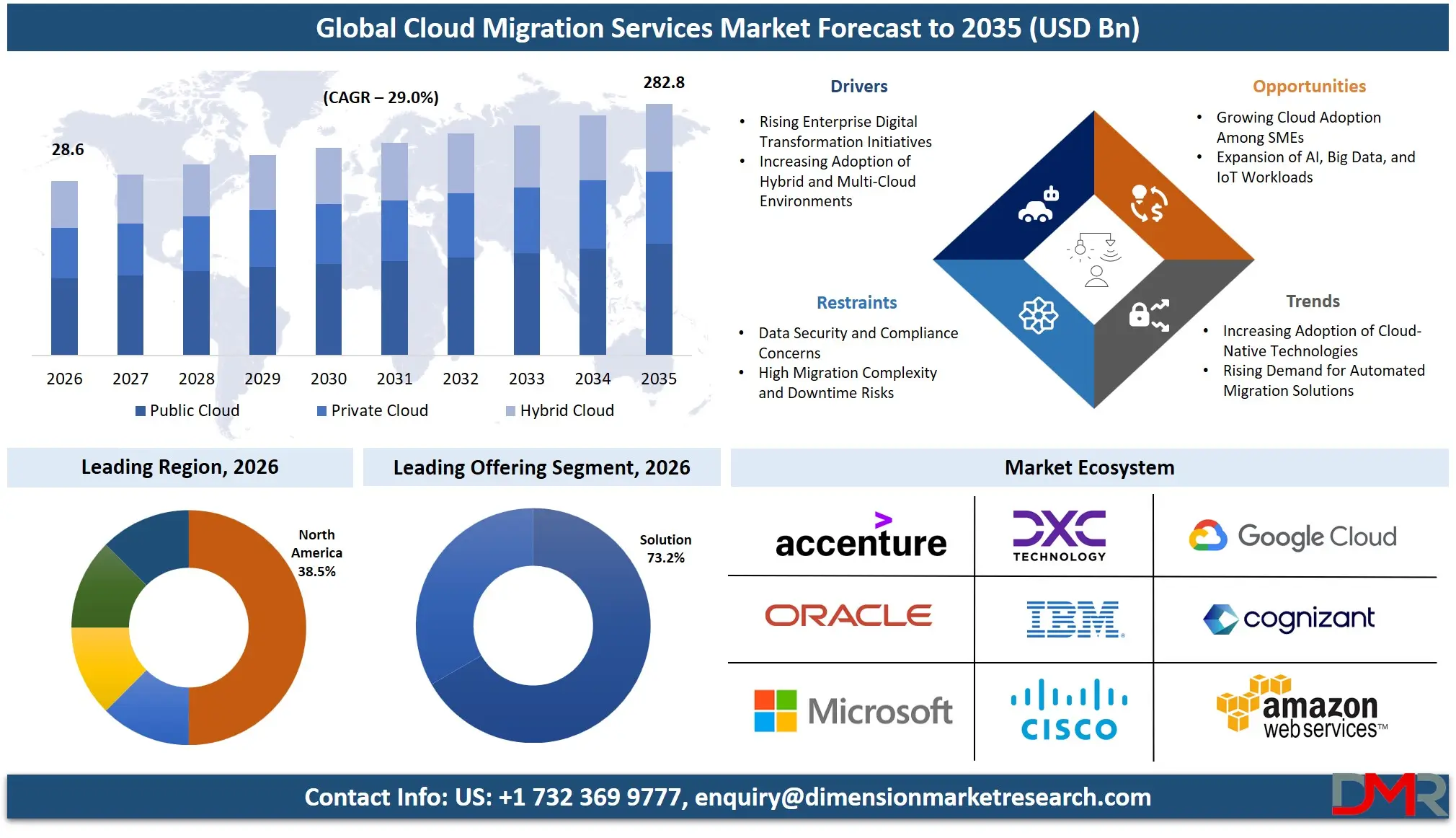
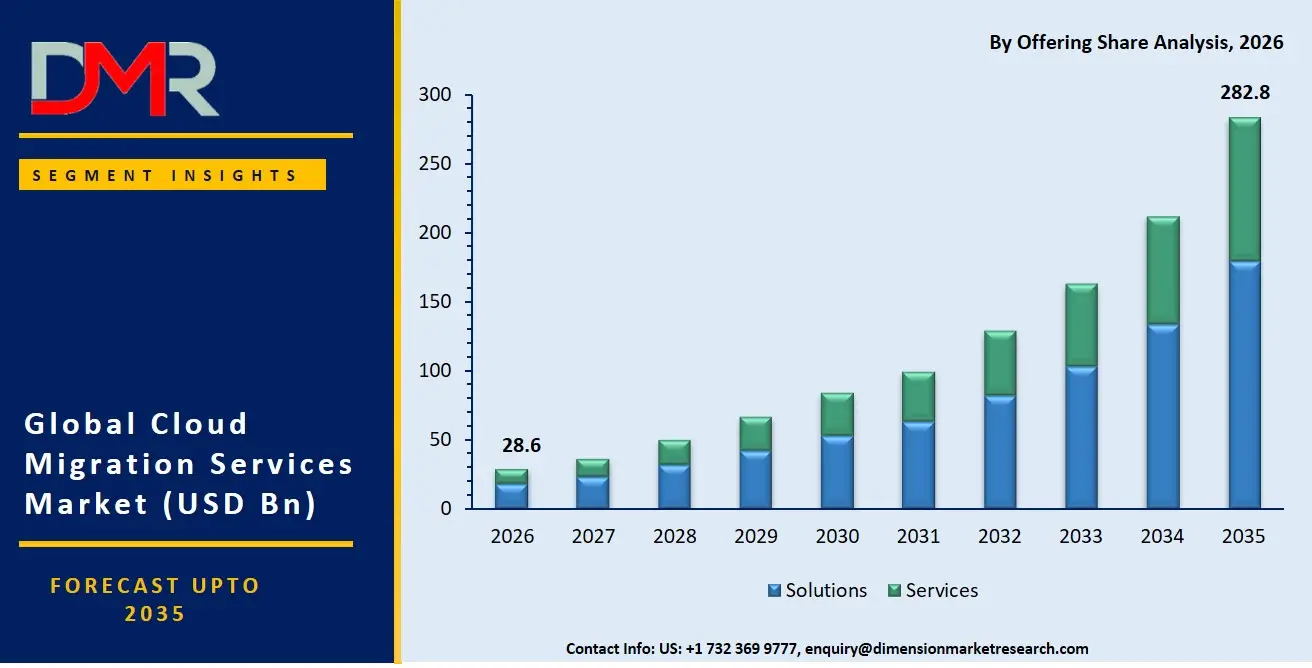
The Global Cloud Migration Services Market is expected to reach a value of USD 28.6 billion in 2026, and it is further anticipated to reach USD 282.8 billion by 2035, growing at a CAGR of 29.0% during the forecast period.
ℹ
To learn more about this report –
Download Your Free Sample Report Here
There has been an exponential rise in the cloud migration services market because there has been a rise in companies accelerating their digital transformation process and shifting from traditional infrastructures to cloud infrastructures. Some of the services included in the cloud migration services market include assessment and planning services, migration and deployment services, integration and customization services, data migration and management services, security and compliance services, training and support services, and managed cloud services.
The above-listed services assist organizations in migrating their workloads, applications, databases, and data centers to public, private, and hybrid cloud infrastructures. There is an increasing requirement for multi-cloud adoption, modernizing legacy monolithic applications, cybersecurity compliance during migration processes, and management of artificial intelligence workloads. These factors make it increasingly important for companies to migrate to cloud migration services. Businesses from different industries are some of the biggest users of cloud migration services, and infrastructure migration and application migration are the two most popular use cases for cloud migration services.
ℹ
To learn more about this report –
Download Your Free Sample Report Here
The US Cloud Migration Services Market
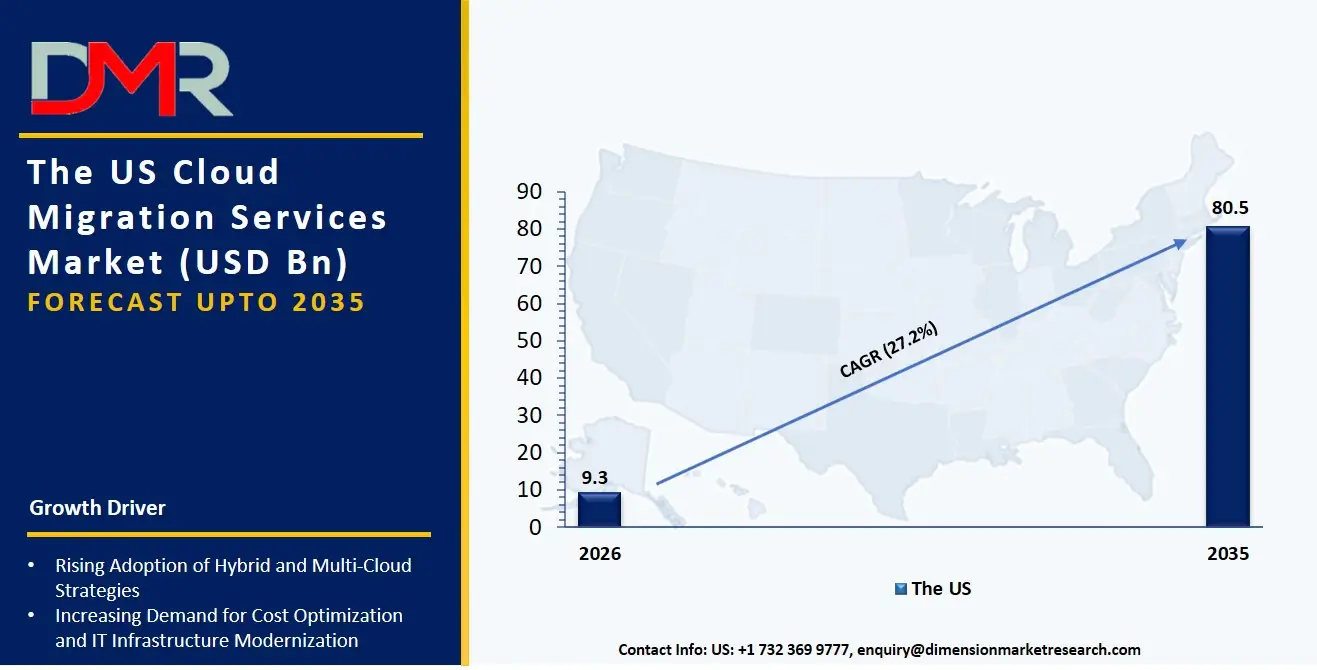
The US Cloud Migration Services Market is projected to reach USD 9.3 billion in 2026 at a compound annual growth rate of 27.2% over its forecast period, which is further expected to reach a value of USD 80.5 billion by 2035. The US remains the leading and most advanced market in cloud migration services owing to the robust modernization efforts undertaken by Fortune 500 companies and the wide availability of hyperscale data centers offered by AWS, Microsoft Azure, and Google Cloud. Historically, the market has been characterized by high demand for application migration services, where companies have been engaged in refactoring their monolithic legacy applications into cloud-native microservices-based architecture. Infrastructure migration services involving virtual machine migration and network re-architecture account for significant investment made by companies who are shutting down their on-premise data centers. In addition, the deployment of Generative AI tools in cloud-based processes has necessitated the need for security and compliance services to ensure proper data governance and AI ethics frameworks. Readiness assessment and dependency mapping have become highly sought after services by US enterprises to avoid migration errors and unnecessary downtime.
ℹ
To learn more about this report –
Download Your Free Sample Report Here
The Europe Cloud Migration Services Market
The Europe Cloud Migration Services Market is estimated to be valued at USD 8.3 billion in 2026 and is further anticipated to reach USD 79.2 billion by 2035 at a CAGR of 28.5%. Regulatory frameworks like GDPR and the imminent EU AI Act play an important role in influencing the European market and creating the necessity to utilize security and compliance services, which include compliance adherence and identity and access management during cloud migrations. The rapid development of hybrid cloud migration services is being seen in the region owing to the efforts of the manufacturing and automotive industry in Germany and France to strike a balance between OT security and cloud analytics capabilities. Data migration and management services, particularly data mapping and cleansing and data migration, become essential for organizations in Europe due to the stringent data residency regulations. Moreover, initiatives like GAIA-X require service providers to design specific sovereign cloud migration strategies and interoperability solutions to ensure that data stays within the European cloud ecosystem while retaining its scalability.
The Japan Cloud Migration Services Market
The Japan Cloud Migration Services Market is projected to be valued at USD 3.0 billion in 2026. It is further expected to witness robust growth, holding USD 26.0 billion in 2035 at a CAGR of 27.1%. Japanese markets are quite distinctive, with a push towards digital transformation by corporations due to the dwindling labor force and outdated IT systems. Migration platform services, especially data center migration and DevOps integration, constitute a major chunk of the expenditure because the largest conglomerates are moving mission-critical applications from the existing on-premise mainframe architecture to new cloud platforms. Infrastructure migration services, including virtual machine and network migrations are crucial because Japanese firms are moving away from their aging hardware-based infrastructure.
Key Takeaways
- Market Size & Forecast: The Global Cloud Migration Services market is projected to reach USD 28.6 billion in 2026, expanding dramatically to USD 282.8 billion by 2035, due to the twin factors of legacy systems decommissioning across the entire enterprise and the necessity of modernizing old IT infrastructure through structured migrations.
- Growth Rate & Outlook: Global market growth is expected at a CAGR of 29.0%, owing to the acute scarcity of internal migration architects, the increasing complexities involved in orchestrating multi-cloud migration processes, and the mounting need for data migration and management services to manage petabyte-level database migrations.
- Primary Growth Drivers: The key driving forces behind market growth include the transition from capital expenditure data centers to operational expenditure cloud computing, the urgent requirement for migrating legacy applications prior to end-of-life dates, and the necessity of security and compliance services to maintain regulatory compliance during migrations.
- Key Market Trends: Current market trends include automation in migration services, adoption of factory migration approaches, the use of artificial intelligence within assessment engines as part of readiness assessment services for auto-discovering application dependencies, and increased interest in managed cloud services post-migration to optimize performance.
- By Offering Analysis: Services account for the majority of market share, where assessment and planning services form the vital first step of every migration project. Migration and deployment services, especially lift and shift migration and DevOps integration, receive significant investments as companies aim to limit disruptions to their businesses.
- By Deployment Mode Analysis: The segment of the public cloud takes the lead in the global cloud migration services market because of its advantages, such as high scalability, flexibility, and cost-effectiveness for companies of various sizes. Companies migrate their workload to the public cloud because of its benefits.
- Regional Leadership: North America is poised to lead in this market with 38.5% market share in 2026 because of its advanced technological infrastructure, presence of major cloud players, and migration plans of enterprises in response to data center contracts' expiration and the end of life of mainframes.
What is the Cloud Migration Services?
Cloud Migration Services refers to the set of consulting and implementation services that will enable the movement of applications, data, infrastructure, and other workloads from existing on-premise systems and traditional platforms to cloud infrastructures. The list of cloud migration services includes assessment and planning, migration and deployment, integration and customization, data migration and management, security and compliance, training and support, and also managed cloud services, which are required for successful migration without operational disruptions. Cloud migration service providers assist businesses in evaluating their readiness for migration, identifying dependencies, implementing DevOps, ensuring compatibility, managing data lifecycles, complying with regulations, identity and access management, and optimizations after migration. The growing trend towards cloud-first strategies and digital transformations by enterprises drives up the demand for cloud migration services.
Use Cases
- Banking Core Application Migration: Application migration services are engaged by banking organizations to migrate their COBOL-based core banking applications from the traditional mainframe platform to cloud microservices architecture.
- Healthcare Data Center Exit: Healthcare organizations use infrastructure migration and data migration and management services to exit old data centers and migrate petabytes of imaging data, electronic health records, and clinical systems to the HIPAA-compliant cloud storage.
- Government Sovereign Cloud Migration: Government agencies use assessment and planning services for sovereign cloud migration projects, where the migration roadmap must be developed to adhere to strict data residency laws, which ensure no migration of citizens' data across national boundaries.
- Manufacturing Hybrid Platform Migration: Manufacturers across the globe engage platform migration services, including data center migration and DevOps services, to integrate their factory floor PLCs with cloud ERP systems.
How AI is Transforming the Cloud Migration Services Market?
AI is radically changing the cloud migration services market through faster assessment processes, automated migrations, and optimized post-migration solutions. Assessment and planning services will be significantly enhanced by intelligent assessment tools, which can automatically scan the entire environment of enterprises and identify the dependencies of various applications, network architecture, and other aspects that would take months for human consultants to uncover. Intelligent assessment engines will be able to analyze thousands of servers and detect all possible communication patterns to optimize migration and create a roadmap for migration based on workload complexity, importance for business, and compatibility.
Migration and deployment services will be transformed by automation and machine learning that allow predicting and avoiding migration errors, and refactoring legacy code. Machine learning will make it possible to predict migration failures by analyzing migration history and detecting certain patterns in it. Automated refactoring will allow converting legacy code into cloud-native architectures with the help of AI and significantly reduce the amount of manual labor required during migration of custom applications and enterprise applications.
Market Dynamics
Key Drivers in the Global Cloud Migration Services Market
Rising Enterprise Digital Transformation Initiatives
One of the important factors that contribute to the growth of the global cloud migration services market is the fast-paced digital transformation of enterprises. The enterprises are seeking to revamp their conventional IT infrastructure by becoming more agile, scalable, efficient, and customer-oriented. Through cloud migration services, enterprises can move their workload, application, and data to the cloud without interrupting their ongoing activities. Various sectors including BFSI, healthcare, retail, and manufacturing have started adopting cloud computing technology to enable automation, collaboration, analysis, and artificial intelligence-related operations.
Increasing Adoption of Hybrid and Multi-Cloud Environments
The growing trend towards hybrid and multi-cloud environments has been playing a major role in fueling the demand for cloud migration services worldwide. Companies have now understood that hybrid cloud solutions provide better scalability, flexibility, control, and compliance. The multi-cloud solutions make sure that organizations are not dependent on any particular vendor's solutions and, hence, their workloads perform optimally. In the wake of enterprises operating with IT environments comprising on-premises, private, and public cloud infrastructure, there has been an increased need for migration services.
Restraints in the Global Cloud Migration Services Market
Data Security and Compliance Concerns
The issues of data security and compliance continue to act as major constraints in the international market for cloud migration services. Many businesses that have financial, health care, and personal data often refrain from moving their operations to the cloud because of threats of hacking and other cyberattacks, and also because of issues of data security and protection against unauthorized access. Adhering to stringent regional and sectoral compliance frameworks, such as GDPR and HIPAA, makes it even more challenging to perform cloud migrations. Companies that operate in various jurisdictions also struggle to maintain consistent governance and security frameworks.
High Migration Complexity and Downtime Risks
The problem of migrating existing systems and vital applications to the cloud infrastructure represents one of the major barriers to market adoption. Companies operate on the basis of existing technology with heavily intertwined systems which makes the migration process quite challenging and cumbersome. Risks related to application incompatibility, data loss, disruptions, and downtimes are among those factors that represent a challenge to companies during the migration process. Also, the lack of skills in areas such as cloud computing infrastructure, DevOps, and workload management may represent a significant barrier for companies.
Growth Opportunities in the Global Cloud Migration Services Market
Growing Cloud Adoption Among SMEs
The increasing cloud adoption among small and medium-sized enterprises presents significant growth opportunities for the global cloud migration services market. SMEs are increasingly recognizing the advantages of cloud infrastructure, including reduced capital expenditure, improved scalability, remote accessibility, and operational flexibility. Cloud migration service providers are offering cost-effective and customized migration solutions tailored to the requirements of smaller businesses with limited IT resources. Additionally, the expansion of subscription-based SaaS platforms and managed cloud services has simplified cloud deployment for SMEs. Government-led digitalization initiatives and expanding internet penetration in emerging economies are also encouraging smaller enterprises to accelerate their cloud transformation journeys globally.
Expansion of AI, Big Data, and IoT Workloads
The fast-paced developments in AI, big data analysis, and IoT are paving the way for lucrative prospects in the cloud migration services industry. Enterprises today need flexible cloud infrastructure that can handle high amounts of real-time data and deliver enhanced analytical functions. The process of migrating AI and IoT workloads to the cloud will help organizations enhance their computing efficiency, automation, predictive maintenance, and customer insights. More and more cloud migration vendors are now providing tailored solutions for workload modernization, containerization, and cloud-native application development. In addition, increased corporate spending on machine learning, edge computing, and digital twins is further driving the demand for advanced cloud migration services around the world.
Trends in the Global Cloud Migration Services Market
Increasing Adoption of Cloud-Native Technologies
The increasing use of cloud-native solutions like containers, Kubernetes, serverless computing, and microservices architecture is another trend in the cloud migration services market around the world. Many companies are now moving towards application modernization while migrating to take advantage of scalability, flexibility, and more efficient deployment methods. In cloud-native platforms, companies can speed up their software development processes, manage resources effectively, and practice continuous integration and delivery. Migration service providers are now concentrating on approaches like re-platforming and refactoring in order to help their customers get the full benefits of cloud-native systems.
Rising Demand for Automated Migration Solutions
Automated migration has emerged as one of the most prominent trends within the cloud migration services industry worldwide, as businesses look for quick, efficient, and risk-free cloud migration processes. The inclusion of artificial intelligence, machine learning, and automation technology in cloud migration services has become commonplace among service providers looking to limit human intervention and avoid disruption to their operations. Automated cloud migration services provide an efficient process of assessing workloads, conducting dependency mapping, testing, monitoring, and optimizing operations. Businesses use automated cloud migration services to enable efficient and cost-effective large-scale cloud migrations.
Research Scope and Analysis
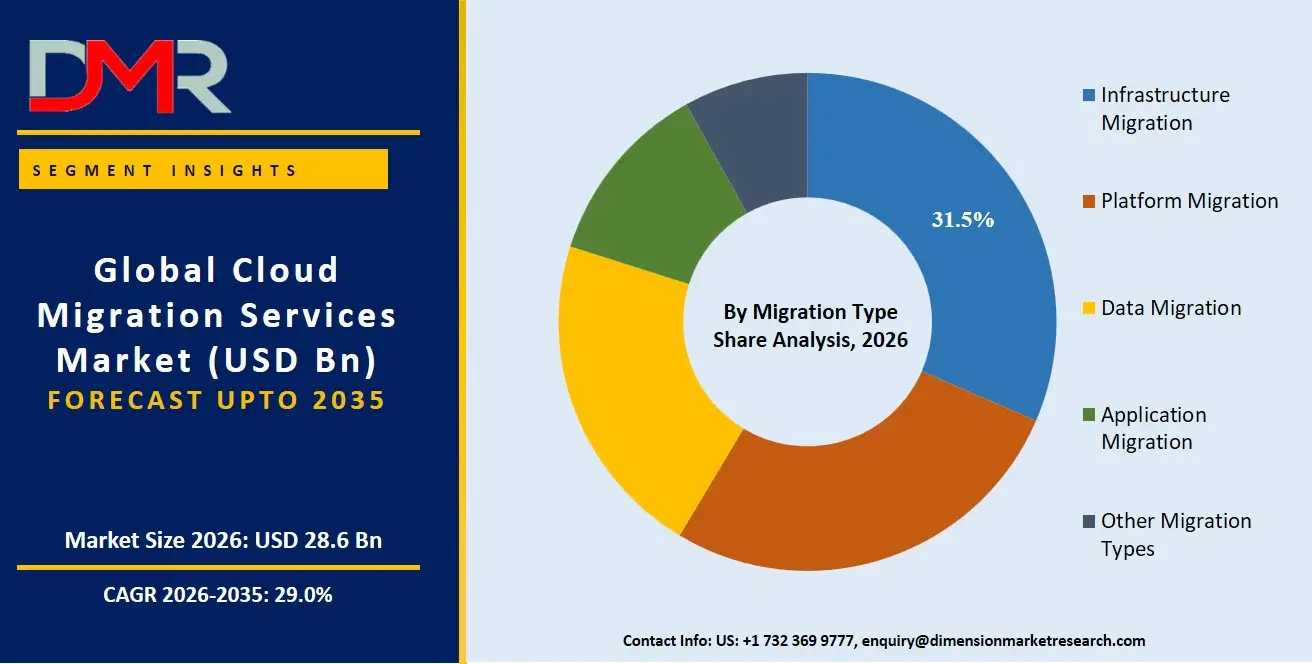
The Global Cloud Migration Services Market is segmented by offering into solutions and services, by deployment mode into public, private, and hybrid cloud, by migration type including infrastructure, platform, data, and application migration, by application across enterprise operations and analytics, and by verticals such as BFSI, healthcare, telecom, manufacturing, retail, and government.
ℹ
To learn more about this report –
Download Your Free Sample Report Here
By Offering Analysis
The service category is poised to dominate in the global cloud migration services market owing to the ever-growing intricacy involved in cloud migration projects undertaken by enterprises and the growing need for specialized skills. Enterprises from diverse sectors depend largely on consulting, migration, deployment, integration, security, and managed services in order to migrate to the cloud without disrupting their operations. The assessment & planning services are especially essential in assessing the IT preparedness of organizations and formulating migration plans. Meanwhile, there is increasing demand for managed cloud services, which are required for optimizing and managing the security of the infrastructure continuously.
By Deployment Mode Analysis
Public clouds have expected to dominate the global cloud migration services market because of their scalable, flexible, and economical nature for businesses of all sizes. Firms are opting for public cloud services to cut costs, increase agility, and drive digital transformation efforts. The leading cloud players like AWS, Microsoft Azure, and Google Cloud keep adding to their infrastructure and services across the world, thus compelling businesses to move towards public cloud platforms. Moreover, the rising adoption of remote working options, software as a service models, artificial intelligence analytics, and cloud-native app development has further fueled demand for public cloud migration services across various industries such as BFSI, retail, healthcare, and manufacturing.
By Migration Type Analysis
The application migration segment is anticipated to be leading the market for cloud migration services across the globe owing to the increasing emphasis on application modernization and efficiency improvement among enterprises. Enterprises are rapidly moving their enterprise applications, web applications, and custom software solutions into cloud-based systems to ensure better scalability, performance, and user experience. The rising adoption of cloud-based technologies, microservices architecture, and containerization technologies has led to an increasing need for application migration services. Application modernization is being emphasized by organizations to facilitate their digital transformation initiatives, remote working capabilities, and real-time operations.
By Application Analysis
The business intelligence & analytics segment leads the global cloud migration services market, driven by the increasing demand for real-time insights, predictive analytics, and analytics capabilities among enterprises. Enterprises are increasingly adopting cloud-based analytics systems to improve scalability, access, and speed. By adopting cloud analytics, businesses can effectively manage huge amounts of both structured and unstructured data without increasing costs. The increased adoption of artificial intelligence, machine learning, and big data technologies by enterprises is also contributing to the growth in migration. Self-service analytics and embedded analytics applications are experiencing high adoption rates across industries.
By Vertical Analysis
The BFSI industry segment holds the major share of the global cloud migration services market due to the emphasis on digital transformation, cybersecurity, efficiency, and regulatory compliance in this industry segment. The financial services companies are adopting cloud migration for their workloads, databases, payment processes, and core banking applications. This will help them scale up, improve their customers' experience, and support real-time transaction processing. The BFSI industry is adopting cloud technology to make use of advanced technologies like artificial intelligence, fraud detection, predictive analytics, and blockchain integration. The BFSI industry is also witnessing fast-paced growth of digital banking, fintech, and mobile payment ecosystems.
The Global Cloud Migration Services Market Report is segmented on the basis of the following:
By Offering
- Solution
- Infrastructure Migration
- Platform Migration
- Database Migration
- Application Migration
- Storage Migration
- Services
- Assessment & Planning Services
- Readiness Assessment
- Dependency Mapping
- Migration Roadmap
- Migration & Deployment Services
- Lift & Shift Migration
- DevOps Integration
- Integration & Customization Services
- Application Integration
- Customization & Configuration
- System Interoperability
- Data Migration & Management Services
- Data Mapping & Cleansing
- Large-Scale Data Migration
- Data Lifecycle Management
- Security & Compliance Services
- Security Assessment & Remediation
- Compliance Adherence
- Identity & Access Management (IAM)
- Training & Support Services
- User Training & Adoption
- Ongoing Support
- Knowledge Transfer
- Managed Cloud Services
- Cloud Infrastructure Management
- Security Management
- Performance Optimization
- Other Services
By Deployment Mode
- Public Cloud
- Private Cloud
- Hybrid Cloud
By Migration Type
- Infrastructure Migration
- Virtual Machines
- Network Configurations
- Logging Infrastructure
- Platform Migration
- Data Center
- DevOps and Testing
- Access Control
- Identity & Access Management (IAM)
- Data Migration
- Application Migration
- Web Applications
- Enterprise Applications
- Custom Applications
- Other Migration Types
By Application
- Supply Chain Management
- Order Management
- Inventory Management
- Procurement Management
- Logistics & Fulfilment Management
- Other Supply Chain Management Applications
- Project Management
- Task Management
- Workflow Automation
- Issue Tracking & Reporting
- Collaboration & Communication
- Other Project Management Applications
- Content Management
- Content Authoring & Publishing
- Website Building & Maintenance
- User Management
- Other Content Management Applications
- Data Warehouse Management
- Performance Optimization
- Data Analytics
- Data Integration
- Data Sharing & Collaboration
- Other Data Warehouse Management Applications
- Business Intelligence & Analytics
- Data Visualization
- Embedded Analytics
- Data Modeling & Preparation
- Self-Service Analytics
- Other Applications
By Vertical
- BFSI
- Healthcare & Life Sciences
- Telecom
- Government & Public Sector
- Manufacturing
- Retail & Consumer Goods
- Media & Entertainment
- Automotive & Transportation
- Other Verticals
Regional Analysis
Leading Region by Market Share
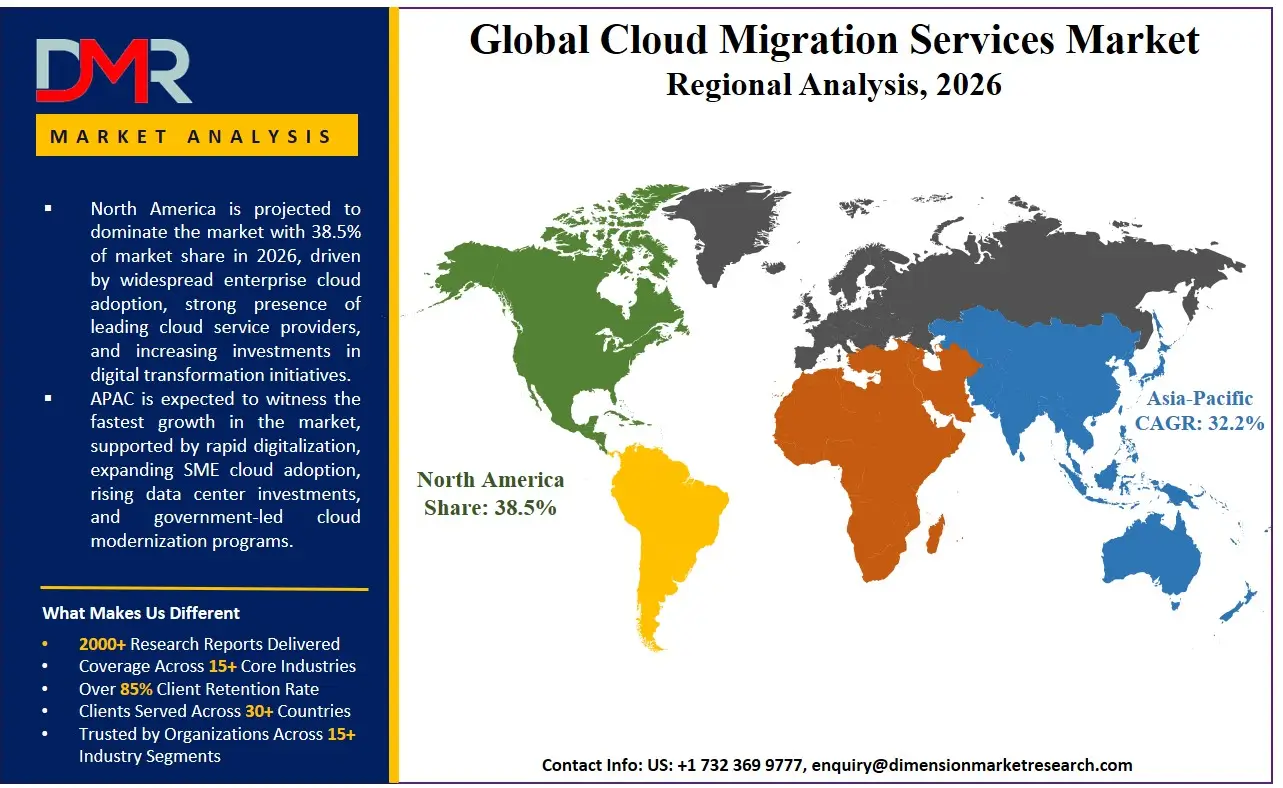
North America is poised to dominate the global cloud migration services market, holding 38.5% of the market share by the end of 2026. The United States, which dominates North America, maintains the highest share in cloud migration services due to the unmatched concentration of hyperscale cloud data centers operated by AWS, Microsoft Azure, and Google Cloud, combined with the aggressive digital transformation agendas of Fortune 500 companies. The region benefits from an established ecosystem of global system integrators, specialized migration consultancies, and a rich talent pool of cloud migration architects and engineers. Enterprise investment in retiring legacy mainframe systems, consolidating data center footprints, and enabling AI-driven innovation contributes to sustained demand for comprehensive migration services.
ℹ
To learn more about this report –
Download Your Free Sample Report Here
Fastest-Growing Regional Market
Asia-Pacific is anticipated to experience the fastest growth in the cloud migration services market, owing to government-led digital transformation programs in India, China, Japan, South Korea, and Southeast Asian countries. Economic growth, digitalization of the economy, and the need to update legacy systems have been pushing traditional companies and governmental institutions to adopt their cloud migration plans quickly. Cloud migration within the Asia-Pacific region is generally focused on migrating applications from highly outdated systems, which can be decades old, to the cloud; therefore, it requires specialized knowledge of legacy technologies. The demand for assessment and planning services is very high since organizations without prior experience in cloud services are developing their migration strategies. Japan's peculiar market situation, which is shaped by its digital transformation programs targeting workforce reduction, creates an impressive need for platform migration, including mainframe modernization and DevOps implementation. At the same time, India's large-scale IT service sector satisfies global demand for cloud migration services while also driving domestic migration of Indian organizations.
By Region
North America
Europe
- Germany
- The U.K.
- France
- Italy
- Russia
- Spain
- Benelux
- Nordic
- Rest of Europe
Asia-Pacific
- China
- Japan
- South Korea
- India
- ANZ
- ASEAN
- Rest of Asia-Pacific
Latin America
- Brazil
- Mexico
- Argentina
- Colombia
- Rest of Latin America
Middle East & Africa
- Saudi Arabia
- UAE
- South Africa
- Israel
- Egypt
- Rest of MEA
Competitive Landscape
The competitive landscape in the global cloud migration services industry has turned out to be quite dynamic, encompassing a diverse range of multinational global system integrators, professional services offerings of hyperscale cloud providers, and specialized cloud native migration consulting firms. Competition in this market is fierce, with companies vying for dominance based on maturity in migration methodology, levels of automation, industry knowledge, and strength of strategic relationships with hyperscaler cloud providers such as AWS, Microsoft Azure, and Google Cloud. Such strategic relationships are crucial, enabling co-selling opportunities, early access to migration tools and programs, and even financing through programs like AWS MAP and Azure Migrate & Modernize.
Some of the prominent players in the Global Cloud Migration Services Market are:
- Accenture
- Amazon Web Services (AWS)
- Microsoft
- Google Cloud
- IBM
- Oracle
- Cognizant
- DXC Technology
- Cisco Systems
- Rackspace Technology
- Capgemini
- Deloitte
- Wipro
- Infosys
- Tech Mahindra
- HCLTech
- Tata Consultancy Services (TCS)
- VMware
- NTT DATA
- Cloud4C
- Other Key Players
Recent Developments
- January 2026: Amazon Web Services (AWS) launched an extension of their migration acceleration program with more funds and professional service personnel to help clients from Healthcare and Life Sciences and Manufacturing in their infrastructure and application migrations using the partner network.
- November 2025: IBM Consulting expanded its partnership with Microsoft by establishing a specialized practice that will provide security and compliance services and data migration and management services tailored to the needs of BFSI clients who want to migrate their core banking operations to Azure without compromising regulatory compliance.
- October 2025: Accenture acquired a European cloud migration and security consultancy firm to bolster its services related to assessment and planning services and integration and customization services for sovereign cloud environments needed by Government and Public Sector clients.
Report Details
| Report Characteristics |
| Market Size (2026) |
USD 28.6 Bn |
| Forecast Value (2035) |
USD 282.8 Bn |
| CAGR (2026–2035) |
29.0% |
| The US Market Size (2026) |
USD 9.3 Bn |
| Historical Data |
2021 – 2025 |
| Forecast Data |
2027 – 2035 |
| Base Year |
2025 |
| Estimate Year |
2026 |
| Segments Covered |
By Offering, By Deployment Mode, By Migration Type, By Application, and By Vertical |
| Regional Coverage |
North America – The US and Canada; Europe – Germany, The UK, France, Russia, Spain, Italy, Benelux, Nordic, & Rest of Europe; Asia-Pacific – China, Japan, South Korea, India, ANZ, ASEAN, Rest of APAC; Latin America – Brazil, Mexico, Argentina, Colombia, Rest of Latin America; Middle East & Africa – Saudi Arabia, UAE, South Africa, Turkey, Egypt, Israel, & Rest of MEA |
Frequently Asked Questions
How big is the Global Cloud Migration Services Market?
▾ The Global Cloud Migration Services market is poised to be valued at USD 28.6 billion in 2026 and is projected to reach USD 282.8 billion by 2035, driven by the universal need for specialized skills in assessment, planning, and execution of complex cloud migrations across infrastructure, applications, and data.
What is the CAGR of the Global Cloud Migration Services Market from 2026 to 2035?
▾ The market is expected to grow at a CAGR of 29.0% from 2026 to 2035, reflecting the accelerating pace of enterprise cloud adoption, the urgency of legacy system modernization, and the persistent shortage of internal migration expertise.
What factors are driving the growth of the Global Cloud Migration Services Market?
▾ Key drivers include the global IT skills gap for migration architects and engineers, the imperative to modernize legacy applications before end-of-life deadlines, the management complexity of multi-cloud and hybrid migration strategies, regulatory pressures compelling data center consolidation, and the surge in demand for security and compliance services amid evolving data sovereignty laws.
Which region held the largest share of the Cloud Migration Services Market in 2026?
▾ North America, specifically the United States, is projected to hold 38.5% of market share in 2026, driven by a mature hyperscaler ecosystem, aggressive Fortune 500 migration programs, and substantial enterprise investment in application migration, infrastructure migration, and data migration to cloud platforms.
Which region is expected to grow the fastest in the Cloud Migration Services Market?
▾ The Asia-Pacific region is expected to grow the fastest, fueled by rapid digital transformation in India, China, Japan, and Southeast Asia, where assessment and planning services and migration and deployment services are critical for transitioning large conglomerates and government agencies to cloud environments.
What are the major trends in the Global Cloud Migration Services Market?
▾ Major trends include the rise of AI-powered automated migration assessment and discovery tools, the integration of FinOps principles into migration planning and execution, the emergence of continuous migration models replacing one-time project approaches, and the growing emphasis on GreenOps and sustainable migration practices.
Who are the key players in the Global Cloud Migration Services Market?
▾ Key players include Global System Integrators like Accenture, Deloitte, IBM Consulting, TCS, and Capgemini, as well as the professional services divisions of hyperscalers like AWS, Microsoft, and Google Cloud, alongside specialized cloud-native migration consultancies and major IT service providers.
How is the Global Cloud Migration Services Market segmented?
▾ The market is segmented by Offering, by Deployment Mode, by Migration Type, by Application, and by Vertical.