What is the Cloud Native Applications Market Size?
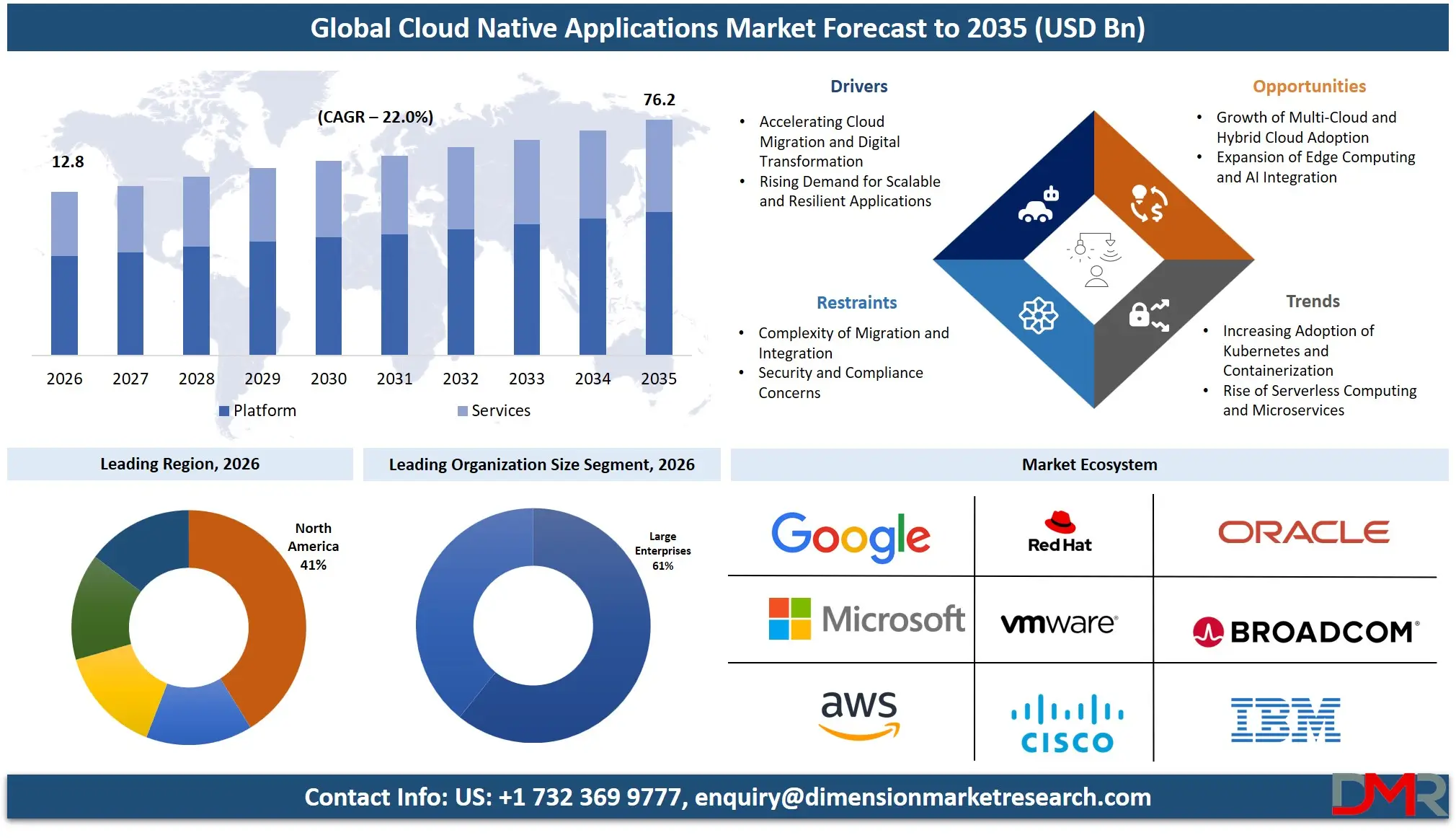
The Cloud Native Applications Market size is expected to be USD 12.8 billion in 2026 and increase at a compound annual growth rate of 22.0% to USD 76.2 billion in 2035 due to accelerating cloud migration and digital transformation.
ℹ
To learn more about this report –
Download Your Free Sample Report Here
The cloud native applications market is experiencing strong expansion due to increasing enterprise adoption of scalable, flexible, and resilient software architectures. It includes platforms, services, and tools that support containerization, microservices, and DevOps automation. Rising demand for digital transformation, cloud migration, and faster application delivery is driving growth across industries such as BFSI, IT, healthcare, and retail. Emerging trends include serverless computing, AI-driven automation, and multi-cloud strategies. Organizations are shifting from legacy systems to cloud-native environments to improve agility, reduce operational costs, and enhance system reliability. Continuous integration and continuous deployment practices are further accelerating market adoption globally.
The US Cloud Native Applications Market
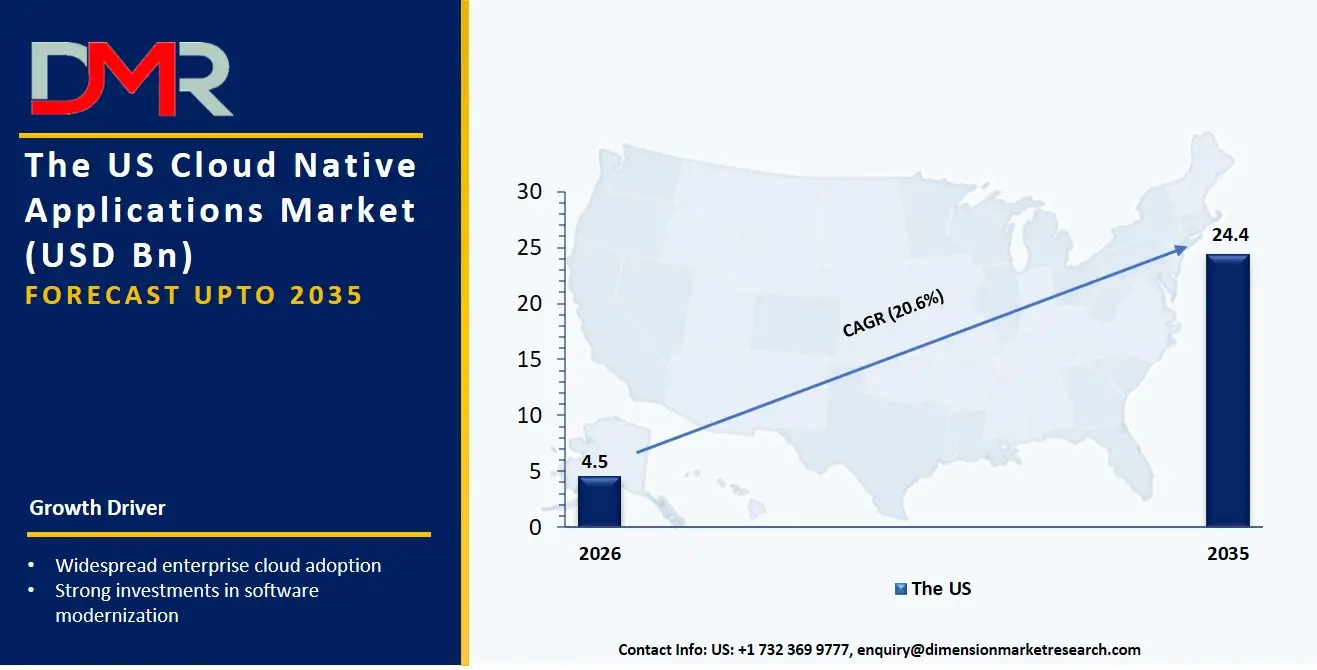
The US Cloud Native Applications Market size is estimated to be USD 4.5 billion in 2026 and is expected to increase at a CAGR of 20.6% over the forecast period.
ℹ
To learn more about this report –
Download Your Free Sample Report Here
The United States represents one of the most mature markets for cloud native applications due to widespread enterprise cloud adoption, strong investments in software modernization, and the presence of leading hyperscale cloud providers. Organizations across financial services, healthcare, manufacturing, retail, and government increasingly adopt Kubernetes, containers, and serverless platforms to improve operational agility. Federal cybersecurity initiatives, software supply chain security requirements, and continued investments in AI-enabled cloud infrastructure further accelerate market growth while encouraging enterprises to modernize legacy applications through cloud-native architectures.
Europe Cloud Native Applications Market
The Europe Cloud Native Applications Market size is estimated to be USD 3.2 billion in 2026 and is expected to increase at a CAGR of 20.1% over the forecast period.
Europe continues to experience steady adoption of cloud native applications as enterprises focus on digital sovereignty, cybersecurity, sustainability, and regulatory compliance. Regional initiatives encouraging secure cloud adoption and digital innovation have increased investments in hybrid cloud, container platforms, and cloud automation. Organizations are emphasizing energy-efficient cloud infrastructure while adopting DevSecOps and platform engineering practices. Financial institutions, manufacturing companies, telecommunications providers, and public sector organizations remain among the leading adopters, supported by evolving digital regulations and cloud governance initiatives.
Japan Cloud Native Applications Market
The market size of Japan Cloud Native Applications will be USD 640 million in 2026 and at a CAGR of 20.8% in the forecast period.
Japan is experiencing rapid adoption of cloud native technologies as enterprises modernize legacy IT systems and accelerate digital transformation. Manufacturing, automotive, financial services, telecommunications, and healthcare organizations increasingly implement microservices, containers, and hybrid cloud architectures to improve operational efficiency. Government-led digital transformation programs, investments in smart manufacturing, and growing AI integration continue to stimulate demand. Although legacy infrastructure migration remains challenging, increasing cloud investments and skilled workforce development create significant long-term opportunities for cloud-native application deployment.
Key Takeaways
- Market Size & Forecast: The Cloud Native Applications Market size is projected to reach USD 2.8 billion in 2026 and is anticipated to have a value of USD 76.2 billion in 2035.
- Growth Rate & Outlook: The Cloud Native Applications Market size is set to grow at a compound annual growth rate of 22.0% during the forecast period of 2026 to 2035.
- Primary Growth Drivers: Some of the major growth drivers in the market Accelerating Cloud Migration and Digital Transformation and more.
- Key Market Trends: Some of the major trends in the market are Rise of Serverless Computing and Microservices and more.
- By Component Type: Platform segment is anticipated to get the majority share of the Cloud Native Applications Market in 2026.
- By Organization Size Type: Large Enterprises is expected to get the largest revenue share in 2026 in the Cloud Native Applications Market.
- By Deployment Mode Type: Public Cloud is expected to get the largest revenue share in 2026 in the Cloud Native Applications Market.
- Regional Leadership: North America is set to lead the Cloud Native Applications Market with an estimated 41.0% share in 2026.
What is the Cloud Native Applications?
Cloud native applications are software programs designed and built to run in distributed cloud environments using modern architectures such as microservices, containers, serverless computing, and continuous delivery pipelines. These applications are developed to fully leverage cloud computing capabilities like scalability, resilience, automation, and rapid deployment. Unlike traditional monolithic systems, cloud native applications are modular, allowing independent development and updates of services. They rely heavily on orchestration tools like Kubernetes, APIs, and DevOps practices. Their significance lies in enabling faster innovation, improved operational efficiency, and seamless scalability across hybrid and multi-cloud environments, driven by digital transformation across industries.
Use Cases
- Enterprise Application Modernization: Organizations replace legacy monolithic software with cloud-native microservices to improve scalability, resilience, and deployment speed. Containerized applications reduce downtime while enabling continuous software updates and better operational flexibility across hybrid cloud environments.
- AI and Machine Learning Platforms: Cloud native architectures provide scalable infrastructure for AI model training, deployment, and inference. Kubernetes orchestration automatically manages compute resources, improving resource utilization while accelerating AI application development and operational efficiency.
- Financial Services Digital Banking: Banks utilize cloud-native applications to build secure digital banking platforms capable of processing millions of transactions with minimal latency. Automated scaling, API integration, and DevSecOps improve customer experiences while maintaining regulatory compliance.
- IoT and Edge Computing: Manufacturing, logistics, and smart city deployments use cloud-native applications to process large volumes of real-time sensor data. Containerized workloads deployed at the edge reduce latency while improving reliability and supporting distributed computing environments.
How AI Is Transforming the Cloud Native Applications Market
Artificial intelligence significantly enhances cloud-native application development by automating software engineering workflows, infrastructure provisioning, application monitoring, and performance optimization. AI-powered observability platforms detect anomalies, predict infrastructure failures, optimize resource allocation, and improve application reliability across complex Kubernetes environments. These capabilities reduce operational costs while increasing deployment efficiency.
AI also improves customer experiences through intelligent automation, predictive analytics, conversational applications, recommendation engines, and autonomous cloud operations. Enterprises increasingly integrate generative AI into DevOps pipelines for automated code generation, testing, documentation, security analysis, and deployment, enabling faster software delivery while maintaining high levels of reliability, scalability, and governance.
Market Dynamic
Driving Factors in the Cloud Native Applications Market
Accelerating Cloud Migration and Digital Transformation
Enterprises across industries are rapidly shifting from legacy infrastructure to cloud-native environments to improve agility and reduce operational costs. The adoption of microservices, containers, and serverless computing enables faster deployment cycles and continuous innovation. Organizations are increasingly investing in Kubernetes-based orchestration and DevOps pipelines to streamline software delivery. This shift is also driven by remote work expansion and the need for scalable digital platforms, making cloud-native applications a core enabler of modern enterprise IT strategies globally.
Restraints in the Cloud Native Applications Market
Security and Compliance Concerns
Cloud native environments introduce security challenges due to distributed architectures, multiple APIs, and containerized workloads. Organizations face risks related to data breaches, misconfigurations, and regulatory compliance issues. Industries such as healthcare and finance are particularly sensitive due to strict data protection regulations. Managing security across multi-cloud environments adds further complexity, requiring advanced security frameworks and continuous monitoring, which increases operational costs and slows adoption in highly regulated sectors.
Opportunities in the Cloud Native Applications Market
Expansion of Edge Computing and AI Integration
The rise of edge computing and AI-driven applications is creating new opportunities for cloud native architectures. Cloud native frameworks enable distributed processing closer to data sources, improving latency and performance. Industries like manufacturing, automotive, and IoT are increasingly adopting these solutions. Integration of AI and machine learning into cloud native environments further enhances automation, predictive analytics, and intelligent decision-making, expanding the market's long-term growth potential.
Trends in the Cloud Native Applications Market
Rise of Serverless Computing and Microservices
Serverless computing is gaining traction as organizations seek to eliminate infrastructure management overhead. Combined with microservices architecture, it enables faster development cycles, cost efficiency, and improved scalability. This trend is reshaping how applications are designed and deployed in cloud environments.
Research Scope and Analysis
The research scope covers segmentation analysis across component, deployment model, organization size, application, and end user categories within the cloud native applications market. It evaluates adoption patterns, growth drivers, and competitive positioning, alongside regional performance trends and technological advancements shaping enterprise cloud transformation globally.
ℹ
To learn more about this report –
Download Your Free Sample Report Here
By Component Analysis
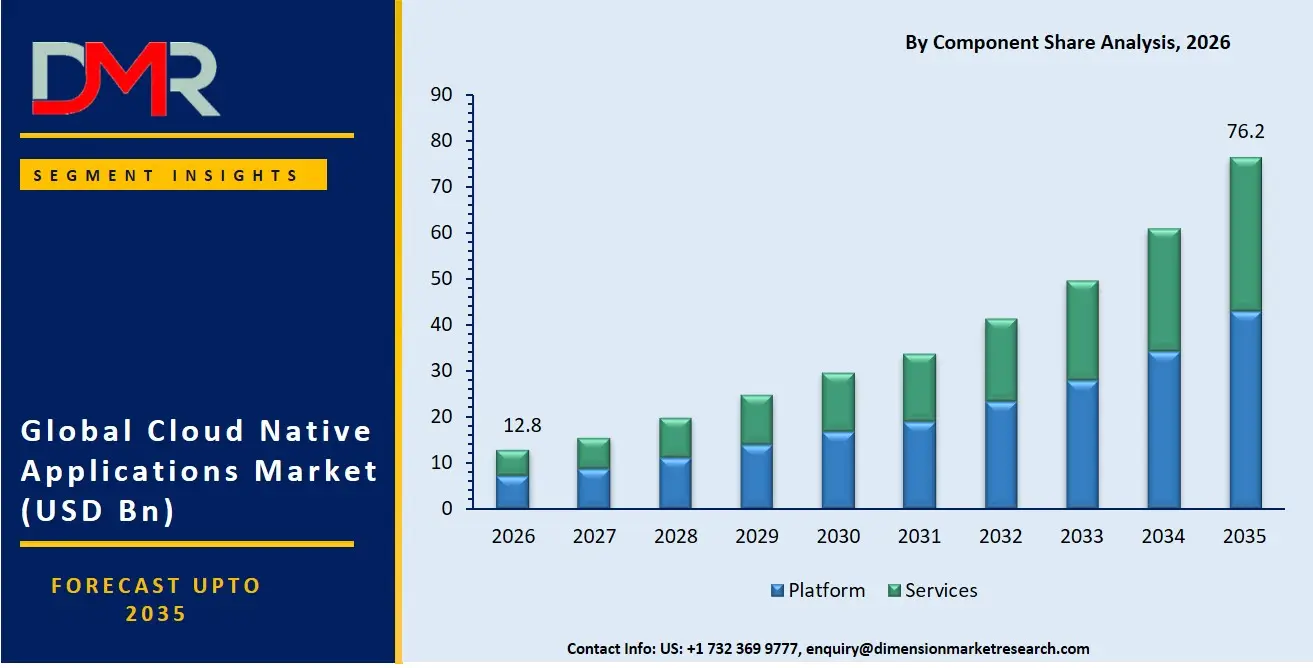
Platform dominates this segment with an estimated 56% share in 2026, driven by high demand for Kubernetes, container orchestration tools, and cloud-native development platforms. Enterprises increasingly prefer integrated platforms because they simplify deployment, improve scalability, and reduce operational complexity across hybrid environments.
ℹ
To learn more about this report –
Download Your Free Sample Report Here
These platforms also support faster application modernization and seamless CI/CD integration. Services, particularly managed services, are the fastest-growing segment due to rising outsourcing of cloud operations, increasing system complexity, and a persistent shortage of skilled cloud professionals. Organizations are increasingly relying on external experts to manage infrastructure, optimize performance, and ensure continuous system reliability.
By Deployment Model Analysis
Public cloud holds the largest share at 52% in 2026, supported by strong cost efficiency, on-demand scalability, and widespread adoption of leading ecosystems such as AWS, Azure, and Google Cloud. Enterprises prefer public cloud environments for rapid deployment, reduced capital expenditure, and global accessibility of applications. Hybrid cloud is the fastest-growing segment as organizations seek a balanced approach combining flexibility, security, and regulatory compliance across distributed environments. It enables seamless workload portability between private and public infrastructures. Private cloud continues to serve highly regulated industries like banking and government, where data control and security remain critical priorities.
By Organization Size Analysis
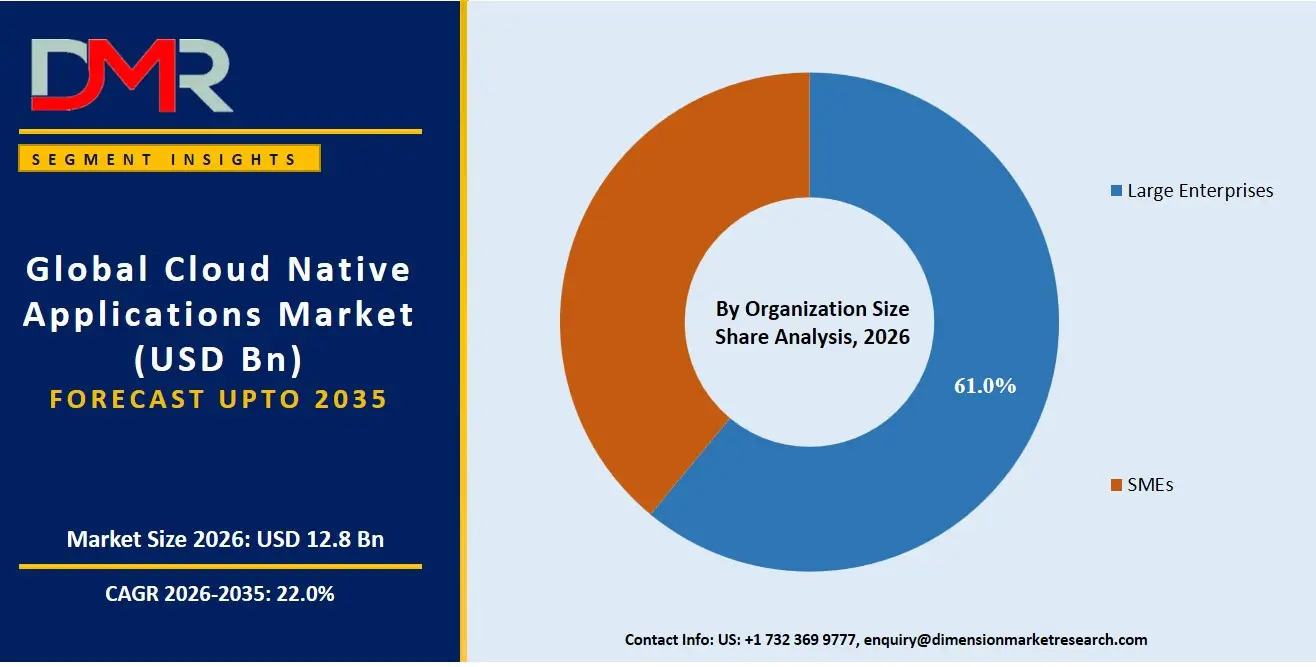
Large enterprises dominate with 61% market share in 2026, driven by significant IT budgets, large-scale digital transformation initiatives, and complex application modernization requirements. These organizations actively invest in cloud-native architectures to improve agility, scalability, and global service delivery. SMEs are the fastest-growing segment as cloud-native solutions become more accessible through managed services, low-code platforms, and subscription-based pricing models. This reduces entry barriers and enables smaller firms to adopt advanced technologies without heavy infrastructure investment. Growing competition and digital-first business models are further accelerating SME adoption across industries.
By Application Analysis
Enterprise applications lead with 38% share in 2026, driven by modernization of ERP systems, CRM platforms, and internal workflow automation tools. Organizations are shifting toward cloud-native architectures to improve operational efficiency, data integration, and system responsiveness. AI & Machine Learning applications are the fastest-growing segment due to increasing demand for intelligent automation, predictive analytics, and real-time decision-making across industries. These applications are enabling enterprises to extract deeper insights from data, enhance customer experiences, and optimize business operations through adaptive and self-learning systems integrated into cloud environments.
By End User Analysis
BFSI holds the largest share at 29% in 2026, driven by strong demand for secure, scalable, and real-time transaction processing systems. Financial institutions are heavily investing in cloud-native platforms to improve digital banking services, fraud detection, and regulatory compliance. Retail & e-commerce is the fastest-growing segment due to rapid growth in online transactions, omnichannel retail strategies, and increasing demand for personalized customer experiences. Cloud-native systems enable retailers to scale dynamically during peak demand periods while supporting advanced analytics, recommendation engines, and seamless customer engagement across digital platforms.
The Cloud Native Applications Market Report is segmented on the basis of the following:
By Component
- Platform
- Services
- Professional Services
- Managed Services
By Deployment Model
- Public Cloud
- Private Cloud
- Hybrid Cloud
By Organization Size
- Large Enterprises
- Small & Medium Enterprises (SMEs)
By Application
- Enterprise Applications
- Customer-Facing Applications
- DevOps & CI/CD
- API Management
- Data & Analytics Applications
- AI & Machine Learning Applications
- IoT Applications
By End User
- BFSI
- IT & Telecommunications
- Retail & E-commerce
- Healthcare & Life Sciences
- Manufacturing
- Government & Public Sector
- Media & Entertainment
- Energy & Utilities
- Transportation & Logistics
- Others
Regional Analysis
Leading Region in the Cloud Native Applications Market
ℹ
To learn more about this report –
Download Your Free Sample Report Here
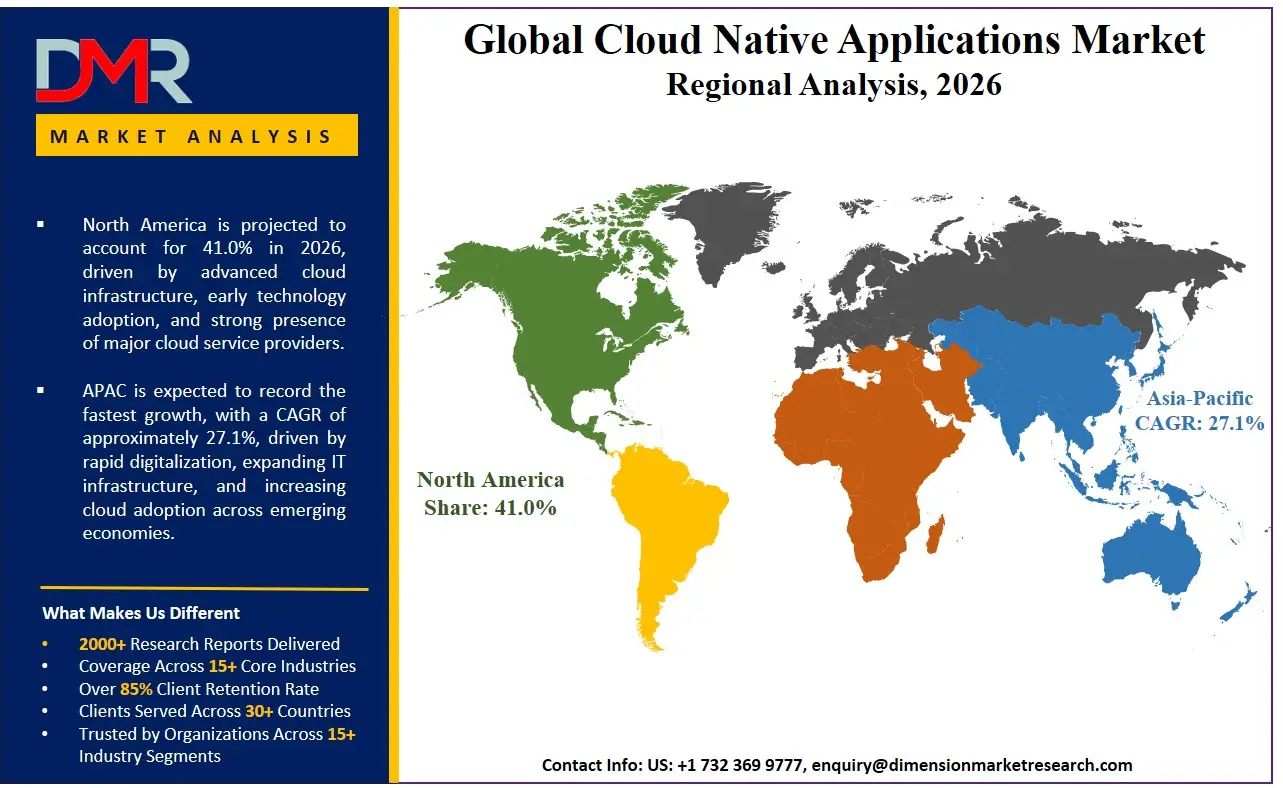
North America leads the market with an estimated 41% share in 2026, driven by advanced cloud infrastructure, early technology adoption, and strong presence of major cloud service providers. The US dominates regional growth due to widespread enterprise digital transformation and high DevOps maturity. Strong investment in AI integration, microservices, and Kubernetes ecosystems further strengthens dominance. Government support for cloud security standards and modernization initiatives also contributes to sustained leadership. The region continues to set global benchmarks in cloud-native application development and deployment strategies.
Fastest Growing Region in the Cloud Native Applications Market
Asia Pacific is the fastest-growing region due to rapid digitalization, expanding IT infrastructure, and increasing cloud adoption across emerging economies like India, China, and Southeast Asia. Government initiatives supporting digital transformation, smart cities, and industrial automation are key drivers. Rising startup ecosystems and growing SME adoption further accelerate demand. Additionally, increasing investments in 5G, AI, and IoT technologies are enhancing cloud-native adoption, making the region a major future growth hub for the global market.
By Region
North America
Europe
- Germany
- The U.K.
- France
- Italy
- Russia
- Spain
- Benelux
- Nordic
- Rest of Europe
Asia-Pacific
- China
- Japan
- South Korea
- India
- ANZ
- ASEAN
- Rest of Asia-Pacific
Latin America
- Brazil
- Mexico
- Argentina
- Colombia
- Rest of Latin America
Middle East & Africa
- Saudi Arabia
- UAE
- South Africa
- Israel
- Egypt
- Rest of MEA
Competitive Landscape
The cloud native applications market is highly competitive, driven by rapid innovation, open-source collaboration, and continuous platform enhancements. Companies focus on strengthening their Kubernetes ecosystems, improving DevOps toolchains, and expanding multi-cloud capabilities. Strategic partnerships, acquisitions, and R&D investments are key approaches to gaining market advantage. Vendors are also emphasizing security, automation, and AI integration to differentiate offerings. High switching costs and technical complexity create moderate entry barriers, favoring established ecosystem players while still allowing niche innovators to grow through specialized solutions.
Some of the prominent players in the global Cloud Native Applications are:
- Amazon Web Services (AWS)
- Microsoft
- Google
- IBM
- Oracle
- Red Hat
- VMware
- SUSE
- Cisco Systems
- Broadcom
- Nutanix
- Docker
- Mirantis
- HashiCorp
- CloudBees
- GitLab
- JFrog
- Dynatrace
- Datadog
- New Relic
- Other Key Players
Recent Developments
- In June 2025, Microsoft Azure announced new AI-powered DevOps capabilities within its cloud-native ecosystem, enabling predictive pipeline optimization and automated failure detection. This initiative enhances continuous delivery workflows and reduces deployment downtime for enterprise applications. The integration supports microservices-based architectures and improves developer productivity through intelligent automation tools. It also strengthens Azure's position in the competitive cloud-native market by combining AI with infrastructure orchestration and application lifecycle management.
- In March 2025, Google Cloud introduced major enhancements to its Kubernetes Engine, focusing on improved workload scalability, AI-driven monitoring, and simplified multi-cluster management. The update aims to strengthen enterprise adoption of cloud native architectures by reducing operational complexity and improving reliability. This development supports hybrid and multi-cloud deployments, enabling organizations to manage distributed workloads more efficiently. The enhancement also integrates deeper security controls and automated patching features, reflecting increasing demand for secure and autonomous cloud-native infrastructure.
- In January 2025, Amazon Web Services rolled out enhancements to its serverless container offerings, allowing developers to deploy microservices without managing underlying infrastructure. The update improves scalability, cost efficiency, and deployment speed for cloud-native applications. It also supports deeper integration with Kubernetes-based environments and expands support for hybrid cloud deployments. This development reflects the growing demand for flexible, event-driven architectures in enterprise applications across industries.
Report Details
| Report Characteristics |
| Market Size (2026) |
USD 12.8 Bn |
| Forecast Value (2035) |
USD 76.2 Bn |
| CAGR (2026–2035) |
22.0% |
| Historical Period |
2021 – 2025 |
| Forecast Period |
2027 – 2035 |
| Base Year |
2025 |
| Estimate Year |
2026 |
| Segments Covered |
By Component, By Deployment Model, By Organization Size, By Application, By End User |
| Regional Coverage |
North America – The US and Canada; Europe – Germany, The UK, France, Russia, Spain, Italy, Benelux, Nordic, & Rest of Europe; Asia-Pacific – China, Japan, South Korea, India, ANZ, ASEAN, Rest of APAC; Latin America – Brazil, Mexico, Argentina, Colombia, Rest of Latin America; Middle East & Africa – Saudi Arabia, UAE, South Africa, Turkey, Egypt, Israel, & Rest of MEA |
Frequently Asked Questions
How big is the Cloud Native Applications Market?
▾ The Cloud Native Applications Market size is expected to reach USD 12.8 billion by 2026 and is projected to reach USD 76.2 billion by the end of 2035.
What is the CAGR of the Cloud Native Applications Market from 2026 to 2035?
▾ The market is growing at a CAGR of 22.0 percent over the forecasted period.
What factors are driving the growth of the Cloud Native Applications Market?
▾ Accelerating Cloud Migration and Digital Transformation, and more are the factors driving the growth of the Cloud Native Applications Market.
What are the major trends in the Cloud Native Applications Market?
▾ Rise of Serverless Computing and Microservices, and more are some of the major trends in the market.
Who are the key players in the Cloud Native Applications Market?
▾ Some of the key players in the Cloud Native Applications Market include Google, AWS, IBM, and more.
How is the Cloud Native Applications Market segmented?
▾ The Cloud Native Applications Market is segmented by component, deployment model, organization size, application, end user.
Which region held the largest share of the Cloud Native Applications Market in 2026?
▾ North America is set to lead the Cloud Native Applications Market with an estimated 41.0% share in 2026.
Which region is expected to grow the fastest in the Cloud Native Applications Market?
▾ Asia Pacific is the fastest-growing region in the Cloud Native Applications Market during the forecast period.