Market Snapshot
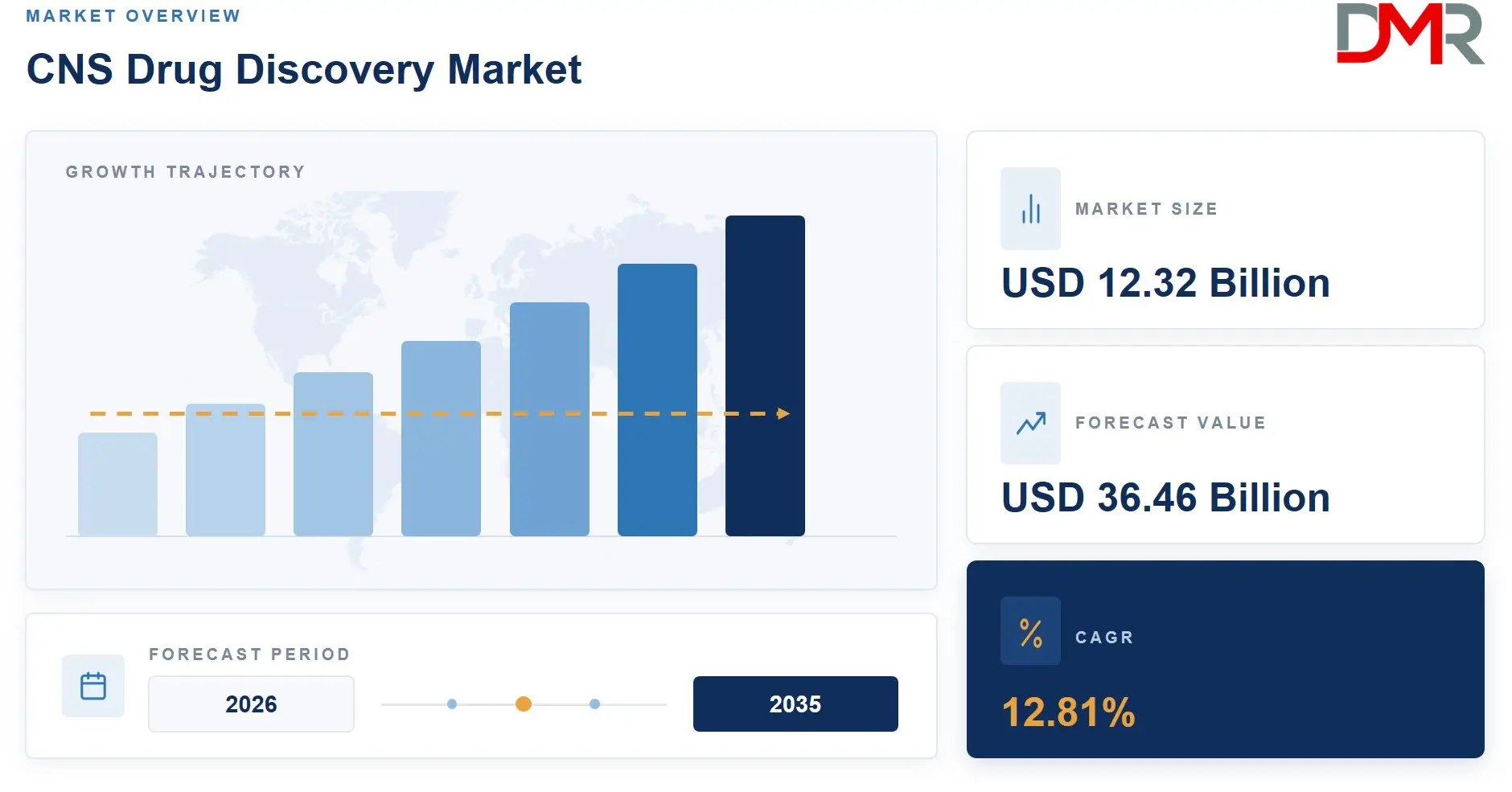
- The market size is USD 10.92 Billion in 2025, reached USD 12.32 Billion in 2026, and is projected to hit USD 36.46 Billion by 2035 at a CAGR of 12.81%.
- By Drug Type: Small Molecules led with a 54.82% share in 2025.
- By Indication: Alzheimer's Disease led with a 28.26% share in 2025.
- By Discovery Stage: Preclinical Development led with a 30.25% share in 2025.
- By Technology: High Throughput Screening (HTS) led with a 32.36% share in 2025.
- By End User: Pharmaceutical Companies led with a 49.28% share in 2025.
- By Region: North America led with a 43% share, valued at USD 4.70 Billion, in 2025.
- AI-enabled platforms and CRISPR-based technologies represent the fastest-growing technology categories in the discovery stack.
Market Overview
The CNS drug discovery market covers the full range of research and development activities directed at identifying, validating, and advancing therapeutic candidates for neurological and psychiatric conditions. The scope includes small molecules, biologics, gene therapies, and cell therapies across indications from Alzheimer's disease and Parkinson's disease to epilepsy, schizophrenia, and depression. Diagnostics, imaging tools, and purely clinical-stage programs without active discovery components fall outside this boundary.
Alzheimer's disease represents the single largest burden within this space. As the primary cause of dementia, it accounts for 60–80% of all dementia cases worldwide, as confirmed by EXCLI 2025, which creates a structurally captive demand for discovery programs focused on amyloid, tau, and neuroinflammatory targets. The scale of unmet need positions this indication as the central organizing force behind portfolio decisions at major pharmaceutical companies.
In September 2024, the FDA approved Bristol Myers Squibb's Cobenfy (xanomeline-trospium) for schizophrenia, marking the first approval built on a genuinely new mechanism in over 70 years. Approvals of this nature signal that the CNS discovery field is moving beyond incremental refinement of existing receptor targets. Platform diversification, including RNA-based modalities and AI-guided target identification, is pulling early-stage investment toward candidates with differentiated biological rationale rather than established receptor profiles.
Market Size and Forecast
The Global CNS Drug Discovery Market size is estimated at USD 12.32 Billion in 2026 from USD 10.92 Billion in 2025, and is projected to reach USD 36.46 Billion by 2035, exhibiting a CAGR of 12.81% during the forecast period.
Growth through the early forecast years reflects a convergence of factors rooted in the 2022–2024 period. Pipeline reinvestment following several high-profile late-stage failures accelerated early-stage activity. Pharmaceutical companies shifted capital toward target identification and lead optimization rather than late clinical-stage bets. This structural reallocation supports durable demand across discovery service providers, technology platform vendors, and academic-industry partnerships.
ℹ
To learn more about this report –
Download Your Free Sample Report Here
In November 2025, the FDA approved J&J's Caplyta (lumateperone) as adjunctive therapy for major depressive disorder, based on positive Phase 3 results from Study 501 and Study 502. Approvals at this stage validate the discovery programs that preceded them by a decade, reinforcing confidence in CNS pipelines currently at preclinical and lead optimization stages. Upside to the 12.81% CAGR forecast depends on continued regulatory receptiveness to novel CNS mechanisms and sustained private funding for AI-native discovery platforms.
Drug Type Analysis
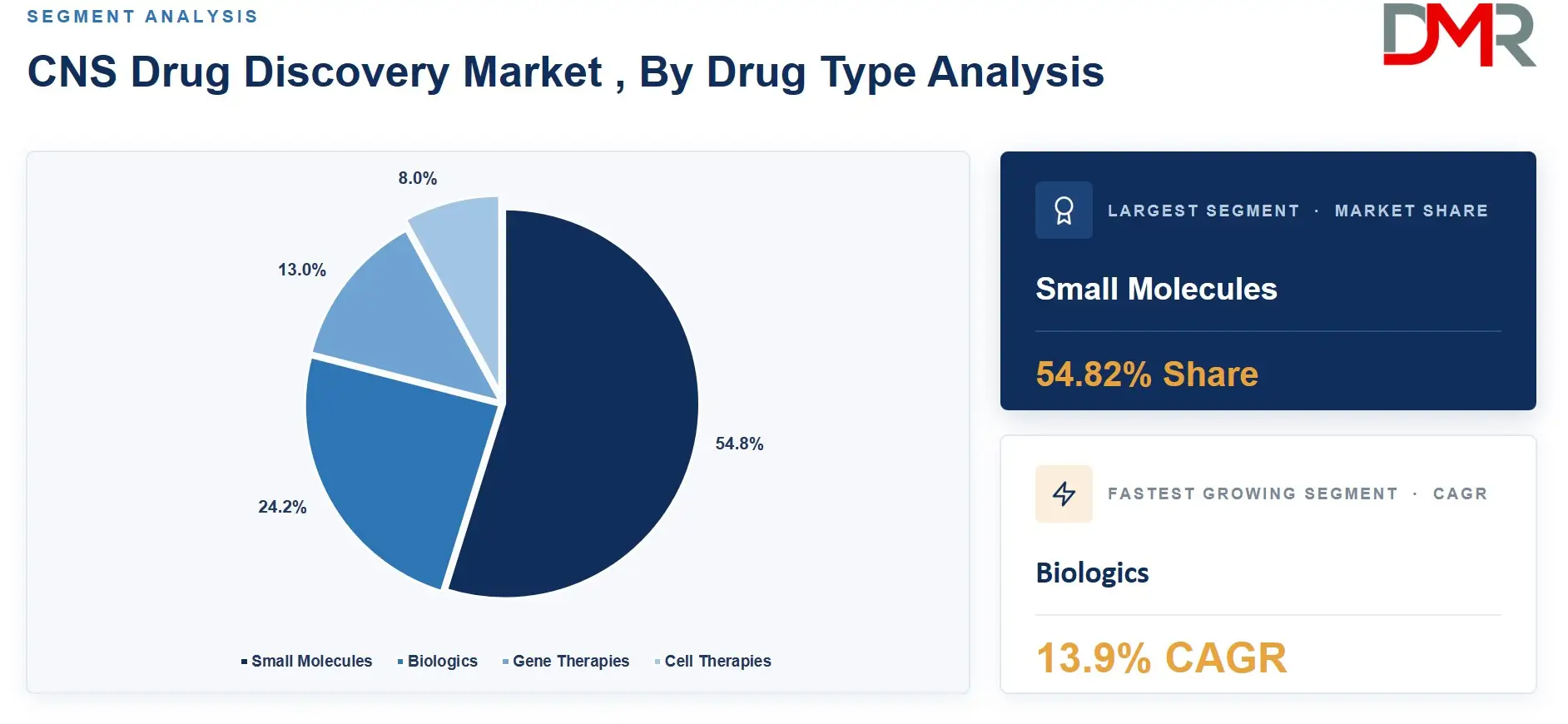
Small Molecules accounted for 54.82% of Drug Type demand in 2026, the highest of any category.
Small molecules retain dominance because they address the most fundamental commercial constraint in CNS drug delivery: blood-brain barrier (BBB) penetration. Established medicinal chemistry toolkits, decades of formulation data, and lower manufacturing complexity relative to biologics give small molecules a durable cost and speed advantage. Pharmaceutical companies allocating capital to CNS programs continue to anchor their portfolios here, even as the field diversifies.
ℹ
To learn more about this report –
Download Your Free Sample Report Here
Biologics represent the fastest-growing drug type segment, driven by receptor-specific antibodies and antisense oligonucleotides entering CNS programs at an accelerating rate. Gene therapies and cell therapies remain the smallest categories by revenue but carry outsized pipeline significance. Both require breakthrough delivery technologies to cross the BBB at therapeutic concentrations. Success by even one program in these modalities would shift investment flows substantially, making them high-risk but strategically important categories for vendors building discovery infrastructure.
Indication Analysis
With a 28.26% share in 2026, Alzheimer's Disease outpaced all other Indication categories.
Alzheimer's commands the largest share because it presents the broadest patient population, the deepest commercial incentive, and the longest unresolved discovery history. Every new amyloid-adjacent or tau-targeting program extends the upstream market for assay developers, biomarker companies, and preclinical model providers. Alzheimer's alone sustains multiple parallel technology platforms within the same discovery cycle.
Parkinson's disease and epilepsy follow as the next-largest indication segments, with established drug classes providing reference frameworks for candidate evaluation. Multiple sclerosis discovery activity is increasingly separating from broader CNS programs as immunology platforms take a larger role. Schizophrenia gained fresh commercial validation from the Cobenfy approval, which may redirect discovery investment toward muscarinic and glycinergic targets that were previously deprioritized. Depression and anxiety disorders represent the largest patient volume of any CNS category but carry among the highest Phase 2 attrition rates, making early-stage discovery returns difficult to project with confidence.
Discovery Stage Analysis
Preclinical Development led the Discovery Stage segment with a 30.25% share in 2026.
Preclinical development leads because it is the stage where candidate compounds face the widest suite of evaluations before entering human trials. CNS programs spend disproportionately long periods here relative to other therapeutic areas, given the complexity of central nervous system pharmacology and the difficulty of translating animal model data to clinical outcomes. Service providers and platform vendors serving this stage benefit from high repeat demand across multiple compound iterations.
Target identification and validation, while earlier in the workflow, is the stage most actively disrupted by AI platforms. Lead identification and lead optimization complete the discovery funnel, with lead optimization carrying the highest per-compound cost. Vendors operating across all four stages increasingly compete on data integration capability rather than assay throughput alone. Programs that can link genomic profiling at target identification to ADMET prediction at lead optimization represent a structurally differentiated offering for pharmaceutical clients prioritizing capital efficiency.
Technology Analysis
High Throughput Screening (HTS) captured 32.36% of the Technology segment in 2026, ahead of all rivals.
HTS retains the largest share because it serves as the primary screening layer for compound libraries in both early and later lead identification phases. The installed base of HTS infrastructure at pharmaceutical companies and CROs creates a high switching cost that newer platforms must overcome with clear efficacy advantages, not just theoretical superiority. Vendors supplying reagents, robotics, and software to HTS operations benefit from this institutional inertia.
Genomics and proteomics platforms are growing fastest among established technology categories, powered by falling sequencing costs and better multi-omics integration tools. AI-enabled drug discovery is the highest-growth segment by investment activity and strategic partnership volume, though its revenue share remains below HTS at this stage. Biomarker-based discovery is gaining traction because regulators now accept biomarker-defined patient populations as endpoints in some CNS studies. CRISPR and gene editing platforms remain the smallest technology segment by revenue but are expanding rapidly in target validation workflows, where their precision in gene knockout and insertion offers capabilities no legacy platform can replicate.
End User Analysis
A 49.28% share made Pharmaceutical Companies the clear leader across End User categories in 2026.
Pharmaceutical companies lead because they fund, direct, and ultimately commercialize the majority of CNS candidates across the discovery pipeline. Their share reflects both internal discovery programs and externally contracted work placed with CROs and academic partners. Capital allocation by this group sets the demand ceiling for every other end user category below it.
Biotechnology companies hold the second-largest share and are the primary source of novel discovery programs at the preclinical stage. Academic and research institutes generate foundational target identification and validation work, which feeds both biotech spinouts and in-licensing pipelines at pharmaceutical firms. Contract Research Organizations are the fastest-growing end user segment, as pharmaceutical and biotech firms shift fixed research costs to variable-cost outsourcing models. CRO growth is structurally linked to the broader trend of pharmaceutical companies narrowing internal R&D to core therapeutic franchises while outsourcing peripheral discovery activities.
Key Market Segments
By Drug Type
- Small Molecules
- Biologics
- Gene Therapies
- Cell Therapies
By Indication
- Alzheimer's Disease
- Parkinson's Disease
- Epilepsy
- Multiple Sclerosis
- Schizophrenia
- Depression and Anxiety Disorders
By Discovery Stage
- Preclinical Development
- Target Identification and Validation
- Lead Identification
- Lead Optimization
By Technology
- High Throughput Screening (HTS)
- Genomics and Proteomics
- AI-enabled Drug Discovery
- Biomarker-based Discovery
- CRISPR and Gene Editing Platforms
By End User
- Pharmaceutical Companies
- Biotechnology Companies
- Academic and Research Institutes
- Contract Research Organizations (CROs)
Regional Analysis
North America led all regions with a 43% revenue share in 2026, valued at USD 4.70 Billion.
North America's lead reflects decades of concentrated pharmaceutical and biotech infrastructure, particularly across the US Northeast and West Coast corridors. The US market alone was valued at USD 4.21 Billion in 2025 with a CAGR of 11.8% through 2035, as per data from the report. Federal funding through NIH, combined with the deepest private venture capital base for neuroscience programs globally, sustains a discovery ecosystem that no other region currently replicates at scale.
Over 6 million strokes occur annually worldwide, and more than 80% of stroke-related deaths occur in low- and middle-income nations, according to EXCLI 2025. This burden concentration in Asia Pacific, Latin America, and parts of Africa signals a structural gap between where neurological disease incidence is rising fastest and where discovery investment currently flows. Asia Pacific is the fastest-growing region and carries the highest long-term upside, led by China's expanding biotech sector, South Korea's CRO capability build-out, and India's growing pool of neuroscience research talent.
ℹ
To learn more about this report –
Download Your Free Sample Report Here
Europe holds the second-largest share, with Germany and the UK hosting both established pharmaceutical R&D centers and a growing cluster of AI-native discovery startups. Latin America and the Middle East and Africa regions remain underpenetrated relative to disease burden, representing early-mover opportunities for CROs and platform vendors willing to establish regional footprints ahead of the forecast curve.
Key Regions and Countries
North America
Europe
- Germany
- France
- The UK
- Spain
- Italy
- Rest of Europe
Asia Pacific
- China
- Japan
- South Korea
- India
- Australia
- Rest of APAC
Latin America
- Brazil
- Mexico
- Rest of Latin America
Middle East & Africa
- GCC
- South Africa
- Rest of MEA
Market Dynamics
Driver: Neurological Disease Burden Creating Sustained Discovery Investment
CNS disease-modifying therapies have recorded a 100% failure rate across all approved programs to date, as confirmed by EXCLI 2025. That failure record does not suppress investment. Instead, it redirects capital toward earlier-stage discovery, where target diversity and platform differentiation offer the only credible path to breaking the attrition pattern. Pharmaceutical companies responding to this reality are expanding preclinical and target validation budgets rather than waiting to license late-stage assets.
In August 2024, AbbVie completed its $8.7 billion acquisition of Cerevel Therapeutics, folding a CNS-focused pipeline of dopamine and GABA-receptor programs into its neuroscience franchise. A deal of this scale at a time of high clinical failure rates signals that pharmaceutical acquirers see early-pipeline CNS assets as undervalued relative to their probability-adjusted potential. Discovery platform vendors and CROs serving these programs benefit directly from portfolio consolidation at the acquirer level, as newly integrated pipelines typically accelerate outsourcing activity.
Restraint: High Attrition and Cost Ceilings Limiting Risk Appetite
Bringing a new drug to market normally takes over ten years and costs more than $2 billion, and only about 1 in 10 candidates reaches approval, as reported by ELEKS 2025. CNS programs carry attrition rates well above this average, making return-on-investment timelines for early-stage discovery programs among the longest in biopharmaceuticals. Smaller biotechnology companies without deep capital reserves face structural barriers to sustaining multi-year CNS discovery programs independently.
ADMET characteristics, covering absorption, distribution, metabolism, excretion, and toxicity, account for approximately 50% of all clinical failures across drug classes, according to EXCLI 2025. CNS candidates face a compounded version of this challenge because any compound must cross the blood-brain barrier and maintain CNS-appropriate pharmacokinetics before ADMET profiling even becomes the limiting factor. Preclinical model providers that cannot bridge this predictive gap are losing mandates to platforms offering integrated BBB permeability and ADMET prediction from the same dataset.
Opportunity: Precision Neurology and AI Platforms Reshaping Commercial Potential
AI-discovered molecules are predicted to complete all clinical phases at a success rate of 9–18%, compared to a baseline of 5–10% for traditionally discovered candidates, as reported by ELEKS 2025. Doubling clinical success probability at the front end of discovery changes the economics of CNS investment materially. A pipeline of 20 AI-screened candidates at 15% success yields 3 approved drugs; the same pipeline at 7% yields fewer than 2. Platform vendors that can demonstrate this differential credibly are repositioning from cost-reduction tools to revenue-generation enablers.
In February 2026, Recursion Pharmaceuticals received a $4 million milestone payment from Sanofi for an oncology program, bringing total payments from that partnership to $134 million, alongside $754 million in company cash. Recursion's milestone progression demonstrates that AI-native discovery firms can generate milestone-based revenue well before any program reaches approval. For CNS-focused peers, the Recursion-Sanofi model represents a commercial template for monetizing discovery infrastructure without waiting for late-stage clinical outcomes.
Market Trends
AI and Multi-Omics Convergence Redefining CNS Discovery Speed
Insilico Medicine reached a preclinical candidate in 18 months using AI-guided discovery, while Exscientia designed a PKC-Theta inhibitor in just 11 months, compared to a traditional timeline of 3–6 years per program, as confirmed by ELEKS 2025. Multi-omics integration is accelerating target identification by linking genomic, proteomic, and metabolomic datasets into unified disease models. RNA-based and gene-modulating therapeutics are entering mainstream CNS pipelines faster than prior RNA delivery limitations would have predicted, narrowing the gap between platform capability and clinical application.
Market Competition Overview
The CNS drug discovery market is moderately consolidated at the top, with a small group of large-cap pharmaceutical companies holding diversified CNS pipelines, while the mid-tier is populated by specialized biotechs and AI-native discovery firms. Large incumbents compete primarily through pipeline breadth, regulatory experience, and manufacturing scale. Mid-tier biotechs differentiate on platform specificity, whether around a single target class, a modality, or a disease subtype.
Acquisition activity is the primary mechanism of competitive repositioning in CNS Drug Discovery Market . Companies unable to build CNS capability organically are buying it, while smaller biotechs are using platform credibility to attract either acquirers or large-pharma partnerships. AI-native discovery firms are gaining share in the technology layer of the competitive stack, offering timeline compression and candidate filtering capabilities that legacy screening infrastructure cannot replicate at equivalent cost. The most contested competitive space currently sits at the intersection of target identification, AI-enabled lead selection, and biomarker-defined patient stratification.
Company Profiles
Eli Lilly and Company has positioned its CNS franchise around amyloid-targeting programs, most visibly through its Alzheimer's therapy Kisunla (donanemab), which gained FDA approval in 2024 after years of contested clinical evidence. Lilly's competitive advantage lies in its ability to sustain multi-decade CNS investment cycles, absorbing late-stage failures without retreating from the indication. The risk embedded in Lilly's positioning is concentration: a large portion of its CNS pipeline value rests on continued commercial validation of the amyloid hypothesis, which remains scientifically contested among neurologists.
In April 2025, Johnson & Johnson Innovative Medicine completed its acquisition of Intra-Cellular Therapies, folding Caplyta (lumateperone) into its CNS portfolio across schizophrenia and bipolar disorder. In June 2025, Insilico Medicine closed an oversubscribed Series E at $123 million in a pre-IPO raise that valued the company above $1 billion, underscoring investor confidence in its generative AI discovery platform. J&J's strategy centers on acquiring validated CNS assets with proven revenue, while Insilico represents the platform-first model where discovery infrastructure itself is the commercial asset.
Key Players
- Eli Lilly and Company
- Roche
- Novartis
- Pfizer
- AbbVie
- Biogen
- Bristol Myers Squibb
- Johnson & Johnson Innovative Medicine
- Otsuka Pharmaceutical
- Takeda Pharmaceutical
- UCB
- Neurocrine Biosciences
- Acadia Pharmaceuticals
- Denali Therapeutics
- Alkermes
- Insilico Medicine
- Deep Science Ventures
Recent Developments
- January 2025, Johnson & Johnson announced a $14.6 billion acquisition of CNS specialist Intra-Cellular Therapies at $132 per share, gaining schizophrenia and bipolar drug Caplyta (lumateperone).
- October 2024, Lundbeck agreed to acquire Longboard Pharmaceuticals for approximately $2.6 billion ($60 per share), securing bexicaserin, a 5-HT2C agonist targeting rare seizure disorders.
- June 2025, Supernus Pharmaceuticals agreed to acquire Sage Therapeutics for up to $795 million ($8.50 per share upfront plus a $3.50 milestone), surpassing Biogen's rejected $469 million bid from January 2025.
- July 2025, Supernus Pharmaceuticals completed the Sage Therapeutics acquisition, strengthening its neuropsychiatric portfolio.
- March 2025, Insilico Medicine announced a $110 million Series E round to advance its generative AI drug discovery pipeline.
Report Details
| Report Characteristics |
| Market Value (2025) |
USD 10.92 Billion |
| Market Value (2026) |
USD 12.32 Billion |
| Forecast Revenue (2035) |
USD 36.46 Billion |
| CAGR (2026–2035) |
12.81% |
| Base Year for Estimation |
2025 |
| Historic Period |
2020 – 2024 |
| Forecast Period |
2026 – 2035 |
| Report Coverage |
Revenue Forecast, Market Dynamics, Competitive Landscape, Recent Developments |
| Segments Covered |
By Drug Type (Small Molecules, Biologics, Gene Therapies, Cell Therapies), By Indication (Alzheimer's Disease, Parkinson's Disease, Epilepsy, Multiple Sclerosis, Schizophrenia, Depression and Anxiety Disorders), By Discovery Stage (Preclinical Development, Target Identification and Validation, Lead Identification, Lead Optimization), By Technology (High Throughput Screening, Genomics and Proteomics, AI-enabled Drug Discovery, Biomarker-based Discovery, CRISPR and Gene Editing Platforms), By End User (Pharmaceutical Companies, Biotechnology Companies, Academic and Research Institutes, Contract Research Organizations) |
| Regional Analysis |
North America – US and Canada; Europe – Germany, France, The UK, Spain, Italy, and Rest of Europe; Asia Pacific – China, Japan, South Korea, India, Australia, and Rest of APAC; Latin America – Brazil, Mexico, and Rest of Latin America; Middle East & Africa – GCC, South Africa, and Rest of MEA |
| Competitive Landscape |
Eli Lilly and Company, Roche, Novartis, Pfizer, AbbVie, Biogen, Bristol Myers Squibb, Johnson & Johnson Innovative Medicine, Otsuka Pharmaceutical, Takeda Pharmaceutical, UCB, Neurocrine Biosciences, Acadia Pharmaceuticals, Denali Therapeutics, Alkermes, Insilico Medicine, Deep Science Ventures |
| Customization Scope |
Customization for segments and region or country level will be provided. Additional customization can be done based on requirements. |
| Purchase Options |
Three license options: Single User License, Multi-User License (Up to 5 Users), and Corporate Use License (Unlimited Users and Printable PDF) |
Frequently Asked Questions
What is the biggest investment opportunity in CNS Drug Discovery Market ?
▾ AI-enabled discovery platforms represent the highest-return investment category. Predicted clinical success rates for AI-discovered molecules of 9–18% versus 5–10% for traditionally discovered candidates fundamentally change pipeline economics. Vendors demonstrating this improvement credibly are attracting both venture capital and large-pharma partnership mandates ahead of the consolidation curve.
Who are the top companies in CNS Drug Discovery Market ?
▾ Eli Lilly and Company, Johnson & Johnson Innovative Medicine, AbbVie, Biogen, Bristol Myers Squibb, Roche, Novartis, and Pfizer are among the largest CNS-active pharmaceutical players. Insilico Medicine and Denali Therapeutics lead among platform-first and biotech-focused entrants. The competitive set also includes CRO-adjacent firms and academic spinouts building on AI and multi-omics discovery infrastructure.
Which segment is growing fastest in CNS Drug Discovery Market and why?
▾ AI-enabled drug discovery is the fastest-growing technology segment, driven by demonstrated timeline compression from years to months in target-to-candidate workflows. Among end user categories, Contract Research Organizations are growing fastest as pharmaceutical companies shift fixed R&D costs to variable outsourcing models. Both trends are compounding simultaneously, benefiting platform vendors positioned at their intersection.
Which region is growing fastest in CNS Drug Discovery Market and why?
▾ Asia Pacific is the fastest-growing region, led by China's expanding biotech sector, South Korea's CRO build-out, and India's neuroscience research base. The region also carries the highest unmet neurological disease burden relative to current discovery investment. Early-mover platform vendors and CROs establishing APAC operations before 2028 are well-positioned to capture outsized share as regional pharmaceutical R&D spending scales.
What is the biggest challenge holding CNS Drug Discovery Market back?
▾ High clinical attrition is the primary structural constraint. CNS disease-modifying programs have recorded a 100% failure rate historically, and conventional preclinical models cannot reliably predict human CNS outcomes. Without better translational tools, pharmaceutical investors remain cautious about committing capital to early-stage CNS programs that carry a decade-plus path to any commercial return.