Market Overview
The collapsible recycled plastic packaging market covers transport and logistics containers manufactured from post-consumer or post-industrial recycled polymers, including rHDPE, rPP, and rPET, that fold or knock down when empty to reduce return-trip volume. The market excludes single-use plastic packaging, virgin-resin containers, and rigid non-collapsible packaging formats. Buyers span food and beverage logistics, automotive supply chains, pharmaceutical handling, agriculture, and e-commerce distribution, where repeated asset pooling drives total cost of ownership below single-use alternatives.
A 2025 peer-reviewed lifecycle assessment found that the reusable-plastic-crate approach emitted 78.5% less CO₂ than equivalent single-use packaging across a comparable functional unit, as reported in the Queen's University Belfast academic review. That emissions gap is now a procurement lever, not merely a sustainability credential. Corporate scope 3 reporting requirements push procurement teams to quantify transport packaging emissions, and collapsible recycled formats offer a documented reduction pathway that single-use cardboard cannot match.
IFCO's 2025 ESG Report disclosed that its reusable packaging model had replaced more than 10 billion single-use boxes globally since the company's founding, a scale milestone that signals the category has moved well beyond pilot programs into mainstream fresh-grocery supply chains. Pooled reusable systems now compete directly with contract packaging and pallet rental networks, reshaping how logistics operators calculate asset utilization and reverse-supply-chain costs.
Key Takeaways
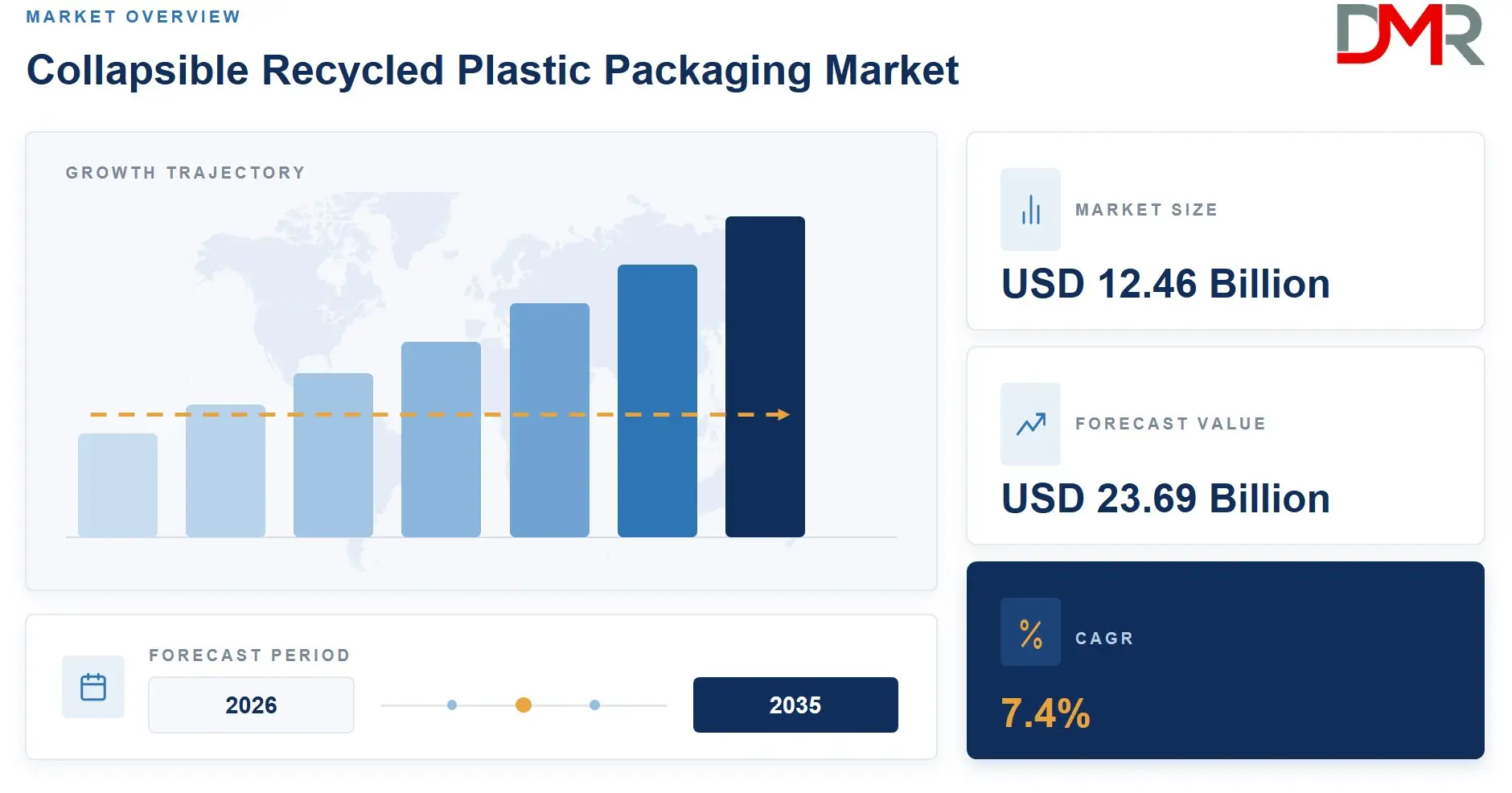
- The market size is USD 12.46 Billion in 2026, and is projected to hit USD 23.69 Billion by 2035 at a CAGR of 7.4%.
- By Material: Recycled High-Density Polyethylene (rHDPE) led as the largest category with a 45.1% share in 2026.
- By Product Type: Collapsible Pallets led as the largest category with a 46.2% share in 2026.
- By End Use: Food & Beverage Logistics led as the largest category with a 40.2% share in 2026.
- By Region: Asia Pacific led with a 40.6% share, valued at USD 4.70 Billion, in 2026.
- The May 2025 merger announcement between IPL and Schoeller Allibert, creating a combined entity with more than USD 1.4 Billion in pro-forma 2024 revenue, signals accelerating consolidation among tier-one reusable packaging manufacturers.
Market Size and Forecast
The Global Collapsible Recycled Plastic Packaging Market size is estimated at USD 12.46 Billion in 2026, and is projected to reach USD 23.69 Billion by 2035, exhibiting a CAGR of 7.4% during the forecast period.
Historical growth in Collapsible Recycled Plastic Packaging Market tracks directly with the expansion of closed-loop pooling networks across food retail, automotive, and pharmaceutical logistics. Operators replacing single-use cardboard and wooden pallet systems with pooled collapsible plastic formats generated a durable demand base through the early 2020s. The 7.4% CAGR reflects a forecast built on two compounding inputs: rising mandated recycled-content requirements across Europe and North America, and the steady commercial maturation of asset-pooling business models that convert capital expenditure on packaging into a per-trip operational fee.
ℹ
To learn more about this report –
Download Your Free Sample Report Here
Regulatory deadlines sharpen the forecast trajectory on the upside. In July 2026, IFCO provided customers with formal Declaration of Conformity documentation for its packaging types ahead of the EU Packaging and Packaging Waste Regulation's August 12, 2026 application date. Vendors that completed compliance documentation before the PPWR deadline secured a near-term advantage over competitors still preparing certification. A downside scenario exists if raw material costs for recycled polymers spike significantly, narrowing the cost advantage over virgin-resin formats and slowing fleet expansion decisions among mid-sized logistics operators.
Material Analysis
Recycled High-Density Polyethylene (rHDPE) accounted for 45.1% of material demand in 2026, the highest of any category.
rHDPE dominates because its mechanical properties translate directly into structural performance under the stacking loads and repeat-handling cycles that define pooled transport packaging. Supply chains running automated sortation and cold-chain operations rely on dimensional stability that rHDPE consistently delivers at post-consumer recycled grades. Buyers in food logistics and automotive parts handling specify rHDPE containers as a default because the material's resistance to moisture, temperature cycling, and chemical exposure reduces reject rates during reconditioning.
Recycled Polypropylene (rPP) holds the second position and gains share in lighter-duty collapsible tote and crate formats where weight reduction per trip matters more than maximum stacking load. Recycled Polyethylene Terephthalate (rPET) remains a smaller category concentrated in collapsible bottle formats and specialty consumer-facing packaging where clarity and brand presentation carry weight alongside sustainability credentials. Craemer's February 2026 launch of the CB3 Low pallet box extended the industrial-grade heavy-duty plastic pallet box segment into food processing and metalworking applications, illustrating how material formulation choices are widening the addressable scope of recycled-content formats beyond traditional fresh-produce logistics.
Product Type Analysis
With a 46.2% share in 2026, Collapsible Pallets outpaced all other product type categories.
Collapsible pallets anchor the market because pallets sit at the intersection of every supply chain node, from manufacturer to distribution center to retail floor. The pallet segment's scale advantage over crates and IBCs reflects the universal need to standardize load units across automated warehouse systems, transport fleets, and retail back-of-house operations. Recycled-content collapsible pallets now compete directly against wooden pallets on total lifecycle cost, particularly where return logistics costs are captured.
Foldable Intermediate Bulk Containers (IBCs) serve chemical handling, agricultural inputs, and liquid food applications where containment volume and cleanability outrank pallet-format standardization. Collapsible Crates and Foldable Totes represent the highest-velocity growth sub-segment within fresh produce and food retail, driven by pooling operators expanding into new geographies and crop categories. Collapsible Bottles and Tubes address niche dispensing and personal-care logistics use cases. Knock-Down Bulk Bins and Foldable Pallet Boxes serve heavy industrial and manufacturing applications where part count and weight per load unit define the business case for switching from single-trip wooden alternatives.
End Use Analysis
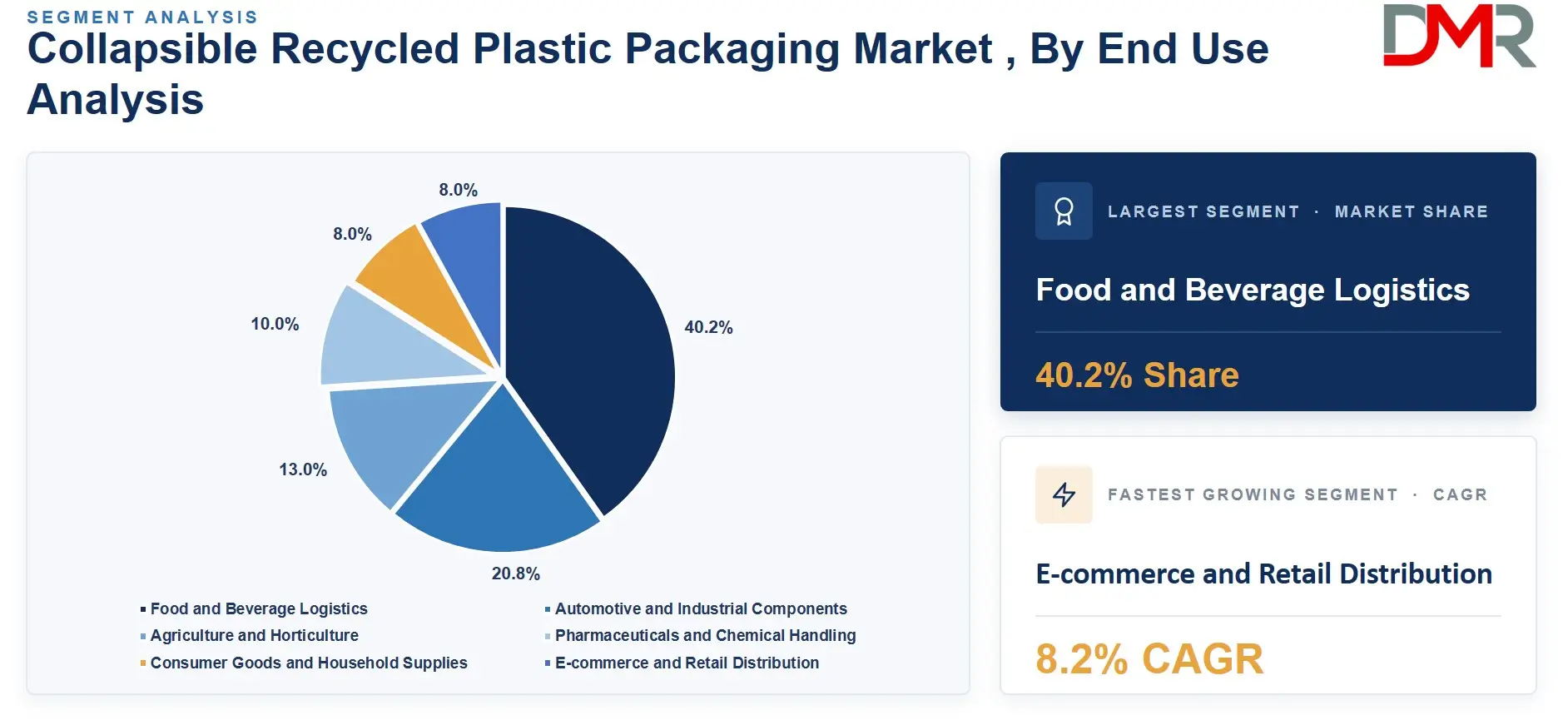
Food & Beverage Logistics led the end use segment with a 40.2% share in 2026.
Fresh produce, chilled dairy, and beverage distribution chains drive food and beverage logistics to the top position because these supply chains operate high-frequency pooled loops where the collapse ratio of an empty container translates directly into lower return-trip cost per unit. Temperature-controlled distribution also favors plastic over cardboard on hygiene grounds, accelerating conversion rates from single-use formats. The segment's scale creates network effects for pooling operators: a larger installed fleet lowers the cost per active crate for every participant in the pool.
ℹ
To learn more about this report –
Download Your Free Sample Report Here
Automotive and Industrial Components hold the second position, supported by just-in-time manufacturing environments where sequence-packaged collapsible containers reduce line-side inventory of empty packaging. Agriculture and Horticulture represents a fast-converting category, particularly in export markets where phytosanitary concerns rule out wooden packaging and plastic pooling is a regulatory fit. Pharmaceuticals and Chemical Handling demand containers that meet GMP cleaning standards and chemical resistance specifications, making rHDPE the default material choice in that end use. E-commerce and Retail Distribution is the fastest-growing end-use category by conversion rate from single-use corrugated, as high return-trip volumes and sustainability reporting targets combine to make collapsible reusable formats a measurable operational improvement.
Key Market Segments
By Material
- Recycled High-Density Polyethylene (rHDPE)
- Recycled Polypropylene (rPP)
- Recycled Polyethylene Terephthalate (rPET)
- Others
By Product Type
- Collapsible Pallets
- Foldable Intermediate Bulk Containers (IBCs)
- Collapsible Crates & Foldable Totes
- Collapsible Bottles & Tubes
- Knock-Down Bulk Bins / Foldable Pallet Boxes
By End Use
- Food & Beverage Logistics
- Automotive & Industrial Components
- Agriculture & Horticulture
- Pharmaceuticals & Chemical Handling
- Consumer Goods & Household Supplies
- E-commerce & Retail Distribution
Regional Analysis
Asia Pacific led the collapsible recycled plastic packaging market with a 40.6% share, valued at USD 4.70 Billion, in 2026.
Asia Pacific
Asia Pacific's dominance reflects the concentration of high-volume export manufacturing, food processing, and retail distribution infrastructure across China, Japan, South Korea, and India. Chinese manufacturers supply the majority of the region's collapsible plastic container stock and increasingly specify recycled-content grades to meet both domestic environmental standards and the recycled-content procurement requirements of their multinational retail customers. Japan and South Korea contribute disproportionate demand through their automotive supply chains, where collapsible returnable containers are a standard just-in-time logistics tool.
North America
North American buyers are converting fresh-produce supply chains from single-use wax-coated cardboard to reusable plastic crates at an accelerating rate, driven by retailer sustainability commitments and state-level extended producer responsibility mandates. The US market hosts a mature pooling-operator infrastructure, with asset-management and reverse-logistics networks capable of supporting national-scale closed loops across grocery, foodservice, and automotive sectors.
.webp)
ℹ
To learn more about this report –
Download Your Free Sample Report Here
Europe
Europe operates under the most prescriptive packaging regulation globally, and the EU PPWR's August 2026 application date has pulled forward investment decisions among both operators and manufacturers. Pooling operators in Europe run some of the world's densest reusable-container networks, particularly in fresh produce and retail grocery, where standardized Euro-format crates allow multi-retailer pooling across country borders. Germany, France, and the Netherlands anchor the continent's demand base through their food distribution scale and automotive manufacturing density.
Latin America
Latin America's fresh fruit and vegetable export chains, concentrated in Brazil, Chile, Mexico, and Colombia, create a natural demand base for pooled reusable plastic crates where export phytosanitary requirements eliminate wooden packaging options. Infrastructure investment in cold-chain logistics across Brazil and Mexico is the primary enabler of adoption growth in the region, as pooling economics only work when a return-logistics network exists to recover and recondition containers.
Middle East and Africa
The Middle East and Africa region generates demand through its expanding food retail networks and agricultural export sectors in countries including South Africa, Morocco, Egypt, and the UAE. Temperature-resistant rHDPE formats serve the GCC's food import distribution chains, where ambient heat conditions accelerate the degradation of cardboard alternatives and make plastic pooling a functional necessity rather than an optional upgrade.
Key Regions and Countries
North America
Europe
- Germany
- France
- The UK
- Spain
- Italy
- Rest of Europe
Asia Pacific
- China
- Japan
- South Korea
- India
- Australia
- Rest of APAC
Latin America
- Brazil
- Mexico
- Rest of Latin America
Middle East & Africa
- GCC
- South Africa
- Rest of MEA
Macroeconomic Impact
Inflation in energy and raw material costs between 2022 and 2024 widened the total cost of ownership advantage that reusable plastic packaging holds over single-use corrugated and wooden alternatives. Cardboard prices are directly exposed to pulp and energy input costs, while pooled plastic containers distribute their production cost across dozens or hundreds of reuse cycles. More than 50% of IFCO's reusable plastic crates were produced using renewable energy in 2025, according to the company's circular-manufacturing update, a structural cost hedge that reduces exposure to fossil-fuel price volatility compared with conventionally manufactured alternatives.
Trade policy shifts present a dual dynamic. Expanded extended producer responsibility legislation in the EU and select US states increases the compliance cost of single-use packaging, effectively subsidizing the business case for reusable formats without requiring direct government procurement intervention. Currency appreciation in Asian manufacturing hubs marginally raises the landed cost of imported container stock in North American and European markets, creating a pricing environment that benefits domestically produced and pooled reusable formats over imported single-use alternatives.
Market Dynamics
Driver: Space Efficiency and Damage Reduction Redefine Logistics Economics
IFCO reported in 2025 that its foldable reusable plastic crates collapse to 14% of their original volume, enabling up to 6× more empty crates per transport trip. That collapse ratio transforms the return-logistics cost equation: a truck returning six times the container count per trip reduces the per-unit logistics cost of the empty-return leg by a factor that single-use packaging cannot replicate regardless of purchase price. Operators with high return-trip frequency capture the largest absolute savings per year.
Product protection performance reinforces the economic case. A 2025 Fraunhofer Institute for Material Flow and Logistics study cited by IFCO found that replacing cardboard packaging with reusable plastic crates reduced overall product damage by 98%. At scale, a 98% damage reduction is not a marginal operational improvement. Buyers in fresh produce, pharmaceuticals, and high-value automotive parts translate that figure directly into lower claims, fewer replacements, and tighter inventory planning. In April 2025, Tosca and Cabka launched the Tosca Circular Pallet CP 1208, manufactured from 100% recycled plastic and designed for automated FMCG and retail supply chains, demonstrating that the driver extends beyond crates into the full pallet-and-container system.
Restraint: Variable Lifecycle Emissions Create Certification Complexity
Reusable plastic crates do not automatically carry a lower carbon footprint than single-use alternatives. The 2025 peer-reviewed LCA review published by Queen's University Belfast found global-warming impacts ranging from 65 to 628 g CO₂e per crate cycle across the reviewed systems. That 10-fold variation across comparable systems signals that emissions performance depends heavily on pooling loop length, washing energy source, fill rate, and end-of-life treatment. Buyers seeking scope 3 credits from switching to reusable formats face a due-diligence requirement to validate the specific LCA of their chosen supplier's system, not just the category average.
Certification complexity slows procurement decisions. Procurement teams at multinationals must reconcile supplier-provided LCA claims with internal methodology standards and external auditor requirements before reporting reductions. A wide emissions range across nominally identical products puts the compliance burden on the buyer and creates a competitive disadvantage for smaller pooling operators that lack the resources to commission full, independently audited lifecycle assessments.
Opportunity: Recycled-Content Innovation Expands Addressable Applications
Produce stored in reusable plastic crates was 100% saleable after four days, compared with 60% saleable in single-use packaging, as reported in IFCO's 2025 technical article on mushroom storage. A 40-percentage-point salability gap at any point in a fresh-produce supply chain represents direct revenue impact for growers, distributors, and retailers. That performance gap creates an adoption incentive independent of sustainability regulation, anchoring demand in commercial food loss reduction rather than compliance alone.
Material innovation is expanding the product scope of recycled-content formats beyond established rHDPE crate systems. In September 2025, Cabka and Renewi launched the Eco CP3 pallet, manufactured from 100% recycled polyethylene sourced from Renewi, designed to withstand more than 25 reuse cycles. A pallet built entirely from recycled waste streams and validated for repeated industrial use addresses a segment of the market where virgin-resin performance assumptions previously blocked recycled-content adoption.
Porter's Five Forces
Competitive rivalry in the collapsible recycled plastic packaging market is high among a small number of scaled pooling operators and container manufacturers, but the barriers protecting incumbents are substantial. New entrants face capital-intensive requirements: building a reusable container fleet requires upfront manufacturing investment, and building a pooling network requires service infrastructure across collection, washing, and redistribution. The 2025 academic LCA review confirmed that reusable plastic crates need a minimum of 3 circulation cycles to outperform a same-capacity single-use alternative on lifecycle emissions, meaning a new fleet must complete multiple turns before its environmental proposition is defensible.
Supplier bargaining power is moderate, concentrated in recycled polymer feedstock sourcing where rHDPE and rPP grades trade at premiums over virgin resin depending on post-consumer collection volumes. Buyer bargaining power is higher for large grocery chains and automotive manufacturers that can negotiate pooling terms across multi-year contracts or run competitive pooling tenders. The threat of substitutes from corrugated cardboard, wooden pallets, or virgin-resin single-use containers is declining as extended producer responsibility regulation and corporate sustainability commitments narrow the acceptable options for large shippers.
AI and Gen AI Impact
Artificial intelligence is reshaping asset tracking and fleet optimization across reusable packaging pooling networks. Pooling operators manage container fleets spanning millions of assets across hundreds of collection, washing, and redistribution nodes. AI-driven demand forecasting and route optimization reduce empty-transport kilometers and container dwell time at non-productive nodes, directly lowering per-cycle cost. Computer vision systems deployed at washing and reconditioning stations automate damage detection and sort containers for repair or retirement faster than manual inspection allows, compressing reconditioning throughput time.
Generative AI is entering the design workflow for new container formats, accelerating structural simulation and materials testing cycles for recycled-content grades where mechanical property variation across batches requires iterative validation. Early movers integrating AI into reconditioning quality control and fleet dispatch are reducing operational cost per cycle. Laggards operating manual asset-tracking and paper-based reconditioning inspection risk higher loss rates, longer cycle times, and weaker LCA documentation — a commercially meaningful gap as buyers increasingly require auditable lifecycle data to support scope 3 reporting.
Market Trends
Circular Material Sourcing Moves From Pilot to Commercial Standard
IFCO's FY25 customer results report confirmed 803,514 metric tonnes of CO₂e saved, 56,680 megalitres of water saved, 16,551 TJ of energy saved, 1,436,359 metric tonnes of solid waste saved, and 70,236 metric tonnes of product waste avoided through its reusable-crate pooling system. Those cumulative metrics represent a closed-loop system operating at a scale that gives pooling operators a data asset competitors cannot replicate without equivalent fleet tenure. Circular material sourcing is advancing in parallel: in March 2025, Tetra Pak and Schoeller Allibert announced a transport crate manufactured from polyAl recovered from used beverage cartons, converting a waste stream from one packaging category directly into the feedstock of another. Vendors that close material loops across packaging categories will define the next competitive threshold in recycled-content specification.
Market Competition Overview
The collapsible recycled plastic packaging market is moderately consolidated at the top, with a small group of global pooling operators and container manufacturers commanding disproportionate fleet scale and customer contract depth. Scale creates a self-reinforcing advantage: larger fleets lower per-cycle cost, wider service networks reduce container dwell time, and longer operational tenure generates the lifecycle performance data that procurement teams and auditors require. IFCO injection-moulded collapsible crates withstand up to 120 reuse cycles per unit, a durability figure that compresses per-trip asset cost below what smaller operators can match with shorter-lived container stock.
Consolidation is accelerating. In May 2025, IPL and Schoeller Allibert announced a merger creating a combined entity with more than USD 1.4 Billion in pro-forma 2024 revenue and manufacturing operations across North America, Europe, and the UK. Mid-tier manufacturers without the capital to invest in fleet scale, reconditioning automation, and regulatory certification now face a structurally wider gap relative to the consolidated leaders. Challengers gaining share are doing so through material innovation and niche application focus, particularly in agricultural export markets and industrial bulk-bin formats where major pooling operators have thinner coverage.
Pricing Analysis
Pricing in collapsible recycled plastic packaging operates across two distinct commercial models. Asset-sale models price containers as capital equipment, with per-unit costs ranging widely by format, material grade, and recycled-content specification. Pooling or rental models price on a per-trip or per-day basis, converting the container cost into an operational line item and shifting asset ownership to the pooling operator. Pooling models command pricing power in markets with dense logistics networks and high container utilization rates, while asset-sale models dominate in markets or applications where return logistics are inconsistent or customer-managed.
Recycled-content premiums are narrowing as post-consumer polymer supply chains mature and collection infrastructure expands. rHDPE grades carry lower cost premiums over virgin resin than rPET in most market conditions, which reinforces rHDPE's dominance in the material segment. Leaders price reconditioning costs into their pooling fee structures and absorb the operational variable, while challengers often underestimate reconditioning cost inflation over longer fleet operating periods, creating a margin risk that surfaces at high cycle counts.
Company Profiles
Tosca Services, LLC positions itself as a closed-loop reusable packaging partner for FMCG and grocery retail supply chains, competing primarily through pooling network density and container system integration. Tosca's strategic collaboration with Cabka on 100% recycled-content pallets demonstrates a deliberate move to link recycled-material sourcing with automation-ready pallet design, targeting the PPWR-compliance window as a commercial accelerator rather than a compliance cost.
Schoeller Allibert built its competitive position through European fresh-produce and food retail pooling scale before entering a merger with IPL. In July 2025, IPL and Schoeller Allibert completed their combination to create IPL Schoeller, an international sustainable packaging company with 26 manufacturing locations and more than 4,000 employees. The merged entity enters the market with a geographic footprint spanning North America and Europe that neither company could match independently, positioning IPL Schoeller to compete for cross-regional retail pooling contracts that require consistent container standards across multiple trade lanes.
Key Players
- Tosca Services, LLC
- Schoeller Allibert
-
360Eco Packaging
- CHEP
- IPL, Inc.
- SSI SCHÄFER Plastics GmbH
- IFCO SYSTEMS
- RPP Containers
- DS Smith
- ORBIS Corporation
Supply Chain and Value Chain Analysis
The value chain begins at post-consumer and post-industrial polymer collection, where rHDPE, rPP, and rPET feedstocks are sorted, cleaned, and pelletized before reaching container manufacturers. Maximum margin concentration sits at the pooling-operator layer, where asset ownership, reconditioning infrastructure, and logistics network control create the highest barriers to displacement. The critical operational variable is reconditioning cost. At 125 reuse cycles, the crate reconditioning process accounted for 30–70% of total lifecycle impacts in one of the reviewed reusable-plastic-crate scenarios, as reported in the 2025 Queen's University Belfast LCA review. Washing energy source and water consumption at reconditioning nodes are not peripheral sustainability metrics. They are direct determinants of both cost per cycle and the defensibility of an operator's lifecycle emissions claims.
End-of-life polymer recovery closes the loop and represents the segment of the value chain with the largest ongoing investment need. Operators that control their own end-of-life material streams and feed recovered resin back into new container production gain a feedstock cost advantage and a chain-of-custody documentation advantage over those relying entirely on open-market recycled-polymer procurement.
Regulatory Landscape
The EU Packaging and Packaging Waste Regulation is the single most consequential regulatory development for Collapsible Recycled Plastic Packaging Market in the 2025 to 2026 period. The PPWR sets mandatory reuse targets for transport packaging categories and requires that packaging placed on the EU market meet defined recycled-content thresholds on a scheduled timeline. The regulation's August 12, 2026 application date compressed vendor certification timelines and forced procurement teams at multinational shippers to document their packaging compliance posture. In April 2026, Tosca and Cabka introduced the Euro-sized Circular Pallet CP 1208, explicitly positioned as a PPWR-compliant alternative to one-way packaging, illustrating how regulation is functioning as a product development driver rather than solely a compliance cost.
Outside the EU, extended producer responsibility frameworks in Canada, several US states, and selected Asia Pacific markets are increasing the cost of single-use packaging disposal. Those frameworks do not mandate reusable formats directly, but they alter the total cost comparison by adding disposal fees to single-use packaging that do not apply to assets managed within closed pooling loops. Operators and manufacturers that invest in multi-jurisdictional regulatory certification documentation will hold a commercial advantage as procurement standards increasingly require auditable compliance evidence.
Investment and White Space Analysis
Investment in collapsible recycled plastic packaging is concentrating at the infrastructure layer of the pooling ecosystem. In July 2025, Stonepeak agreed to acquire a 50% co-controlling interest in IFCO Group from the Abu Dhabi Investment Authority, a transaction that places one of the world's largest reusable-packaging pooling networks into the hands of a specialist infrastructure investor. Stonepeak's entry signals that institutional capital now classifies large-scale reusable packaging pooling as infrastructure rather than manufacturing, a reclassification with significant implications for valuation multiples and long-term capital availability across the sector.
White space exists in three underserved segments. Agricultural export markets in Latin America, sub-Saharan Africa, and Southeast Asia lack the pooling-operator density that makes closed-loop economics viable, creating a first-mover opportunity for operators willing to build regional collection and reconditioning infrastructure. Pharmaceutical and chemical handling represents a high-margin niche where GMP-grade collapsible containers with validated cleaning protocols command pricing premiums that food-logistics formats cannot reach. E-commerce reverse-logistics packaging, where high return-shipment volumes create natural closed loops, is a structurally attractive segment that current pooling operators have not yet penetrated at scale.
Recent Developments
- January 2024 — IFCO launched Dora, a reusable plastic pallet across Europe, designed to work with IFCO's reusable packaging containers and circular pooling system. The pallet is more than 25% lighter than conventional wooden pallets.
- February 2024 — ORBIS Corporation expanded its OpteBulk portfolio with the new 48×45 series, adding a pallet, top cap, and reusable sleeve system for collapsible bulk packaging to optimize transportation, storage, and reverse logistics.
- April 2024 — ORBIS Corporation introduced ORBIShield ECO, a new sustainable protective-dunnage product line designed to reduce solid waste and carbon footprint while maintaining packaging protection and performance.
- June 2024 — Rehrig Pacific highlighted its reusable plastic container solutions for agricultural supply chains, covering stackable, nestable, washable, and collapsible crates for field picking, transportation, storage, and delivery applications.
- December 2024 — Rehrig Pacific expanded its reusable plastic packaging solutions portfolio, covering collapsible containers, pallets, RPCs, bins, trays, and crates serving agriculture, retail, e-commerce, and adjacent industries.
Report Details
| Report Characteristics |
| Market Value (2025) |
USD 11.6 Billion |
| Market Value (2026) |
USD 12.46 Billion |
| Forecast Revenue (2035) |
USD 23.69 Billion |
| CAGR (2026–2035) |
7.4% |
| Base Year for Estimation |
2025 |
| Historic Period |
2020 – 2024 |
| Forecast Period |
2026 – 2035 |
| Report Coverage |
Revenue Forecast, Market Dynamics, Competitive Landscape, Recent Developments |
| Segments Covered |
By Material (rHDPE, rPP, rPET, Others), By Product Type (Collapsible Pallets, Foldable IBCs, Collapsible Crates and Foldable Totes, Collapsible Bottles and Tubes, Knock-Down Bulk Bins / Foldable Pallet Boxes), By End Use (Food and Beverage Logistics, Automotive and Industrial Components, Agriculture and Horticulture, Pharmaceuticals and Chemical Handling, Consumer Goods and Household Supplies, E-commerce and Retail Distribution) |
| Regional Analysis |
North America – US and Canada; Europe – Germany, France, The UK, Spain, Italy, and Rest of Europe; Asia Pacific – China, Japan, South Korea, India, Australia, and Rest of APAC; Latin America – Brazil, Mexico, and Rest of Latin America; Middle East and Africa – GCC, South Africa, and Rest of MEA |
| Competitive Landscape |
Tosca Services LLC, Schoeller Allibert, 360Eco Packaging, CHEP, IPL Inc., SSI SCHÄFER Plastics GmbH, IFCO SYSTEMS, RPP Containers, DS Smith, ORBIS Corporation |
| Customization Scope |
Customization for segments and region or country level will be provided. Additional customization can be done based on requirements. |
| Purchase Options |
Three license options: Single User License, Multi-User License (Up to 5 Users), and Corporate Use License (Unlimited Users and Printable PDF) |
Frequently Asked Questions
What is the biggest investment opportunity in the Collapsible Recycled Plastic Packaging market?
▾ The largest investment opportunity sits in pooling infrastructure for underserved markets, particularly agricultural export supply chains in Latin America, Southeast Asia, and sub-Saharan Africa. The July 2025 Stonepeak acquisition of a 50% stake in IFCO demonstrates that institutional infrastructure capital is actively valuing closed-loop reusable packaging networks. Pharmaceutical-grade collapsible containers represent a high-margin niche where GMP-compliance certification creates a durable pricing premium.
Who are the top companies in the Collapsible Recycled Plastic Packaging market?
▾ Leading companies include Tosca Services LLC, IFCO SYSTEMS, ORBIS Corporation, CHEP, and IPL Schoeller, the entity formed by the July 2025 merger of IPL and Schoeller Allibert. CHEP and IFCO operate the largest global pooling networks by fleet scale. IPL Schoeller entered the consolidated market with 26 manufacturing locations across North America and Europe.
Which segment is growing fastest in the Collapsible Recycled Plastic Packaging market and why?
▾ E-commerce and Retail Distribution is the fastest-growing end-use segment, driven by the structural alignment between high return-shipment volumes in e-commerce and the closed-loop logistics requirements of reusable packaging pooling. Extended producer responsibility mandates in the EU and North America are adding disposal cost to single-use corrugated alternatives, accelerating the business-case comparison in favor of reusable collapsible formats.
Which region is growing fastest in the Collapsible Recycled Plastic Packaging market and why?
▾ Europe is the fastest-growing region by conversion rate from single-use to reusable formats, driven by the EU PPWR's mandatory reuse and recycled-content requirements taking effect from August 2026. Asia Pacific holds the largest share at 40.6% by market value, but Europe's regulatory-led conversion pipeline is compressing a multi-year adoption cycle into a near-term compliance window that is pulling forward capital investment decisions.
What is the biggest challenge holding Collapsible Recycled Plastic Packaging Market back?
▾ The widest restraint is lifecycle emissions certification complexity. The 2025 peer-reviewed LCA review found a 10-fold range in global-warming impact across nominally comparable reusable crate systems, from 65 to 628 g CO2e per cycle. Buyers cannot claim scope 3 reductions without system-specific audited LCA data, creating a due-diligence cost and timeline that slows procurement conversion, particularly among mid-market shippers without dedicated sustainability procurement resources.