Market Overview
The global color masterbatch market covers concentrated mixtures of pigments or dyes encapsulated within a carrier resin, sold to plastics processors who disperse them into base polymers during manufacturing. The market excludes compounded pre-colored resins, liquid colorants, and dry pigment blends sold without a carrier matrix. Color masterbatch sits at the intersection of specialty chemicals and plastics processing, serving packaging converters, automotive tier suppliers, consumer goods manufacturers, and construction materials producers across every major polymer platform.
Formulators calibrate performance across a wide processing window. As reported by a 2026 manufacturer technical guide, standard high-quality color-masterbatch let-down ratios typically range from 1% to 5% of the finished polymer blend, with formulation precision determining whether a converter achieves consistent color across production runs without rework losses. That precision requirement makes masterbatch a high-value additive rather than a commodity input, which supports pricing power for technically differentiated suppliers even as raw material costs fluctuate.
Packaging converters and automotive OEM programs both demand lot-to-lot color consistency that generic pigment blends cannot reliably deliver. Color masterbatch suppliers that invest in spectrophotometric quality systems and proprietary carrier-resin formulations create switching costs that protect margins. Suppliers unable to meet tightening food-contact, UV-stability, or REACH compliance requirements face displacement by certified global suppliers with broader regulatory portfolios.
Key Takeaways
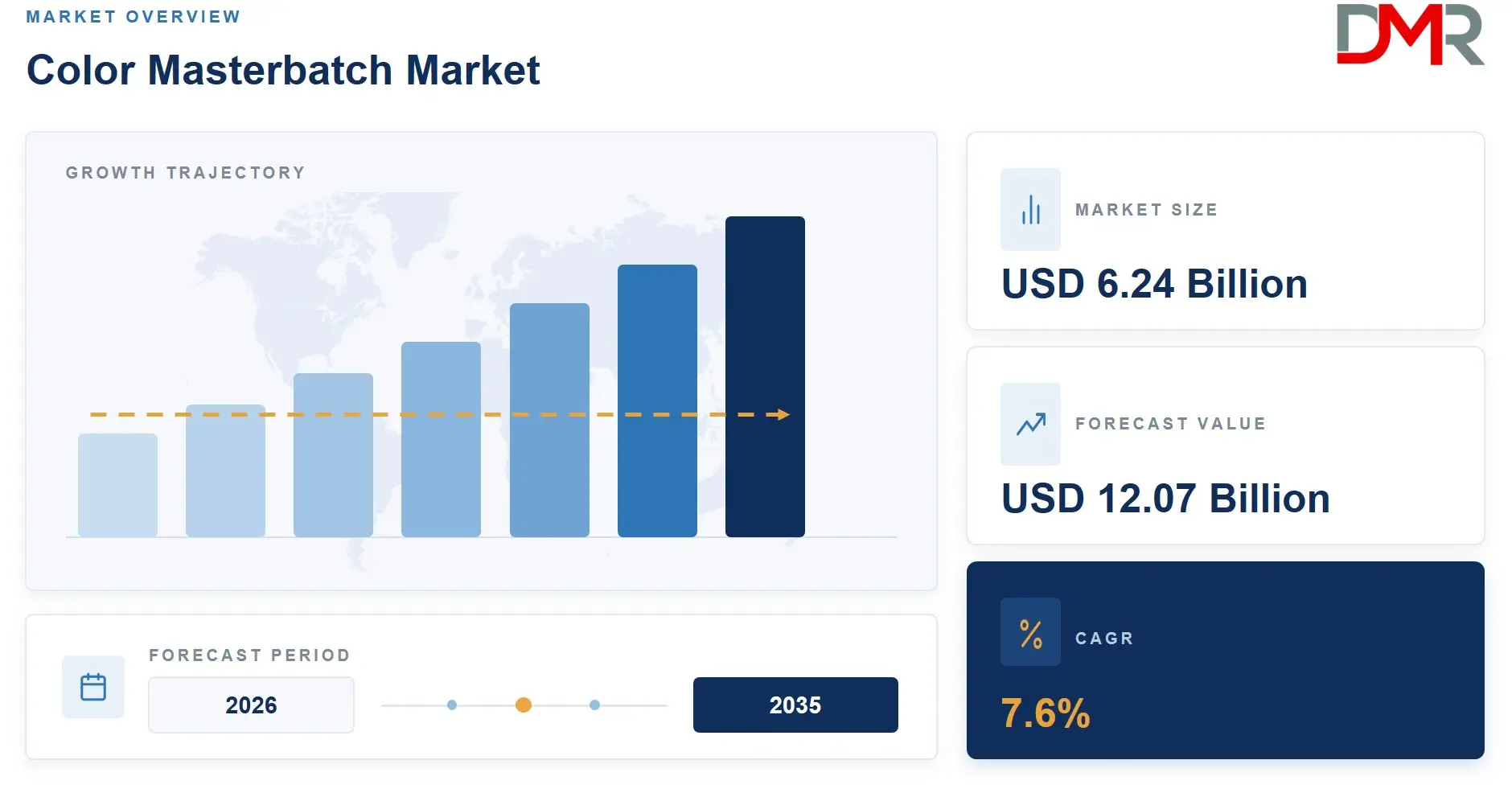
- The market size is USD 6.24 Billion in 2026, and is projected to hit USD 12.07 Billion by 2035 at a CAGR of 7.6%.
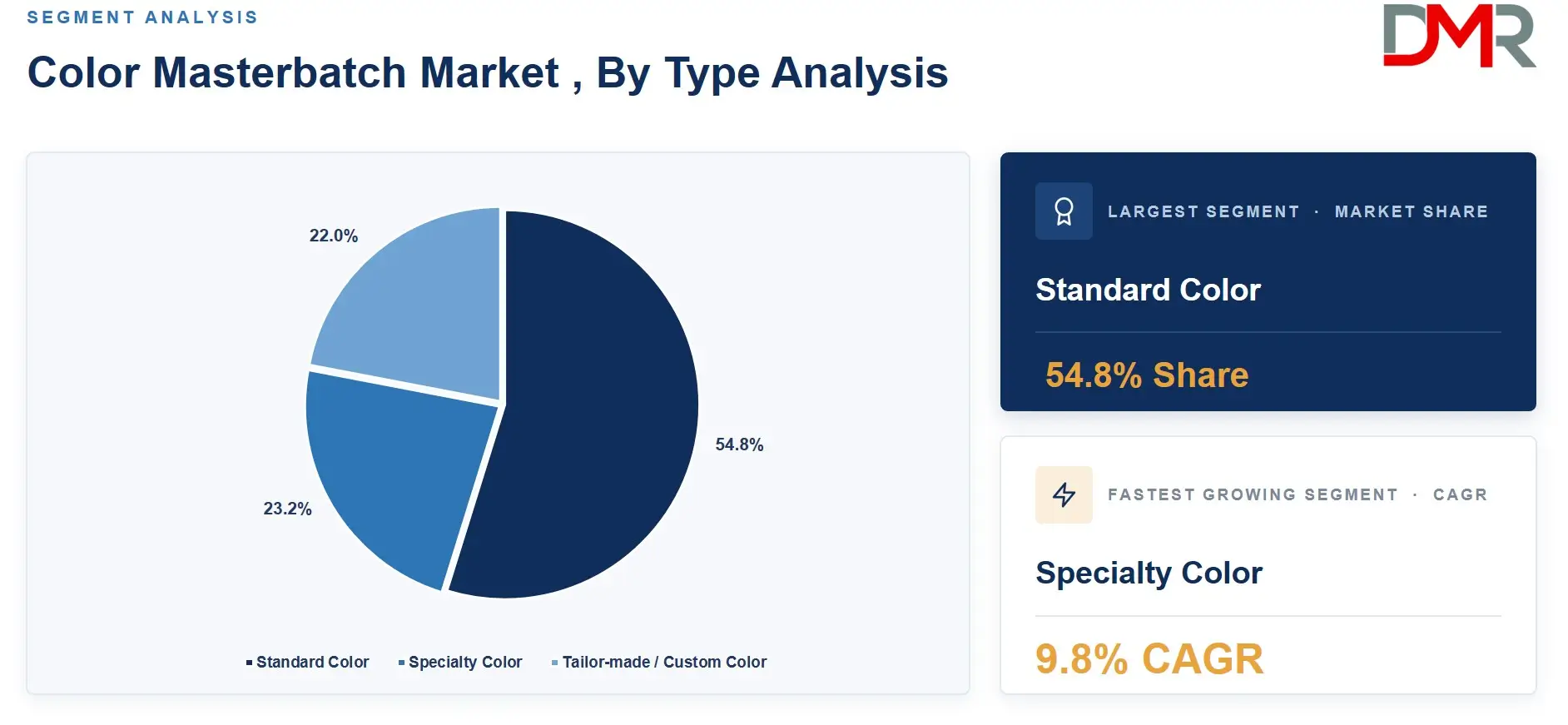
- By Type: Standard Color led the type segment with a 54.8% share in 2026.
- By Carrier Resin: Polypropylene (PP) led the carrier resin segment with a 35.7% share in 2026.
- By Processing Technology: Extrusion led as the largest category in 2026.
- By End-Use Industry: Packaging led the end-use industry segment with a 48.9% share in 2026.
- By Distribution Channel: Direct Sales led as the largest category in 2026.
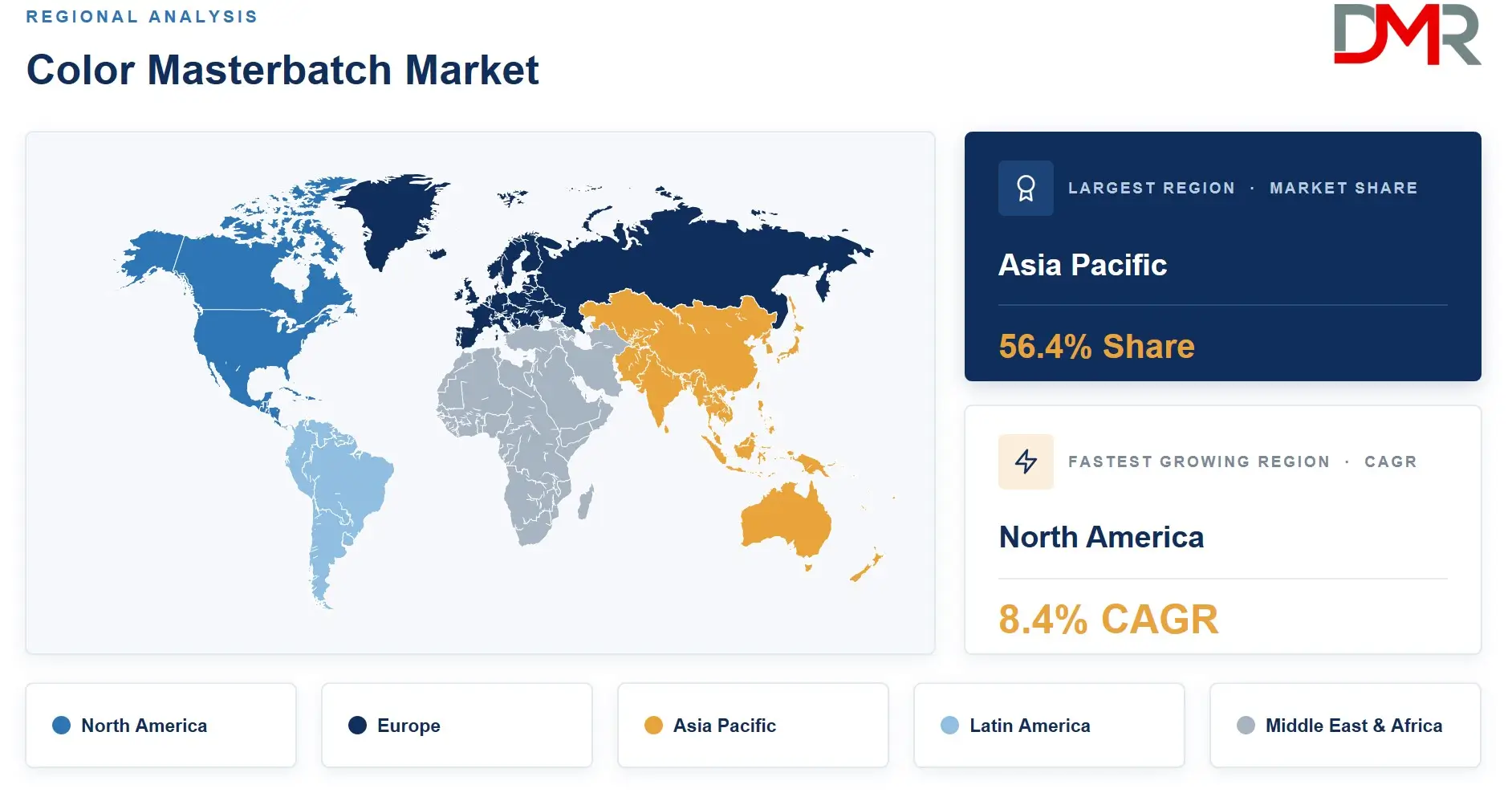
- By Region: Asia Pacific led with a 56.4% share in 2026.
- Twenty key players compete across the global market, including Avient Corporation, Ampacet Corporation, LyondellBasell Industries, BASF SE, and SABIC, among others.
Market Size and Forecast
The Global Color Masterbatch Market size is estimated at USD 6.24 Billion in 2026, and is projected to reach USD 12.07 Billion by 2035, exhibiting a CAGR of 7.6% during the forecast period.
ℹ
To learn more about this report –
Download Your Free Sample Report Here
Growth through 2035 rests on three structural pillars: continued polymer consumption growth in Asia Pacific, premiumization of packaging aesthetics in consumer goods, and substitution of solvent-based colorants with safer masterbatch formats across regulated end-use industries. Historical expansion from 2020 to 2024 was shaped by post-pandemic packaging volume recovery and accelerating EV adoption, which created new polymer coloring requirements in automotive interiors and high-voltage connector systems.
The forecast scenario assumes steady PP and PE resin supply, continued brand-owner investment in color differentiation, and expanding regulatory pressure on direct dye use in food-contact and medical packaging. A downside scenario exists if polymer demand contracts sharply in China, which anchors the Asia Pacific volume base. Upside pressure comes from faster-than-anticipated EV production ramp-up and broader adoption of high-performance specialty masterbatches in engineering polymer applications.
Type Analysis
Standard Color accounted for 54.8% of type demand in 2026, the highest of any category.
ℹ
To learn more about this report –
Download Your Free Sample Report Here
Standard Color masterbatches dominate because packaging converters and consumer goods manufacturers run high-volume, continuous production where proven pigment grades reduce color variation risk. Commodity pigment grades covering heat resistance and weathering performance serve the broadest polymer processing base, from flexible packaging lines to rigid container molding. As reported by a 2026 dosing guidance source, standard custom colors require a dosage of 2%–3% of the resin blend to maintain a stable, repeatable hue over continuous production shifts, a narrow window that rewards formulators with tightly controlled pigment loadings.
Specialty Color masterbatches cover metallic, pearlescent, fluorescent, and marble-grain effects. Demand for these formats grows fastest in premium consumer goods packaging and automotive interior trim, where brands pay a meaningful price premium over standard grades. Tailor-made and custom color programs, particularly automotive OEM-matched shades and brand-specific proprietary programs, represent the highest-margin subcategory. Vendors able to hold OEM color approvals for multiple vehicle model cycles create revenue streams that generalist compounders cannot replicate.
Carrier Resin Analysis
With a 35.7% share in 2026, Polypropylene (PP) outpaced all other carrier resin categories.
PP carrier dominance reflects the resin's role as the primary substrate across woven packaging, raffia tapes, nonwoven fabrics, and rigid consumer goods. Masterbatch formulators use PP carriers to ensure compatibility with the base resin and prevent phase separation during melt processing. As per a 2026 technical explainer, fiber, filament, and bulk-continuous-filament processing requires a color-masterbatch dosage range of 1.0%–2.5%, with filter-pressure value and prevention of filament breakage identified as process constraints. These constraints favor established suppliers with proven dispersion technology over low-cost alternatives.
Polyethylene carriers span the widest application base, covering LDPE and LLDPE flexible packaging and agricultural films alongside HDPE rigid containers and pipe systems. PET carrier masterbatches serve food-contact and medical packaging where regulatory migration compliance is non-negotiable. Engineering resin carriers, covering ABS, polyamide, and polycarbonate, command the highest formulation costs and serve technically demanding automotive and electrical applications where color consistency over heat-aging cycles is mandatory.
Processing Technology Analysis
Extrusion led the processing technology segment as the largest category in 2026.
Extrusion's dominance reflects the sheer volume of pipe, wire, cable, sheet, and film produced globally, all of which require continuous-melt color incorporation. Wire and cable extrusion places particularly stringent demands on dispersion quality, as any undispersed pigment agglomerates create electrical insulation defects. Injection molding represents the second-largest processing category, and a 2026 dosing guidance source specifies a masterbatch range of 1.0%–2.0% for thick-wall products such as automotive parts and heavy crates, a narrow addition range that requires batch-consistent formulations from suppliers.
Blow molding for bottles and industrial containers generates predictable repeat demand from FMCG bottlers. Film extrusion, covering both cast and blown film, drives some of the highest per-kilogram masterbatch usage rates given the thin gauge and light-transmission demands of films. Rotational molding serves a niche but growing market in large-format outdoor products and agricultural tanks, where color stability across UV exposure cycles matters more than dosing precision.
End-Use Industry Analysis
Packaging captured 48.9% of the end-use industry segment in 2026, ahead of all rivals.
Packaging converters consume nearly half the global color masterbatch supply because brand owners treat pack color as a primary purchase trigger. Flexible packaging sub-segments, covering food and beverage films, pouches, and e-commerce courier bags, run 24-hour production shifts where masterbatch consistency directly affects scrap rates. Data from a 2026 dosing guidance source identifies a thin-wall blown-film dosage requirement of 3.0%–6.0%, higher than most other applications, reflecting the greater pigment loading needed where light transmission through thin gauge would otherwise reveal color weakness.
Automotive is the second-largest end-use category. Interior trim, dashboard components, and exterior body panels all require OEM-certified colors that retain their specification across temperature cycling and UV exposure. Consumer goods and building and construction follow, with the latter showing growing demand for UV-stable masterbatches in roofing membranes and outdoor pipe systems. Agriculture films, covering mulch and greenhouse applications, represent a volume-driven segment where cost efficiency outweighs aesthetic premiumization.
Distribution Channel Analysis
Direct Sales led the distribution channel segment as the largest category in 2026.
Large packaging converters and automotive OEM suppliers buy direct to secure consistent formulations, guaranteed lead times, and technical service access. Direct relationships also allow color approval workflows that distributor channels cannot replicate. Distributors and channel partners serve mid-market processors who lack the volume thresholds for direct supply agreements. Online and digital catalog channels are nascent but growing among smaller processors seeking standardized masterbatch grades with fast delivery, particularly in Asia Pacific where e-procurement platforms have expanded supplier reach into tier-2 and tier-3 manufacturing clusters.
Key Market Segments
By Type
- Standard Color
- Commodity pigment grades (heat & weather resistant)
- Black-base standard shades
- White-base standard shades
- Specialty Color
- Metallic effect
- Pearlescent & glitter effect
- Fluorescent & translucent effect
- Marble & wood-grain effect
- Tailor-made / Custom Color
- Automotive OEM-matched shades
- Brand-specific proprietary color programs
By Carrier Resin
- Polypropylene (PP)
- Woven packaging & raffia tapes
- Nonwoven fabrics
- Rigid consumer goods packaging
- Polyethylene (PE)
- LDPE & LLDPE (flexible packaging, agricultural & stretch films)
- HDPE (pipes, conduits, blow-molded containers)
- Polystyrene (PS)
- Polyvinyl Chloride (PVC)
- Polyethylene Terephthalate (PET)
- Food & beverage packaging
- Medical packaging
- Other Engineering Resins
- Acrylonitrile Butadiene Styrene (ABS)
- Polyamide (Nylon 6 & 66)
- Polycarbonate (PC)
By Processing Technology
- Extrusion
- Pipe & profile extrusion
- Wire & cable extrusion
- Sheet & film extrusion
- Injection Molding
- Automotive interior parts
- Medical device components
- Consumer goods housings
- Blow Molding
- Bottles & narrow-neck containers
- Industrial drums & jerry cans
- Rotational Molding
- Film Extrusion (Cast & Blown Film)
By End-Use Industry
- Packaging
- Flexible packaging
- Food & beverage films & pouches
- E-commerce & courier bags
- Rigid packaging
- Bottles, caps & closures
- Crates & industrial containers
- Automotive
- Interior trim & dashboard components
- Exterior body panels & bumpers
- Under-hood & underbody parts
- Consumer Goods
- Housewares & kitchenware
- Toys & leisure products
- Personal care product containers
- Building & Construction
- Pipes, fittings & conduits
- Window profiles & door frames
- Roofing & waterproofing membranes
- Agriculture
- Mulch & silage films
- Greenhouse & tunnel films
- Textiles
- Synthetic fiber coloration (polyester, nylon)
- Nonwoven fabric coloration
- Others (Electrical & Electronics, Healthcare)
By Distribution Channel
- Direct Sales
- Distributors / Channel Partners
- Others (Online / Digital Catalog)
Regional Analysis
Asia Pacific led the global Color Masterbatch Market with a 56.4% share in 2026, valued at USD 3.52 Billion.
ℹ
To learn more about this report –
Download Your Free Sample Report Here
Asia Pacific
Asia Pacific commands the majority of global color masterbatch consumption because China, India, and Southeast Asia collectively host the world's largest concentration of polymer processing capacity. China's packaging and consumer goods sectors absorb the highest single-country volume, while India's PP woven sack and nonwoven sectors pull substantial PP-carrier masterbatch demand. Manufacturing clusters in Vietnam, Thailand, and Indonesia have added meaningful volume since 2022, drawn by supply chain diversification strategies from global brand owners.
Europe
European processors prioritize regulatory compliance and sustainable formulation over volume growth. REACH restrictions, food-contact migration limits, and expanding SVHC candidate lists force masterbatch suppliers to invest in reformulation, which consolidates supply toward larger certified players. In May 2026, LyondellBasell expanded distribution of its masterbatches and custom performance colors into Germany and Austria through an agreement with Interpolimeri, signaling that even established global players see distribution gaps worth closing in mature European markets.
North America
North American demand concentrates in packaging, automotive, and healthcare end-uses. US processors benefit from proximity to resin producers, which shortens masterbatch reformulation cycles when feedstock specifications change. EV production ramp-up in North America creates a new automotive masterbatch demand node, with high-voltage connector systems requiring certified color identification grades distinct from standard automotive trim colorants.
Latin America
Brazil and Mexico anchor Latin American demand, primarily through flexible packaging for food and beverage and PP agricultural films. Currency volatility in the region compresses converter margins and limits willingness to pay premiums for specialty masterbatch grades. Suppliers with local compounding capacity in Brazil carry a logistics advantage over importers during periods of currency weakness.
Middle East & Africa
GCC countries represent the highest-growth sub-region within MEA, supported by expanding petrochemical-to-plastics integration and growing domestic packaging capacity. African markets remain volume-constrained but show early momentum in PP woven sacks and agricultural film applications tied to food security investments.
Key Regions and Countries
North America
Europe
- Germany
- France
- The UK
- Spain
- Italy
- Rest of Europe
Asia Pacific
- China
- Japan
- South Korea
- India
- Australia
- Rest of APAC
Latin America
- Brazil
- Mexico
- Rest of Latin America
Middle East & Africa
- GCC
- South Africa
- Rest of MEA
Macroeconomic Impact
Color masterbatch demand tracks polymer processing output, which correlates tightly with GDP-driven consumer spending and industrial production indices. Rising interest rates in 2023 and 2024 slowed capital investment in new plastics processing capacity across North America and Europe, moderating near-term volume growth in those regions. Asia Pacific's relative monetary easing cycle and continued government infrastructure spending sustained polymer demand even as Western markets paused.
Raw material cost inflation, particularly for titanium dioxide and organic pigments, passed through to masterbatch pricing from 2021 to 2023. Normalization since 2024 has partially restored converter margins. Trade tariff shifts between the US and China alter the competitive position of Asian masterbatch exporters, creating openings for domestic US formulators serving mid-market converters who cannot absorb import duty additions.
Market Dynamics
Driver: Packaging Color Premiumization Lifts Certified Masterbatch Demand
Brand owners across food, personal care, and e-commerce packaging sectors treat color consistency as a non-negotiable brand asset. Any color deviation at the point of sale carries a reputational cost that far exceeds the per-unit masterbatch cost. Avient's January 2025 launch of ColorMatrix™ Lactra™ ESL, a light-blocking additive solution for extended-shelf-life dairy packaging, illustrates how masterbatch suppliers now embed functional performance alongside aesthetic color, charging premium prices for solutions that extend product shelf life rather than merely delivering a color specification.
Americhem reports that its closure color masterbatches match target colors at use levels below 1 part per hundred of the base resin by weight. Achieving color at such low addition rates requires high-concentration pigment dispersion expertise. Suppliers who can certify color performance at sub-1% dosing command formulation fees and application support contracts that commodity masterbatch producers cannot justify.
Restraint: Pigment Concentration Variability Raises Process Complexity for Converters
Color masterbatch products vary widely in pigment loading, and that variation creates process management risk for converters. A 2026 technical explainer reports that masterbatches with 40%–60% active-pigment concentration can be used at lower let-down ratios, while products containing only 10%–15% pigment may require 8%–10% dosing to reach comparable opacity or color strength. Converters running multiple masterbatch grades across a single production line must therefore adjust feed rates continuously, increasing the risk of color drift and resin waste.
Smaller converters often lack the spectrophotometric measurement systems needed to detect let-down ratio drift before it produces off-specification output. That quality control gap creates downstream warranty claims for masterbatch suppliers and erodes trust in products where pigment concentration labeling is inconsistent. Suppliers that invest in verified batch-certification documentation reduce these incidents and build preferred-supplier status that justifies margin protection.
Opportunity: Antimicrobial and Functional Masterbatch Expands Healthcare and Food-Contact Revenue
Healthcare and pharmaceutical packaging buyers now specify masterbatches that deliver both color identification and active functionality in a single additive system. Ampacet introduced ProVital™+ GermsClean in 2025, a medical-grade antimicrobial masterbatch designed to inhibit bacterial growth and slow fungal proliferation on plastic components in healthcare environments. Products that combine color with certified antimicrobial claims command significant price premiums over standalone color masterbatches and face far fewer direct competitors.
PE wax, used to improve pigment dispersion and color consistency in masterbatch production, has an evaluated working range of 0.5%–3.0% by total batch weight, as published in a 2026 formulation article by Rallychem. Formulators that optimize PE wax loading alongside pigment concentration can reduce process-related color variation without reformulation, creating cost-efficiency gains that fund R&D investment in functional masterbatch platforms targeting healthcare, food-contact, and extended-shelf-life applications.
Porter's Five Forces
Competitive intensity in the color masterbatch market is moderate-to-high, shaped by a concentrated supplier base competing for a fragmented buyer pool. New entrant barriers are meaningful: resin-polymer compatibility expertise, pigment sourcing relationships, and color approval qualification cycles with automotive OEMs or food-contact regulators take years to build. A 2025 injection-molding article confirms a typical color-masterbatch let-down ratio of 1%–4%, a narrow technical window that requires proven formulation competence rather than simple mixing capability. Supplier bargaining power is moderate, as TiO2 and specialty organic pigment markets are themselves concentrated, giving pigment producers leverage during supply tightening. Buyer power is highest among large packaging converters and automotive tier-one suppliers who can dual-source and run competitive auctions across approved vendor lists. Substitute pressure from liquid colorants and pre-colored compounds is real but limited by masterbatch's superior handling, dosing precision, and waste reduction profile in high-volume continuous processing. Competitive rivalry among the top ten global players focuses on color accuracy, food-contact certification breadth, and technical service depth rather than pure price competition.
AI and Gen AI Impact
Artificial intelligence is reshaping color matching and formulation development at the upstream end of the masterbatch value chain. AI-assisted spectrophotometric modeling now allows suppliers to predict let-down ratio performance across polymer matrices before physical trial runs, compressing development cycles from weeks to days. A 2025 dosing guidance source specifies application-level dosing of 1%–4% for film extrusion, 1%–3% for fiber or filament, and 2%–5% for injection molding, with shade-specific ranges of 3%–5% for light shades through to 1%–2% for dark shades. AI systems that encode these application-specific parameters can auto-generate formulation starting points that previously required experienced technician judgment, reducing the cost and time of custom color development.
Generative AI tools are beginning to enter color trend forecasting, enabling masterbatch marketers to predict consumer palette preferences one to two years ahead of market. Suppliers that embed AI color-trend outputs into annual forecasting tools create early pull-through demand with brand-owner design teams, giving them first access to new color programs before competitors are even briefed.
Market Trends
Special-Effects and Multifunctional Masterbatches Redefine Value
Packaging and consumer goods converters are shifting from single-function color masterbatches toward products that combine aesthetics with measurable physical performance. A 2025 Society of Plastics Engineers article identifies a low coefficient-of-friction target of ≤0.20 for plastic films when color masterbatch is combined with slip-additive masterbatch, a combined-function requirement that drives sales of pre-blended additive-color systems. Ampacet's May 2026 launch of the Rooted Collection, a special-effects masterbatch combining swirl effects with laser-marking technology for injection-molded PE and PP, shows the commercial direction: nature-inspired textures paired with downstream traceability capability in a single masterbatch addition.
Market Competition Overview
The color masterbatch market is moderately consolidated at the top, with a handful of global suppliers controlling the certified supply chains for automotive and food-contact applications, while a large fragmented tier of regional compounders serves commodity packaging demand in Asia and Latin America. A 2025 technical guide confirms that the broad typical masterbatch addition range of 0.5%–15%, with pigment or additive content in concentrates ranging from 10%–70% by weight, creates room for both ultra-concentrated premium grades and volume-driven standard grades within the same market. That spectrum allows global players to compete on certification and technical service while regional players compete on price and local inventory availability.
Global players gain share by expanding application coverage through new product launches rather than purely through M&A. Regional players in Asia face margin pressure from rising pigment costs and customer consolidation among packaging converters, which pushes volume leverage toward the buyer side. Suppliers with proprietary carrier-resin technology or exclusive pigment sourcing agreements hold the strongest long-term competitive positions.
Pricing Analysis
Color masterbatch prices vary substantially by pigment system, carrier resin, and performance certification. Standard black and white masterbatches carry the lowest per-kilogram prices, while automotive-certified, food-contact-compliant, and specialty-effect grades command premiums of 30%–100% or more over standard grades. A 2026 dosing guidance source defines a 2% let-down ratio as 2 kg of masterbatch plus 98 kg of base resin per 100 kg of total processed material, a formulation structure where even modest per-kilogram price increases translate into meaningful per-unit packaging cost impacts that brand owners scrutinize during raw material reviews.
A 2026 supplier technical page confirms a general color-masterbatch dosage of 1%–5%, with dosage rising to 10% for intense colors. Higher-dosage applications carry proportionally greater raw material cost exposure, which pushes processors toward high-concentration masterbatch grades that cost more per kilogram but reduce dosage and net processing cost. That dynamic creates a price segmentation opportunity for suppliers who can document total-cost-of-use advantages over lower-concentration alternatives.
Company Profiles
Avient Corporation positions itself as a color and functional solutions leader rather than a volume compounder, investing in application-specific product lines that command premium pricing across automotive, healthcare, and sustainable packaging segments. Avient's product development cadence has been consistently active, including multiple 2024 launches covering EV connector colorants, non-PFAS mold-release additives, and metallic effect formulations for high-performance sulfone polymers.
Ampacet Corporation competes through broad formulation breadth and deep geographic presence, serving converters across injection molding, blow molding, and film applications simultaneously. At MD&M West 2026 in February 2026, Ampacet featured its ProVital™ masterbatch and additive portfolio, highlighting medical-grade color and additive solutions for pharmaceutical packaging, medical devices, and in-vitro diagnostic applications, signaling a deliberate push into higher-margin regulated end-uses beyond its core packaging base.
Key Players
- Avient Corporation (US)
- Ampacet Corporation (US)
- LyondellBasell Industries N.V. (Netherlands)
- Penn Color, Inc. (US)
- Gabriel-Chemie Group (Austria)
- Tosaf Group (Israel)
- Americhem, Inc. (US)
- Plastika Kritis S.A. (Greece)
- RTP Company (US)
- Teknor Apex Company (US)
- Plastiblends India Ltd. (India)
- Cabot Corporation (US)
- Hubron International Ltd. (UK)
- GCR Group
- Alok Masterbatches Pvt. Ltd. (India)
- BASF SE (Germany)
- SABIC (Saudi Arabia)
- Techmer PM, LLC (US)
- Chroma Color Corporation (US)
- Sukano AG (Switzerland)
Supply Chain and Value Chain Analysis
The color masterbatch value chain begins with pigment and dye producers who supply organic, inorganic, and effect pigments to masterbatch formulators. Formulators compound pigments into carrier resins using twin-screw extruders, producing pelletized concentrates that ship to plastics processors. Maximum value creation occurs at the formulation stage, where proprietary dispersion technology and application knowledge justify margin premiums over commodity mixing. Processors buy masterbatch from direct sales agreements or distributors, then meter it into base resin at the production machine.
The biggest supply chain risk sits at the pigment sourcing node. TiO2 supply is concentrated among a small number of global producers, and specialty organic pigments face periodic shortages when specific color families see demand spikes. Formulators that carry safety stock of critical pigment grades, or that hold dual-sourced approval for chemically equivalent pigment substitutes, buffer their processors against color program disruptions during supply constraints.
Regulatory Landscape
Food-contact plastic regulations under EU Regulation 10/2011 and FDA 21 CFR mandate specific positive lists for colorants and carriers used in packaging that contacts food. Compliance requires masterbatch suppliers to maintain migration testing documentation for every lot supplied to food-contact converters. Tightening REACH restrictions on hazardous substances, including certain azo pigments and heavy-metal-based colorants, force reformulation cycles that smaller regional suppliers struggle to fund without losing competitive position.
Automotive OEM color approval programs impose their own regulatory overlay, requiring weathering, chemical resistance, and interior air quality certifications before a masterbatch grade enters an approved vendor list. EV-specific applications add electrical safety certifications for connector and housing colorants. Healthcare masterbatches must meet ISO 10993 biocompatibility standards in markets where medical device regulatory clearance depends on complete material traceability.
Investment and White Space Analysis
Investment in the color masterbatch market flows disproportionately toward functional and sustainable formulation platforms. Sustainable masterbatch grades using certified circular or bio-based pigment carriers attract ESG-driven brand-owner procurement commitments that standard grades cannot capture. The biggest white space lies in high-performance engineering resin masterbatches for EV and electronics applications, where current supply is thin relative to projected polymer consumption growth in those end-uses.
Regional white space exists in Southeast Asia, where polymer processing capacity has expanded faster than local masterbatch formulation capability, creating import dependency that a regionally based supplier with certified application support could displace. India represents a similar opportunity in automotive and healthcare masterbatch categories, where domestic formulation capacity lags the end-use sector's growth trajectory.
Recent Developments
Report Details
| Report Characteristics |
| Market Value (2026) |
USD 6.24 Billion |
| Forecast Revenue (2035) |
USD 12.07 Billion |
| CAGR (2026–2035) |
7.6% |
| Historical Data |
2020 – 2024 |
| Forecast Data |
2026 – 2035 |
| Base Year |
2025 |
| Estimate Year |
2026 |
| Report Coverage |
Revenue Forecast, Market Dynamics, Competitive Landscape, Recent Developments |
| Segments Covered |
By Type (Standard Color, Specialty Color, Tailor-made / Custom Color); By Carrier Resin (PP, PE, PS, PVC, PET, Other Engineering Resins); By Processing Technology (Extrusion, Injection Molding, Blow Molding, Rotational Molding, Film Extrusion); By End-Use Industry (Packaging, Automotive, Consumer Goods, Building & Construction, Agriculture, Textiles, Others); By Distribution Channel (Direct Sales, Distributors / Channel Partners, Others) |
| Regional Coverage |
North America – US, Canada; Europe – Germany, France, UK, Spain, Italy, Rest of Europe; Asia-Pacific – China, Japan, South Korea, India, Australia, Rest of APAC; Latin America – Brazil, Mexico, Rest of Latin America; Middle East & Africa – GCC, South Africa, Rest of MEA |
| Prominent Players |
Avient Corporation, Ampacet Corporation, LyondellBasell Industries N.V., Penn Color Inc., Gabriel-Chemie Group, Tosaf Group, Americhem Inc., Plastika Kritis S.A., RTP Company, Teknor Apex Company, Plastiblends India Ltd., Cabot Corporation, Hubron International Ltd., GCR Group, Alok Masterbatches Pvt. Ltd., BASF SE, SABIC, Techmer PM LLC, Chroma Color Corporation, Sukano AG, and Other Key Players |
| Customization Scope |
Customization for segments and region or country level will be provided. Additional customization can be done based on requirements. |
| Purchase Options |
Three license options: Single User License, Multi-User License (Up to 5 Users), and Corporate Use License (Unlimited Users and Printable PDF) |
Frequently Asked Questions
What is the biggest investment opportunity in the Color Masterbatch market?
▾ The highest-return investment opportunity lies in functional and specialty masterbatch platforms serving EV, healthcare, and extended-shelf-life packaging segments. These application categories carry price premiums of 30%–100% or more over standard grades and face far fewer qualified competitors than the commodity packaging segment.
Who are the top companies in the Color Masterbatch market?
▾ Leading companies include Avient Corporation, Ampacet Corporation, LyondellBasell Industries N.V., BASF SE, Cabot Corporation, and SABIC, among a broader field of twenty key players. Avient and Ampacet hold the strongest positions in certified specialty and functional masterbatch categories globally.
Which segment is growing fastest in the Color Masterbatch market and why?
▾ Specialty Color and functional masterbatches, including antimicrobial, light-blocking, and special-effects grades, show the strongest growth trajectory. Brand owners and regulated-sector buyers pay premium prices for masterbatch grades that combine aesthetic color with certified performance functions, creating revenue pools that standard grades cannot access.
Which region is growing fastest in the Color Masterbatch market and why?
▾ Asia Pacific holds a dominant 56.4% market share and continues to expand fastest, driven by polymer processing capacity additions in India, Vietnam, and Indonesia. These markets are absorbing masterbatch volume at a rate that outpaces local formulation capacity, pulling in certified imports from global suppliers with technical service presence in the region.
What is the biggest challenge holding Color Masterbatch Market back?
▾ Pigment concentration variability across masterbatch grades is the primary technical and commercial barrier, as processors must recalibrate dosing systems when switching between suppliers or grades with differing pigment loadings. Converters that lack in-line color measurement equipment face the highest scrap and rework exposure when let-down ratios are not tightly controlled.