Market Overview
The commercial sandwich-panel market covers prefabricated composite building-envelope elements in which a rigid insulating core is bonded between two structural facings, typically steel or aluminum. These panels serve exterior walls, roofs, interior partitions, and ceilings in commercial and industrial buildings. The market excludes residential construction panels, loose insulation materials, and curtain-wall glazing systems. Demand is tightly linked to nonresidential construction activity and to energy-code stringency across major building markets.
Sandwich panels compete directly with conventional built-up systems combining separate structural framing, insulation batts, and cladding layers. The key competitive advantage panels offer is installation speed. A single factory-assembled unit replaces multiple site-applied components, compressing envelope installation timelines by weeks on large commercial projects. Energy regulations in the European Union and North American commercial building codes have steadily narrowed the thermal compliance gap, pushing specifiers toward higher-performance panel assemblies.
In November 2024, Ruukki Construction announced supply of Ruukki® Life LowCarbon sandwich panels, manufactured with SSAB fossil-free steel, to a new Amazon Web Services data center in Sweden. That contract illustrated a structural shift: hyperscale data-center developers are now treating low-embodied-carbon panel systems as a specification requirement, not a procurement preference. Vendors unable to document steel-supply chain emissions face active disqualification from major commercial tenders.
Key Takeaways
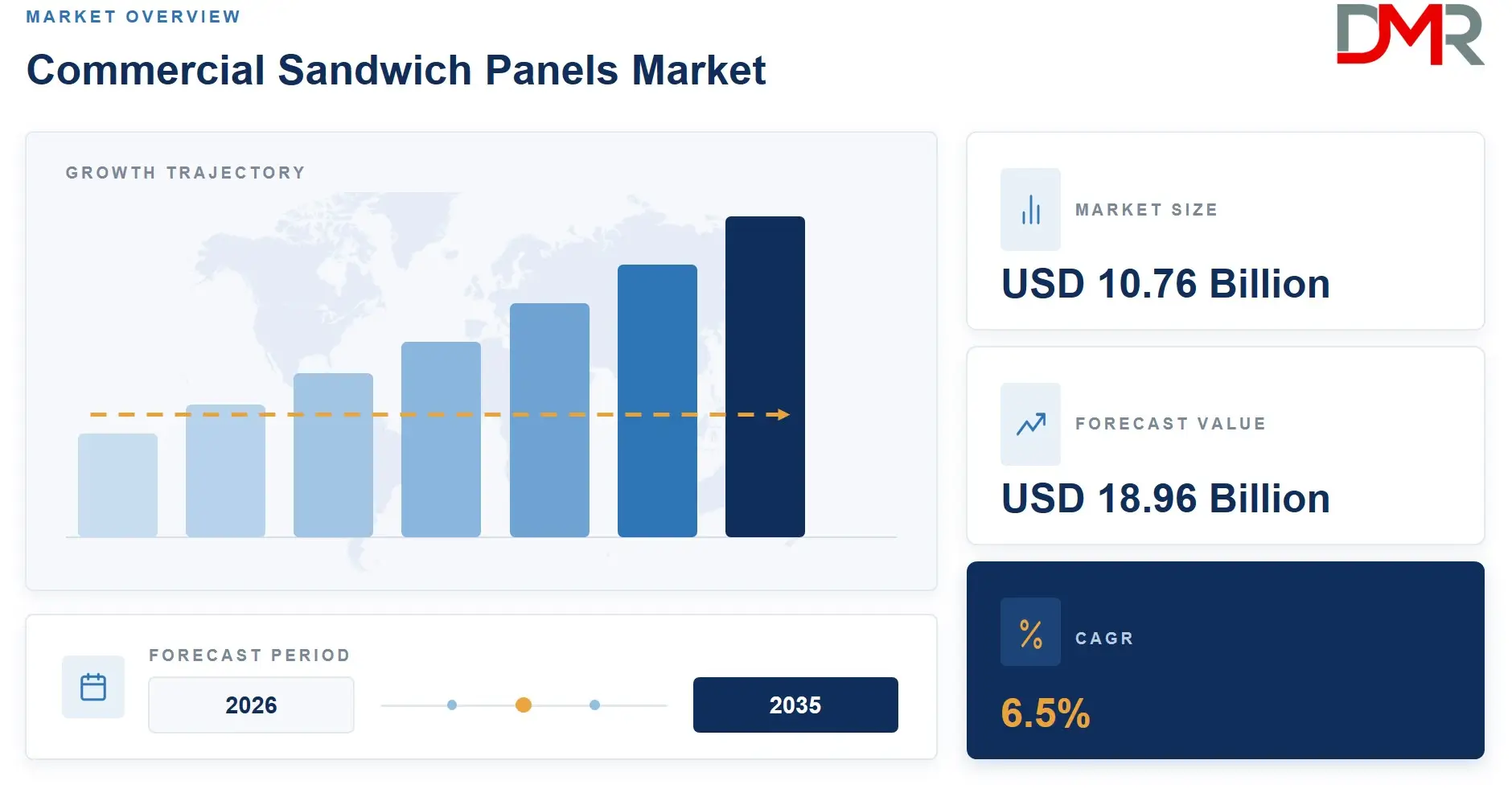
- The market size is USD 10.76 Billion in 2026, and is projected to hit USD 18.96 Billion by 2035 at a CAGR of 6.5%.
- By Insulation Material: PIR/PUR led as the largest category in 2026.
- By Facing Material: Steel led as the largest category in 2026.
- By Application: Exterior Walls led as the largest category in 2026.
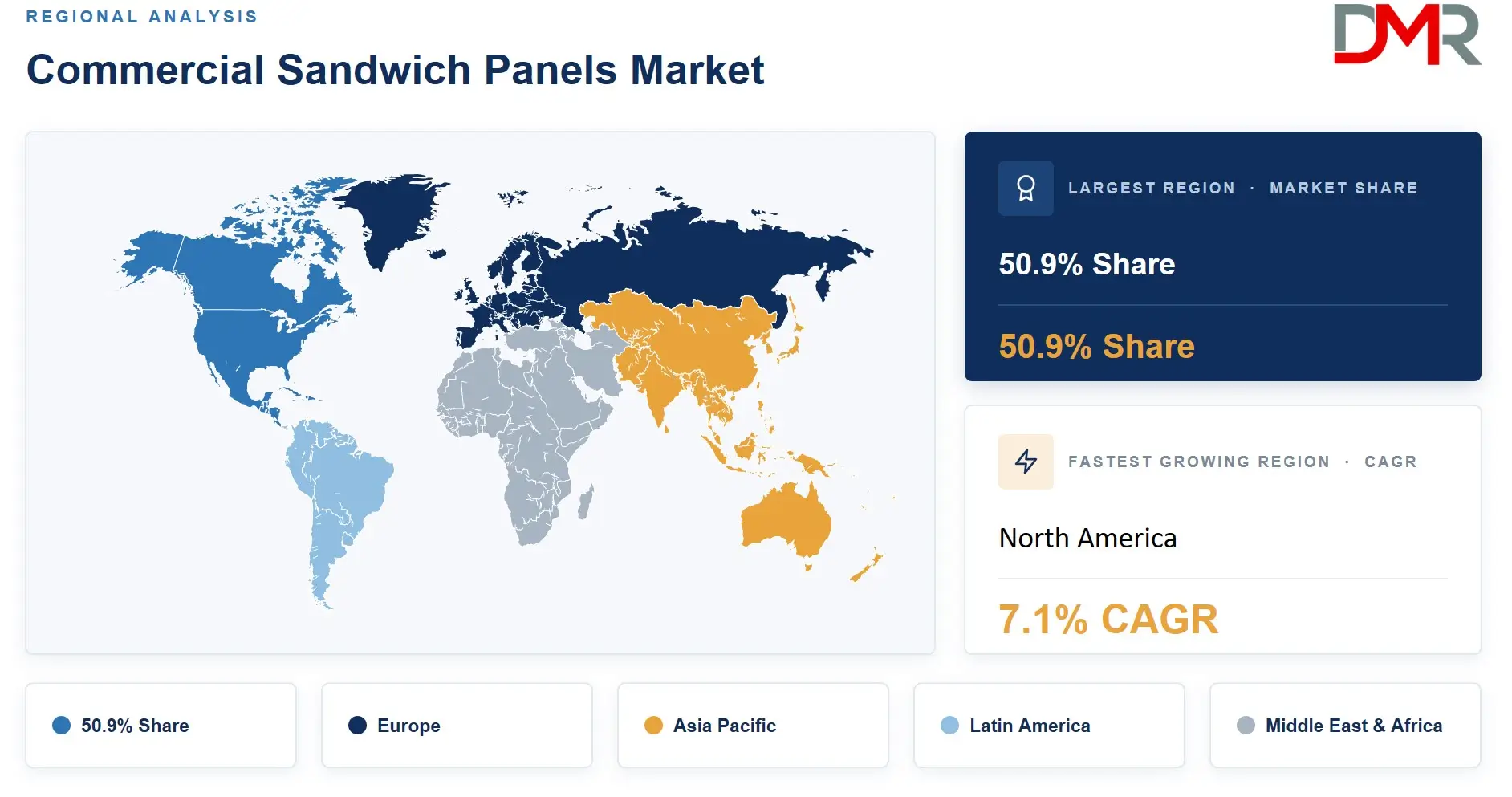
- By Region: Asia Pacific led with a 50.9% share in 2026, valued at USD 5.48 Billion.
- North America is the fastest-growing regional market through the forecast period.
Market Size and Forecast
The Global Commercial Sandwich Panels Market size is estimated at USD 10.76 Billion in 2026, and is projected to reach USD 18.96 Billion by 2035, exhibiting a CAGR of 6.5% during the forecast period.
A 6.5% compound rate sustained over nine years reflects steady structural demand rather than a cyclical spike. Commercial construction pipelines across logistics, cold-chain infrastructure, and data centers are providing the volume base. Energy-code upgrades in Europe and Asia Pacific are pulling forward building-envelope replacement cycles that would otherwise stretch across longer timelines. Those two demand streams together give the forecast its durability.
ℹ
To learn more about this report –
Download Your Free Sample Report Here
In 2025, Kingspan expanded its manufacturing network to 278 sites and committed more than €500 million to its Insulated Building Envelopes business. Insulated-panel backlog volume finished 2025 at a level 8% above the prior year. That backlog figure is a forward-looking demand signal: specifiers are locking in panel orders earlier, which provides vendor revenue visibility well into the forecast window and reduces earnings risk for established manufacturers.
Insulation Material Analysis
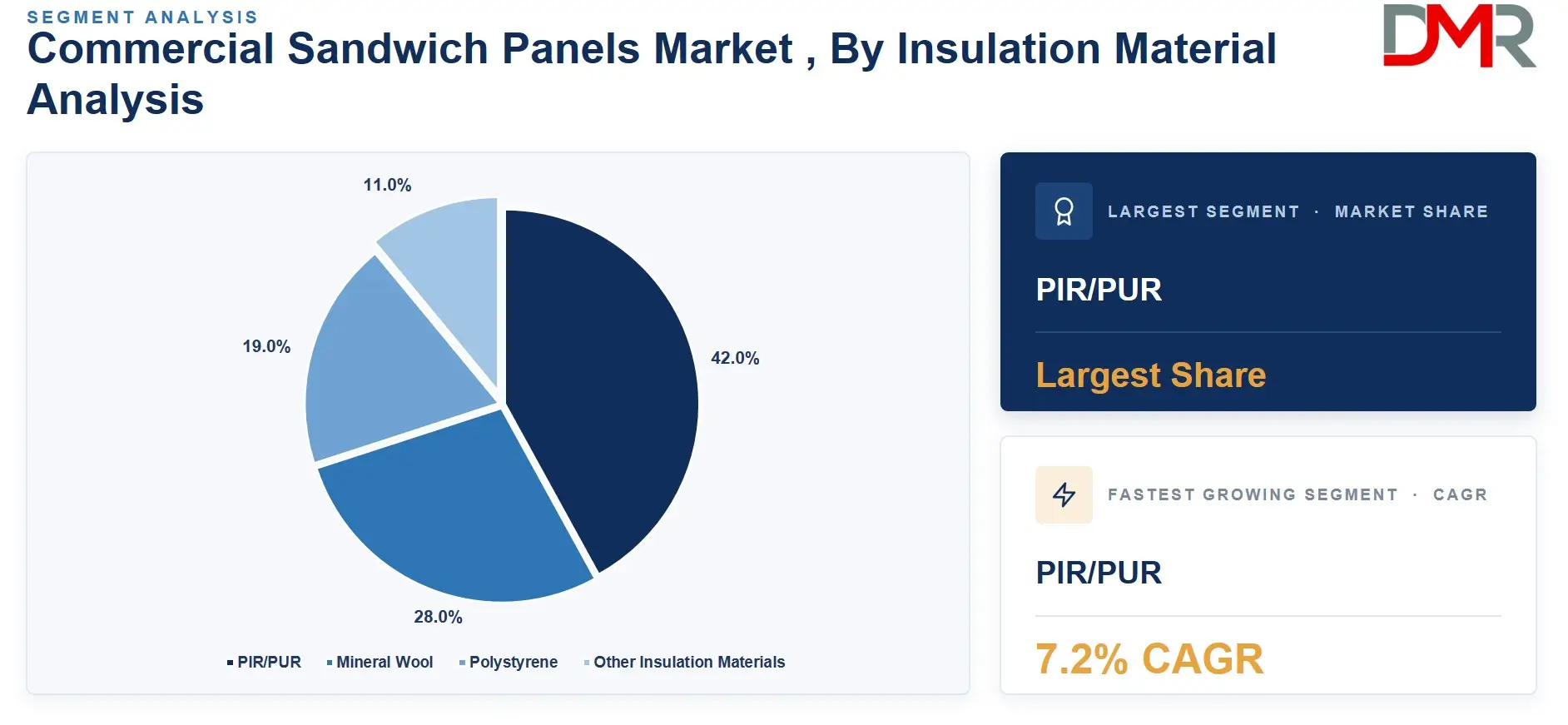
PIR/PUR led the Insulation Material segment as the largest category in 2026.
PIR and PUR cores dominate commercial sandwich-panel specification because they offer the highest thermal resistance per unit of thickness available in a continuous-production panel. As reported by rinac.com, PIR insulation achieves thermal conductivity of approximately 0.022–0.027 W/m·K, compared with 0.025–0.035 W/m·K for standard polyurethane. That performance gap translates directly into thinner wall assemblies, which preserves floor area in high-value commercial buildings and simplifies compliance with tightening U-value requirements.
ℹ
To learn more about this report –
Download Your Free Sample Report Here
Mineral wool is gaining specification share in markets where fire-performance requirements have tightened following post-2017 regulatory reviews. Polystyrene cores retain a cost position in lower-specification commercial applications but face growing pressure from insurers and building-control authorities in multi-story segments. The shift within insulation types signals a bifurcation: high-specification commercial projects will concentrate purchasing on PIR and mineral wool, while polystyrene-core panels compete on price in single-story industrial and agricultural applications.
Facing Material Analysis
Steel accounted for the largest share of Facing Material demand in 2026, ahead of all rivals.
Steel facings dominate because the material combines structural rigidity, paintability, and weldability at a cost point no alternative matches at scale. Pre-painted galvanized and Galvalume steel skins are the default specification in logistics, manufacturing, and cold-store facilities. Aluminum facings serve specialized segments where corrosion resistance and weight savings outweigh the higher material cost, primarily in coastal installations and food-processing facilities with aggressive wash-down environments.
Application Analysis
With Exterior Walls as the largest application category in 2026, the segment outpaced all other end-use classifications.
Exterior wall panels carry the highest installed volume because every commercial and industrial building requires a complete building envelope. Roofing panels represent the second-largest application and are growing in importance as integrated photovoltaic and acoustic-performance requirements create demand for more technically specified roof assemblies. Interior wall and ceiling panels serve cold-store, cleanroom, and food-processing facilities where hygiene, thermal continuity, and rapid installation drive the specification decision. Those segments are smaller in total area but carry meaningfully higher per-square-meter values.
Key Market Segments
By Insulation Material
- PIR/PUR
- Mineral Wool
- Polystyrene
- Other Insulation Materials
By Facing Material
- Steel
- Aluminum
- Other Facing Materials
By Application
- Exterior Walls
- Roofs
- Interior Walls
- Ceilings
- Other Applications
Regional Analysis
Asia Pacific led all regions with a 50.9% share in 2026, valued at approximately USD 5.48 Billion.
Asia Pacific
Asia Pacific's majority share reflects the scale of commercial and industrial construction activity across China, India, South Korea, and Southeast Asia. China's logistics infrastructure buildout and cold-chain expansion programs have absorbed substantial panel volumes. India's commercial construction pipeline, anchored by manufacturing corridors and government-backed industrial parks, creates a large and recurring panel demand base. Both markets are also building domestic panel manufacturing capacity, which compresses import dependence and lowers system costs for local developers.
North America
North America is the fastest-growing regional market in the forecast period. Reshoring of manufacturing and semiconductor fabrication, combined with hyperscale data-center construction across the US Sun Belt and Midwest, is generating panel demand at a pace exceeding what code upgrades alone would produce. American and Canadian energy codes adopted since 2021 now set minimum continuous-insulation thresholds that conventional stud-and-batt wall systems struggle to meet cost-competitively. Sandwich panels are the direct beneficiary of that compliance gap.
ℹ
To learn more about this report –
Download Your Free Sample Report Here
Europe
Europe operates under some of the world's most demanding building-energy regulations, and sandwich panels are a primary compliance tool for commercial developers. The EU's Energy Performance of Buildings Directive is accelerating retrofits of older commercial stock, opening a panel-replacement cycle that extends beyond new construction. Fire-performance requirements adopted across the UK, France, and the Netherlands following regulatory reviews of cladding systems have redirected specification toward mineral-wool-core panels at the expense of combustible-core alternatives.
Key Regions and Countries
North America
Europe
- Germany
- France
- The UK
- Spain
- Italy
- Rest of Europe
Asia Pacific
- China
- Japan
- South Korea
- India
- Australia
- Rest of APAC
Latin America
- Brazil
- Mexico
- Rest of Latin America
Middle East & Africa
- GCC
- South Africa
- Rest of MEA
Macroeconomic Impact
Commercial construction activity tracks GDP growth with a lag, and sandwich-panel demand inherits that cyclicality. In markets where interest rates remain elevated, commercial development timelines extend as developers reprice financing costs. North America and Europe both face this dynamic in the near term, which shifts near-term volume growth toward retrofit and refurbishment projects rather than ground-up new construction. Retrofit work typically uses smaller panel orders placed with shorter lead times, altering vendor production planning assumptions.
Currency movements affect manufacturers with centralized European production serving Asian and Middle Eastern buyers. A stronger euro relative to the Indian rupee or Indonesian rupiah raises landed cost for imported panels and accelerates the shift toward local panel manufacturing in growth markets. That localization trend, accelerated by macroeconomic pressure, will reshape the competitive landscape in Asia Pacific over the forecast period as local producers gain scale and certification credibility.
Market Dynamics
Driver: Energy Code Stringency Elevates High-Performance Panel Demand
Commercial building energy codes in the EU, US, and major Asia Pacific economies now set minimum thermal envelope standards that legacy cladding systems cannot meet without substantial add-on insulation. Sandwich panels deliver the required continuous insulation in a single factory-assembled product. That code-driven specification shift is not discretionary: developers face compliance obligations at permitting, which makes panel adoption structurally embedded in the commercial construction approval process.
PIR cores offer a specific performance advantage where fire resistance and thermal efficiency must coexist. As reported by rinac.com, standard PUF panel cores begin to soften and degrade at approximately 110°C, whereas PIR cores remain stable to approximately 200°C. That 90°C gap in high-temperature stability is why specifiers in warehouse and data-center segments increasingly default to PIR over PUF, even at a cost premium. Code compliance and fire-rating requirements are converging to favor PIR, compressing PUF's addressable market in higher-specification commercial applications.
Restraint: Raw-Material Price Volatility Compresses Margins and Disrupts Procurement
Steel and aluminum represent the largest direct material cost in a commercial sandwich panel. Global steel prices moved sharply in both directions between 2021 and 2024, forcing panel manufacturers into either margin compression or price renegotiation with contractors who hold fixed-price commercial contracts. Contractors operating under lump-sum agreements absorb the difference when input costs rise mid-project, which creates procurement friction and delays specification decisions as buyers defer orders while watching commodity cycles.
Combustible-core fire-performance concerns add a second restraint layer that affects market access rather than cost. Post-Grenfell regulatory reviews across the UK, Australia, and parts of Europe have elevated the evidence burden for specifying PIR and EPS-core panels in buildings above certain heights. Insurance underwriters are independently applying surcharges or coverage limits to structures with combustible-core cladding, which narrows the addressable application base for the market's dominant insulation category in multi-story commercial segments.
Opportunity: Controlled-Environment Facilities and Retrofit Programs Open High-Value Segments
Pharmaceutical cold-chain, biotech manufacturing, and food-distribution facilities require building envelopes that combine high R-values, hygienic interior surfaces, and airtight construction. These facilities specify panels from the top of the performance range and replace them on shorter cycles than standard commercial buildings. As reported by rinac.com, India alone operated 8,815 cold-storage facilities with a combined capacity of 402.18 lakh metric tonnes as of June 2025. That installed base represents both a maintenance-replacement panel market and a pipeline of capacity-expansion projects as food-logistics networks extend into secondary cities.
In October 2025, ArcelorMittal inaugurated its Helioroof® production line in France, launching an insulated steel roofing solution that integrates steel panels, thermal insulation, and photovoltaic solar cells. That product launch identifies the retrofit opportunity: building owners with aging commercial roofs now have access to a single-product solution that delivers energy-code compliance, thermal upgrading, and on-site power generation simultaneously. Vendors that can package roof replacement with energy-yield credentials will capture a disproportionate share of the retrofit cycle over the forecast period.
Porter's Five Forces
New entrants face capital-intensive barriers: continuous-lamination production lines require significant investment before a single saleable panel is produced, and specifiers in commercial markets require third-party fire, thermal, and structural certifications that take years to accumulate. Supplier power is moderate but episodic; steel and aluminum are globally traded commodities, but price spikes during supply-chain disruptions translate quickly into panel cost inflation that manufacturers cannot always pass through on short notice. Buyer power is high in large commercial and institutional procurement, where developers and main contractors use competitive tendering to extract price concessions from multiple qualified panel suppliers. Substitutes exist in the form of built-up insulated cladding systems, but the installed-cost and timeline advantages of panelized systems limit substitution to projects where architectural complexity makes factory-prefabrication impractical. Competitive rivalry among established manufacturers is intense: the market includes large vertically integrated players alongside regional specialists, and product differentiation on technical performance alone is becoming harder as PIR and mineral-wool panel specifications converge across supplier catalogues. Price, delivery reliability, and carbon-footprint documentation now jointly determine award decisions in major commercial tenders.
AI and Gen AI Impact
Artificial intelligence is entering the commercial sandwich-panel value chain at two distinct points. At the design and specification stage, AI-assisted building-performance modelling tools allow architects and energy consultants to optimize panel thickness, core type, and orientation against energy-code targets in minutes rather than days. Faster compliance modelling reduces the design-phase friction that previously caused specifiers to default to conservative, over-specified panel assemblies. That efficiency gain benefits technically differentiated suppliers whose products score well in simulation environments.
At the manufacturing stage, AI-driven quality-control systems on continuous lamination lines are improving dimensional consistency and reducing waste on factory-cut panel packages. Vendors investing in machine-vision inspection and predictive maintenance on lamination equipment are shortening production cycle times and reducing off-specification output. Laggards relying on manual inspection face compounding disadvantages: higher rework costs and inability to guarantee the tight dimensional tolerances that digitally configured panel packages now require.
Market Trends
Integrated Performance Panels Replace Single-Function Assemblies
Mineral-wool-core panels are gaining specification share as fire-safety scrutiny intensifies across European and Asia Pacific commercial markets. Simultaneously, polyurethane-core panels are consolidating position in applications where maximum thermal efficiency is the primary design constraint. Kingspan's QuadCore PowerPanel illustrates the convergence point: the product achieves a U-value as low as 0.11 W/m²K and delivers up to 475 Wp of photovoltaic output per module, combining roofing insulation with on-panel power generation. Panels that can satisfy multiple compliance and sustainability targets within a single product are moving from premium specification to mainstream commercial procurement over the forecast period.
Market Competition Overview
The commercial sandwich-panel market is moderately consolidated at the global level but fragmented at the regional level. A small number of large vertically integrated manufacturers, with their own steel-processing and panel-lamination capacity, hold the majority of revenue in Europe and North America. Those players compete on certification breadth, product range, and supply-chain carbon credentials as much as on price. Regional specialists in Asia Pacific, the Middle East, and Latin America compete primarily on local delivery speed, pricing, and relationships with domestic construction contractors.
Share is shifting toward manufacturers that can document environmental product declarations and supply panels with low-embodied-carbon steel skins. Carbon credentialing is becoming a de facto qualification threshold in European public-sector and hyperscale data-center procurement. Suppliers lacking certified-steel supply chain agreements face progressive exclusion from the most valuable commercial tenders, which will accelerate consolidation among mid-tier manufacturers without direct steelmaker partnerships.
Pricing Analysis
Panel pricing varies by core type, facing gauge, thickness, and geography. As reported by rinac.com, a standard 50 mm PUF panel with PPGI facings is priced at approximately ₹130–165 per sq ft ex-factory in 2026, while the equivalent PIR panel range is ₹150–205 per sq ft before freight and installation. PIR panels command a 15–25% premium over same-thickness PUF panels, reflecting the added fire and thermal-performance specification. That premium is sustainable where energy-code compliance or fire-rating requirements mandate the higher specification, but it compresses PIR's addressable market in cost-sensitive single-story commercial applications.
Freight costs introduce a meaningful regional price layer. Delivered sandwich-panel pricing varies by approximately 5–22% by region depending on distance from production hubs, as reported by rinac.com. Manufacturers with distributed production networks gain a structural pricing advantage over rivals shipping from a single centralized plant. In markets where freight costs erode the installed-cost advantage of panelized systems, local manufacturing presence is a competitive necessity, not an option.
Company Profiles
Kingspan Group is the largest commercially scaled insulated-panel manufacturer globally, with a manufacturing network of 278 sites and a product range spanning cold-store, cleanroom, data-center, and commercial-façade applications. The company's QuadCore UltraTech Versatile cleanroom panel is available in lengths from 1.8 m to 14.5 m, thicknesses from 50 mm to 220 mm, and U-values as low as 0.08 W/m²K, as confirmed by Kingspan's published product data. That specification range positions Kingspan to serve the full span of commercial temperature-controlled construction, from ambient-logistics to pharmaceutical-grade cleanrooms, within a single product family.
Nucor Corporation occupies a structurally different position: the company's competitive advantage is upstream integration into electric-arc furnace steelmaking, which provides cost-stable and increasingly low-carbon steel supply for its building-products division. Where European panel manufacturers source certified low-carbon steel from third-party mills at a premium, Nucor controls its steel feedstock, giving its North American panel operations a cost-structure advantage that is difficult for import-dependent competitors to replicate.
Key Players
- KPS Global LLC
- WGI Westman Group Inc.
- BRUCHA GmbH
- Green Span Profiles
- Falcon Bouwsystemen B.V.
- Romakowski GmbH & Co. KG
- Kingspan Group
- Nucor Corporation
- ArcelorMittal Building Solutions
- Tata Steel
- Cornerstone Building Brands
- Recticel NV/SA
- Metecno Group
- Isopan S.p.A.
- Assan Panel A.S.
- Manni Group
- Lattonedil S.p.A.
- DANA Group of Companies
- Marcegaglia
- Jiangsu Jingxue Insulation Technology Co. Ltd.
- Zhong Jie Group
- Balex Metal
- Norbec Inc.
Supply Chain and Value Chain Analysis
The commercial sandwich-panel value chain runs from steel and aluminum coil production through continuous lamination to site installation. Steel coil is the highest-cost input and the primary source of margin risk. Panel manufacturers purchase pre-painted coil from integrated steel mills, uncoil and profile the facings, apply adhesive or inject foam between the skins, and compress the assembly through a double-belt laminator. PIR panels manufactured on continuous production lines are available in thicknesses from 30 mm to 200 mm, as reported by rinac.com. That thickness range is set on the lamination line, giving manufacturers flexibility to switch between thermal-duty specifications without retooling.
Maximum value in the chain concentrates at the product-specification and distribution stages. Manufacturers that achieve third-party fire, thermal, and structural certifications can price at a premium over uncertified alternatives and gain preferred-vendor status with major commercial developers. The biggest supply-side risk sits at steel procurement: panel manufacturers without long-term coil supply agreements are exposed to commodity price swings that compress margins faster than selling prices can be adjusted in fixed-price commercial contracts.
Regulatory Landscape
European commercial building regulation is the most demanding globally for sandwich-panel specification. The EU Energy Performance of Buildings Directive sets minimum energy-performance standards for new and renovated commercial buildings, directly driving demand for high-performance insulated envelope systems. The UK's post-Grenfell regulatory framework, including updated Approved Document B requirements, has elevated the fire-classification evidence required to specify combustible-core panels on higher-risk buildings. Manufacturers supplying into the UK market now need Class A2 or A1 fire-rated products, or BS 8414 compliant test evidence, to access multi-story commercial projects.
In North America, ASHRAE 90.1 continuous-insulation requirements set the commercial building-envelope thermal baseline, and state-level adoption varies, creating a patchwork compliance landscape for panel vendors. Asia Pacific markets are moving toward more stringent standards: China's updated GB 50736 and India's Energy Conservation Building Code both set performance thresholds that favor panelized insulated-envelope systems over conventional construction. Regulatory convergence across major markets is reducing the number of markets where lower-specification panels remain commercially viable.
Investment and White Space Analysis
Investment is concentrating in two areas: low-carbon manufacturing capability and controlled-environment construction. Manufacturers are committing capital to certified-steel supply agreements, renewable-energy-powered lamination lines, and environmental product declaration programs to meet procurement thresholds set by European and North American institutional buyers. Vendors without credible carbon-reduction roadmaps are losing access to the highest-value commercial tender categories.
White space exists in retrofit markets across aging commercial real estate in Europe and North America. Buildings constructed before 2005 overwhelmingly fail current energy-performance standards, creating a reclad and re-roof opportunity that is structurally separate from new construction. Demountable cold-chain modules for regional food and last-mile logistics operators represent a second underserved segment: scalable, relocatable panel-based enclosures serve operators who need capacity flexibility without permanent construction commitments. Both white-space segments reward vendors with modular product design and rapid-deployment supply chains.
Recent Developments
- October 2024 — Kingspan | Invespanel launched a new range of sandwich panels using ArcelorMittal's XCarb® recycled and renewably produced steel, becoming the first sandwich-panel producer in Spain and Portugal to use this steel grade. The launch targeted a reduction in the carbon footprint of commercial building-envelope solutions.
- April 2025 — Ruukki Construction launched a digital visualization tool for its sandwich panel range, allowing customers to configure colors, façade profiles, profiling options, and installation directions before construction begins. The tool was designed to reduce design-phase decision time on commercial building projects.
- May 2025 — Ruukki Construction received FM certification for sandwich panels manufactured at its Alajärvi plant in Finland. The certification strengthened the company's supply position for certified steel-based building-envelope solutions in demanding commercial and industrial applications.
- June 2025 — Ruukki Construction launched an acoustic partition wall element designed to be compatible with its standard sandwich panel joint system. The new element enables integration into existing panel assemblies without requiring separate fixing or sealing details.
- December 2025
- — Tata Steel Nederland launched the Green Box, a sustainable green-roof system using recycled polyethylene and targeting metal-roofing applications including sandwich-panel roofs. The product was positioned around sustainability credentials, simplified installation, and lifecycle cost efficiency.
Report Details
| Report Characteristics |
| Market Value (2026) |
USD 10.76 Billion |
| Forecast Revenue (2035) |
USD 18.96 Billion |
| CAGR (2026–2035) |
6.5% |
| Historical Data |
2020 – 2024 |
| Forecast Data |
2026 – 2035 |
| Base Year |
2025 |
| Report Coverage |
Revenue Forecast, Market Dynamics, Competitive Landscape, Recent Developments |
| Segments Covered |
By Insulation Material (PIR/PUR, Mineral Wool, Polystyrene, Other Insulation Materials), By Facing Material (Steel, Aluminum, Other Facing Materials), By Application (Exterior Walls, Roofs, Interior Walls, Ceilings, Other Applications) |
| Regional Coverage |
North America – US, Canada; Europe – Germany, France, UK, Spain, Italy, Rest of Europe; Asia-Pacific – China, Japan, South Korea, India, Australia, Rest of APAC; Latin America – Brazil, Mexico, Rest of Latin America; Middle East & Africa – GCC, South Africa, Rest of MEA |
| Prominent Players |
KPS Global LLC, WGI Westman Group Inc., BRUCHA GmbH, Green Span Profiles, Falcon Bouwsystemen B.V., Romakowski GmbH & Co. KG, Kingspan Group, Nucor Corporation, ArcelorMittal Building Solutions, Tata Steel, Cornerstone Building Brands, Recticel NV/SA, Metecno Group, Isopan S.p.A., Assan Panel A.S., Manni Group, Lattonedil S.p.A., DANA Group of Companies, Marcegaglia, Jiangsu Jingxue Insulation Technology Co. Ltd., Zhong Jie Group, Balex Metal, Norbec Inc., and Other Key Players |
| Customization Scope |
Customization for segments and region or country level will be provided. Additional customization can be done based on requirements. |
| Purchase Options |
We have three licenses to opt for: Single User License, Multi-User License (Up to 5 Users), and Corporate Use License (Unlimited Users and Printable PDF). |
Frequently Asked Questions
What is the biggest investment opportunity in the Commercial Sandwich Panels market?
▾ Retrofit programs targeting aging commercial building envelopes represent the largest near-term investment opportunity. Buildings constructed before modern energy codes are structurally unable to meet current compliance thresholds without full envelope replacement, creating a reclad and re-roof pipeline that operates independently of new-construction cycles. Vendors with modular, rapid-deployment product systems are best positioned to capture this segment.
Who are the top companies in the Commercial Sandwich Panels market?
▾ Leading players include Kingspan Group, Nucor Corporation, ArcelorMittal Building Solutions, Tata Steel, Metecno Group, Isopan S.p.A., Cornerstone Building Brands, Recticel NV/SA, and Manni Group, among others. Kingspan holds the largest global manufacturing footprint, operating across 278 production sites as of 2025. Competition among the top tier centers on certification breadth, carbon-footprint documentation, and supply-chain steel traceability.
Which segment is growing fastest in the Commercial Sandwich Panels market and why?
▾ PIR/PUR insulation-core panels are growing fastest within the insulation material segment, driven by tightening thermal compliance requirements and fire-rating mandates in commercial construction. PIR cores remain thermally stable to approximately 200°C versus approximately 110°C for standard PUF, giving specifiers a technically justified reason to upgrade. Controlled-environment construction, including pharmaceutical cold-chain and data-center facilities, is absorbing a disproportionate share of this growth.
Which region is growing fastest in the Commercial Sandwich Panels market and why?
▾ North America is the fastest-growing regional market, powered by reshoring of manufacturing capacity, hyperscale data-center construction, and commercial building-code upgrades that mandate continuous insulation in new commercial structures. Asia Pacific retains the largest revenue share at 50.9% of the global total in 2026, but North America's growth rate over the forecast period exceeds Asia Pacific's as code adoption and construction investment accelerate simultaneously.
What is the biggest challenge holding Commercial Sandwich Panels Market back?
▾ Steel and aluminum price volatility is the primary structural challenge, compressing panel manufacturer margins during commodity price spikes and forcing contractors into procurement delays on fixed-price commercial contracts. Combustible-core fire-performance concerns create a secondary barrier, restricting PIR and EPS panel specification in multi-story commercial buildings across the UK, Australia, and parts of Europe, which limits the market's access to the highest-volume commercial construction segments.