Market Overview
The companion animal point-of-care blood testing market covers in-clinic and near-patient diagnostic instruments, consumables, and reagents used to assess blood chemistry, immunological markers, and metabolic function in dogs, cats, horses, and other companion animals. The market excludes laboratory-scale capital equipment sold exclusively to human diagnostics facilities and non-companion livestock diagnostics. Veterinary hospitals, reference laboratories, and academic institutions form the primary demand base.
Pet ownership rates underpin the entire demand structure. As reported by APPA's 2025 National Pet Owners Survey, 95 million U.S. households own at least one pet, establishing a permanently high patient volume for veterinary services. Humanization of pets continues to shorten the time between symptom onset and clinical intervention, pulling blood panel requests earlier into care pathways.
Europe reinforces this picture at scale. FEDIAF's 2025 facts and figures reported 299 million pets across European households, with the European pet-food market valued at €29.3 billion and annual growth of 9%. Pet spending momentum at that level converts directly into higher diagnostic utilization as owners seek preventive care alongside treatment.
Key Takeaways
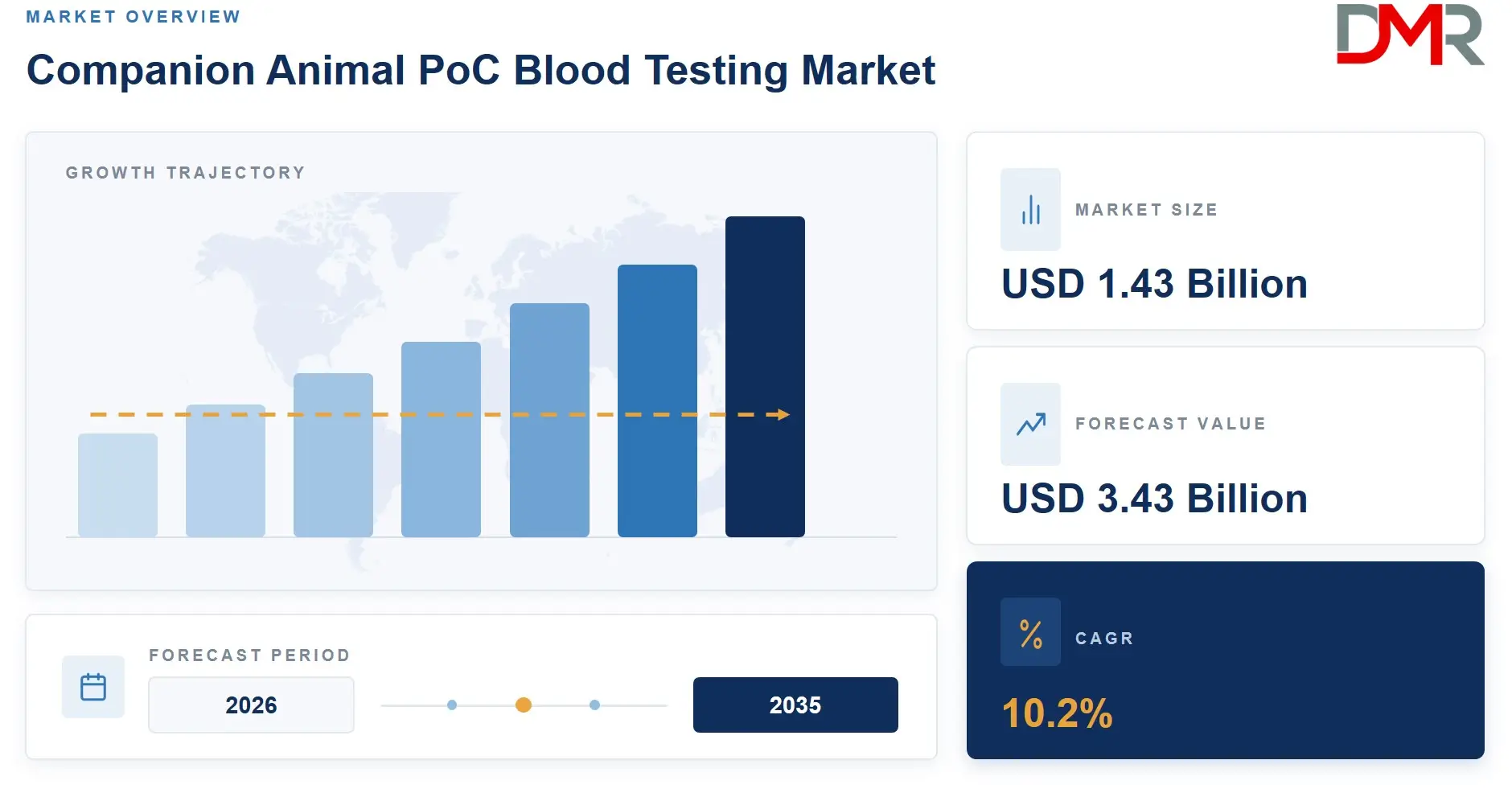
- The market size is USD 1.30 Billion in 2025, reached USD 1.43 Billion in 2026, and is projected to hit USD 3.43 Billion by 2035 at a CAGR of 10.2%.
- By Product: Consumables & Reagents led with a 64.5% share in 2025.
- By Testing Category: Clinical Chemistry/Biochemistry Testing led with a 72.7% share in 2025.
- By Animal: Dogs led with a 55.1% share in 2025.
- By End Use: Veterinary Hospitals & Clinics led with a 58.6% share in 2025.
- By Region: North America led with a 40.8% share in 2025.
- Immunoassay Testing and Cats are the fastest-growing sub-segments across their respective categories.
Market Size and Forecast
The Global Companion Animal PoC Blood Testing Market size is estimated at USD 1.43 Billion in 2026 from USD 1.30 Billion in 2025, and is projected to reach USD 3.43 Billion by 2035, exhibiting a CAGR of 10.2% during the forecast period.
Product revenue data from leading vendors confirms the upward trajectory. IDEXX recorded nine-month 2025 product revenue of $1.8868 Billion, compared with $1.6883 billion in the same 2024 period, as reported by the company's SEC filing. That 11.8% year-over-year gain in a single vendor's product line validates the broader market acceleration embedded in the 10.2% CAGR assumption.
ℹ
To learn more about this report –
Download Your Free Sample Report Here
IDEXX raised its 2026 revenue guidance to $4.70 Billion–$4.745 billion, representing organic growth of 8.5%–9.7%, signaling that the company expects sustained commercial momentum rather than a cyclical bounce. Vendors entering adjacent diagnostics segments before 2028 face a narrowing window, as incumbent instrument networks deepen lock-in through recurring consumable and reagent revenue.
Product Analysis
Consumables & Reagents accounted for 64.5% of product demand in 2026, the highest of any category.
Consumables and reagents generate recurring revenue tied directly to test volume, making this sub-segment structurally more resilient than capital equipment sales. Veterinary clinics running daily panels on dogs and cats buy replacement cartridges and reagent kits at predictable intervals. Instrument vendors that lock in consumable supply relationships protect margin through the entire clinic lifecycle.
Instruments capture the remaining share, split across biochemistry and immunoassay analyzer formats. Immunoassay analyzers are gaining faster traction as clinics expand thyroid, cardiac, and endocrine marker testing beyond the traditional chemistry panel. Vendors offering bundled instrument-plus-consumable procurement reduce the capital barrier for smaller practices and accelerate installed-base growth in underserved clinic segments.
Testing Category Analysis
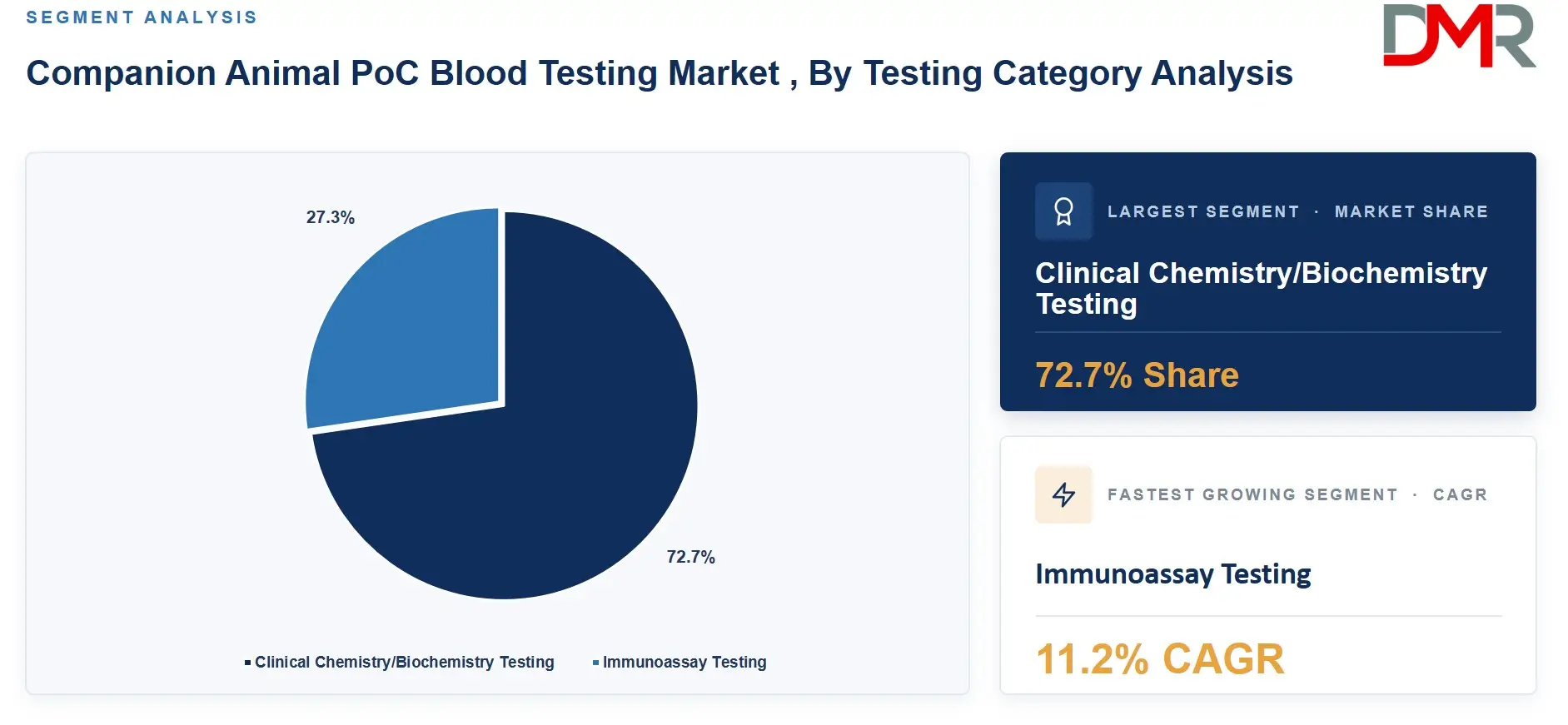
Clinical Chemistry/Biochemistry Testing led the Testing Category segment with a 72.7% share in 2026.
Liver function, kidney function, electrolyte, and metabolic panel tests anchor biochemistry demand. These are baseline diagnostics performed at virtually every clinical visit for sick or aging animals, making this sub-segment volume-stable regardless of economic cycles. Biochemistry testing density per patient increases as pet longevity rises.
ℹ
To learn more about this report –
Download Your Free Sample Report Here
Immunoassay Testing is the fastest-growing category, extending the diagnostic reach of in-clinic analyzers into infectious disease, thyroid hormones, cardiac markers, endocrine biomarkers, and inflammatory markers. As per APPA's Dog & Cat Report, cat ownership increased 23% in 2024, and cats are disproportionate users of thyroid and endocrine panels relative to their population size. Early movers expanding immunoassay menus gain a dual advantage: they capture the cat ownership surge and differentiate on panel breadth against biochemistry-only competitors.
Animal Analysis
With a 55.1% share in 2026, Dogs outpaced all other Animal categories.
Dog ownership volume, combined with a higher average annual veterinary visit rate per animal, concentrates blood testing demand in this sub-segment. Dogs undergo more frequent preventive panels, pre-surgical screens, and chronic disease monitoring than other companion species. High per-animal test density sustains consumable pull-through for instrument vendors serving dog-heavy practices.
Cats are the fastest-growing animal sub-segment, driven by the ownership surge noted above. Horses represent a smaller but high-value niche where premium testing panels justify elevated instrument and reagent pricing. Other companion animals, including rabbits and exotic species, form an emerging category that specialist practices and academic institutions increasingly serve, signaling a long-run diversification of demand beyond the traditional dog-and-cat core.
End Use Analysis
A 58.6% share made Veterinary Hospitals & Clinics the clear leader across End Use categories in 2026.
Point-of-care testing originated in clinic settings, and the installed-base advantage compounds over time as clinics build workflows around specific analyzer platforms. Same-day results drive treatment decisions at the point of encounter, reducing referral rates and increasing per-visit revenue for the practice. Vendors with deep clinic penetration convert that installed base into recurring consumable revenue.
Reference Laboratories handle complex or low-frequency assays that in-clinic analyzers cannot yet perform cost-effectively. Academic & Research Institutes represent the fastest-growing end-use segment, driven by a pipeline of novel biomarker research that feeds future commercial test menus. Growth in academic demand is a leading indicator: assays that achieve research-scale adoption today reach clinical deployment within two to five years.
Key Market Segments
By Product
- Consumables & Reagents
- Biochemistry Analyzers
- Immunoassay Analyzers
- Instruments
- Biochemistry Analyzers
- Immunoassay Analyzers
By Testing Category
- Clinical Chemistry/Biochemistry Testing
- Liver Function Testing
- Kidney Function Testing
- Electrolyte Testing
- Metabolic Panels
- Immunoassay Testing
- Infectious Disease Immunoassays
- Non-Infectious Immunoassays
- Thyroid Hormone Testing
- Cardiac Marker Testing
- Endocrine Biomarker Testing
- Inflammatory Marker Testing
By Animal
- Dogs
- Cats
- Horses
- Other Companion Animals
By End Use
- Veterinary Hospitals & Clinics
- Reference Laboratories
- Academic & Research Institutes
Regional Analysis
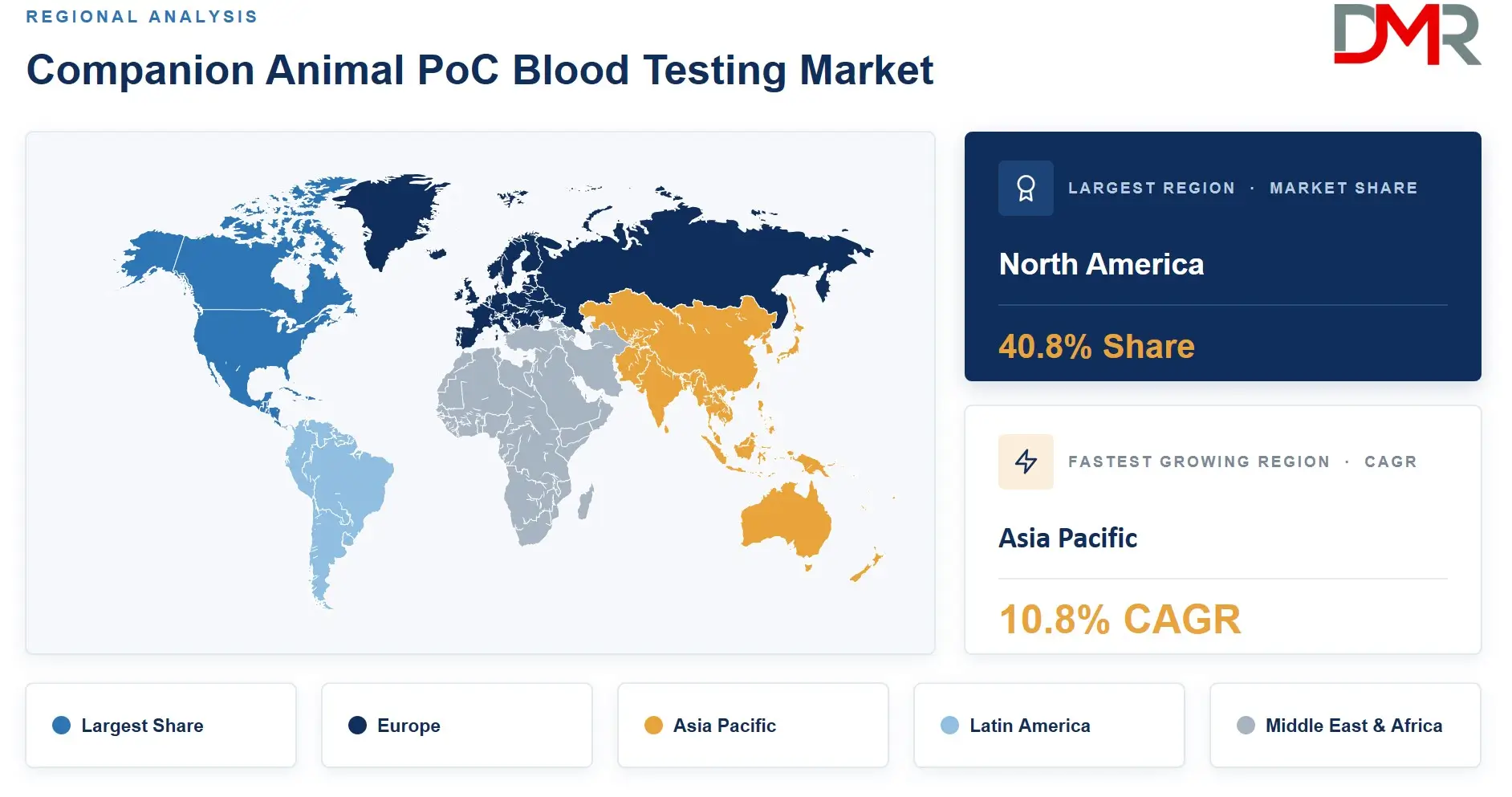
North America led the regional breakdown with a 40.8% share in 2026.
North America's dominance reflects the convergence of high pet ownership density, well-funded veterinary infrastructure, and a mature diagnostics reimbursement culture. Dog ownership reached 71 million U.S. households in 2025, up 4% year over year, according to Morningstar citing APPA data. Clinics serving that ownership base run significantly higher annual blood panel volumes per installed analyzer than clinics in any other region, sustaining North America's consumable pull-through advantage.
Research by the UK Pet Food Manufacturers' Association confirmed that 62% of UK households own one of the country's 36.5 million pets, with approximately 15.5 million pet dogs. The UK figures illustrate that Western Europe's demand concentration rivals North America on a per-household basis, even if total market size remains smaller. Asia Pacific is the fastest-growing region, with the Asian Development Bank forecasting a moderation in developing Asia's GDP growth from 5.0% in 2025 to 4.6% in 2026. Latin America and the Middle East & Africa remain underpenetrated but attract vendor interest as clinic infrastructure investment accelerates in Brazil, the GCC, and South Africa.
ℹ
To learn more about this report –
Download Your Free Sample Report Here
Key Regions and Countries
North America
Europe
- Germany
- France
- The UK
- Spain
- Italy
- Rest of Europe
Asia Pacific
- China
- Japan
- South Korea
- India
- Australia
- Rest of APAC
Latin America
- Brazil
- Mexico
- Rest of Latin America
Middle East & Africa
- GCC
- South Africa
- Rest of MEA
Market Dynamics
Driver: Pet Ownership Density Sustains Diagnostic Volume
Companion animal population growth in Europe is converting directly into higher clinical visit rates and longer annual diagnostic cycles. FEDIAF data shows that 140 million European households, representing 49% of all households, own one or more of Europe's 306 million pets. A patient base that large, served by clinics that are adopting point-of-care platforms at an accelerating rate, generates compounding consumable demand with each new instrument placement.
IDEXX's companion-animal diagnostics recurring revenue grew 10.3% organically in Q2 2026, even as U.S. same-store clinical visits declined 1.3%, as reported by Yahoo Finance. That divergence is analytically significant: testing intensity per visit is rising faster than visit volume, meaning each clinic contact now generates more diagnostic revenue than it did a year earlier. Vendors with high installed bases benefit from this dynamic without adding new clinic accounts.
Restraint: Trade Cost Escalation Compresses Instrument Margins
Global trade friction is a structural headwind for instrument manufacturers reliant on cross-border component sourcing. The World Bank projected global economic growth would slow to 2.5% in 2026, reducing the capital spending appetite of veterinary practices that were already deferring large equipment purchases. Slower GDP growth compresses the replacement cycle for analyzers, particularly in price-sensitive emerging markets.
UNCTAD reported that tariffs increased by 10% for developed countries, 16% for developing countries, and 18% for least-developed countries in 2025. Nations simultaneously face average import duties of almost 20% under most-favoured-nation treatment, per UNCTAD's March 2025 trade update. Non-tariff measures compound the burden: UNCTAD's May 2026 report confirmed that such measures impose higher export costs than tariffs for 88% of countries. Manufacturers sourcing precision optical or electronic components from multiple jurisdictions absorb these costs directly into instrument bill-of-materials.
Opportunity: AI-Enabled Analyzers Expand the Addressable Menu
IDEXX introduced the AI-based inVue Dx Cellular Analyzer, capable of delivering cytology and blood-morphology results in approximately 10 minutes. Cytology has historically required manual slide preparation and pathologist review, a process that excluded most in-clinic settings from offering the service. Bringing that capability to the point of care expands the addressable test menu per installed unit and increases the revenue ceiling for each clinic relationship.
Zoetis formed a partnership with VitalRADS in August 2025, pairing diagnostic blood-testing infrastructure with veterinary teleradiology. Integrated diagnostic ecosystems that combine blood panels, imaging, and remote specialist review create a higher switching barrier than any single-modality instrument. Vendors who position early as end-to-end diagnostic platforms capture a disproportionate share of clinic spending before competitors can replicate the integrated offering.
Market Trends
Multi-Modality In-Clinic Analyzers Consolidate the Diagnostic Workflow
Bionote USA launched the Vcheck C10, integrating four testing capabilities into a single chemistry analyzer. Multi-modality instruments reduce bench space requirements, simplify staff training, and lower the total cost of ownership for clinics managing tight square footage and labor budgets. Vendors that deliver integrated platforms rather than single-assay devices capture more of the clinic's per-visit diagnostic spend and reduce the likelihood that a competing instrument is placed alongside their own.
Market Competition Overview
The companion animal PoC blood testing market is moderately consolidated at the top, with a small number of diagnostics-focused specialists controlling the largest share of installed instrument bases and recurring consumable revenue. Zoetis reported Q4 2025 revenue of $2.4 Billion with 3% growth and net income of $603 million, as reported by the company's investor relations site. Thermo Fisher Scientific generated annual revenue of more than $45 Billion in 2025, per its investor relations annual report, signaling that large life-sciences conglomerates have the balance sheet to cross-subsidize veterinary diagnostics expansion from adjacent human health divisions.
Competition is shifting from instrument hardware toward platform breadth. Firms that bundle analyzers, reagents, software, and specialist services into integrated diagnostic networks are erecting switching costs that pure-hardware competitors cannot easily replicate. Smaller regional players retain footholds in price-sensitive markets by offering lower-cost consumable alternatives, but their ability to match the data-connectivity and AI-enabled features of the leading platforms is constrained by R&D investment scale.
Company Profiles
IDEXX Laboratories, Inc. operates as the dominant diagnostics-focused specialist in companion animal PoC blood testing. Q2 2026 total revenue reached $1.2166 Billion, with Companion Animal Group revenue of $1.1182 billion, as reported in the company's SEC 10-Q filing. Full-year 2025 results showed Q4 revenue of $1.091 billion and diagnostics recurring-revenue growth of 8.6%–10.6%, confirming that the company's razor-and-blade consumable model continues to generate durable margin. IDEXX's 2026 commercial plan targets 5,500 inVue Dx cellular-analyzer placements, which would deepen its installed base advantage and expand per-clinic annual test volume.
Mars, Incorporated approaches the market through Mars Science & Diagnostics, an operating portfolio spanning veterinary point-of-care instruments and consumables, rapid assays, reference laboratories, imaging, telemedicine, digital cytology, and practice-management technology through Antech, Heska, and SYNLAB Vet. Mars Petcare completed the acquisition of SYNLAB Vet, integrating the European specialist veterinary-laboratory diagnostics provider into its Science & Diagnostics division. Mars reported more than $47 billion in annual company sales and more than 140,000 associates, giving it a capital base to sustain acquisitive growth across diagnostics segments that organic R&D alone cannot match at this pace.
Zoetis reported full-year 2025 revenue of $9.5 Billion, as per the company's investor relations site, underscoring the financial scale it applies to veterinary health across pharmaceuticals and diagnostics. Virbac's full-year 2025 revenue reached €1.465 Billion, compared with €1.397 billion in 2024, representing reported growth of 4.8% and organic growth of 7.9%, as reported by Euronext. Virbac's organic growth rate outpacing its reported rate indicates favorable underlying demand stripping out currency headwinds, a useful benchmark for regional veterinary health spending resilience.
Key Players
- ProtectLife International Biomedical Inc.
- IDEXX Laboratories, Inc.
- BIONOTE
- Zoetis Services LLC
- Fujifilm Holdings Corporation
- Chengdu Seamaty Technology Co., Ltd.
- Mars, Incorporated
- Virbac
- Randox Laboratories Ltd.
- Thermo Fisher Scientific, Inc.
Supply Chain and Value Chain Analysis
Raw material inputs for PoC blood testing instruments include precision optical components, microfluidic substrates, antibodies and enzyme-linked reagents, and electronic assemblies. Value creation concentrates at the reagent formulation and analyzer software layers, where proprietary chemistry and algorithm development create differentiation that commodity hardware cannot replicate. The most significant supply chain risk sits at the antibody and biological reagent sourcing tier, where a small number of specialty manufacturers supply multiple competing instrument platforms. Disruption at that tier cascades into consumable shortages across vendor lines simultaneously. Distribution moves through veterinary distributors, direct sales forces, and, increasingly, digital procurement portals that compress the time between clinic order and delivery.
Regulatory Landscape
Veterinary in-vitro diagnostic devices face national-level approval requirements that vary by jurisdiction but share common elements: analytical validation, labeling compliance, and post-market surveillance obligations. The FDA published its list of 2025 Biological Device Application approvals in January 2026, confirming an active regulatory pipeline for veterinary biologics in the U.S. market. Manufacturers seeking multi-market launches must sequence approvals across the U.S., EU, and key Asia Pacific regulators, a process that extends commercialization timelines by 12 to 36 months depending on assay complexity.
FDA announced that it achieved its first-year implementation goals under the April 2025 roadmap to reduce animal testing in drug development. For companion animal diagnostics, the practical effect is a shift toward in-vitro validation methods and computational modeling as acceptance criteria for new assay submissions. Companies with existing in-vitro validation platforms gain a procedural advantage as regulators formalize non-animal testing pathways for diagnostic device approvals.
Investment and White Space Analysis
Investment in the companion animal PoC blood testing market is concentrating around two themes: AI-enabled analyzer capability expansion and multi-modality platform consolidation. Academic & Research Institutes represent the fastest-growing end-use segment, yet they remain underserved by commercial instrument vendors whose go-to-market efforts focus on clinic volume. Research institutions that adopt a platform early become the proving ground for novel biomarker assays, making them disproportionately influential in setting future clinical standard-of-care requirements.
Asia Pacific carries the highest white-space potential relative to current penetration. Pet ownership growth across South Korea, China, and India is accelerating ahead of veterinary infrastructure investment, creating a demand pull that precedes the clinic buildout needed to absorb instrument placements. Vendors that establish distributor relationships and regulatory approvals in those markets before 2028 position themselves to capture the first wave of clinic-scale deployments as infrastructure catches up with ownership rates.
Recent Developments
- July 2026 — Zoetis completed its acquisition of VitalRADS, expanding veterinary teleradiology and diagnostic-imaging capabilities following the announcement of the acquisition agreement and the prior August 2025 partnership between the two companies.
- December 2025 — Mars completed its approximately $36 Billion acquisition of Kellanova after receiving European Commission approval.
- 2026 — IDEXX set a commercial target of 5,500 inVue Dx cellular-analyzer placements as part of its annual plan, a placement volume that would materially extend its installed-base lead in AI-enabled in-clinic cytology.
- 2026 — Bionote USA launched the Vcheck U in-clinic analyzer, combining urine chemistry and sediment analysis in a single unit and extending multi-modality diagnostics beyond blood testing.
- 2025 — China's IPO market recorded 115 listings raising a combined 128 billion yuan ($18.3 billion), signaling renewed capital market appetite that could fund veterinary diagnostics entrants in Asia Pacific.
- January 2026 — Virbac reported full-year 2025 revenue of €1.465 Billion and organic growth of 7.9%, outpacing its reported growth rate as currency headwinds masked underlying demand strength.
Report Details
| Report Characteristics |
| Market Value (2025) |
USD 1.30 Billion |
| Market Value (2026) |
USD 1.43 Billion |
| Forecast Revenue (2035) |
USD 3.43 Billion |
| CAGR (2026–2035) |
10.2% |
| Base Year for Estimation |
2025 |
| Historic Period |
2020 – 2024 |
| Forecast Period |
2026 – 2035 |
| Report Coverage |
Revenue Forecast, Market Dynamics, Competitive Landscape, Recent Developments |
| Segments Covered |
By Product (Consumables & Reagents, Instruments), By Testing Category (Clinical Chemistry/Biochemistry Testing, Immunoassay Testing), By Animal (Dogs, Cats, Horses, Other Companion Animals), By End Use (Veterinary Hospitals & Clinics, Reference Laboratories, Academic & Research Institutes) |
| Regional Analysis |
North America – US and Canada; Europe – Germany, France, The UK, Spain, Italy, and Rest of Europe; Asia Pacific – China, Japan, South Korea, India, Australia, and Rest of APAC; Latin America – Brazil, Mexico, and Rest of Latin America; Middle East & Africa – GCC, South Africa, and Rest of MEA |
| Competitive Landscape |
ProtectLife International Biomedical Inc., IDEXX Laboratories Inc., BIONOTE, Zoetis Services LLC, Fujifilm Holdings Corporation, Chengdu Seamaty Technology Co. Ltd., Mars Incorporated, Virbac, Randox Laboratories Ltd., Thermo Fisher Scientific Inc. |
| Customization Scope |
Customization for segments and region or country level will be provided. Additional customization can be done based on requirements. |
| Purchase Options |
Three license options: Single User License, Multi-User License (Up to 5 Users), and Corporate Use License (Unlimited Users and Printable PDF) |
Frequently Asked Questions
What is the biggest investment opportunity in Companion Animal PoC Blood Testing Market ?
▾ AI-enabled multi-modality analyzers represent the highest-return investment theme. Platforms that combine blood chemistry, immunoassay, and cytology in a single in-clinic unit expand the addressable test menu per placement and raise switching costs. Academic & Research Institutes are the fastest-growing end-use segment and remain underserved by current commercial go-to-market strategies, making them an accessible entry point for targeted investment.
Who are the top companies in Companion Animal PoC Blood Testing Market ?
▾ IDEXX Laboratories, Mars Incorporated (through Mars Science & Diagnostics), Zoetis Services LLC, Virbac, and Thermo Fisher Scientific are the leading players. IDEXX holds the strongest diagnostics-specific position. Mars competes through a vertically integrated portfolio spanning point-of-care instruments, reference laboratories, imaging, and telemedicine through Antech, Heska, and SYNLAB Vet.
Which segment is growing fastest in Companion Animal PoC Blood Testing Market and why?
▾ Immunoassay Testing is the fastest-growing testing category, driven by clinic adoption of thyroid, cardiac, endocrine, and inflammatory marker panels at the point of care. The fastest-growing animal sub-segment is Cats, with ownership rising 23% in 2024, and cats generating disproportionately high immunoassay demand relative to their share of the pet population. Academic & Research Institutes are the fastest-growing end-use segment, serving as the commercialization pipeline for next-generation biomarker assays.
Which region is growing fastest in Companion Animal PoC Blood Testing Market and why?
▾ Asia Pacific is the fastest-growing region. Pet ownership is accelerating across China, South Korea, and India ahead of the clinic infrastructure needed to absorb new instrument placements. That demand-supply gap creates a first-mover advantage for vendors establishing distribution and regulatory approvals in those markets before 2028.
What is the biggest challenge holding Companion Animal PoC Blood Testing Market back?
▾ Trade cost escalation is the primary structural restraint. UNCTAD confirmed that non-tariff measures impose higher export costs than tariffs for 88% of countries, directly increasing the bill-of-materials cost for precision instrument components sourced across multiple jurisdictions. Combined with slowing global GDP growth, this compresses instrument replacement cycles in price-sensitive markets and delays new clinic installations in emerging regions.