Market Overview
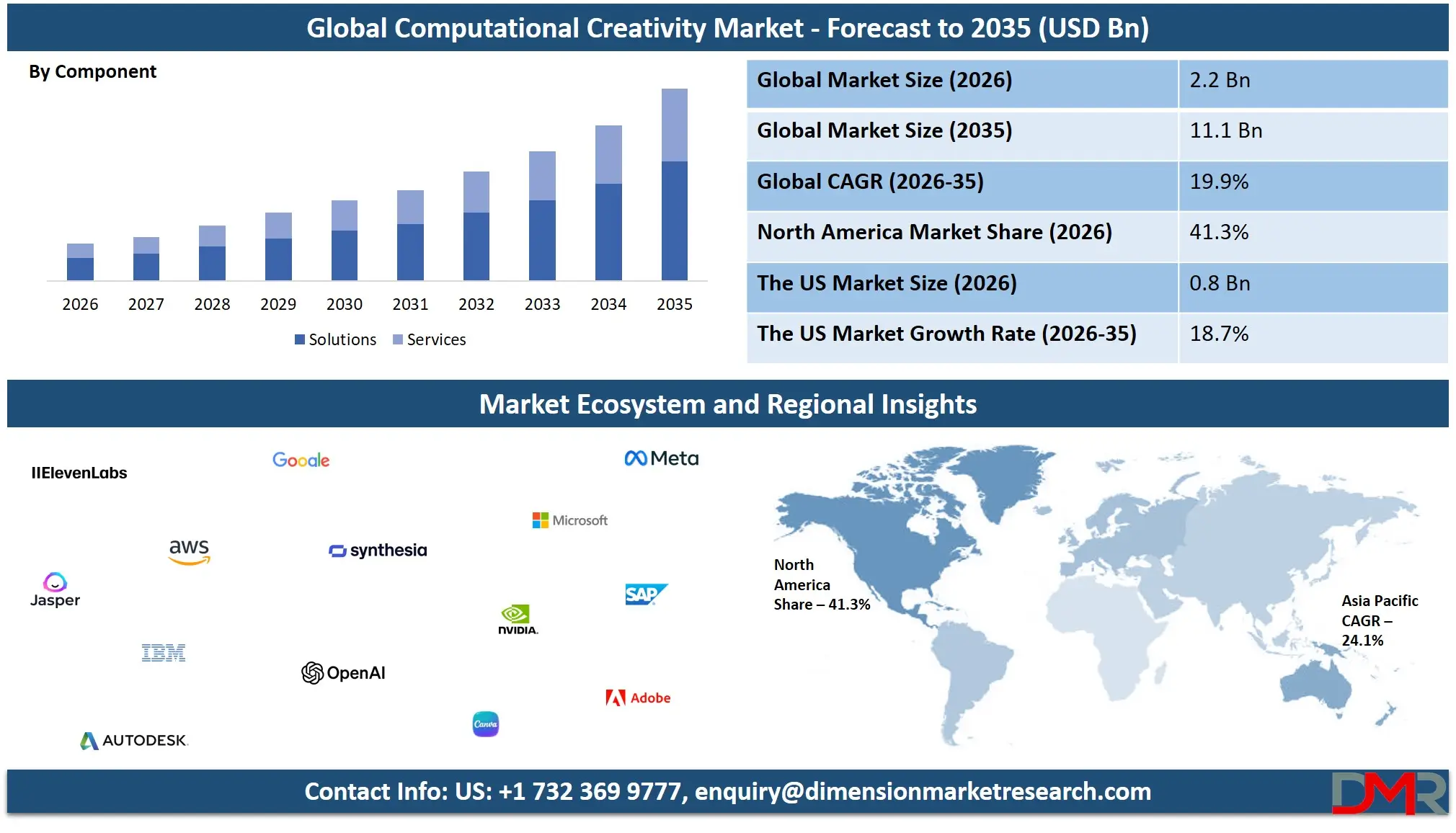
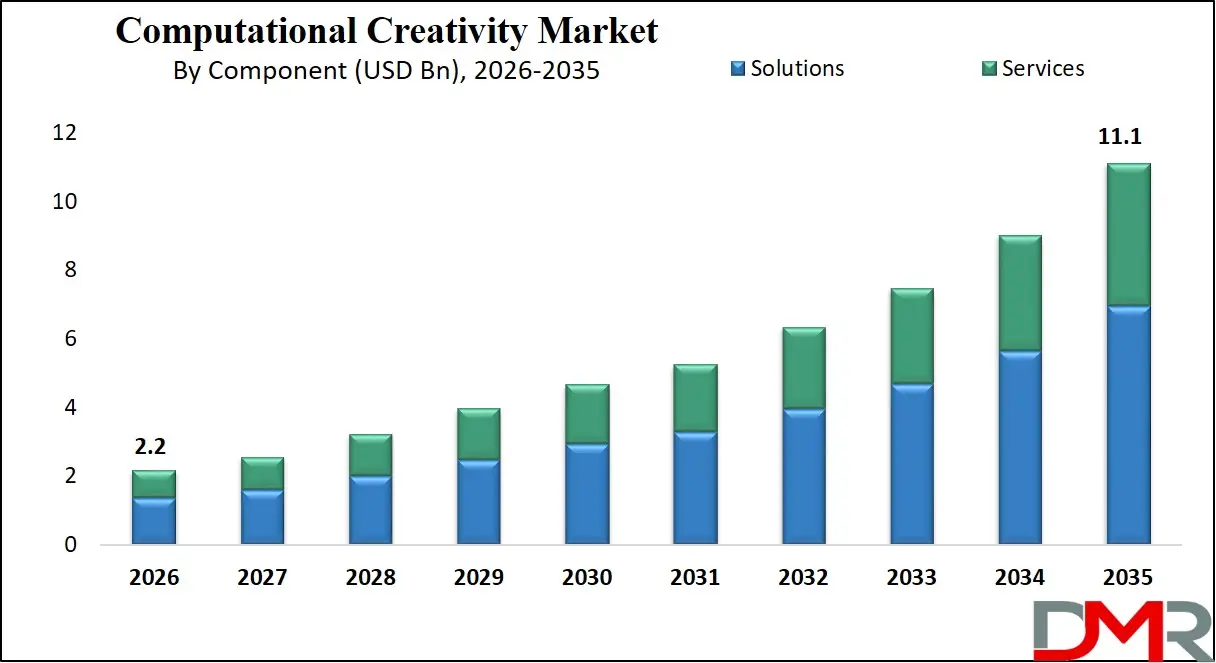
The Global Computational Creativity Market size is projected to reach USD 2.2 billion in 2026 and grow at a compound annual growth rate of 19.9% to reach a value of USD 11.1 billion in 2035.
ℹ
To learn more about this report –
Download Your Free Sample Report Here
Computational Creativity refers to the field of artificial intelligence focused on enabling machines to generate original, valuable, and context-aware creative outputs that traditionally require human imagination. This market includes creative AI platforms, generative models, algorithmic design engines, music and audio generation systems, and intelligent content creation tools. It combines disciplines such as machine learning, deep learning, natural language processing, evolutionary algorithms, and generative adversarial networks to produce creative artifacts across text, visuals, audio, and multimedia. The market plays a critical role within the broader AI ecosystem by transforming how creative processes are automated, augmented, and scaled across industries.
Growth in this market is strongly influenced by rising digital content demand, increasing adoption of cloud-based creative tools, and enterprise interest in reducing creative production time and costs. Businesses across marketing, media, gaming, education, and retail are increasingly integrating computational creativity solutions into their workflows. The shift toward personalized and immersive digital experiences has accelerated the use of AI-generated designs, narratives, and audiovisual assets, positioning computational creativity as a strategic capability rather than a niche innovation.
ℹ
To learn more about this report –
Download Your Free Sample Report Here
Recent momentum reflects a transition from experimental deployments to mature, enterprise-grade solutions. Improvements in model accuracy, multimodal generation, and ethical AI governance have increased commercial trust and adoption. Regulatory discussions around data ownership, copyright, and responsible AI usage are shaping platform development strategies, while hybrid human-AI creative collaboration models are becoming mainstream, reinforcing long-term market expansion.
The US Computational Creativity Market
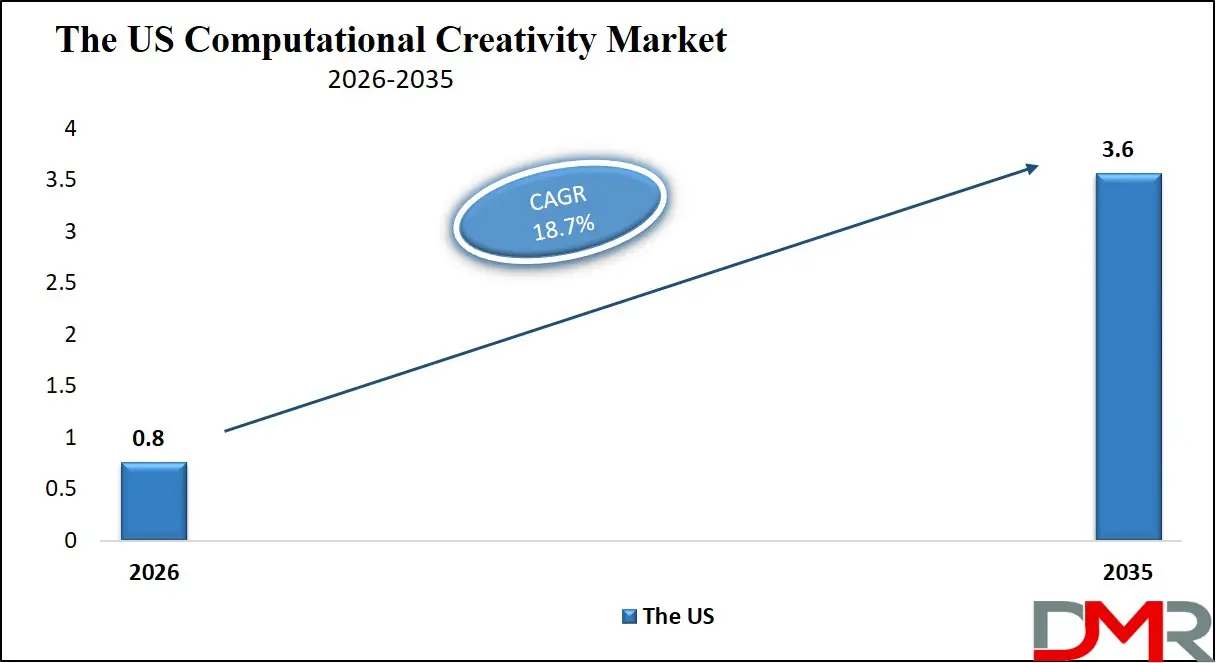
The US Computational Creativity Market size is projected to reach USD 800 million in 2026 at a compound annual growth rate of 18.7% over its forecast period.
ℹ
To learn more about this report –
Download Your Free Sample Report Here
The US market remains a global leader due to its advanced AI infrastructure, strong venture capital ecosystem, and early adoption of generative technologies. Creative industries such as media, advertising, gaming, and entertainment actively deploy computational creativity platforms to enhance productivity and innovation. Government-backed AI research initiatives and favorable intellectual property frameworks encourage rapid commercialization. Large enterprises dominate adoption, but SMEs are increasingly leveraging cloud-based creative tools due to lower entry barriers. The presence of AI research institutions and continuous R&D investment further strengthens the US market’s maturity and competitive advantage.
Europe Computational Creativity Market
Europe Computational Creativity Market size is projected to reach USD 550 million in 2026 at a compound annual growth rate of 18.1% over its forecast period.
Europe’s market is shaped by strong regulatory oversight, ethical AI frameworks, and regional digital policies such as the European Green Deal and AI Act. Adoption is particularly visible in design automation, cultural content creation, and education technologies. European companies emphasize transparency, explainability, and responsible deployment, influencing platform architecture and governance models. Public funding, cross-border research programs, and creative industry clusters support innovation, although regulatory compliance can slow commercialization. Despite this, rising demand for sustainable and culturally adaptive creative solutions continues to drive steady growth across the region.
Japan Computational Creativity Market
Japan Computational Creativity Market size is projected to reach USD 110 million in 2026 at a compound annual growth rate of 19.6% over its forecast period.
Japan’s market is expanding rapidly due to its strong presence in gaming, animation, robotics, and digital entertainment. Government-led digital transformation initiatives and AI innovation programs support adoption across industries. Urbanization and advanced industrial ecosystems enable the integration of computational creativity into design, manufacturing visualization, and educational platforms. Japanese firms actively blend traditional artistic principles with AI-driven creativity, creating unique market applications. Challenges include integration with legacy systems and talent shortages, but strong public-private collaboration continues to unlock long-term growth opportunities.
Computational Creativity Market: Key Takeaways
- Market Growth: The Computational Creativity Market size is expected to grow by USD 8.5 billion, at a CAGR of 19.9%, during the forecasted period of 2027 to 2035.
- By Component: The solution segment is anticipated to get the majority share of the Computational Creativity Market in 2026.
- By Application: The content creation segment is expected to get the largest revenue share in 2026 in the Computational Creativity Market.
- Regional Insight: North America is expected to hold a 41.3% share of revenue in the Global Computational Creativity Market in 2026.
- Use Cases: Some of the use cases of Computational Creativity include gaming & content creation, education & training media, and more.
Computational Creativity Market: Use Cases
- Automated Content Generation: AI systems generate articles, marketing copy, and social media content at scale while maintaining contextual relevance and brand tone.
- Design & Visual Arts Automation: Creative engines assist in layout design, concept ideation, and visual experimentation, reducing manual effort and iteration cycles.
- Music & Audio Composition: Algorithms produce original music, sound effects, and voice synthesis for media, gaming, and advertising applications.
- Video & Script Generation: Platforms automate storyboarding, script drafting, and video editing, significantly shortening production timelines.
- Gaming Content Creation: Procedural generation supports dynamic game environments, character development, and adaptive narratives.
- Education & Training Media: Personalized creative learning content improves engagement through interactive visuals, audio, and storytelling.
- Brand Personalization Solutions: AI generates customized creative assets for targeted campaigns across digital commerce and advertising platforms.
Stats & Facts
- US Department of Commerce reported AI-enabled creative software adoption growth exceeding 18% in 2024.
- European Commission estimated that generative and creative AI contributed over EUR 4.2 billion to digital content industries in 2024.
- Japan Ministry of Economy, Trade and Industry indicated AI-assisted design tools adoption increased by 21% in 2024.
- OECD observed that over 35% of creative enterprises globally integrated AI tools by 2025.
- World Intellectual Property Organization recorded a 28% rise in AI-generated content-related patent filings in 2024.
- US Bureau of Labor Statistics noted productivity gains of up to 30% in creative roles using AI tools.
- European Patent Office reported accelerated filings related to generative design and creative algorithms in 2025.
- UNESCO highlighted AI-driven creative technologies as key drivers of digital cultural economies in 2024.
- Japan Cabinet Office confirmed increased government funding for AI creativity research in FY2025.
- International Telecommunication Union reported cloud-based creative AI usage accounted for over 65% of deployments in 2024.
Market Dynamic
Driving Factors in the Computational Creativity Market
Rising Demand for Digital Content
The rapid expansion of digital platforms, social media, streaming services, and e-commerce has sharply increased demand for continuous, high-volume creative output. Organizations are expected to deliver visually engaging, personalized, and time-sensitive content across multiple channels. Computational creativity supports this need by automating repetitive creative tasks while preserving quality and brand consistency. Scalable content generation reduces production costs, shortens turnaround times, and enables faster market entry, making AI-driven creativity a critical growth driver for content-intensive industries.
Advances in Generative AI Technologies
Ongoing advances in deep learning, multimodal systems, and hybrid AI architectures have significantly enhanced the quality and contextual relevance of AI-generated creative outputs. Improved training techniques, larger datasets, and advanced computing infrastructure enable the generation of complex visuals, narratives, and audio content. These technological improvements reduce adoption barriers, expand professional-grade use cases, and increase enterprise confidence, directly accelerating market expansion and broadening the application scope of computational creativity solutions.
Restraints in the Computational Creativity Market
Intellectual Property and Copyright Concerns
Unclear regulations surrounding ownership of AI-generated content and the legality of training data present notable challenges for market growth. Creative professionals, enterprises, and regulators remain cautious about copyright infringement, authorship attribution, and ethical use of generated content. These uncertainties increase compliance costs and slow adoption, particularly in regulated industries. Until clearer legal frameworks emerge, intellectual property risks may limit large-scale deployment despite strong technological capabilities.
Skill Gaps and Integration Challenges
Successful implementation of computational creativity solutions requires specialized expertise in AI systems, creative workflows, and data management. Many organizations face shortages of skilled talent and internal resistance to workflow transformation. Additionally, integrating AI tools with legacy creative software and production pipelines can be complex and time-consuming. These challenges increase deployment costs, extend implementation timelines, and may discourage adoption among smaller organizations with limited technical resources.
Opportunities in the Computational Creativity Market
Expansion in Emerging Creative Economies
Emerging economies with rapidly growing digital ecosystems present strong growth opportunities for computational creativity solutions. Rising internet access, smartphone usage, and digital entrepreneurship are driving demand for cost-effective creative automation tools. AI-generated content tailored to local languages, cultures, and consumer preferences enables broader market penetration. Vendors that offer scalable, localized solutions can tap into underserved markets and accelerate adoption across education, media, marketing, and digital commerce sectors.
Government Support and AI Policy Frameworks
Increasing government investments in artificial intelligence, digital infrastructure, and creative industries are creating a favorable environment for market growth. National AI strategies, innovation grants, and public-private partnerships support research, commercialization, and adoption of creative AI technologies. Clearer policy frameworks and ethical AI guidelines also build enterprise trust. These initiatives encourage long-term investment and accelerate the integration of computational creativity across public and private sectors.
Trends in the Computational Creativity Market
Human-AI Creative Collaboration
The market is shifting toward collaborative models where AI enhances rather than replaces human creativity. Computational creativity tools act as co-creators, supporting ideation, experimentation, and refinement while leaving final creative control to humans. This approach improves productivity without diminishing artistic expression. Human-AI collaboration increases acceptance among creative professionals and enables organizations to balance efficiency with originality, making it a defining trend across creative industries.
Multimodal and Hybrid Creative Systems
There is growing demand for platforms capable of generating text, visuals, audio, and video within a single integrated workflow. Multimodal and hybrid creative systems combine multiple AI techniques to deliver richer, context-aware outputs. These platforms streamline creative production, reduce tool fragmentation, and enable consistent storytelling across formats. As enterprises seek end-to-end creative solutions, multimodal systems are reshaping production pipelines and redefining creative scalability.
Impact of Artificial Intelligence in Computational Creativity Market
- Automated Ideation: AI accelerates brainstorming by generating multiple creative concepts rapidly.
- Personalization Engines: Systems tailor content to individual user preferences at scale.
- Workflow Optimization: AI reduces manual creative tasks, improving operational efficiency.
- Multimodal Creation: Integrated generation of text, visuals, and audio enhances content richness.
- Quality Enhancement: Advanced models improve aesthetic consistency and originality.
- Cost Reduction: Automation lowers production and labor expenses.
- Real-Time Adaptation: AI adjusts creative outputs based on performance feedback.
- Scalable Innovation: Platforms enable rapid experimentation and creative iteration.
Research Scope and Analysis
By Component Analysis
Solutions dominate the Computational Creativity market with an expected 62.4% share in 2026, primarily due to strong enterprise adoption of generative AI platforms, creative content creation tools, and advanced design engines. Organizations increasingly prefer ready-to-deploy solutions that integrate seamlessly with existing digital workflows such as marketing automation platforms, content management systems, and creative software suites. These solutions provide immediate operational value by reducing manual creative effort, accelerating production timelines, and ensuring consistent output quality. Continuous innovation in user interfaces, multimodal generation, and model accuracy further strengthens adoption. As vendors focus on scalable, cloud-native, and subscription-based offerings, solutions remain the backbone of market revenue and long-term growth.
Services represent the fastest-growing component segment as organizations seek expert support for consulting, system integration, deployment customization, and ongoing maintenance. As computational creativity platforms become more complex, enterprises require specialized expertise to align AI capabilities with creative objectives and internal workflows. Large enterprises, in particular, depend on professional services to manage large-scale deployments, ensure data governance compliance, and optimize performance. Demand is also rising for training and change management services as creative teams adapt to AI-augmented processes. With increasing focus on tailored implementations and long-term platform optimization, services are becoming a critical enabler of successful adoption and sustained market expansion.
By Technology Analysis
Machine learning and deep learning technologies lead the market with an estimated 45.8% share in 2026, reflecting their foundational role in enabling computational creativity. These technologies power core creative capabilities such as pattern recognition, language generation, visual synthesis, and audio modeling. Continuous improvements in neural network architectures, training efficiency, and scalability have significantly enhanced output quality and reliability. Their flexibility allows deployment across diverse creative applications, from text and design to music and video. As organizations prioritize accuracy, performance, and scalability, machine learning and deep learning remain the most widely adopted and commercially mature technologies in this market.
Hybrid models are expanding rapidly as they combine multiple AI approaches—such as deep learning, NLP, evolutionary algorithms, and rule-based systems—to deliver richer and more adaptable creative outputs. These models overcome the limitations of single-technology systems by enhancing contextual understanding, creativity control, and output diversity. Hybrid architectures are particularly valuable in complex creative tasks requiring multimodal generation and human-AI collaboration. As enterprises seek flexible solutions capable of handling varied creative demands, hybrid models are gaining traction across media, design, education, and entertainment applications, positioning them as a key growth driver in the technology landscape.
By Application Analysis
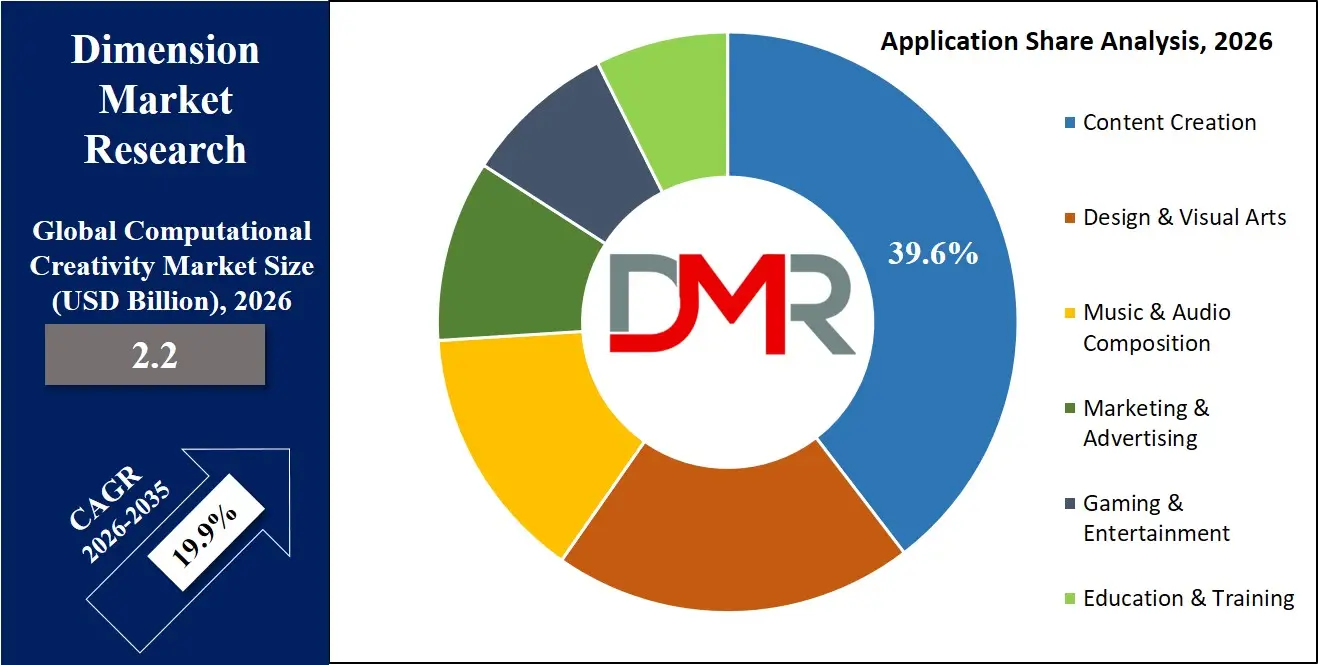
Content creation is projected to account for 39.6% market share in 2026, driven by escalating demand for AI-generated text, scripts, video content, and marketing assets. Businesses across advertising, media, e-commerce, and social platforms rely on computational creativity to produce high volumes of engaging, personalized content efficiently. AI-driven tools enable rapid iteration, multilingual support, and consistent brand messaging while reducing creative production costs. As digital channels multiply and content cycles shorten, organizations increasingly adopt AI-powered content creation solutions to maintain competitiveness and audience engagement, reinforcing this segment’s market leadership.
ℹ
To learn more about this report –
Download Your Free Sample Report Here
The design and visual arts segment is experiencing rapid growth as AI tools enhance ideation, prototyping, and visual experimentation. Computational creativity enables designers to explore multiple concepts, styles, and layouts quickly, improving innovation speed and creative diversity. Applications include logo design, digital illustration, product visualization, and generative art. Growing adoption among creative professionals and enterprises reflects increasing acceptance of AI as a collaborative design partner. As visual content becomes central to digital branding and user experience, AI-enhanced design solutions are expected to gain broader adoption and sustained growth.
By Deployment Mode Analysis
Cloud deployment dominates the market with an expected 68.2% share in 2026, supported by scalability, cost efficiency, and rapid access to advanced AI capabilities. Cloud-based platforms allow organizations to deploy computational creativity solutions without heavy infrastructure investments while benefiting from continuous updates and performance improvements. Subscription pricing models further enhance affordability, particularly for SMEs. Cloud deployment also enables collaboration across distributed creative teams and seamless integration with other digital tools. These advantages make cloud-based solutions the preferred choice for organizations seeking agility, scalability, and faster innovation cycles.
On-premises deployment is gaining traction in industries with strict data security, privacy, and compliance requirements. Organizations handling sensitive creative assets or proprietary data prefer on-premises solutions to maintain greater control over infrastructure and intellectual property. While higher upfront costs and longer deployment timelines limit widespread adoption, demand is increasing among regulated sectors and large enterprises with established IT capabilities. As vendors improve on-premises flexibility and hybrid deployment options, this segment is expected to grow steadily alongside cloud-based solutions.
By Organization Size Analysis
Large enterprises are expected to hold 57.1% market share in 2026, driven by their capacity to invest in advanced computational creativity platforms at scale. These organizations leverage AI-driven creativity to maintain brand consistency, accelerate global content production, and optimize marketing and media operations. Large enterprises also benefit from dedicated AI teams, enabling deeper customization and integration across business units. Their emphasis on automation, analytics, and personalization continues to fuel adoption, making them the primary revenue contributors to the market.
SMEs represent the fastest-growing organization size segment due to increasing access to affordable, cloud-based creative AI tools. Subscription pricing models and user-friendly platforms enable smaller businesses to compete with larger firms by producing professional-grade creative content. SMEs increasingly use computational creativity to enhance digital marketing, branding, and customer engagement without expanding creative teams. As awareness and accessibility improve, SMEs are expected to drive strong incremental growth across emerging and developed markets.
By End User Analysis
The media and entertainment sector leads with an estimated 33.9% market share in 2026, driven by continuous demand for creative automation across film, television, gaming, music, and digital content platforms. Computational creativity supports rapid content generation, visual effects, scriptwriting, and sound design, enabling faster production cycles and creative experimentation. As audience demand for immersive and personalized experiences increases, media companies increasingly rely on AI-powered creativity to scale production while maintaining artistic quality.
Education institutions are emerging as a fast-growing end-user segment as AI-generated learning content enhances engagement, personalization, and accessibility. Computational creativity enables the creation of interactive visuals, adaptive learning materials, and multimedia educational resources. Growing emphasis on digital education, remote learning, and personalized curricula is accelerating adoption. As institutions modernize teaching methodologies, creative AI tools are becoming integral to content development and student engagement strategies.
The Computational Creativity Market Report is segmented on the basis of the following:
By Component
- Solutions
- Generative AI Platforms
- Creative Content Creation Tools
- Design & Ideation Engines
- Music & Audio Generation Tools
- Services
- Integration & Deployment
- Consulting
- Support & Maintenance
By Technology
- Machine Learning & Deep Learning
- Natural Language Processing (NLP)
- Generative Adversarial Networks (GANs)
- Evolutionary Algorithms
- Hybrid Models
By Application
- Content Creation
- Text & Writing
- Video & Script Generation
- Design & Visual Arts
- Music & Audio Composition
- Marketing & Advertising
- Gaming & Entertainment
- Education & Training
By Deployment Mode
By Organization Size
- Large Enterprises
- Small & Medium Enterprises (SMEs)
By End User
- Media & Entertainment
- Advertising & Marketing Agencies
- IT & Software Companies
- Gaming Industry
- Education Institutions
- Retail & E-commerce
Regional Analysis
Leading Region in the Computational Creativity Market
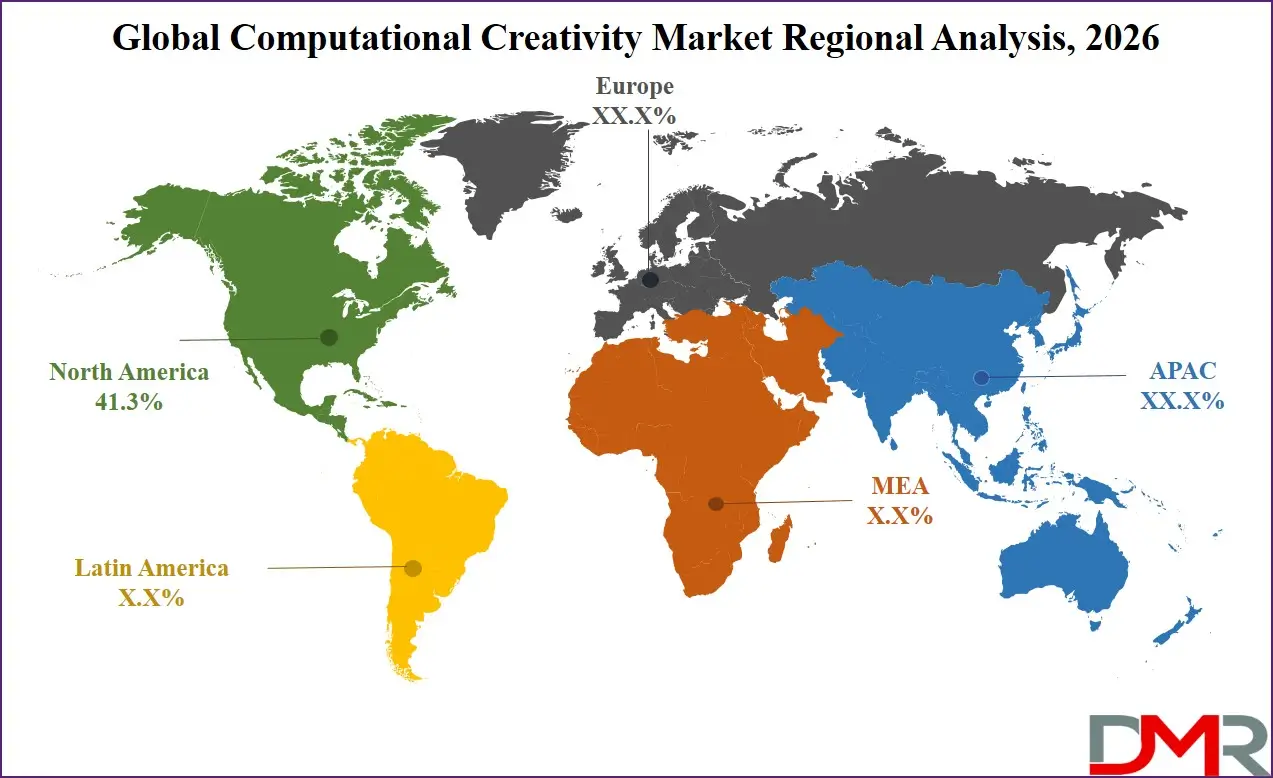
North America is expected to hold 41.3% market share in 2026, supported by advanced AI infrastructure, a strong innovation ecosystem, and early enterprise adoption. High investment in research and development, widespread cloud adoption, and strong collaboration between industry and academia reinforce regional leadership. Favorable regulatory environments and strong demand from media, marketing, and technology sectors further strengthen North America’s dominance. The presence of AI-focused startups and mature enterprises ensures continuous innovation and sustained market leadership.
ℹ
To learn more about this report –
Download Your Free Sample Report Here
Fastest Growing Region in the Computational Creativity Market
Asia-Pacific is projected to be the fastest-growing region due to expanding digital economies, government-led AI initiatives, and increasing investment in creative industries. Rapid adoption across gaming, education, advertising, and digital media is driving market momentum. Growing internet penetration, mobile-first consumption, and a large creative workforce support widespread adoption. As regional governments promote AI innovation and digital transformation, Asia-Pacific is expected to deliver the highest growth rate during the forecast period.
By Region
North America
Europe
- Germany
- The U.K.
- France
- Italy
- Russia
- Spain
- Benelux
- Nordic
- Rest of Europe
Asia-Pacific
- China
- Japan
- South Korea
- India
- ANZ
- ASEAN
- Rest of Asia-Pacific
Latin America
- Brazil
- Mexico
- Argentina
- Colombia
- Rest of Latin America
Middle East & Africa
- Saudi Arabia
- UAE
- South Africa
- Israel
- Egypt
- Rest of MEA
Competitive Landscape
The Computational Creativity market is moderately competitive, shaped by rapid innovation cycles, high levels of research and development investment, and a strong emphasis on platform differentiation. Market participants concentrate on expanding creative capabilities, enhancing model accuracy, and improving multimodal generation performance to address diverse industry needs. Strategic partnerships, collaborations, and ecosystem development play a crucial role in strengthening market presence and accelerating adoption. Entry barriers in the Computational Creativity market include advanced technical expertise, access to high-quality training data, and compliance with evolving regulatory and ethical AI frameworks.
Some of the prominent players in the global Computational Creativity are:
- Adobe Inc.
- OpenAI
- Microsoft Corporation
- Google (Alphabet Inc.)
- NVIDIA Corporation
- Amazon Web Services (AWS)
- IBM Corporation
- Meta Platforms, Inc.
- Autodesk Inc.
- Canva
- Stability AI
- Salesforce, Inc.
- SAP SE
- Siemens AG
- Runway AI
- Midjourney
- Jasper AI
- Anthropic
- ElevenLabs
- Synthesia
- Other Key Players
Recent Developments
- In October 2025, NVIDIA has announced a major partnership with Oracle to build the U.S. Department of Energy’s largest AI supercomputer to accelerate scientific discovery. The Solstice system will deploy 100,000 NVIDIA Blackwell GPUs, while the Equinox system will add 10,000 GPUs, delivering a combined 2,200 exaflops of AI performance. Located at Argonne National Laboratory, the systems will support advanced AI model development and agentic scientific workflows.
- In September 2025, Unity announced the formation of the Unity AI Council to accelerate innovation across its platform for games and interactive experiences. The Council brought together leading AI expertise with Unity’s product leadership to enhance the pace and quality of AI-driven development. Unity also indicated plans to add more members in the coming months, reinforcing its focus on supporting the next generation of interactive content creation.
Report Details
| Report Characteristics |
| Market Size (2026) |
USD 2.2 Bn |
| Forecast Value (2035) |
USD 11.1 Bn |
| CAGR (2026-2035) |
19.9% |
| The US Market Size (2026) |
USD 0.8 Bn |
| Historical Data |
2021 – 2025 |
| Forecast Data |
2027 – 2035 |
| Base Year |
2025 |
| Estimate Year |
2026 |
| Report Coverage |
Market Revenue Estimation, Market Dynamics, Competitive Landscape, Growth Factors and etc. |
| Segments Covered |
By Component (Solutions, Services), By Technology (Machine Learning & Deep Learning, Natural Language Processing (NLP), Generative Adversarial Networks (GANs), Evolutionary Algorithms, Hybrid Models), By Application (Content Creation, Design & Visual Arts, Music & Audio Composition, Marketing & Advertising, Gaming & Entertainment, Education & Training), By Deployment Mode (Cloud, On-Premises), By Organization Size (Large Enterprises, Small & Medium Enterprises (SMEs)), By End User (Media & Entertainment, Advertising & Marketing Agencies, IT & Software Companies, Gaming Industry, Education Institutions, Retail & E-commerce) |
| Regional Coverage |
North America – The US and Canada; Europe – Germany, The UK, France, Russia, Spain, Italy, Benelux, Nordic, & Rest of Europe; Asia-Pacific – China, Japan, South Korea, India, ANZ, ASEAN, Rest of APAC; Latin America – Brazil, Mexico, Argentina, Colombia, Rest of Latin America; Middle East & Africa – Saudi Arabia, UAE, South Africa, Turkey, Egypt, Israel, & Rest of MEA |
| Prominent Players |
Adobe Inc., OpenAI, Microsoft Corporation, Google (Alphabet Inc.), NVIDIA Corporation, Amazon Web Services (AWS), IBM Corporation, Meta Platforms, Inc., Autodesk Inc., Canva, Stability AI, Salesforce, Inc., SAP SE, Siemens AG, Runway AI, Midjourney, Jasper AI, Anthropic, ElevenLabs, Synthesia, and Other Key Players |
Frequently Asked Questions
How big is the Global Computational Creativity Market?
▾ The Global Computational Creativity Market size is expected to reach USD 2.2 billion by 2026 and is projected to reach USD 11.1 billion by the end of 2035.
Which region accounted for the largest Global Computational Creativity Market?
▾ North America is expected to have the largest market share in the Global Computational Creativity Market, with a share of about 41.3% in 2026.
How big is the Computational Creativity Market in the US?
▾ The US Computational Creativity market is expected to reach USD 800 million by 2026.
Who are the key players in the Computational Creativity Market?
▾ Some of the major key players in the Global Computational Creativity Market include AWS, Microsoft, Google, and others.
What is the growth rate in the Global Computational Creativity Market?
▾ The market is growing at a CAGR of 19.9 percent over the forecasted period.