What is the Confidential Computing Market Size?
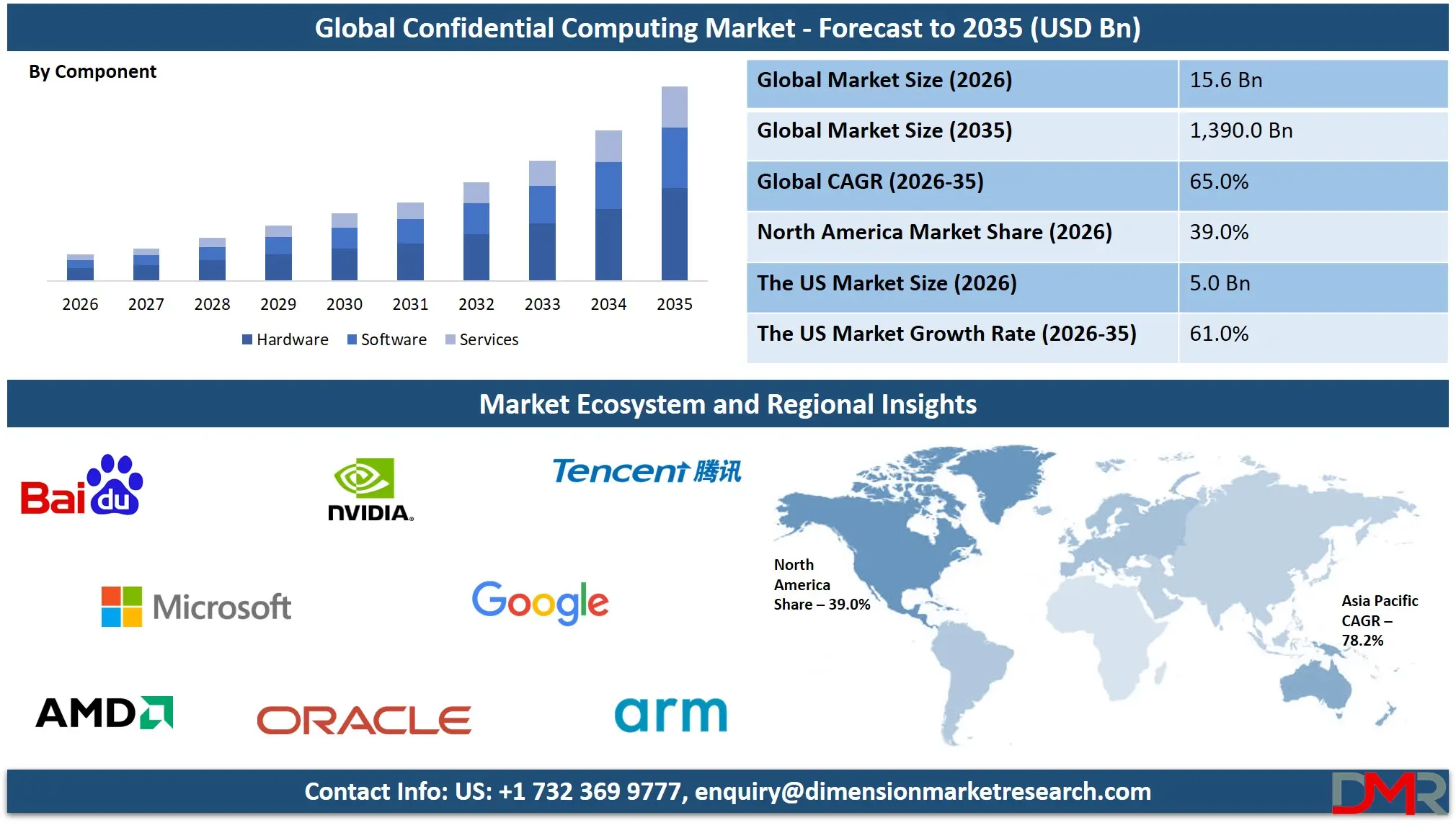
The Confidential Computing Market size is expected to be USD 15.6 billion in 2026 and increase at a compound annual growth rate of 65.0% to USD 1,390.0 billion in 2035 due to increase in various regulatory requirements around the world like GDPR and others is forcing firms to implement sophisticated technology solutions for data protection.
ℹ
To learn more about this report –
Download Your Free Sample Report Here
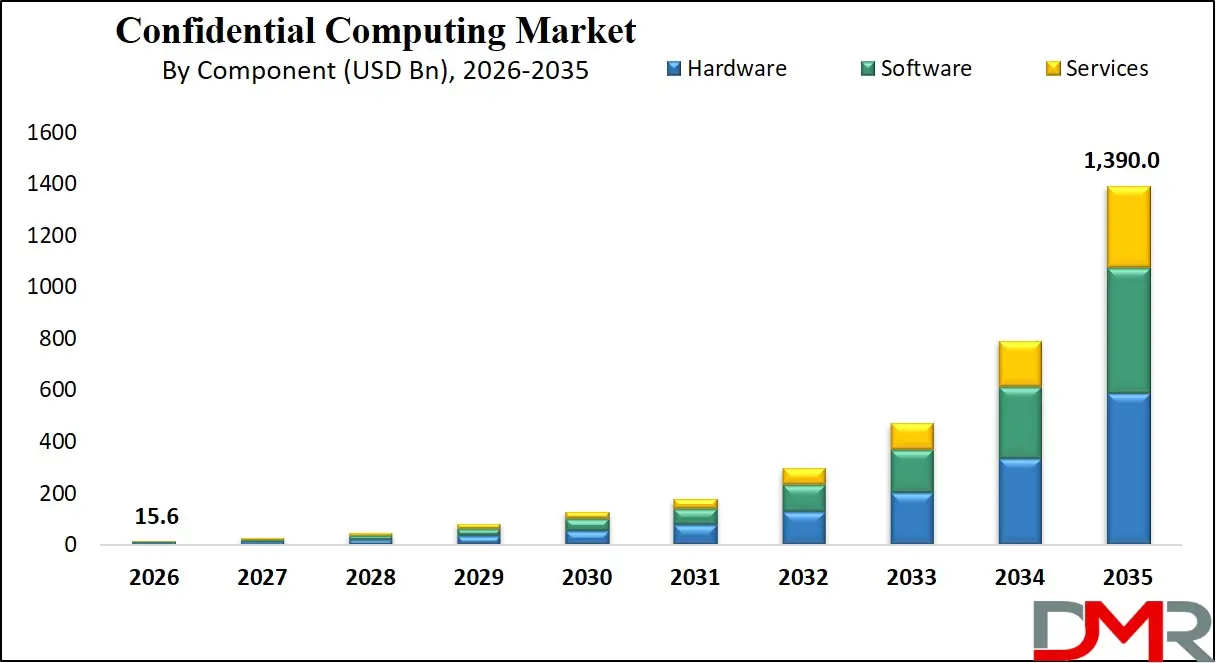
The Global Confidential Computing Market is witnessing increasing adoption as organizations seek stronger protection for sensitive data during processing. Confidential computing uses hardware-backed trusted execution environments (TEEs), memory encryption, and attestation technologies to safeguard workloads from unauthorized access. Rising demand for secure cloud computing, privacy-preserving artificial intelligence, confidential data analytics, and regulated digital infrastructure is supporting market development. Growth opportunities are emerging across financial services, healthcare, government, telecommunications, and enterprise cloud environments. The market assessment focuses on revenues directly attributable to confidential computing hardware capabilities, software platforms, and specialized services, while excluding unrelated cloud infrastructure expenditure and general-purpose computing revenue.
ℹ
To learn more about this report –
Download Your Free Sample Report Here
The US Confidential Computing Market
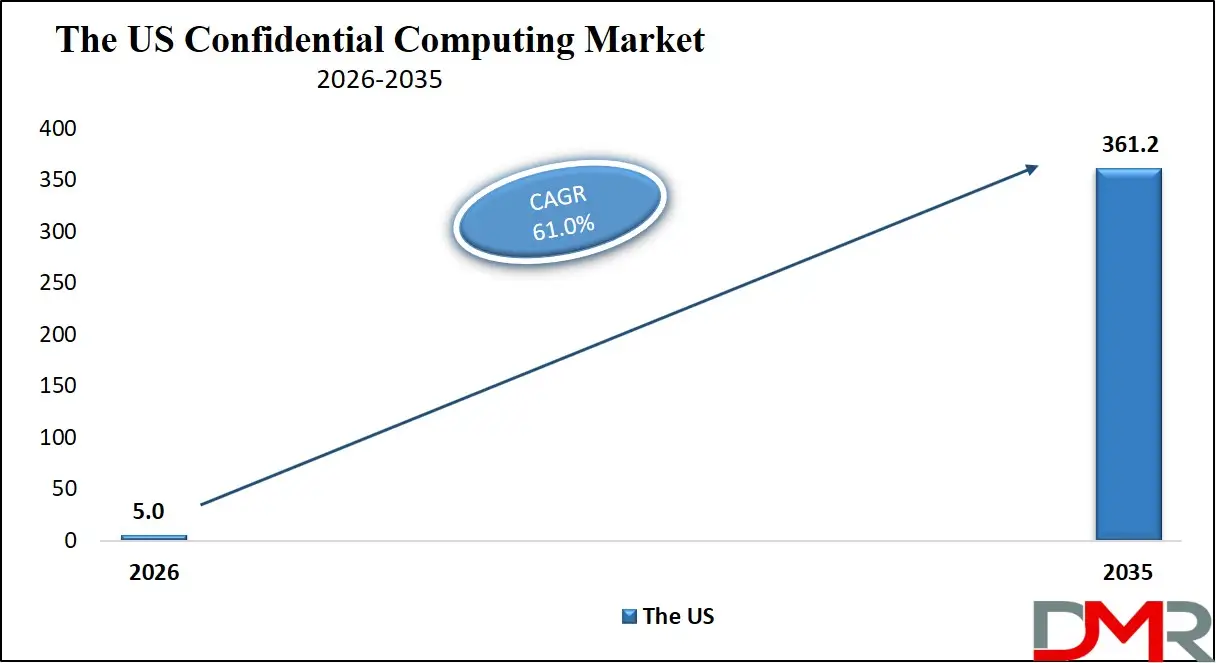
The US Confidential Computing Market size is estimated to be USD 5.0 billion in 2026 and is expected to increase at a CAGR of 61.0% over the forecast period.
ℹ
To learn more about this report –
Download Your Free Sample Report Here
There is high demand for this technology in the US market due to its wide adoption by cloud service providers, financial services, and government organizations. This is enhanced by the fact that there is advancement in cybersecurity technologies along with regulatory measures focusing on protecting customer data. The existence of technological innovators and high investment in research is another factor promoting market growth.
Europe Confidential Computing Market
The Europe Confidential Computing Market size is estimated to be USD 3.6 billion in 2026 and at a CAGR of 62.4% over the forecast period.
The Europe Confidential Computing Market is supported by increasing regulatory emphasis on data protection, secure cloud infrastructure, and digital sovereignty. The General Data Protection Regulation (GDPR) encourages organizations to implement appropriate technical and organizational measures to protect personal data, while the EU Data Act introduces requirements related to data access, portability, and cloud service switching. These regulatory developments are encouraging enterprises to adopt secure computing architectures that protect sensitive workloads during processing.
Additionally, European initiatives supporting sovereign cloud infrastructure, trusted data spaces, and secure cross-border data collaboration are creating opportunities for confidential computing technologies. Financial institutions, healthcare providers, government organizations, and cloud service operators are increasingly exploring hardware-backed trusted execution environments, encrypted data processing, and secure multi-party analytics to strengthen privacy, confidentiality, and operational resilience across digital platforms.
Japan Confidential Computing Market
The market size of Japan Confidential Computing will be USD 624 million in 2026 and at a CAGR of 64.2% in the forecast period.
The Japan Confidential Computing Market is experiencing significant growth, supported by increasing digital transformation, adoption of advanced cloud infrastructure, and rising awareness of data privacy and security. Government initiatives promoting secure digital infrastructure, along with investments in artificial intelligence, IoT, and smart manufacturing, are encouraging the adoption of confidential computing technologies. Organizations across financial services, healthcare, manufacturing, and government sectors are increasingly exploring trusted execution environments, hardware-based encryption, and secure data processing platforms to protect sensitive information. Expanding demand for privacy-preserving AI applications and secure multi-cloud environments is expected to drive further growth in the Japanese confidential computing market.
Key Takeaways
- Market Size & Forecast: The Confidential Computing Market size is projected to reach USD 15.6 billion in 2026 and is anticipated to have a value of USD 1,390.0 billion in 2035.
- Growth Rate & Outlook: The Confidential Computing Market size is set to grow at a compound annual growth rate of 65.0% during the forecast period of 2026 to 2035.
- Primary Growth Drivers: Some of the major growth drivers in the market include rising data privacy regulations and cybersecurity threats, growth of cloud computing and AI workloads, and more.
- Key Market Trends: Some of the major trends in the market are adoption of privacy-enhancing technologies (PETs), confidential AI platforms, and security integration across multi-cloud and hybrid cloud environments.
- By Deployment: The cloud segment is anticipated to get the majority share of the Confidential Computing market in 2026.
- By Component: The hardware segment is expected to get the largest revenue share in 2026 in the Confidential Computing market.
- By Isolation Type: The virtual machine level segment is expected to get the largest revenue share in 2026 in the Confidential Computing market.
- Regional Leadership: North America is set to lead the Confidential Computing market with an estimated 39.0% share in 2026.
What Is Confidential Computing?
Confidential computing is a specialized computing security approach that protects sensitive data while it is being processed through hardware-backed trusted execution environments, memory isolation, encryption, and remote attestation. It is closely related to privacy-enhancing technologies (PETs), which also include homomorphic encryption, secure multi-party computation, differential privacy, federated learning, and privacy-preserving analytics. For market measurement, confidential computing revenues should be distinguished according to their specific hardware, software, and service applications. Any overlap with the Privacy-Enhancing Technology Market must be explicitly identified, and revenues attributed to confidential computing should be consistently classified across both markets to prevent double counting.
Use Cases
- Secure Data Collaboration: Enables multiple organizations to jointly analyze sensitive data without exposing raw datasets, ensuring privacy in sectors like healthcare and finance.
- AI Model Training Protection: Protects sensitive training datasets and algorithms during AI/ML processing, reducing risks of data leakage and model theft.
- Cloud Security Enhancement: Secures workloads in public and hybrid cloud environments by encrypting data during processing, improving trust in cloud adoption.
- Financial Transactions Security: Ensures secure processing of transactions and fraud detection models without exposing confidential financial data.
How AI Is Transforming the Confidential Computing Market
Artificial Intelligence technology is improving confidential computing by making it possible to detect threats, recognize anomalies, and assess risks automatically in a secure environment. AI technology makes it easy for organizations to analyze data more efficiently without compromising on the privacy of data, particularly in industries such as health care and finance.
Moreover, AI speeds up the creation of secure algorithms which can be deployed in an encrypted environment to carry out machine learning tasks.
Market Dynamic
Driving Factors in the Confidential Computing Market
Rising Data Privacy Regulations and Cybersecurity Threats
The increase in various regulatory requirements around the world like GDPR and others is forcing firms to implement sophisticated technology solutions for data protection. In parallel with the growing number of sophisticated attacks on data in use, the weaknesses in the conventional methods of security have been exposed. The solution lies in confidential computing, which guarantees encryption during processing.
Growth of Cloud Computing and AI Workloads
There is an increased need for confidential computing due to the quick adoption of cloud services and applications that leverage artificial intelligence. The use of cloud platforms means that companies will need to have a secure environment where they can run their operations. This makes confidential computing very important when implementing machine learning models in cloud infrastructure.
Restraints in the Confidential Computing Market
High Implementation Costs and Infrastructure Complexity
The utilization of confidential computing technology may require special hardware, software, and skill sets that will be costly during the initial process. For many enterprises, particularly small and medium-sized businesses, it becomes difficult to upgrade their existing technology to adopt confidential computing.
Limited Awareness and Standardization Issues
Although increasing attention has been given to the concept of confidential computing, many companies remain unaware of the opportunities it offers. Moreover, the lack of commonly recognized standards and interoperability platforms poses some risk for businesses. Such a situation is likely to impede the expansion of the market into less advanced areas.
Opportunities in the Confidential Computing Market
Expansion in Emerging Markets and Digital Economies
Emerging economies are undergoing a rapid process of digitization, which creates considerable opportunities for the implementation of confidential computing solutions. The growing investment in digital infrastructure, cloud computing, and financial technology is increasing the need for secure data processing.
Integration with Advanced Technologies like Blockchain and IoT
The integration of confidential computing with blockchain and IoT technologies provides additional opportunities for expansion. The secure handling of data within decentralized systems and IoT devices increases efficiency and credibility. Such an implementation opens up new possibilities, including supply chain security, smart city management, and live analytics, broadening the scope of the industry.
Trends in the Confidential Computing Market
Adoption of Privacy-Enhancing Technologies (PETs)
PETs are being used by more organizations together with confidential computing, thereby improving their approach to protecting their data assets. Homomorphic encryption and secure multi-party computation have gained popularity lately. Such an approach is characterized by the use of complete privacy systems for data protection throughout its lifecycle.
Multi-Cloud and Hybrid Cloud Security Integration
Companies are adopting multi-cloud and hybrid cloud solutions, requiring uniformity in security practices. Cloud-native security measures are incorporated in such scenarios to provide security when moving workloads from one platform to another. These trends have spurred cloud-native security innovation and collaboration between cloud companies and security organizations.
Research Scope and Analysis
By Component Analysis
The hardware component is set to lead the market in 2026 with a projected 42% market share due to growing demand for processors that support TEEs and secure enclaves. Hardware forms the bedrock of confidential computing because it provides the means for executing secure code isolated from any external interference. Increased funding for developing chip-based security solutions and encryption technologies has led to a rapid growth rate in the component. The software component holds the highest growth rate owing to increased use of encryption, key management, and confidential computing platforms. This technology enhances the flexibility and compatibility offered by such infrastructure. The services segment is experiencing growth on account of the demand for consulting and managed services related to implementing infrastructure for confidential computing.
By Deployment Analysis
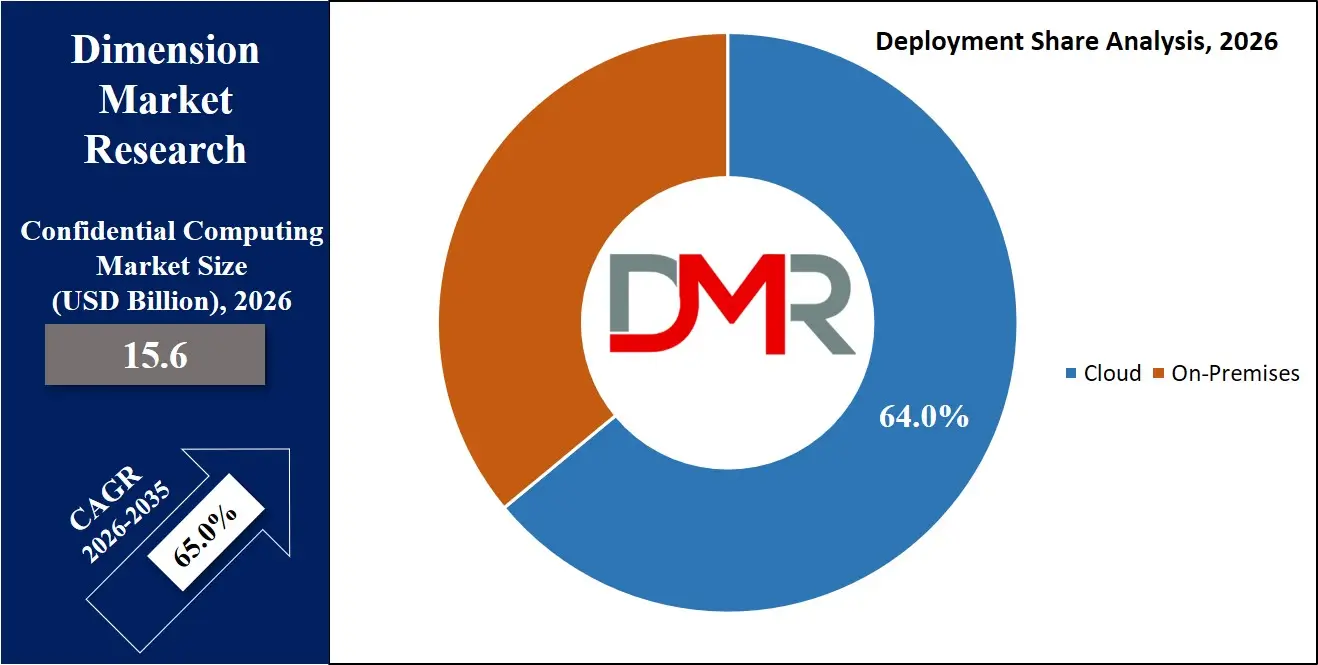
Cloud deployment is the leading segment with around 64% market share by 2026 owing to the increased adoption of both public and hybrid cloud architectures. The companies favor cloud-based confidential computing due to its high scalability, flexibility, and cost-effectiveness with the increasing adoption of remote workforces and digital services. Hybrid cloud deployment offers the most rapid expansion rate with the firms trying to achieve a balance between agility and improved management over critical applications.
ℹ
To learn more about this report –
Download Your Free Sample Report Here
In addition, on-premises deployment is still applicable to highly regulated sectors like the financial and governmental industry due to their stringent regulatory compliance requirements. The growing confidence in cloud security and development in encryption technology and confidential VMs has been reinforcing the cloud deployment paradigm.
By Workload Analysis
The most dominant area is the data-in-use, which accounts for about 36% in 2026 owing to the high importance of securing the ongoing process of data management amid changing cyber security threats. The growth of the above-mentioned segment can be explained by the growing interest of companies in addressing cybersecurity challenges, the emergence of strict data regulations, and the significance of analytics. The most promising area is AI/ML privacy, which has been fueled by the growing use of artificial intelligence in business processes. This segment involves ensuring cybersecurity during the training and inference processes for artificial intelligence technologies. Secure data collaboration and SMPC are gaining popularity among companies managing confidential collaborative datasets, including the health care, financial services, and research industries.
By Isolation Type Analysis
The virtual machine isolation will occupy the maximum market share of 48% in 2026 owing to its high level of security and scalability along with good compatibility with the current cloud and virtualization infrastructures. Organizations can ensure the security of their workloads without any major modification in the architecture using this form of isolation technique. In terms of growth rate, the function isolation is the fastest growing one due to the growing adoption of the serverless and microservice architectures, which demand precise security mechanisms. The application isolation is also growing at a steady pace since the containerization is gaining popularity among organizations.
By Industry Analysis
The BFSI sector will take the leading position, with a market share of around 28% in 2026, due to the need to protect the integrity of financial transactions and data, and the importance of fraud detection technology. The demand for cybersecurity solutions within the BFSI sector is being fueled by rising regulation compliance and high levels of cyberattacks against businesses. Among other industries, healthcare is emerging at the highest growth rate due to increasing digitization, electronic medical recordkeeping, and the protection of patient data. In addition, government and military organizations have adopted confidential computing to enhance national security and carry out operations in secure ways.
By Enterprise Size Analysis
Large enterprise companies dominate with an expected market share of 67% by 2026 due to their large IT spending, intricate data environment, and adoption of highly sophisticated security mechanisms. Such firms rely on confidential computing for safeguarding confidential data within various divisions and around the globe. The SME sector is currently the most dynamic market due to rising consciousness levels and availability of low-cost, cloud-based confidential computing services. Small firms are slowly becoming aware of the significance of data security in ensuring customer confidence and complying with regulations. Cloud-based confidential computing services appeal significantly to SMEs because they can benefit from enterprise-class protection at lower costs.
The Confidential Computing Market Report is segmented on the basis of the following:
By Component
- Hardware
- TEE-enabled processors
- Secure enclaves
- Hardware security modules
- Software
- Confidential computing platforms
- Encryption & key management
- Privacy-enhancing technologies (PETs)
- Services
- Consulting & integration
- Managed services
By Deployment
By Workload
- Data-in-use protection
- Secure data collaboration
- AI/ML privacy
- Secure multi-party computation (SMPC)
- Confidential containers / applications
By Isolation Type
- Virtual machine-level
- Application-level
- Function-level
By Industry
- BFSI
- Healthcare
- Government & Defense
- IT & Telecom
- Retail & E-commerce
- Manufacturing
- Others
By Enterprise Size
Regional Analysis
Leading Region in the Confidential Computing Market
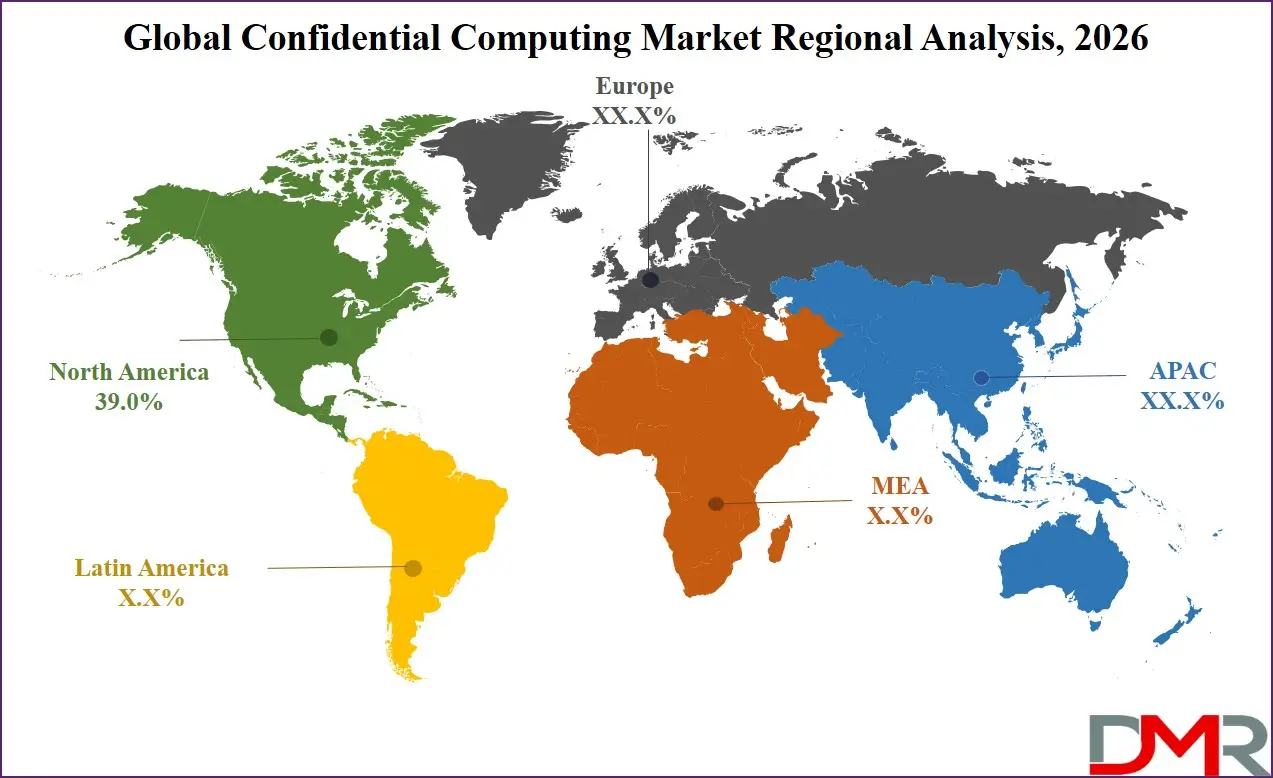
It is anticipated that North America will capture the market with a forecasted market share of 39% in 2026. It is due to several factors such as the availability of highly developed technological infrastructure, the presence of well-known cloud computing services providers, and high awareness about cybersecurity issues within the enterprises. Government policies encouraging the adoption of cloud computing in a secure manner and enforcing data protection policies and zero trust security framework policies also support the dominance of North America. Technological innovation and R&D investments are some other factors contributing to leadership in the market.
ℹ
To learn more about this report –
Download Your Free Sample Report Here
Fastest Growing Region in the Confidential Computing Market
The Asia-Pacific region has emerged as the most rapidly growing area on account of digital transformation, rising use of clouds, and investments in cybersecurity in the emerging markets. This growth can be attributed to government-sponsored digital efforts, development of smart cities, and embracing of advanced technologies in the countries like Japan, India, and China. Fintech services, ecommerce platforms, and artificial intelligence solutions are contributing significantly towards the demand for data processing security solutions. Growing understanding about data privacy laws and increasing international data transfers are making companies implement confidential computing solutions.
By Region
North America
Europe
- Germany
- The U.K.
- France
- Italy
- Russia
- Spain
- Benelux
- Nordic
- Rest of Europe
Asia-Pacific
- China
- Japan
- South Korea
- India
- ANZ
- ASEAN
- Rest of Asia-Pacific
Latin America
- Brazil
- Mexico
- Argentina
- Colombia
- Rest of Latin America
Middle East & Africa
- Saudi Arabia
- UAE
- South Africa
- Israel
- Egypt
- Rest of MEA
Competitive Landscape
The Confidential Computing Market is highly competitive, where players concentrate on innovation, partnership, and ecosystem creation for sustaining and reinforcing their positions in the market. The barriers to entry remain high owing to technology sophistication, hardware specialization, and large investments involved. Research and development expenditure are on the rise to improve the hardware components and software aspects of security. Furthermore, partnership initiatives with cloud computing companies, semiconductors, and consortia in the industry are common practices used by players in order to broaden their presence in the market.
Some of the Prominent Players in the Global Confidential Computing Market Are:
- Intel Corporation
- Advanced Micro Devices (AMD)
- Arm Limited
- NVIDIA Corporation
- IBM Corporation
- Microsoft Corporation
- Google LLC
- Amazon Web Services (AWS)
- Alibaba Cloud
- Oracle Corporation
- Tencent Cloud
- Baidu, Inc.
- Thales Group
- Fortanix
- Anjuna Security
- Cosmian
- Decentriq
- Cysec SA
- Scontain
- Profian
- Other Key Players
Recent Developments
- October 2026: Google Cloud announced the general availability of Confidential G4 instances powered by NVIDIA RTX PRO 6000 Blackwell Server Edition GPUs. Available across 36 cloud zones, the offering integrates hardware-backed confidential computing with accelerated AI infrastructure to protect sensitive workloads, proprietary models, and data during processing.
- June 2026: NVIDIA announced its collaboration with Apple and Google to support the expansion of Apple Intelligence Private Cloud Compute using NVIDIA Blackwell GPUs equipped with confidential computing capabilities. The initiative focuses on securing AI inference workloads through hardware-backed data protection and trusted computing infrastructure.
- March 2026: Microsoft announced the general availability of Azure Confidential Computing virtual machines using AMD Secure Encrypted Virtualization–Secure Nested Paging (SEV-SNP) technology across US government data classification levels. The solution provides hardware-backed trusted execution environments and attestation capabilities to protect sensitive government workloads.
Report Details
| Report Characteristics |
| Market Size (2026) |
USD 15.6 Bn |
| Forecast Value (2035) |
USD 1,390.0 Bn |
| CAGR (2026–2035) |
65.0% |
| Historical Period |
2021 – 2025 |
| Forecast Period |
2027 – 2035 |
| Base Year |
2025 |
| Estimate Year |
2026 |
| Segments Covered |
By Component (Hardware, Software, Services), By Deployment (Cloud, On-Premises), By Workload (Data-in-use protection, Secure data collaboration, AI/ML privacy, Secure multi-party computation (SMPC), Confidential containers / applications), By Isolation Type (Virtual machine-level, Application-level, Function-level), By Industry (BFSI, Healthcare, Government & Defense, IT & Telecom, Retail & E-commerce, Manufacturing, Others), By Enterprise Size (Large Enterprises, SMEs) |
| Regional Coverage |
North America – The US and Canada; Europe – Germany, The UK, France, Russia, Spain, Italy, Benelux, Nordic, & Rest of Europe; Asia-Pacific – China, Japan, South Korea, India, ANZ, ASEAN, Rest of APAC; Latin America – Brazil, Mexico, Argentina, Colombia, Rest of Latin America; Middle East & Africa – Saudi Arabia, UAE, South Africa, Turkey, Egypt, Israel, & Rest of MEA |
Frequently Asked Questions
How big is the Confidential Computing Market?
▾ The Confidential Computing Market size is expected to reach USD 15.6 billion by 2026 and is projected to reach USD 1,390.0 billion by the end of 2035.
What is the CAGR of the Confidential Computing Market from 2026 to 2035?
▾ The market is growing at a CAGR of 65.0 percent over the forecasted period.
What factors are driving the growth of the Confidential Computing Market?
▾ Rising data privacy regulations and cybersecurity threats, growth of cloud computing and AI workloads, and more are the factors driving the growth of the Confidential Computing Market.
What are the major trends in the Confidential Computing Market?
▾ Major trends in the Confidential Computing Market include the increasing adoption of privacy-enhancing technologies (PETs), hardware-backed trusted execution environments (TEEs), confidential AI processing, secure multi-party data collaboration, and integration of confidential computing across hybrid and multi-cloud environments.
Who are the key players in the Confidential Computing Market?
▾ Some of the key players in the Global Confidential Computing Market include Intel Corporation, Advanced Micro Devices, Inc. (AMD), NVIDIA Corporation, Microsoft Corporation, International Business Machines Corporation (IBM), Google LLC, Amazon Web Services (AWS), Fortanix, and other specialized confidential computing technology providers.
How is the Confidential Computing Market segmented?
▾ The Confidential Computing Market is segmented by component, deployment, workload, isolation type, industry, and enterprise size.
Which region held the largest share of the Confidential Computing Market in 2026?
▾ North America is set to lead the Confidential Computing market with an estimated 39.0% share in 2026.
Which region is expected to grow the fastest in the Confidential Computing Market?
▾ Asia-Pacific is the fastest-growing region in the Confidential Computing market during the forecast period.