Market Snapshot
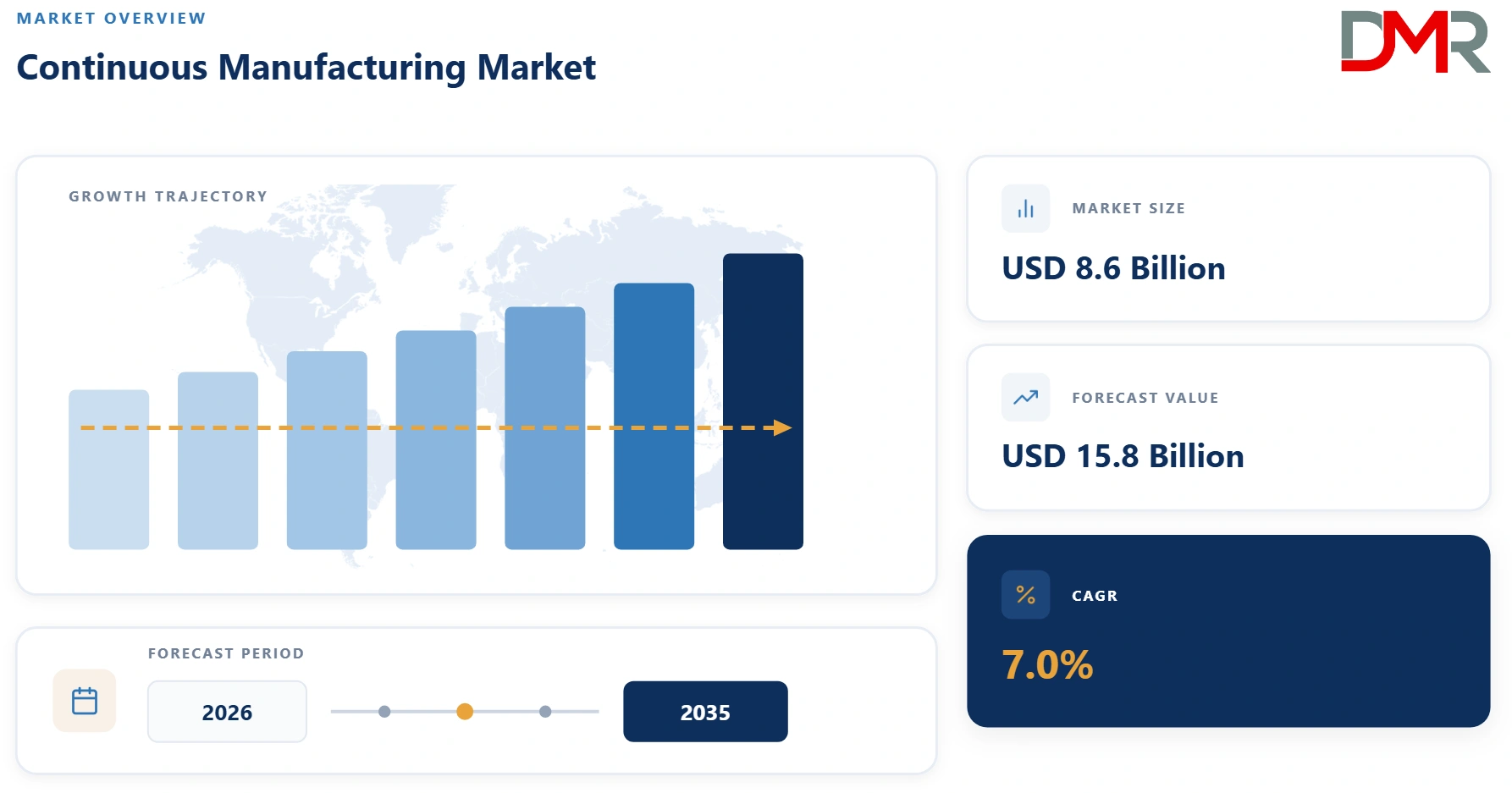
- Market Size (2026): USD 8.6 Bn
- Forecast Value (2035): USD 15.8 Bn
- CAGR (2026-2035): 7.0%
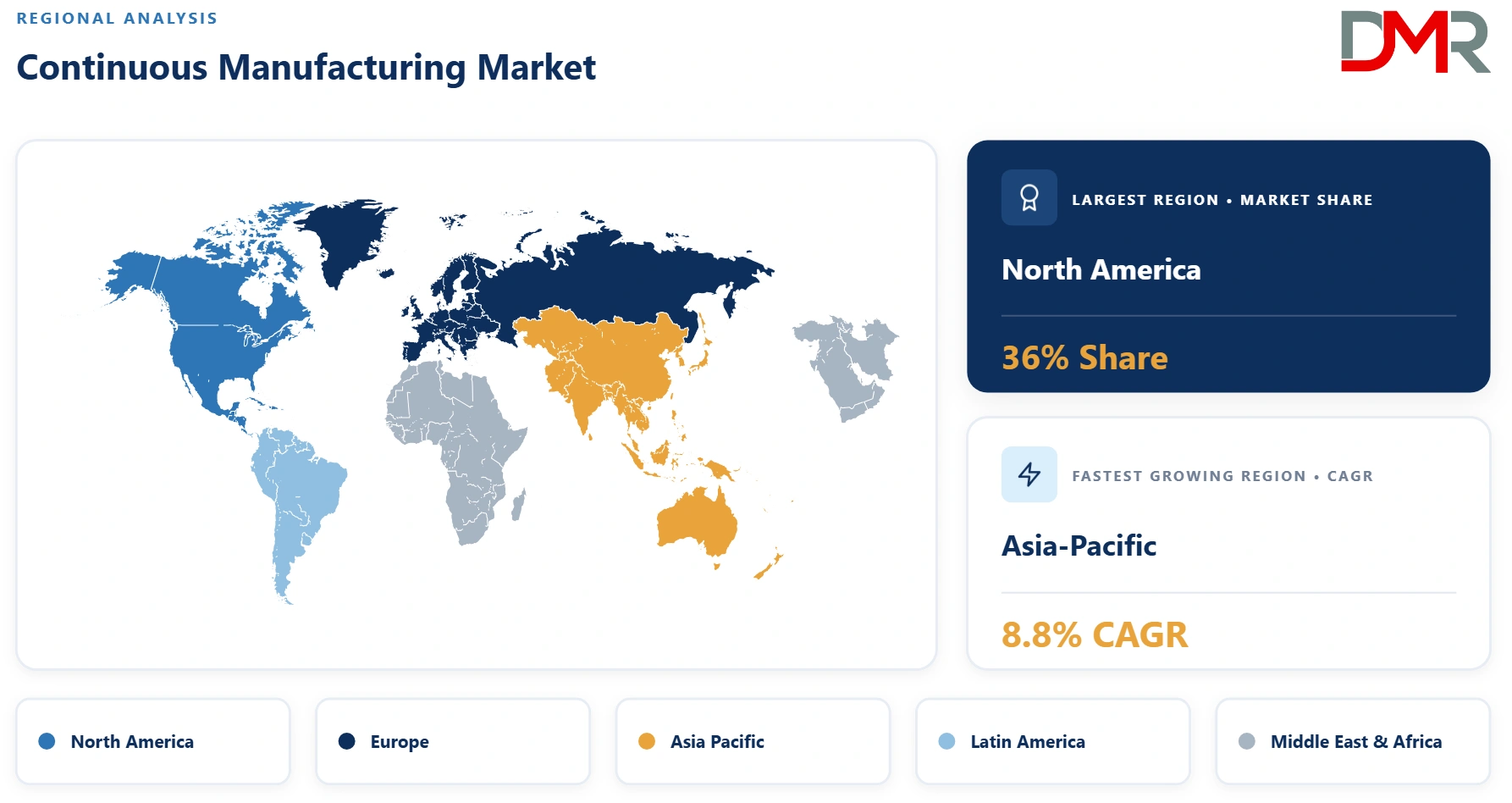
- Largest Region (2026): North America, approximately 36%
- Fastest-Growing Region: Asia-Pacific
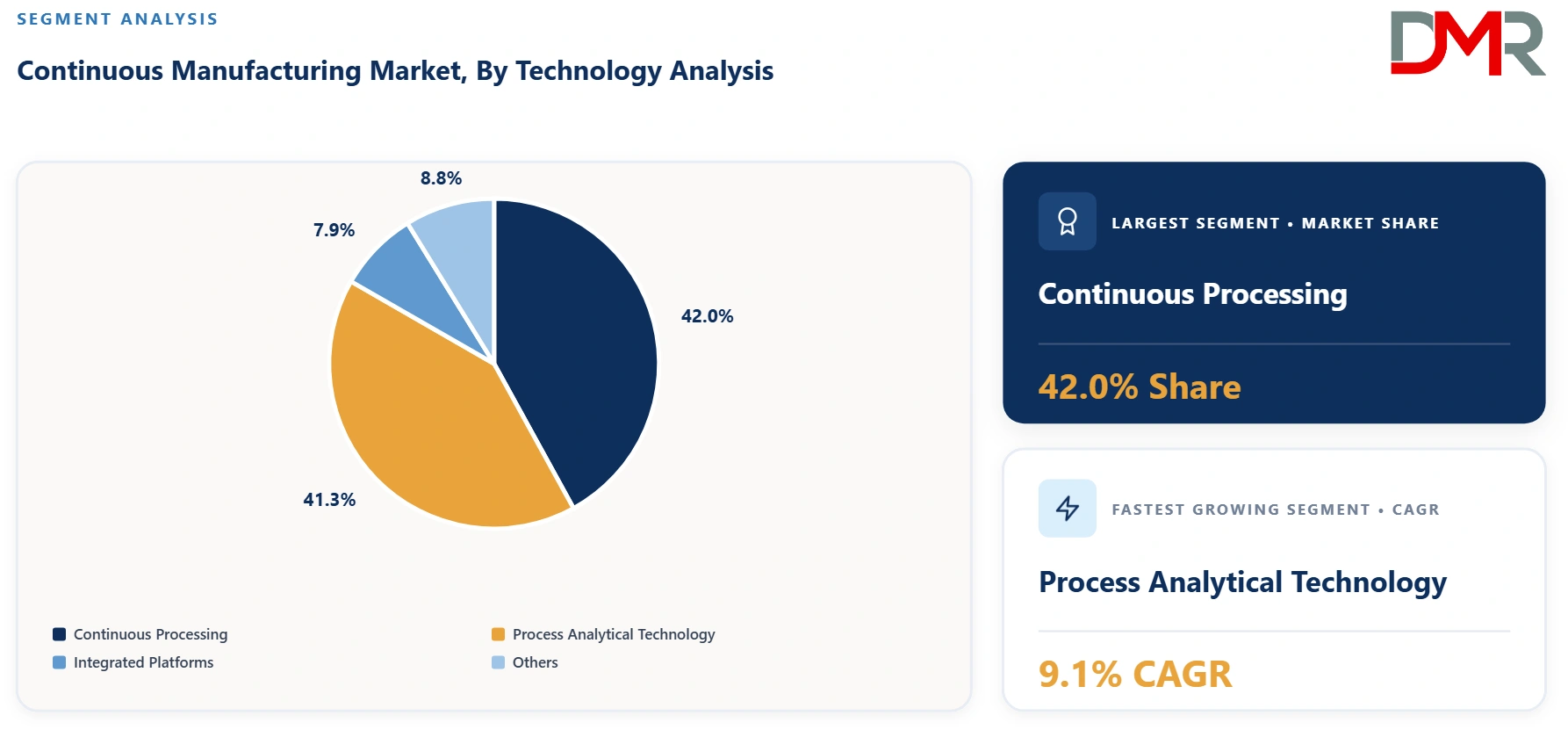
- Leading Technology (2026): Continuous Processing, around 42%
- Leading Application (2026): Pharmaceuticals, close to 58%
- Key Players: Thermo Fisher Scientific, Cytiva, Siemens, and Others
What is Continuous Manufacturing Market and its Market Size?
Global Continuous Manufacturing Market size is estimated to reach USD 8.6 Bn in 2026 and is further anticipated to reach USD 15.8 Bn by 2035, at a CAGR of 7.0%.
ℹ
To learn more about this report –
Download Your Free Sample Report Here
Continuous manufacturing is an integrated production approach in which raw materials enter a process continuously and products leave at a controlled rate. The market includes continuous reactors, feeders, mixers, crystallizers, granulators, filtration systems, process analytical technology, automation, digital twins, control software, validation services, and lifecycle support. It covers pharmaceutical, biopharmaceutical, chemical, food, and advanced-material production where stable material flow and automated control are commercially relevant.
Compared with batch production, continuous systems can reduce work-in-process inventory, shorten residence times, improve process consistency, and support smaller facility footprints. Adoption depends on product characteristics, process maturity, regulatory strategy, facility design, and the ability to connect unit operations into a validated control architecture.
Pharmaceutical companies remain major buyers because continuous platforms can support quality-by-design, real-time release testing, and flexible production of oral solid doses and selected biologics. Contract manufacturers are also evaluating the model to improve asset utilization and offer differentiated manufacturing capacity.
Use Cases
- Pharmaceutical solid-dose production: Drug manufacturers connect feeding, blending, granulation, drying, compression, and coating to reduce intermediate storage and improve batch-to-batch consistency. Integrated monitoring can lower deviation rates and support faster product changeovers when recipes and control strategies are appropriately validated.
- Biopharmaceutical production: Bioprocess operators use perfusion, continuous chromatography, and continuous viral inactivation to maintain steady product flow and increase utilization of expensive single-use or stainless-steel assets. The approach can reduce hold times and improve capacity planning for selected molecules.
- Specialty chemical synthesis: Chemical producers apply continuous reactors and inline analytics to control exothermic reactions, improve heat transfer, and reduce exposure to hazardous intermediates. Better residence-time control can increase selectivity, lower solvent consumption, and improve worker and site safety.
- Contract manufacturing: CDMOs deploy modular continuous platforms to serve products with variable demand and limited commercial volumes. Standardized equipment, automated recipes, and digital records can reduce commissioning effort and allow capacity to be reassigned across campaigns.
Key Takeaways
- Market Size & Share: The market is estimated at USD 8.6 Bn in 2026, with pharmaceuticals representing approximately 58% of demand.
- Technology Analysis: Process Analytical Technology is projected to expand at a CAGR of 9.1% between 2026 and 2035.
- Application Analysis: Pharmaceuticals lead with an approximate 2026 revenue share of 58%.
- Regional Analysis: North America and Europe together account for approximately 65% of 2026 revenue.
- Commercial Catalyst: Real-time monitoring and automated control can reduce manual sampling requirements by approximately 20% to 35% in suitable lines.
- Competitive Dynamics: The market remains moderately concentrated, with platform providers competing through integrated equipment, software, validation, and service portfolios.
How AI/Gen AI is Transforming the Continuous Manufacturing Market?
AI is being integrated into continuous manufacturing through soft sensors, anomaly detection, predictive maintenance, recipe optimization, and adaptive control. Models combine equipment signals, process analytical technology data, material attributes, and laboratory results to estimate quality variables that are difficult or slow to measure directly. This supports earlier intervention when residence time, moisture, particle size, potency, or impurity profiles begin to drift.
Generative AI adds a natural-language layer to manufacturing data and standard operating procedures. Engineers can query deviation histories, compare process runs, draft investigation summaries, and identify likely relationships between settings and quality outcomes. Deployment still requires validated data pipelines, model governance, cybersecurity controls, and human approval because regulated production cannot rely on unexplained recommendations.
- Predictive quality control: Soft sensors estimate critical quality attributes from continuous process signals and trigger corrective actions.
- Predictive maintenance: Machine-learning models identify vibration, temperature, or power signatures associated with feeder, pump, and compressor failures.
- Generative investigation support: Language models organize batch records, alarms, and prior deviations to accelerate root-cause review while preserving quality-unit oversight.
Key Drivers in the Global Continuous Manufacturing Market
Manufacturers are seeking production systems that can respond to variable demand, launch products with lower initial volumes, and reduce dependence on large campaign inventories. Continuous platforms can be configured as modular lines and operated with smaller work-in-process inventories, supporting localized or multiproduct production. The benefit is strongest when recipes are stable, materials can be fed consistently, and unit operations can be linked without excessive hold points. CDMOs value this flexibility because it can improve scheduling across products and reduce changeover losses. As manufacturing networks diversify, continuous systems are increasingly evaluated as part of capacity strategy rather than only as a process-development experiment.
Higher Control Requirements and Digital Integration
Continuous processing depends on reliable instrumentation, synchronized control loops, and rapid detection of deviations. This is driving investment in PAT, distributed control systems, manufacturing execution software, and data historians that can maintain traceability across connected unit operations. Digital integration also supports real-time release strategies when analytical methods and validation packages are mature. Suppliers that combine equipment with automation, cybersecurity, recipe management, and lifecycle service can address more of the implementation burden. The commercial opportunity therefore extends beyond machinery to software, integration, training, qualification, and ongoing performance monitoring.
Restraints in the Global Continuous Manufacturing Market
High Qualification and Integration Costs
Continuous lines require coordinated engineering across equipment, automation, analytics, facility utilities, and quality systems. Qualification is more complex when multiple unit operations are connected and material flows continuously through the process. Companies may need new control strategies, additional sensors, specialized operators, and extensive comparability work before commercial release. These requirements increase upfront spending and can extend implementation timelines, especially for smaller manufacturers. Limited internal expertise can also create dependence on integrators and equipment vendors. The restraint is most significant when the expected production volume is too low to justify redesigning an established batch process.
Limited Process Transfer and Standardization
Continuous manufacturing is not equally suitable for every formulation, organism, or chemical route. Material variability, fouling, residence-time distribution, and scale-up behavior can complicate transfer between development and commercial lines. Manufacturers may also face inconsistent interfaces between equipment suppliers, software platforms, and data standards. A lack of widely reusable templates increases engineering effort for each new product. Although standards and regulatory experience are improving, companies remain cautious where process knowledge is incomplete or where a failure could interrupt a high-value supply chain.
Growth Opportunities in the Global Continuous Manufacturing Market
Expansion in Biologics and Advanced Therapies
Biologics manufacturers are evaluating continuous upstream and downstream steps to improve facility utilization, reduce hold times, and support intensified production. Opportunities exist in perfusion culture, continuous clarification, membrane processing, chromatography, viral clearance, and integrated single-use workflows. Suppliers can differentiate through closed processing, low-shear fluid handling, inline analytics, and control architectures designed for long operating windows. As demand for flexible biologics capacity grows, continuous platforms may be adopted first in selected products and then extended to broader portfolios after process capability and regulatory confidence are established.
Modular Facilities and Distributed Manufacturing
Modular skids, standardized automation, and compact equipment can support distributed production close to regional demand centers. This model is attractive for products requiring supply resilience, rapid replenishment, or smaller market-specific volumes. Equipment makers can develop repeatable platform designs with preconfigured control logic, digital documentation, and remote service capabilities. The opportunity also includes retrofit packages that connect selected continuous steps to existing batch operations rather than requiring a complete plant conversion. Such hybrid approaches can lower adoption barriers while allowing manufacturers to capture benefits from targeted process intensification.
Trends in the Global Continuous Manufacturing Market
Growing Use of Inline and At-Line Analytics
Manufacturers are increasing the use of spectroscopy, particle measurement, imaging, chromatography, and automated sampling to observe process behavior with less delay. Analytics help detect drift before material reaches downstream operations and provide evidence for control strategies based on process understanding. The trend is expanding demand for calibration models, data management, chemometrics, and validation services. It also changes supplier competition because equipment performance is increasingly judged by the quality and accessibility of the data generated during operation, not only by throughput or mechanical reliability.
Hybrid Batch-Continuous Production Models
Many companies are adopting selective continuous steps instead of converting an entire process at once. Continuous feeding, blending, crystallization, filtration, or chromatography can be connected to existing batch operations where the economics and technical risks are favorable. Hybrid designs allow organizations to build internal experience, reuse existing assets, and create staged validation plans. This approach broadens the addressable market for suppliers because adoption no longer depends on a complete facility replacement. It also creates demand for interfaces that manage material transfer, data continuity, and quality decisions across different operating modes.
Research Scope and Analysis
The report evaluates continuous manufacturing across technology, application, component, and end-user dimensions, with regional coverage and attention to automation, analytics, validation, and service economics. Growth is assessed through adoption intensity, capacity investment, regulatory readiness, and process suitability.
ℹ
To learn more about this report –
Download Your Free Sample Report Here
By Technology
Continuous Processing leads this dimension with an estimated share of around 42% in 2026, supported by established procurement patterns and broad compatibility with commercial production. Growth, however, is concentrated in Process Analytical Technology, projected to expand at a CAGR of 9.1% between 2026 and 2035 as manufacturers invest in tighter process control, data visibility, and more responsive production economics.
By Application
Pharmaceuticals leads this dimension with an estimated share of around 42% in 2026, supported by established procurement patterns and broad compatibility with commercial production. Growth, however, is concentrated in Biopharmaceuticals, projected to expand at a CAGR of 9.1% between 2026 and 2035 as manufacturers invest in tighter process control, data visibility, and more responsive production economics.
By Component
Equipment leads this dimension with an estimated share of around 42% in 2026, supported by established procurement patterns and broad compatibility with commercial production. Growth, however, is concentrated in Software and Control Systems, projected to expand at a CAGR of 9.1% between 2026 and 2035 as manufacturers invest in tighter process control, data visibility, and more responsive production economics.
By End User
Large Manufacturers leads this dimension with an estimated share of around 42% in 2026, supported by established procurement patterns and broad compatibility with commercial production. Growth, however, is concentrated in Contract Manufacturers, projected to expand at a CAGR of 9.1% between 2026 and 2035 as manufacturers invest in tighter process control, data visibility, and more responsive production economics.
The Global Continuous Manufacturing Market Report is Segmented Based on the Following
By Technology
- Continuous Processing
- Process Analytical Technology
- Integrated Platforms
- Others
By Application
- Pharmaceuticals
- Biopharmaceuticals
- Integrated Platforms
- Others
By Component
- Equipment
- Software and Control Systems
- Integrated Platforms
- Others
By End User
- Large Manufacturers
- Contract Manufacturers
- Integrated Platforms
- Others
Regional Analysis
Demand is concentrated in regions with advanced pharmaceutical, chemical, automation, and process-engineering ecosystems. Adoption varies with regulatory experience, capital availability, local manufacturing policy, and the presence of qualified system integrators.
Region with the Largest Revenue Share
North America holds the largest share, at approximately 36% in 2026. The region benefits from major pharmaceutical and biotechnology manufacturing bases, established automation suppliers, strong investment in process intensification, and a broad network of engineering and validation providers. US manufacturers are also assessing continuous platforms for supply resilience and flexible capacity. Demand includes both new facilities and targeted retrofits, particularly where real-time analytics and digital quality systems can improve release decisions. Canada contributes through bioprocessing, specialty chemicals, and contract manufacturing activity, although its market is smaller than that of the United States.
ℹ
To learn more about this report –
Download Your Free Sample Report Here
Region with the Highest CAGR
Asia-Pacific is expected to record the highest growth, with a forecast CAGR of approximately 8.8% from 2026 to 2035. Expansion is supported by pharmaceutical capacity additions, increasing biologics manufacturing, local automation investment, and efforts to improve production efficiency. China, India, South Korea, Japan, and Australia present different adoption profiles, ranging from large-scale generic production to advanced biologics and specialty chemical applications. Suppliers that offer modular systems, local service, training, and cost-conscious automation packages are positioned to capture incremental demand.
By Region
- North America: 36%
- Europe: 29%
- Asia-Pacific: 24%
- Latin America: 6%
- Middle East & Africa: 5%
Technology Analysis
Technology competition is moving toward integrated platforms that combine continuous equipment, PAT, automation, data management, and validation support. Vendors with interoperable control architectures can reduce engineering friction across connected unit operations. Development priorities include better feeder accuracy, fouling-resistant designs, reliable sensors, cybersecurity, and models that translate process signals into quality decisions. Adoption is likely to remain application-specific, with hybrid systems serving as a practical bridge for manufacturers that are not ready for full process conversion.
Investment and White Space Analysis
Investment opportunity is strongest in modular continuous lines, PAT software, digital validation, and services that help manufacturers retrofit existing facilities. White space remains in standardized interfaces, affordable systems for mid-sized producers, and platforms designed for multiproduct CDMO operations. Investors should assess installed-base compatibility, recurring service revenue, regulatory track record, and the supplier’s ability to support commissioning across multiple geographies. Partnerships between equipment makers, automation firms, analytics providers, and engineering organizations can shorten commercialization cycles.
Competitive Landscape
The market includes process-equipment companies, automation vendors, life-science suppliers, engineering firms, and specialized software providers. Competition is based on process performance, analytical integration, validation support, interoperability, service coverage, and the ability to scale from development to commercial production. Larger suppliers can bundle equipment and automation, while specialists compete through application expertise and customized modules. Partnerships and acquisitions are likely to continue as vendors seek complete offerings that connect physical process steps with data, quality, and lifecycle services.
Some of the Prominent Players in the Global Continuous Manufacturing Market Are:
- Baker Hughes
- Bausch+Ströbel
- Biosero
- Coperion
- Cytiva
- Dassault Systèmes
- Eppendorf
- Fette Compacting
- GEA Group
- Glatt Group
- Honeywell
- IMA Group
- Intelligen
- Korsch
- Krones
- Lonza
- Mettler Toledo
- Mitsubishi Chemical Group
- NNE
- Novartis
- Optima Pharma
- Pall Corporation
- Pfizer
- Pharma Technologies
- Pharmatech
- ProMach
- Rockwell Automation
- Romaco
- Schneider Electric
- Siemens
- Syntegon Technology
- Thermo Fisher Scientific
- Uhlmann Group
- Unither Pharmaceuticals
- ValGenesis
- Vetter Pharma
- Werum Software & Systems
- WuXi Biologics
- Zeton
- Zhejiang Jiuzhou Pharmaceutical
- Other Key Players
Recent Developments
- In March 2026, process technology suppliers expanded demonstration and customer-support programs focused on continuous pharmaceutical processing, PAT, and integrated automation.
- In November 2025, life-science equipment providers introduced additional modular process and analytics configurations for development and commercial manufacturing environments.
- In August 2025, contract manufacturers increased evaluation of continuous and intensified bioprocessing platforms to improve capacity flexibility and reduce hold times.
- In May 2025, automation vendors strengthened digital manufacturing offerings linking process control, manufacturing execution, and data-integrity functions.
Report Details
| Report Characteristics |
| Market Size (2026) |
USD 8.6 Bn |
| Forecast Value (2035) |
USD 15.8 Bn |
| CAGR (2026–2035) |
7.0% |
| The US Market Size (2026) |
USD 3.1 Bn |
| Historical Data |
2021 – 2025 |
| Forecast Data |
2026 – 2035 |
| Base Year |
2025 |
| Segments Covered |
By Technology, By Application, By Component, By End User |
| Regional Coverage |
North America, Europe, Asia-Pacific, Latin America, Middle East & Africa |
Frequently Asked Questions
How big is the Global Continuous Manufacturing Market?
▾ Global Continuous Manufacturing Market size is estimated to reach USD 8.6 Bn in 2026 and is projected to reach USD 15.8 Bn by 2035, growing at a CAGR of 7.0%.
What is the growth rate of the Global Continuous Manufacturing Market?
▾ The market is expanding at an estimated CAGR of 7.0% from 2026 to 2035, supported by process intensification, digital control, and demand for flexible manufacturing capacity.
Which region holds the largest share in the Global Continuous Manufacturing Market?
▾ North America leads the market, holding approximately 36% of global revenue in 2026.
Who are the key players in the Global Continuous Manufacturing Market?
▾ Prominent operating companies include Thermo Fisher Scientific, Cytiva, Siemens, and GEA Group.
Which segment is leading the Global Continuous Manufacturing Market?
▾ The Pharmaceuticals segment commands the highest share, accounting for roughly 58% in 2026.
Which segment is expanding fastest in the Global Continuous Manufacturing Market?
▾ The Process Analytical Technology segment is projected to record the highest growth, registering a CAGR of 9.1% through 2035.
What are the major growth drivers in the Global Continuous Manufacturing Market?
▾ Market expansion is primarily propelled by demand for flexible, smaller-scale production and greater use of integrated analytics and automated control.