Global Customer Experience as a Service Market Snapshot
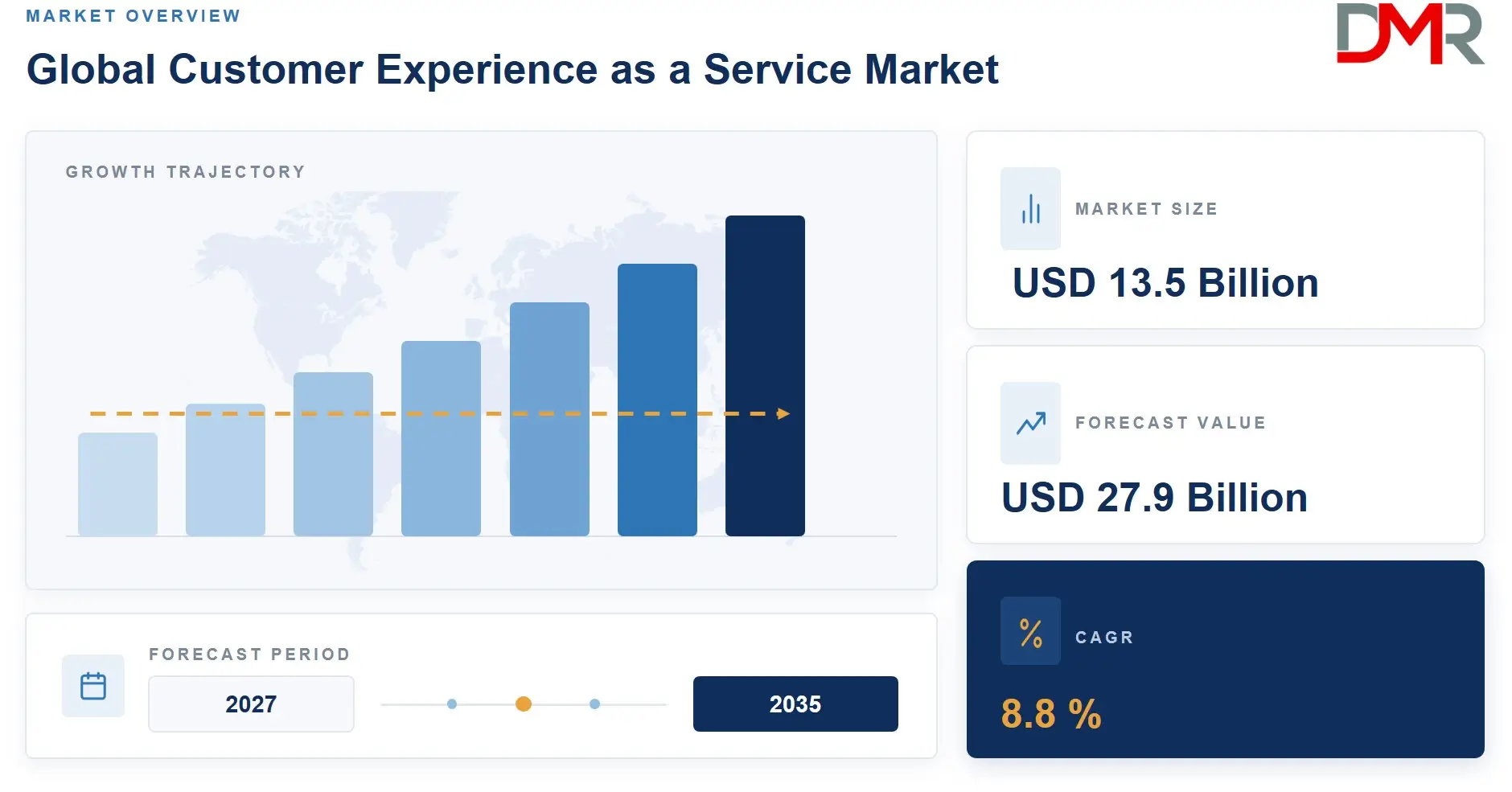
- Global Customer Experience as a Service Market Size in 2026: USD 13.5 billion
- Global Customer Experience as a Service Market Size in 2035: USD 27.9 billion
- Global CAGR from 2027 to 2035: 8.8%
- Omnichannel Engagement is the leading Service Type segment in 2026: 45.8%
- Solutions is the leading Component segment in 2026: 67.5%
- Customer Experience Analytics is the fastest-growing Service Type segment: 9.1% CAGR
- Services is the fastest-growing Component segment: 9.5% CAGR
- North America is the leading Region in 2026: 34.8%
- Asia Pacific is the fastest-growing Region: 11.2% CAGR
What is the Global Customer Experience as a Service and its Market Size?
The Global Customer Experience as a Service Market size is projected to be valued at USD 13.5 billion in 2026, and it is further anticipated to reach a market value of USD 27.9 billion by 2035 at a CAGR of 8.8%.
ℹ
To learn more about this report –
Download Your Free Sample Report Here
The Cloud-based platforms and services that help companies to manage customer interactions, enhance customer satisfaction, and facilitate personalized experiences through various digital and traditional communication channels are part of the Global Customer Experience as a Service (CXaaS) Market. These are solutions that combine customer engagement, multi-channel communication, customer experience analytics, marketing campaign management, and automated customer service, all in one. CXaaS services are employed by businesses to handle client inquiries, review customer interactions, streamline service operations, and enhance communication throughout websites, cell apps, email, messaging systems, social media and contact centers. The segments that the market caters to are BFSI, telecom, retail, healthcare, manufacturing, government, and media. With the expectations of the customers on the rise, digital commerce is increasing, and cloud and AI-powered engagement tools are driving the growth of CXaaS platforms. Issues of data protection and integration complexity, along with customer information security, continue to be significant concerns for organizations that are in the process of putting these solutions in place.
Use Cases
- Omnichannel Customer Engagement: Businesses use CXaaS platforms to manage customer interactions across voice calls, email, live chat, mobile applications, and social media. Centralized communication systems provide customer interaction histories, improve service continuity, and support consistent responses across multiple communication channels.
- Customer Journey Management: Organizations use customer experience platforms to track customer interactions throughout purchasing, onboarding, service delivery, and post-purchase support. Customer journey analytics help identify engagement gaps, understand customer preferences, improve service processes, and strengthen customer retention strategies.
- AI-Powered Customer Support: Companies deploy AI-powered chatbots, virtual assistants, and automated communication systems to respond to routine customer inquiries. These solutions support customer service availability, intelligent request routing, automated response generation, and reduced operational workloads.
- Customer Feedback and Experience Analytics: Businesses use CXaaS platforms to collect customer feedback, analyze satisfaction levels, monitor communication quality, and identify service-related issues. Customer experience analytics support decision-making, service improvement, customer sentiment analysis, and personalized engagement activities.
Key Takeaways
- Global Market Value: The Global Customer Experience as a Service Market is generating revenue of USD 13.5 billion in 2026 and is further anticipated to reach USD 27.9 billion by 2035.
- Global Growth Rate: The Global Customer Experience as a Service Market is expected to have a CAGR of 8.8% during the forecast period from 2027 to 2035.
- Technology Trends: Increasing integration of artificial intelligence, generative AI, conversational automation, customer journey analytics, and cloud-based communication platforms is supporting the development of customer experience solutions.
- Market Drivers: Factors supporting market growth include increasing adoption of omnichannel customer engagement, expanding digital commerce, rising demand for personalized customer interactions, and growing investment in cloud-based customer service technologies.
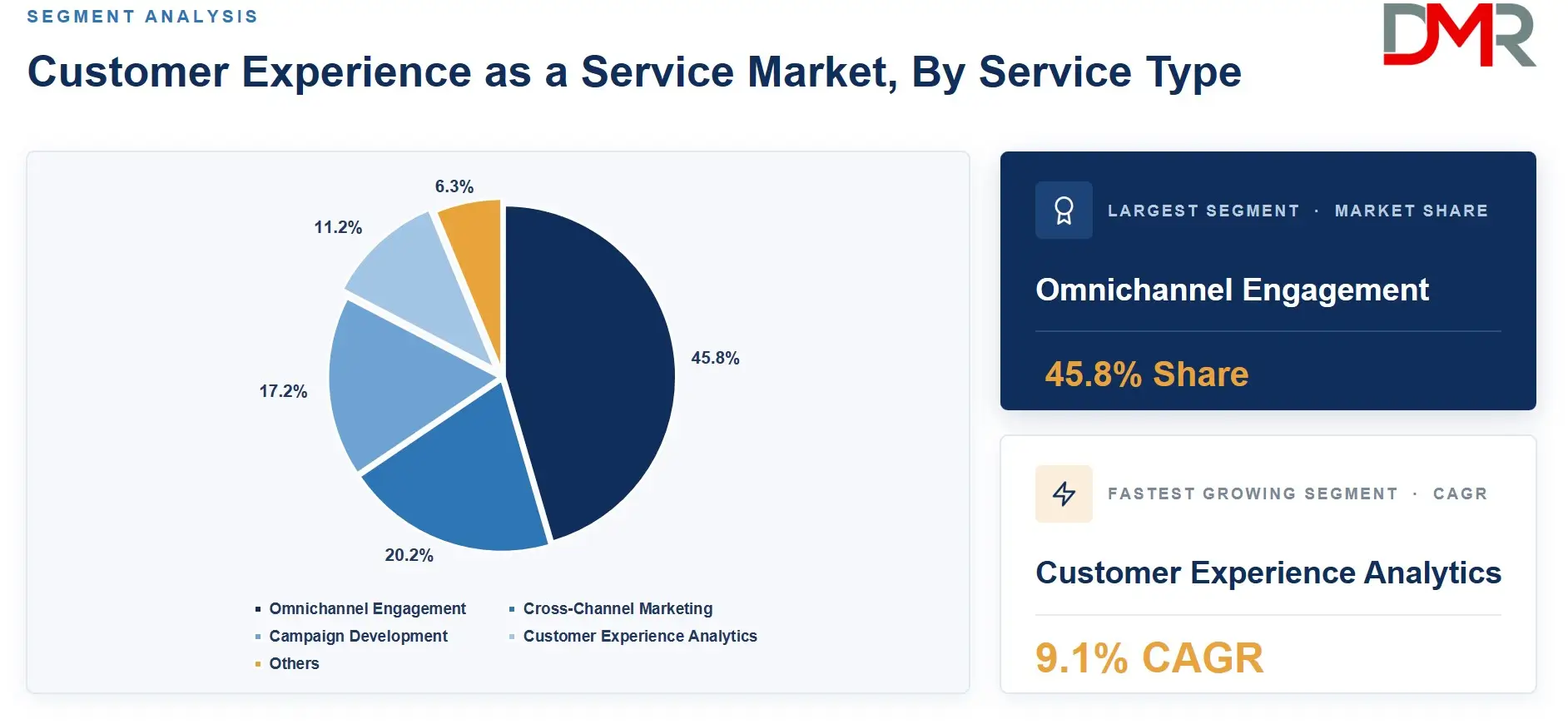
- Service Type Segment Analysis: The Omnichannel Engagement segment is anticipated to be the largest Service Type segment, having a market share of 45.8% by the end of 2026. Whereas the Customer Experience Analytics segment is expected to be the fastest-growing segment with a CAGR of 9.1% from 2027 to 2035.
- Component Segment Analysis: The Solutions segment is the major Component segment, representing the highest market share of 67.5% in 2026, while the Services segment is projected to have the highest growth rate with a CAGR of 9.5% during the forecast period.
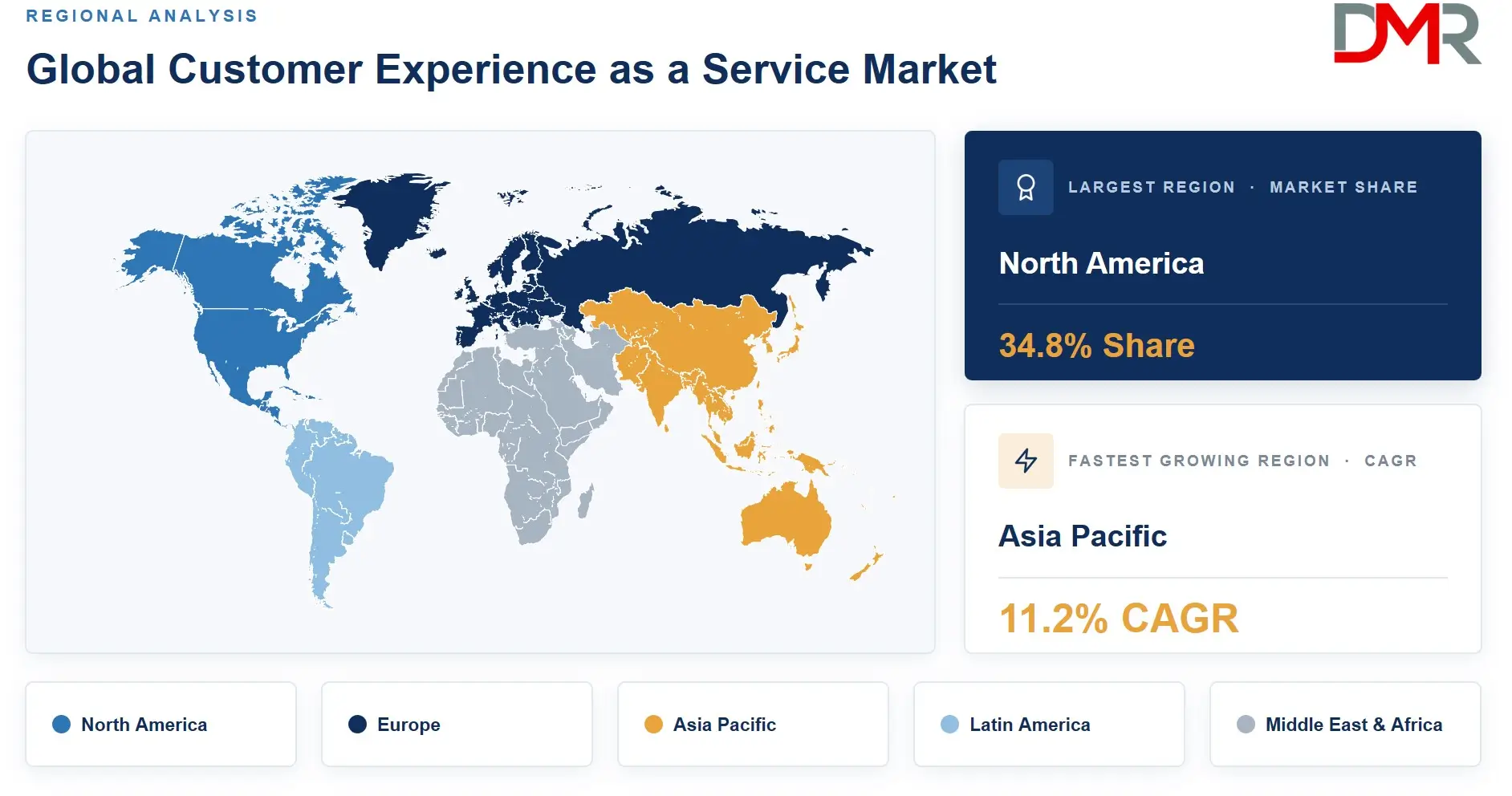
- Regional Analysis: The North America region is poised to hold the largest market share of 34.8% in the global market in 2026. The Asia Pacific region is expected to be the fastest-growing region with a CAGR of 11.2% during the forecast period.
How AI/Gen AI is Transforming the Customer Experience as a Service Market?
Artificial intelligence (AI) and generative artificial intelligence (Gen AI) are transforming the Global Customer Experience as a Service Market through automated customer interactions, intelligent service management, and advanced customer analytics. AI-powered platforms can analyze customer communication records, identify customer preferences, classify service inquiries, and recommend appropriate responses. These capabilities support faster customer service operations and improve consistency across communication channels. Generative AI enables conversational virtual assistants, automated response generation, customer interaction summarization, and knowledge-based support. AI-driven analytics also help organizations identify customer dissatisfaction, predict service requirements, and optimize customer journeys. The integration of AI with customer relationship management systems, cloud communication platforms, and enterprise applications supports more connected customer experiences. Agentic AI technologies are expanding automation capabilities by enabling multistep service processes and coordinated customer support activities. However, data privacy, response accuracy, cybersecurity, and regulatory requirements remain important considerations when deploying AI-enabled customer experience solutions.
Key Drivers
Increasing Demand for Omnichannel Customer Engagement
The increasing use of digital communication channels is supporting the growth of the Global Customer Experience as a Service Market. Customers communicate with businesses through websites, mobile applications, email, messaging platforms, social media, and telephone support, creating demand for consistent customer service across different channels. CXaaS platforms enable organizations to centralize customer information, manage communication histories, and coordinate service activities through integrated systems. Businesses in retail, banking, telecommunications, and healthcare are adopting omnichannel engagement solutions to improve service accessibility and customer satisfaction. The expansion of digital commerce and growing customer expectations for personalized communication are encouraging investment in cloud-based customer engagement platforms. Integrated communication systems also support operational efficiency by reducing disconnected workflows and improving coordination between customer service departments. Continued digital transformation is expected to strengthen demand for omnichannel customer experience solutions.
Growing Adoption of Cloud-Based Customer Experience Platforms
Increasing adoption of cloud technologies is driving demand for Customer Experience as a Service solutions across different industries. Businesses are transitioning from traditional customer service infrastructure toward cloud-based platforms offering scalable communication capabilities, centralized management, and subscription-based pricing. Cloud deployment supports customer engagement across multiple locations without requiring substantial investment in physical infrastructure. Organizations can integrate communication channels, customer analytics, and service automation within centralized platforms. Cloud-based customer experience solutions also support remote service operations, software updates, and flexible resource allocation. Financial institutions, retailers, telecommunications companies, and professional service providers are increasingly investing in cloud technologies to modernize customer interaction systems. Growing demand for scalable digital services and efficient customer communication is strengthening market adoption.
Restraints
Customer Data Privacy and Information Security Concerns
Customer experience platforms process large volumes of personal information, communication histories, purchase records, and customer behavior data. The collection and processing of sensitive information create challenges related to cybersecurity, privacy protection, and regulatory compliance. Organizations adopting CXaaS platforms must establish appropriate controls for customer data access, storage, retention, and processing. Regulations such as the European Union General Data Protection Regulation introduce requirements concerning lawful information processing, transparency, and personal data protection. Security incidents involving customer information can affect business reputation and increase operational costs. Concerns regarding third-party cloud services, AI-based data analysis, and cross-border data transfers may also influence technology adoption. Financial institutions, healthcare organizations, and government agencies often require additional security measures before implementing customer experience platforms.
High Implementation Costs and System Integration Challenges
The implementation of a Customer Experience as a Service platform can involve technical complexity and additional operational expenses, particularly within organizations using multiple legacy systems. CXaaS platforms often require integration with customer relationship management applications, enterprise resource planning software, customer databases, payment systems, and existing communication infrastructure. Differences in data structures, application compatibility, and security requirements can increase deployment complexity. Organizations may also incur costs associated with platform migration, employee training, workflow modification, and ongoing technical support. Businesses operating across different countries can face additional challenges involving communication regulations and regional data protection requirements. Limited financial resources and technical capabilities may restrict adoption among smaller enterprises. These factors can increase implementation periods and influence purchasing decisions.
Growth Opportunities
Expansion of AI-Powered Customer Experience Solutions
The increasing adoption of artificial intelligence is creating significant opportunities in the Global Customer Experience as a Service Market. Businesses are investing in AI-powered customer support, conversational virtual assistants, predictive analytics, and automated service management to improve customer interactions. Advanced AI systems can analyze customer communication patterns, identify service requirements, and automate routine inquiries. Generative AI also supports personalized communication, knowledge management, and real-time assistance for customer service personnel. CXaaS providers can develop integrated AI capabilities to improve service efficiency and reduce manual workloads. Growing demand for intelligent automation across banking, retail, healthcare, and telecommunications is creating opportunities for specialized customer experience solutions. Vendors offering reliable AI governance, multilingual capabilities, and flexible integration options can address expanding enterprise requirements.
Growing Adoption Among Small and Medium Enterprises
Small and Medium Enterprises represent an important opportunity for the expansion of cloud-based customer experience solutions. Subscription-based CXaaS platforms enable smaller businesses to access customer communication tools, marketing automation, and customer analytics without substantial upfront infrastructure investment. Increasing digital commerce, mobile application adoption, and online customer engagement are encouraging smaller organizations to modernize customer service operations. Cloud-based platforms provide flexible pricing, simplified deployment, centralized customer information, and scalable service capabilities. Technology providers can develop affordable packages and modular solutions to meet different business requirements. Expanding digital infrastructure across emerging markets in Asia Pacific, Latin America, and the Middle East and Africa is also creating opportunities for CXaaS vendors. Demand for cost-effective customer engagement tools is expected to support the adoption of these platforms.
Trends
Increasing Integration of AI-Based Customer Experience Analytics
AI-based customer experience analytics is becoming an important trend in the Global Customer Experience as a Service Market. CXaaS providers are introducing advanced analytical capabilities to examine customer behavior, communication patterns, service interactions, and customer satisfaction levels. AI-powered tools can identify recurring service issues, analyze customer sentiment, and generate insights into customer engagement performance. Predictive analytics also supports customer retention planning and personalized service strategies. Businesses can use analytical dashboards to monitor service quality, customer response times, and engagement outcomes. The integration of generative AI enables automated reporting and conversational access to customer information.
Growing Demand for Unified Customer Engagement Platforms
Organizations are increasingly adopting unified customer experience platforms that combine communication channels, customer information, service automation, and analytics within centralized systems. Disconnected customer engagement applications can create inconsistent communication and limit visibility into customer journeys. Unified CXaaS platforms help businesses coordinate interactions across sales, marketing, and customer service departments. Integration with CRM applications, enterprise software, and cloud communication platforms improves information accessibility and operational coordination. Technology providers are expanding integration capabilities, workflow automation, and AI-powered service features to support enterprise requirements.
Research Scope and Analysis
On the basis of Service Type, the Global Customer Experience as a Service Market is segmented into Campaign Development, Cross-Channel Marketing, Omnichannel Engagement, Customer Experience Analytics, and Others. The market can be segmented on the basis of Component into Solutions and Services. On the basis of Deployment Mode, the market includes Public, Private, and Hybrid. By Enterprise Size, the market includes Small and Medium Enterprises and Large Enterprises. On the basis of Industry Vertical, the market includes BFSI, IT and Telecommunications, Retail and E-commerce, Healthcare and Life Sciences, Manufacturing, Government and Public Sector, Media and Entertainment, and Others.
ℹ
To learn more about this report –
Download Your Free Sample Report Here
By Service Type
Omnichannel Engagement is projected to dominate the Service Type segment in the Global Customer Experience as a Service Market, accounting for 45.8% of the total market share in 2026. The dominance is attributed to increasing demand for centralized customer communication, growing adoption of digital engagement channels, integration with customer relationship management systems, and rising investment in personalized customer service. Businesses are adopting omnichannel platforms to manage customer interactions across voice, email, live chat, social media, and mobile applications while maintaining consistent communication histories. Customer Experience Analytics is anticipated to register the highest CAGR of 9.1% during the forecast period from 2027 - 2035, supported by increasing demand for predictive customer insights, AI-powered sentiment analysis, customer behavior monitoring, personalized engagement strategies, and data-driven customer retention management.
By Component
Solutions is projected to dominate the Component segment in the Global Customer Experience as a Service Market, accounting for 67.5% of the total market share in 2026. The dominance is supported by increasing adoption of cloud-based customer experience software, omnichannel communication platforms, customer analytics applications, and AI-powered customer service technologies. Organizations are investing in integrated solutions to manage customer interactions, improve service coordination, automate communication workflows, and strengthen customer engagement across different channels. The growing integration of CXaaS platforms with CRM systems and enterprise applications further supports demand. Services is anticipated to register the highest CAGR of 9.5% during the forecast period from 2027-2035, driven by increasing demand for implementation support, consulting, system integration, platform customization, managed customer service operations, and technical assistance across different industries.
By Deployment Mode
Public is projected to dominate the Deployment Mode segment in the Global Customer Experience as a Service Market, accounting for 48.4% of the total market share in 2026. The dominance is supported by increasing demand for scalable customer communication platforms, subscription-based pricing, centralized system administration, and lower initial infrastructure requirements. Public deployment enables organizations to manage customer interactions across multiple locations, introduce automated service capabilities, and integrate communication applications with enterprise systems. The growing adoption of digital customer service channels and cloud-based business applications further strengthens market demand. Hybrid is anticipated to register the highest CAGR of 10.1% during the forecast period from 2027 -2035, supported by increasing demand for flexible deployment environments, stronger customer data management, integration with legacy infrastructure, and greater control over sensitive customer information.
By Enterprise Size
Large Enterprises is projected to dominate the Enterprise Size segment in the Global Customer Experience as a Service Market, accounting for 61.2% of the total market share in 2026. The dominance is attributed to substantial investment in customer experience transformation, complex customer communication requirements, large customer databases, and increasing adoption of integrated engagement platforms across business departments. Large organizations require centralized solutions capable of managing customer interactions, customer journey analytics, marketing activities, and automated service operations across different locations. Increasing adoption of AI-powered customer engagement technologies further supports enterprise spending. Small and Medium Enterprises is anticipated to register the highest CAGR of 9.8% during the forecast period from 2027-2035, driven by increasing availability of affordable cloud-based customer experience solutions, flexible subscription models, simplified implementation, growing digital commerce activities, and rising demand for efficient customer communication systems.
By Industry Vertical
BFSI is projected to dominate the Industry Vertical segment in the Global Customer Experience as a Service Market, accounting for 38.2% of the total market share in 2026. The dominance is supported by increasing adoption of digital banking platforms, growing demand for personalized financial services, secure customer communication, and efficient customer support operations. Banks, insurance companies, and financial service providers are investing in omnichannel engagement platforms to manage customer inquiries, improve service accessibility, and automate routine support activities. Customer experience analytics also supports customer retention, complaint management, and service improvement across financial institutions. Retail and E-commerce is anticipated to register the highest CAGR of 9.0% during the forecast period from 2027-2035, driven by expanding online shopping activities, increasing demand for personalized marketing, automated customer service, integrated digital communication, and growing investment in customer engagement technologies.
The Global Customer Experience as a Service Market Report is segmented based on the following:
By Service Type
- Campaign Development
- Cross-Channel Marketing
- Omnichannel Engagement
- Customer Experience Analytics
- Others
By Component
By Deployment Mode
By Enterprise Size
- Small and Medium Enterprises
- Large Enterprises
By Industry Vertical
- BFSI
- IT and Telecommunications
- Retail and E-commerce
- Healthcare and Life Sciences
- Manufacturing
- Government and Public Sector
- Media and Entertainment
- Others
Regional Analysis
North America is the Leading Region in the Global Customer Experience as a Service Market
North America is expected to become the dominant force within the Global Customer Experience as a Service Market as it will hold a market share of 34.8% in 2026. The dominance of the market is supported by widespread adoption of cloud-based customer engagement platforms, increasing investment in artificial intelligence, advanced digital infrastructure, and the strong presence of customer experience technology providers across the United States and Canada. Growing demand for omnichannel communication, personalized customer interactions, and automated customer service is supporting regional market development. Enterprises across financial services, retail, telecommunications, and healthcare are increasingly investing in integrated customer experience platforms to improve service efficiency and customer retention.
ℹ
To learn more about this report –
Download Your Free Sample Report Here
Asia Pacific is the Fastest-Growing Region in the Global Customer Experience as a Service Market
Asia Pacific is expected to witness the fastest-growing regional market with a compound annual growth rate of 11.2% during the forecast period from 2027-2035, due to rapid digital transformation, expanding e-commerce activities, increasing adoption of cloud technologies, and growing demand for customer engagement solutions across China, India, Japan, Australia, and South Korea. Businesses are increasingly deploying AI-powered customer support, omnichannel communication platforms, and customer experience analytics to manage rising customer interaction volumes. Expanding digital financial services and business process outsourcing activities are also creating opportunities for customer experience platform providers.
Europe Customer Experience as a Service Market
The Europe Customer Experience as a Service Market is supported by increasing adoption of digital customer engagement platforms, growing enterprise investment in cloud technologies, and rising demand for personalized customer interactions. Businesses across Germany, France, the United Kingdom, Italy, and Spain are introducing omnichannel communication systems and customer analytics capabilities to modernize service operations. The banking, retail, telecommunications, healthcare, and manufacturing industries represent important adopters of customer experience platforms. Organizations are increasingly integrating customer service applications with CRM systems to improve communication consistency and operational efficiency. The European Union General Data Protection Regulation influences customer information management, privacy controls, and data security requirements.
Latin America Customer Experience as a Service Market
The Latin America Customer Experience as a Service Market is supported by expanding digital commerce, increasing enterprise cloud adoption, and growing investment in customer communication technologies. Brazil, Mexico, Argentina, and Chile represent important markets as businesses modernize customer service operations and expand digital engagement channels. Financial institutions, telecommunications companies, retailers, and business process outsourcing providers are adopting customer experience platforms to manage customer inquiries, improve communication efficiency, and support service automation. Cloud-based CXaaS solutions provide flexible deployment options and reduce dependence on traditional customer service infrastructure. Increasing smartphone adoption and expanding online business activities are supporting demand for omnichannel customer engagement.
Middle East and Africa (MEA) Customer Experience as a Service Market
The Middle East and Africa Customer Experience as a Service Market is supported by increasing digital transformation initiatives, enterprise technology investment, and growing adoption of cloud-based customer communication platforms. Saudi Arabia, the United Arab Emirates, and South Africa represent important regional markets as organizations modernize customer engagement operations across financial services, telecommunications, retail, healthcare, and government activities. The expansion of digital banking, e-commerce, tourism, and online public services is creating demand for integrated customer experience solutions.
Major Countries Analysis
United States Customer Experience as a Service Market
The US Customer Experience as a Service Market is projected to be valued at USD 3.5 billion in 2026. The market is supported by increasing adoption of cloud-based customer engagement platforms, AI-powered service automation, and omnichannel communication solutions. Rising demand for personalized customer interactions, advanced analytics, digital banking services, and integrated CRM systems is encouraging investment across retail, healthcare, telecommunications, and financial services industries throughout the country.
Japan Customer Experience as a Service Market
The Japan Customer Experience as a Service Market is supported by enterprise digital transformation, increasing adoption of cloud-based business applications, and growing demand for efficient customer service operations. Japanese businesses are investing in integrated customer engagement platforms to manage communication across telephone support, websites, mobile applications, and digital messaging services. The financial services, manufacturing, retail, telecommunications, and hospitality industries represent important adopters of customer experience solutions.
Saudi Arabia Customer Experience as a Service Market
The Saudi Arabia Customer Experience as a Service Market is supported by digital transformation programs, increasing enterprise cloud adoption, and growing investment in modern customer engagement platforms. Saudi Vision 2030 is encouraging the development of digital services across financial institutions, telecommunications, tourism, healthcare, retail, and government organizations. Businesses are adopting omnichannel communication systems to improve customer interactions, support automated inquiries, and strengthen digital service delivery. The expansion of online banking, e-commerce, and public service applications is increasing demand for integrated customer experience technologies.
Regulatory Landscape
The Data Protection Regulations, Consumer Privacy Laws, Cybersecurity Requirements, and Electronic Communication Policies are important factors influencing the Global Customer Experience as a Service Market. The European Union General Data Protection Regulation establishes requirements concerning lawful personal data processing, transparency, information security, and individual privacy rights. In the United States, federal and state privacy regulations influence customer information management, electronic communication, and the handling of sensitive personal information. The California Consumer Privacy Act introduces additional obligations for covered businesses concerning personal data collection, disclosure, and consumer rights.
Investment and White Space Analysis
The Global Customer Experience as a Service Market presents investment opportunities in AI-powered customer support, cloud-based engagement platforms, customer journey analytics, and automated communication technologies. Organizations are increasingly seeking integrated customer experience solutions capable of improving service efficiency, strengthening customer retention, and supporting personalized interactions. Technology providers can expand offerings through conversational AI, predictive customer analytics, automated service workflows, and intelligent communication routing. Growing demand for integration with CRM platforms, enterprise applications, and digital communication channels is creating opportunities for platform development and system integration services. Small and Medium Enterprises represent an expanding market for affordable subscription-based customer experience solutions with simplified deployment and flexible pricing structures.
By Region
North America
Europe
- Germany
- France
- The U.K.
- Italy
- Spain
- Rest of Europe
Asia Pacific
- China
- Japan
- India
- Australia
- South Korea
- Rest of APAC
Latin America
- Mexico
- Brazil
- Rest of LATAM
Middle East & Africa
- Saudi Arabia
- The UAE
- South Africa
- Rest of MEA
Competitive Landscape
The Global Customer Experience as a Service Market is characterized by competition among cloud-based customer engagement providers, contact center technology companies, customer relationship management software vendors, and customer analytics specialists. Major participants include NICE, Genesys, Salesforce, Microsoft, Oracle, Adobe, Five9, Zendesk, and other customer experience technology providers. Competition is influenced by omnichannel communication capabilities, AI-powered automation, platform integration, customer analytics, deployment flexibility, and subscription pricing. Some companies focus on customer service automation, intelligent communication routing, and cloud contact center infrastructure, while others provide customer journey analytics, marketing automation, and integrated customer engagement platforms. Businesses increasingly require solutions capable of connecting customer information across multiple communication channels and enterprise applications. Technology providers are investing in conversational AI, generative AI, predictive analytics, and automated service workflows to strengthen platform capabilities. Strategic partnerships, product development, and technology integration are influencing the competitive environment as organizations seek scalable customer experience solutions with stronger data security and operational efficiency.
Some of the prominent players in the Global Customer Experience as a Service Market are:
- Genesys Cloud Services, Inc.
- Salesforce, Inc.
- Microsoft Corporation
- Oracle Corporation
- Adobe Inc.
- Five9, Inc.
- Zendesk, Inc.
- Cisco Systems, Inc.
- Amazon Web Services, Inc.
- SAP SE
- ServiceNow, Inc.
- NICE Ltd.
- Talkdesk, Inc.
- Sprinklr, Inc.
- Twilio Inc.
- 8x8, Inc.
- RingCentral, Inc.
- Freshworks Inc.
- Avaya LLC
- Verint Systems Inc.
- Medallia, Inc.
- Qualtrics International Inc.
- Zoom Communications, Inc.
- Zoho Corporation Pvt. Ltd.
- HubSpot, Inc.
- Braze, Inc.
- Content Guru Limited
- Nextiva, Inc.
- Sinch AB
- Infobip Ltd.
- Vonage
- Dialpad, Inc.
- UJET, Inc.
- Uniphore Technologies Inc.
- Kore.ai, Inc.
- Yellow.ai
- CallMiner, Inc.
- TTEC Holdings, Inc.
- Concentrix Corporation
Recent Developments
- In November 2026, NICE introduced advancements to its Cognigy conversational AI capabilities, including reusable AI skills and improved decision tracing. The developments support the management of automated customer interactions and provide additional visibility into AI-driven customer service processes. The expanded capabilities help organizations coordinate automated service workflows and improve customer experience operations.
- In September 2026, Genesys introduced new Genesys Cloud capabilities focused on agentic customer experience orchestration. The developments included Genesys Cloud Navigator, designed to provide intelligence at the beginning of customer interactions and support more coordinated service experiences. The platform enhancements strengthen AI-enabled communication, customer journey management, and enterprise customer service automation.
- In March 2026, Salesforce introduced Agentforce Contact Center, an integrated customer service solution combining voice communication, digital channels, CRM information, and AI agents within a unified platform. The solution supports automated customer assistance, coordinated transitions between AI and human service personnel, and improved visibility across customer interactions.
- In January 2026, Five9 announced an expanded partnership with Google Cloud and introduced a joint Enterprise Customer Experience AI solution. The collaboration combines cloud-based customer engagement technologies with AI capabilities to support intelligent customer interactions, improve service automation, and strengthen enterprise customer experience management.
Report Details
| Report Characteristics |
| Market Size (2026) |
USD 13.5 Bn |
| Forecast Value (2035) |
USD 27.9 Bn |
| CAGR (2027–2035) |
8.8% |
| The US Market Size (2026) |
USD 3.5 Bn |
| Historical Data |
2021 – 2025 |
| Forecast Data |
2027 – 2035 |
| Base Year |
2026 |
| Segments Covered |
By Service Type, By Component, By Deployment Mode, By Enterprise Size, By Industry Vertical |
| Regional Coverage |
North America – The US and Canada; Europe – Germany, France, The UK, Italy, Spain, Rest of Europe; Asia-Pacific – China, Japan, India, Australia, South Korea, Rest of APAC; Latin America – Mexico, Brazil, Colombia, Argentina, Rest of LATAM; Middle East & Africa – Saudi Arabia, The UAE, South Africa, Rest of MEA |
Frequently Asked Questions
How big is the Customer Experience as a Service Market?
▾ The Global Customer Experience as a Service Market is projected to be valued at USD 13.5 billion in 2026 and is expected to reach USD 27.9 billion by 2035.
What is the CAGR of the Customer Experience as a Service Market from 2027 to 2035?
▾ The Global Customer Experience as a Service Market is anticipated to grow at a compound annual growth rate (CAGR) of 8.8% during the forecast period from 2027 to 2035.
What factors are driving the growth of the Customer Experience as a Service Market?
▾ The market is supported by increasing adoption of cloud-based customer engagement platforms, rising demand for omnichannel communication, growing investment in AI-powered customer service, and expanding digital commerce activities. Organizations are adopting customer experience solutions to improve service delivery, strengthen customer retention, manage communication across multiple channels, and support personalized customer interactions.
What are the major trends in the Customer Experience as a Service Market?
▾ Major trends include increasing integration of generative AI, conversational virtual assistants, customer journey analytics, omnichannel engagement platforms, and automated customer service workflows. Technology providers are also focusing on unified customer experience platforms, predictive analytics, personalized communication, and cloud-based service management to support enterprise customer engagement requirements.
Which region held the largest share of the Customer Experience as a Service Market in 2026?
▾ North America is poised to hold the largest share of the Global Customer Experience as a Service Market in 2026, accounting for 34.8% of the total market.
Which region is expected to grow the fastest in the Customer Experience as a Service Market?
▾ Asia Pacific is projected to be the fastest-growing regional market during the forecast period, registering a CAGR of 11.2%.
Who are the key players in the Customer Experience as a Service Market?
▾ Companies relevant to the market include NICE Ltd., Genesys, Salesforce, Microsoft, Oracle, Adobe, Five9, Zendesk, Cisco, Amazon Web Services, Talkdesk, Sprinklr, Twilio, and other customer experience technology providers. These companies offer cloud-based customer engagement platforms, omnichannel communication systems, customer analytics, AI-powered service automation, CRM integration, and related customer experience management solutions.
How is the Customer Experience as a Service Market segmented?
▾ The market is segmented by Service Type into Campaign Development, Cross-Channel Marketing, Omnichannel Engagement, Customer Experience Analytics, and Others. By Component, the market includes Solutions and Services. By Deployment Mode, the market includes Public, Private, and Hybrid. By Enterprise Size, the market includes Small and Medium Enterprises and Large Enterprises. By Industry Vertical, the market covers BFSI, IT and Telecommunications, Retail and E-commerce, Healthcare and Life Sciences, Manufacturing, Government and Public Sector, Media and Entertainment, and Others. Geographically, the market covers North America, Europe, Asia Pacific, Latin America, and the Middle East and Africa.