What is the Data Center Leak Detection Market Size?
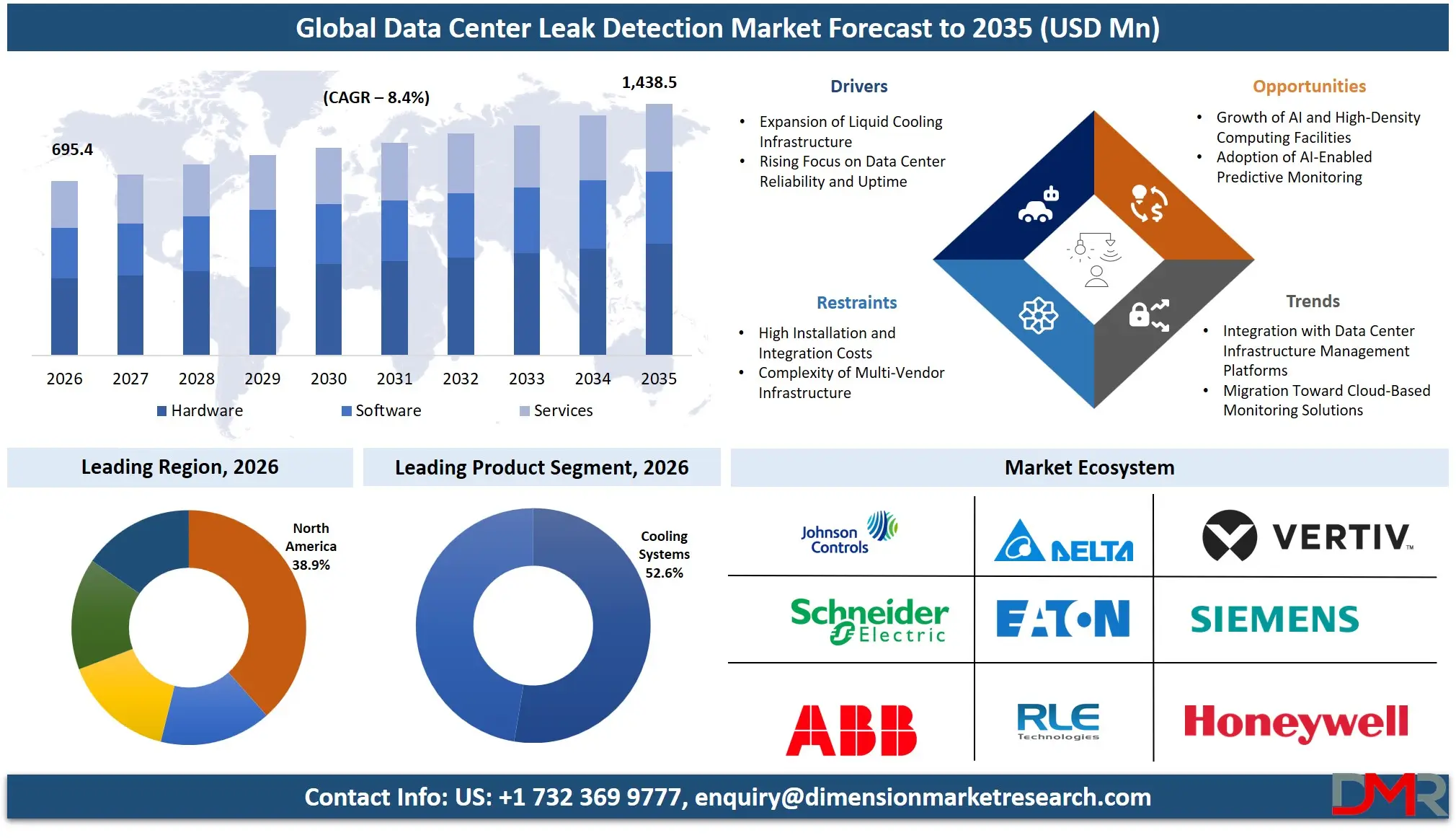
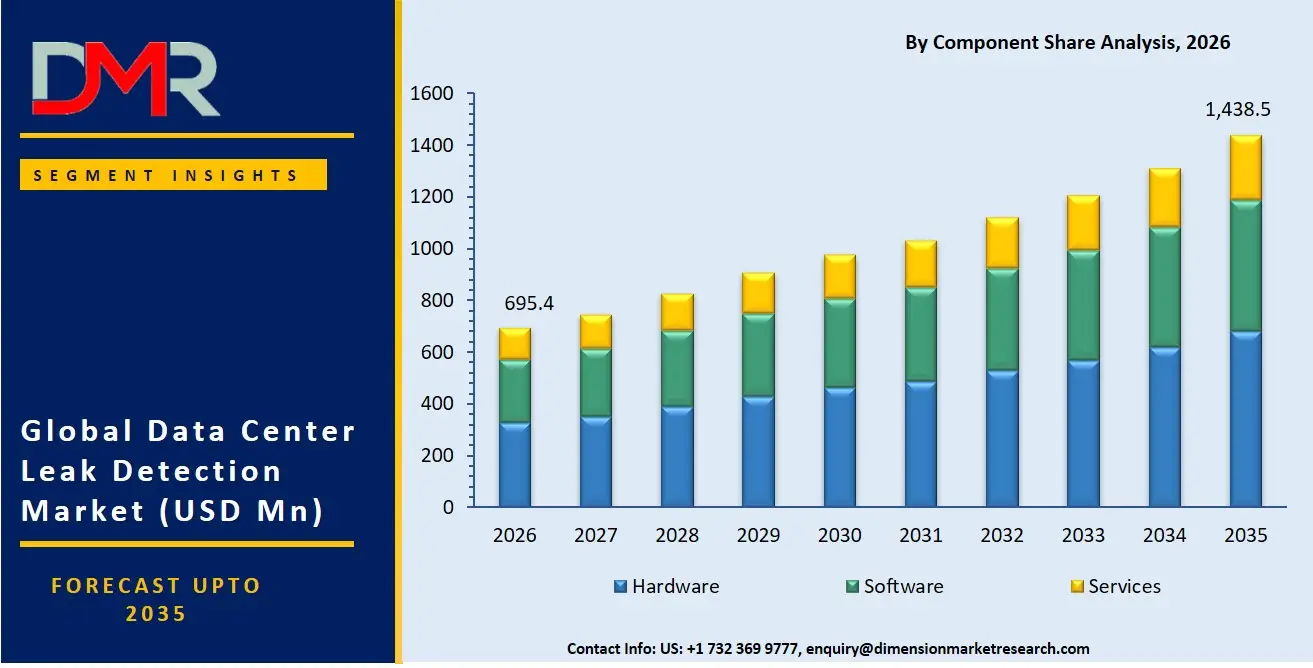
The Data Center Leak Detection Market size is expected to be USD 695.4 million in 2026 and increase at a compound annual growth rate of 8.4% to USD 1,438.5 million in 2035 due to expansion of liquid cooling infrastructure.
ℹ
To learn more about this report –
Download Your Free Sample Report Here
The Data Center Leak Detection Market is growing steadily because operators need to keep their infrastructure resilient and protect valuable IT assets. They're also using liquid cooling more often, which makes advanced leak detection essential. This field covers hardware sensors, monitoring software, and managed services for spotting water, coolant, and condensation leaks. To meet strict standards, hit sustainability targets, and avoid costly downtime, there's increased demand. Also, the use of IoT, AI predictive analytics, and cloud-based monitoring is reshaping competition in this space.
The US Data Center Leak Detection Market
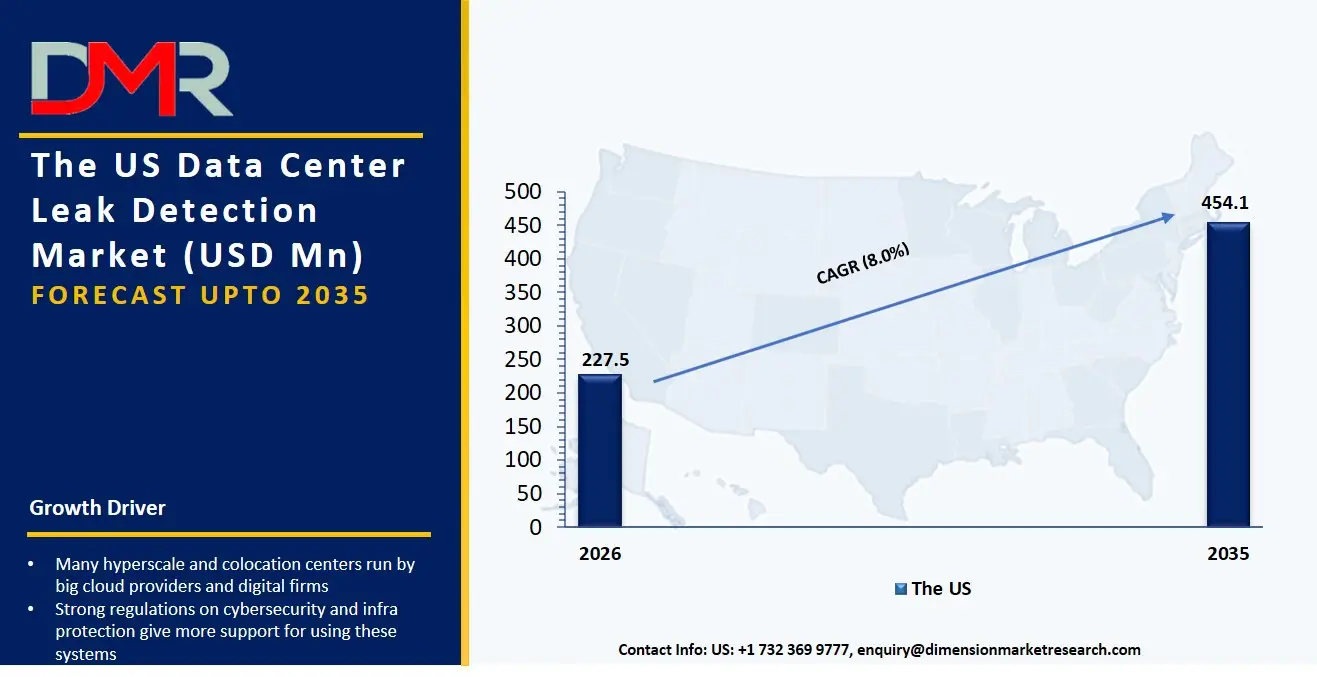
The US Data Center Leak Detection Market size is estimated to be USD 227.5 million in 2026 and is expected to increase at a CAGR of 8.0% over the forecast period.
The U.S. leads in data center markets because of its many hyperscale and colocation centers run by big cloud providers and digital firms. With growing AI workloads, investments in liquid cooling systems are rising too, boosting the need for leak detection tech. Plus, strong regulations on cybersecurity and infrastructure protection give more support for using these systems. Investments in edge computing and AI data centers increase demand for cutting-edge cable and predictive leak detection systems. Given the mature tech vendors and lots of capital spent on building data centers, the future market looks really promising.
ℹ
To learn more about this report –
Download Your Free Sample Report Here
Europe Data Center Leak Detection Market
The Europe Data Center Leak Detection Market size is estimated to be USD 173.9 million in 2026 and is expected to increase at a CAGR of 8.1% over the forecast period.
Europe's market is pushed by rules on sustainability, energy efficiency, and strict standards. The European Green Deal policies nudge operators towards better facility efficiency and a lighter environmental impact. Over in Northern and Western Europe, places are expanding with liquid cooling and water-saving gear, which drives need for advance leak detectors. Big investments keep rolling in for data centers in spots like Germany, the Netherlands, Ireland, and the Nordic countries. Plus, there's more focus on keeping tabs on water use, sustainability numbers, and how well ops hold up, which just keeps pushing everyone to amp up their monitoring tech.
Japan Data Center Leak Detection Market
The market size of Japan Data Center Leak Detection will be USD 34.8 million in 2026 and at a CAGR of 7.9% in the forecast period.
Japan's market gains from cloud adoption and digital transformation. There's also a high demand for sturdy infrastructure that supports advanced computing. Cities are more developed there, pushing needs for leak monitoring to stay safe and managed properly. Investments in edge data centers and AI tech are boosting the use of liquid cooling systems, which need good leak detection. With the government pushing for efficient and modern digital structures, the future looks bright for this industry. They focus heavily on system reliability and uptime too, making those leak detection setups crucial.
Key Takeaways
- Market Size & Forecast: The Data Center Leak Detection Market size is projected to reach USD 695.4 million in 2026 and is anticipated to have a value of USD 1,438.5 million in 2035.
- Growth Rate & Outlook: The Data Center Leak Detection Market size is set to grow at a compound annual growth rate of 8.4% during the forecast period of 2026 to 2035.
- Primary Growth Drivers: Some of the major growth drivers in the market is expansion of Liquid Cooling Infrastructure, and more.
- Key Market Trends: Some of the major trends in the market are Integration with Data Center Infrastructure Management Platforms, and more.
- By Component: Hardware segment is anticipated to get the majority share of the Data Center Leak Detection Market in 2026.
- By Deployment: On-Premise is expected to get the largest revenue share in 2026 in the Data Center Leak Detection Market.
- By Application: Cooling Systems segment is expected to get the largest revenue share in 2026 in the Data Center Leak Detection Market.
- Regional Leadership: North America is set to lead the Data Center Leak Detection Market with an estimated 38.9% share in 2026.
What is the Data Center Leak Detection?
Data center leak detection involves tech, systems, and services for spotting fluid leaks. This includes sensors, conductive cables, and fiber-optic gear, plus monitoring software and alarms. Predictive analytics is part of it too. Leak detection is key to protecting servers, network devices, cooling systems, raised floors, and power stuff from fluid harm. With more liquid cooling and denser data centers, these solutions are getting smarter. They now offer real-time, AI-backed monitoring which makes operations reliable and cuts risk.
Use Cases
- Cooling System Protection: Leak detection systems keep an eye on chilled water lines, liquid cooling loops, and HVAC infra, spotting leaks before they can harm servers or disrupt ops. This early detection cuts downtime, lowers maintenance costs, and shields vital gear.
- Raised Floor Monitoring: Data centers put sensing cables under raised floors to catch water coming in from pipes or cooling systems. This lets specialists respond quickly and stops major damage to the setup.
- Liquid-Cooled AI Infrastructure: Direct-to-chip and immersion cooling are more common for dense AI clusters. Real-time leak checks on these keep equipment running and save on repairmnet cost when things go wrong.
- Remote Facility Management: Operators use cloud-based systems to watch over all their sites from one screen. This sets off auto alerts and uses predicitive analytics to make reactions faster and boost how reliable the whole place is.
How AI Is Transforming the Data Center Leak Detection Market
Artificial intelligence is changing leak detection systems by adding predictive analytics, catching anomalies, and boosting automated monitoring. It looks at sensor data, environmental conditions, humidity, flow rates, and cooling system performance to spot patterns that signal possible leaks. This lets operators step in early and avoid pricey breakdowns.
AI makes things more efficient too, by sorting alerts and cutting down on false alarms. This aids predictive maintenance. With data centers moving toward liquid cooling, these smart systems will be essential for keeping reliable infrastructure and safeguarding important equipment.
Market Dynamic
Driving Factors in the Data Center Leak Detection Market
Rising Adoption of Liquid Cooling in AI Data Centers
The rapid deployment of AI, high-performance computing, and accelerated computing infrastructure is increasing rack power densities and encouraging data-center operators to adopt direct-to-chip, rear-door, and other liquid-cooling technologies. Unlike conventional air cooling, liquid-cooling architectures introduce coolant lines, manifolds, connectors, cold plates, and distribution units closer to sensitive IT equipment, creating additional leak points. Consequently, continuous leak monitoring is becoming an increasingly important component of data-center protection strategies. Market research indicates that liquid-cooled data centers are a major growth catalyst for leak detection demand, particularly as AI infrastructure expands across hyperscale and colocation facilities.
Growing Cost of Data-Center Downtime and Equipment Damage
Data centers support increasingly critical cloud, enterprise, financial, telecommunications, and AI workloads, making unexpected downtime increasingly costly. Water, coolant, refrigerant, fuel, and other fluid leaks can damage servers, electrical equipment, flooring, and cooling infrastructure while potentially disrupting operations. Leak detection systems provide early warning and enable facility personnel to isolate affected areas before a small leak develops into a major incident. Growing emphasis on operational continuity, uptime commitments, asset protection, and preventive maintenance is therefore encouraging operators to invest in continuous monitoring rather than relying solely on manual inspections.
Restraints in the Data Center Leak Detection Market
High Retrofit Complexity Across Existing Data Centers
A significant portion of the installed data-center base was designed around conventional air-cooling architectures and was not originally configured for extensive liquid monitoring. Retrofitting leak detection across raised floors, cooling distribution networks, racks, mechanical rooms, and existing piping can require additional engineering, sensor placement, cabling, controllers, software integration, and facility downtime. Complex legacy layouts can therefore increase installation costs and extend deployment timelines. The challenge becomes more pronounced when operators introduce liquid cooling into facilities that were not designed with coolant sensing infrastructure from the beginning. This can encourage phased implementation rather than comprehensive leak detection deployment across the entire facility.
Integration and Compatibility Challenges Across Monitoring Systems
Data centers commonly operate multiple monitoring, building-management, DCIM, environmental-monitoring, and alarm systems from different suppliers. Integrating leak detection into these existing platforms can create interoperability and configuration challenges, particularly where operators require centralized alarms, automated responses, historical data, and precise fault localization. Different sensing technologies may also be required for water, glycol-based coolants, refrigerants, fuels, or other fluids. This fragmentation can increase system complexity and procurement requirements. Operators may consequently prioritize solutions with established communication protocols, centralized monitoring capabilities, and compatibility with existing facility-management infrastructure, potentially slowing adoption of standalone systems.
Opportunities in the Data Center Leak Detection Market
Development of Coolant-Specific Detection for AI Infrastructure
The expansion of direct-to-chip and other liquid-cooling architectures creates an opportunity for manufacturers to develop sensing technologies specifically optimized for data-center coolants. Traditional water sensors may not provide equivalent performance across water-glycol mixtures, dielectric fluids, and other specialized cooling fluids. Vendors can therefore differentiate through coolant-specific sensing, faster response, precise localization, and compatibility with high-density rack environments. Demand is particularly relevant around cold plates, manifolds, quick connectors, coolant distribution units, piping joints, and under-rack areas. The growing liquid-cooling market provides a substantial adjacent opportunity for specialized leak-detection manufacturers.
Integration With DCIM, IoT, and Predictive Analytics Platforms
Connecting leak detection systems with DCIM, building-management systems, IoT networks, and predictive-maintenance platforms creates opportunities beyond basic alarm generation. Integrated systems can combine leak information with temperature, humidity, pressure, flow, cooling, and equipment-status data to identify abnormal conditions and accelerate response. Wireless monitoring can also simplify deployment in facilities where extensive new cabling is difficult. As operators increasingly seek centralized visibility across large hyperscale and colocation campuses, vendors can develop software-enabled platforms offering remote alerts, event histories, automated escalation, and analytics. Such capabilities can increase the value of leak detection from a standalone safety product to an integrated facility-management solution.
Trends in the Data Center Leak Detection Market
Shift From Basic Water Detection Toward Multi-Fluid Monitoring
Data-center leak detection is evolving beyond traditional water monitoring toward broader protection against coolant, glycol mixtures, refrigerants, fuel, and other fluids. The transition is particularly visible as liquid cooling introduces new fluid types directly into IT environments. Manufacturers are therefore expanding sensing capabilities to identify different fluids across white spaces, cooling infrastructure, mechanical rooms, and power areas. This trend is increasing demand for specialized sensors, addressable sensing cables, point detection devices, and monitoring platforms capable of distinguishing leak locations and fluid-related risks.
Increasing Adoption of Intelligent and Networked Leak Detection
The market is moving toward intelligent leak detection systems that provide continuous monitoring, precise location identification, centralized alerts, and integration with facility-management platforms. Wireless IoT-based systems, software analytics, DCIM connectivity, and automated response capabilities are gaining importance as data-center operators manage increasingly large and distributed facilities. Instead of simply generating an alarm after liquid is detected, newer systems are increasingly designed to provide actionable information regarding the location and severity of the event. This supports faster intervention, automated escalation, and improved preventive maintenance, particularly in hyperscale, AI-focused, and colocation data-center environments.
Research Scope and Analysis
This analysis breaks down the Data Center Leak Detection Market, cutting it up by components, techs used, deployment models, data center types, and applications. It also examines trends like growing liquid cooling and the push for AI-ready infrastructures, along with the emphasis on uptime. The report delves into regional growth, tech advances, the competitive scene, and how regulations impact the market. These factors greatly influence the market's future, especially for hyperscale, colocation, enterprise, and edge data centers.
ℹ
To learn more about this report –
Download Your Free Sample Report Here
By Component Analysis
Hardware is expected to stay the leader, accounting for about 47.3% of the market in 2026. This is because of the growing use of leak detection sensors, sensing cables, and alarm systems at big data centers. These hardware pieces are very essential; they set up leak detection systems which are needed in new places as well as older ones that get updated.
ℹ
To learn more about this report –
Download Your Free Sample Report Here
Software is the quickest growing part of the business. Why? Because more companies want cloud-based platforms and AI-driven tools to help manage their facilities better. It lets them keep track of everything in real time and gives them useful info.
Services, like installing, calibrating, and maintaining these systems, are also becoming more important. Operators need help dealing with all the advanced tech for detecting leaks.
By Detection Technology Analysis
Cable-based systems are forecasted to have about 44.8% market share in 2026 because they can continuously monitor large areas and quickly find leaks. They're commonly used under raised floors, around cooling equipment, and in crucial infrastructure spots. Fiber-optic and addressable cable systems are becoming more popular for their accuracy and flexibility. The flow-based systems are the quickest growing part of the market; liquid cooling is getting more common in AI and high-performance computing setups. These systems monitor coolant flow and spot issues in circulation systems, which is super helpful for early warnings. For local needs that require targeted monitoring at a lower cost, spot detection systems still work well.
By Deployment Analysis
On-premise deployments will make up around 63.5% of the market in 2026. Many operators favor controlling monitoring systems locally because of security needs and worries about operational reliability. Plus, integrating with current facility management systems is easier this way. Big companies keep putting money into on-site monitoring setups. Yet, the cloud-based segment is growing quickly because firms want easy-to-use, scalable solutions that offer remote access. These cloud-enabled options handle multisite tasks smoothly, allow predictive analytics, and even do automated reports. As more people accept cloud infrastructures, its use should grow faster, especially with colocation and distributed edge data center operators.
By Data Center Type Analysis
Hyperscale data centers will control around 41.9% of the market in 2026. This is due to big investments in cooling, high-density computing, and reliable operations. They need thorough leak detection systems for their complex cooling needs and vital machinery. Colocation facilities matter a lot too, since providers have to meet strict service agreements and build customer trust. Edge data centers will grow the fastest because of spreading edge computing and 5G. Plus, there's a surge in low-latency services that demand solid environmental monitoring.
By Application Analysis
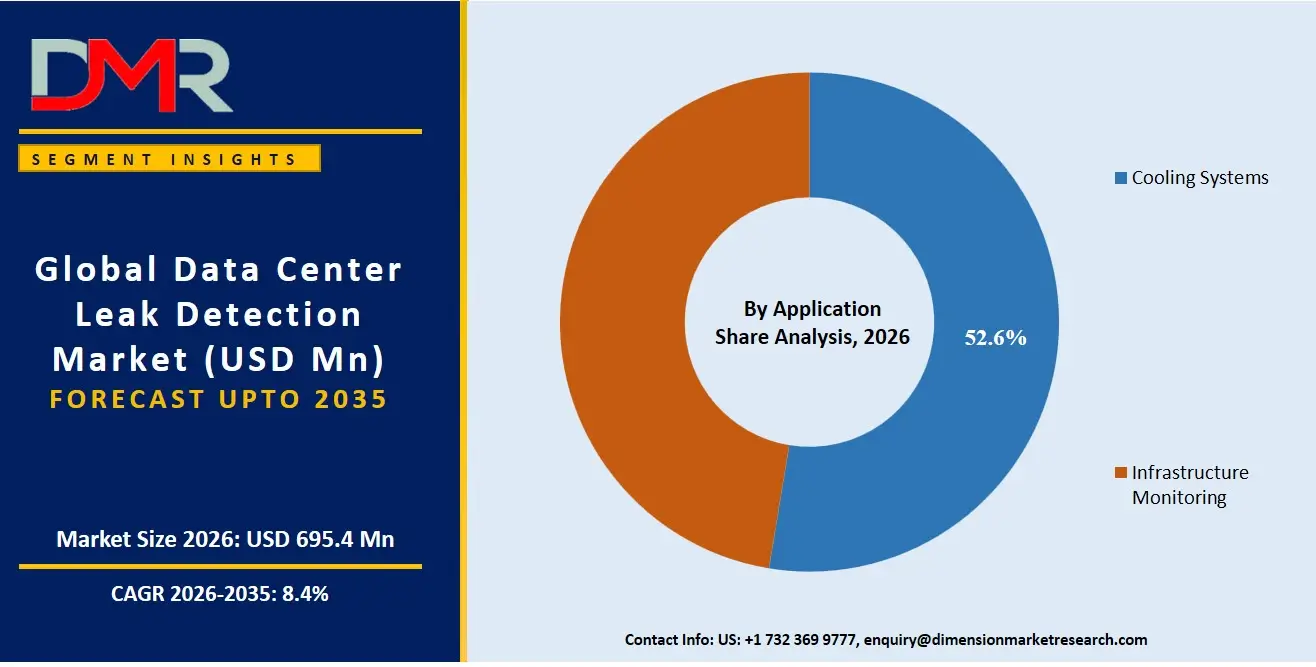
Cooling systems are expected to be the top application segment, holding about 52.6% of the market share in 2026. As more folks adopt chilled water and liquid cooling tech, along with high-density computing setups, there's a big need for leak detection to watch over the cooling equipment. Since cooling failures can cause both operations and financial headaches, many operators are cautious.
Infrastructure monitoring looks set to see the fastest growth, since companies want to get ahead with their facility management. Checking on raised floors, pipes, server racks, and similar crucial parts helps them handle risks before they happen, making operations way more resilient.
The Data Center Leak Detection Market Report is segmented on the basis of the following:
By Component
- Hardware
- Leak detection sensors
- Leak detection cables
- Alarm & control units
- Software
- Monitoring & alert platforms
- DCIM-integrated leak management systems
- AI-based predictive detection tools
- Services
- Installation & integration
- Maintenance & calibration
- Managed monitoring services
By Detection Technology
- Cable-Based Systems
- Conductive cables
- Fiber optic sensing cables
- Addressable leak detection systems
- Spot Detection Systems
- Point moisture sensors
- Localized leak detectors
- Flow-Based Systems
- Coolant flow monitoring systems
- Chilled water leak detection systems
By Deployment
- On-premise systems
- Cloud-based systems
By Data Center Type
- Hyperscale data centers
- Colocation data centers
- Enterprise data centers
- Edge data centers
By Application
- Cooling Systems
- HVAC and chilled water systems
- Liquid cooling systems
- Infrastructure Monitoring
- Raised floor areas
- Pipe & plumbing networks
- Server racks and IT zones
Regional Analysis
Leading Region in the Data Center Leak Detection Market
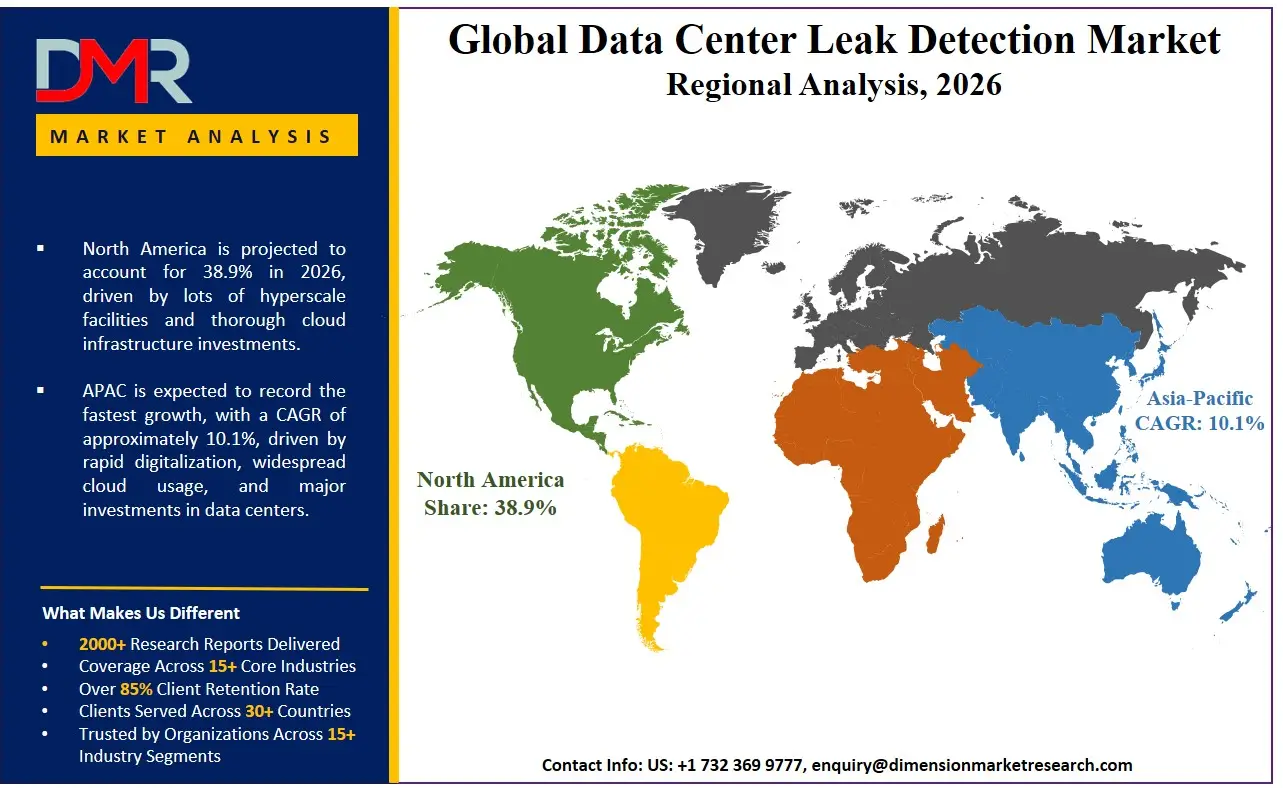
North America will likely stay as the top regional market, expected to have about 38.9% of the global market by 2026. This area benefits from lots of hyperscale facilities and thorough cloud infrastructure investments. Plus, there's a wide use of AI technologies and advanced cooling systems. The U.S. leads in driving growth because of big investments in building and modernizing data centers. Strong tech ecosystems, strict operational needs, and a high demand for reliable infrastructure all support this market leadership. With more focus on predictive maintenance and environmental monitoring, these practices get adopted even more in enterprise, colocation, and hyperscale facilities.
ℹ
To learn more about this report –
Download Your Free Sample Report Here
Fastest Growing Region in the Data Center Leak Detection Market
Asia-Pacific will likely lead all other regions in growth because of rapid digitalization, widespread cloud usage, and major investments in data centers. Countries like China, India, Japan, Singapore, and Australia are building and upgrading facilities to handle booming AI workloads, e-commerce, and digital services. Besides, governments back these tech transformations and enforce data localization rules, boosting demand. As a result, there's a rise in liquid cooling system use and a stronger focus on keeping operations running smoothly, creating big chances for leak detection companies across the region.
By Region
North America
Europe
- Germany
- The U.K.
- France
- Italy
- Russia
- Spain
- Benelux
- Nordic
- Rest of Europe
Asia-Pacific
- China
- Japan
- South Korea
- India
- ANZ
- ASEAN
- Rest of Asia-Pacific
Latin America
- Brazil
- Mexico
- Argentina
- Colombia
- Rest of Latin America
Middle East & Africa
- Saudi Arabia
- UAE
- South Africa
- Israel
- Egypt
- Rest of MEA
Competitive Landscape
The Data Center Leak Detection Market thrives on tech innovation and service differentiation. Companies compete by enhancing sensor accuracy and adding predictive analytics. They're also hooking up with broader data center management systems. This space demands high tech know-how and strict reliability, creating decent entry barriers. More firms are teaming up with cooling system makers and data center operators for an edge. Also, businesses are ramping up managed services, and sinking money into AI. Plus, they're crafting flexible solutions that work for hyperscale, colocation, enterprise, and edge data centers.
Some of the prominent players in the global Data Center Leak Detection Market are:
- Schneider Electric
- Vertiv Holdings Co.
- Eaton Corporation
- Siemens AG
- nVent (Raychem TraceTek)
- Honeywell International Inc.
- ABB Ltd.
- Johnson Controls International
- RLE Technologies
- TTK Leak Detection Systems
- Danfoss
- Carrier Global Corporation
- Emerson Electric Co.
- Legrand SA
- STULZ GmbH
- Delta Electronics
- Bosch
- TE Connectivity
- Other Key Players
Recent Developments
- In July 2026, Vertiv introduced its approach to monitoring and managing liquid-cooled AI data centers, including integrated leak detection and response capabilities that can trigger mitigation actions such as valve isolation and CDU shutdown across rack, row, and site levels.
- In June 2026, TTK highlighted liquid leak detection as a critical requirement for high-density data centers during DCD Connect Bali, emphasizing early detection and protection against coolant leaks as liquid-cooling adoption accelerates across APAC data centers.
- In December 2025, Schneider Electric detailed its data-center gas leakage detector calibration service, highlighting the importance of accurately detecting refrigerant leaks in cooling systems to prevent efficiency losses, safety risks, and cooling-related downtime.
- In December 2025, Danfoss highlighted its data-center liquid-cooling solutions, including leak-free, helium-tested couplings and fluid-conveyance components designed to minimize leakage risks in high-density data-center cooling circuits.
- In November 2025, Delta Electronics showcased advanced liquid-cooling solutions for AI data centers, including a 2 MW Coolant Distribution Unit for high-density infrastructure; its CDU portfolio incorporates standard leak detection and alarm functionality for liquid-cooling systems.
Report Details
| Report Characteristics |
| Market Size (2026) |
USD 695.4 Mn |
| Forecast Value (2035) |
USD 1,438.5 Mn |
| CAGR (2026–2035) |
8.4% |
| Historical Period |
2021 – 2025 |
| Forecast Period |
2026 – 2035 |
| Base Year |
2025 |
| Estimate Year |
2026 |
| Segments Covered |
By Component, By Detection Technology, By Deployment, By Data Center Type, By Application |
| Regional Coverage |
North America – The US and Canada; Europe – Germany, The UK, France, Russia, Spain, Italy, Benelux, Nordic, & Rest of Europe; Asia-Pacific – China, Japan, South Korea, India, ANZ, ASEAN, Rest of APAC; Latin America – Brazil, Mexico, Argentina, Colombia, Rest of Latin America; Middle East & Africa – Saudi Arabia, UAE, South Africa, Egypt, Israel, & Rest of MEA |
Frequently Asked Questions
How big is the Data Center Leak Detection Market?
▾ The Data Center Leak Detection Market size is expected to reach USD 695.4 million by 2026 and is projected to reach USD 1,438.5 million by the end of 2035.
What is the CAGR of the Data Center Leak Detection Market from 2026 to 2035?
▾ The market is growing at a CAGR of 8.4 percent over the forecasted period.
What factors are driving the growth of the Data Center Leak Detection Market?
▾ Expansion of Liquid Cooling Infrastructure, and more are the factors driving the growth of the Data Center Leak Detection Market.
What are the major trends in the Data Center Leak Detection Market?
▾ Integration with Data Center Infrastructure Management Platforms, and more are some of the major trends in the market.
Who are the key players in the Data Center Leak Detection Market?
▾ Some of the key players in the Data Center Leak Detection Market include Siemens, ABB, Honeywell, and more.
How is the Data Center Leak Detection Market segmented?
▾ The Data Center Leak Detection Market is segmented by component, detection technology, deployment, data center type, application.
Which region held the largest share of the Data Center Leak Detection Market in 2026?
▾ North America is set to lead the Data Center Leak Detection Market with an estimated 38.9% share in 2026.
Which region is expected to grow the fastest in the Data Center Leak Detection Market?
▾ Asia Pacific is the fastest-growing region in the Data Center Leak Detection Market during the forecast period.