Market Snapshot
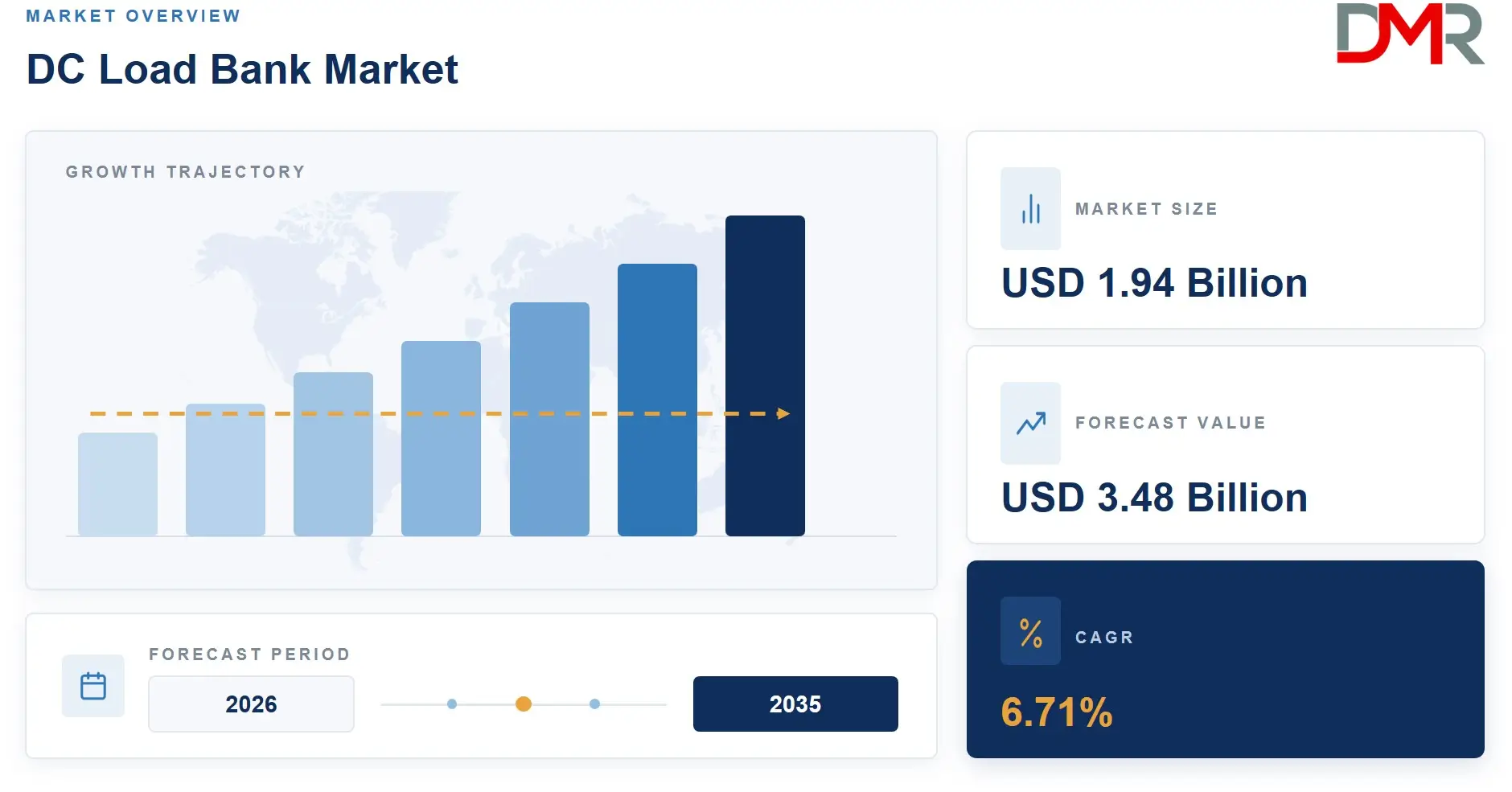
- The Global DC Load Bank Market was valued at USD 1.82 Billion in 2025 and is projected to reach USD 3.48 Billion by 2035, at a CAGR of 6.71%.
- By product type, Portable DC Load Banks led with a 57.8% share in 2025; Stationary DC Load Banks held the remaining 42.2%.
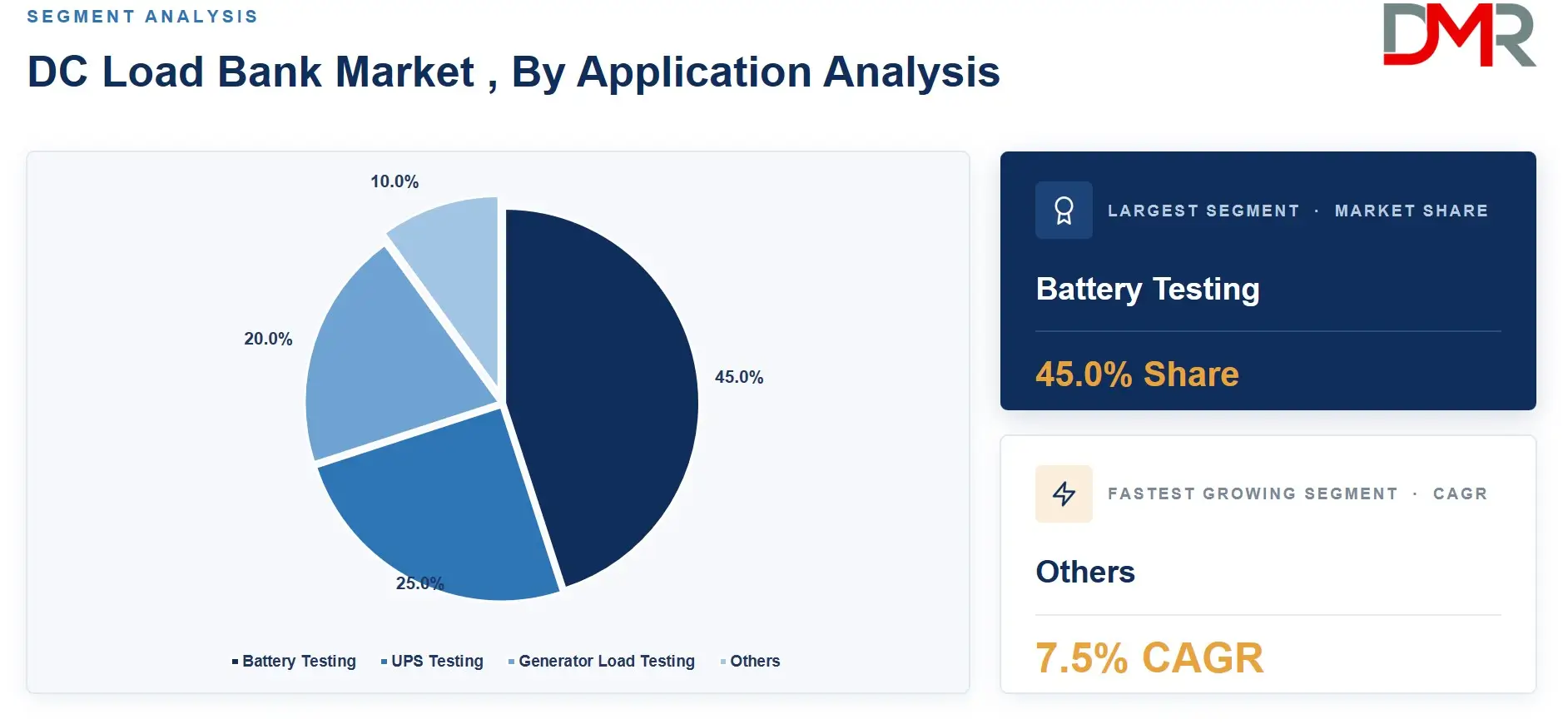
- By application, Battery Testing commanded a 45.0% share, followed by UPS Testing at 25.0%, Generator Load Testing at 20.0%, and Others at 10.0%.
- By end-use, Data Centers held the largest share at 36.0%, followed by Power Generation at 20.0%, Telecommunications at 19.0%, Industrial at 15.0%, and Others at 10.0%.
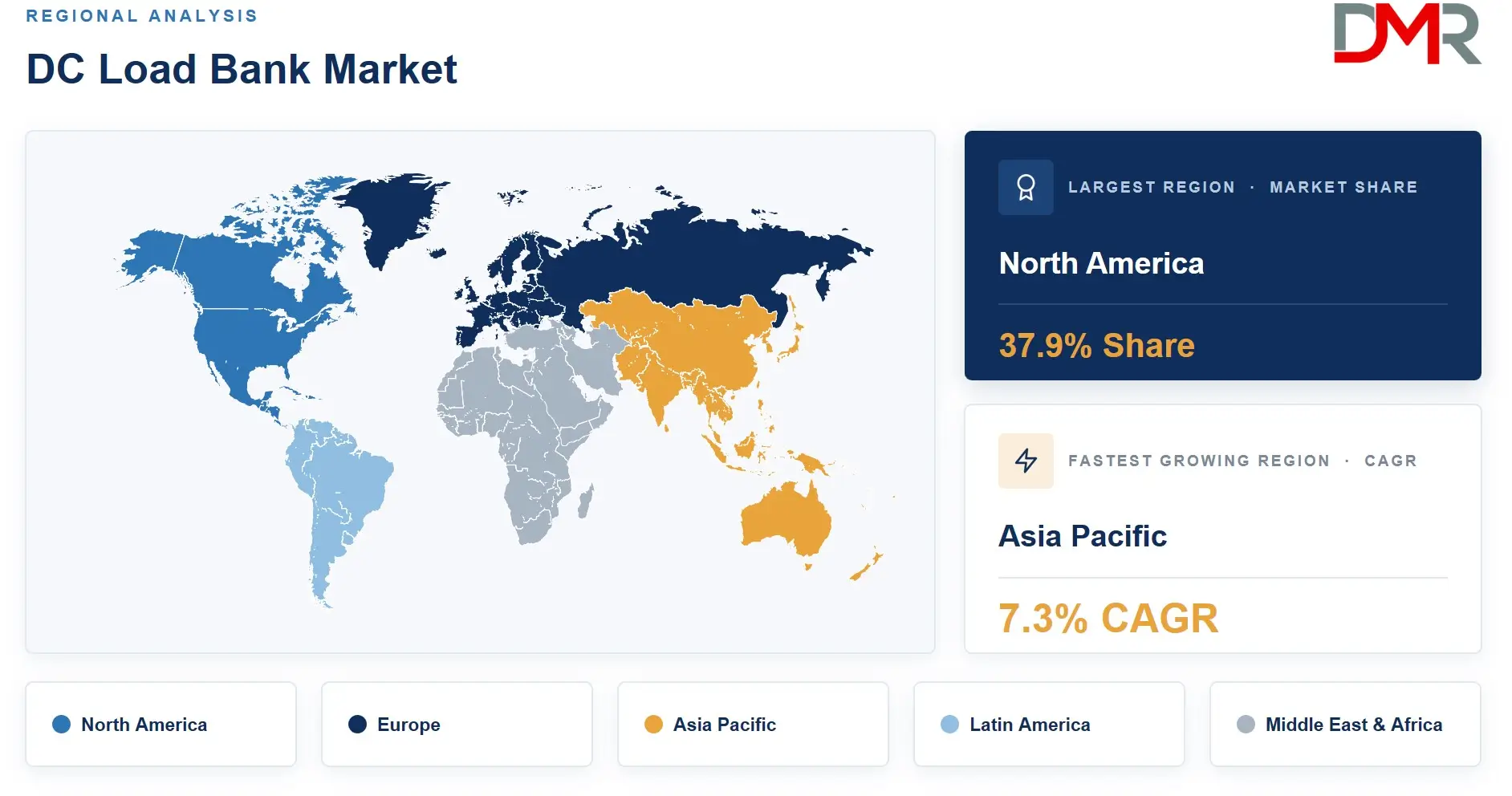
- North America was the dominant region with a 37.9% share in 2025.
Market Overview
The DC load bank market covers purpose-built resistive and electronic equipment used to simulate electrical loads on DC power sources, including batteries, UPS systems, fuel cells, generators fitted with rectifiers, and DC microgrids. The market excludes AC load banks, AC-to-DC conversion testing equipment purchased for purely AC applications, and general-purpose electronic test instruments. The primary buyers are data center operators, telecom network owners, power generation utilities, and industrial facilities where backup power integrity is non-negotiable.
Power outages carry quantifiable financial consequences for critical infrastructure operators. As reported by leddypower.com, data centers lose approximately $8,500 per minute during a power failure, which makes load bank testing a cost-avoidance tool rather than a discretionary expense. That calculus has pulled DC load bank procurement out of capital budget conversations and into operational risk management, shifting the buyer profile from engineering teams to C-suite and risk officers.
The broader power infrastructure industry is embedding more DC architecture as renewable energy, battery storage, and EV charging create DC-native grids. DC load banks connect to this shift directly. Equipment designed for validating AC systems cannot replicate the discharge curves, voltage plateaus, or fault conditions unique to DC sources. Vendors building DC-specific test platforms with remote monitoring and automated scripting are capturing budget that previously had no dedicated product category to absorb it.
Market Size and Forecast
The Global DC Load Bank Market size is estimated at USD 1.94 Billion in 2026 from USD 1.82 Billion in 2025, and is projected to reach USD 3.48 Billion by 2035, exhibiting a CAGR of 6.71% during the forecast period.
The forecast rests on three durable structural forces. Hyperscale data center construction continues at pace globally, with each facility requiring battery backup and UPS validation before commissioning. Utility-scale battery energy storage projects have expanded from pilot scale to grid-critical infrastructure, mandating formal discharge capacity verification. A 500 kW AC/DC load bank technical specification issued in November 2025 details a continuous DC load capacity of 500 kW, with a resistor range sized to absorb up to 115 MJ of energy per test cycle, illustrating how individual project requirements are scaling upward faster than older equipment fleets can meet. Both forces together imply that average contract values per unit will rise as buyer requirements outgrow standard catalog products.
ℹ
To learn more about this report –
Download Your Free Sample Report Here
In January 2026, Avtron Power Solutions introduced 500 kW and 720 kW liquid-cooled load bank models aimed directly at hyperscale data center commissioning. The entry of new high-capacity products at this scale signals that vendors are betting on sustained, not cyclical, demand. Downside risk exists if data center construction timelines slip due to power grid constraints or permitting delays, which could compress near-term order flow without affecting the long-run demand trajectory.
Product Type Analysis
Portable DC Load Banks led the product type segment with a 57.8% share in 2025.
Portable units dominate because project-based testing economics favor mobility over permanent installation for most operators outside Tier IV hyperscale facilities. A portable DC load bank rated at 0–28.5 kW, such as the 28.5 V aircraft ground power unit documented by gse-global.com with continuous DC current draw of 0–1000 A and IP21 enclosure protection, illustrates the form factor flexibility that makes portable models attractive across aviation, telecom, and small-site power validation. Buyers avoid the capital and space costs of fixed equipment while still meeting compliance test intervals.
Stationary DC Load Banks, holding 42.2% of the product segment, serve large permanent facilities where recurring test schedules justify fixed infrastructure. Standard stationary units operate safely up to 1000 V, with bespoke designs reaching 1500 V and continuous power output up to 1000 kW, as confirmed by data from ukana.nl in 2026. That ceiling is decisive for hyperscale data center and grid-scale battery operators who cannot ship a portable unit on-site for every quarterly test cycle. Vendors offering modular stationary configurations that can scale power capacity in stages are taking share from fixed-spec competitors as facility power densities rise.
Application Analysis
Battery Testing accounted for 45.0% of application demand in 2025, the highest of any category.
Battery testing leads because lithium-ion and advanced lead-acid battery banks now sit at the core of every major power backup architecture, from data centers to telecom towers to grid storage facilities. Every new installation requires baseline capacity verification, and every aging installation requires periodic discharge testing to flag degraded cells before failure. The share gap between battery testing and the next largest application reveals how much the broader shift to electrified infrastructure has concentrated DC load bank demand on a single use case.
ℹ
To learn more about this report –
Download Your Free Sample Report Here
UPS Testing, at 25.0%, represents the second-largest application and aligns with the data center build cycle that drives overall market growth. Generator Load Testing at 20.0% remains stable as diesel backup systems undergo mandatory commissioning and compliance cycles. The Others category, covering fuel cell validation and emerging EV charging depot testing, holds 10.0% but represents the fastest-developing application class. Buyers in EV depot and DC microgrid testing do not yet have purpose-built products designed to their specific voltage profiles, which leaves room for vendors willing to invest in application-specific configurations.
End-Use Analysis
A 36.0% share made Data Centers the clear leader across end-use categories in 2026.
Data centers generate the highest per-site testing budgets of any end-use vertical, and regulatory and insurance requirements in many jurisdictions mandate annual or more frequent load bank tests. Power Generation end-use, at 20.0%, reflects utility and distributed generation operators testing rectifiers, converters, and battery banks connected to renewable assets. Telecommunications, at 19.0%, remains structurally important because every cell site and edge hub carries a battery string that must be validated on a recurring schedule. Industrial facilities at 15.0% use DC load banks for factory UPS and motor drive testing, with demand tracking capital expenditure cycles rather than regulatory mandates. The Others segment at 10.0% captures oil and gas, defense, and transportation electrification, all of which are early in formalizing DC backup power testing requirements.
Key Market Segments
By Product Type
- Portable DC Load Banks
- Stationary DC Load Banks
By Application
- Battery Testing
- UPS (Uninterruptible Power Supply) Testing
- Generator Load Testing
- Others
By End-Use
- Data Centers
- Telecommunications
- Power Generation
- Industrial
- Others
Regional Analysis
North America led the regional segment with a 37.9% share, equivalent to approximately USD 0.69 Billion of the USD 1.82 Billion 2026 market.
North America's dominance reflects the concentration of the world's largest hyperscale data center campuses in Virginia, Texas, and the Pacific Northwest, each requiring systematic DC load bank commissioning on every new hall. Federal mandates around critical infrastructure resilience and insurance requirements in the financial and healthcare sectors reinforce annual testing cycles. US operators also set the pace for adopting liquid-cooled and modular load bank formats, pulling forward product development investment that benefits the entire market.
ℹ
To learn more about this report –
Download Your Free Sample Report Here
Europe holds the second-largest share, anchored by the UK, Germany, and the Netherlands as primary data center hubs where EU energy efficiency regulation drives infrastructure investment and compliance testing. Asia Pacific is the fastest-growing region, with China and India expanding both hyperscale capacity and utility-scale battery storage at rates that North American and European markets have already passed. Latin America and Middle East and Africa remain early-stage but strategic, with GCC sovereign energy projects and Brazil's expanding telecom infrastructure creating structured entry points for load bank vendors willing to establish regional service presence ahead of larger competitors.
Key Regions and Countries
North America
Europe
- Germany
- France
- The UK
- Spain
- Italy
- Rest of Europe
Asia Pacific
- China
- Japan
- South Korea
- India
- Australia
- Rest of APAC
Latin America
- Brazil
- Mexico
- Rest of Latin America
Middle East & Africa
- GCC
- South Africa
- Rest of MEA
Market Dynamics
Data Center and Battery Storage Build-Outs Drive Mandatory Test Demand
Hyperscale and AI data center campuses require DC load bank commissioning before any battery backup, UPS, or generator system goes live. Data center operators follow structured protocols: testing runs a minimum of two hours, ramping generators to 30% load for the first 30 minutes, 50% for the second, and 100% for the final hour, as documented by leddypower.com in June 2025. No facility passes commissioning without completing this sequence, which makes DC load bank access a non-negotiable procurement item at every new build.
Utility-scale battery energy storage rollouts compound this demand. Each battery string must demonstrate its rated discharge capacity against a calibrated load before it connects to the grid. Standardized maintenance combined with smart monitoring can reduce DC load bank failure rates by over 70% and extend equipment service life by 1.5 times, as reported by kxloadbank.com in 2025. Operators who adopt predictive maintenance protocols protect both their test equipment investment and the uptime of the assets those banks validate.
Capital Cost and Skilled Labor Shortages Limit Permanent Fleet Ownership
High-capacity DC load banks carry significant upfront costs that push many operators toward short-term rental rather than permanent ownership. The economic logic is straightforward: a facility that tests its backup power twice per year cannot justify owning equipment that sits idle for 363 days. Rental and service models absorb capital cost but shift margin from manufacturers to service providers, compressing the total available market for outright equipment sales.
A 2025 case study documented by kxloadbank.com found that continuous 120% overloading of a load bank prematurely aged IGBT modules by 60%, pointing to the consequences of running complex DC test equipment without specialist oversight. The shortage of power-test engineers who can design safe, standards-compliant procedures for high-voltage DC systems means that buyers face both a cost constraint and a competency gap. Vendors who bundle field engineering services with equipment supply reduce customer risk and justify premium pricing.
Liquid-Cooled and Purpose-Built DC Platforms Open New Revenue Streams
Immersion-cooled and direct liquid-cooled data centers cannot use air-cooled load banks without compromising the thermal architecture of the facility. In March 2026, Crestchic launched its 600 kW Liquid Cooled Loadbank at Data Centre World London, engineered for commissioning high-density liquid-cooled data centers and delivering up to 648 kW at 415 V with temperature accuracy to ±0.5°C. The launch created a product category that did not exist in catalog form before 2025, and competing vendors will need equivalent products to participate in this segment of the build cycle.
EV charging depots, containerized remote solar-plus-storage installations, and DC microgrid projects each require load banks configured for their specific voltage, current, and thermal profiles. Battery and fuel cell power profiles can be simulated at ±5% accuracy in DC current and voltage using current-generation DC load bank electronics, as confirmed by ukana.nl in 2026. That accuracy level is sufficient for commissioning but insufficient for high-precision research and development work, leaving a specification gap that premium product tiers can fill.
Market Trends
Liquid Cooling, Portability, and Opex Models Reshape Product and Commercial Strategy
Liquid-cooled DC load banks are moving from prototype to catalog product as rack power densities in modern data centers exceed the thermal limits of air-cooled test equipment. DC load banks now deliver voltage and current measurement accuracy within ±0.2%, with resolution down to 0.001, as documented by ukana.nl in 2026, raising the quality floor for all new product introductions. Portable units are displacing fixed installations in project-based and field environments, and the shift from capital purchase to rental and service contracts is converting traditionally lump-sum equipment budgets into recurring revenue streams for vendors with national service networks.
Market Competition Overview
The DC load bank market is moderately fragmented at the mid-range of the power capacity spectrum, with consolidation accelerating at the high-capacity end. Large diversified power equipment manufacturers hold the most product breadth and command the strongest relationships with global data center operators and utilities, while specialist load bank manufacturers compete on application depth, customization speed, and field service availability. No single player controls enough share to dictate pricing across the full voltage and power range.
The competitive pivot is toward liquid-cooled, software-enabled products rather than resistive hardware. A 20 kW DC load bank with variable, multi-step load control for incremental testing, as described by cnloadbank.com in December 2025, illustrates how even lower-capacity products now compete on control sophistication rather than raw wattage alone. Vendors without automated test scripting and remote monitoring capabilities are losing ground in data center and telecom procurement rounds, where buyers are standardizing test platforms across multi-site portfolios.
Company Profiles
Ametek, Inc. competes in the DC load bank market through its programmable power division, which serves aerospace, defense, and critical infrastructure test applications. The company's broad instrumentation portfolio allows cross-selling test and measurement equipment alongside load bank products, giving it an account penetration advantage with large industrial and government buyers. Ametek's scale enables it to sustain certification and compliance investment that smaller specialists cannot match.
Chroma ATE Inc. positions its DC load banks as precision test platforms for battery manufacturers, EV system integrators, and fuel cell developers. In July 2025, Thermon Group Holdings released the Poseidon™ and Pontus™ Liquid Load Banks for the US and international markets respectively, targeting liquid-cooled data center commissioning. Chroma's strength lies in simulation accuracy for complex DC source profiles, an area where performance requirements are tightening as battery chemistry diversity increases across the EV and grid storage sectors.
Key Players
- Ametek, Inc.
- Chroma ATE Inc.
- Crestchic Loadbanks Ltd.
- Doble Engineering Company
- Eagle Eye Power Solutions
- Emerson Electric Co.
- GE Power (General Electric)
- Global Power Technologies Group
- Hitec Products AS
- Joventa Ltd.
- Korea Electric Power Corporation (KEPCO)
- Loadbanks.com
- MTE Corporation
- Princeton Power Systems, Inc.
- Shenzhen SROH Technology Co., Ltd.
Supply Chain and Value Chain Analysis
The DC load bank value chain runs from resistor alloy and IGBT module suppliers through sub-assembly manufacturers, system integrators, and distributors to end-user facilities. Maximum margin concentration sits at the system integration and software layer, where automated test scripting and remote monitoring capabilities command price premiums over equivalent hardware. The largest bottleneck is IGBT module availability, which is shared with EV powertrain and inverter supply chains, creating competition for components during demand peaks.
Post-delivery service represents a growing value capture point. Calibration must be conducted at 23±2°C with 45%–75% relative humidity, using a 5-point full-range calibration covering 0%, 25%, 50%, 75%, and 100% load steps with temperature drift compensation, as specified in 2025 calibration standards from kxloadbank.com. Vendors who own the calibration and maintenance relationship extend the customer lifecycle and reduce churn to rental competitors.
Regulatory Landscape
DC load bank test procedures in critical facilities are governed by national grid codes, building commissioning standards, and in some jurisdictions, insurance-mandated test protocols. The strictest specifications require voltage and current accuracy errors controlled within ±0.1% full scale, power factor compensation at or above 99% across the 0.2–1.0 range, and total harmonic distortion below 5%, as documented by kxloadbank.com in 2025. Equipment that cannot meet these thresholds is disqualified from commissioning large data centers or grid-connected battery assets in jurisdictions that have adopted formal test standards.
The EU's Critical Entities Resilience Directive and the US National Electric Code both increase the documentation burden on operators of backup power systems, which indirectly mandates more frequent and more formally recorded load bank tests. Vendors whose equipment generates automated, audit-ready test logs gain a procurement advantage in regulated sectors. Emerging markets in Asia Pacific and the Middle East are adopting IEC-based standards, creating a converging global requirement baseline that favors vendors with internationally certified product lines.
Investment and White Space Analysis
Investment is concentrating at two ends of the power range. At the high end, liquid-cooled units above 500 kW for hyperscale data center commissioning are attracting vendor capital and generating the largest single-contract values. At the low end, compact, portable units for edge telecom sites and remote renewable installations are pulling investment from service-oriented businesses that prioritize fleet deployment over per-unit margin. The middle range of 50–300 kW air-cooled stationary units is the most commoditized segment and offers the least pricing power for new entrants.
EV charging depot testing and DC microgrid commissioning represent the clearest white space. No major vendor has yet launched a purpose-built product line for fleet depot voltage profiles. Asia Pacific, where utility-scale battery storage and data center construction are both accelerating, offers the highest growth rate against the lowest current vendor saturation outside China. A regional service partner model targeting India and Southeast Asia would face limited direct competition from established Western players who lack local engineering capacity.
Recent Developments
- April 2025 — TerraVest Industries announced the acquisition of Simplex Inc., a manufacturer of test systems, load banks, and fuel systems for standby power, for an enterprise value of approximately US$28.0 million, expanding TerraVest's footprint in critical power testing.
- March 2025 — Crestchic showcased its 200 kW stackable data centre load bank at Data Centre World London on March 12, 2025, targeting modular capacity expansion for commissioning mid-scale colocation facilities.
- March 2026 — Crestchic confirmed that its 600 kW liquid-cooled loadbank maintains temperature accuracy to ±0.5°C, establishing a new precision benchmark for commissioning liquid-cooled data centre power infrastructure.
Report Details
| Report Characteristics |
| Market Value (2025) |
USD 1.82 Billion |
| Market Value (2026) |
USD 1.94 Billion |
| Forecast Revenue (2035) |
USD 3.48 Billion |
| CAGR (2026–2035) |
6.71% |
| Base Year for Estimation |
2025 |
| Historic Period |
2020 – 2024 |
| Forecast Period |
2026 – 2035 |
| Report Coverage |
Revenue Forecast, Market Dynamics, Competitive Landscape, Recent Developments |
| Segments Covered |
By Product Type (Portable DC Load Banks, Stationary DC Load Banks); By Application (Battery Testing, UPS Testing, Generator Load Testing, Others); By End-Use (Data Centers, Telecommunications, Power Generation, Industrial, Others) |
| Regional Analysis |
North America – US, Canada; Europe – Germany, France, The UK, Spain, Italy, Rest of Europe; Asia Pacific – China, Japan, South Korea, India, Australia, Rest of APAC; Latin America – Brazil, Mexico, Rest of Latin America; Middle East & Africa – GCC, South Africa, Rest of MEA |
| Competitive Landscape |
Ametek Inc., Chroma ATE Inc., Crestchic Loadbanks Ltd., Doble Engineering Company, Eagle Eye Power Solutions, Emerson Electric Co., GE Power, Global Power Technologies Group, Hitec Products AS, Joventa Ltd., KEPCO, Loadbanks.com, MTE Corporation, Princeton Power Systems Inc., Shenzhen SROH Technology Co. Ltd. |
| Customization Scope |
Customization for segments and region or country level will be provided. Additional customization can be done based on requirements. |
| Purchase Options |
Three license options: Single User License, Multi-User License (Up to 5 Users), and Corporate Use License (Unlimited Users and Printable PDF) |
Frequently Asked Questions
What is the biggest investment opportunity in DC Load Bank Market ?
▾ Liquid-cooled DC load banks above 500 kW for hyperscale and immersion-cooled data center commissioning represent the highest-value near-term opportunity. EV charging depot and DC microgrid testing is the fastest-developing white space, with no established product leader yet holding the category. Vendors who enter these two segments before 2027 will set the specification benchmarks that subsequent buyers use to evaluate all competitors.
Who are the top companies in DC Load Bank Market ?
▾ The market's leading players include Ametek Inc., Chroma ATE Inc., Crestchic Loadbanks Ltd., Emerson Electric Co., and GE Power, alongside specialists such as Eagle Eye Power Solutions, Hitec Products AS, and Doble Engineering Company. A full roster of 15 key players spans large diversified manufacturers and focused load bank specialists competing across power range and application categories.
Which segment is growing fastest in DC Load Bank Market and why?
▾ The Others application segment, covering EV charging depot and DC microgrid testing, is growing fastest from a low base as electrified transport infrastructure creates demand for DC-native test equipment with no equivalent in the established battery or UPS testing product lines. Purpose-built portable DC load banks are also outpacing stationary formats, reflecting the project-based nature of renewable energy and edge computing commissioning cycles.
Which region is growing fastest in DC Load Bank Market and why?
▾ Asia Pacific is the fastest-growing region, with China and India expanding hyperscale data center capacity and utility-scale battery storage simultaneously. Both build cycles require formal DC load bank commissioning, and neither market yet has the vendor density that North America and Europe have established. Southeast Asia and India in particular offer high growth rates against low current competition outside domestically focused Chinese suppliers.
What is the biggest challenge holding DC Load Bank Market back?
▾ The shortage of specialist power-test engineers capable of designing safe, standards-compliant DC load bank procedures is the most binding constraint on market expansion. Capital cost is a secondary barrier, partially addressed by rental and service models, but no service model replaces the engineering expertise required to run a compliant test on a high-voltage DC system at a critical facility. Until workforce availability improves, buyers will remain conservative in test frequency and scope.