Market Snapshot
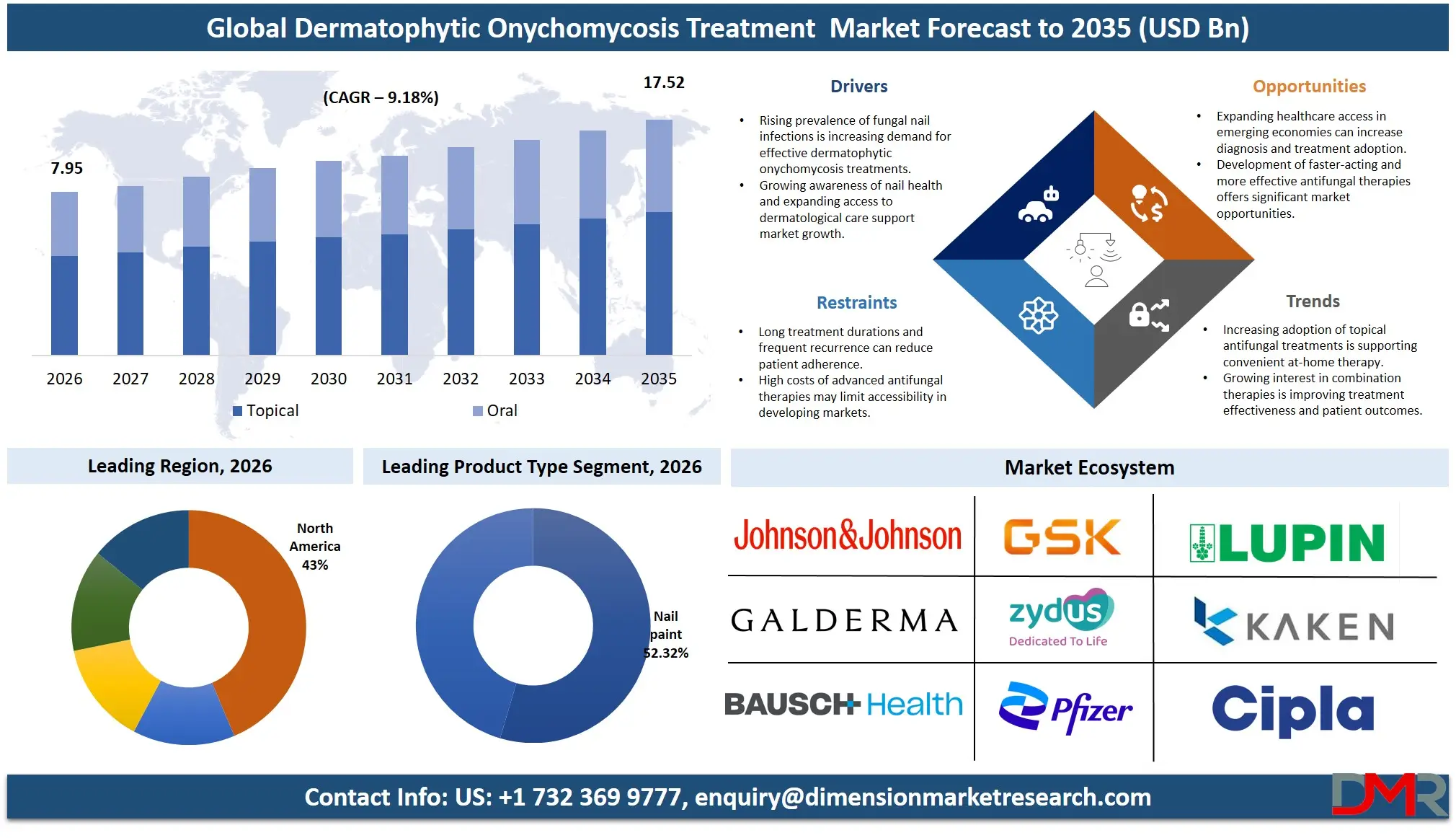
- The Global Dermatophytic Onychomycosis Treatment Market is estimated at USD 7.95 Billion in 2026.
- The market is forecast to reach USD 17.52 Billion by 2035.
- The market grows at a CAGR of 9.18% across the forecast period.
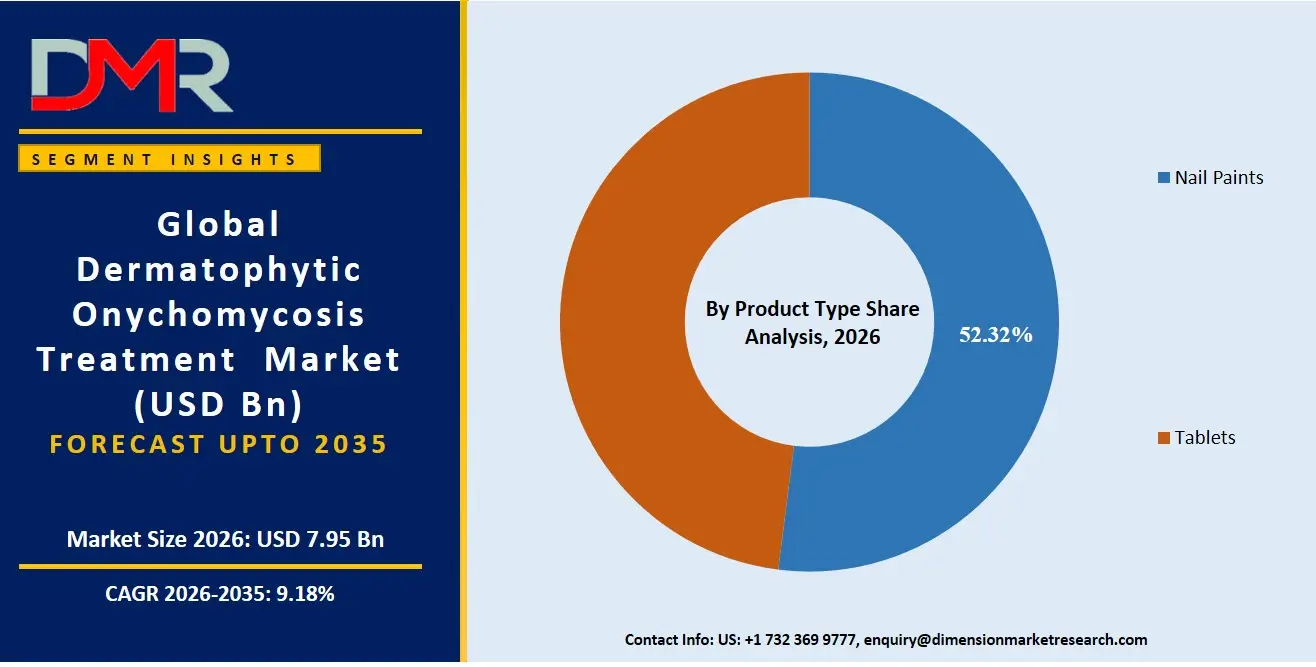
- Nail Paints lead the Product Type segment with a 52.32% revenue share.
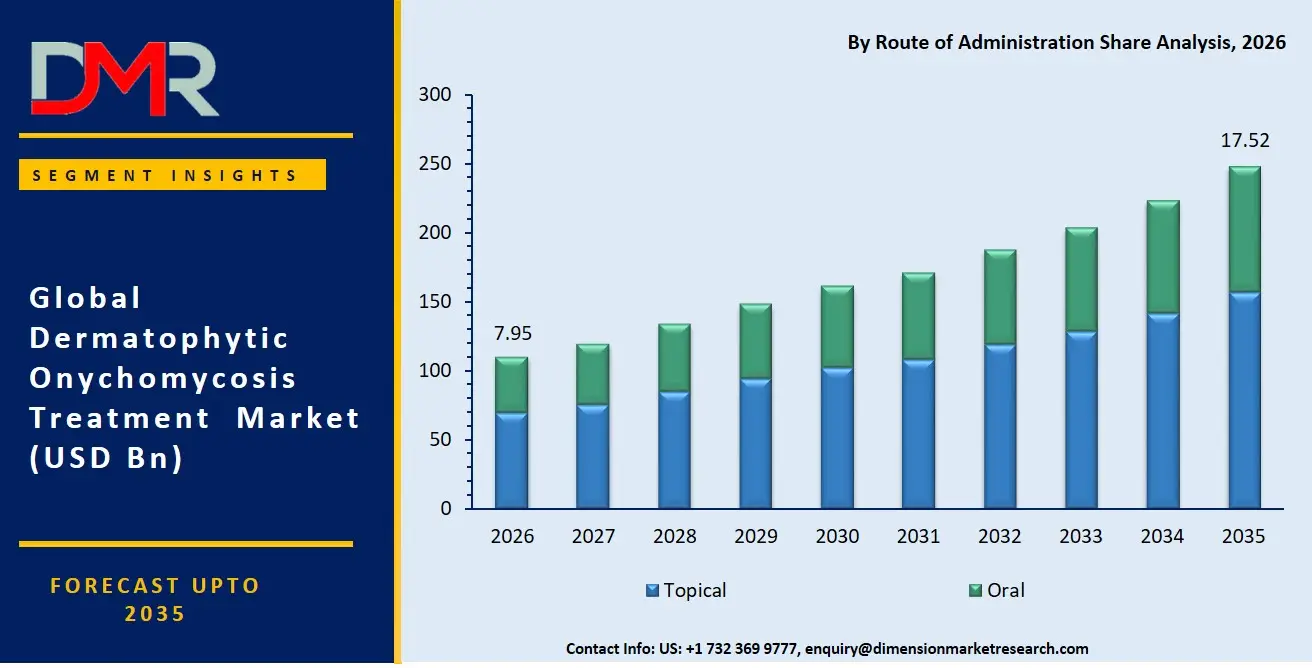
- Topical formulations lead the Route of Administration segment with a 60.45% revenue share.
- Over-the-Counter products lead the Drug Prescription Class segment with a 56.27% revenue share.
- Retail Pharmacies lead the Distribution Channel segment with a 41.71% revenue share.
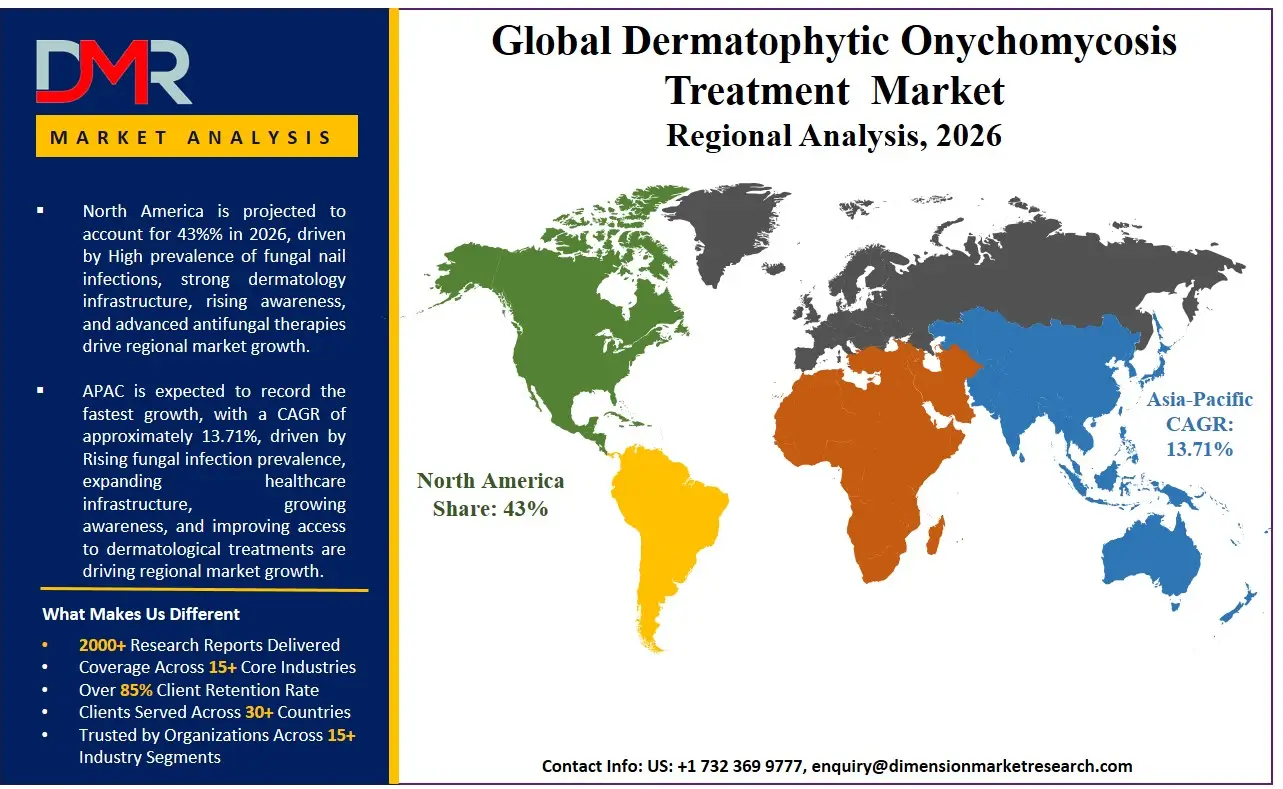
- North America leads all regions with a 43.80% revenue share.
Market Overview
Dermatophytic onychomycosis treatment covers prescription and over-the-counter antifungal therapies for fungal nail infections, spanning oral tablets, topical lacquers, and combination regimens. Diagnostic testing, susceptibility screening, and physician monitoring sit adjacent to the market but fall outside core treatment revenue. Dermatophytes cause the vast majority of cases. Fungi account for 90% of toenail infections and 50% of fingernail infections, as reported by NCBI clinical data, while Candida albicans and nondermatophytic molds make up the remainder.
Treatment choice splits along efficacy lines that buyers weigh against convenience. Oral fluconazole reaches a 48% mycological cure rate, the weakest among systemic options, based on data from NCBI. That gap pushes prescribers toward terbinafine or itraconazole for stubborn infections, even though oral therapy carries liver-monitoring requirements that topical products avoid. Moberg Pharma's February 2025 commercial launch of Terclara in Norway extended its European footprint beyond the original Swedish entry, signaling that single-market launches are giving way to phased regional rollouts across the EU4 and Nordic countries.
Market Size and Forecast
The Global Dermatophytic Onychomycosis Treatment Market size is estimated at USD 7.95 Billion in 2026 from USD 7.28 Billion in 2025, and is projected to reach USD 17.52 Billion by 2035, exhibiting a CAGR of 9.18% during the forecast period.
ℹ
To learn more about this report –
Download Your Free Sample Report Here
Oral terbinafine anchors revenue at the high end of efficacy, delivering a 76% mycological cure rate that remains the benchmark for systemic therapy. Itraconazole pulse dosing trails at 63%, positioning it as the fallback when terbinafine fails or resistance emerges. The United States alone holds 61% of value across the seven major markets tracked in the dataset, concentrating branded prescription revenue in a single high-reimbursement geography. Moberg Pharma's December 2024 move to secure a new terbinafine supplier removed a manufacturing bottleneck just as topical-product demand began climbing, a timing advantage that let the company scale supply ahead of its 2025 European launches rather than reacting to shortages after the fact.
Product Type Analysis
Nail Paints led the Product Type segment with a 52.32% share in 2026.
Nail Paints command the segment because they apply directly to the visible problem without systemic drug interactions. Patients self-administer them, which lowers the cost of care for over-the-counter buyers and skips the physician visit oral therapy often requires. FDA-approved topical complete cure rates climbed from 8.5% with ciclopirox lacquer to 18% with efinaconazole solution, based on data from NCBI, a gain that makes nail paints credible even against systemic alternatives.
ℹ
To learn more about this report –
Download Your Free Sample Report Here
Tablets remain the second category and still carry the strongest raw cure rates in the market. Oral options work faster against deep or total dystrophic infections that topical formulas cannot penetrate. Vendors building combination kits, pairing a tablet course with a maintenance lacquer, are starting to blur the line between these two categories rather than compete head to head.
Route of Administration Analysis
With a 60.45% share in 2026, Topical outpaced all other Route of Administration categories.
Topical formulations dominate because regulators and physicians steer mild-to-moderate cases away from systemic drug interaction risk. Efinaconazole solution reaches a 55% mycological cure rate among topical options, while tavaborole and ciclopirox each land near 36%, as reported by NCBI. That spread gives prescribers room to step up therapy within the topical class itself before reaching for an oral drug.
ℹ
To learn more about this report –
Download Your Free Sample Report Here
Oral therapy still holds the category for severe or recalcitrant nails where topical penetration cannot reach the nail bed. Diabetic patients and older adults with thickened nails frequently need oral courses regardless of drug-interaction concerns. Manufacturers are responding with hybrid protocols that start patients on oral therapy and transition them to topical maintenance once active infection clears.
Drug Prescription Class Analysis
Over-the-Counter accounted for 56.27% of Drug Prescription Class demand in 2026, the highest of any category.
OTC products lead because most early-stage onychomycosis cases are mild enough to self-treat without a prescription. Pharmacy shelf access removes the friction of a clinic visit, which matters most for patients who delay treatment until symptoms become visible.
Prescribed therapy still controls the moderate-to-severe segment, where physicians need to confirm species identification before choosing a drug. As resistant strains spread, more patients are likely to move from OTC self-treatment into prescribed care after an OTC course fails, a shift that favors diagnostics-linked prescribing over blind OTC repeat purchases.
Distribution Channel Analysis
Retail Pharmacies captured 41.71% of the Distribution Channel segment in 2026, ahead of all rivals.
Retail pharmacies lead because OTC nail paints and topical solutions sell directly off the shelf without a prescription gate. Walk-in convenience matters more for a chronic, slow-resolving condition than for acute illness, so patients default to the nearest pharmacy rather than planning a clinic visit.
Hospital pharmacies handle the prescription-heavy oral and combination cases that require monitoring. Online channels are the smallest category today but fit a condition patients often treat privately, and growing telehealth prescribing could push more oral-drug refills toward online channels over the next several years.
Key Market Segments
By Product Type
By Route of Administration
By Drug Prescription Class
- Over-the-Counter (OTC)
- Prescribed
By Distribution Channel
- Retail Pharmacies
- Hospital Pharmacies
- Online Channels
Regional Analysis
North America led all regions with a 43.80% share, equivalent to roughly USD 3.48 Billion of the 2026 market.
ℹ
To learn more about this report –
Download Your Free Sample Report Here
North America leads on reimbursement depth and prescriber access to branded oral antifungals. The region's institutional infrastructure for diagnosis and follow-up testing supports higher-cost therapy choices that other regions cannot match as easily. A 2025 global survey found that access barriers persist even here. More than 30% of North American dermatology respondents reported trouble accessing desired diagnostic tests, based on data published in the Journal of Dermatological Treatment.
Europe holds the second position behind a base built on national health systems that fund prescription antifungals. Asia Pacific trails both but carries the highest unmet need. The same 2025 survey found access problems exceeding 90% among South Asian respondents, a gap wide enough to make the region a target for diagnostics investment rather than treatment-volume expansion alone. Rest of World remains the smallest share but benefits from rising OTC retail penetration.
Key Regions and Countries
North America
Europe
- Germany
- France
- The UK
- Spain
- Italy
- Rest of Europe
Asia Pacific
- China
- Japan
-
South Korea
- India
- Australia
- Rest of APAC
Latin America
- Brazil
- Mexico
- Rest of Latin America
Middle East & Africa
- GCC
- South Africa
- Rest of MEA
Market Dynamics
Terbinafine's Cure-Rate Lead Anchors Oral Revenue
Terbinafine's 70% mycological cure rate keeps it the default first-line oral drug, supporting a 44% revenue share for oral therapy across the treatment mix, according to the Driving Factors dataset. Physicians default to terbinafine before trying alternatives, which locks in repeat prescriptions across a treatment course that often runs 12 weeks or longer.
That reliance has a diagnostic blind spot. Susceptibility testing was unavailable to 34% of European survey respondents and to 50% or more of North American and South Asian respondents, as reported by the Journal of Cutaneous and Ocular Toxicology survey. Hepatic function testing at 5 weeks of continuous therapy catches fewer than 2% of idiosyncratic liver reactions, based on data from NCBI, meaning monitoring protocols exist mainly as a formality rather than a real safety net.
Resistance and Low Cure Ceilings Limit Treatment Success
Systemic terbinafine's complete cure rate caps at 38%, far below its mycological cure figure, based on data from NCBI. Patients see lab results improve without seeing their nail fully clear, and that gap drives non-adherence over a treatment course that can stretch past 48 weeks. Recurrence compounds the problem. Reported recurrence rates range from 5% to 50%, leaving prescribers unable to promise a durable result even after a technically successful course.
Resistance is now a measurable threat rather than a theoretical one. Trichophyton indotineae carries SQLE-mutation resistance in 85.3% of documented cases, undermining terbinafine's allylamine class and forcing costlier itraconazole substitution. The traditional KOH wet-mount test, still the most common first diagnostic step, is only 60% sensitive and cannot identify which species is present, so many resistant infections go untreated as resistant until a first-line drug fails.
Better Diagnostics Open a Path for Resistant-Case Therapies
PCR testing improves species-specific dermatophyte detection by 20% over fungal culture alone, based on data from NCBI, giving prescribers a faster route to the correct drug class before a patient burns through a failed course. Tavaborole solution already shows what a narrow but real opening looks like. It reaches a 9.1% complete cure rate in mild-to-moderate distal subungual cases, modest in absolute terms but meaningful for a segment that previously had few non-systemic options.
Pipeline candidates targeting recalcitrant and resistant dermatophyte infections, a category with no approved options today, represent the clearest white space in the therapy landscape. Combination regimens pairing itraconazole with luliconazole or terbinafine are being tested specifically to salvage cases where SQLE-mutation resistance has already defeated standard monotherapy.
Market Trends
Itraconazole Dosing Escalates to Counter Resistant Strains
Itraconazole at an escalated 400 mg per day dosing schedule now achieves an 86% eight-week cure rate against resistant strains, based on the Trending Factors dataset, a result strong enough to displace terbinafine as first-line therapy in resistant cases. Toenails grow at roughly 1mm per month, and full clearance of an infected nail can take up to 12 months, a biological constraint that keeps treatment courses long regardless of which drug wins the resistance battle. Terbinafine-resistant Trichophyton indotineae has already spread from South Asia into US clinical isolates, pushing prescribers toward susceptibility-informed drug selection rather than empirical first-line dosing.
Market Competition Overview
The market stays fragmented because no single therapy class solves every infection stage or severity. Diagnostic accuracy gaps reinforce that fragmentation. The most sensitive confirmatory test, a pathologist-read PAS plus Grocott methenamine silver-stained nail clip biopsy, reaches 95% sensitivity, while routine fungal culture manages only about 60%, based on data from NCBI. That accuracy gap means many prescribers choose a drug before confirming species, leaving room for multiple product types to coexist within the same patient population rather than one drug consolidating share.
Branded prescription players compete on cure-rate data and reimbursement access, while OTC manufacturers compete on shelf placement and price. Pipeline entrants targeting resistant strains are starting to reshape competitive positioning, since incumbents built around terbinafine face a credibility question every time a resistant case fails first-line therapy.
Company Profiles
Moberg Pharma built its position around MOB-015, sold under the Terclara brand, expanding market by market across Europe rather than launching continent-wide at once. The company's November 2025 exclusive licensing agreement with Karo Healthcare covers 19 European markets, handing commercialization to a partner with existing pharmacy distribution rather than building that infrastructure itself. That partnership model trades margin for speed, a reasonable trade given that onychomycosis treatment carries relapse rates up to 25% or higher and requires courses of one year or more, based on the Journal of Dermatological Treatment survey, conditions that reward a brand with patience and reach over one chasing fast share gains.
Key Players
- Bausch Health Companies Inc.
- Pfizer Inc.
- Galderma
- GlaxoSmithKline plc
- Johnson & Johnson
- Cipla Inc.
- Kaken Pharmaceuticals Co., Ltd.
- Lupin
- Zydus
- Almirall S.A.
- Aleor Dermaceuticals
Regulatory Landscape
At least 50% of survey respondents across Europe, North America, and South Asia were unaware of any national requirement to report treatment-resistant dermatophytosis, based on the Journal of Dermatological Treatment survey. That gap means resistant strains can circulate for months before health authorities have visibility into local prevalence. Without mandatory reporting, regulators lack the surveillance data needed to update treatment guidelines as resistance spreads, leaving prescribers to rely on individual clinical experience rather than a coordinated national response.
Investment and White Space Analysis
Europe outside the core EU4 markets shows the clearest white space. The EU4-and-UK base sits at USD 364 Million, with France alone contributing USD 123 Million, the largest single-country share, based on the Growth Opportunities dataset. That concentration in one country signals underpenetrated demand across the remaining EU4 markets and the UK. Total dystrophic onychomycosis, the most advanced disease stage, takes 10 to 15 years of chronic infection to develop, based on data from NCBI, which means today's mild cases are tomorrow's severe-treatment pipeline. New entrants able to capture patients early, before progression to total dystrophic disease, can build long-term treatment relationships rather than competing only for late-stage, harder-to-treat cases.
Report Details
| Report Characteristics |
| Market Value (2025) |
USD 7.28 Billion |
| Market Value (2026) |
USD 7.95 Billion |
| Forecast Revenue (2035) |
USD 17.52 Billion |
| CAGR (2026–2035) |
9.18% |
| Historical Data |
2020 – 2024 |
| Forecast Data |
2026 – 2035 |
| Base Year |
2025 |
| Estimate Year |
2026 |
| Report Coverage |
Revenue Forecast, Market Dynamics, Competitive Landscape, Recent Developments |
| Segments Covered |
By Product Type (Nail Paints, Tablets); By Route of Administration (Topical, Oral); By Drug Prescription Class (Over-the-Counter, Prescribed); By Distribution Channel (Retail Pharmacies, Hospital Pharmacies, Online Channels) |
| Regional Coverage |
North America – US, Canada; Europe – Germany, France, UK, Spain, Italy, Rest of Europe; Asia-Pacific – China, Japan, South Korea, India, Australia, Rest of APAC; Latin America – Brazil, Mexico, Rest of Latin America; Middle East & Africa – GCC, South Africa, Rest of MEA |
| Prominent Players |
Bausch Health Companies Inc., Pfizer Inc., Galderma, GlaxoSmithKline plc, Johnson & Johnson, Cipla Inc., Kaken Pharmaceuticals Co., Ltd., Lupin, Zydus, Almirall S.A., Aleor Dermaceuticals, and Other Key Players |
| Customization Scope |
Customization for segments and region or country level will be provided. Additional customization can be done based on requirements. |
| Purchase Options |
Three license options: Single User License, Multi-User License (Up to 5 Users), and Corporate Use License (Unlimited Users and Printable PDF) |
Frequently Asked Questions
What is the biggest investment opportunity in Dermatophytic Onychomycosis Treatment Market ?
▾ Pipeline antifungals targeting recalcitrant and resistant dermatophyte infections represent the largest open opportunity, since no approved option exists for this segment today. France's USD 123 Million share of the EU4 base also points to underpenetrated demand across neighboring European markets.
Who are the top companies in Dermatophytic Onychomycosis Treatment Market ?
▾ Bausch Health Companies Inc., Pfizer Inc., Galderma, and GlaxoSmithKline plc lead branded prescription therapy, while Moberg Pharma has expanded fastest across Europe through its Terclara brand and a 19-market licensing deal with Karo Healthcare.
Which segment is growing fastest in Dermatophytic Onychomycosis Treatment Market and why?
▾ Topical therapy is gaining ground fastest, supported by FDA-approved complete cure rates that climbed from 8.5% to 18% with efinaconazole. Topical products avoid the systemic drug-interaction risk that limits oral therapy in older or diabetic patients.
Which region is growing fastest in Dermatophytic Onychomycosis Treatment Market and why?
▾ Asia Pacific carries the strongest unmet-need growth signal, with over 90% of South Asian dermatology respondents reporting diagnostic access problems in a 2025 survey. That gap creates room for both diagnostics and treatment expansion as infrastructure catches up.
What is the biggest challenge holding Dermatophytic Onychomycosis Treatment Market back?
▾ Trichophyton indotineae resistance, found in 85.3% of documented cases, is undermining terbinafine's effectiveness as the standard first-line drug. That resistance forces costlier itraconazole substitution and longer treatment courses with uncertain outcomes.