What is the Digital Cinema Lens Market Size in 2026?
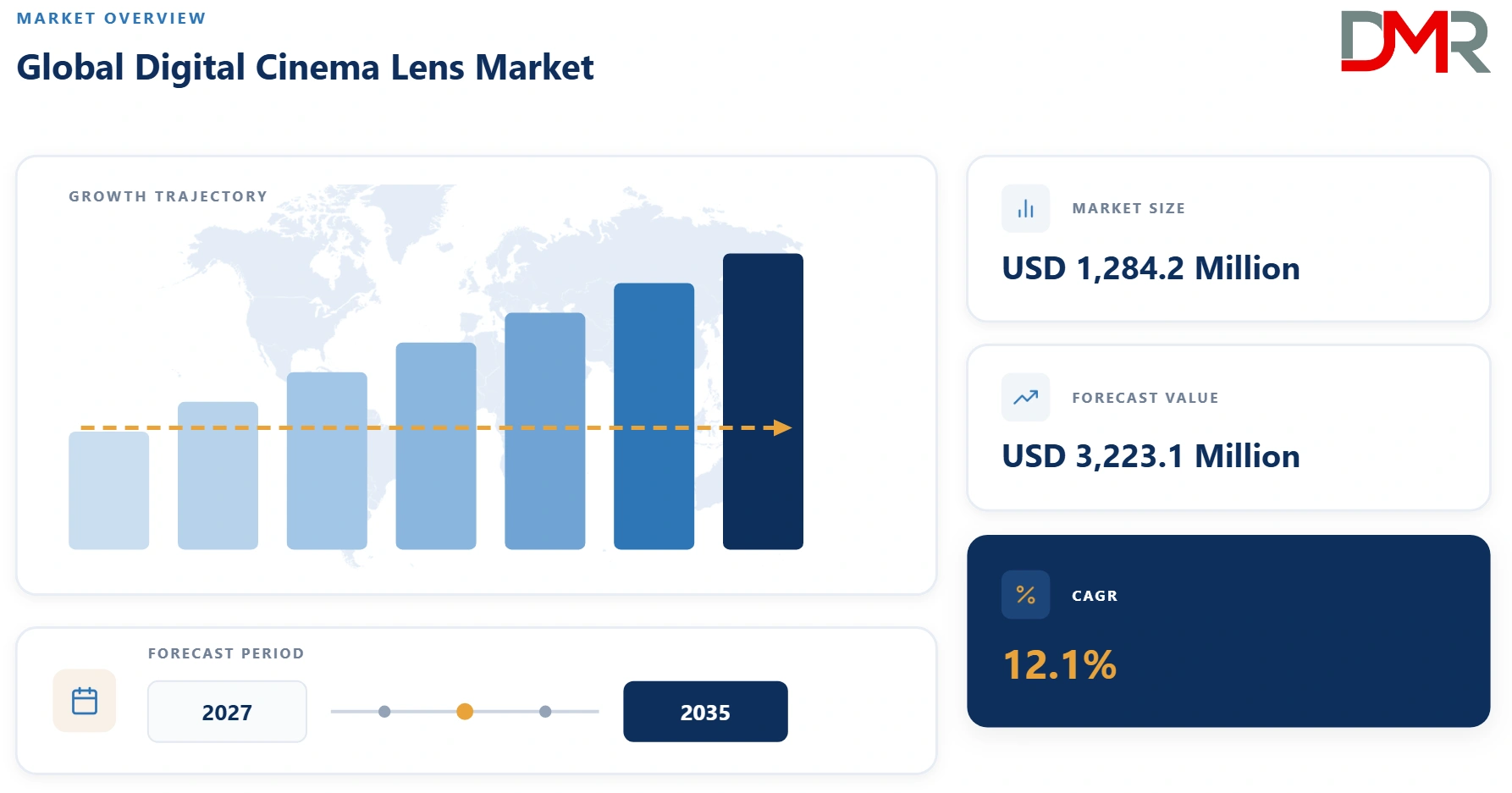
The Global Digital Cinema Lens Market is valued at USD 1,284.2 million in 2026 and is projected to reach USD 3,223.1 million by 2035, growing at a CAGR of 12.1% from 2027 to 2035. Growth is driven by increasing film production activities, expanding streaming platforms, rising demand for high-resolution visual content, technological advancements in optical systems, and growing adoption of professional digital cinematography equipment.
ℹ
To learn more about this report –
Download Your Free Sample Report Here
Digital cinema lenses are optical components that are used in the digital cinema and professional motion picture production. These lenses offer precise focus control, consistent aperture performance, accurate color reproduction, and minimize optical distortions in various shooting situations. The digital cinema lenses are compatible with different camera mounting systems and different focal length, which allows the film maker to achieve a certain visual effect and create a certain composition. This includes making films, broadcasting on television, commercial advertising, documentary film making, and making digital content.
Global Digital Cinema Lens Market focuses on the optical lenses that are intended for use in professional digital cinematography scenarios. Market coverage includes prime, zoom of various focal lengths and camera mounting configurations. Analysis of applications in film production, television production, commercial advertising, documentary filmmaking, and digital content creation. Revenue assessment considers commercial sales of digital cinema lenses through manufacturers, distributors, and professional equipment suppliers.
Digital Cinema Lens Market Snapshot
Digital Cinema Lens Market Snapshot, 2027-2035
| Metric |
Value |
| Market Size (2026) |
USD 1,284.2 Million |
| Forecast Value (2035) |
USD 3,223.1 Million |
| CAGR (2027–2035) |
12.1% |
| Largest Region (2026) |
North America, 35.0% share |
| Fastest-Growing Region (2027–2035) |
Asia Pacific, 12.9% CAGR |
| Leading Lens Type (2026) |
Prime, 62.4% share |
| Leading Focal Length (2026) |
Standard, 42.6% share |
| Key Players |
Canon Inc., Carl Zeiss AG, Fujifilm Corporation, Sony Corporation, Sigma Corporation, Nikon Corporation, Venus Optics, and DZOFILM Inc. |
Digital Cinema Lens Market: Key Takeaways
- Market Growth: The market is valued at USD 1,284.2 million in 2026 and is projected to reach USD 3,223.1 million by 2035, registering a CAGR of 12.1%.
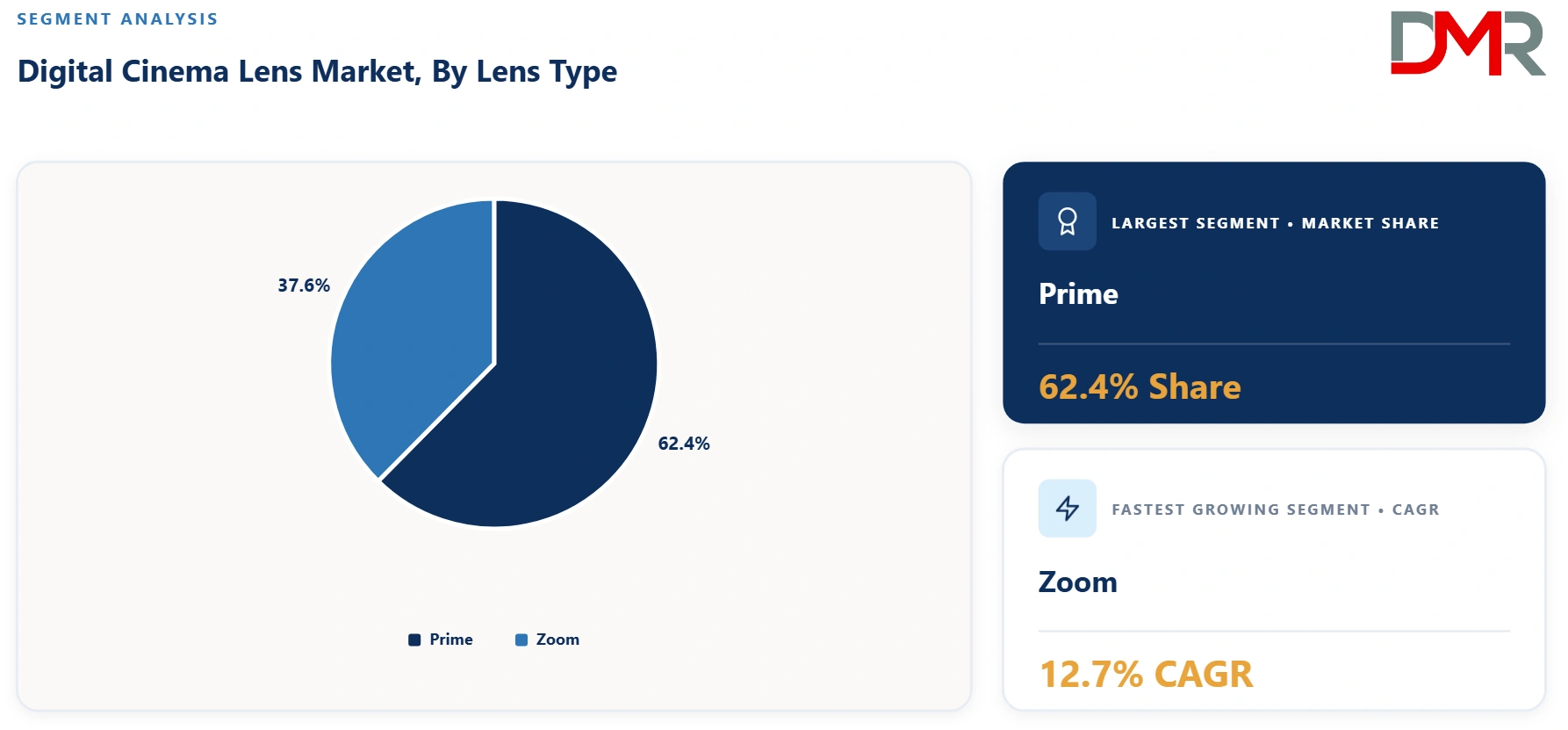
- Lens Type Leader: Prime accounts for 62.4% of market revenue in 2026, supported by superior optical performance and consistent image quality.
- Fastest-Growing Lens Type: Zoom is projected to grow at a CAGR of 12.7%, driven by increasing demand for flexible shooting capabilities.
- Focal Length Leader: Standard accounts for 42.6% of market revenue in 2026, supported by versatile cinematography applications.
- Fastest-Growing Focal Length: Wide-Angle is projected to grow at a CAGR of 12.4%, supported by immersive visual production requirements.
- Regional Picture: North America leads with a 35.0% market share in 2026, while Asia Pacific is projected to grow at a CAGR of 12.9%.
What are the Key Use Cases of Digital Cinema Lens?
- Motion Picture Production: Delivers precise optical performance, controlled depth of field, and consistent image quality for professional feature films and cinematic productions.
- Television Content Production: Supports flexible framing, accurate focus adjustments, and reliable visual performance across television series and studio-based production environments.
- Commercial Video Production: Enables high-resolution product visualization, creative compositions, and distinctive cinematic effects for advertising campaigns and promotional content.
- Digital Content Creation: Provides professional image quality and versatile shooting capabilities for online videos, streaming content, and independent digital productions.
How are Foundation Models and Generative AI Transforming the Digital Cinema Lens Market
Foundation models and generative AI are influencing digital cinema lens requirements through advancements in computational imaging, automated production workflows, and intelligent image processing. AI-assisted cinematography systems support subject tracking, focus adjustment, scene recognition, and exposure optimization when paired with compatible cameras and lenses. Generative AI applications assist production teams in previsualizing scenes, planning camera movements, and evaluating focal length selections before filming, improving production efficiency and creative decision-making.
AI integration also supports virtual production, visual effects, and automated post-production processes requiring accurate lens metadata and optical calibration. Lens distortion information, focus distance, and aperture data facilitate alignment between physical footage and computer-generated environments. Increasing adoption of intelligent production technologies encourages manufacturers to develop lenses offering electronic communication, metadata compatibility, and precise optical performance across modern cinematography systems.
Digital Cinema Lens Market Dynamics at a Glance
Drivers, Restraints, Opportunities and Trends in the Digital Cinema Lens Market
| Type |
Factor |
Impact |
| Driver |
Expansion of Film and Streaming Content Production |
High |
| Driver |
Increasing Adoption of High-Resolution Cinema Cameras |
High |
| Restraint |
High Cost of Professional Cinema Lenses |
Medium |
| Restraint |
Limited Compatibility Across Camera Systems |
High |
| Opportunity |
Expansion of Independent Filmmaking and Digital Content Creation |
High |
| Opportunity |
Increasing Adoption of Virtual Production Technologies |
Medium |
| Trend |
Growing Adoption of Compact and Lightweight Cinema Lenses |
Medium |
| Trend |
Increasing Integration of Electronic Lens Metadata |
High |
What is Driving the Growth of the Digital Cinema Lens Market?
Expansion of Film and Streaming Content Production
The expansion of film and streaming content production is driving demand for digital cinema lenses across professional production environments. Increasing investments in original films, television series, and subscription-based entertainment platforms create requirements for advanced cinematography equipment. Production studios prioritize lenses offering consistent optical performance, accurate color reproduction, and precise focus control to maintain visual quality across different scenes. Growing demand for multilingual and regional entertainment content further supports equipment procurement across emerging production markets. Increasing competition among entertainment platforms encourages higher production standards, strengthening demand for specialized cinema lenses across commercial filmmaking and television production activities.
Increasing Adoption of High-Resolution Cinema Cameras
The increasing adoption of high-resolution digital cinema cameras is accelerating demand for advanced lenses capable of supporting detailed image capture. Professional production environments increasingly utilize cameras featuring high-resolution sensors, enhanced dynamic range, and improved low-light performance. These technologies require lenses offering superior resolving power, minimal chromatic aberration, and consistent sharpness across the image area. Conventional optical systems may restrict the performance capabilities of advanced digital sensors, encouraging equipment upgrades among production studios and cinematographers. Increasing requirements for high-quality visual content and technically demanding filming applications support demand for precision-engineered digital cinema lenses.
What are the Key Restraints in the Digital Cinema Lens Market?
High Cost of Professional Cinema Lenses
The high cost of professional cinema lenses restricts market adoption, particularly among independent filmmakers and production organizations operating with limited budgets. Advanced cinema lenses require specialized optical glass, precision engineering, durable mechanical components, and extensive manufacturing quality control. Premium lens systems command substantial prices due to superior optical performance and specialized production capabilities. Additional expenditure associated with maintenance, calibration, transportation, and supporting equipment increases overall ownership costs. Budget-conscious production organizations frequently rely on rental services or previously owned equipment, limiting new product purchases and creating pricing challenges for manufacturers operating across professional cinematography markets.
Limited Compatibility Across Camera Systems
Limited compatibility across camera systems presents significant challenges for digital cinema lens adoption. Different camera manufacturers utilize distinct mounting configurations, electronic communication protocols, flange distances, and sensor coverage requirements. Existing lens investments may become incompatible when production organizations transition between camera platforms or upgrade equipment. Mount adapters can address certain compatibility limitations but may introduce operational constraints involving electronic functionality, focus control, or physical stability. Production teams operating multiple camera systems face additional equipment management requirements. These technical limitations complicate purchasing decisions and restrict the flexibility of lens utilization across diverse professional production environments.
What are the Key Opportunities in the Digital Cinema Lens Market?
Expansion of Independent Filmmaking and Digital Content Creation
The expansion of independent filmmaking and digital content creation presents significant opportunities for cinema lens manufacturers offering accessible professional equipment. Independent creators increasingly prioritize cinematic image quality, controlled depth of field, and distinctive visual presentation across commercial and online productions. Growing accessibility of digital cinema cameras encourages investments in compatible optical equipment among smaller production teams. Manufacturers can address emerging demand through competitively priced lens sets, flexible mounting options, and simplified mechanical designs. Increasing participation in independent filmmaking and creator-driven media production creates opportunities to expand distribution networks and develop products tailored to budget-conscious professional customers.
Increasing Adoption of Virtual Production Technologies
The increasing adoption of virtual production technologies creates opportunities for cinema lens manufacturers developing specialized optical solutions compatible with digitally integrated filming environments. Virtual production combines physical cinematography with computer-generated backgrounds, real-time rendering, and advanced camera tracking systems. These workflows require accurate optical calibration, predictable distortion characteristics, and consistent focus performance to maintain alignment between physical and digital elements. Manufacturers can address these requirements through specialized lens designs and compatibility with production tracking systems. Expanding investments in virtual studios and immersive production infrastructure create opportunities for premium cinema lenses optimized for technologically advanced filmmaking applications.
What are the Latest Trends in the Digital Cinema Lens Market?
Growing Adoption of Compact and Lightweight Cinema Lenses
The growing adoption of compact and lightweight cinema lenses reflects changing production requirements across professional cinematography environments. Smaller production crews increasingly utilize handheld cameras, stabilizers, drones, and mobile filming systems requiring balanced and portable optical equipment. Manufacturers are introducing compact lens designs that maintain professional focus control, consistent aperture performance, and reliable optical quality while reducing equipment weight. Lightweight construction improves camera mobility and simplifies equipment transportation across multiple filming locations. Increasing demand for flexible shooting configurations encourages manufacturers to optimize lens dimensions, mechanical construction, and optical performance for modern production workflows.
Increasing Integration of Electronic Lens Metadata
The increasing integration of electronic lens metadata is transforming professional cinematography by improving communication between lenses, cameras, and post-production systems. Advanced cinema lenses increasingly support electronic transmission of focal length, aperture settings, focus distance, and optical characteristics during filming. Recorded lens information facilitates visual effects processing, image correction, and production continuity across complex shooting environments. Manufacturers are incorporating standardized data communication technologies to improve compatibility with professional production equipment. Growing requirements for efficient post-production workflows encourage the development of metadata-enabled cinema lenses, strengthening product differentiation through enhanced technical functionality and operational integration.
Research Scope and Analysis
The research covers the Global Digital Cinema Lens Market across lens type, focal length, mount type, application, and region. The analysis evaluates revenue generated through specialized optical equipment designed for digital cinematography. Market assessment incorporates product adoption, technological developments, camera compatibility, competitive positioning, purchasing patterns, and growth opportunities across professional filmmaking and content production environments globally.
ℹ
To learn more about this report –
Download Your Free Sample Report Here
By Lens Type Analysis
Prime is projected to dominate the lens type segment in the Global Digital Cinema Lens Market, accounting for 62.4% of the total market share in 2026. Dominance is supported by superior optical performance, wider aperture capabilities, and consistent image quality. Zoom are projected to be the fastest-growing segment, registering a CAGR of 12.7% from 2027 to 2035, driven by flexible focal length adjustment, reduced lens replacement requirements, and increasing demand for efficient shooting workflows.
By Focal Length Analysis
Standard is projected to dominate the focal length segment in the Global Digital Cinema Lens Market, accounting for 42.6% of the total market share in 2026. Dominance is supported by natural perspective reproduction and versatility across professional filming applications. Wide-Angle is projected to be the fastest-growing segment, registering a CAGR of 12.4% from 2027 to 2035, driven by increasing demand for immersive visual compositions, expansive scene coverage, and dynamic cinematography applications.
By Mount Type Analysis
Positive Lock is projected to dominate the mount type segment in the Global Digital Cinema Lens Market, accounting for 36.8% of the total market share in 2026. Dominance is supported by reliable mechanical stability and extensive compatibility with professional cinema cameras. Canon RF is projected to be the fastest-growing segment, registering a CAGR of 13.2% from 2027 to 2035, driven by expanding adoption of compatible digital cinema cameras and increasing availability of specialized cinema lenses.
By Application Analysis
Film Production is projected to dominate the application segment in the Global Digital Cinema Lens Market, accounting for 38.7% of the total market share in 2026. Dominance is supported by extensive investments in professional filmmaking and advanced cinematography equipment. Digital Content Creation is projected to be the fastest-growing segment, registering a CAGR of 13.4% from 2027 to 2035, driven by expanding online video platforms, independent content production, and growing demand for professional cinematic image quality.
How is the Digital Cinema Lens Market Segmented?
By Lens Type
By Focal Length
- Wide-Angle
- Standard
- Telephoto
By Mount Type
- Positive Lock
- Electro-Focus
- Sony E
- Canon RF
- Large Positive Lock
- Others
By Application
- Film Production
- Television Production
- Commercial & Advertising
- Documentary Production
- Digital Content Creation
- Others
Which Region Leads the Digital Cinema Lens Market?
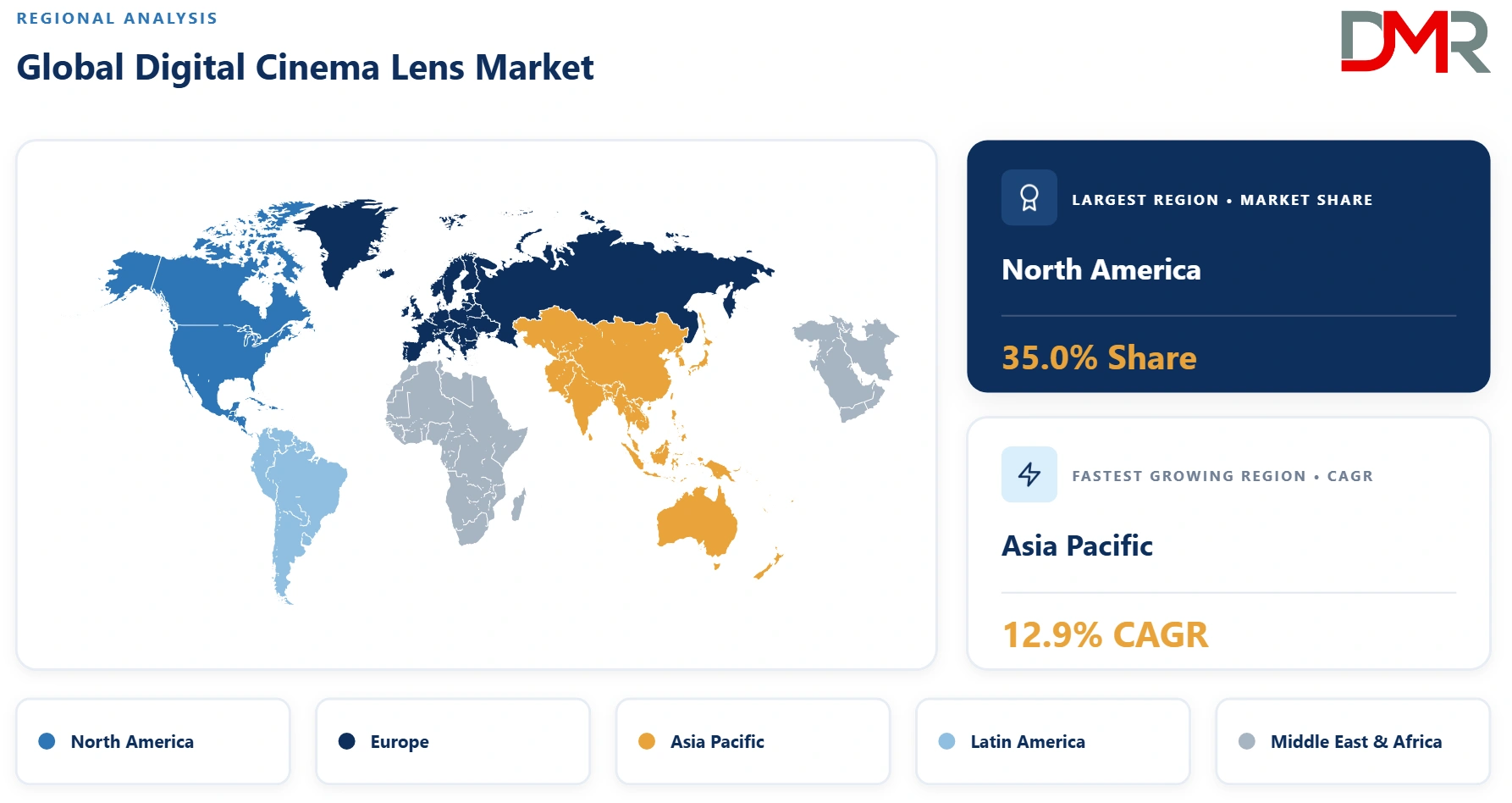
North America leads the Global Digital Cinema Lens Market with a 35.0% share in 2026, while Asia Pacific is projected to register the highest CAGR of 12.9% from 2027 to 2035.
Region with the Largest Revenue Share
North America dominates the Global Digital Cinema Lens Market, accounting for 35.0% of the total market share in 2026. Regional dominance is supported by established film production infrastructure, advanced television studios, and substantial investments in professional cinematography equipment. The U.S. and Canada contribute to market demand through commercial filmmaking, streaming content production, and advertising activities. The presence of professional equipment distribution networks and advanced production facilities supports adoption of premium digital cinema lenses across diverse commercial filmmaking and entertainment applications.
Region with the Highest CAGR
Asia Pacific is projected to register the highest CAGR of 12.9% in the Global Digital Cinema Lens Market from 2027 to 2035. Regional growth is supported by expanding entertainment industries, increasing investments in digital filmmaking, and growing demand for professional content production equipment. China, Japan, India, Australia, and South Korea contribute to market expansion through established film industries and technological advancements. Increasing production of regional entertainment content and growing availability of competitively priced cinema lenses strengthen market growth opportunities.
Regional Analysis
Europe Digital Cinema Lens Market
The Europe Digital Cinema Lens Market is supported by established cinematography industries, advanced optical engineering capabilities, and increasing investments in professional film production. Germany, France, the U.K., Italy, and Spain contribute to regional demand through commercial filmmaking, television production, and advertising activities. Established optical equipment manufacturing infrastructure supports technological innovation and premium lens development. Growing adoption of advanced digital cinema cameras and increasing demand for high-quality visual content encourage investment in specialized lenses across professional production environments and independent filmmaking activities.
ℹ
To learn more about this report –
Download Your Free Sample Report Here
Latin America Digital Cinema Lens Market
The Latin America Digital Cinema Lens Market is supported by expanding regional entertainment industries, increasing digital content consumption, and growing investments in television and film production. Mexico and Brazil contribute to regional demand through established media production networks and commercial advertising activities. Increasing accessibility of professional digital cinema equipment encourages adoption among independent filmmakers and smaller production organizations. Growing production of local-language streaming content and expansion of digital distribution platforms support demand for affordable, versatile, and high-performance digital cinema lenses.
Middle East & Africa Digital Cinema Lens Market
The Middle East & Africa Digital Cinema Lens Market is supported by expanding media infrastructure, increasing investments in entertainment production, and growing commercial advertising activities. Saudi Arabia, the UAE, and South Africa contribute to regional demand through film production initiatives, television broadcasting, and independent content creation. Developing production facilities and increasing participation in international filmmaking activities encourage investments in professional cinematography equipment. Growing demand for regional entertainment content and promotional video production creates opportunities for specialized digital cinema lens suppliers.
By Region
North America
Europe
- Germany
- France
- The U.K.
- Italy
- Spain
- Rest of Europe
Asia-Pacific
- China
- Japan
- India
- Australia
- South Korea
- Rest of APAC
Latin America
- Mexico
- Brazil
- Rest of LATAM
Middle East & Africa
- Saudi Arabia
- The UAE
- South Africa
- Rest of MEA
Technology Analysis
Technological advancements in the Global Digital Cinema Lens Market focus on optical precision, sensor compatibility, mechanical functionality, and electronic integration. Manufacturers increasingly develop advanced optical coatings, aspherical elements, and specialized glass materials to minimize aberrations, improve contrast, and enhance light transmission. Full-frame and large-format cinema lenses support modern high-resolution digital sensors, while advanced mechanical designs provide accurate focus control and consistent aperture adjustments. Electronic communication technologies facilitate lens metadata transmission and compatibility with intelligent camera systems. Increasing requirements for efficient visual effects processing, accurate image reproduction, and flexible cinematography workflows encourage manufacturers to develop technologically advanced lens systems supporting professional production environments and evolving digital imaging applications
Investment and White Space Analysis
Investment opportunities in the Global Digital Cinema Lens Market concentrate on affordable professional optics, advanced manufacturing capabilities, and specialized product development. Increasing participation in independent filmmaking creates opportunities for mid-priced cinema lens portfolios offering professional performance and broad camera compatibility. Emerging production markets present opportunities for manufacturers to expand distribution networks, localized technical support, and equipment servicing capabilities. Investment in precision manufacturing, automated optical inspection, and advanced coating technologies supports product quality and production efficiency. Additional opportunities exist in large-format lenses, interchangeable mounting systems, and customized optical designs. Competitive pricing pressures, lengthy product development cycles, and fluctuating production budgets remain important considerations influencing investment decisions and long-term market expansion.
Who are the Leading Companies in the Digital Cinema Lens Market?
The Global Digital Cinema Lens Market is characterized by competition among established optical equipment manufacturers and specialized cinematography lens developers. Major participants include Canon Inc., Carl Zeiss AG, Fujifilm Corporation, Sony Corporation, and Sigma Corporation. Competitive differentiation focuses on optical quality, focal length versatility, mounting compatibility, mechanical precision, and product affordability. Companies strengthen market positioning through product innovation, expanded lens portfolios, technological integration, and professional equipment distribution partnerships.
- Canon Inc. (Tokyo, Japan): Provides Cinema EOS lenses, including CN-E prime lenses, Flex Zoom lenses, and RF cinema lenses, supporting professional filmmaking through advanced optical performance and camera compatibility.
- Carl Zeiss AG (Oberkochen, Germany): Offers Supreme Prime, Cinema Zoom, Horizon Anamorphic, and Panoptes 65 cinema lenses, supporting professional cinematography through precision optics and advanced lens metadata capabilities.
- Fujifilm Corporation (Tokyo, Japan): Provides FUJINON Premista, Cabrio, and MK cinema lens series, delivering advanced optical performance, flexible zoom capabilities, and professional digital cinematography compatibility.
- Sony Corporation (Tokyo, Japan): Offers Cinema Line-compatible optical solutions, including professional E-mount power zoom lenses, supporting high-resolution video production and flexible cinematography workflows.
- Sigma Corporation (Kawasaki, Japan): Provides specialized cinema lenses through the Aizu Prime, FF High Speed Prime, High Speed Zoom, and AF Cine product lines, supporting professional digital filmmaking applications.
Some of the prominent players in the Global Digital Cinema Lens are:
- Canon Inc.
- Carl Zeiss AG
- Fujifilm Corporation
- Sony Corporation
- Sigma Corporation
- Nikon Corporation
- Venus Optics
- DZOFILM Inc.
- LK Samyang Co., Ltd.
- Kenko Tokina Co., Ltd.
- Ernst Leitz Wetzlar GmbH
- Atlas Lens Co.
- Vantage Film GmbH
- SIRUI Optical Co., Ltd.
- Schneider-Kreuznach
- Kowa Company, Ltd.
- SLR Magic
- Meike
- Viltrox
- NiSi
- BLAZAR LENS
- 7Artisans
- Shenyang Zhongyi Optical & Electronic Co., Ltd.
- CHIOPT
- DULENS
- IRIX
- KIPON
- IB/E Optics GmbH
- P+S Technik GmbH
- True Lens Services Ltd.
- Whitepoint Optics
- Xelmus
- TRIBE7
- Caldwell Photographic Inc.
- Musashi Optical System Co., Ltd.
- GL Optics
- MasterBuilt Optics
- Thypoch
- TTArtisan
- AstrHori
- Other Key Players
Recent Developments
- In September 2026, Sigma Corporation announced the November 2026 launch schedule for three additional Aizu Prime cinema lenses, featuring 21mm, 100mm, and 125mm focal lengths with T1.3 apertures. The portfolio expansion strengthens large-format cinematography capabilities across professional production environments.
- In June 2026, Carl Zeiss AG introduced the Panoptes 65 cinema lens series at Cine Gear Expo in Los Angeles. The lenses support large-format digital cinema cameras, advanced optical performance, electronic lens metadata, and integration with virtual production workflows.
- In April 2026, Canon Inc. introduced the CINE-SERVO 40-1200mm T5.0-10.8 lens along with a Cinema EOS firmware update, announced ahead of NAB 2026. The development expands Canon's professional cine-servo zoom range with an ultra-long focal length lens. It supports demand for versatile optics in live production, broadcast and high-end cinematography.
- In February 2026, Carl Zeiss AG introduced the Aatma series, a set of nine full-frame T1.5 cinema primes ranging from 18mm to 135mm. The lenses support Zeiss eXtended Data metadata for visual effects, camera tracking and virtual production workflows. The development strengthens Zeiss's premium prime portfolio and the market's shift toward metadata-enabled cinema lenses.
- In November 2025, Canon Inc. introduced the CN5×11 IAS T/R1 RF cinema zoom lens, expanding the professional cinema lens portfolio and supporting increasing demand for flexible optical solutions compatible with RF-based digital cinema camera systems.
Digital Cinema Lens Market Report Scope and Research Methodology
Market definition: The Digital Cinema Lens Market encompasses specialized optical lenses designed for professional digital cinematography, supporting precise image capture, focal length adjustment, focus control, and advanced visual performance across film, television, advertising, documentary, and digital content production applications.
Methodology: Dimension Market Research's proposed market estimation methodology combines bottom-up analysis of cinema lens manufacturer revenues, product sales volumes, average selling prices, and application-specific adoption with top-down validation against professional cinematography equipment expenditure. Primary interviews with lens manufacturers, equipment distributors, cinematographers, and production organizations support validation of pricing and adoption assumptions. Forecasts incorporate segment-level growth expectations for 2027–2035 and periodic assessment of technological developments and market conditions.
Digital Cinema Lens Market Report Details
| Report Characteristics |
Details |
| Market Size (2026) |
USD 1,284.2 Million |
| Market Size (2027) |
USD 1,290.1 Million |
| Forecast Value (2035) |
USD 3,223.1 Million |
| CAGR (2027–2035) |
12.1% |
| Historical Data |
2021–2026 |
| Forecast Data |
2027–2035 |
| Base Year |
2026 |
| Estimate Year |
2027 |
| Regional Coverage |
North America (The US, Canada); Europe (Germany, France, The UK, Italy, Spain, Rest of Europe); Asia Pacific (China, Japan, India, Australia, South Korea, Rest of APAC); Latin America (Mexico, Brazil, Rest of LATAM); Middle East & Africa (Saudi Arabia, The UAE, South Africa, Rest of MEA) |
Frequently Asked Questions
How big is the Digital Cinema Lens Market in 2026?
▾ The Global Digital Cinema Lens Market is valued at USD 1,284.2 million in 2026 and is projected to reach USD 3,223.1 million by 2035.
What is the growth rate of the Digital Cinema Lens Market?
▾ The Global Digital Cinema Lens Market is projected to grow at a CAGR of 12.1% from 2027 to 2035.
Which region leads the Digital Cinema Lens Market?
▾ North America dominates the Digital Cinema Lens Market, accounting for 35.0% of the total market share in 2026.
Which lens type segment dominates the Digital Cinema Lens Market?
▾ Prime dominate the lens type segment, accounting for 62.4% of the total market share in 2026.
Which application is growing fastest in the Digital Cinema Lens Market?
▾ Digital Content Creation is projected to be the fastest-growing application, registering a CAGR of 13.4% from 2027 to 2035.
Who are the key players in the Digital Cinema Lens Market?
▾ Key players include Canon Inc., Carl Zeiss AG, Fujifilm Corporation, Sony Corporation, Sigma Corporation, Nikon Corporation, Venus Optics, and DZOFILM Inc.
What are the main challenges facing the Digital Cinema Lens Market?
▾ High professional cinema lens costs, limited compatibility across camera systems, and substantial equipment investment requirements represent significant challenges affecting market adoption.