Market Overview
The Global Digital Experience Monitoring Market size is projected to reach USD 4.6 billion in 2025 and grow at a compound annual growth rate of 16.3% to reach a value of USD 17.7 billion in 2034.
Digital Experience Monitoring (DEM) is a process that helps businesses understand how users interact with their digital services, such as websites, applications, and online platforms. It involves tracking and analyzing performance, usability, and availability of digital tools from the user’s point of view. By doing this, companies can identify problems early, improve digital services, and provide a smoother, faster, and more reliable user experience. DEM uses various tools and technologies like synthetic monitoring, real-user monitoring, and session replay to capture this information.

ℹ
To learn more about this report –
Download Your Free Sample Report Here
In recent years, the demand for DEM has grown significantly. As more businesses move to online and cloud-based platforms, the digital experience becomes a critical factor in customer satisfaction and brand loyalty. If a website or app is slow or difficult to use, users quickly move to competitors. This pressure has pushed businesses to invest in DEM tools to ensure they deliver the best experience possible across devices, locations, and networks.
Key trends shaping DEM include the growing use of artificial intelligence and machine learning to predict issues before users notice them. Businesses are also combining DEM with other IT operations tools to get a fuller picture of performance. Edge computing and 5G are also driving the need for more precise monitoring as digital interactions become more real-time and distributed.
Several important events have influenced DEM’s rise. The global shift to remote work during the pandemic made it clear how vital good digital performance is, even outside office networks. Major cloud service outages in recent years also showed how dependent users are on digital platforms, increasing the importance of constant monitoring.

ℹ
To learn more about this report –
Download Your Free Sample Report Here
Another notable trend is the integration of DEM with customer journey analytics. Companies want not only to track performance but also to understand how it affects user behavior. This has made DEM an important part of customer experience strategies. Instead of just looking at technical problems, DEM now connects performance data with business impact, such as conversion rates or support calls.
The US Digital Experience Monitoring Market
The US Digital Experience Monitoring Market size is projected to reach USD 1.8 billion in 2025 at a compound annual growth rate of 15.3% over its forecast period.
The US plays a leading role in the Digital Experience Monitoring (DEM) market due to its strong digital infrastructure, high adoption of advanced technologies, and presence of key industry players. Organizations across sectors in the US are heavily investing in digital transformation, cloud services, and remote work tools, which increases the need for monitoring digital performance.
The US market is often the first to adopt innovations in AI, predictive analytics, and observability, driving the evolution of DEM solutions. Additionally, the country's focus on customer experience and data-driven decision-making supports wider use of DEM tools. Regulatory awareness and a mature IT environment make the US a trendsetter, influencing DEM strategies and technology developments globally.

ℹ
To learn more about this report –
Download Your Free Sample Report Here
Europe Digital Experience Monitoring Market
Europe Digital Experience Monitoring Market size is projected to reach USD 1.2 billion in 2025 at a compound annual growth rate of 15.7% over its forecast period.
Europe holds a significant position in the Digital Experience Monitoring (DEM) market, driven by its strong emphasis on data privacy, user experience, and digital transformation across public and private sectors. With increasing adoption of cloud services, mobile platforms, and e-government services, European organizations are prioritizing DEM to ensure seamless digital interactions. Strict regulations like GDPR have made businesses more conscious of performance monitoring and data handling, pushing the demand for secure and compliant DEM solutions.
Countries in Western Europe, especially, are investing in advanced IT infrastructure and smart technologies, further fueling market growth. Europe also supports innovation through funding and tech-friendly policies, encouraging both local vendors and global players to expand their DEM offerings tailored to regional compliance and user expectations.
Japan Digital Experience Monitoring Market
Japan Digital Experience Monitoring Market size is projected to reach USD 322 million in 2025 at a compound annual growth rate of 16.9% over its forecast period.
Japan plays an important role in the Digital Experience Monitoring (DEM) market, driven by its strong focus on technology, automation, and user-centric innovation. As a leader in electronics, telecommunications, and digital services, Japan places high value on seamless digital performance, especially in sectors like finance, e-commerce, and smart manufacturing. The country’s push for digital government services and smart city initiatives is also boosting the need for effective DEM tools.
Japan’s businesses are known for their attention to detail and quality, making real-time monitoring of user experience a priority. With growing cloud adoption and remote work trends, organizations are integrating DEM solutions to ensure consistent service delivery. Japan's mature IT ecosystem and commitment to continuous improvement support the steady growth of the DEM market.
Digital Experience Monitoring Market: Key Takeaways
- Market Growth: The Digital Experience Monitoring Market size is expected to grow by USD 12.5 billion, at a CAGR of 16.3%, during the forecasted period of 2026 to 2034.
- By Component: The software segment is anticipated to get the majority share of the Digital Experience Monitoring Market in 2025.
- By Enterprise Size: The large enterprises segment is expected to get the largest revenue share in 2025 in the Digital Experience Monitoring Market.
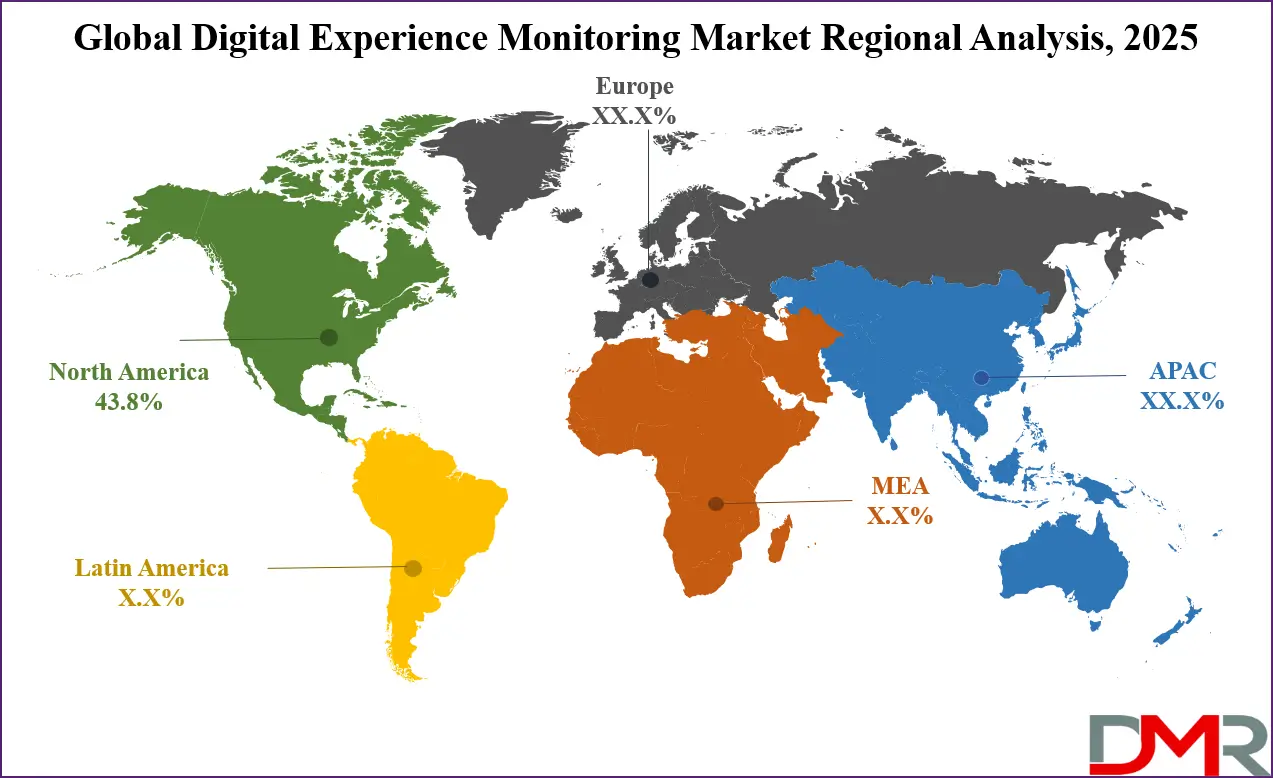
- Regional Insight: North America is expected to hold a 43.8% share of revenue in the Global Digital Experience Monitoring Market in 2025.
- Use Cases: Some of the use cases of Digital Experience Monitoring include website performance optimization, remote workforce experience, and more.
Digital Experience Monitoring Market: Use Cases:
- Website Performance Optimization: DEM helps track how quickly and smoothly a website loads for users across different regions, devices, and browsers. It identifies issues like slow page load times, broken links, or server delays. This data allows teams to fix problems quickly and improve the overall user experience.
- Application Health Monitoring: Businesses use DEM to continuously check how well their web or mobile applications are functioning. It monitors crashes, response times, and user flows to catch performance issues before they affect a large number of users. This ensures higher uptime and reliability of digital services.
- Remote Workforce Experience: With more employees working remotely, DEM helps IT teams understand how digital tools perform for users outside the office. It monitors access to cloud apps, VPN connections, and collaboration platforms, helping teams fix problems that affect productivity and employee satisfaction.
- Customer Journey Analysis: DEM tools can be used to track how users interact with digital platforms during their buying or service journey. By mapping user behavior and performance metrics together, companies can find drop-off points, optimize user paths, and improve conversion rates or service outcomes.
Stats & Facts
- According to U.S. Digital Service, 75% of users will abandon an online government service if it loads slowly or fails to function properly.
- The European Commission’s e-Government Benchmark found that only 61% of public services in the EU are optimized for mobile access.
- As per NHS Digital, digital patient portals improved appointment management efficiency by 20% across UK hospitals.
- The OECD reports that over 65% of SMEs in member countries are investing in digital platforms to enhance customer engagement.
Market Dynamic
Driving Factors in the Digital Experience Monitoring Market
Growing Dependence on Digital Services
As businesses across all industries shift their operations to digital platforms, there is a growing need to ensure smooth and consistent user experiences. From e-commerce and banking to healthcare and education, customers now expect fast, reliable, and intuitive digital interactions at all times. Any delay, error, or failure can lead to lost sales, reduced customer loyalty, and brand damage. This has made monitoring the end-user experience a business-critical task rather than just an IT responsibility.
Digital Experience Monitoring helps detect issues in real-time, understand their root causes, and optimize services before users are affected. The increasing adoption of cloud services, mobile apps, and remote access solutions is pushing organizations to invest in DEM tools to stay competitive in a digital-first environment.
Need for Proactive IT and Business Insights
Traditional monitoring tools focus on systems and infrastructure but often miss the actual user experience. DEM addresses this gap by offering real-time visibility into how users interact with digital systems, allowing businesses to take proactive action. With the rise of AI and machine learning, DEM tools are becoming smarter and can predict performance issues before they impact users.
This proactive approach supports not only technical performance but also strategic business decisions. Companies can now connect performance data with user behavior and outcomes, such as drop-off rates or support tickets. This alignment of IT metrics with business goals is driving demand for advanced DEM solutions that offer both technical depth and business insights, helping companies stay ahead in fast-changing digital landscapes.
Restraints in the Digital Experience Monitoring Market
High Implementation Complexity and Costs
Despite the clear benefits, adopting Digital Experience Monitoring solutions can be challenging due to their complex setup and high initial investment. Integrating DEM tools across multiple platforms, networks, and applications often requires technical expertise and time. For smaller businesses with limited IT budgets, the cost of advanced features, licensing, and skilled personnel can be a major barrier.
Additionally, maintaining DEM tools and analyzing the collected data continuously may place extra pressure on IT teams. As digital ecosystems grow more complex, aligning DEM solutions with existing systems without disruptions can further complicate implementation. These factors can slow down adoption, especially in resource-constrained environments.
Data Privacy and Security Concerns
Digital Experience Monitoring often involves collecting real-time data from user sessions, devices, and locations, which can raise privacy and security concerns. As regulations like GDPR, CCPA, and others become stricter, organizations must ensure that DEM practices comply with data protection laws. Mishandling sensitive data or failing to obtain proper consent can lead to legal and reputational risks.
Companies must also secure the collected data against cyber threats, which adds another layer of responsibility. These concerns make some organizations cautious about adopting DEM tools, especially in industries dealing with highly confidential information like finance or healthcare. Ensuring privacy while maintaining visibility is a key challenge.
Opportunities in the Digital Experience Monitoring Market
Integration with AI and Predictive Analytics
One of the biggest opportunities in the Digital Experience Monitoring (DEM) market lies in integrating AI and predictive analytics. As digital environments become more dynamic, organizations are looking for smarter tools that not only detect issues but also predict them before users are impacted. AI-powered DEM solutions can analyze vast amounts of user data in real time, identify patterns, and suggest preventive actions.
This helps IT teams shift from reactive to proactive management. Predictive capabilities also support better decision-making by providing deeper insights into user behavior and system performance. The growing demand for intelligent automation and self-healing systems creates strong potential for advanced AI-driven DEM platforms.
Expansion into Emerging Markets and SMBs
There is growing opportunity for DEM providers to expand into emerging markets and serve small and medium-sized businesses (SMBs). As digital transformation accelerates globally, companies in developing regions are increasingly investing in cloud services, e-commerce platforms, and mobile apps. These businesses need affordable and easy-to-deploy DEM tools to stay competitive and meet rising customer expectations.
Vendors that offer scalable, low-cost, or subscription-based DEM solutions can capture significant demand in these regions. Similarly, SMBs often lack large IT teams and need user-friendly solutions with strong support. Catering to this underserved segment with tailored offerings opens new growth avenues for DEM solution providers.
Trends in the Digital Experience Monitoring Market
Convergence of DEM with Observability Platforms
A growing trend in the Digital Experience Monitoring (DEM) market is the merging of DEM tools with full-stack observability platforms. Organizations are seeking unified solutions that offer both end-user experience insights and backend system visibility. By combining DEM with application performance monitoring (APM), infrastructure monitoring, and log analysis, businesses can gain a comprehensive view of their digital environments.
This convergence helps identify the root causes of performance issues faster, enabling quicker resolution and better collaboration between IT and business teams. The shift toward integrated platforms supports efficiency, reduces tool sprawl, and strengthens overall digital performance management strategies.
Focus on Experience-Centric Business Metrics
Another important trend is the growing emphasis on tying DEM data to business outcomes and customer experience metrics. Instead of just tracking technical performance indicators like latency or uptime, companies are now measuring how performance issues affect user satisfaction, conversion rates, and customer retention.
This experience-centric approach helps bridge the gap between IT operations and business goals. It also enables more informed decision-making across departments such as marketing, product development, and customer service. As businesses prioritize user satisfaction in digital strategies, DEM tools that offer actionable insights aligned with business impact are gaining more traction in the market.
Impact of Artificial Intelligence in Digital Experience Monitoring Market
- Predictive User Behavior Analysis: AI algorithms analyze past user behavior to forecast future actions, enabling proactive UX design and conversion path optimization.
- Automated Performance Tuning: AI models detect anomalies in real time and auto-tune backend systems or app configurations to maintain optimal performance.
- Intelligent Chatbots and Virtual Assistants: AI-driven bots enhance digital experiences through real-time support, personalized responses, and 24/7 engagement across platforms.
- Content Personalization Engines: Machine learning tailors content dynamically based on user profile, location, and behavior — increasing relevance and retention.
- AIOps for Root-Cause Analysis: AI-enabled observability tools help IT teams pinpoint performance issues instantly, reducing downtime and improving user satisfaction.
Research Scope and Analysis
By Component Analysis
Software dominates the digital experience market in 2025 with 64.8%, as enterprises across industries prioritize deploying robust platforms to manage, measure, and optimize user interactions. These tools include Digital Experience Platforms (DXPs), Customer Data Platforms (CDPs), analytics engines, and front-end performance tools. Organizations rely on these software solutions to ensure consistency across touchpoints, improve personalization, and gain real-time visibility into user behavior. With increasing emphasis on cloud-based and AI-driven experiences, software solutions offer modular, scalable capabilities tailored for both SMEs and large enterprises.
Industries such as BFSI, e-commerce, and IT leverage these tools to meet customer expectations and minimize friction in the user journey. Furthermore, the integration of analytics, journey mapping, and API monitoring into single platforms makes software indispensable for digital operations. As digital transformation becomes business-critical, software continues to be the foundation for delivering optimized and seamless digital experiences.
Further services segment is a fast growing segment, within it managed services are the fastest-growing sub-segment driven by growing demand from businesses that seek end-to-end support for digital experience infrastructure. With digital ecosystems becoming more complex, many organizations especially SMEs lack the resources or expertise to manage performance monitoring, application experience, and user analytics internally.
Managed service providers offer continuous performance tracking, optimization, security, and updates, freeing businesses to focus on core operations. These services also provide cost predictability, quicker deployment, and scalability. In sectors like healthcare, education, and government, managed services help maintain compliance and availability without building large internal IT teams. As user expectations around uptime, responsiveness, and personalization increase, outsourcing digital experience management becomes a strategic necessity. The ability to bundle monitoring, analytics, and UX enhancements makes managed services a compelling choice for long-term growth.
By Enterprise Size Analysis
Large Enterprises lead the digital experience market in 2025 in 74.1% due to their strong digital infrastructure, larger customer base, and higher technology budgets. These organizations operate complex, multi-channel digital ecosystems that require advanced monitoring, performance optimization, and real-time customer engagement tools. Large enterprises in industries such as BFSI, telecommunications, and e-commerce invest heavily in software and services that offer deep analytics, predictive monitoring, and journey mapping.
Their focus lies in ensuring seamless user experience at scale, often across regions, devices, and business units. With the rise of cloud-native applications, personalized content delivery, and performance-based SLAs, these enterprises rely on comprehensive digital experience platforms for visibility and control. Integration with CRM, CMS, and DevOps pipelines further drives the need for advanced digital experience tools. As digital becomes the primary channel of customer interaction, large enterprises continue to dominate the market, both in terms of volume and value.
SMEs are the fastest-growing segment in the digital experience market, primarily due to the democratization of cloud-based monitoring and analytics tools. Affordable SaaS solutions, flexible pricing, and plug-and-play platforms allow smaller organizations to adopt digital experience technologies without heavy infrastructure investment.
SMEs are increasingly recognizing the value of performance optimization and real-time insights to compete with larger players in e-commerce, services, and education. With limited IT staff, many turn to managed services for digital experience management, ensuring smooth application performance and customer journey tracking. SMEs benefit from solutions that provide integrated analytics, user behavior insights, and lightweight monitoring tools tailored to their scale. As digital channels become central to SME operations from customer acquisition to service delivery the need to deliver a smooth, responsive, and engaging experience is driving rapid adoption of digital experience solutions.

ℹ
To learn more about this report –
Download Your Free Sample Report Here
By Access Point Analysis
The Web remains the dominant access point in the digital experience market, as 40.7% most business-to-consumer and business-to-business interactions still occur via browsers. Enterprises rely heavily on web portals, e-commerce sites, customer service dashboards, and web-based applications to deliver services. Ensuring fast load times, low bounce rates, and smooth user navigation is critical to retaining customers and driving conversions. Tools that monitor uptime, track user behavior, and analyze performance are focused heavily on web platforms.
This is especially true for sectors like banking, retail, education, and media, where websites serve as primary engagement and transaction points. With increasing expectations for personalized and responsive experiences, companies invest in web performance optimization, A/B testing, and session replay tools to continuously refine the digital journey. In 2025, web remains central to omni-channel strategies, even as other access points gain traction.
Mobile is the fastest-growing access point in 2025, driven by the surge in smartphone usage, mobile-first design trends, and consumer preference for on-the-go access. Industries like e-commerce, BFSI, and media are seeing mobile traffic outpace desktop and web usage, prompting organizations to prioritize mobile user experience. The growth of mobile apps and PWAs (Progressive Web Apps) has accelerated the need for mobile-specific performance monitoring and UX optimization tools. Mobile platforms demand lightweight, responsive, and secure experiences, especially as users expect instant load times and seamless navigation.
Companies are leveraging digital experience platforms with mobile SDKs, app analytics, and crash monitoring to improve responsiveness. Additionally, mobile access is vital for remote work, real-time engagement, and field-based operations, further boosting its relevance. As user expectations evolve, mobile becomes a strategic focus for delivering personalized, localized, and context-aware digital experiences.
By Application Analysis
Performance Monitoring is the leading application in 2025 with 32.7, as organizations place high importance on maintaining fast, reliable, and uninterrupted digital experiences. Performance metrics such as page load times, server response, and user interaction speeds are directly tied to user satisfaction and revenue generation. Enterprises use performance monitoring tools to gain real-time insights into system uptime, latency issues, and end-user impact. These solutions are especially critical for e-commerce, banking, and SaaS companies where digital availability directly affects business continuity.
Monitoring infrastructure health, application availability, and backend processes ensures optimized delivery of services. Integrated with DevOps and CI/CD workflows, performance monitoring also helps in proactive issue resolution and performance benchmarking. In a digital-first economy, real-time visibility into digital operations makes this application foundational to experience management.
API Monitoring is the fastest-growing application area, reflecting the increasing dependency on interconnected services and microservices architectures. APIs are the backbone of digital ecosystems powering mobile apps, web platforms, third-party integrations, and cloud services. Any downtime or delay in API calls can severely degrade the user experience. API monitoring tools track performance, availability, and transaction success across distributed systems to ensure seamless interactions.
As businesses expose APIs to partners, clients, and internal teams, ensuring their performance and security becomes crucial. In 2025, with widespread adoption of API-first strategies, API gateways, and serverless architectures, organizations are expanding their monitoring beyond infrastructure to service-level performance. API failures not only cause technical disruptions but also damage trust and business outcomes, making proactive monitoring a strategic priority..
By Industry Vertical Analysis
The BFSI sector leads the digital experience market with 30.9% in 2025, due to its heavy reliance on digital channels for customer interaction, service delivery, and operational management. From mobile banking to online loan processing and robo-advisory platforms, financial institutions must offer secure, seamless, and responsive digital interfaces. The sector’s high regulatory and security demands make real-time monitoring, latency control, and user behavior analysis essential. Banks and insurers use digital experience platforms to personalize user journeys, reduce friction in onboarding, and monitor application performance across mobile and web portals.
Downtime or transaction delays can significantly impact trust, making performance and endpoint monitoring critical. Additionally, the rise of fintech competition is pushing traditional institutions to enhance user experience through AI chatbots, dynamic UI, and analytics-driven optimization. The need for operational resilience, customer retention, and omnichannel delivery keeps BFSI at the forefront of digital experience investments.
Healthcare is the fastest-growing industry in the digital experience market, driven by the rapid digitalization of patient care, telemedicine, and electronic health services. Hospitals, clinics, and insurers are investing in digital platforms to facilitate remote consultations, patient portals, health monitoring apps, and appointment systems. The sector is highly sensitive to latency, availability, and user navigation especially during critical care or emergency services.
Patients expect smooth, secure, and accessible interactions, whether booking appointments or accessing medical records. Healthcare providers use performance and endpoint monitoring to ensure reliability, particularly for cloud-hosted EMR systems and IoT-connected medical devices. Additionally, HIPAA and local privacy regulations require strict monitoring of user activity, session tracking, and access control, further increasing demand for integrated digital experience solutions. As telehealth adoption expands and digital front doors become standard, healthcare is emerging as a major growth area in the market.
The Digital Experience Monitoring Market Report is segmented on the basis of the following:
By Component
- Software
- Services
- Professional Services
- Managed Services
By Enterprise Size
- Large Enterprises
- Small & Medium Enterprises (SMEs)
By Access Point
By Application
- Performance Monitoring
- Application Monitoring
- Network Monitoring
- API Monitoring
- Endpoint Monitoring
By Industry Vertical
- BFSI
- Retail & E-commerce
- IT & Telecommunications
- Healthcare
- Government & Public Sector
- Media & Entertainment
- Travel & Hospitality
- Education
- Others
Regional Analysis
Leading Region in the Digital Experience Monitoring Market
North America, led by the United States, dominates the digital experience market in 2025 with 43.8% due to its advanced technological infrastructure, early adoption of cloud and AI technologies, and a strong ecosystem of solution providers. Enterprises across key sectors—such as retail, BFSI, media, and IT—have integrated digital experience platforms (DXPs), real-time monitoring tools, and personalization engines into their core digital strategies.
The region benefits from high internet penetration, a mobile-first consumer base, and intense competition that pushes businesses to deliver flawless digital engagement. The presence of global tech leaders like Adobe, Salesforce, Oracle, and Microsoft further accelerates innovation and deployment across web, mobile, and API ecosystems.
Additionally, mature DevOps cultures, data-driven marketing, and customer experience (CX) investments continue to reinforce North America’s leadership. Regulatory stability and digital maturity make the region not only a technological leader but also a benchmark for digital experience best practices worldwide.
ℹ
To learn more about this report –
Download Your Free Sample Report Here
Fastest Growing Region in the Digital Experience Monitoring Market
Asia Pacific is emerging as the fastest-growing region in the Digital Experience Monitoring (DEM) market, driven by rapid digital transformation across industries such as BFSI, retail, healthcare, and IT & telecom. The surge in mobile internet usage, cloud adoption, and e-commerce platforms is creating a strong need for real-time performance analytics and user experience optimization.
Countries like China, India, Japan, and South Korea are leading with large-scale investments in AI, IoT, and 5G technologies that enhance DEM capabilities. Moreover, the region’s expanding startup ecosystem and government-led digital initiatives are accelerating enterprise adoption of monitoring tools. As organizations focus on delivering seamless digital experiences to competitive, tech-savvy consumers, Asia Pacific is expected to witness the highest CAGR during the forecast period.
By Region
North America
Europe
- Germany
- The U.K.
- France
- Italy
- Russia
- Spain
- Benelux
- Nordic
- Rest of Europe
Asia-Pacific
- China
- Japan
- South Korea
- India
- ANZ
- ASEAN
- Rest of Asia-Pacific
Latin America
- Brazil
- Mexico
- Argentina
- Colombia
- Rest of Latin America
Middle East & Africa
- Saudi Arabia
- UAE
- South Africa
- Israel
- Egypt
- Rest of MEA
Competitive Landscape
The Digital Experience Monitoring (DEM) market is highly competitive, with many companies offering tools to track and improve user experience across digital platforms. Players in this space focus on innovation, adding features like AI-driven analytics, real-time data, and cloud-based solutions. The competition is driven by rising customer expectations for smooth and fast digital experiences. Companies are also working to combine DEM with broader IT and business systems. The market sees both established providers and new entrants, making it dynamic and fast-evolving. Success depends on accuracy, ease of use, integration capabilities, and the ability to provide insights that support business goals.
Some of the prominent players in the global Digital Experience Monitoring are:
- Dynatrace
- Cisco
- IBM
- New Relic
- Broadcom
- Microsoft
- Datadog
- Splunk
- Riverbed Technology
- BMC Software
- AppDynamics (Cisco)
- Instana (IBM)
- SolarWinds
- lastic N.V.
- Honeycomb.io
- Coralogix
- Lightstep (ServiceNow)
- Grafana Labs
- ScienceLogic
- Sematext
- Other Key Players
Recent Developments
- In June 2025, Dynatrace was named a Customers’ Choice in the 2025 Gartner Peer Insights “Voice of the Customer” for Digital Experience Monitoring, with a customer-rating of 4.6/5 and 93% of reviewers saying they would recommend Dynatrace.
- In February 2025, New Relic launched its “Streaming Video and Ads Intelligence” and “Engagement Intelligence” as part of its DEM suite—tools designed to monitor video playback, ad experiences, session replays and user behavior end-to-end across devices and regions,
Report Details
| Report Characteristics |
| Market Size (2025) |
USD 4.6 Bn |
| Forecast Value (2034) |
USD 17.7 Bn |
| CAGR (2025–2034) |
16.3% |
| The US Market Size (2025) |
USD 1.8 Bn |
| Historical Data |
2019 – 2024 |
| Forecast Data |
2026 – 2034 |
| Base Year |
2024 |
| Estimate Year |
2025 |
| Report Coverage |
Market Revenue Estimation, Market Dynamics, Competitive Landscape, Growth Factors, etc. |
| Segments Covered |
By Component (Software and Services), By Enterprise Size (Large Enterprises and Small & Medium Enterprises (SMEs)), By Access Point (Web, Mobile, and Desktop), By Application (Performance Monitoring, Application Monitoring, Network Monitoring, API Monitoring, and Endpoint Monitoring), By Industry Vertical (BFSI, Retail & E-commerce, IT & Telecommunications, Healthcare, Government & Public Sector, Media & Entertainment, Travel & Hospitality, Education, and Others)
|
| Regional Coverage |
North America – US, Canada; Europe – Germany, UK, France, Russia, Spain, Italy, Benelux, Nordic, Rest of Europe; Asia-Pacific – China, Japan, South Korea, India, ANZ, ASEAN, Rest of APAC; Latin America – Brazil, Mexico, Argentina, Colombia, Rest of Latin America; Middle East & Africa – Saudi Arabia, UAE, South Africa, Turkey, Egypt, Israel, Rest of MEA |
| Prominent Players |
Dynatrace, Cisco (ThousandEyes). IBM, New Relic, Broadcom (AppNeta), Microsoft (Azure Monitor), Datadog, Splunk, Riverbed Technology, BMC Software, AppDynamics (Cisco), nstana (IBM), SolarWinds, lastic N.V., Honeycomb.io, Coralogix, Lightstep (ServiceNow), Grafana Labs, ScienceLogic, Sematext, and Other Key Players |
| Purchase Options |
We have three licenses to opt for: Single User License (Limited to 1 user), Multi-User License (Up to 5 Users), and Corporate Use License (Unlimited User) along with free report customization equivalent to 0 analyst working days, 3 analysts working days, and 5 analysts working days respectively. |
Frequently Asked Questions
How big is the Global Digital Experience Monitoring Market?
▾ The Global Digital Experience Monitoring Market size is expected to reach a value of USD 4.6 billion in 2025 and is expected to reach USD 17.7 billion by the end of 2034.
Which region accounted for the largest Global Digital Experience Monitoring Market?
▾ North America is expected to have the largest market share in the Global Digital Experience Monitoring Market, with a share of about 43.8% in 2025.
How big is the Digital Experience Monitoring Market in the US?
▾ The Digital Experience Monitoring Market in the US is expected to reach USD 1.8 billion in 2025.
Who are the key Digital Experience Monitoring Market?
▾ Some of the major key players in the Global Digital Experience Monitoring Market are IBM, Cisco, Microsoft, and others
What is the growth rate in the Global Digital Experience Monitoring Market?
▾ The market is growing at a CAGR of 16.3 percent over the forecasted period.