Market Overview
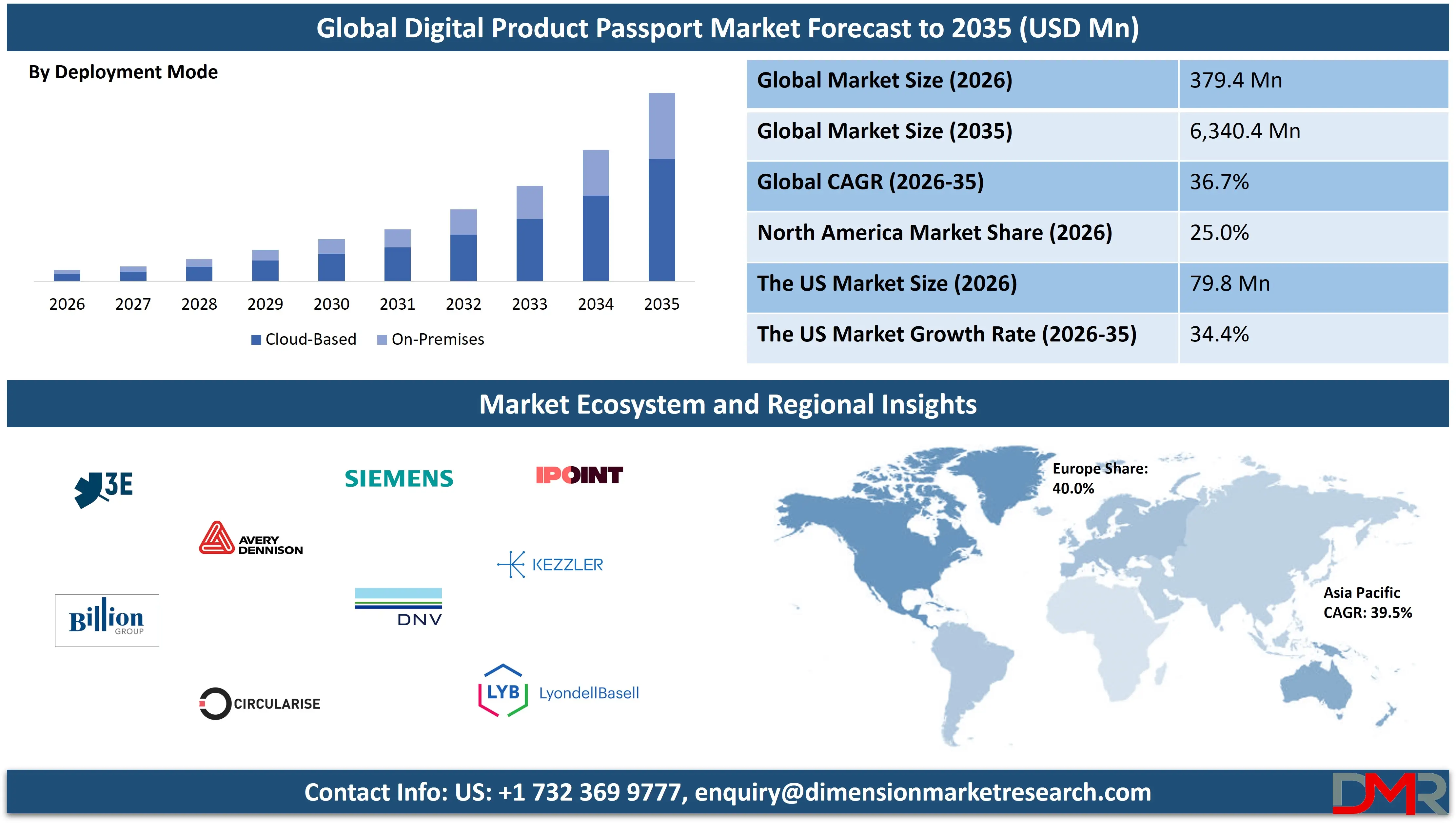
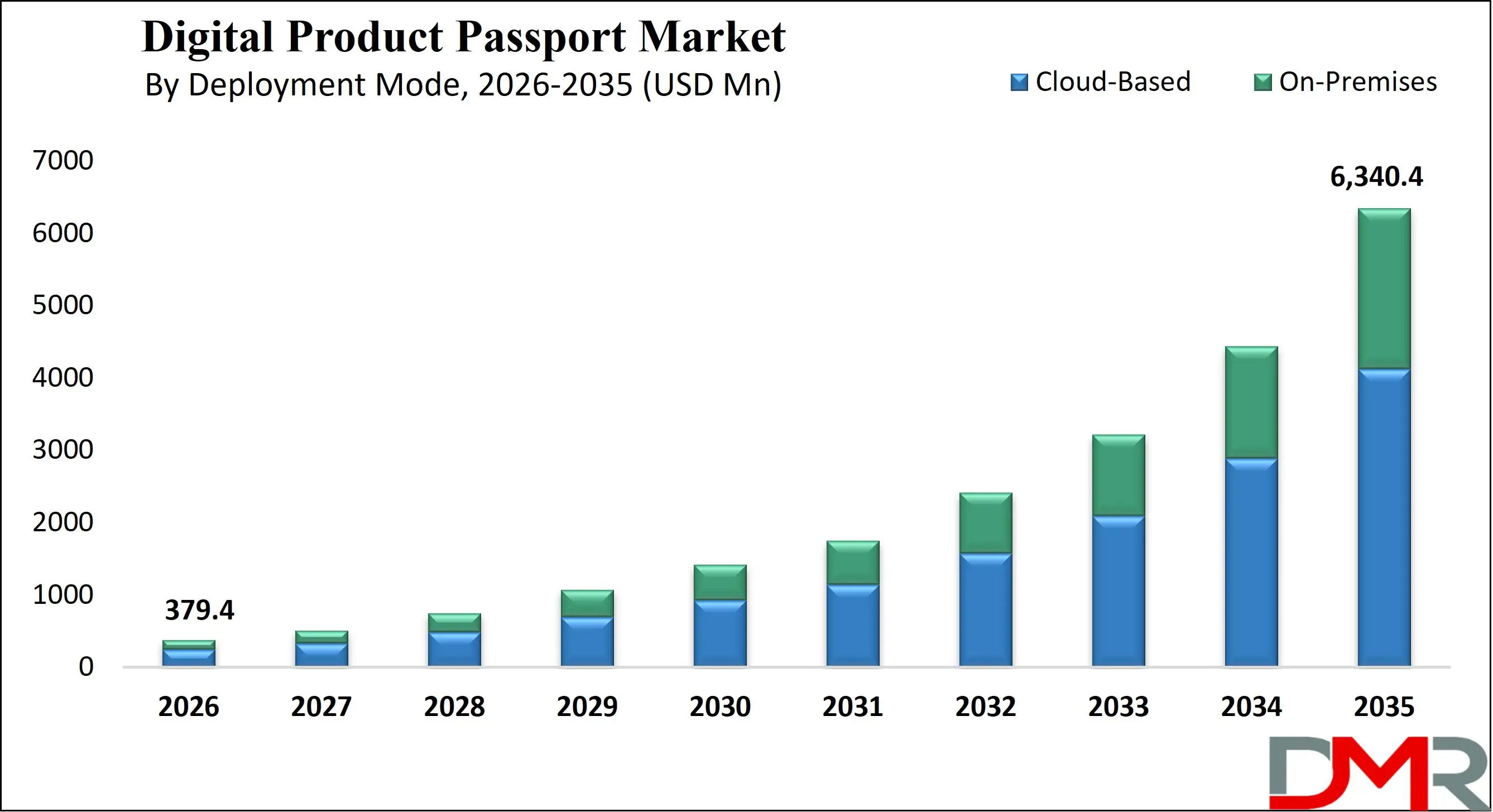
The Global Digital Product Passport market size is projected at USD 379.4 million in 2026 and is set to grow at a CAGR of 36.7%, reaching USD 6.34 billion by 2035, driven by supply chain traceability, regulatory compliance, and adoption of cloud, IoT, and blockchain solutions across key industries.
ℹ
To learn more about this report –
Download Your Free Sample Report Here
A Digital Product Passport is a comprehensive digital record that provides detailed information about a product throughout its lifecycle, from design and manufacturing to distribution, usage, and end-of-life. It serves as a centralized repository of product data, including materials, components, production processes, certifications, and sustainability attributes, enabling transparency and traceability across the supply chain. By leveraging technologies such as cloud platforms, IoT sensors, blockchain, and digital twins, the digital product passport allows manufacturers, regulators, and consumers to access accurate, real-time information, facilitating compliance with environmental and safety standards while promoting circular economy practices and enhancing customer trust in product authenticity and quality.
The global Digital Product Passport market is experiencing rapid growth as industries increasingly adopt digital solutions to meet regulatory requirements and enhance supply chain visibility. Market expansion is driven by rising demand for product transparency, sustainable production practices, and traceability of materials and components. Key industries including automotive, pharmaceuticals, electronics, and food and beverages are deploying advanced platforms and analytics to streamline operations, ensure regulatory compliance, and provide consumers with detailed product insights. The market also benefits from increasing investments in cloud-based deployment, IoT integration, and blockchain-enabled secure data management, which enable scalable and interoperable solutions across regions.
ℹ
To learn more about this report –
Download Your Free Sample Report Here
The digital product passport market is expanding as companies focus on improving operational efficiency and product accountability. By integrating real-time data tracking, analytics, and secure information exchange, organizations can monitor materials, verify authenticity, and optimize production and logistics processes. Rising demand for sustainable practices, circular economy initiatives, and consumer-driven transparency is fueling innovation in software and service solutions. Solutions are being designed to support lifecycle management, regulatory adherence, and environmental impact reporting, making digital product passports an essential tool for businesses aiming to combine compliance, efficiency, and sustainability in modern manufacturing and supply chains.
The US Digital Product Passport Market
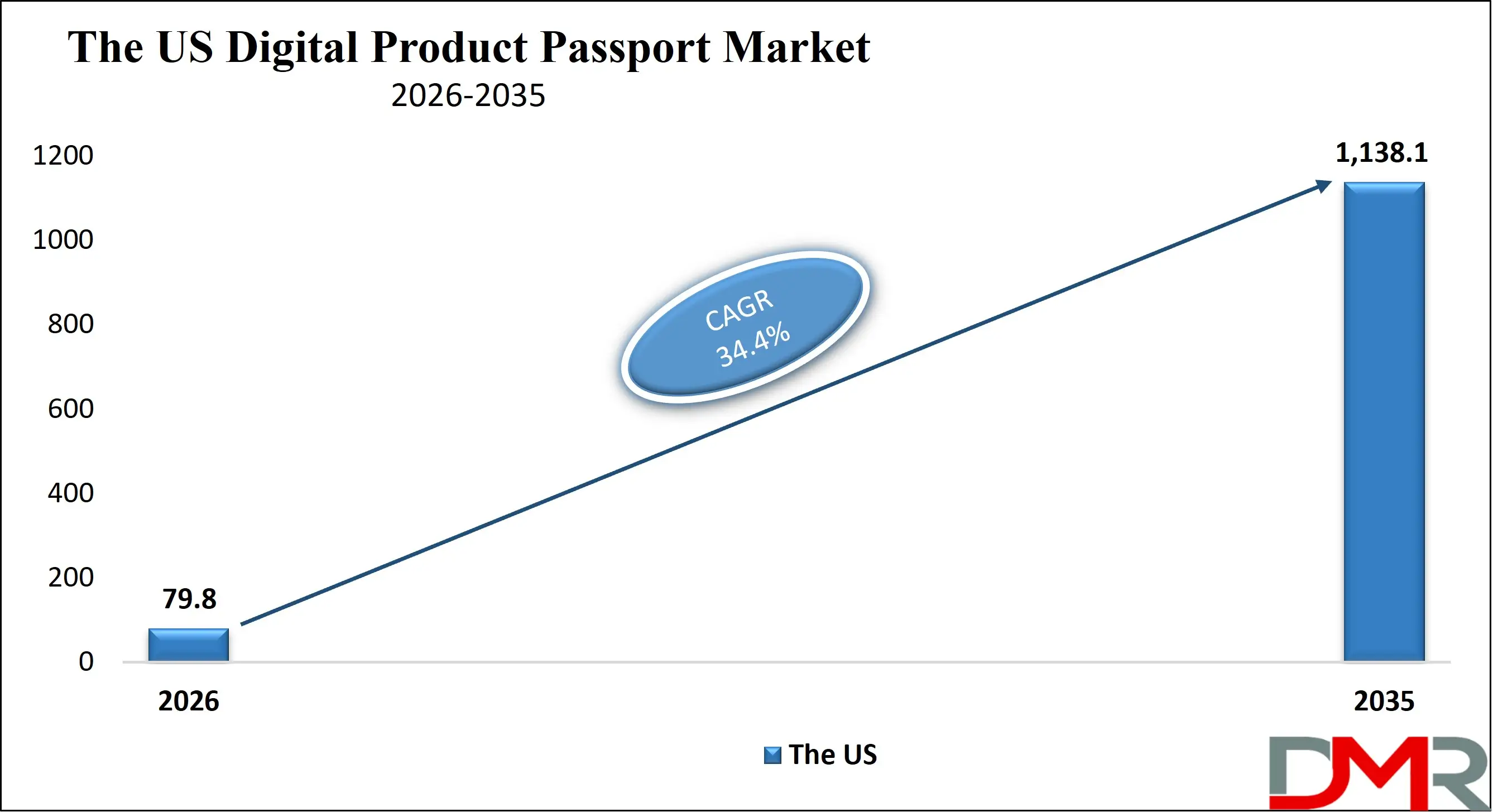
The U.S. Digital Product Passport Market size is expected to reach at USD 79.8 million in 2026. It is further expected to witness subsequent growth in the upcoming period, holding USD 1,138.1 million in 2035 at a CAGR of 34.4%.
ℹ
To learn more about this report –
Download Your Free Sample Report Here
The U.S. Digital Product Passport market is gaining momentum as manufacturers and regulators push for improved product transparency and enhanced supply chain visibility. Increasing emphasis on compliance with safety and environmental standards is prompting adoption of digital solutions that record and share detailed product information across stakeholders. Adoption of cloud‑native platforms, analytics tools, and IoT‑enabled tracking systems is accelerating, enabling organizations across automotive, pharmaceuticals, consumer electronics, and food sectors to streamline operations, reduce risk, and deliver detailed product insights to customers and partners.
Investment in digital product passport technologies in the U.S. is also driven by demand for sustainability reporting, lifecycle management, and circular economy practices. Enterprises are integrating advanced data management, API‑based interoperability, and secure traceability capabilities to support end‑to‑end visibility and meet evolving regulatory expectations. Growth is further supported by collaborations between technology vendors, industry consortia, and standardization bodies focused on interoperability and scalable deployment models that enhance product integrity and lifecycle accountability.
The Europe Digital Product Passport Market
The Europe Digital Product Passport market is projected to reach USD 151.8 million in 2026, reflecting strong adoption across industries such as automotive, pharmaceuticals, electronics, and food and beverages. The growth is driven by stringent environmental regulations, circular economy initiatives, and increasing demand for supply chain transparency and product traceability. Companies are investing in cloud platforms, IoT devices, and interoperable solutions to ensure compliance with evolving regulatory standards and provide detailed product information throughout the lifecycle, from manufacturing to end-of-life recycling or disposal.
The market in Europe is expected to expand at a CAGR of 30.6%, highlighting robust and sustained growth. This momentum is supported by regulatory enforcement, technological innovation, and rising awareness of sustainable production practices among manufacturers and consumers. Digital product passports enable businesses to track materials, optimize logistics, prevent counterfeiting, and enhance customer trust through transparency. As a result, Europe is positioned as a leading region in the global Digital Product Passport market, driving both adoption and innovation in traceability and lifecycle management solutions.
The Japan Digital Product Passport Market
The Japan Digital Product Passport market is projected to reach USD 30.3 million in 2026, reflecting growing adoption across industries such as automotive, electronics, and pharmaceuticals. The market is driven by increasing demand for product traceability, regulatory compliance, and sustainable production practices. Companies in Japan are leveraging digital product passports to monitor materials, track manufacturing processes, and provide end-to-end visibility throughout the product lifecycle, supporting quality assurance, anti-counterfeiting measures, and enhanced supply chain management.
The market in Japan is expected to grow at a robust CAGR of 38.2%, indicating one of the fastest growth rates globally. This rapid expansion is fueled by government initiatives promoting smart manufacturing and digital transformation, as well as rising consumer awareness around product authenticity and sustainability. Integration of IoT devices, cloud platforms, and analytics tools allows businesses to automate reporting, optimize logistics, and strengthen lifecycle management, positioning Japan as a key emerging player in the global Digital Product Passport landscape.
Global Digital Product Passport Market: Key Takeaways
- Global Market Size and Growth: The global Digital Product Passport market is projected at USD 379.4 million in 2026 and is expected to reach USD 6.34 billion by 2035, expanding at a CAGR of 36.7%.
- Europe Market Share: Europe is the largest regional contributor, holding 40.0% of the global market in 2026 with a projected value of USD 151.8 million and a CAGR of 30.6%.
- U.S. Market Growth: The U.S. Digital Product Passport market is expected at USD 79.8 million in 2026, growing at a CAGR of 34.4%, reaching USD 1,138.1 million by 2035.
- Japan as Fastest-Growing Market: Japan is projected to reach USD 30.3 million in 2026 with the highest CAGR of 38.2%, driven by adoption in automotive, electronics, and pharmaceutical sectors.
- Segment Dominance: Software solutions are estimated to capture 60.0% of the offering segment, while cloud-based deployments dominate 65.0% of the deployment mode segment in 2026, highlighting technology-led adoption.
Global Digital Product Passport Market: Use Cases
- Supply Chain Traceability: Digital product passports enable end-to-end visibility across supply chains by recording product origin, materials, and movement. Manufacturers and distributors can track goods in real time, reduce errors, and ensure authenticity, supporting logistics optimization, inventory management, and risk mitigation. This improves operational efficiency while meeting compliance requirements.
- Regulatory Compliance: Enterprises leverage digital product passports to comply with environmental, safety, and industry-specific regulations. Automated reporting, audit trails, and secure data sharing simplify adherence to standards such as product safety certifications and chemical content disclosure, reducing penalties and enhancing corporate governance.
- Sustainability & Circular Economy: Digital product passports provide insights into material composition, recyclability, and environmental impact, supporting sustainable production practices. Companies can track resource usage, optimize recycling, and enable circular economy initiatives, reducing waste and promoting eco-friendly operations.
- Product Transparency & Consumer Engagement: Consumers gain access to detailed product information including origin, ingredients, and lifecycle data through digital passports. This builds trust, enhances brand reputation, and drives informed purchasing decisions, aligning with rising demand for transparency, ethical sourcing, and responsible consumption.
Impact of Iran Conflict on Digital Product Passport Market
- Supply Chain Disruption and Cost Pressure: The conflict has significantly disrupted key shipping routes such as the Strait of Hormuz, a vital corridor for global energy and industrial goods, leading to elevated freight costs, transportation delays, and logistical bottlenecks. These disruptions ripple through global supply networks, increasing the cost of components, materials, and technology hardware that underpin digital product passport platforms and IoT deployment, thereby slowing implementation timelines and raising prices for traceability solutions.
- Inflationary Impact on Deployment Budgets: Surging energy costs and inflationary pressures driven by the conflict raise operational expenditure for manufacturers and technology providers. Higher costs for cloud infrastructure, data centers, and edge computing can constrain IT budgets allocated to digital product passport initiatives, particularly in energy‑intensive industries. This leads organizations to re‑prioritize investments, potentially delaying adoption of advanced analytics, blockchain traceability modules, and interoperable data management solutions.
- Geopolitical Risk and Strategic Diversification: Heightened geopolitical uncertainty increases risk premiums for cross‑border technology projects and incentivizes companies to diversify supply chains and digital partners. As firms seek to reduce dependency on conflict‑exposed regions, there is accelerated interest in resilient digital ecosystems, localized data sovereignty strategies, and secure traceability frameworks that can operate across multi‑regional networks. This shift could reshape go‑to‑market approaches for digital product passport vendors and influence roadmap priorities toward greater decentralization and cybersecurity integration.
Global Digital Product Passport Market: Stats & Facts
-
European Union – ESPR / EU Commission
- The Digital Product Passport applies to all 27 EU Member States under the ESPR.
- The regulation documents are published in 24 official EU languages.
- The Ecodesign for Sustainable Products Regulation came into force in 2024.
- Battery Passports will be mandatory starting 2027.
- Textile products will require Digital Product Passports starting mid‑2027.
- Electronics products are expected to comply with DPP requirements by 2028.
- Additional product groups will follow phased DPP compliance starting 2029.
- The EU aims to fully implement DPPs across regulated categories by 2030.
- Article 8 of ESPR defines mandatory DPP information categories.
- Article 7 governs DPP requirements for products sold in the EU.
- Article 18 sets the rules for product safety documentation.
- The technical committee CEN/CLC/JTC 24 oversees harmonized DPP standards.
- Harmonized DPP standards are targeted for completion by end of 2025.
- Initial technical standard outputs are expected in 2026.
- Companies have an 18-month compliance window after publication of delegated acts.
-
Japan – METI / Government Pilot Programs
- Japan completed its first Digital Product Passport implementation in medical apparel in July 2025.
- The pilot program ran for one year starting in July 2024.
Global Digital Product Passport Market: Market Dynamic
Driving Factors in the Global Digital Product Passport Market
Rising Demand for Supply Chain Transparency
Companies across automotive, pharmaceuticals, electronics, and food industries are increasingly adopting digital product passports to enhance end-to-end supply chain visibility. By integrating IoT sensors, cloud platforms, and blockchain-enabled traceability, organizations can monitor product provenance, ensure authenticity, and streamline logistics, supporting regulatory compliance and minimizing counterfeiting risks. The growing emphasis on ethical sourcing and responsible manufacturing further accelerates the need for real-time product data management.
Regulatory Compliance and Sustainability Mandates
Global regulations focused on environmental protection, chemical safety, and circular economy initiatives are compelling businesses to implement traceable and auditable product information systems. Digital product passports enable companies to comply with complex reporting standards, track material composition, and provide lifecycle documentation. This regulatory push, combined with rising corporate sustainability goals, drives investment in interoperable platforms, digital twins, and analytics-driven product lifecycle management solutions.
Restraints in the Global Digital Product Passport Market
High Implementation and Integration Costs
Deploying digital product passport solutions involves significant upfront investments in software platforms, IoT devices, cloud infrastructure, and integration with existing enterprise systems. Smaller and mid-sized enterprises may face budget constraints, limiting market penetration. Additionally, interoperability challenges across legacy systems and global supply chains can slow adoption and increase operational complexity.
Data Security and Privacy Concerns
As digital product passports rely on real-time data sharing across multiple stakeholders, concerns regarding data breaches, unauthorized access, and intellectual property protection act as major restraints. Companies must implement robust cybersecurity measures and adhere to data privacy regulations, which may increase operational overhead and complicate large-scale adoption of blockchain and cloud-based traceability solutions.
Opportunities in the Global Digital Product Passport Market
Expansion in Emerging Markets
Emerging economies with rapidly growing manufacturing hubs present significant growth potential. Adoption of digital product passports in sectors such as textiles, consumer electronics, and food processing can improve supply chain efficiency, support regulatory compliance, and enhance brand reputation. Cloud-based deployment and mobile-enabled platforms make it easier for companies in these regions to implement traceability solutions with lower initial costs.
Integration with Advanced Technologies
The convergence of AI, machine learning, IoT, blockchain, and digital twins with digital product passports offers opportunities for predictive analytics, automated compliance reporting, and intelligent lifecycle management. Companies can leverage these innovations to optimize production, reduce waste, enable circular economy initiatives, and provide end-users with transparent, real-time product information, enhancing customer trust and engagement.
Trends in the Global Digital Product Passport Market
Adoption of Circular Economy Practices
Industries are increasingly using digital product passports to track material reuse, recyclability, and environmental impact, aligning with circular economy principles. This trend supports sustainable manufacturing, reduces waste, and enables reporting of carbon footprint and resource consumption, promoting eco-friendly operations across product lifecycles.
Shift Toward Cloud-Based and Hybrid Platforms
Organizations are moving from on-premises solutions to cloud and hybrid deployment models for scalability, interoperability, and remote accessibility. Cloud-enabled digital product passports allow real-time data sharing across global supply chains, integration with ERP systems, and secure storage of product lifecycle information, making digital traceability solutions more agile and accessible to diverse industries.
Global Digital Product Passport Market: Research Scope and Analysis
By Offering Analysis
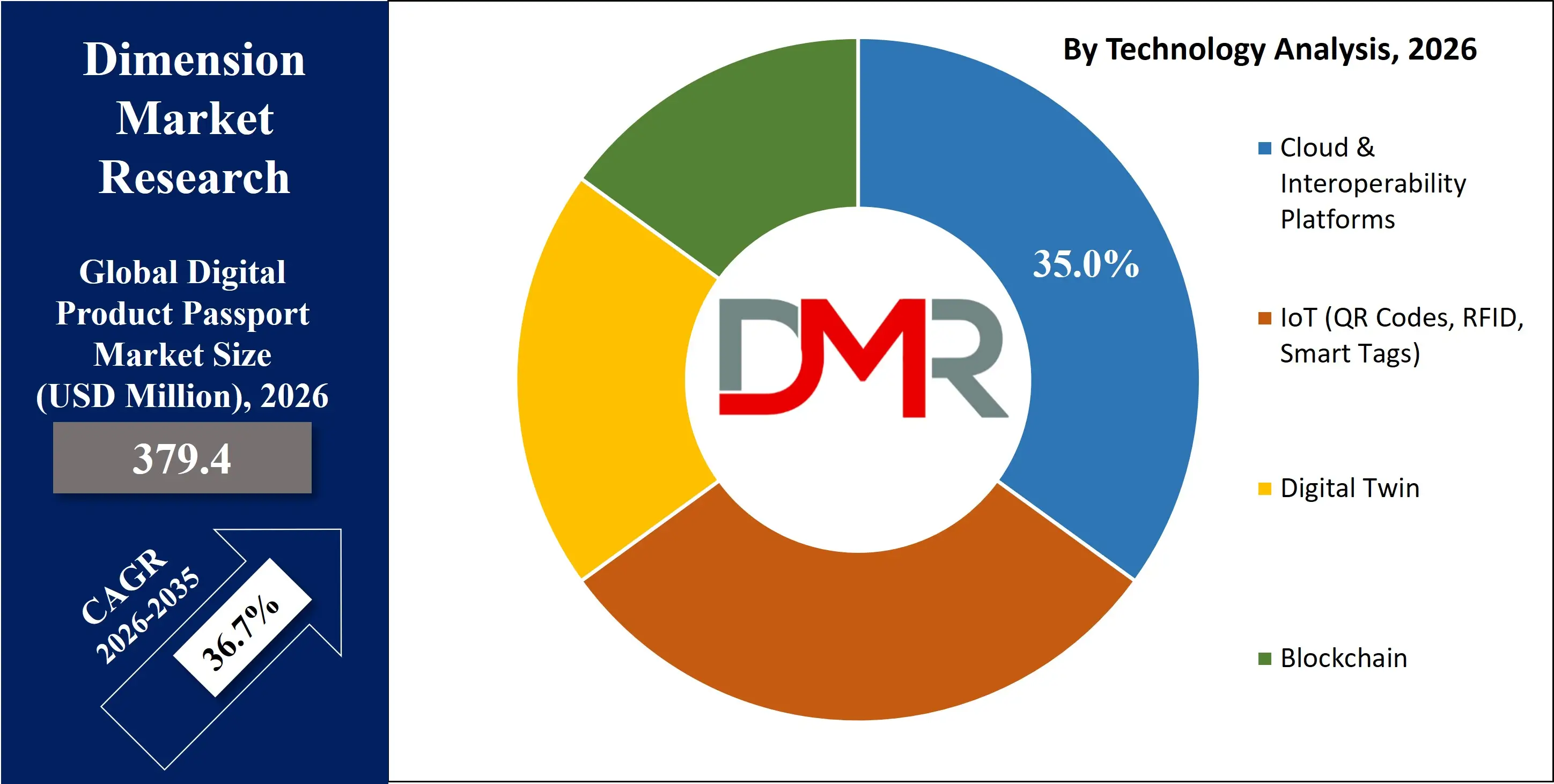
In the Digital Product Passport market, software solutions are expected to dominate the offering segment, accounting for around 60.0% of the total market share in 2026. This is primarily because the core functionality of digital product passports relies on platforms that enable data collection, management, and analytics. Software solutions provide the essential infrastructure for integrating IoT devices, cloud systems, and digital twins, allowing businesses to track product information across the entire lifecycle, ensure regulatory compliance, and maintain transparency for consumers. Advanced analytics and integration capabilities make software a critical driver of adoption across industries such as automotive, pharmaceuticals, electronics, and food and beverages.
Services also play a significant role in this market segment, complementing software by supporting implementation, customization, and ongoing operational management. Consulting and advisory services help organizations design and deploy digital product passport strategies aligned with regulatory requirements and sustainability goals. Integration and deployment services ensure seamless incorporation of digital passport platforms into existing enterprise systems, while support and maintenance services guarantee continuous functionality, security, and updates. Together, these services facilitate smooth adoption, maximize platform efficiency, and help businesses realize the full benefits of traceability, supply chain transparency, and lifecycle management.
By Deployment Mode Analysis
In the Digital Product Passport market, cloud-based deployment is expected to dominate, capturing approximately 65.0% of the total market share in 2026. Cloud solutions offer significant advantages such as scalability, lower upfront costs, and easier integration with existing enterprise systems and IoT devices. They enable real-time access to product data across the supply chain, supporting analytics, traceability, and regulatory compliance without the need for extensive on-site infrastructure. The flexibility of cloud platforms allows companies to quickly adapt to changing business requirements and regulatory mandates, making them a preferred choice for industries focused on digital transformation and sustainability initiatives.
ℹ
To learn more about this report –
Download Your Free Sample Report Here
On-premises deployment, while representing a smaller portion of the market, remains important for organizations with strict data security, privacy, or compliance requirements. This deployment mode allows companies to maintain full control over their infrastructure and sensitive product information. On-premises solutions are often preferred by large enterprises in highly regulated sectors such as pharmaceuticals, defense, and aerospace, where internal governance, custom integration, and localized data storage are critical. Although these solutions require higher upfront investment and ongoing maintenance, they provide organizations with a secure, customizable environment to manage product lifecycle information effectively.
By Product Lifecycle Stage Analysis
In the Digital Product Passport market, the manufacturing and production stage is expected to dominate the product lifecycle segment, accounting for approximately 25.0% of the total market share in 2026. This is because the majority of investment in digital product passport solutions is concentrated on capturing accurate and detailed information during production, including material composition, assembly processes, quality checks, and compliance with safety or environmental standards. By digitizing production data, manufacturers can ensure traceability, streamline operations, and create a reliable foundation for downstream supply chain visibility and lifecycle management, enhancing overall product integrity and operational efficiency.
The distribution and logistics stage also plays a significant role in the adoption of digital product passports. During this phase, products move across multiple stakeholders, including warehouses, transportation providers, and retailers, making real-time tracking and traceability critical. Digital product passports integrated with IoT sensors, RFID tags, and cloud platforms allow companies to monitor shipments, ensure accurate inventory management, prevent loss or counterfeiting, and maintain compliance with delivery and storage regulations. By providing visibility into the movement and condition of products, organizations can optimize logistics, improve customer satisfaction, and strengthen supply chain resilience.
By Application Analysis
In the Digital Product Passport market, supply chain traceability is expected to dominate the application segment, capturing around 30.0% of the total market share in 2026. This is because businesses increasingly require real-time visibility across the entire supply chain to track products, materials, and components from origin to end-user. Digital product passports integrated with IoT devices, cloud platforms, and analytics tools enable accurate monitoring, reduce errors, prevent counterfeiting, and optimize inventory and logistics processes. Enhanced traceability also supports operational efficiency, improves decision-making, and strengthens trust among stakeholders.
Regulatory compliance and ESG reporting is another key application driving adoption of digital product passports. Companies are under growing pressure to meet environmental, social, and governance standards, as well as industry-specific safety and quality regulations. Digital product passports facilitate automated reporting, secure record-keeping, and audit-ready documentation of product composition, manufacturing processes, and lifecycle impact. By providing accurate and accessible data, organizations can demonstrate compliance, support sustainability initiatives, and align with investor and consumer expectations for ethical and responsible business practices.
By Industry Vertical
In the Digital Product Passport market, the automotive industry is expected to dominate the industry vertical segment, capturing approximately 20.0% of the total market share in 2026. This is driven by the sector’s complex supply chains, stringent regulatory requirements, and growing focus on sustainability and circular economy practices. Digital product passports enable automakers to track materials, components, and finished vehicles throughout their lifecycle, ensuring compliance with safety and environmental standards, supporting warranty management, and enhancing transparency for both manufacturers and consumers. Adoption of IoT, cloud platforms, and blockchain further strengthens traceability and operational efficiency in automotive manufacturing and logistics.
The electronics and electrical batteries sector also represents a significant portion of the market due to increasing demand for product traceability, safety compliance, and sustainability reporting. Digital product passports allow manufacturers to monitor component origin, assembly processes, and battery lifecycle, helping to prevent counterfeit products, optimize recycling, and ensure regulatory compliance. Integration of IoT-enabled sensors, analytics, and interoperable platforms provides real-time insights into product status and performance, supporting quality assurance, end-of-life management, and responsible sourcing practices, which are critical in high-tech and energy storage industries.
The Global Digital Product Passport Market Report is segmented on the basis of the following
By Offering
- Software
- DPP Management Platforms
- Product Lifecycle Data Platforms
- Traceability & Serialization Software
- Compliance & Reporting Software
- Blockchain/Distributed Ledger Platforms
- Data Integration & APIs
- Services
- Consulting & Advisory
- Integration & Deployment
- Support & Maintenance
By Deployment Mode
By Product Lifecycle Stage
- Design & Development
- Manufacturing / Production
- Distribution & Logistics
- Usage Phase
- End-of-Life (Recycling / Disposal)
By Application
- Supply Chain Traceability
- Regulatory Compliance & ESG Reporting
- Product Lifecycle Management
- Circular Economy/Recycling Tracking
- Customer Transparency & Product Information
- Anti-Counterfeiting & Authentication
By Industry Vertical
- Automotive
- Electronics & Electrical Batteries
- Textiles & Apparel
- Consumer Goods
- Packaging & Plastics
- Construction Materials
- Healthcare & Medical Devices
- Industrial Manufacturing
- Others
Impact of Artificial Intelligence in the Global Digital Product Passport Market
Artificial Intelligence is transforming the global Digital Product Passport market by enabling smarter data management, predictive analytics, and automated decision-making across the product lifecycle. AI algorithms can analyze vast volumes of product information collected through IoT devices, cloud platforms, and digital twins to identify patterns, detect anomalies, and optimize supply chain processes. This improves traceability, reduces errors, and ensures compliance with regulatory standards. By automating routine tasks such as data entry, reporting, and quality verification, AI enhances operational efficiency and allows companies to focus on strategic initiatives like sustainability and circular economy practices.
AI also drives enhanced consumer engagement and transparency by providing actionable insights from product data. Intelligent systems can track material composition, environmental impact, and usage patterns to generate real-time reports accessible to end-users, regulators, and supply chain partners. Machine learning models can predict maintenance needs, lifecycle risks, and potential recalls, supporting proactive interventions and cost savings. Overall, AI integration with digital product passports strengthens data-driven decision-making, accelerates adoption of traceability solutions, and fosters trust and accountability across industries such as automotive, pharmaceuticals, electronics, and food and beverages.
Global Digital Product Passport Market: Regional Analysis
Region with the Largest Revenue Share
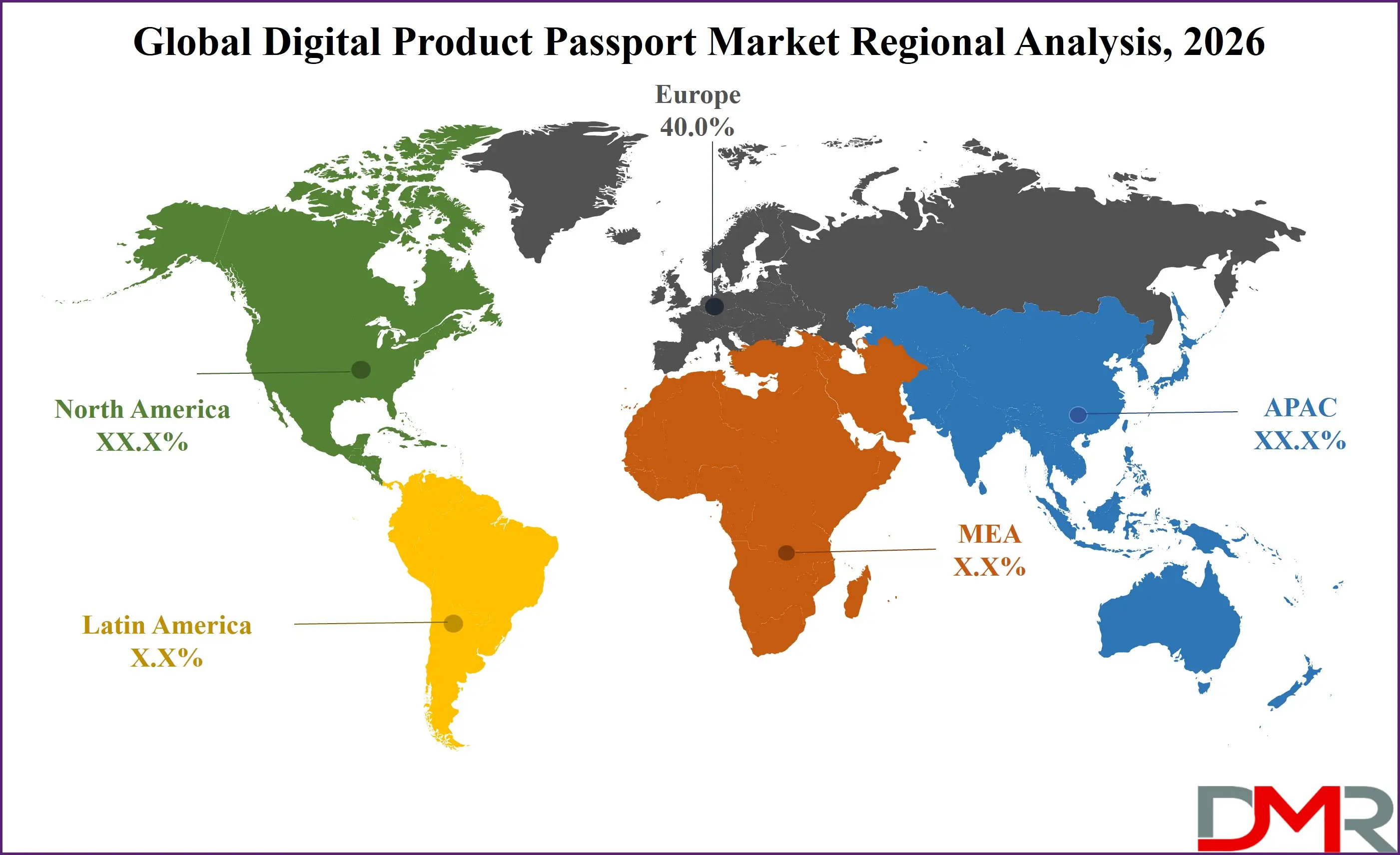
Europe is expected to lead the global Digital Product Passport market, accounting for approximately 40.0% of total revenue in 2026, driven by stringent environmental regulations, circular economy initiatives, and strong adoption of traceability and compliance solutions across key industries. The region’s focus on sustainable manufacturing, product lifecycle transparency, and regulatory enforcement encourages businesses to implement digital product passports for supply chain visibility, material tracking, and lifecycle reporting. Advanced technological infrastructure, combined with growing awareness of consumer demands for product authenticity and eco-friendly practices, further reinforces Europe’s dominant position in the market.
ℹ
To learn more about this report –
Download Your Free Sample Report Here
Region with the Highest CAGR
The Asia-Pacific region is expected to register the highest CAGR in the global Digital Product Passport market, driven by rapid industrialization, expanding manufacturing hubs, and increasing adoption of advanced technologies such as IoT, cloud platforms, and blockchain. Growing demand for supply chain transparency, regulatory compliance, and sustainable production practices is accelerating deployment of digital product passports across industries including automotive, electronics, and food and beverages. Supportive government initiatives, rising awareness of circular economy practices, and investments in smart manufacturing further contribute to the region’s faster growth compared to other global markets.
By Region
North America
Europe
- Germany
- The U.K.
- France
- Italy
- Russia
- Spain
- Benelux
- Nordic
- Rest of Europe
Asia-Pacific
- China
- Japan
- South Korea
- India
- ANZ
- ASEAN
- Rest of Asia-Pacific
Latin America
- Brazil
- Mexico
- Argentina
- Colombia
- Rest of Latin America
Middle East & Africa
- Saudi Arabia
- UAE
- South Africa
- Israel
- Egypt
- Rest of MEA
Global Digital Product Passport Market: Competitive Landscape
The competitive landscape of the global Digital Product Passport market is marked by the presence of diverse technology providers, solution integrators, and service specialists focused on innovation in traceability, data interoperability, and lifecycle management. Vendors are investing in advanced features such as cloud‑native platforms, IoT‑enabled tracking, analytics dashboards, and blockchain‑based secure data exchange to differentiate their offerings and meet varying industry requirements. Strategic partnerships, mergers and acquisitions, and collaborations with regulatory bodies and industry consortia are increasingly common as players seek to expand geographic reach and enhance product capabilities. Ongoing emphasis on R&D and customization to address sector‑specific use cases, such as sustainability reporting and compliance automation, further intensifies competition and drives continuous evolution of market solutions.
Some of the prominent players in the Global Digital Product Passport Market are
- 3E
- Avery Dennison
- Billon Group
- Circularise
- Siemens AG
- Det Norske Veritas (DNV)
- iPoint-systems GmbH
- Kezzler
- LyondellBasell Industries
- OPTEL Group
- Sigma Technology
- Bluestone PIM
- Spherity
- Rudholm Group (ShareLabel)
- Minespider
- Arianee
- Yelosquare (Yelo Business)
- Eviden
- AVL
- Verofax
- Other Key Players
Recent Developments in the Global Digital Product Passport Market
- March 2026: BASF, BMW Group, and Siemens jointly launched Path.Era, a digital battery passport system designed to enhance supply chain transparency and meet upcoming EU regulatory requirements for battery and product lifecycle data, strengthening traceability across the value chain.
- February 2026: The Hashgraph Group announced the commercial launch of TrackTrace, a platform aligned with EU Digital Product Passport regulation that enables companies to link physical goods to tamper‑proof digital records for compliance with sustainability and transparency standards.
- September 2025: Ovido, a Helsinki‑based startup focused on supply chain and product data automation, secured €2.4 million in seed funding led by Lifeline Ventures and Kvanted to expand its compliance and traceability platform capabilities.
Report Details
| Report Characteristics |
| Market Size (2026) |
USD 379.4 Mn |
| Forecast Value (2035) |
USD 6,340.4 Mn |
| CAGR (2026–2035) |
36.7% |
| The US Market Size (2026) |
USD 79.8 Mn |
| Historical Data |
2021 – 2025 |
| Forecast Data |
2027 – 2035 |
| Base Year |
2025 |
| Estimate Year |
2026 |
| Report Coverage |
Market Revenue Estimation, Market Dynamics, Competitive Landscape, Growth Factors, etc. |
| Segments Covered |
By Offering (Software, Services), By Deployment Mode (Cloud-Based, On-Premises), By Product Lifecycle Stage (Design & Development, Manufacturing / Production, Distribution & Logistics, Usage Phase, End-of-Life (Recycling / Disposal)), By Application (Supply Chain Traceability, Regulatory Compliance & ESG Reporting, Product Lifecycle Management, Circular Economy/Recycling Tracking, Customer Transparency & Product Information, Anti-Counterfeiting & Authentication), and By Industry Vertical (Automotive, Electronics & Electrical Batteries, Textiles & Apparel, Consumer Goods, Packaging & Plastics, Construction Materials, Healthcare & Medical Devices, Industrial Manufacturing, Others) |
| Regional Coverage |
North America – US, Canada; Europe – Germany, UK, France, Russia, Spain, Italy, Benelux, Nordic, Rest of Europe; Asia-Pacific – China, Japan, South Korea, India, ANZ, ASEAN, Rest of APAC; Latin America – Brazil, Mexico, Argentina, Colombia, Rest of Latin America; Middle East & Africa – Saudi Arabia, UAE, South Africa, Turkey, Egypt, Israel, Rest of MEA |
| Prominent Players |
3E, Avery Dennison, Billon Group, Circularise, Siemens AG, Det Norske Veritas (DNV), iPoint-systems GmbH, Kezzler, LyondellBasell Industries, OPTEL Group, Sigma Technology, Bluestone PIM, Spherity, Rudholm Group (ShareLabel), Minespider, Arianee, Yelosquare (Yelo Business), Eviden, AVL, Verofax. and Other Key Players |
| Purchase Options |
We have three licenses to opt for: Single User License (Limited to 1 user), Multi-User License (Up to 5 Users), and Corporate Use License (Unlimited User) along with free report customization equivalent to 0 analyst working days, 3 analysts working days, and 5 analysts working days respectively. |
Frequently Asked Questions
How big is the Global Digital Product Passport Market?
▾ The Global Digital Product Passport Market size is estimated to have a value of USD 379.4 million in 2026 and is expected to reach USD 6,340.4 million by the end of 2035.
What is the growth rate in the Global Digital Product Passport Market in 2026?
▾ The market is growing at a CAGR of 36.7% over the forecasted period of 2026.
What is the size of the US Digital Product Passport Market?
▾ The US Digital Product Passport market is projected to be valued at USD 79.8 million in 2026. It is expected to witness subsequent growth in the upcoming period as it holds USD 1,138.1 million in 2035 at a CAGR of 34.4%.
Which region accounted for the largest Global Digital Product Passport Market?
▾ Europe is expected to have the largest market share in the Global Digital Product Passport Market with a share of about 40.0% in 2026.
Who are the key players in the Global Digital Product Passport Market?
▾ Some of the major key players in the Global Digital Product Passport Market are 3E, Avery Dennison, Billon Group, Circularise, Siemens AG, Det Norske Veritas (DNV), iPoint-systems GmbH, Kezzler, LyondellBasell Industries, OPTEL Group, Sigma Technology, Bluestone PIM, Spherity, and many others.