What is the Direct Lithium Extraction Market Size?
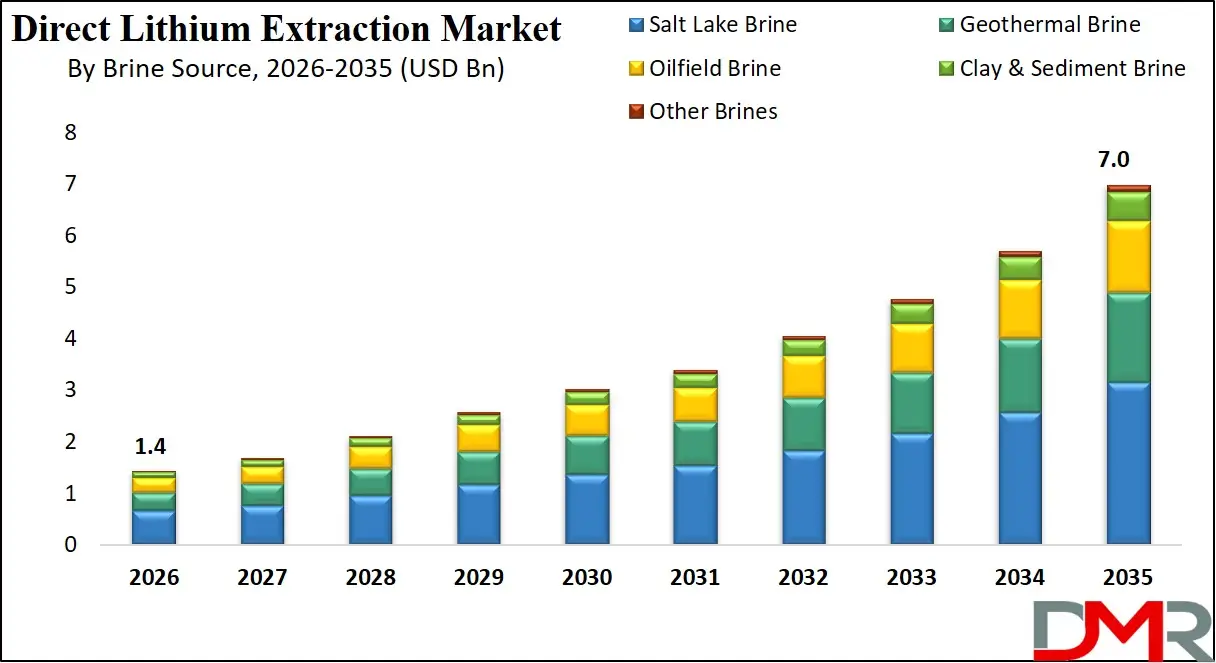
The Direct Lithium Extraction (DLE) market is projected to grow from USD 1.4 billion in 2026 to USD 7.0 billion by 2035, at a CAGR of 19.2%. This growth is driven mainly by the sharp rise in electric vehicle and battery production, which requires large, reliable supplies of battery-grade lithium. As demand scales, manufacturers are increasingly turning to advanced extraction methods capable of meeting quality and volume requirements that traditional mining approaches struggle to match consistently.
According to the International Energy Agency (IEA), global electric car sales exceeded 14 million units in 2023 and are expected to surpass 20 million in 2025, reaching about 40 million by 2030, roughly four times 2022 levels. This rapid EV fleet expansion translates directly into multi-fold growth in lithium ion battery demand. The IEA notes that lithium demand for batteries ranks among the fastest-growing critical mineral segments in its Net Zero scenario, intensifying pressure on supply chains.
ℹ
To learn more about this report –
Download Your Free Sample Report Here
As automakers and cell makers scale up gigafactory capacity, they need new lithium sources capable of delivering consistent quality, high recovery rates, and competitive cost profiles. This is pushing the industry toward advanced brine based DLE routes rather than relying solely on conventional hard rock mining. Securing dependable, scalable supply has become essential as production targets rise and existing extraction methods face growing constraints.>
At the same time, regulators and communities are imposing stricter limits on water use, land footprint, and emissions from traditional evaporation-pond brine projects. These conventional operations account for roughly two thirds of global lithium production and are known for high water losses and broader ecosystem impacts. Growing scrutiny over environmental costs is prompting operators and policymakers to seek extraction methods that reduce ecological disruption while maintaining output and profitability across existing and future lithium projects.
Emerging DLE technologies based on ion exchange, adsorption, solvent extraction, and membrane systems can cut extraction times from months to hours, raise lithium recovery from low grade brines, and reduce water and chemical consumption compared to legacy methods. These improvements directly enhance project economics and ESG scores, making DLE increasingly attractive to operators facing both regulatory pressure and rising demand. Lower resource intensity also helps projects gain approval in regions with strict environmental standards.
As governments in major EV regions support cleaner critical mineral supply chains and OEMs include low carbon lithium in their procurement criteria, DLE is becoming the preferred technology for unlocking new brine resources and upgrading existing operations. This convergence of regulatory support, corporate sourcing standards, and technological advantage underpins the forecast that the DLE market will scale almost fivefold between 2026 and 2035, reflecting its growing centrality to the global lithium supply chain.
Key Takeaways
- The global Direct Lithium Extraction market is valued at USD 1.4 billion and is projected to reach USD 7.0 billion, growing at a CAGR of 19.2%.
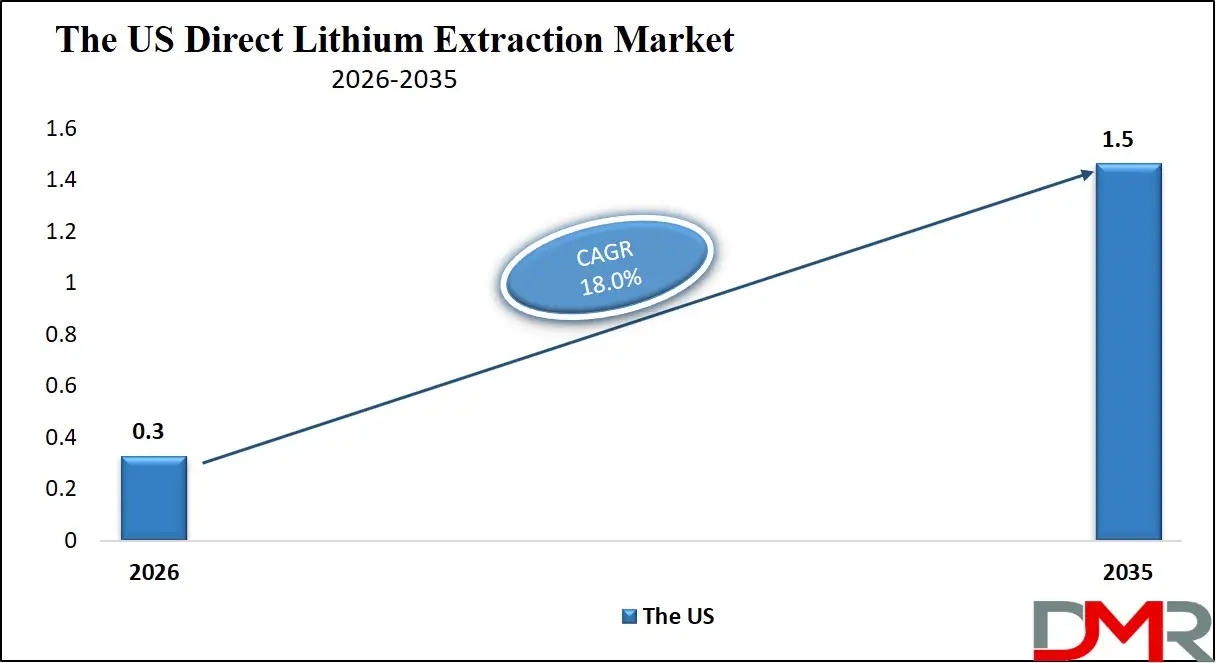
- The US Direct Lithium Extraction market is valued at USD 0.3 billion and is expected to reach USD 1.5 billion, expanding at a CAGR of 18.0%.
- Europe represents a significant regional market, valued at USD 154 million, growing at a CAGR of 18.4%.
- Japan accounts for USD 56.0 million in market value, registering a CAGR of 17.9%.
- By Brine Source, Salt Lake Brine dominates the market with a share of 45.0%.
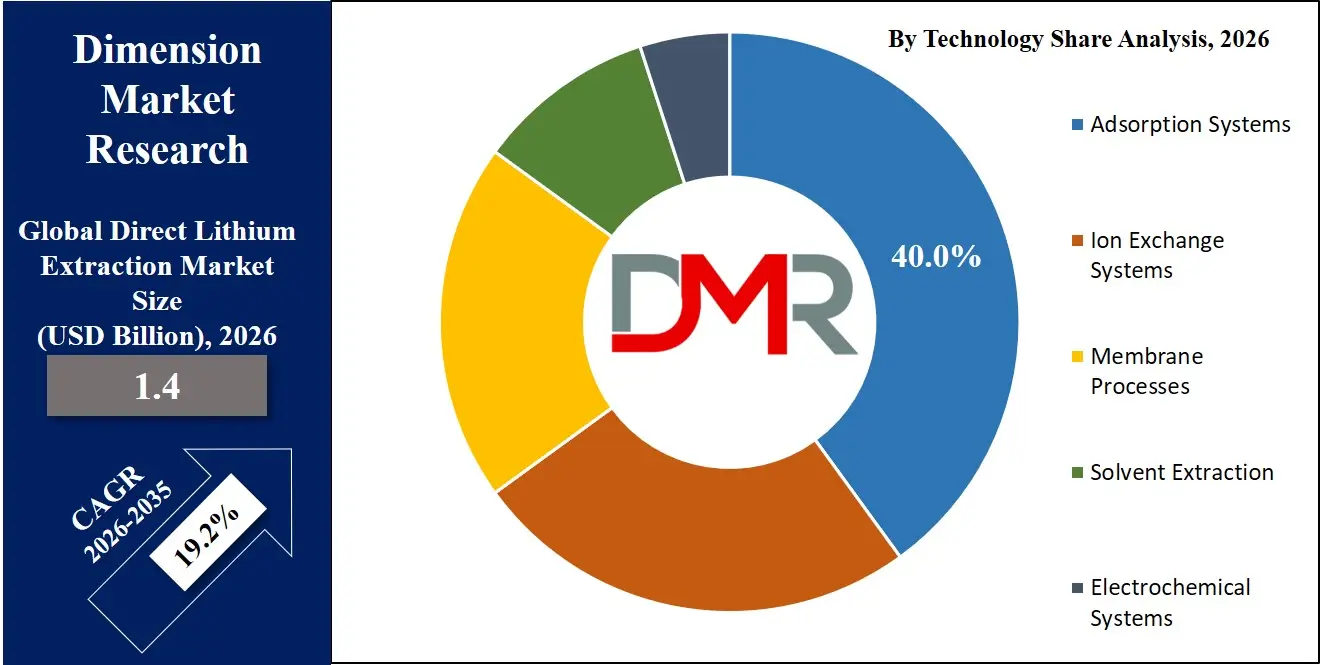
- By Technology, Adsorption Systems lead the segment with a share of 40.0%.
- By Deployment Model, Standalone DLE Plants account for the largest share at 45.0%.
- By Business Model, Build-Operate Systems hold the dominant position with a share of 38.0%.
- By Application, Battery Grade Lithium represents the leading segment with a share of 65.0%.
- By End-Use Industry, EV Manufacturing is the dominant sector, capturing a share of 40.0%.
- Leading players in the Direct Lithium Extraction market include Albemarle Corporation, SQM (Sociedad Química y Minera de Chile), and Rio Tinto.
US Direct Lithium Extraction Market
The US Direct Lithium Extraction (DLE) market is projected to reach USD 0.3 billion in 2026 and USD 1.5 billion by 2035 at an 18.0% CAGR.
ℹ
To learn more about this report –
Download Your Free Sample Report Here
The US Direct Lithium Extraction (DLE) market is expanding with the increase in need of EV batteries, energy storage, and security of domestic lithium supply. Lithium rich states such as Nevada and Arkansas are building pilot and commercial DLE projects being supported and financed by government. The market is motivated by the quest to decrease the reliance on imports and build the local supply chains. New technologies in adsorption, ion exchange, and membrane are enhancing efficiency in extraction. In general, America is becoming an important center of DLE innovation and commercialization.
Europe Direct Lithium Extraction Market
It is expected that Europe Direct Lithium Extraction Market will grow to USD 154 million in 2026 with a CAGR of 18.4. The development is catalyzed by the growing interest in the security of regional lithium supply and lessening the reliance on imports. The high policy backing of clean energy and the use of electric vehicles is driving up the need to extract lithium in a sustainable manner. Pilot projects in some countries such as Germany and France are also further enhancing the growth of the market owing to advancements in the DLE technologies.
Japan Direct Lithium Extraction Market
Japan Direct Lithium Extraction Market is expected to grow to USD 56.0 million in 2026 at a CAGR of 17.9%. The advanced battery manufacturing and electronics industries contribute to the growth as there is strong demand. Japan's interest in stable lithium supply chains is leading to investments in new extraction technologies. The growth of international partnerships with manufacturers of lithium and technology is also serving to bolster the market.
What is Direct Lithium Extraction?
Direct Lithium Extraction (DLE) is a technology that extracts lithium directly out of brine through adsorption, ion exchange and membrane technologies, rather than evaporation ponds. The International Energy Agency (IEA) reported that the demand of lithium is increasing due to the rapid increase in clean energy and electrification. DLE is efficient because it selectively removes lithium, and consumes less land and water. It also allows the economic recovery of low-grade brines. Its adoption is being encouraged by government energy strategies. All in all, DLE is a future-level approach to lithium production that is sustainable.
Use Cases
- Electric Vehicle Batteries: DLE supplies high-purity battery-grade lithium used in lithium-ion batteries for electric vehicles. It ensures stable and scalable lithium output to meet rising EV production demand. This supports faster electrification of passenger and commercial transport.
- Grid Energy Storage: DLE enables lithium supply for large-scale battery storage systems used in renewable energy integration. These systems help balance solar and wind power variability in power grids. It improves energy reliability and grid stability.
- Electronics Manufacturing: Lithium extracted through DLE is used in consumer electronics like smartphones, laptops, and wearables. It provides consistent quality lithium for compact, high-performance batteries. This supports continued growth in demand for portable devices.
- Industrial Chemical Production: DLE-derived lithium is used in producing lithium compounds for greases, glass, and ceramics. It ensures efficient sourcing of raw materials for industrial chemical processes. This helps industries maintain production efficiency and material quality.
How AI is transforming the Direct Lithium Extraction Market?
The Direct Lithium Extraction (DLE) market is evolving with AI, which is optimizing the analysis of the brine, increasing the yield prediction of lithium, and enhancing the efficiency of the separation process with the help of real-time data modeling. It allows smarter control of adsorption, ion exchange and membrane processes and consumes less energy and chemicals.
The monitoring systems based on AI also enhance operational reliability, as inefficiencies in the processes are recognized at an early stage. In general, AI is rendering DLE more efficient, scalable, and cost-effective to large-scale lithium production.
Brine Source Analysis
Salt Lake Brine will dominate the segment with a 45.0% share in 2026, given the concentration of lithium and large-scale extractions in other regions such as South America. It is stable in composition and therefore, it is very effective in the direct lithium extraction processes. Geothermal Brine is becoming a green source, allowing lithium to be recovered as well as renewable energy to be produced. It is less concentrated, but offers continuous flow and high environmental advantages. Combining these two sources, scalable and efficient lithium production.
Technology Analysis
Adsorption Systems will have 40.0% share of the technology segment in 2026 because of their high lithium ion selectivity, good recovery, and ability to process large volume of brine. These systems employ specialized sorbents which enable quicker and purer extraction than traditional technique.
ℹ
To learn more about this report –
Download Your Free Sample Report Here
Ion Exchange Systems are also popular and are based on the resin or inorganic media to selectively extract lithium in brine solutions. They are appreciated by flexibility and capacity to accommodate different brine compositions, but generally need additional steps in regeneration. The combination of the two technologies to constitute the essence of efficient and scalable direct lithium extraction processes.
Deployment Model Analysis
Standalone Direct Lithium Extraction plants are expected to capture around 45.0% of deployment in 2026 because they can be built as modular units directly at salt‑lake or geothermal brine sites, cutting the need for long pipelines and reducing logistics cost. DLE projects often target remote “Lithium Triangle” basins in Argentina, Bolivia, and Chile, where over 60% of global lithium reserves are located, making proximity to brine a key design factor. Standalone plants also ramp up faster than large integrated complexes, allowing operators to respond quickly to EV‑driven lithium demand and add capacity in scalable blocks.
Business Model Analysis
Build‑Operate systems are expected to take the largest business model share at 38.0% in 2026 because they reduce risk and upfront capital burden for lithium producers while still delivering bankable DLE capacity. In this model, specialized DLE operators design, finance, and run the plant, then sell lithium or extraction services under long‑term contracts, which fits well with the volatile but fast‑growing lithium market driven by EV batteries. As DLE is still an emerging technology, many miners prefer proven partners that can build and operate facilities end‑to‑end, accelerating project timelines and improving performance guarantees.
Application Analysis
Battery grade lithium is expected to capture about 65.0% of Direct Lithium Extraction applications in 2026 because almost all new lithium demand comes from rechargeable batteries for electric vehicles and energy storage systems. Industry data show that batteries already account for more than 80% of total lithium use, and lithium demand is forecast to grow by roughly 12% per year this decade, largely driven by battery manufacturing. DLE technologies are designed to produce high‑purity lithium solutions that can be refined into carbonate or hydroxide meeting battery‑grade specifications, so most new DLE capacity is naturally aligned to serve this fast‑growing battery segment.
End-Use Industry Analysis
EV manufacturing is expected to lead end‑use with around 40.0% share in 2026 because electric vehicles already represent the largest single source of lithium‑ion battery demand worldwide. The International Energy Agency reports that global nameplate lithium‑ion battery manufacturing capacity exceeded 4 TWh by the end of 2025, largely built to supply traction batteries for EVs. Analysis of lithium demand shows that automotive batteries account for roughly 60% of total lithium consumption today and are projected to keep growing as EV sales move toward more than 20–25 million units per year, reinforcing EV manufacturing as the main driver of DLE‑based lithium supply.
The Global Direct Lithium Extraction Market Report is segmented based on the following:
By Brine Source
- Salt Lake Brine
- Geothermal Brine
- Oilfield Brine
- Clay & Sediment Brine
- Other Brines
By Technology
- Adsorption Systems
- Ion Exchange Systems
- Membrane Processes
- Solvent Extraction
- Electrochemical Systems
By Deployment Model
- Standalone DLE Plants
- Integrated Mining Systems
- O-production Systems
By Business Model
- Build-Operate Systems
- Technology Licensing
- Engineering Services
- Equipment Supply
By Application
- Battery Grade Lithium
- Industrial Processing
- Chemical Production
- Pharma Grade Lithium
- Specialty Uses
By End-Use Industry
- EV Manufacturing
- Energy Storage Systems
- Chemical Industry
- Electronics
- Oil & Gas Sector
Regional Analysis
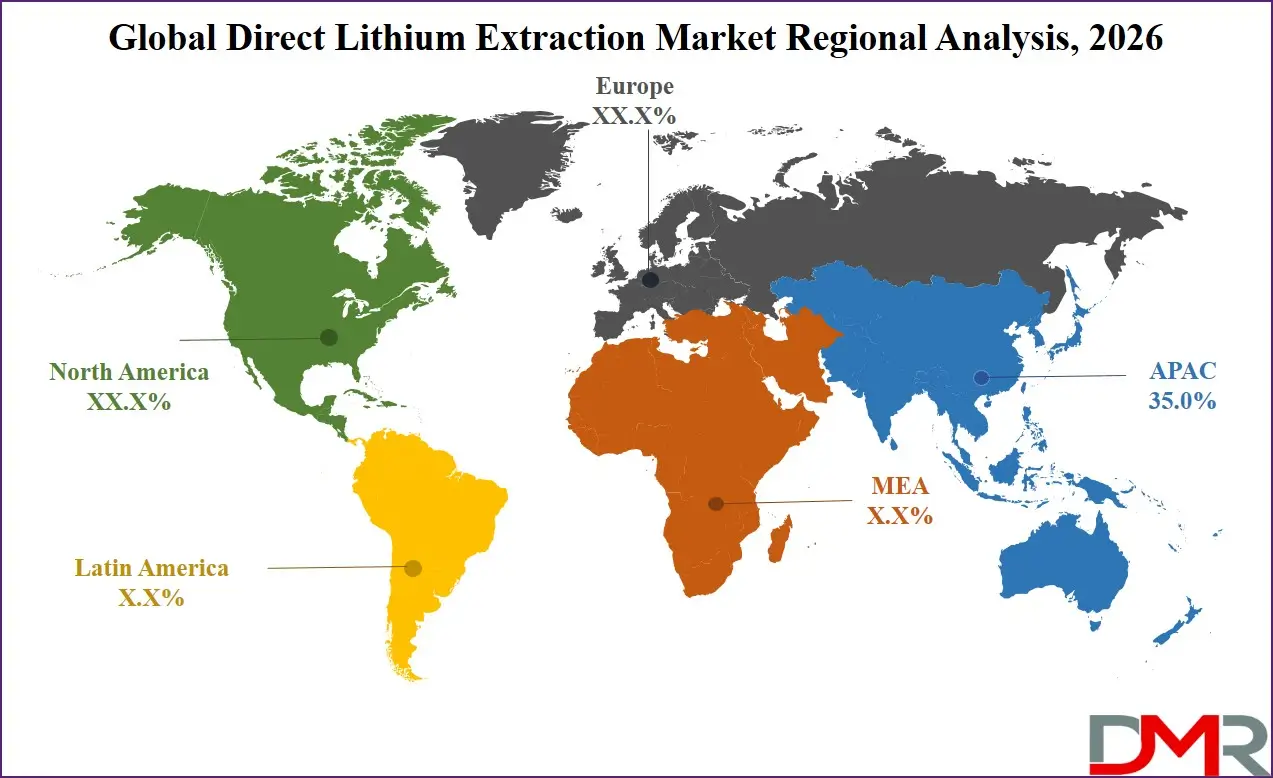
Asia Pacific is projected to dominate the market with a 35.0% market share in 2026 since it has a high lithium processing capacity and dominance in battery manufacturing. The most prominent countries in mining and refining of lithium are China and Australia. The rapid increase in the production of electric vehicles and energy storage systems also contributes to regional demand. The market leadership of the region is enhanced by supportive government policies and investments.
ℹ
To learn more about this report –
Download Your Free Sample Report Here
The fastest-growing regional market is North America, which is fueled by high domestic lithium supply chain investments and DLE commercialization. In the lithium-rich brine areas, the United States is on the vanguard with several pilot and large-scale projects. Market development is gaining pace due to governmental support of critical minerals and clean energy transition. There is further demand as EV production and energy storage is expanded, increasing the demand in the region.
By Region
North America
Europe
- Germany
- The U.K.
- France
- Italy
- Russia
- Spain
- Benelux
- Nordic
- Rest of Europe
Asia-Pacific
- China
- Japan
- South Korea
- India
- ANZ
- ASEAN
- Rest of Asia-Pacific
Latin America
- Brazil
- Mexico
- Argentina
- Colombia
- Rest of Latin America
Middle East & Africa
- Saudi Arabia
- UAE
- South Africa
- Israel
- Egypt
- Rest of MEA
Market Dynamics
Key Drivers in the Global Direct Lithium Extraction Market
Increased Battery Grade Lithium Demand.
The demand for high-purity lithium is rapidly rising due to the fast growth of electric cars. Renewable energy integration and energy storage systems are also contributing powerful incremental demand. The push to cleaner mobility by governments is driving quicker lithium consumption in different areas. This change in the structure is generating a long-term strain on lithium production technologies. Consequently, the adoption of DLE is increasing at a pace of satisfying the quality and volume requirements.
Improvement of the Extraction Systems in Technology.
Adsorption, ion exchange and membrane technologies are continuously being improved to increase lithium recovery. These innovations enable low-grade brines which were previously uneconomical to be extracted. Operations are also being enhanced by automation of processes and digital monitoring. DELE is becoming more commercially viable due to higher recovery rates. This is fostering large-scale pilot and commercial deployments around the world.
Restraints in the Global Direct Lithium Extraction Market
Expensive Capital and Operation
The initial investment in sophisticated processing systems and infrastructure in DLE projects is huge. The complexity of technology and the need to use energy make the operational costs high. The number of projects is still in pilot or early commercialization stages, which restricts economies of scale. This retards its popularization in economically sensitive areas. One of the major challenges to large-scale deployment is financial viability.
Lack of Commercial Maturity of Technology
The industry has not yet adopted most of the DLE technologies which are not fully standardized. The performance is different with the brine composition and location conditions. It is still technical to scale up pilot to industrial operations. This leaves investors and operators in doubt. Consequently, the rate of commercialization is low as compared to traditional lithium mining processes.
Growth Opportunities in the Global Direct Lithium Extraction Market
Development of untapped brine resources
Geothermal and oilfield as well as low-grade brines have large lithium reserves that are not fully utilized in the world. DLE allows economic recovery of these sources which were not economically viable. This greatly increases the world base of lithium. These unconventional resources are being actively investigated by countries to obtain domestic supply security. It introduces new geographic and resource diversification to the market.
Government Support of Critical Minerals
Lithium is emerging as a strategic critical mineral in the energy transition in many governments. The development of DLE is being hastened by policy incentives, funding programs and pilot project support. Localizing supply chain activities is boosting investments in home country extraction technology. This lessens reliance on imports and enhances energy security. This regulatory support is generating robust market growth prospects in the long-term.
Trends in the Global Direct Lithium Extraction Market
AI and Digital Monitoring
There is a growing application of artificial intelligence in order to optimize the lithium recovery processes. Monitoring systems enable real-time performance and minimise operation losses. Predictive analytics assists in controlling the variability of the brine and process stability. Human intervention is being minimized and scalability is being enhanced through automation. This is ensuring that operations of DLE are becoming smarter and economical.
Move to Low-Carbon Lithium Production
Sustainability is emerging as a big concern throughout the lithium value chain. DLE is becoming popular because it has a lesser environmental footprint than evaporation techniques. Businesses are focusing on water conservation and less land disturbance. Technology adoption decisions are being affected by carbon reduction targets. The tendency is making DLE a preferred method of extraction in the future.
Competitive Landscape
The competitive environment is typified by the combination of new technology suppliers and the old resource players in scalable DLE solutions. Businesses are competing based on efficiency in extraction, cost reduction, and flexibility to various brine compositions. The most effective ways of achieving commercialization are strategic alliances, pilot programs, and technology licensing. Long-term competitive positioning is being influenced by continuous innovation and sustainability-driven developments.
Some of the prominent players in the Global Direct Lithium Extraction Market are:
- Albemarle Corporation
- SQM (Sociedad Química y Minera de Chile)
- Rio Tinto
- Eramet
- Livent Corporation
- Standard Lithium
- Lilac Solutions
- EnergyX
- Summit Nanotech
- Adionics
- International Battery Metals (IBAT)
- Koch Technology Solutions
- Sunresin New Materials
- POSCO Holdings
- CleanTech Lithium
- E3 Lithium
- Lake Resources
- Anson Resources
- Controlled Thermal Resources
- American Battery Materials
- Other Key Players
Recent Developments
- March 2026: LibertyStream initiated construction of a new DLE-based lithium production facility in Texas, integrating extraction and refining systems for scalable output.
- March 2026: Albemarle began environmental review for a large-scale DLE project in Chile aimed at doubling lithium recovery while reducing brine usage.
- July 2025: EnergyX acquired Daytona Lithium to expand its lithium resource base and strengthen DLE capabilities.
- March 2025: Rio Tinto completed the acquisition of Arcadium Lithium for USD 6.7 billion to expand its lithium production portfolio.
- February 2025, Project ATLiS secured a $1.36 billion DOE loan commitment to deploy its piloted ILiAD DLE technology. The project will tap the Salton Sea geothermal area, which prior DOE assessments proved contains over 4 million metric tons of lithium, enough for 10,000 GWh of battery capacity.
- January 2025 - The Department of Energy issued a conditional loan commitment of up to $1.36 billion to EnergySource Minerals LLC. Funds will finance construction of the Imperial County ATLiS facility in California.
- May 2025 - Argentina approved Rio Tinto's $2.5 billion expansion of the Rincon Lithium Project in Salta Province. The DLE facility targets 60,000 tonnes per year of battery-grade lithium carbonate.
Report Details
| Report Characteristics |
| Market Size (2026) |
USD 1.4 Bn |
| Forecast Value (2035) |
USD 7.0 Bn |
| CAGR (2026–2035) |
19.2% |
| Historical Data |
2021 – 2025 |
| Forecast Data |
2027 – 2035 |
| Base Year |
2025 |
| Estimate Year |
2026 |
| Segments Covered |
By Brine Source (Salt Lake Brine, Geothermal Brine, Oilfield Brine, Clay & Sediment Brine, Other Brines),
By Technology (Adsorption Systems, Ion Exchange Systems, Membrane Processes, Solvent Extraction, Electrochemical Systems),
By Deployment Model (Standalone DLE Plants, Integrated Mining Systems, Co-production Systems),
By Business Model (Build-Operate Systems, Technology Licensing, Engineering Services, Equipment Supply),
By Application (Battery Grade Lithium, Industrial Processing, Chemical Production, Pharma Grade Lithium, Specialty Uses),
By End-Use Industry (EV Manufacturing, Energy Storage Systems, Chemical Industry, Electronics, Oil & Gas Sector) |
| Regional Coverage |
North America – The US and Canada;
Europe – Germany, The UK, France, Russia, Spain, Italy, Benelux, Nordic, & Rest of Europe;
Asia-Pacific – China, Japan, South Korea, India, ANZ, ASEAN, Rest of APAC;
Latin America – Brazil, Mexico, Argentina, Colombia, Rest of Latin America;
Middle East & Africa – Saudi Arabia, UAE, South Africa, Turkey, Egypt, Israel, & Rest of MEA |
Frequently Asked Questions
How big is the Direct Lithium Extraction Market?
▾ The Direct Lithium Extraction (DLE) market is projected to be valued at USD 1.4 billion in 2026 and is projected to reach USD 7.0 billion by 2035.
What is the CAGR of the Direct Lithium Extraction Market from 2026 to 2035?
▾ The market is expected to grow at a CAGR of 19.2% during the forecast period.
What factors are driving the growth of the Direct Lithium Extraction Market?
▾ Growth is driven by rising demand for battery-grade lithium, rapid expansion of electric vehicles and energy storage systems, and increasing adoption of sustainable brine extraction technologies.
What are the major trends in the Direct Lithium Extraction Market?
▾ Key trends include adoption of low-carbon lithium extraction, integration of AI and automation, and increasing focus on unconventional brine resources.
Which region held the largest share of the Direct Lithium Extraction Market in 2026?
▾ Asia Pacific held the largest share in 2026, with a market share of 35.0%.
Which region is expected to grow the fastest in the Direct Lithium Extraction Market?
▾ North America is expected to be the fastest-growing region.
Who are the key players in the Direct Lithium Extraction Market?
▾ Albemarle Corporation, SQM (Sociedad Química y Minera de Chile), Rio Tinto, Eramet, Livent Corporation, Standard Lithium, Lilac Solutions, EnergyX, Summit Nanotech, Adionics, International Battery Metals (IBAT), Koch Technology Solutions, Sunresin New Materials, POSCO Holdings, CleanTech Lithium, E3 Lithium, Lake Resources, Anson Resources, Controlled Thermal Resources, American Battery Materials, Other Key Players.
How is the Direct Lithium Extraction Market segmented?
▾ By Brine Source, By Technology, By Deployment Model, By Business Model, By Application, By End-Use Industry.