What is the Directed Energy Weapons Market Size?
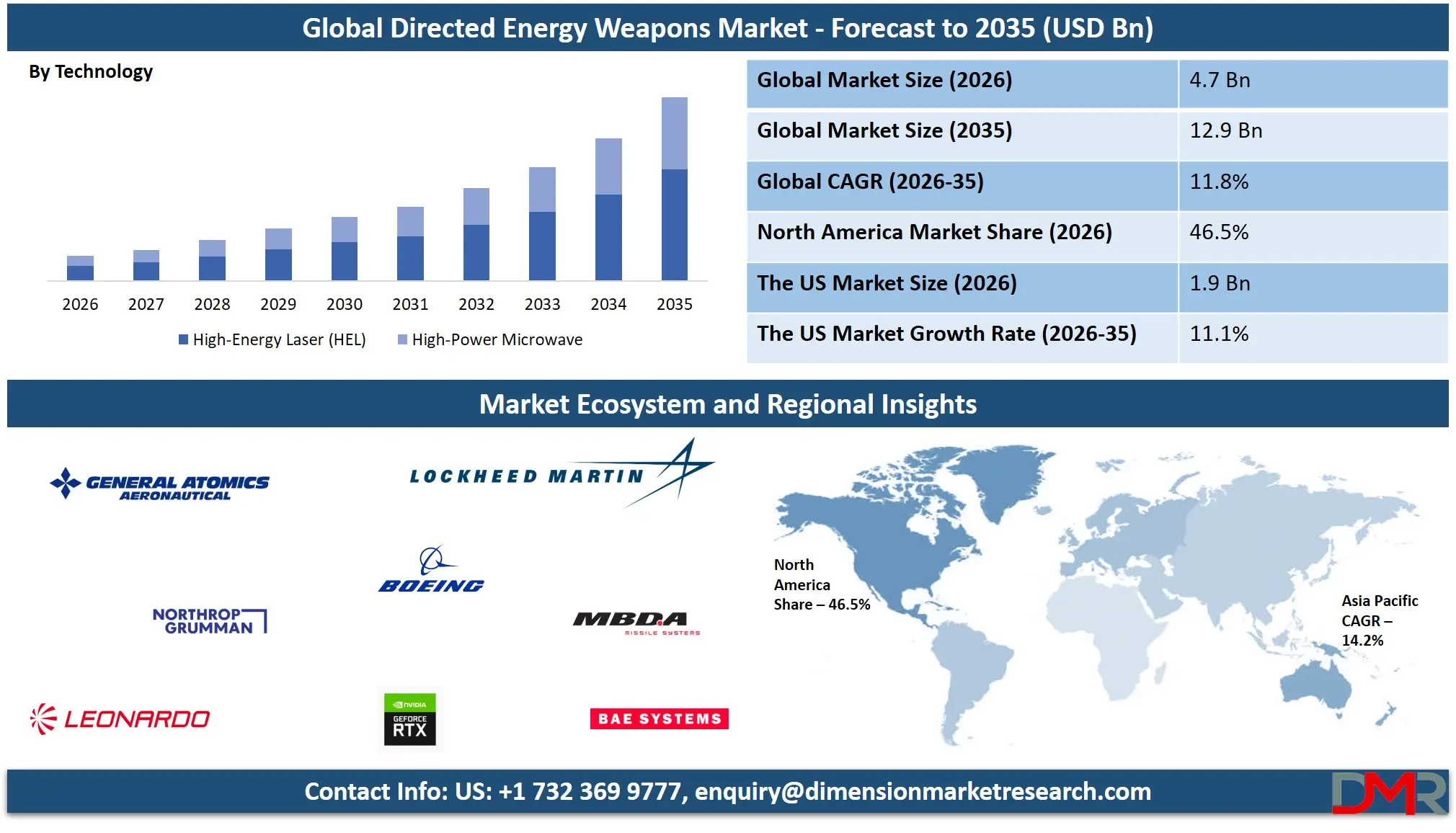
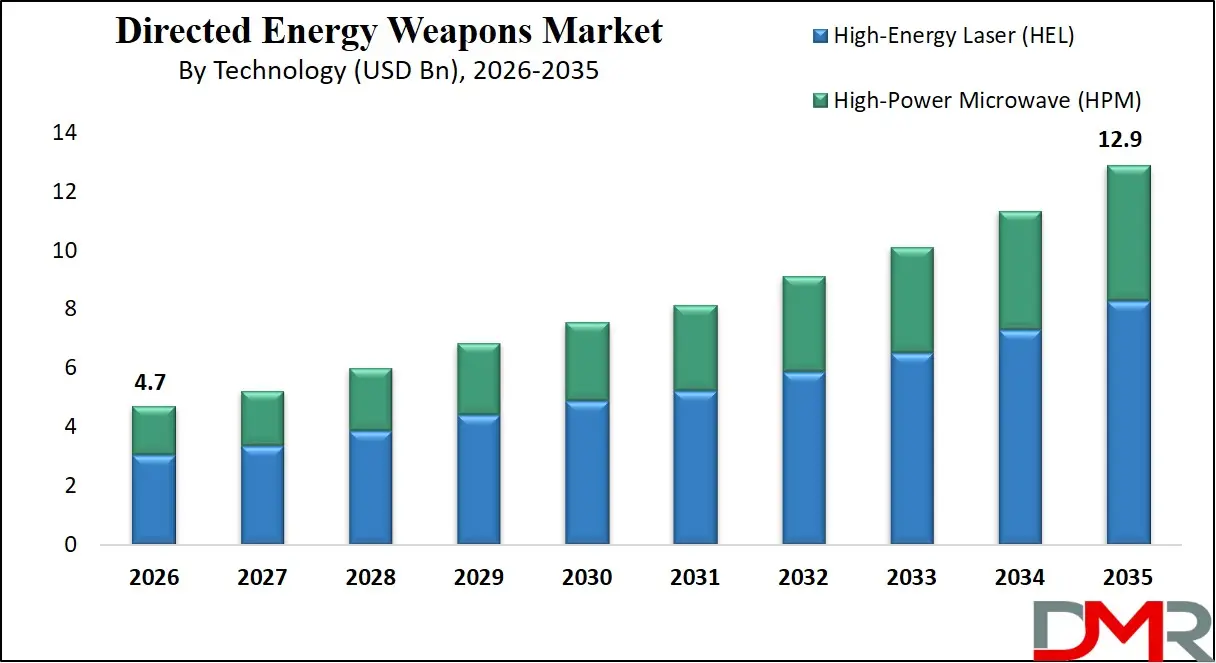
The Directed Energy Weapons Market size is expected to be USD 4.7 billion in 2026 and increase at a compound annual growth rate of 11.8% to USD 12.9 billion in 2035 due to the growing use of renewable energy sources like solar and wind.
ℹ
To learn more about this report –
Download Your Free Sample Report Here
In the Directed Energy Weapons market, there is substantial growth due to modernization initiatives within the military, the rise of geopolitical tensions, and technological breakthroughs in lasers and microwaves. Governments around the world are developing new weapons systems that allow for better targeting and minimize unintended damage. Other factors affecting the Directed Energy Weapons market are the need for affordable weapons and reduced logistics. Future developments will involve artificial intelligence, miniaturization, and use in various platforms like land-based, sea, and aircrafts.
ℹ
To learn more about this report –
Download Your Free Sample Report Here
The US Directed Energy Weapons Market
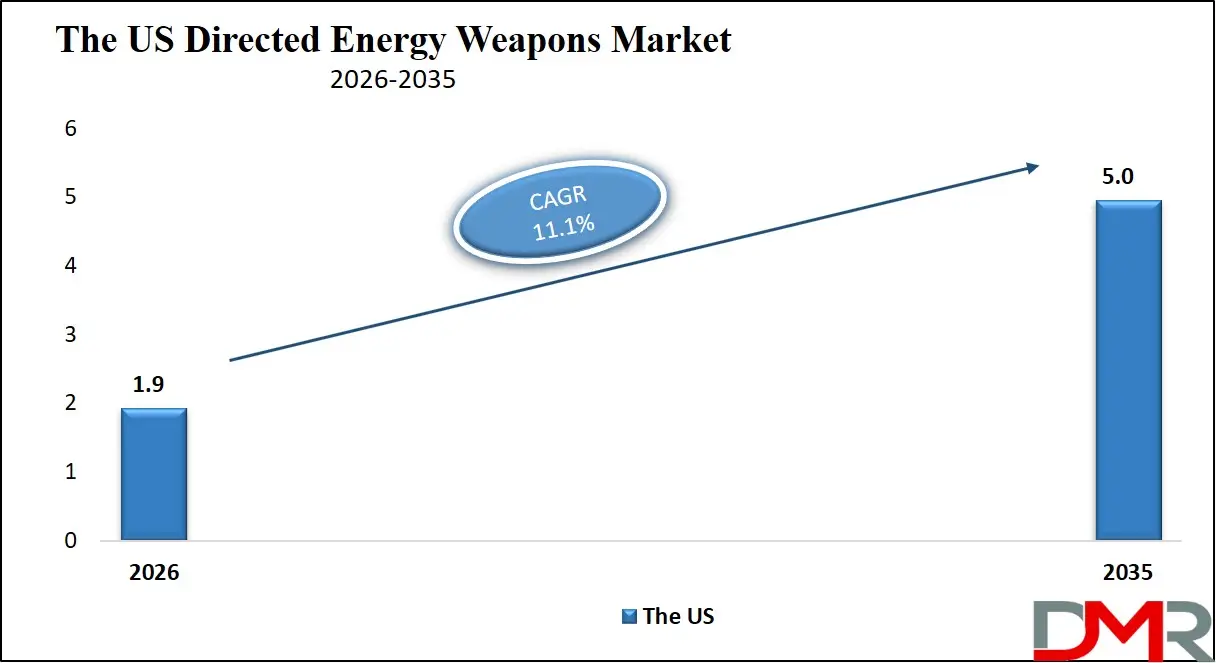
The US Directed Energy Weapons Market size is estimated to be USD 1.9 billion in 2026 and is expected to increase at a CAGR of 11.1% over the forecast period.
ℹ
To learn more about this report –
Download Your Free Sample Report Here
The market in the US is propelled by high levels of expenditure on defense, research and development activities, and participation of defense organizations. The government's effort to promote laser technology in various military sectors through different programs is increasing rapidly. Regulations and policies on defense modernization play an important role in encouraging innovations.
Europe Directed Energy Weapons Market
The Europe Directed Energy Weapons Market size is estimated to be USD 1.0 billion in 2026 and at a CAGR of 11.6% over the forecast period.
The market environment in Europe is defined by regional collaboration in defense matters and policies that foster innovation. Efforts aimed at fostering sustainability and advanced capabilities within the defense sector have been instrumental in fueling adoption. Nations are currently working on incorporating DEWs into their naval and terrestrial forces through defense collaborations. Growth is being fueled by regulatory frameworks and partnerships across borders.
Japan Directed Energy Weapons Market
The market size of Japan's Directed Energy Weapons will be USD 188 million in 2026, with a CAGR of 11.5% in the forecast period.
Japan's market is growing because of increased defense budget spending and the country's concern for its own security. The government is pushing programs that will promote the development of sophisticated weaponry and self-sufficiency. In addition, Japan's industrial power and rapid urbanization will help to facilitate innovations in small yet efficient DEWs.
Key Takeaways
- Market Size & Forecast: The Directed Energy Weapons Market size is projected to reach USD 4.7 billion in 2026 and is anticipated to have a value of USD 12.9 billion in 2035.
- Growth Rate & Outlook: The Directed Energy Weapons Market size is set to grow at a compound annual growth rate of 11.8% during the forecast period of 2026 to 2035.
- Primary Growth Drivers: Some of the major growth drivers in the market include technological advancements in energy systems, the increasing demand for cost-effective defense solutions, and more.
- Key Market Trends: Some of the major trends in the market are integration of artificial intelligence and automation, miniaturization and mobility of systems, and more.
- By Technology: The high-energy laser segment is anticipated to get the majority share of the Directed Energy Weapons market in 2026.
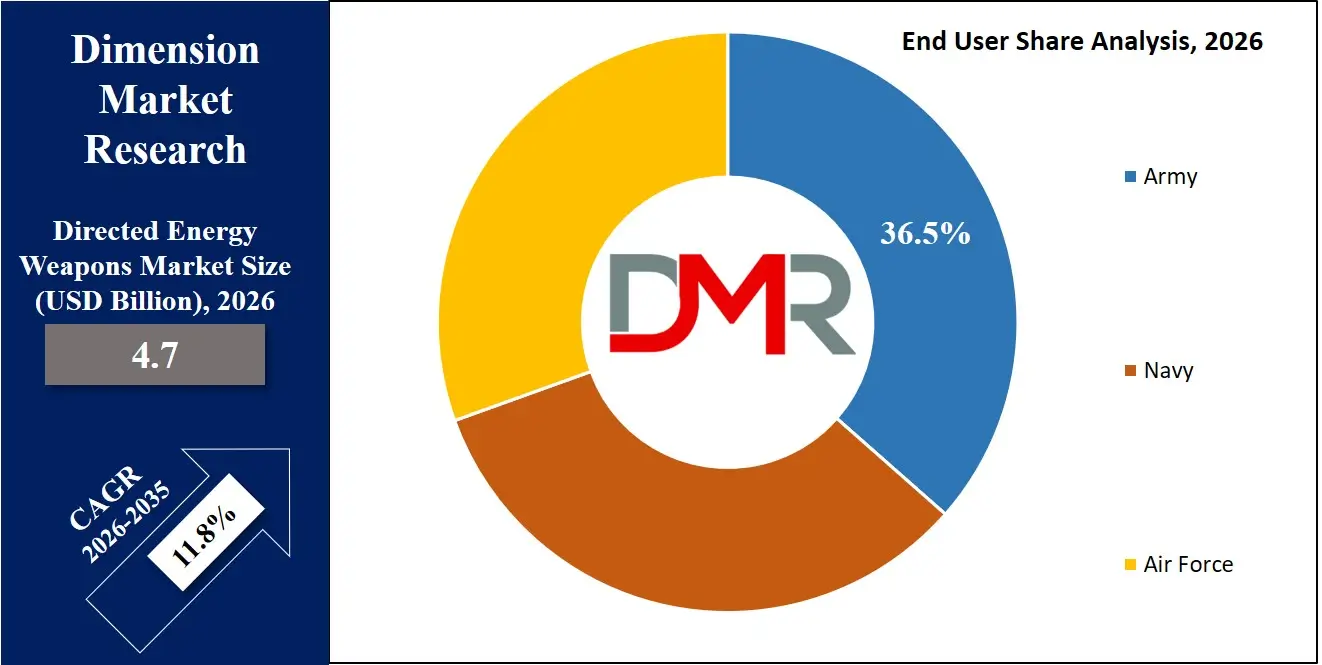
- By End User: The army segment is expected to get the largest revenue share in 2026 in the Directed Energy Weapons market.
- By Power Output: The 50-150 kW segment is expected to get the largest revenue share in 2026 in the Directed Energy Weapons market.
- Regional Leadership: North America is set to lead the Directed Energy Weapons market with an estimated 46.5% share in 2026.
What is the Directed Energy Weapons?
Directed Energy Weapons (DEWs) refer to high-end warfare systems used to deploy energy, such as laser beams, microwave or particle beams, onto enemy targets. The systems are built to emit directed energy and not to fire physical missiles. Major elements in DEWs include energy source, beam control, and target acquisition and tracking technology. Directed Energy Weapons have gained popularity owing to their precision, fast engagement at the speed of light, relatively low cost of engagement per missile fired, and reduced collateral damage.
Use Cases
- Missile Interception: Directed energy weapons are used to neutralize incoming missiles by targeting them at the speed of light, reducing response time and improving defense efficiency.
- Counter-Drone Operations: DEWs effectively disable unmanned aerial systems with precision, making them ideal for protecting sensitive zones and military bases.
- Naval Defense Systems: Ships utilize DEWs for maritime security, offering cost-effective protection against aerial and surface threats.
- Battlefield Tactical Support: Ground forces deploy DEWs for precise targeting, minimizing collateral damage and enhancing operational control in combat scenarios.
How AI Is Transforming the Directed Energy Weapons Market
AI has revolutionized directed energy weapon technology through advanced targeting mechanisms, real-time threat evaluation, and automation of decision-making processes. Through analyzing huge amounts of data from sensors, the use of AI in this technology ensures accuracy while engaging enemy targets in challenging environments.
Moreover, AI technology helps in improving the efficiency and effectiveness of DEWs in terms of maintenance, optimization, and adaptive capability against changing scenarios.
Market Dynamic
Driving Factors in the Directed Energy Weapons Market
Technological Advancements in Energy Systems
Laser efficiency, scaling in power generation, and thermal management capabilities are rapidly advancing. This results in more efficient and robust DEWs that can be mounted on a range of platforms. The improved accuracy and lower cost have made DEWs an attractive option compared to conventional weaponry.
Increasing Demand for Cost-Effective Defense Solutions
Directed energy weapons provide a cheaper cost per shot than their traditional counterparts; thus, they are financially sustainable. The reduction in logistical challenges and scalability of these weapons makes them sustainable for consistent use. Directed energy weapons are especially cost-effective for use in anti-drone and anti-missile applications.
Restraints in the Directed Energy Weapons Market
High Initial Development and Deployment Costs
While it offers significant economic advantages, the high initial capital cost of DEWs remains a critical drawback. The high cost of research and development, the infrastructure needed, and the sophistication involved in technology make it difficult to deploy on a broad scale.
Technical and Environmental Limitations
The performance of directed energy weapons may be impacted by environmental conditions like weather, atmospheric conditions, and range limitations. Furthermore, difficulties in storing energy and maintaining beam stability limit their efficiency. Such constraints impede their effectiveness in some military operations.
Opportunities in the Directed Energy Weapons Market
Expansion into Multi-Domain Defense Applications
There is increasing attention being given to using DEWs in conjunction with land-based, naval, and airborne assets. The flexible and scalable nature of such weapons enables their deployment on a single system in all areas of operation.
Government Support and Strategic Defense Programs
Greater investments from the government and defense programs that emphasize modernization are providing new opportunities for market growth. Security-driven strategies that seek to enhance national security are hastening the adoption of state-of-the-art DEW systems.
Trends in the Directed Energy Weapons Market
Integration of Artificial Intelligence and Automation
The application of AI technology to DEWs has increased their ability to target accurately and detect threats. The use of automated decision-making improves speed and decreases human involvement, increasing system effectiveness.
Miniaturization and Mobility of Systems
With the emergence of advances in technology, there is potential for the creation of smaller and more portable DEW. This will allow for better use in mobile and unmanned operations.
Research Scope and Analysis
By Technology Type Analysis
The High-Energy Laser (HEL) technology is a major player in the market and is projected to account for nearly 64.3% of the market share by 2026 owing to their precise and scalable nature as well as widespread usage in military applications. The use of solid-state and fiber lasers is prominent since both are energy-efficient and reliable. HELs have a large number of applications in missiles and counter-drone activities. However, the High-Power Microwaves (HPMs) segment holds the highest growth rate because they are highly effective against unmanned aerial vehicles.
By Platform Analysis
Platforms on land will be the most preferred by the year 2026 with an expected 41.8% market share because of their easy installation, integration efficiency, and high utility in ground defense applications. The military finds it more convenient to employ land platforms for border defense. However, the fastest growing segment in the DEW platforms industry is the airborne segment because of the rapid increase in the integration of DEWs in fighter aircraft and unmanned air vehicles.
By Application Analysis
The application of DEWs in missile defense is most prominent, accounting for about 38.6% in 2026. The need for speedy counter measures that can effectively respond to highly agile missiles makes it necessary for countries to adopt such technologies. Counter-drone applications represent another emerging area with an increase in threat from drones around the world. Battlefield use and maritime applications represent areas of expansion in the DEWs market.
By End User Analysis
The largest market share will belong to the army segment owing to their extensive usage of DEWs in ground warfare and defense, with an estimated value of 36.9% in 2026. The flexibility and portability of DEWs have proven advantageous for armies around the world. The most rapidly growing market will be that of the air force owing to the use of DEWs in aircrafts.
ℹ
To learn more about this report –
Download Your Free Sample Report Here
By Power Output Analysis
The power range of 50-150 kW is expected to dominate the market, accounting for about 44.7% of the market share in 2026, as the power range provides a combination of energy efficiency and effectiveness of operations. The application range is mainly seen in missile defense and drone combat missions. The power range above 150 kW is anticipated to grow at the fastest pace owing to the growing preference for high-energy laser technology.
The Directed Energy Weapons Market Report is segmented on the basis of the following:
By Technology Type
- High-Energy Laser (HEL)
- Solid-State Laser
- Fiber Laser
- High-Power Microwave (HPM)
- Narrowband
- Ultra-Wideband
By Platform
By Application
- Missile Defense
- Counter-UAS
- Battlefield Operations
- Maritime Security
By End-User
By Power Output
Regional Analysis
Leading Region in the Directed Energy Weapons Market
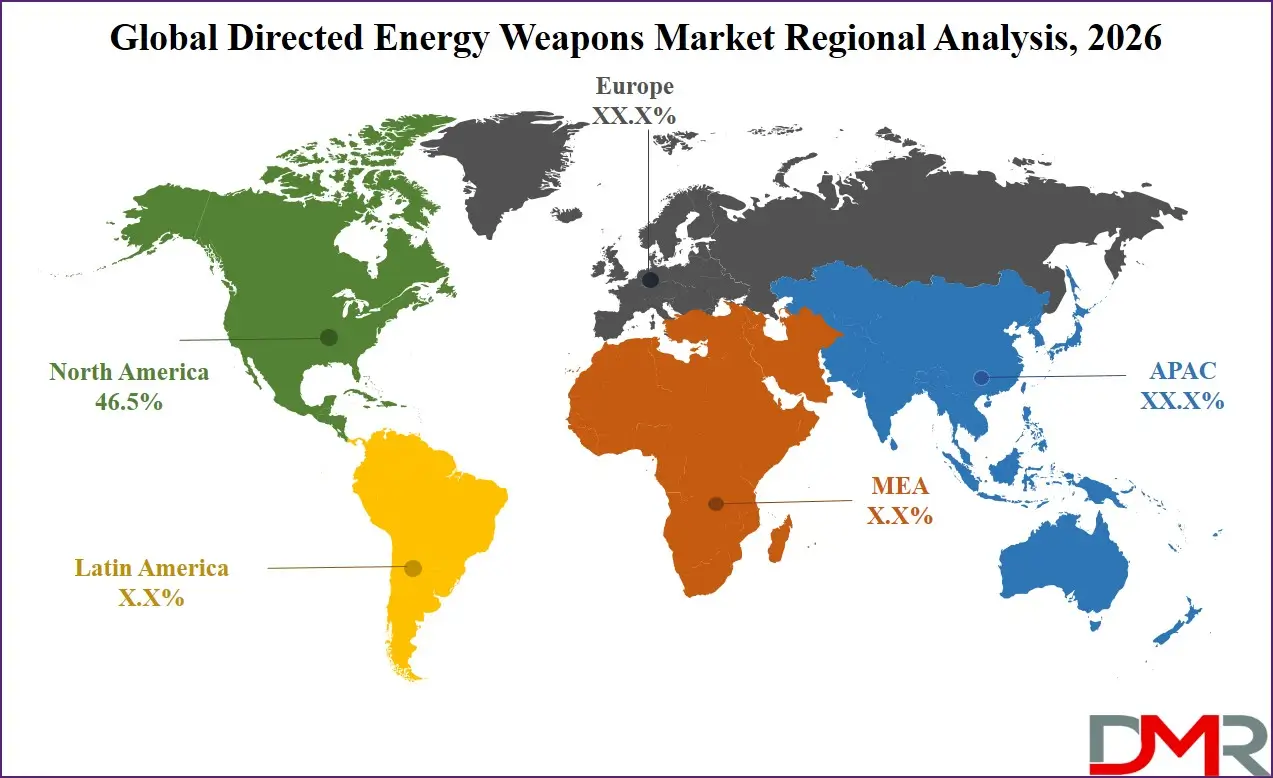
The North American region is anticipated to hold the largest market share of about 46.5% in 2026 owing to high budget allocations for defense spending, advanced infrastructure, and significant Research & Development activities. This regional market enjoys constant government support and military dominance strategies that contribute toward its dominance. Adoption of directed energy weapons within different defense forces, including ground, maritime, and air forces, helps to bolster the pace of implementation. Moreover, established defense ecosystem, availability of test centers, and the use of next-gen technologies further solidify its dominant status.
ℹ
To learn more about this report –
Download Your Free Sample Report Here
Fastest Growing Region in the Directed Energy Weapons Market
The fastest growing region for the Directed Energy Weapons market is Asia-Pacific owing to several factors including rising defense spending, geopolitical tensions, and technological developments. There are efforts by nations in the region to focus on military upgrades that will boost their national security. The support from governments towards developing domestic weapons manufacturing and technological innovations will fuel growth in the coming years. Other key factors driving development include growing investments into the development of weapons industry and greater cooperation between the private and government sectors. There is also increased concern about regional wars and border issues, leading to investments in innovative weapon technology.
By Region
North America
Europe
- Germany
- The U.K.
- France
- Italy
- Russia
- Spain
- Benelux
- Nordic
- Rest of Europe
Asia-Pacific
- China
- Japan
- South Korea
- India
- ANZ
- ASEAN
- Rest of Asia-Pacific
Latin America
- Brazil
- Mexico
- Argentina
- Colombia
- Rest of Latin America
Middle East & Africa
- Saudi Arabia
- UAE
- South Africa
- Israel
- Egypt
- Rest of MEA
Competitive Landscape
The Directed Energy Weapons industry exhibits high barriers to entry because of the substantial financial outlay needed and technical know-how. Companies have been known to make consistent research and development expenditures, form alliances, and pursue government contracts in order to build market presence. Improvement in energy efficiency and integration technology serves as an advantage. Development timelines and regulatory approvals are factors that affect competitiveness, while cooperation with defense organizations is vital for sustained growth.
Some of the prominent players in the global Directed Energy Weapons are:
- Lockheed Martin Corporation
- RTX Corporation
- Northrop Grumman Corporation
- The Boeing Company
- BAE Systems plc
- Thales Group
- Leonardo S.p.A
- Rheinmetall AG
- Rafael Advanced Defense Systems Ltd.
- Elbit Systems Ltd.
- L3Harris Technologies Inc.
- Honeywell International Inc.
- QinetiQ Group plc
- General Atomics
- MBDA
- Kratos Defense & Security Solutions Inc.
- Dynetics Inc.
- Leidos Inc.
- Textron Inc.
- Moog Inc.
- Other Key Players
Recent Developments
- In April 2026, AeroVironment successfully demonstrated its LOCUST® Laser Weapon System aboard the USS George H.W. Bush (CVN-77) in collaboration with the United States Navy and Rapid Capabilities and Critical Technologies Office. The system tracked and neutralized multiple drones, validating its platform-agnostic capability across land, sea, and mobile defense environments.
- In March 2026, Iron Beam has reportedly seen its first combat use, intercepting rockets and drones amid escalating conflict. Developed by Rafael Advanced Defense Systems and Elbit Systems, it highlights a shift toward cost-efficient directed energy weapons. The development has also increased focus on Project KALI, emphasizing next-generation high-speed defense technologies.
- In December 2025, Apollo Micro Systems received approval from Defence Research and Development Organisation to access Directed Energy Weapon technologies. The transfer includes laser-based DEW systems and EO tracking systems, boosting its defence capabilities. Following the announcement, the company's shares surged, hitting the 5% upper circuit on the Bombay Stock Exchange.
Report Details
| Report Characteristics |
| Market Size (2026) |
USD 4.7 Bn |
| Forecast Value (2035) |
USD 12.9 Bn |
| CAGR (2026–2035) |
11.8% |
| Historical Period |
2021 – 2025 |
| Forecast Period |
2027 – 2035 |
| Base Year |
2025 |
| Estimate Year |
2026 |
| Segments Covered |
By Technology Type (High-Energy Laser (HEL) and High-Power Microwave (HPM)), By Platform (Land, Naval, and Airborne), By Application (Missile Defense, Counter-UAS, Battlefield Operations, and Maritime Security), By End-User (Army, Navy, and Air Force), By Power Output (<50 kW, 50–150 kW, and 150 kW) |
| Regional Coverage |
North America – The US and Canada; Europe – Germany, The UK, France, Russia, Spain, Italy, Benelux, Nordic, & Rest of Europe; Asia-Pacific – China, Japan, South Korea, India, ANZ, ASEAN, Rest of APAC; Latin America – Brazil, Mexico, Argentina, Colombia, Rest of Latin America; Middle East & Africa – Saudi Arabia, UAE, South Africa, Turkey, Egypt, Israel, & Rest of MEA |
Frequently Asked Questions
How big is the Directed Energy Weapons Market?
▾ The Directed Energy Weapons Market size is expected to reach USD 4.7 billion by 2026 and is projected to reach USD 12.9 billion by the end of 2035.
What is the CAGR of the Directed Energy Weapons Market from 2026 to 2035?
▾ The market is growing at a CAGR of 11.8 percent over the forecasted period.
What factors are driving the growth of the Directed Energy Weapons Market?
▾ Technological advancements in energy systems, the increasing demand for cost-effective defense solutions, and other factors are driving the growth of the Directed Energy Weapons Market.
What are the major trends in the Directed Energy Weapons Market?
▾ Integration of artificial intelligence and automation, miniaturization and mobility of systems, and more are some of the major trends in the market.
Who are the key players in the Directed Energy Weapons Market?
▾ Some of the key players in the Directed Energy Weapons Market include RTX, Boeing, Thales, and more
How is the Directed Energy Weapons Market segmented?
▾ The Directed Energy Weapons Market is segmented by technology type, platform, application, end-user, and power output.
Which region held the largest share of the Directed Energy Weapons Market in 2026?
▾ North America is set to lead the Directed Energy Weapons market with an estimated 46.5% share in 2026.
Which region is expected to grow the fastest in the Directed Energy Weapons Market?
▾ Asia-Pacific is the fastest-growing region in the Directed Energy Weapons market during the forecast period.