Market Overview
The global Dissolved Air Flotation (DAF) unit market covers pressurized water treatment systems that inject microbubbles to float suspended solids, fats, oils, grease, and fine particulates to the surface for removal. DAF units serve industrial effluent pretreatment, municipal wastewater polishing, food processing discharge management, oil and gas produced-water conditioning, and process-water recycling. The market excludes conventional gravity sedimentation, chemical precipitation-only systems, and biological treatment units unless integrated with a DAF stage.
DAF occupies a critical position within the broader water and wastewater treatment equipment industry. Regulators worldwide are tightening discharge limits for total suspended solids and phosphorus, making DAF the preferred pretreatment choice ahead of biological stages. A 2025 pilot-scale study published on ScienceDirect confirmed that DAF achieved up to 67.5% total chemical oxygen demand removal when treating anaerobic secondary effluent, demonstrating measurable load reduction before downstream biological treatment.
Manufacturers increasingly embed DAF into closed-loop water recycling programs and hybrid treatment trains. Buyers in space-constrained facilities choose DAF specifically because compact pressure vessels deliver high hydraulic throughput within a smaller physical footprint than gravity clarifiers. That operational advantage, combined with stricter effluent enforcement, positions DAF units as non-discretionary capital spending rather than optional upgrades.
Key Takeaways
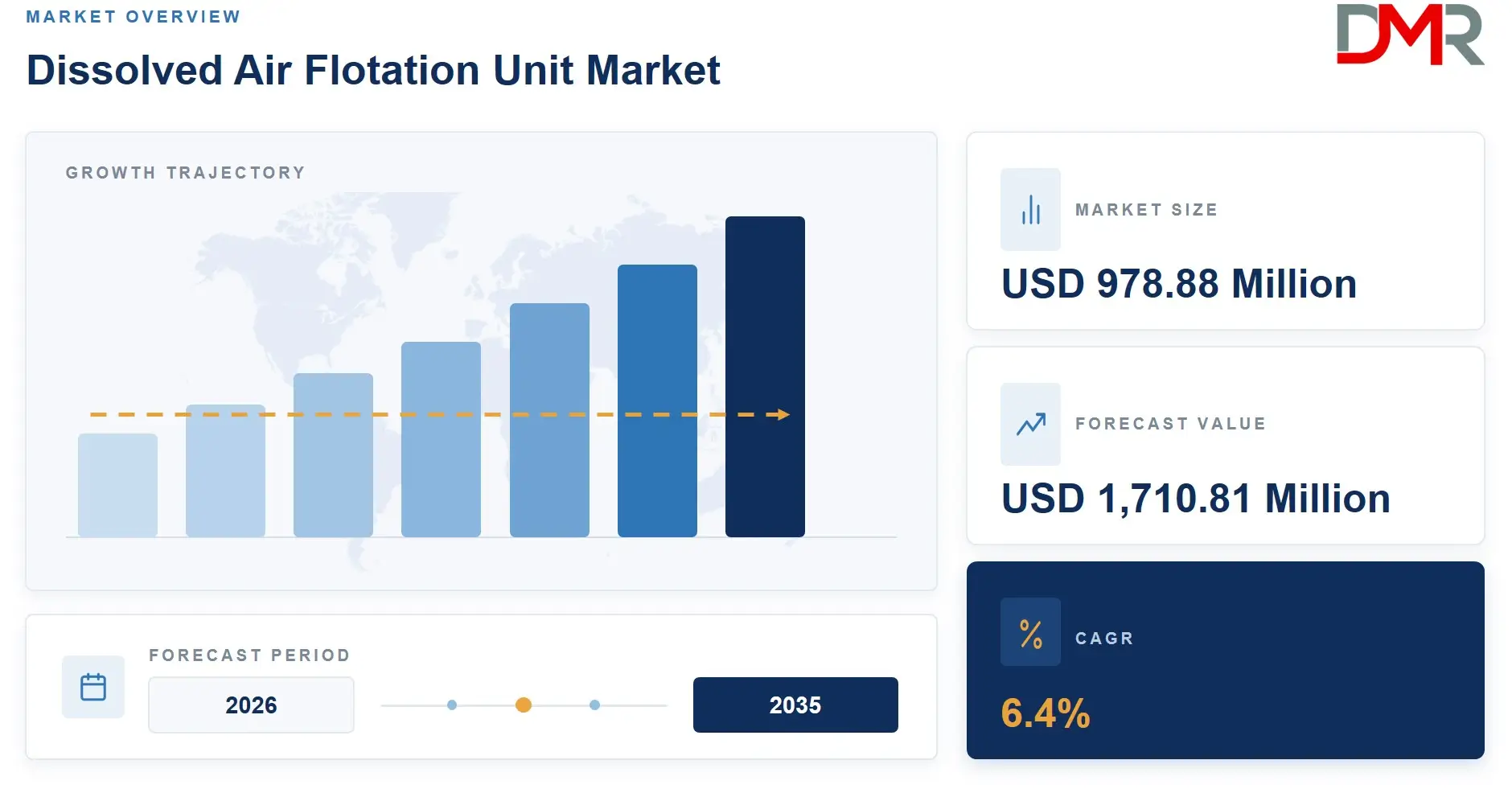
- The market size is USD 978.88 Million in 2026, and is projected to hit USD 1,710.81 Million by 2035 at a CAGR of 6.4%.
- By Type (System Configuration): Full-Flow Pressure Flotation Systems led with a 40% share in 2025.
- By Capacity (Flow Rate): Less Than 20 m³/hour led as the largest category with a 50% share in 2025.
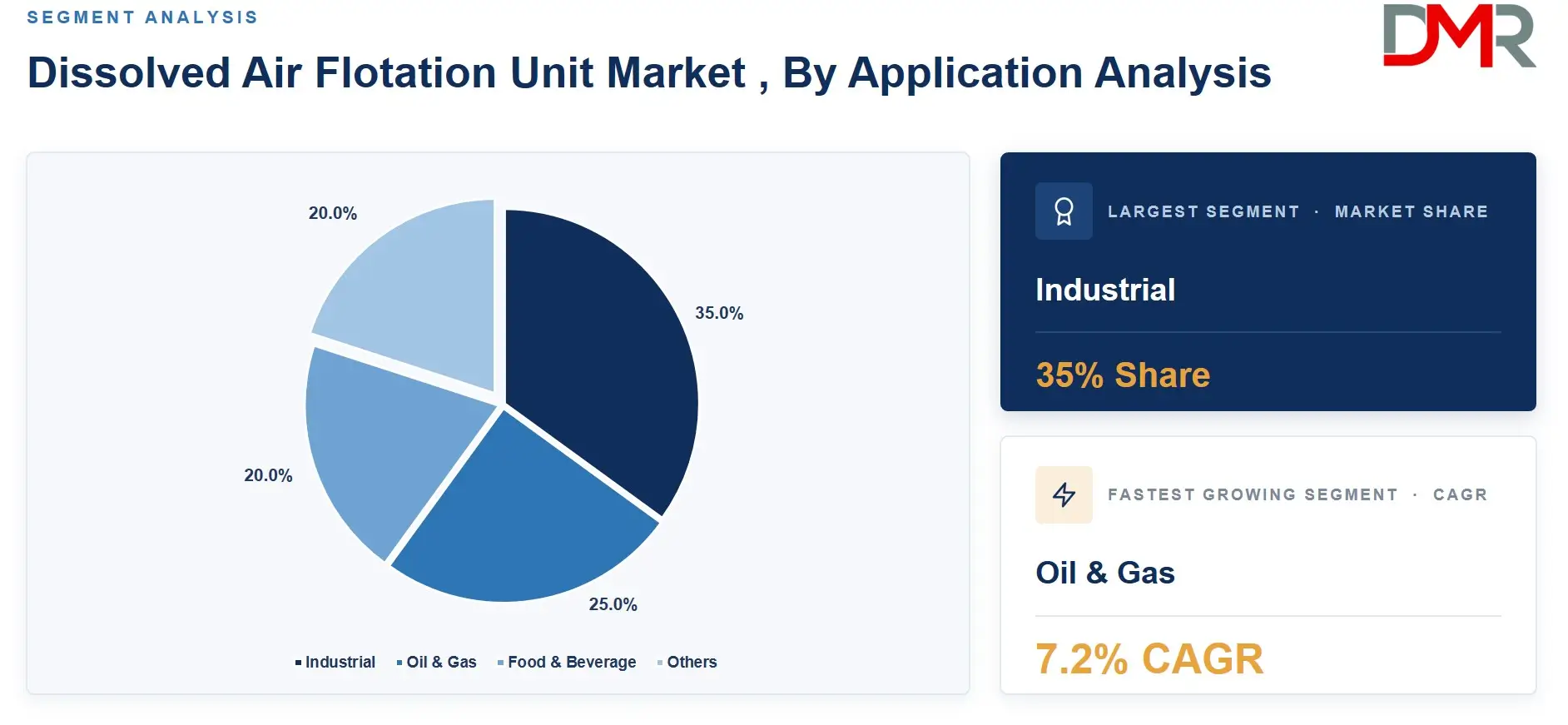
- By Application: Industrial led with a 35% share in 2025.
- By End User: Industrial led as the largest category in 2025.
- By Product Form: Open Tank led as the largest category in 2025.
- By Operation: Single-Stage DAF Systems led as the largest category in 2025.
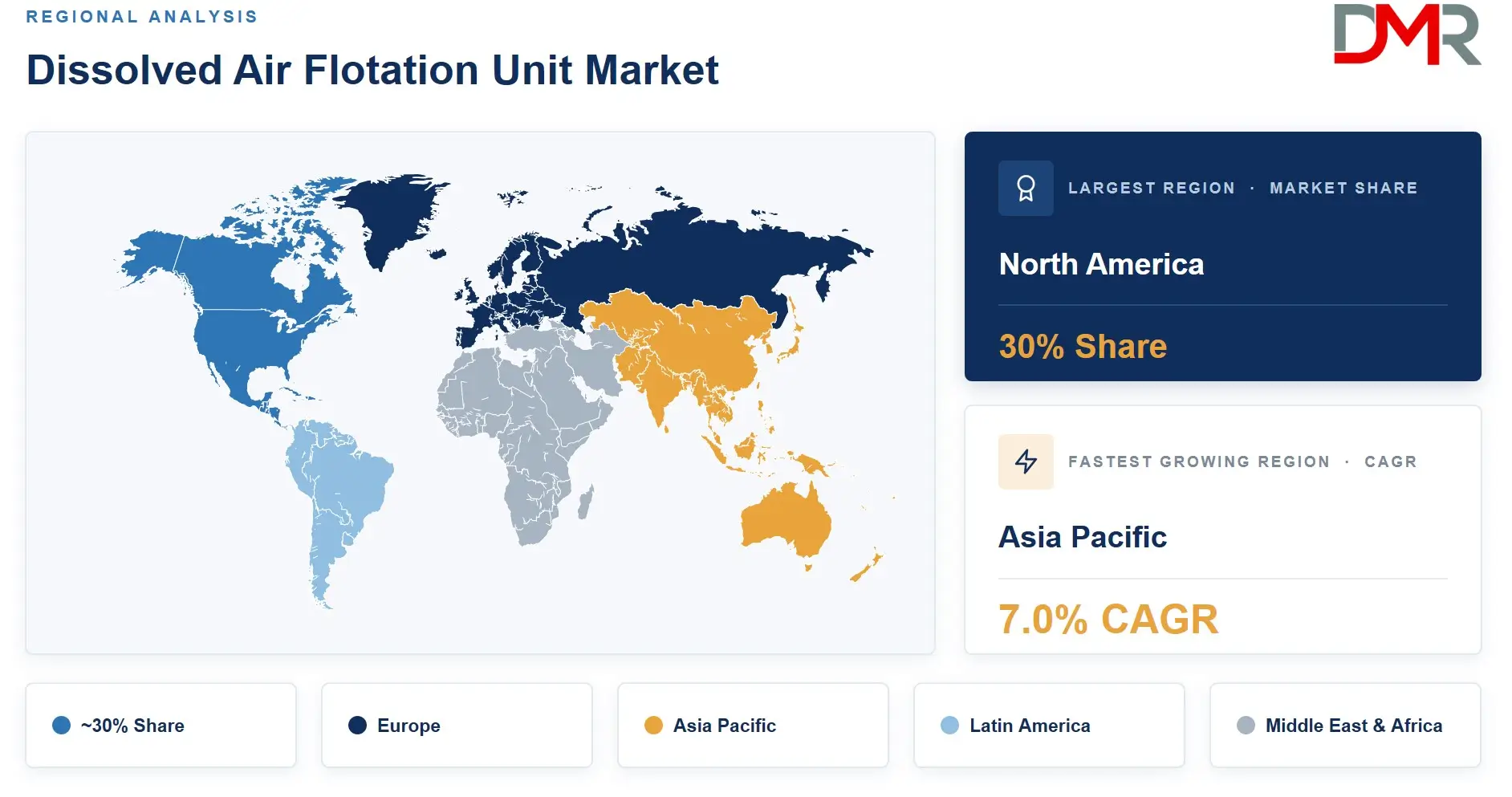
- By Region: North America led with a 30% share, valued at USD 276 Million, in 2025.
- Asia-Pacific is the fastest growing region, driven by expanding industrial output and stricter discharge regulations across manufacturing hubs.
Market Size and Forecast
The Global Dissolved Air Flotation Unit Market size is estimated at USD 978.88 Million in 2026, and is projected to reach USD 1,710.81 Million by 2035, exhibiting a CAGR of 6.4% during the forecast period.
Historical growth from 2020 through 2024 reflected two converging forces. Environmental agencies across North America and Europe progressively tightened effluent discharge limits for total suspended solids and fats-oils-grease, pulling forward capital replacement cycles. Simultaneously, industrial water tariffs rose across water-stressed regions, compelling manufacturers to invest in pretreatment systems that enable reuse rather than discharge.
ℹ
To learn more about this report –
Download Your Free Sample Report Here
The forecast through 2035 rests on sustained regulatory enforcement, expansion of high-strength effluent industries in Asia-Pacific, and the adoption of resource-recovery configurations. A 2025 pilot study reported by ScienceDirect recorded up to 83.3% TSS removal and up to 50.9% phosphorus removal, validating DAF performance benchmarks that buyers now specify in procurement contracts. Downside risk centers on energy cost escalation tightening capital budgets in price-sensitive emerging markets.
Type Analysis
Full-Flow Pressure Flotation Systems accounted for ~40% of System Configuration demand in 2026, the highest of any category.
Full-flow pressure systems dominate because they subject the entire influent stream to air saturation, producing uniform bubble distribution across high-variability industrial effluents. Food processing and chemical manufacturing plants favor this configuration when TSS loads fluctuate sharply and consistent effluent quality is non-negotiable. ALMAWATECH's 2026 product specifications confirm that compact industrial DAF systems in the roughly 3–20 m³/h and 10–200 m³/h flow bands use this pressurization principle across both the ALMA NeoDAF HD and HDED lines.
Recycle-Flow DAF Systems hold approximately 25% share and represent the fastest growing configuration. Recycle systems pressurize only a treated effluent fraction before reintroduction, cutting energy demand and chemical consumption versus full-flow designs. Plate Pack DAF Systems capture around 15% share by offering high surface-area efficiency in constrained footprints. Open Tank and Integrated DAF Systems each account for roughly 10%, with integrated configurations gaining traction in new greenfield plants where buyers want a single-skid solution combining flotation, chemical dosing, and sludge removal.
Capacity (Flow Rate) Analysis
Less Than 20 m³/hour led the Capacity segment with a >50% share in 2026, ahead of all other flow-rate categories.
Small-capacity units dominate because the majority of industrial DAF buyers operate mid-sized processing facilities, remote production sites, or decentralized treatment clusters where daily effluent volumes rarely exceed the 20 m³/h threshold. ALMAWATECH's 2026 commercial specifications list the compact ALMA NeoDAF Blue series at approximately 1–7 m³/h, confirming active manufacturer product lines serving the sub-20 m³/h segment directly.
The 20–50 m³/h band serves mid-scale industrial operations and benefits from strong demand in food and beverage and pharmaceutical wastewater streams. Units above 50 m³/h address municipal wastewater applications and large-scale industrial parks where single-unit throughput requirements are high. As industrial clusters expand across Southeast Asia and the Middle East, vendors with scalable product families spanning all three capacity bands hold a structural advantage over single-tier specialists.
Application Analysis
Industrial applications captured 35% of Application demand in 2026, ahead of all rival categories.
Industrial effluent streams from chemical manufacturing, pulp-and-paper, and metal finishing generate high suspended-solids and FOG loads that require DAF before biological or discharge stages. Buyers in these sub-sectors face regulatory penalties for non-compliance, making DAF a mandatory capital item rather than an optional efficiency upgrade. Vendor contracts in industrial accounts tend to be larger in value and include multi-year service agreements, supporting stable revenue visibility.
ℹ
To learn more about this report –
Download Your Free Sample Report Here
Oil and Gas holds approximately 25% share and represents the fastest growing application, pulled by produced-water volumes at mature oilfields and offshore facilities. Food and Beverage accounts for roughly 20%, driven by dairy, brewing, and meat processing operations facing discharge limits on BOD and FOG. The remaining 20% covers municipal wastewater and specialty applications. Vendors positioned in oil and gas and food processing simultaneously can cross-sell modular DAF configurations and capture wallet share across two of the three highest-growth end markets.
End User Analysis
Industrial led the End User segment as the largest category in 2026.
Industrial buyers account for the largest share of DAF procurement because effluent compliance obligations, water reuse economics, and process-water quality requirements converge in a single facility. A single refinery or food processing plant may operate multiple DAF units at different treatment stages, multiplying per-site equipment spend. Municipal buyers represent the second end-user group, deploying DAF primarily for tertiary polishing and phosphorus removal ahead of sensitive receiving water bodies.
Product Form Analysis
Open Tank led the Product Form segment as the largest category in 2026.
Open tank configurations dominate because they accommodate high-volume flows with lower capital cost per unit of throughput than enclosed pressure vessels. Municipal and large industrial operators who need to process tens of thousands of cubic meters per day default to open tank designs. Plate Pack configurations hold the alternative position, offering a smaller physical footprint and higher surface-overflow rates per square meter, making them the preferred choice at space-constrained urban wastewater plants.
Operation Analysis
Single-Stage DAF Systems led the Operation segment as the largest category in 2026.
Single-stage systems handle the majority of industrial and municipal applications because most effluent streams require only one flotation pass before achieving compliant discharge or reuse quality. Multi-Stage DAF Systems serve high-strength or complex effluent matrices, including semiconductor wastewater with fine metal particulates and produced water with emulsified oil fractions, where sequential flotation stages progressively lower contaminant loads below thresholds that a single pass cannot reach.
Key Market Segments
By Type
- Full-Flow Pressure Flotation Systems
- Recycle-Flow DAF Systems
- Plate Pack DAF Systems
- Open Tank DAF Systems
- Integrated DAF Systems
By Capacity (Flow Rate)
- Less Than 20 m³/hour
- 20–50 m³/hour
- More Than 50 m³/hour
By Application
- Industrial
- Oil & Gas
- Food & Beverage
- Others (Municipal Wastewater, etc.)
By End User
By Product Form
By Operation
- Single-Stage DAF Systems
- Multi-Stage DAF Systems
Regional Analysis
North America led the Dissolved Air Flotation Unit market with a ~30% share, valued at ~USD 276 Million, in 2025.
North America
North America's position reflects decades of Clean Water Act enforcement, active EPA permitting for industrial discharge, and a large installed base of aging treatment infrastructure requiring DAF retrofits. Food and beverage processors across the US Midwest and oil and gas operators in the Permian Basin and Gulf Coast represent two of the highest per-site DAF spend categories globally. Canadian pulp-and-paper and mining operations add a secondary demand base that keeps regional order volumes consistently high.
Asia-Pacific
Asia-Pacific is the fastest growing DAF region, propelled by rapid industrialization in China, India, South Korea, and Southeast Asia. Manufacturing export hubs face increasingly stringent national effluent standards, and local governments in China enforced stricter COD and phosphorus discharge limits for industrial parks from 2023 onward. ALMAWATECH's 2026 commercial documentation references a refinery DAF installation in Greece at 450 m³/h, illustrating the scale of industrial deployments that Asia-Pacific's expanding petrochemical sector is now replicating at comparable or larger throughputs.
ℹ
To learn more about this report –
Download Your Free Sample Report Here
Europe
European demand is shaped by the EU's Urban Wastewater Treatment Directive revisions and the Industrial Emissions Directive, both of which compress compliance timelines for phosphorus and TSS removal at municipal and industrial sites. Germany and the UK lead in retrofit procurement, while Southern European markets invest in new capacity ahead of updated permitting cycles.
Latin America
Brazil and Mexico anchor Latin American DAF demand through food processing export industries, mining operations, and expanding municipal wastewater programs. Budget constraints limit large capital programs, but decentralized and rental DAF configurations are lowering the financial barrier to entry for mid-sized facilities.
Middle East & Africa
GCC countries drive Middle East DAF procurement through oil and gas produced-water management and desalination pretreatment applications. Water scarcity in the region elevates the economic case for wastewater reuse, making DAF a recurring line item in industrial capital budgets even when oil prices compress discretionary spending.
Key Regions and Countries
North America
Europe
- Germany
- France
- The UK
- Spain
- Italy
- Rest of Europe
Asia Pacific
- China
- Japan
- South Korea
- India
- Australia
- Rest of APAC
Latin America
- Brazil
- Mexico
- Rest of Latin America
Middle East & Africa
- GCC
- South Africa
- Rest of MEA
Macroeconomic Impact
Capital expenditure on DAF units is sensitive to industrial production cycles, infrastructure financing conditions, and commodity prices. When oil prices fall sharply, GCC and North American oil and gas operators defer produced-water treatment upgrades, reducing near-term order volumes for DAF vendors despite regulatory pressure. Rising steel and pump component costs since 2022 have added 8–12% to fabrication costs, pressuring margins for mid-tier manufacturers unable to pass costs through long-term supply contracts.
Emerging market growth in Asia-Pacific depends partly on access to multilateral development bank financing for industrial wastewater infrastructure. Currency depreciation in markets like India and Indonesia raises the effective cost of imported DAF units denominated in USD or EUR, pushing buyers toward locally fabricated alternatives or postponing procurement. North America's stable regulatory environment and strong industrial output insulate it from the macro volatility that slows deployment in price-sensitive emerging regions.
Market Dynamics
Driver: Tightening Discharge Limits Accelerating DAF Retrofits
Regulators across North America, Europe, and Asia-Pacific are compressing acceptable thresholds for total suspended solids, fats-oils-grease, and phosphorus in industrial and municipal effluents. A 2025 pilot-scale DAF study published by ScienceDirect confirmed that optimized operating conditions achieved up to 88.1% turbidity removal when treating anaerobic secondary effluent, validating DAF as a technically reliable path to permit compliance. Facilities that historically managed with gravity sedimentation now face permit renewals that require sub-10 mg/L TSS, a target gravity systems cannot consistently reach.
Freshwater scarcity compounds the compliance driver. Industrial water tariffs in water-stressed regions of China, India, and the Middle East have risen materially since 2021, making wastewater reuse economically preferable to fresh-water intake. The same 2025 pilot study documented up to 96.0% particulate-COD removal, confirming that DAF pretreatment substantially reduces organic loading on downstream biological stages and lowers overall treatment costs.
Restraint: High Operating Costs and Operator Complexity Limiting Adoption
DAF systems rely on energy-intensive air saturation pumps and recycle pressurization circuits that contribute meaningfully to lifecycle operating costs. Data from Nijhuis Saur Industries confirms that even high-rate concrete DAF systems handling 1,065–3,500 m³/h per bay generate sludge at approximately 7% dry solids before further dewatering treatment, requiring dedicated sludge-handling infrastructure that adds capital and operating expense beyond the DAF unit itself.
Coagulant and flocculant dose sensitivity creates performance variability when influent quality shifts, which is common in batch-process industries. Operators require specialized training to maintain consistent bubble-to-solids ratios across varying load conditions. Small and mid-sized industrial facilities without in-house process engineers face higher risk of underperformance and may delay DAF procurement in favor of simpler, lower-maintenance alternatives.
Opportunity: Semiconductor Wastewater and Decentralized DAF Configurations
Semiconductor and electronics fabrication plants generate ultrapure-process wastewater containing fine silicon particles, heavy metals, and PFAS precursors at low concentrations requiring high-efficiency pretreatment. DAF's ability to target sub-micron suspended solids when paired with optimized coagulation chemistry makes it a logical front-end stage in PFAS treatment trains being designed at new fab sites in the US, Japan, and South Korea.
Decentralized containerized DAF systems address a structurally underserved segment of the market. Small-to-mid-sized industrial clusters and remote production sites cannot justify permanent treatment plant capital, but containerized plug-and-play DAF packages provide a lower-cost, rapidly deployable alternative. Resource-recovery DAF configurations that capture proteins, fibers, and fats before biological treatment add a revenue offset against operating costs, making the economic case for adoption compelling even in budget-constrained operations.
Porter's Five Forces
The DAF unit market carries moderate-to-high competitive intensity, shaped by a combination of capital access barriers at the technology frontier and low-cost rivalry in commodity configurations. New entrant barriers are real but not prohibitive: fabricating a basic open-tank DAF requires standard steel and pump components, but designing systems that reliably achieve consistent performance across variable effluent compositions demands engineering expertise and validated process data that new players cannot quickly replicate.
A 2025 pilot study published in ScienceDirect documented up to 82.9% apparent-color removal under optimized hydraulic loading conditions, the kind of performance benchmark that buyers now write into procurement specifications, raising the technical bar for challengers. Supplier power is moderate, concentrated in specialty pump and air-saturation component manufacturers. Buyer power is high among large industrial accounts that operate multiple sites and can switch between qualified vendors. Substitutes including gravity sedimentation and membrane filtration exist but cannot match DAF's throughput-to-footprint ratio at comparable cost. Competitive rivalry among the top 20 players is intense on price for standard configurations but shifts to differentiation on performance guarantees and lifecycle service in high-complexity accounts.
AI and Gen AI Impact
Artificial intelligence is entering the DAF value chain primarily at the chemical dosing and process control stage. Real-time water-quality sensors feed AI models that continuously adjust coagulant and flocculant doses and air-to-solids ratios in response to influent variability, reducing chemical consumption and stabilizing effluent quality without manual intervention. Early adopters in food processing and produced-water treatment report fewer permit exceedances and lower reagent costs as a direct result of closed-loop AI control systems embedded in DAF control panels.
Vendors that do not invest in sensor-integrated control platforms risk losing accounts to competitors offering AI-enabled systems with remote monitoring and predictive maintenance. Generative AI tools are beginning to appear in system design, helping engineers specify DAF configurations for unusual effluent matrices by drawing on large process performance databases. Laggards that continue selling manual-adjustment DAF units into regulated markets will face mounting pressure as buyers write AI-enabled automation into procurement requirements.
Market Trends
Containerized and Hybrid DAF Configurations Reshaping Treatment Architecture
Buyers are moving away from standalone DAF units toward hybrid DAF-membrane and DAF-biological treatment trains that combine flotation with polishing stages in a single engineered system. Waterleau and Krofta announced in April 2026 that their European rental fleet would feature containerized plug-and-play DAF units with capacities spanning 1–150 m³/h, combining DAF, chemical dosing, dewatering, and buffer systems in a single mobile package. Vendors offering pre-integrated hybrid systems capture higher per-project revenue and lock in long-term service contracts, while PFAS-driven pretreatment sequencing is establishing DAF as the upstream solids-removal stage in multi-technology treatment trains.
Market Competition Overview
The DAF unit market is moderately fragmented, with a large number of regional and global vendors competing across distinct capacity and application niches. No single player holds a dominant global share; instead, competition clusters around regional strongholds, application specialization, and technology differentiation in control systems and configurations. Vendors with broad product portfolios spanning compact modular units through large-scale open-tank and concrete systems hold a structural advantage because they can serve both small decentralized buyers and large municipal or industrial accounts from one catalog.
In April 2025, Ovivo re-entered the DAF market through its Alar business, bringing more than 380 DAF installations worldwide and immediately signaling that established players with dormant product lines can re-activate competitive presence quickly. Market share dynamics therefore depend not only on active participants but on re-entry risk from large water technology companies repositioning their portfolios in response to tightening effluent regulations.
Pricing Analysis
DAF unit pricing varies substantially by system configuration, capacity, materials of construction, and level of automation. Compact sub-20 m³/h units for small industrial sites carry lower absolute price points but generate higher margin for vendors due to standardized fabrication. Large custom-engineered systems for oil and gas or municipal applications command significant per-unit contract values but require extended sales cycles and bespoke engineering, which stretches cash conversion cycles.
Upward price pressure comes from steel and pump component cost inflation, which has persisted since 2022. Downward pressure comes from growing competition among Asian manufacturers offering commodity open-tank DAF units at lower fabrication cost. Market leaders counter commoditization through bundled service contracts, performance guarantees, and digital monitoring subscriptions that shift the competitive conversation from unit price to total cost of ownership.
Company Profiles
Evoqua Water Technologies operates as one of the most broadly positioned DAF vendors globally, offering systems across municipal, industrial, and specialty applications. Evoqua's competitive advantage rests on its service network, which provides on-site operator support and parts availability that reduces performance risk for buyers who lack in-house process engineers. The company's integrated approach to water treatment, combining DAF with downstream biological and filtration stages, allows it to win full-plant contracts rather than competing unit-by-unit.
Xylem approaches the DAF market through a technology platform strategy, embedding its systems within broader digital water management offerings that include sensor networks and remote monitoring dashboards. Xylem's investment in automation positions it directly against the trend toward AI-enabled dosing control, and its global service infrastructure allows it to compete effectively in Asia-Pacific where local engineering capacity is sometimes limited. The risk for Xylem lies in margin compression if its premium-priced digital platforms face competition from lower-cost AI-enabled control systems from specialized automation vendors.
Key Players
- KWI Group
- Evoqua Water Technologies
- FRC Systems
- Benenv
- Water Tecnik
- Fluence
- DAF Corporation
- Hyland Equipment Company
- WSI International
- Toro Equipment
- WesTech Engineering
- Napier-Reid
- MAK Water
- VanAire
- Nijhuis Water Technology
- Purac
- World Water Works
- Xylem
- Alfa Laval
- Veolia Water Technologies
Supply Chain and Value Chain Analysis
The DAF unit supply chain begins with raw material suppliers providing structural steel, stainless steel, and specialty alloys for tank fabrication. Pump and compressor manufacturers supply air saturation systems and recycle pressurization circuits, which represent the highest-cost mechanical components. Instrumentation and control system vendors supply sensors, programmable logic controllers, and dosing pumps that increasingly carry AI-enabled functionality. DAF unit manufacturers integrate these inputs into complete systems, either in dedicated fabrication facilities or through contract manufacturing partnerships.
Maximum value creation occurs at the system integration and engineering stage, where vendors configure hydraulic loading rates, recycle ratios, and chemical dosing protocols for specific effluent matrices. Distribution passes through direct sales teams for large industrial and municipal accounts and through regional distributors for smaller capacity units. After-sale service contracts, including chemical dosing audits, pressure testing, and control system upgrades, represent a high-margin recurring revenue stream that locks in customer relationships beyond the initial equipment sale.
Regulatory Landscape
North American DAF procurement is shaped by the US Clean Water Act's National Pollutant Discharge Elimination System permits, which set facility-specific discharge limits for TSS, BOD, phosphorus, and FOG. The EPA's pending PFAS effluent guidelines for industrial sectors are expected to drive a new wave of DAF pretreatment investment as facilities design PFAS removal trains that require upstream solids removal. Canada's federal Wastewater Systems Effluent Regulations apply equivalent pressures to municipal operators.
Europe's revised Urban Wastewater Treatment Directive and Industrial Emissions Directive are compressing compliance deadlines for phosphorus and TSS across both municipal and industrial sites, creating a near-term equipment replacement wave. China's increasingly enforced GB18918 and sector-specific discharge standards for industrial parks are the primary regulatory engine for Asia-Pacific DAF demand growth. In the GCC, national water reuse strategies and mandatory pretreatment requirements for injection wells drive produced-water DAF adoption.
Investment and White Space Analysis
Current investment flows concentrate in two areas: AI-enabled control system integration and containerized modular DAF platforms. Vendors acquiring software and sensor capabilities attract premium valuations from strategic buyers seeking to offer digital water management solutions. Containerized rental fleet models, as demonstrated by Waterleau's Krofta platform, represent a white space between permanent capital installation and no treatment at all, serving remote sites and facilities undergoing capacity transitions.
Semiconductor and electronics wastewater pretreatment is an underserved application segment where DAF adoption remains nascent relative to the scale of wastewater volumes being generated at new fab expansions in the US, Japan, and South Korea. Oil and gas produced-water in mature oilfields across Latin America and Africa represents high-volume, low-competition geography. New entrants with compact, automated, energy-efficient DAF configurations targeting these two segments can capture share before the large generalist players deploy dedicated product lines.
Recent Developments
- February 2026: Waterleau launched the Waterleau Krofta Rental Fleet Europe, a plug-and-play rental platform offering compact Krofta DAF units, pretreatment modules, sludge-treatment equipment, and auxiliary systems for rapid deployment across European industrial sites.
- April 2025: Ovivo announced its return to the DAF market with renewed technology and product capabilities, targeting removal of suspended solids, oils, grease, and insoluble BOD across industrial and municipal applications.
- September 2025: Ovivo | Alar delivered a DAF system to an ExxonMobil petrochemical facility in Singapore to remove elevated oil, grease, and suspended solids before biological treatment, combining microbubble technology with automated operation.
- October 2025: Ecologix Environmental Systems highlighted its third-generation Enhanced DAF systems featuring automated operation, remote monitoring, controlled 5–50 micron bubble generation, simplified solids handling, and fewer moving parts than earlier designs.
- July 2025: Ecologix Environmental Systems promoted its E-DAF system as an advanced industrial wastewater treatment solution engineered and manufactured in the US, reinforcing its domestic manufacturing positioning for solid-liquid separation applications.
Report Details
| Report Characteristics |
| Market Value (2026) |
USD 978.88 Million |
| Forecast Revenue (2035) |
USD 1,710.81 Million |
| CAGR (2026–2035) |
6.4% |
| Base Year for Estimation |
2025 |
| Historic Period |
2020 – 2024 |
| Forecast Period |
2026 – 2035 |
| Report Coverage |
Revenue Forecast, Market Dynamics, Competitive Landscape, Recent Developments |
| Segments Covered |
By Type (Full-Flow Pressure Flotation Systems, Recycle-Flow DAF Systems, Plate Pack DAF Systems, Open Tank DAF Systems, Integrated DAF Systems), By Capacity (Less Than 20 m³/hour, 20–50 m³/hour, More Than 50 m³/hour), By Application (Industrial, Oil & Gas, Food & Beverage, Others), By End User (Industrial, Municipal), By Product Form (Open Tank, Plate Pack), By Operation (Single-Stage DAF Systems, Multi-Stage DAF Systems) |
| Regional Analysis |
North America – US and Canada; Europe – Germany, France, The UK, Spain, Italy, and Rest of Europe; Asia Pacific – China, Japan, South Korea, India, Australia, and Rest of APAC; Latin America – Brazil, Mexico, and Rest of Latin America; Middle East & Africa – GCC, South Africa, and Rest of MEA |
| Competitive Landscape |
KWI Group, Evoqua Water Technologies, FRC Systems, Benenv, Water Tecnik, Fluence, DAF Corporation, Hyland Equipment Company, WSI International, Toro Equipment, WesTech Engineering, Napier-Reid, MAK Water, VanAire, Nijhuis Water Technology, Purac, World Water Works, Xylem, Alfa Laval, Veolia Water Technologies |
| Customization Scope |
Customization for segments and region or country level will be provided. Additional customization can be done based on requirements. |
| Purchase Options |
Three license options: Single User License, Multi-User License (Up to 5 Users), and Corporate Use License (Unlimited Users and Printable PDF) |
Frequently Asked Questions
What is the biggest investment opportunity in the Dissolved Air Flotation Unit market?
▾ Semiconductor wastewater pretreatment and decentralized containerized DAF platforms represent the two clearest underserved segments. New fab expansions in the US, Japan, and South Korea are generating fine-particulate and PFAS-containing wastewater streams that require high-efficiency flotation ahead of downstream treatment stages. Vendors with compact, automated DAF systems can capture these accounts before large generalist players build dedicated product lines.
Who are the top companies in the Dissolved Air Flotation Unit market?
▾ Leading participants include KWI Group, Evoqua Water Technologies, Xylem, Alfa Laval, Veolia Water Technologies, Nijhuis Water Technology, WesTech Engineering, Fluence, and World Water Works, among others. The market supports over 20 active vendors globally, spanning compact modular specialists through large-scale system integrators. No single player holds a majority share across all configurations and regions.
Which segment is growing fastest in the Dissolved Air Flotation Unit market and why?
▾ The Oil & Gas application segment is growing fastest, holding approximately ~25% of application demand and expanding on the back of produced-water treatment requirements at mature oilfields and offshore facilities. Regulatory mandates for reinjection-quality water treatment and growing offshore production in the Middle East and Latin America are driving multi-unit DAF procurement at individual production sites. Recycle-Flow DAF Systems are simultaneously the fastest growing configuration type, benefiting from lower energy consumption versus full-flow designs.
Which region is growing fastest in the Dissolved Air Flotation Unit market and why?
▾ Asia-Pacific is the fastest growing region, driven by accelerating industrialization, stricter national discharge standards, and expanding food processing and petrochemical sectors across China, India, and Southeast Asia. Chinese industrial park regulations enforcing lower COD and phosphorus limits since 2023 created a large installed-base replacement cycle. The region's capacity to absorb both small modular and large-scale DAF configurations positions it as the primary volume growth engine through 2035.
What is the biggest challenge holding Dissolved Air Flotation Unit Market back?
▾ High lifecycle operating costs from energy-intensive air saturation and recycle pressurization systems represent the primary barrier to broader DAF adoption, particularly in price-sensitive emerging markets. Coagulant and flocculant dose sensitivity creates performance variability in batch-process industries, requiring skilled operators that small and mid-sized facilities cannot always retain. Together, these factors push some buyers toward simpler treatment alternatives despite DAF's superior effluent quality performance.