What is the Distributed Energy Resources Market Size?
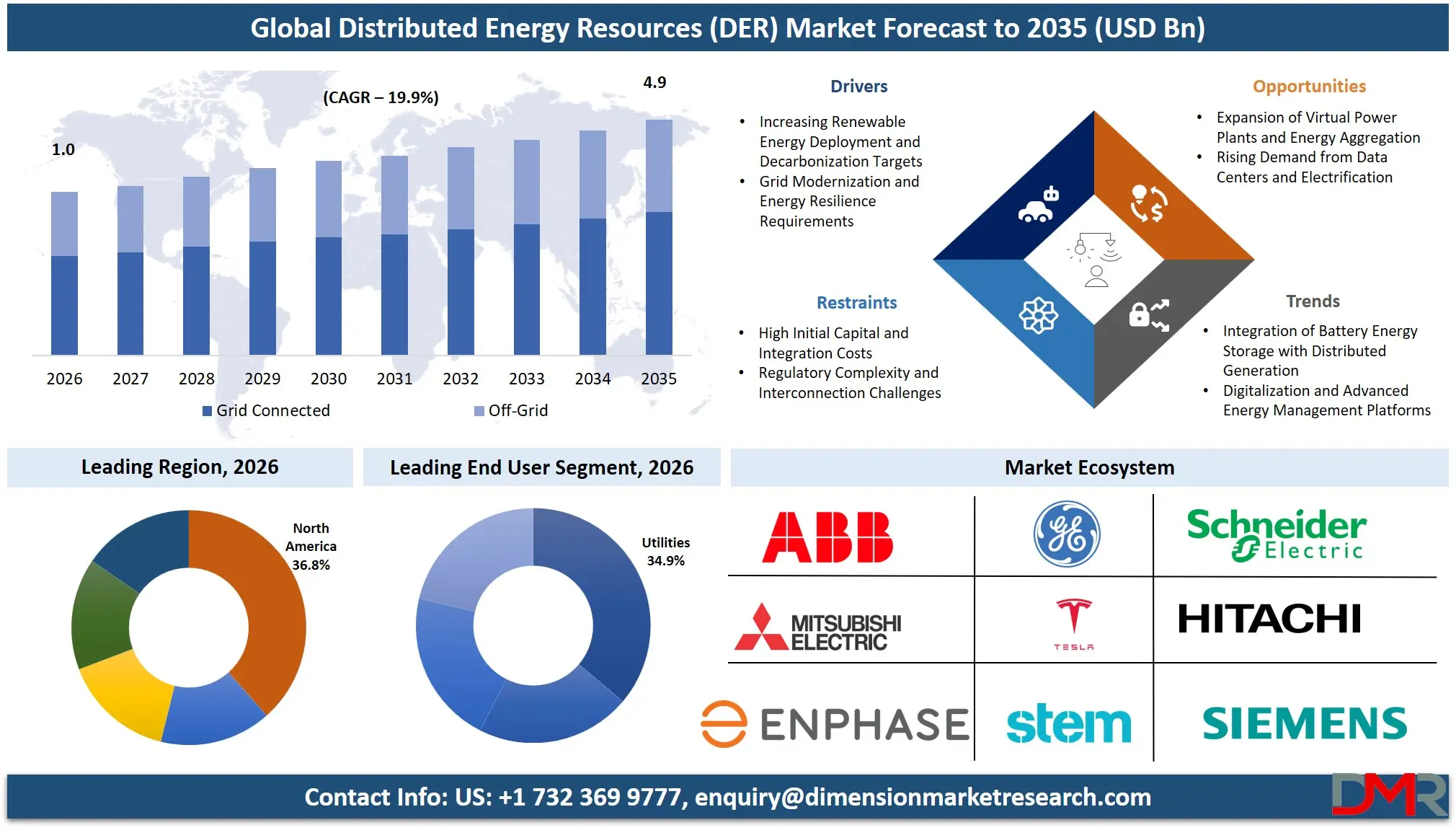
The Distributed Energy Resources (DER) Market size is expected to be USD 1.0 billion in 2026 and increase at a compound annual growth rate of 19.9% to USD 4.9 billion in 2035 due is rising interest in renewable energy systems that can produce electricity through alternative sources.
ℹ
To learn more about this report –
Download Your Free Sample Report Here
Distributed Energy Resources (DERs) are sources of electricity generation, energy storage, and management that are closer to where energy is consumed than central power plants. DERs comprise solar photovoltaics, wind turbines, battery storage, fuel cells, co-generation facilities, demand response, and virtual power plants. These resources enhance flexibility, resilience, and sustainability, making active participation of customers in energy markets possible. The importance of the sector has increased owing to utilities' efforts to update their aging power distribution network and the push for decarbonization by various governments. Significant innovations within energy storage, energy management technology platforms, AI optimization, and rising usage of renewable energy are driving the adoption of DERs worldwide, while rising demand for electricity in the wake of electrification and data centers is propelling the growth of the sector.
The US Distributed Energy Resources (DER) Market
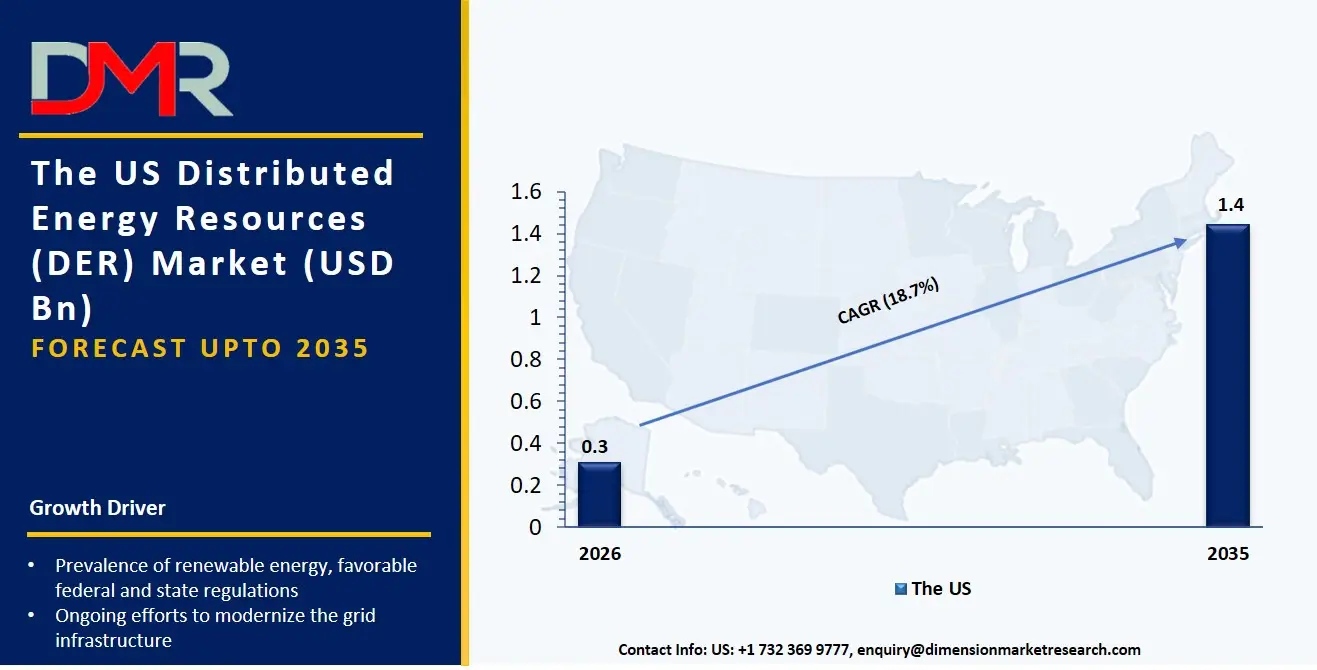
The US Distributed Energy Resources (DER) Market size is estimated to be USD 300 million in 2026 and is expected to increase at a CAGR of 18.7% over the forecast period.
ℹ
To learn more about this report –
Download Your Free Sample Report Here
The US is among the topmost DER markets in the world due to the prevalence of renewable energy, favorable federal and state regulations, and ongoing efforts to modernize the grid infrastructure. The rise in electricity demand owing to increasing numbers of data centers, electric vehicles, and industrialization is further driving investment into DG and storage assets. Utilities are increasingly deploying microgrids for greater resilience in the face of extreme weather conditions, while incentives are promoting the use of solar energy by households and businesses alike. The development of virtual power plants, battery aggregation, and community energy schemes further augments market growth.
Europe Distributed Energy Resources (DER) Market
The Europe Distributed Energy Resources (DER) Market size is estimated to be USD 240 million in 2026 and is expected to increase at a CAGR of 18.8% over the forecast period.
Europe still ranks among the best regions in terms of deploying DERs due to its progressive goals on decarbonization and renewable energy deployment within the context of its European Green Deal initiative. Significant investments have been made by the region in relation to the deployment of distributed solar energy production, battery storage, and smart grids. Nations such as Germany, France, Netherlands, Italy, and Spain are encouraging the use of decentralized power systems in order to boost their energy security and cut down on fossil fuel imports.
Japan Distributed Energy Resources (DER) Market
The market size of Japan Distributed Energy Resources (DER) will be USD 40 million in 2026 and at a CAGR of 18.4% in the forecast period.
The DER market in Japan is growing owing to the issues of energy security, the aim of incorporating renewable energy sources, and the need to build resilience after natural calamities. The main technology used in distributed energy production is solar PVs. Meanwhile, there is a rapid increase in the number of batteries used in distributed energy systems and microgrids. Initiatives from the government towards decarbonization, smart grids, and energy independence are driving the development of distributed energy resources.
Key Takeaways
- Market Size & Forecast: The Distributed Energy Resources (DER) Market size is projected to reach USD 1.0 billion in 2026 and is anticipated to have a value of USD 4.9 billion in 2035.
- Growth Rate & Outlook: The Distributed Energy Resources (DER) Market size is set to grow at a compound annual growth rate of 19.9% during the forecast period of 2026 to 2035.
- Primary Growth Drivers: Some of the major growth drivers in the market are Renewable Energy Expansion and Decarbonization Goals, and more.
- Key Market Trends: Some of the major trends in the market are Battery Energy Storage Systems for Distributed Generation Systems, and more.
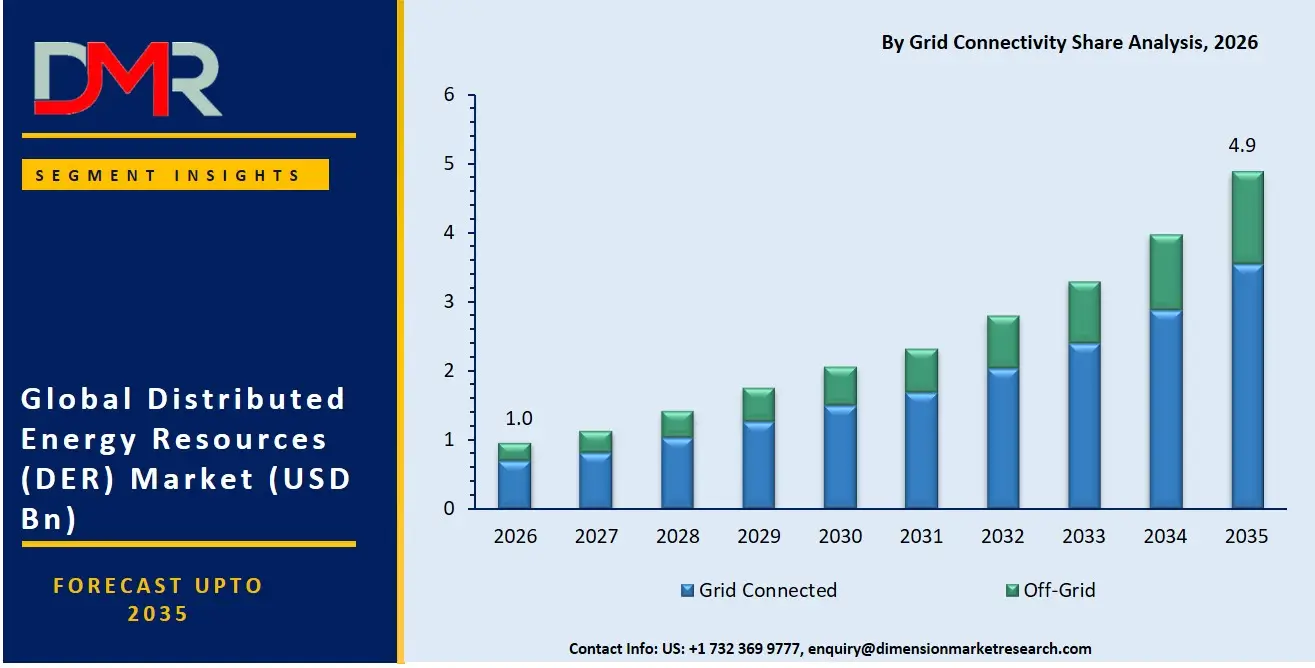
- By Grid Connectivity: Grid connected segment is anticipated to get the majority share of the Distributed Energy Resources (DER) Market in 2026.
- By Deployment Mode: Microgrids is expected to get the largest revenue share in 2026 in the Distributed Energy Resources (DER) Market.
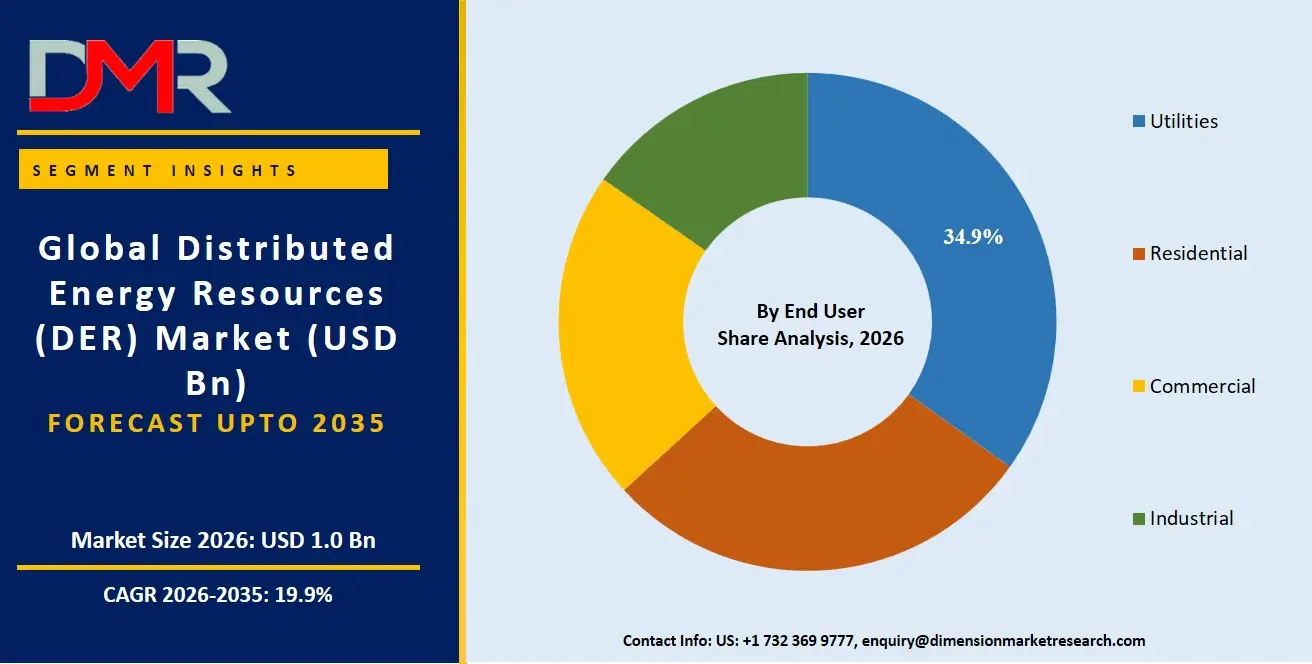
- By End User: Utilities segment is expected to get the largest revenue share in 2026 in the Distributed Energy Resources (DER) Market.
- Regional Leadership: North America is set to lead the Distributed Energy Resources (DER) Market with an estimated 36.8% share in 2026.
What is the Distributed Energy Resources (DER)?
Distributed Energy Resources (DER) consist of energy generation, storage, and management technology solutions that are implemented close to consumers and are connected either to the distribution grid or beyond the consumer's meter. Distributed Energy Resources (DER) may include such technologies as renewable energy generation solutions (e.g. solar photovoltaics and wind power), battery storage, fuel cells, co-generation, microgrids, demand response, and virtual power plants. These technologies altogether help with energy production decentralization, increasing grid resilience, minimizing transmission losses, enhancing energy efficiency, and facilitating renewable energy implementation.
Use Cases
- Improving Grid Resilience: Since DER systems produce electricity locally and have storage capabilities, they are capable of generating electricity even when the electric grid is down. Using microgrids and batteries, continuous electricity will be generated to meet the demands in hospitals, data centers, military bases, and other important infrastructures that need energy independently from central electricity.
- Incorporating Renewable Energy: The use of distributed energy resources in the form of solar PV, battery storage systems, and wind allows the incorporation of renewable energy in power grids. Using advanced management systems, DERs balance supply and demand while minimizing curtailment.
- Demand Response and Peak Shaving: The use of DER technologies allows commercial and industrial entities to shave off peak energy demands. Through energy load balancing, these businesses are able to cut their energy costs while ensuring stable grid operations.
- Virtual Power Plants: With DER technologies, aggregated resources may be coordinated to create virtual power plants. Virtual power plants are used by utility companies and energy providers to participate in the wholesale market, ancillary services, and optimal energy dispatch.
How AI Is Transforming the Distributed Energy Resources (DER) Market
DERs are revolutionizing how the energy system works thanks to AI's contribution in predictive analysis, automation of energy management systems, and optimization of the processes. Using AI, the process of analyzing generation capacity, weather predictions, demand for electricity, and available storage helps maximize the usage of resources. AI technology is used by utilities to predict output of distributed energy, detect maintenance needs, and increase grid resilience. Virtual power plants employ AI to manage hundreds or thousands of distributed energy resources.
The technology of AI increases consumer engagement due to dynamic pricing, load management, and customized energy recommendations. Machine learning models can maximize battery charge/discharge cycles, decrease cost of operation, and allow participation in demand response. With growing complexity of DER deployment, the role of AI in the energy industry will only become bigger.
Market Dynamic
Driving Factors in the Distributed Energy Resources (DER) Market
Renewable Energy Expansion and Decarbonization Goals
There are significant efforts by governments, power companies, and industries aimed at reducing carbon dioxide emissions. As a result, there is rising interest in renewable energy systems that can produce electricity through alternative sources. Solar power facilities and battery storage are becoming very popular, and investments in decentralized renewable energy generation systems are encouraged through regulations and policies. With the lowering costs of decentralized energy technology, many firms and individuals have begun turning towards renewable energy sources.
Restraints in the Distributed Energy Resources (DER) Market
High Initial Capital and Cost of Integration
In spite of reduced costs of technology, the process of integrating Distributed Energy Resources into existing systems tends to necessitate considerable amounts of capital for the acquisition, installation, connection, and control of equipment. The implementation of solar PV storage units or microgrids could pose economic challenges to small enterprises and residential consumers. In addition, power companies would have to upgrade their grids in order to accommodate distributed energy resources.
Opportunities in the Distributed Energy Resources (DER) Market
Growth Opportunities for Virtual Power Plants and Energy Aggregation
Virtual power plants offer significant opportunities for growth in the area of DER. Through energy aggregation of solar photovoltaics, batteries, EVs, and flexible loads, the operators of VPPs will be able to supply grid services and take part in energy trading. Utilities are beginning to realize that VPPs constitute an effective alternative to conventional investments in infrastructure. Innovations in cloud-based energy management and communications are making this possible.
Trends in the Distributed Energy Resources (DER) Market
Battery Energy Storage Systems for Distributed Generation Systems
Batteries are being utilized alongside solar and wind energy projects for dealing with the issue of intermittency and improving the utilization of energy. As prices for batteries fall and their performance increases, their installation has become faster. The inclusion of such storage technologies in distributed generation systems helps in ensuring reliability and enabling peak shaving.
Research Scope and Analysis
The Distributed Energy Resources (DER) market encompasses technologies such as solar photovoltaics, energy storage systems, electric vehicles, demand response solutions, microgrids, and distributed generation assets. Research focuses on market size, growth trends, technology adoption, regulatory frameworks, utility modernization, and grid integration. Analysis evaluates key drivers, challenges, competitive dynamics, investment opportunities, and the impact of DERs on energy efficiency, grid reliability, decarbonization, and the transition toward a more decentralized and sustainable energy ecosystem.
ℹ
To learn more about this report –
Download Your Free Sample Report Here
By Technology Analysis
Solar Photovoltaic (PV) Systems have been forecasted to retain their position as the major technology segment with a share of approximately 38.7% of the market in 2026. The success of Solar PV is attributed to decreasing prices of modules, favorable policies, greater usage in the residential and commercial sectors, and easy installation compared to other distributed generation technologies. Incorporation of batteries makes distributed solar more valuable. Energy Storage Systems form the fastest growing technology segment owing to increasing demands for grid flexibility and renewable integration. Utilities and businesses are using efficient storage systems to meet the challenges of demand peak management and to operate in the energy markets.
By Grid Connectivity Analysis
Grid Connected DER Systems will take the market by storm and are expected to hold a dominant market share of around 72.4% in 2026. The reason behind such rapid growth is that these systems will benefit from existing utilities infrastructure, net-metering, and expanded market access.
ℹ
To learn more about this report –
Download Your Free Sample Report Here
More households, commercial, and industrial customers are choosing grid connected solar and storage solutions in order to cut their electricity bills and stay grid connected. Off-Grid systems are set to experience the highest rate of growth, especially in remote regions and critical infrastructure.
By Deployment Model Analysis
Microgrids are expected to hold the top position in terms of the deployment model with a market share estimation of 41.8% in 2026. Microgrid's capability to function independent of the primary grid during any disturbances is one of the key factors that makes microgrids a viable choice for colleges, hospitals, military bases, and manufacturing units. Investments in the form of resiliency and sustainability drives have contributed to their rising popularity. The fastest growing segment will be the Virtual Power Plants owing to innovations in the digital energy platforms and aggregations of distributed assets.
By Application Analysis
Renewable Energy Integration is expected to hold a market share of around 31.6% by 2026 and will thus be the dominant application segment. The need for distributed energy storage, demand response, and smart energy management solutions is critical to maintain grid stability as renewable generation capacity increases. DER solutions are key in enabling flexibility in balancing renewable sources. Grid Services and Ancillary Services application segments are expected to witness the fastest growth, driven by cost savings compared to traditional grid solutions.
By End User Analysis
Utilities will continue to dominate as the largest end-user segment with a projected market share of around 34.9% by 2026. Utility providers are increasingly incorporating the distributed energy resources into their larger efforts at grid modernization. Smart grid, energy storage, and distributed generation systems contribute towards operational efficiency and reliability goals. The Commercial sector is expected to witness the highest growth rate, driven by increasing energy prices, sustainability considerations, and resilient needs. Companies are deploying DER technologies in order to lower costs, boost energy security, and fulfill sustainability goals.
The Distributed Energy Resources (DER) Market Report is segmented on the basis of the following:
By Technology
- Solar Photovoltaic (PV) Systems
- Wind Energy Systems
- Energy Storage Systems
- Combined Heat and Power (CHP) Systems
- Fuel Cells
- Other DER Technologies
By Grid Connectivity
By Deployment Model
- Standalone DER Systems
- Microgrids
- Campus Microgrids
- Community Microgrids
- Industrial/Commercial Microgrids
- Virtual Power Plants (VPPs)
By Application
- Peak Load Management
- Backup Power Supply
- Renewable Energy Integration
- Grid Services & Ancillary Services
- Demand Response
By End User
- Residential
- Commercial
- Industrial
- Utilities
Regional Analysis
Leading Region in the Distributed Energy Resources (DER) Market
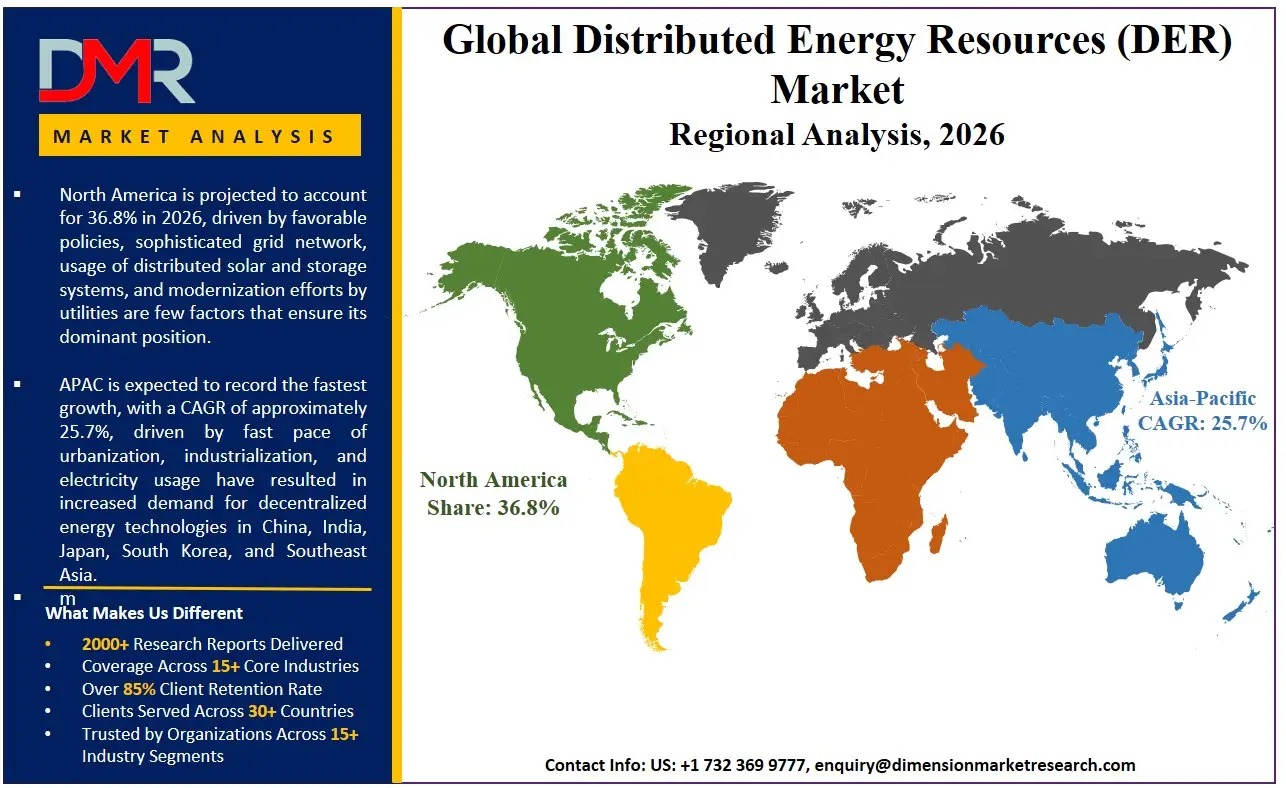
North America is forecasted to lead among all other regions with a projected market share of 36.8% in 2026. Favorable policies, sophisticated grid network, usage of distributed solar and storage systems, and modernization efforts by utilities are few factors that ensure its dominant position. Market growth in the region is led by the US due to developments in microgrids, virtual power plants, and resilience projects. High demand for electricity due to data centers and electrification trends would also facilitate the growth of DERs in the region.
ℹ
To learn more about this report –
Download Your Free Sample Report Here
Fastest Growing Region in the Distributed Energy Resources (DER) Market
APAC is expected to be the fastest growing regional market during the forecast period. The region's fast pace of urbanization, industrialization, and electricity usage have resulted in increased demand for decentralized energy technologies in China, India, Japan, South Korea, and Southeast Asia. Government support for renewables installation, energy security, and carbon emissions reduction programs has been evident through favorable policies and incentive schemes. Massive investments in distributed solar generation, battery storage, smart grid technology, and microgrid technologies have facilitated their adoption. Increased manufacturing capacity and declining technology costs are other key factors fueling growth in the market.
By Region
North America
Europe
- Germany
- The U.K.
- France
- Italy
- Russia
- Spain
- Benelux
- Nordic
- Rest of Europe
Asia-Pacific
- China
- Japan
- South Korea
- India
- ANZ
- ASEAN
- Rest of Asia-Pacific
Latin America
- Brazil
- Mexico
- Argentina
- Colombia
- Rest of Latin America
Middle East & Africa
- Saudi Arabia
- UAE
- South Africa
- Israel
- Egypt
- Rest of MEA
Competitive Landscape
Competition in the Distributed Energy Resources industry is fierce with the constant advancement of technologies and collaborations taking place along the value chain of the industry. The companies in the industry seek to enhance their portfolio in distributed generation, improve their energy management skills, and develop solar-plus-storage solutions. Investments in digital solutions, artificial intelligence, virtual power plants, and grid services have become increasingly significant competitive advantages. Higher levels of technical expertise, regulatory compliance, and infrastructure requirements contribute to moderate entry barriers.
Some of the prominent players in the global Distributed Energy Resources (DER) are:
- Schneider Electric
- Siemens AG
- ABB Ltd.
- General Electric
- Hitachi Energy
- Mitsubishi Electric Corporation
- Honeywell International Inc.
- Eaton Corporation plc
- Johnson Controls International plc
- Emerson Electric Co.
- Tesla Inc.
- Enphase Energy Inc.
- Sunrun Inc.
- SolarEdge Technologies Inc.
- Bloom Energy Corporation
- Generac Holdings Inc.
- Sunnova Energy International Inc.
- Stem Inc.
- Fluence Energy Inc.
- AutoGrid Systems Inc.
- Other Key Players
Recent Developments
- In June 2026, The agreement for a virtual power plant has been signed between Voltus, Inc., and Google for three years in order to work together on BYOC in the PJM electricity market. In accordance with the partnership, Voltus will utilize up to 100 MW of distributed energy resources per year, such as batteries, smart thermostats, etc. through aggregating distributed energy resources into the grid to make them useful for improving reliability and reducing strain on the grid during peak demand hours through providing benefits to the customers.
- In March 2026, Itron Inc. has further strengthened its partnership with Ausgrid for rolling out the IntelliFLEX Low Voltage Distributed Energy Resource Management System (LV DERMS), a solution developed to assist utilities in managing distributed energy resources like solar power on rooftops, battery storage units, and electric cars. With the roll-out, the company intends to enhance grid stability and energy distribution, as well as mitigate problems posed by the fast-growing energy resources in consumer hands, avoiding imbalances in energy distribution.
- In December 2025, Resideo Technologies, Inc., in a strategy aimed at reinforcing its commitment to residential sensing and control technologies, has sold off its Grid Services demand response unit to EnergyHub. With this divestiture, Resideo will be able to refocus on its core offering, which serves the needs of professional contractors and integrators, while still being able to contribute to home energy management using integrations of its thermostats and connected devices to third-party demand response platforms.
Report Details
| Report Characteristics |
| Market Size (2026) |
USD 1.0 Bn |
| Forecast Value (2035) |
USD 4.9 Bn |
| CAGR (2026–2035) |
19.9% |
| Historical Period |
2021 – 2025 |
| Forecast Period |
2027 – 2035 |
| Base Year |
2025 |
| Estimate Year |
2026 |
| Segments Covered |
By Technology, By Grid Connectivity, By Deployment Model, By Application, By End User |
| Regional Coverage |
North America – The US and Canada; Europe – Germany, The UK, France, Russia, Spain, Italy, Benelux, Nordic, & Rest of Europe; Asia-Pacific – China, Japan, South Korea, India, ANZ, ASEAN, Rest of APAC; Latin America – Brazil, Mexico, Argentina, Colombia, Rest of Latin America; Middle East & Africa – Saudi Arabia, UAE, South Africa, Turkey, Egypt, Israel, & Rest of MEA |
Frequently Asked Questions
How big is the Distributed Energy Resources (DER) Market?
▾ The Distributed Energy Resources (DER) Market size is expected to reach USD 1.0 billion by 2026 and is projected to reach USD 4.9 billion by the end of 2035.
What is the CAGR of the Distributed Energy Resources (DER) Market from 2026 to 2035?
▾ The market is growing at a CAGR of 19.9 percent over the forecasted period.
What factors are driving the growth of the Distributed Energy Resources (DER) Market?
▾ Emerging Cybersecurity Challenges and Identity-Focused Attacks, and more are the factors driving the growth of the Distributed Energy Resources (DER) Market.
What are the major trends in the Distributed Energy Resources (DER) Market?
▾ Battery Energy Storage Systems for Distributed Generation Systems, and more are some of the major trends in the market.
Who are the key players in the Distributed Energy Resources (DER) Market?
▾ Some of the key players in the Distributed Energy Resources (DER) Market include CyberArk, IBM, Microsoft, and more
How is the Distributed Energy Resources (DER) Market segmented?
▾ The Distributed Energy Resources (DER) Market is segmented by technology, grid connectivity, deployment model, application, end user.
Which region held the largest share of the Distributed Energy Resources (DER) Market in 2026?
▾ North America is set to lead the Distributed Energy Resources (DER) Market with an estimated 36.8% share in 2026.
Which region is expected to grow the fastest in the Distributed Energy Resources (DER) Market?
▾ Asia Pacific is the fastest-growing region in the Distributed Energy Resources (DER) Market during the forecast period.