What is the Domain-Specific LLM Market Size?
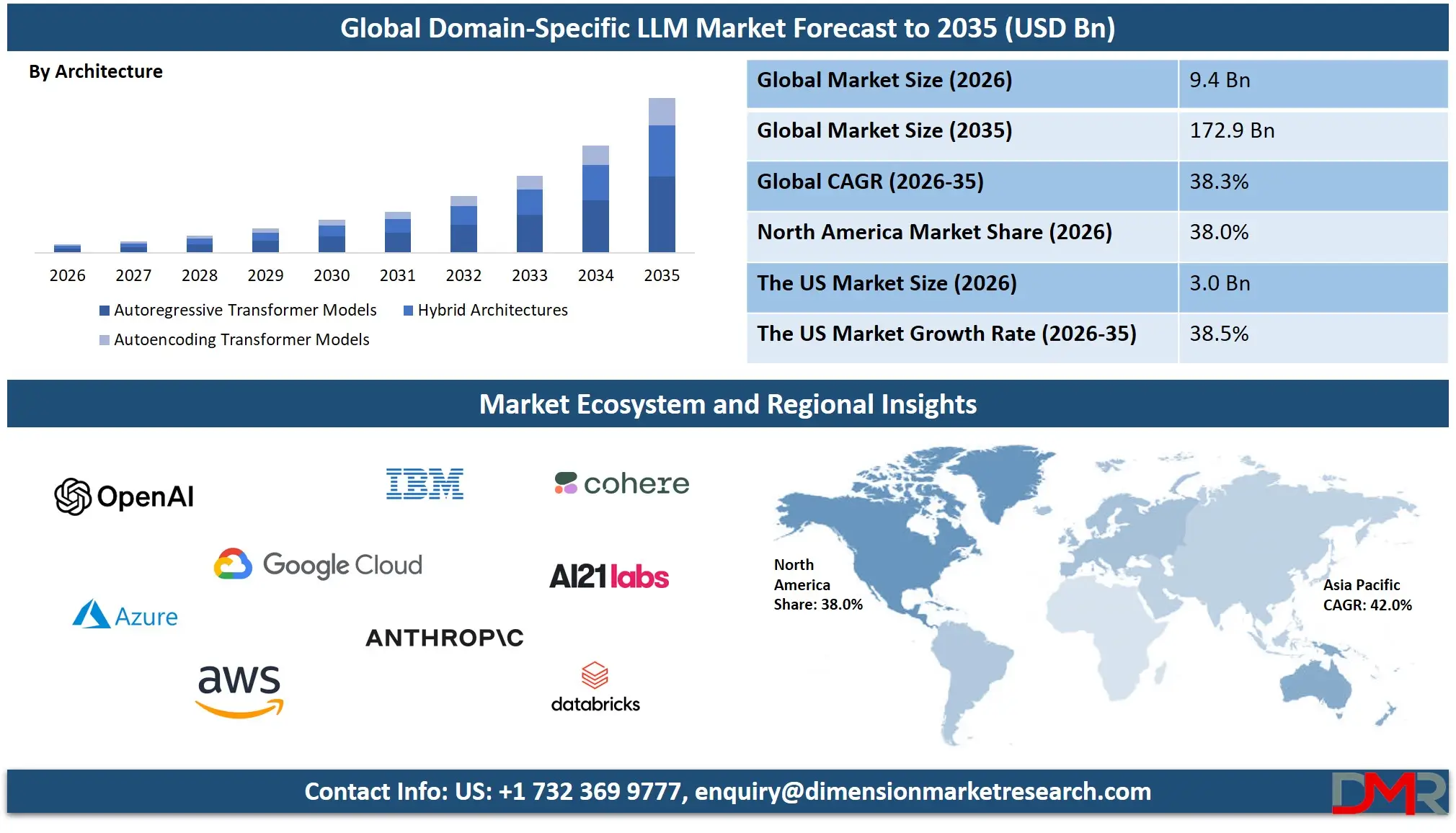
The Global Domain-Specific LLM Market size is expected to reach USD 9.4 billion in 2026 and grow at a 38.3% CAGR to USD 172.9 billion by 2035, driven by demand for industry-specific AI, enterprise LLMs, and domain-focused automation solutions.
ℹ
To learn more about this report –
Download Your Free Sample Report Here
The Domain-Specific LLM Market is specialized in industry-specific AI models, like healthcare, BFSI, and legal, allowing it to be more accurate and make decisions based on the context than general-purpose models. Along with the rising enterprise demand for tailored AI, growing data volumes, and the necessity to have solutions that are secure and compliant, the market is expanding at a high pace. The further development of fine-tuning methods, retrieval-augmented generation, and cloud-based infrastructure is further increasing adoption.
Moreover, regulatory forces are pushing organizations towards the use of private and domain-trained LLMs. In the future, the market will grow considerably as agentic AI and multimodal capabilities start to take off and the enterprise itself becomes increasingly digitized, which will make it one of the primary sources of future digital transformation.
ℹ
To learn more about this report –
Download Your Free Sample Report Here
US Domain-Specific LLM Market
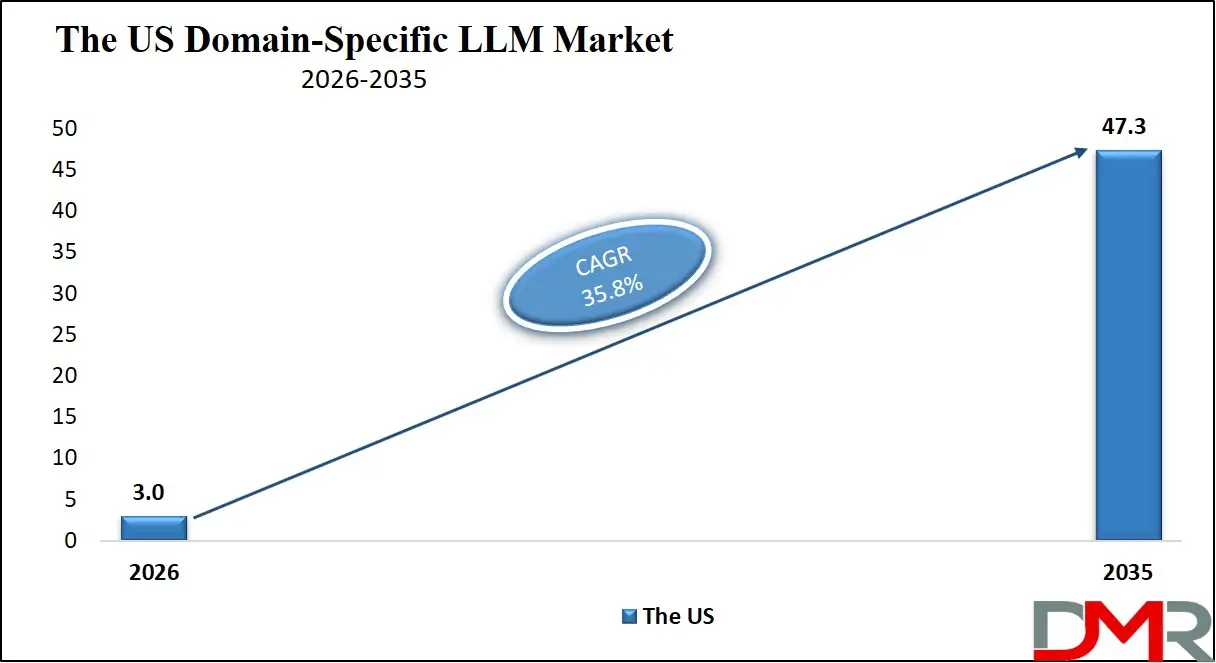
The US Domain-Specific LLM Market is projected to reach USD 3.0 billion in 2026 and expand at a CAGR of 35.8%, reaching approximately USD 47.3 billion by 2035.
ℹ
To learn more about this report –
Download Your Free Sample Report Here
The U.S. Domain-Specific LLM Market is dynamic with a high level of enterprise adoption, top AI firms, and cloud infrastructure. Healthcare, BFSI, and legal are some of the emerging industries that are using domain-specific LLMs to automate, comply, and make decisions that are data-driven. The increasing investments in AI, as well as the demand for customized and secure models, are also increasing growth. The industry has the potential to grow consistently as innovation and more integration of industry-specific AI solutions will be implemented.
Europe Domain-Specific LLM Market
The Europe Domain-Specific LLM Market is anticipated to reach approximately USD 2.2 billion in 2026, growing at a CAGR of 36.5% during the forecast period, which indicates a high uptake of domain-specific LLM in major industries. The area has the advantage of growing enterprise attention to AI deployments that are both regulatory-compliant and secure. The increasing demand in the BFSI sector, healthcare, and manufacturing is also contributing to market growth. Moreover, the further development of AI infrastructure and ethical AI systems is likely to contribute to European growth in the long term.
Japan Domain-Specific LLM Market
The Japan Domain-Specific LLM Market is anticipated to account for approximately USD 752 million in 2026, growing at a CAGR of 37.0%. The market growth is driven by rapid enterprise digitalization and increasing adoption of advanced AI-driven language models. Strong demand from industries such as manufacturing, healthcare, and robotics is further supporting the deployment of domain-specific LLM solutions. Additionally, Japan's focus on automation, precision technologies, and AI-enabled innovation is expected to sustain consistent market expansion.
Key Takeaways
- Market Size: The Global Domain-Specific LLM Market is projected to reach USD 9.4 billion in 2026 and is expected to expand to USD 172.9 billion by 2035, reflecting strong enterprise adoption of specialized AI models across industries.
- Growth Rate and Outlook: The market is anticipated to grow at a CAGR of 38.3% (2026–2035), driven by rising enterprise AI integration, demand for domain-specific intelligence, and expanding use of customized large language models.
- Primary Growth Drivers: Growth is driven by increasing demand for industry-specific AI solutions, automation of complex workflows, and a strong focus on data security and compliance. Advancements in retrieval-augmented generation, fine-tuning, and cloud-based AI infrastructure are further accelerating adoption across enterprises.
- By Deployment Model Analysis: Cloud-based deployment is the dominant segment with 72.0% share in 2026, driven by scalability, flexibility, and cost efficiency.
- By Model Customization Level Analysis: Fine-tuned domain-specific LLMs are the dominant segment with 46.0% share, supported by faster deployment and efficient use of enterprise data.
- By Industry Vertical Analysis: Healthcare and life sciences are the dominant segment with 21.0% share, driven by strong adoption in clinical intelligence and drug discovery applications.
- Regional Leadership: North America is the dominant region with 38.0% market share in 2026, supported by an advanced AI ecosystem and strong enterprise adoption.
What is the Domain-Specific LLM?
A Domain-Specific LLM is a specialized type of artificial intelligence that is trained to work in a specific industry, like healthcare, finance, or legal, and provides more accurate and context-sensitive results compared to general-purpose AI. Organizations such as the National Institute of Standards and Technology state that these models are trained on large language models that have billions of parameters. They are also optimized by means of domain-specific data, which allows for understanding technical language and regulatory requirements better. The Organisation for Economic Co-operation and Development reports that the adoption of enterprise AI is increasing rapidly all over the world, leading to the need for more accurate and trustworthy models. Domain-specific LLMs can reduce the number of mistakes and enhance compliance, particularly in the regulated industry. They find extensive application in automation, document analysis, and decision support in enterprises. On the whole, these models mark a transition to highly-targeted, high-value AI applications that are industry-specific.
Use Cases
- Healthcare Clinical Decision Support: Domain-specific LLMs assist doctors by analyzing patient records, medical literature, and clinical guidelines to provide accurate treatment recommendations, improving diagnostic accuracy and reducing administrative burden through automated documentation, while also supporting drug discovery and personalized medicine initiatives.
- BFSI Risk and Compliance Management: LLMs help financial institutions automate regulatory compliance, fraud detection, and risk assessment by analyzing large volumes of transactional and legal data, identifying anomalies, and ensuring adherence to regulations, thereby enhancing efficiency and reducing operational risks.
- Legal Document Analysis and Automation: Domain-specific LLMs streamline contract review, legal research, and case law analysis by extracting key clauses and insights from complex documents, reducing manual workload and enabling faster, more accurate decision-making across legal operations.
- IT and Software Development Automation: These models enable code generation, debugging, and technical documentation tailored to specific programming environments, improving developer productivity and code quality while accelerating software development cycles and supporting efficient DevOps processes.
How AI is Transforming the Domain-Specific LLM Market
Artificial intelligence is boosting the Domain-Specific LLM Market by making highly specialized models trained on industry-specific data more accurate and contextually relevant. GPT-4 and Google Gemini are changing the market, and they facilitate fine-tuning, multimodal abilities, and enterprise-level AI implementation. Such innovations are assisting companies to automate various complicated business processes, ensure greater compliance, and make better decisions in various sectors. With the further development of AI, agentic systems and domain-trained models will become even more popular, accelerating the expansion of the market and enterprise use.
Market Dynamics
Key Drivers in the Global Domain-Specific LLM Market
Growing Industry-Specific AI needs.
Businesses are moving towards domain-specific LLMs to attain greater accuracy, contextual intelligence, and compliance in business domains like healthcare, BFSI, and legal. These models can be used to automate complicated workflows and enhance the efficiency of decision-making. The increasing popularity of data-driven approaches and the necessity to provide personalized outputs of AI are also driving demand in global businesses.
Improvements in AI Technologies.
Ongoing research and development of finetuning methods, retrieval-enhanced generation, and multimodal tasks are making domain-specific LLMs perform much better. The faster deployment and optimization of costs are facilitated by cloud infrastructure and scalable AI platforms. Such developments are simplifying the process to integrate specialized LLMs into the mainstream business processes to enhance the growth of the market.
Restraints in the Global Domain-Specific LLM Market
Expensive Development and Operational expenses
The development and implementation of domain-specific LLMs take a lot of computational infrastructure investment, quality datasets, and expertise to build and deploy. Custom-trained models, especially fully trained models, are expensive and cannot be used by small and medium enterprises. Constant upkeep, updates of the model, and scaling of infrastructure also contribute to the cost to the organization.
Information Security
Limitations on data protection and compliance (particularly in fields such as health care and finance) are barriers to the implementation of LLM. The possibility of managing sensitive and proprietary information poses a higher risk of privacy violations and lawsuits. Also, the absence of standardized structures and governance models may slow the adoption and provide vagueness to enterprises.
Growth Opportunities in the Global Domain-Specific LLM Market
Growth in the Emerging Industry.
The adoption of domain-specific LLMs in new areas of manufacturing, education, and government is opening up new growth opportunities. The industries are using AI to automate, manage knowledge, and improve work efficiency. The widening scope of application is likely to open up a huge market potential in the future.
Integration with Enterprise Systems
New opportunities are emerging because of the growing integration of LLMs with enterprise software (CRM, ERP, and business intelligence tools). This facilitates smooth workflow automation, real-time insights, and increased productivity. With enterprises increasingly focusing on digital transformation, integrated domain-specific AI solutions are set to gain increased demand.
Trends in the Global Domain-Specific LLM Market
Shift toward Agentic and Autonomous AI
There is a trend toward agent-based LLMs with the ability to make independent decisions and perform tasks in the marketplace. These systems are multi-step, enterprise-interactive, and dynamic. This pattern is redefining the use of AI in organizations, shifting it towards support for complete automation.
Expansion of Private and Secure LLM Deployments.
Companies are moving towards on-premise and private LLM deployments to provide data security and compliance. This is especially high in controlled sectors where information privacy is a key concern. The need to have secure, enterprise-grade AI solutions is fueling innovation in the private LLM architectures and deployment models.
Research Scope and Analysis
By Component Analysis
The component segment is likely to be dominated by platform and software, which should claim approximately 68.0% of the market share in 2026, mainly because of the increasing demand for scalable LLM platforms, fine-tuning frameworks, and API-driven deployment tools that will allow businesses to construct and operationalize domain-specific models effectively. These solutions offer fundamental features like model training, orchestration, and real-time inference, which are essential in the adoption of AI by enterprises. Meanwhile, the services division has a supportive but critical role, including consulting, integration, customization, and continuous monitoring, to assist organizations in deploying, optimizing, and ensuring compliance of domain-specific LLMs in complex business environments.
By Deployment Model Analysis
The deployment model segment is projected to be dominated by cloud-based deployment, which is expected to capture nearly 72.0% of the market share in 2026, due to the scalability, cost-effectiveness, and capability to support continuous model updates and API-based access to enterprises. Instead, organizations are more comfortable with cloud environments to implement faster, integrate seamlessly, and access advanced AI infrastructure without excessive initial investment. Conversely, on-premise deployment will continue to be significant to companies dealing with sensitive data, especially in industries such as healthcare and BFSI, where data security, privacy, and regulatory compliance are paramount, and consistent adoption overrides increased infrastructure and maintenance expenses.
By Model Customization Level Analysis
The model customization level segment will feature fine-tuned domain-specific LLMs, which are expected to take up approximately 46.0% of the market share in 2026 as businesses are more willing to customize pre-trained models with proprietary and industry-specific data to achieve better accuracy, contextual relevance, and cost-efficiency. This method enables it to be deployed faster than creating models directly and still have good performance.
ℹ
To learn more about this report –
Download Your Free Sample Report Here
In the meantime, the retrieval-augmented generation-based LLMs are becoming increasingly popular because they use language models in combination with outside sources of knowledge, allowing real-time access to data, greater factual accuracy, and fewer hallucinations, thereby being perfectly fit to dynamic and data-intensive enterprise-wide applications.
By Model Type Analysis
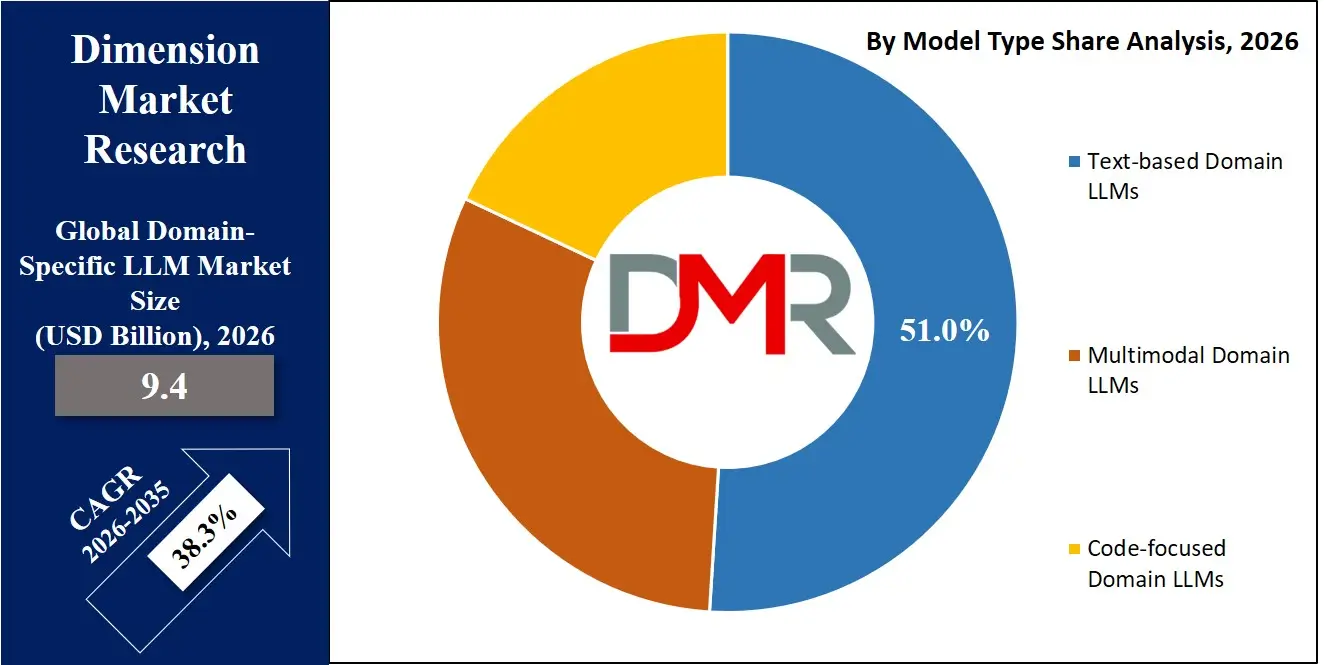
Text-based domain LLMs will be the most prevalent type of models in the market segment, with an estimated share of 51.0% in 2026 due to their popularity in natural language processing applications like document analysis, customer interaction, and knowledge management in enterprises. They are the choice in most industry applications due to their maturity, reduced computation needs, and ease of integration. In the meantime, multimodal domain LLMs are rapidly becoming popular because they can process not only text but also images, audio, and video, and can be used in more advanced applications, in particular, medical imaging analysis, visual inspection in the manufacturing industry, and more comprehensive customer engagement solutions.
By Enterprise Size Analysis
The enterprise size segment is likely to be dominated by large enterprises that will be capturing approximately 64.0% of the market share in 2026 because of their high financial capability, sophisticated IT infrastructure, and capacity to invest in tailored domain-specific LLM solutions for large-scale operations. Such organizations use AI to streamline operations, improve decision-making, and guarantee regulatory adherence to intricate business processes. Conversely, SMEs are slowly starting to embrace the use of domain-specific LLMs by adopting cost-effective cloud-based services and subscription-based business models, so that they can gain access to advanced AI features without significant initial investment, but enhance productivity and competitiveness.
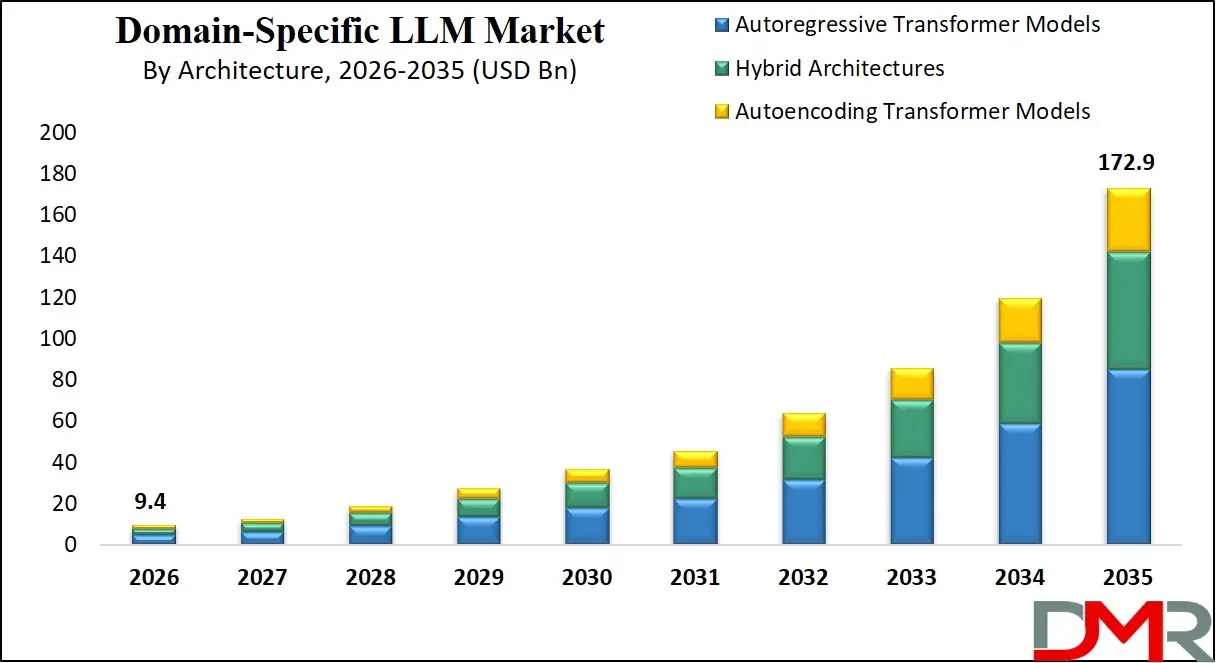
By Architecture Analysis
Autoregressive transformer models are expected to dominate the architecture segment, capturing around 49.0% of the market share in 2026, due to their good ability to produce coherent and contextual generated sequential output, which is highly applied in domain-specific tasks such as content creation, coding, and enterprise automation. Their scalability and the experience of working in large language model systems are also a further boost to adoption. However, in contrast, hybrid architectures are fast becoming a reality by integrating transformer-based generation with retrieval systems and agent-based reasoning to allow better factual accuracy, multi-step reasoning, and real-time decision-making, which is very appropriate to complex enterprise and industry-specific applications.
By Industry Vertical Analysis
The industry vertical segment is projected to be dominated by healthcare and life sciences, which will take up about 21.0% of the market share in 2026, owing to high levels of adoption of domain-specific LLMs in clinical decision-making, drug discovery, medical records, and individual treatment planning, where precision and contextual knowledge are central. The models are used to enhance patient outcomes and lessen the administrative load on healthcare workers. In the meantime, the banking, financial services, and insurance industry is quickly embracing domain-specific LLMs in their fraud detection, risk assessment, regulatory compliance, and customer service automation, using AI to amplify operational efficiency, minimize financial risks, and ensure compliance with stringent regulatory frameworks.
The Global Domain-Specific LLM Market Report is segmented on the basis of the following:
By Component
- Platform and Software
- Model development frameworks
- Fine-tuning environments
- API and inference engines
- Orchestration and prompt management tools
- Services
- Consulting and strategy
- Integration and deployment
- Monitoring and optimization
- Governance and compliance
By Deployment Model
- Cloud-based Deployment
- Public cloud LLM platforms
- Managed AI infrastructure
- API-driven consumption
- On-premise Deployment
- Private enterprise LLMs
- Secure data center environments
- Hybrid and Edge Deployment
- Edge inference systems
- Hybrid infrastructure models
By Model Customization Level
- Fine-tuned Domain-Specific LLMs
- Retrieval-Augmented Generation-Based LLMs
- Fully Custom-trained LLMs
By Model Type
- Text-based Domain LLMs
- NLP-driven enterprise models
- Conversational AI systems
- Multimodal Domain LLMs
- Text and image processing models
- Audio and video capable systems
- Code-focused Domain LLMs
- Software engineering models
- Technical documentation generation
By Enterprise Size
- Large Enterprises
- Small and Medium Enterprises (SMEs)
By Architecture
- Autoregressive Transformer Models
- Decoder-based generative models
- Sequential prediction systems
- Hybrid Architectures
- Retrieval-integrated transformers
- Agent-based reasoning frameworks
- Autoencoding Transformer Models
- Contextual understanding models
- Classification and semantic systems
By Industry Vertical
- Healthcare and Life Sciences
- Banking, Financial Services, and Insurance (BFSI)
- IT and Telecommunications
- Retail and E-commerce
- Manufacturing
- Legal and Professional Services
- Others
Regional Analysis
Leading Region by Market Share
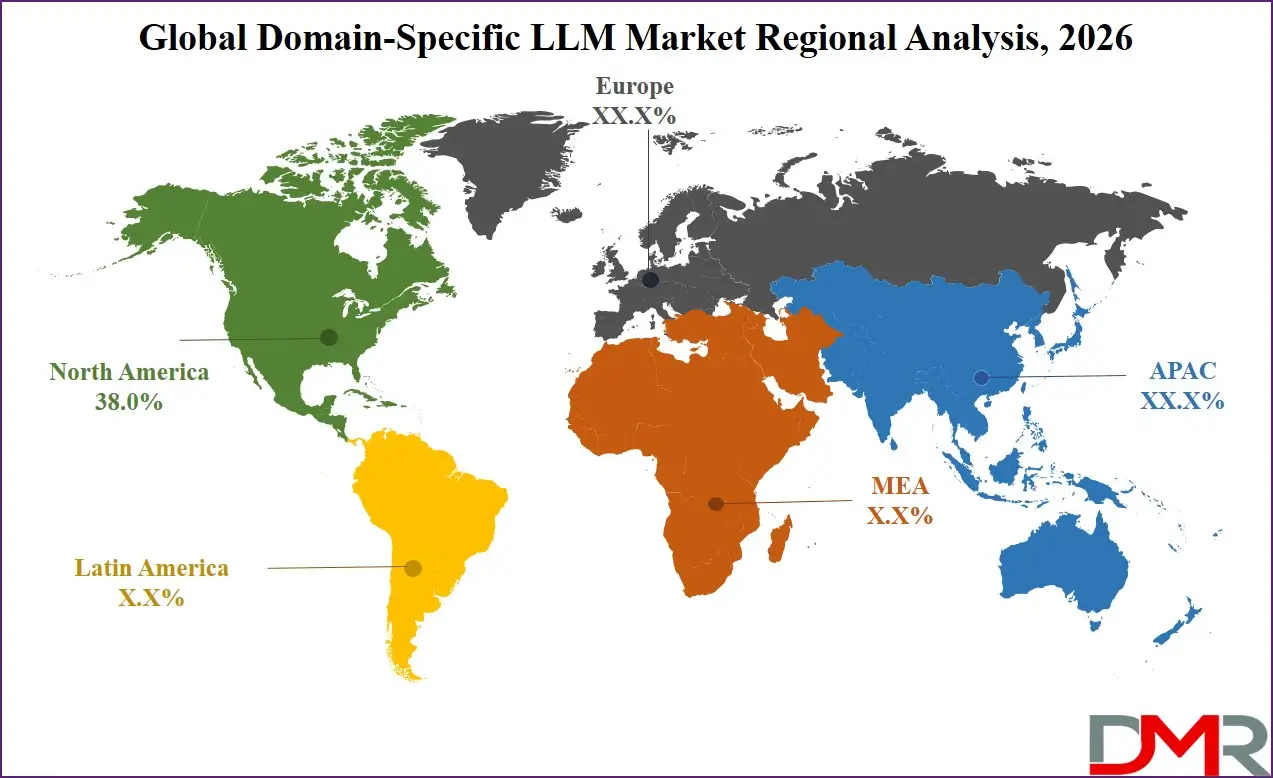
North America is expected to be the leading region in the Domain-Specific LLM Market, accounting for an estimated 38.0% share due to its strong presence of advanced AI companies and early technology adoption. The region is anticipated to benefit from robust cloud infrastructure and high enterprise investment in AI-driven solutions. Widespread deployment across sectors such as healthcare, BFSI, and IT is expected to further strengthen its dominance. Continuous innovation and strong R&D capabilities are projected to sustain its market leadership.
ℹ
To learn more about this report –
Download Your Free Sample Report Here
Fastest-Growing Regional Market
Asia Pacific is anticipated to be the fastest-growing regional market in the Domain-Specific LLM Market, driven by rapid digital transformation and increasing enterprise adoption of AI technologies. The region is expected to witness strong investments in cloud infrastructure and AI research across emerging economies. Government-led initiatives in countries such as China, India, and Japan are projected to accelerate the deployment of advanced language models. Expanding industrial applications and growing demand for localized AI solutions are further expected to fuel robust market growth.
By Region
North America
Europe
- Germany
- The U.K.
- France
- Italy
- Russia
- Spain
- Benelux
- Nordic
- Rest of Europe
Asia-Pacific
- China
- Japan
- South Korea
- India
- ANZ
- ASEAN
- Rest of Asia-Pacific
Latin America
- Brazil
- Mexico
- Argentina
- Colombia
- Rest of Latin America
Middle East & Africa
- Saudi Arabia
- UAE
- South Africa
- Israel
- Egypt
- Rest of MEA
Competitive Landscape
The competitive landscape of the Domain-Specific LLM Market is expected to be highly dynamic, with continuous innovation in model architecture, fine-tuning techniques, and retrieval-augmented generation systems. Intense competition is anticipated as players focus on improving the accuracy, scalability, and domain adaptability of their solutions. Strategic collaborations, partnerships, and rapid cloud integration are projected to shape market positioning. Additionally, increasing demand for secure and compliant enterprise AI solutions is expected to further intensify competition and drive technological advancements.
Some of the prominent players in the Global Domain-Specific LLM Market are:
- OpenAI
- Google Cloud
- Microsoft Azure
- Amazon Web Services
- IBM
- Anthropic
- Cohere
- AI21 Labs
- Databricks
- Hugging Face
- NVIDIA
- Salesforce
- SAP
- Oracle
- Palantir Technologies
- Bloomberg
- Stability AI
- Baidu
- Alibaba Cloud
- Tencent Cloud
- Other Key Players
Recent Developments
- March 2026: Fractal Analytics introduced its LLM Studio platform, built to help enterprises design, fine-tune, and deploy domain-specific large language models using open-source foundations and NVIDIA-powered AI infrastructure for industry-focused applications.
- March 2026: Legora acquired Canadian legal-tech firm Henchman to enhance its domain-specific legal AI capabilities, particularly in contract intelligence and enterprise legal workflow automation.
- February 2026: Sarvam AI launched its multilingual domain-specific large language model designed for enterprise applications, enabling organizations to build localized AI assistants with improved contextual understanding and regulatory compliance across regulated industries such as healthcare and finance.
Report Details
| Report Characteristics |
| Market Size (2026) |
USD 9.4 Bn |
| Forecast Value (2035) |
USD 172.9 Bn |
| CAGR (2026–2035) |
38.3% |
| Historical Data |
2021 – 2025 |
| Forecast Data |
2027 – 2035 |
| Base Year |
2025 |
| Estimate Year |
2026 |
| Segments Covered |
By Component (Platform and Software, Services), By Deployment Model (Cloud-based Deployment, On-premise Deployment, Hybrid and Edge Deployment), By Model Customization Level (Fine-tuned Domain-Specific LLMs, Retrieval-Augmented Generation-Based LLMs, Fully Custom-trained LLMs), By Model Type (Text-based Domain LLMs, Multimodal Domain LLMs, Code-focused Domain LLMs), By Enterprise Size (Large Enterprises, Small and Medium Enterprises), By Architecture (Autoregressive Transformer Models, Hybrid Architectures, Autoencoding Transformer Models), By Industry Vertical (Healthcare and Life Sciences, Banking Financial Services and Insurance, IT and Telecommunications, Retail and E-commerce, Manufacturing, Legal and Professional Services, Others) |
| Regional Coverage |
North America – The US and Canada; Europe – Germany, The UK, France, Russia, Spain, Italy, Benelux, Nordic, & Rest of Europe; Asia-Pacific – China, Japan, South Korea, India, ANZ, ASEAN, Rest of APAC; Latin America – Brazil, Mexico, Argentina, Colombia, Rest of Latin America; Middle East & Africa – Saudi Arabia, UAE, South Africa, Turkey, Egypt, Israel, & Rest of MEA |
Frequently Asked Questions
How big is the Domain-Specific LLM Market?
▾ The Global Domain-Specific LLM Market is expected to reach USD 9.4 billion in 2026 and is projected to surge to approximately USD 172.9 billion by 2035, reflecting strong enterprise AI adoption across industries.
What is the CAGR of the Domain-Specific LLM Market from 2026 to 2035?
▾ The market is anticipated to grow at a CAGR of 38.3% during the forecast period 2026 to 2035, driven by rapid advancements in enterprise AI and industry-specific large language models.
What factors are driving the growth of the Domain-Specific LLM Market?
▾ Growth is driven by increasing demand for industry-specific AI solutions, rising enterprise focus on automation and productivity enhancement, and the need for accurate, compliant, and secure AI systems. Advancements in fine-tuning, retrieval-augmented generation, and cloud-based AI infrastructure are further accelerating adoption across healthcare, BFSI, legal, and IT sectors.
What are the major trends in the Domain-Specific LLM Market?
▾ Key trends include the shift toward agentic AI systems, growing adoption of retrieval-augmented generation (RAG), and increasing deployment of multimodal domain-specific models. Enterprises are also prioritizing private and secure LLM deployments, along with deeper integration of AI into core business workflows and decision-making systems.
Which region held the largest share of the Domain-Specific LLM Market in 2026?
▾ North America is expected to hold the largest market share in 2026, accounting for approximately 38.0%, driven by strong AI ecosystem presence, early technology adoption, and significant enterprise investment in advanced LLM solutions.
Which region is expected to grow the fastest in the Domain-Specific LLM Market?
▾ Asia Pacific is anticipated to be the fastest-growing region, supported by rapid digital transformation, expanding cloud infrastructure, and strong government initiatives promoting AI adoption across countries such as China, India, and Japan.
Who are the key players in the Domain-Specific LLM Market?
▾ Key players in the market include OpenAI, Google Cloud, Microsoft Azure, Amazon Web Services, IBM, Anthropic, Cohere, AI21 Labs, Databricks, Hugging Face, NVIDIA, Salesforce, SAP, Oracle, Palantir Technologies, Bloomberg, Stability AI, Baidu, Alibaba Cloud, and Tencent Cloud, along with other emerging AI solution providers.
How is the Domain-Specific LLM Market segmented?
▾ The market is segmented into By Component, By Deployment Model, By Model Customization Level, By Model Type, By Enterprise Size, By Architecture, and By Industry Vertical.