Market Overview
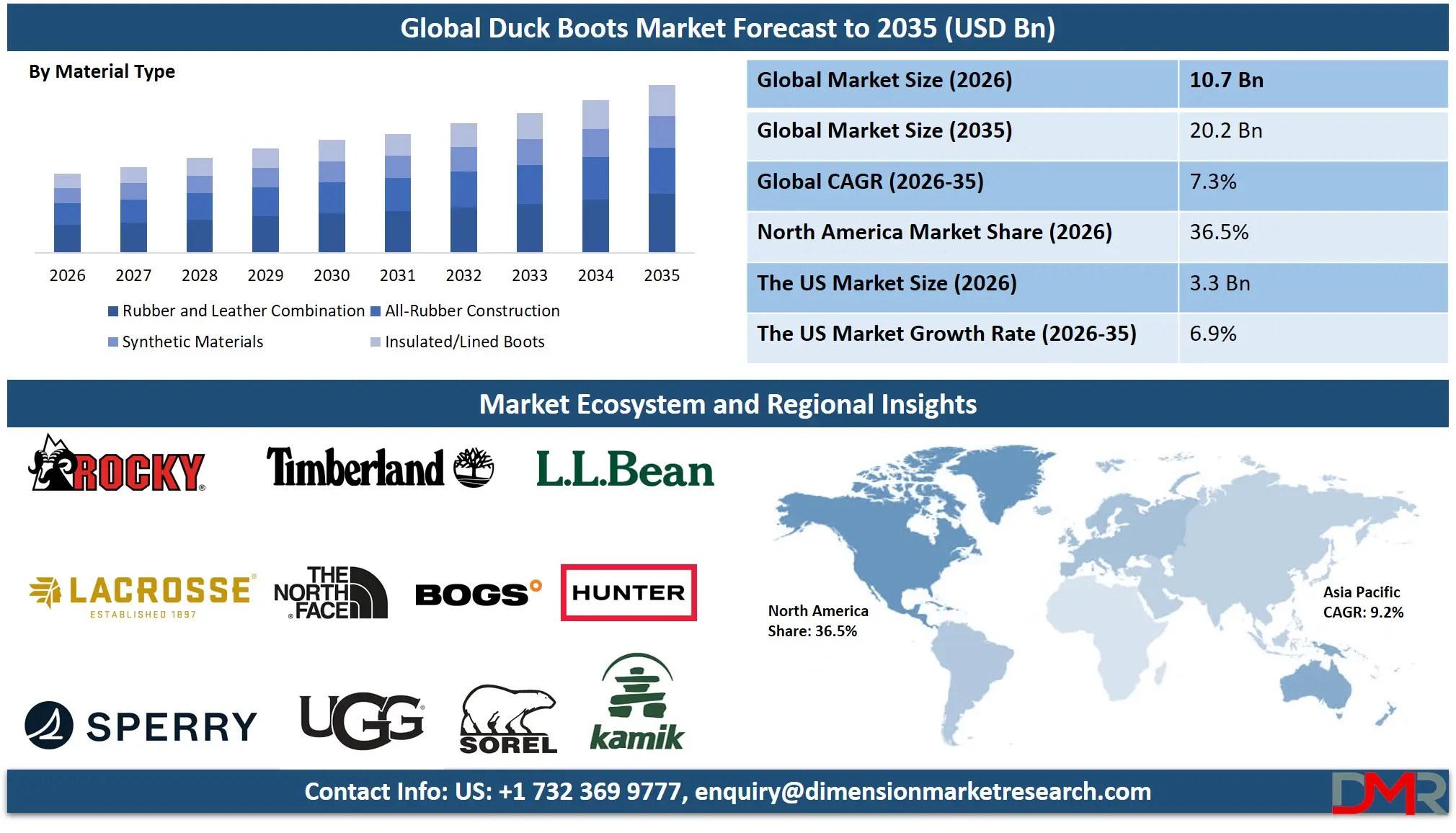
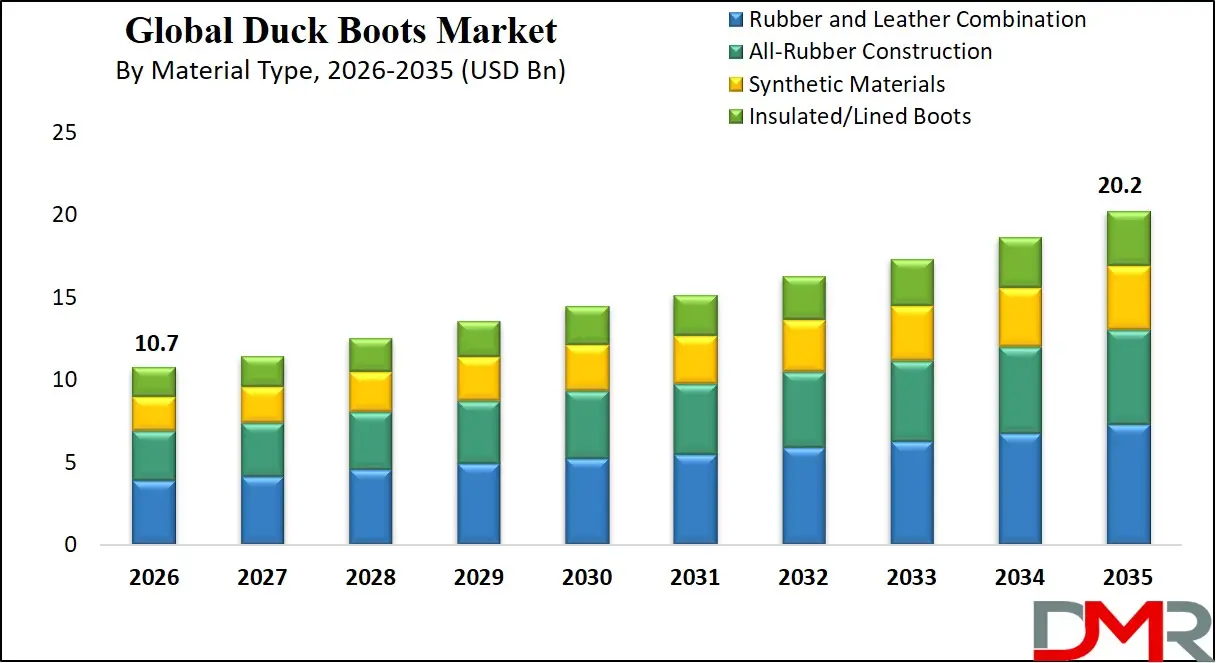
The Global Duck Boots Market is set for substantial expansion, reaching an estimated USD 10.7 billion in 2026 and projected to grow at a strong CAGR of 7.3% from 2026 to 2035, to the market value of USD 20.2 billion by 2035. This robust growth trajectory is fueled by the accelerating adoption of functional and durable footwear solutions, rising consumer preference for all-weather boots, and increasing outdoor recreational activities across industries.
ℹ
To learn more about this report –
Download Your Free Sample Report Here
Rising incidents of unpredictable weather patterns, increased participation in hunting and fishing activities, and growing demand for slip-resistant and insulated footwear are compelling manufacturers to implement advanced waterproofing technologies and ergonomic design frameworks. The rapid expansion of outdoor adventure tourism, e-commerce platforms, lifestyle retail chains, and subscription-based footwear services is significantly increasing demand for reliable duck boots.
Additionally, growing consumer awareness related to sustainable materials, ethical manufacturing practices, and durability standards is further accelerating market adoption. Brands are increasingly integrating rubber vulcanization techniques, memory foam insoles, multi-layer waterproof membranes, and eco-friendly leather alternatives to enhance user comfort and prevent cold-related injuries.
Omnichannel distribution models, D2C brand websites, and marketplace partnerships are enabling footwear companies and SMEs to implement cost-effective and globally accessible sales strategies. As outdoor lifestyles dominate consumer preferences and disposable incomes continue to rise worldwide, the Duck Boots Market is expected to witness sustained steady growth through 2035, driven by fashion functionality convergence and climate adaptation initiatives.
ℹ
To learn more about this report –
Download Your Free Sample Report Here
Growing government initiatives promoting outdoor tourism infrastructure, seasonal employment programs, and trade agreements for raw materials further accelerate global adoption. However, barriers such as varying import tariffs (USMCA, EU trade policies), high logistics costs in international shipping, reliance on natural rubber supply chains, and the rising competition from fast-fashion alternatives remain. Despite these limitations, the convergence of heritage design, technical materials, and direct-to-consumer platforms positions duck boots as a central pillar of global all-weather footwear through 2035.
The US Duck Boots Market
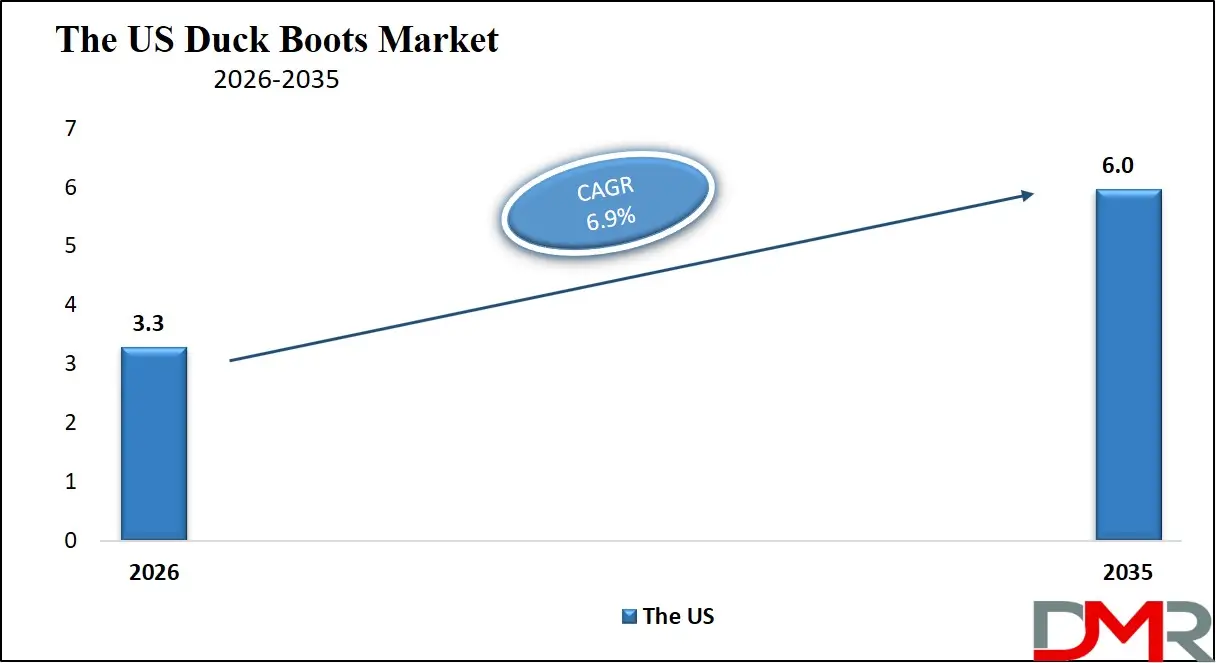
The U.S. Duck Boots Market is projected to reach USD 3.3 billion in 2026 and grow at a CAGR of 6.9%, reaching USD 6.0 billion by 2035. The U.S. leads global adoption due to its strong hunting culture, established outdoor lifestyle brands, and seasonal weather variations across the Northeast and Midwest regions.
ℹ
To learn more about this report –
Download Your Free Sample Report Here
The proliferation of outdoor recreation activities in hunting, fishing, and farming, coupled with consumers' expectation of durable yet stylish boots, fuels demand for robust duck boot designs. Major footwear brands and retail chains such as L.L.Bean, Cabela's, and DICK'S Sporting Goods are integrating advanced waterproof constructions to mitigate risks during wet terrain navigation and cold-weather excursions.
U.S. regulatory support for domestic manufacturing initiatives, alongside frameworks like the American Materials Act, encourages investment in local production facilities. The market is witnessing a shift toward sustainable sourcing and lifetime warranty programs, reducing reliance on imported goods and enhancing brand loyalty. The rise of "buy it for life" consumer movements has further intensified the focus on premium duck boots with replaceable parts, positioning the U.S. as a critical innovator in this space.
The Europe Duck Boots Market
The Europe Duck Boots Market is projected to be valued at approximately USD 1.0 billion in 2026 and is projected to reach around USD 1.8 billion by 2035, growing at a CAGR of about 6.0% from 2026 to 2035. Europe's leadership is anchored by its stringent environmental regulations, particularly the REACH chemicals directive and the EU Timber Regulation, which mandate sustainable material sourcing for footwear.
Countries such as Germany, the U.K., France, and the Nordic region are widely adopting duck boots, driven by a high emphasis on outdoor activities and fashion functionality. The U.K.'s Countryside Alliance and the EU's evolving Circular Economy Action Plan further necessitate sustainable production mechanisms across footwear manufacturers.
Europe's high precipitation levels, cross-border hiking trails, and a mature outdoor apparel ecosystem drive the demand for durable, weather-resistant duck boots. Funding and support for sustainable fashion initiatives encourage eco-friendly material innovation and the standardization of durability testing across member states. With a sophisticated consumer base and a regulatory landscape that prioritizes environmental responsibility, Europe remains a highly advanced and essential region for duck boot sales.
The Japan Duck Boots Market
The Japan Duck Boots Market is anticipated to be valued at approximately USD 535.0 million in 2026 and is expected to attain nearly USD 904.0 million by 2035, expanding at a CAGR of about 6.0% during the forecast period. Japan's aging population and a government push for "Active Senior" initiatives are driving the adoption of safe and comfortable outdoor footwear, making duck boots a cornerstone of seasonal mobility.
The Ministry of Economy, Trade and Industry (METI) actively supports the development of high-performance footwear manufacturing, promoting the use of advanced materials for public and recreational services. Japan's leadership in rubber technology and high domestic consumption provides a robust foundation for premium duck boot production, including slip-resistant soles and lightweight insulation.
Japan's concept of "Forest Therapy" and nature retreats, driven by wellness tourism groups, integrates duck boots into everything from hiking excursions to agricultural tourism. Companies are deploying advanced duck boot designs to combat rising cases of slip-related injuries and ensure the integrity of outdoor experiences in Hokkaido's winter sports sector and regional farming communities. Japan's cultural emphasis on quality and reliability positions it as a high-growth, quality-focused market for duck boot manufacturers.
Global Duck Boots Market: Key Takeaways
- Steady Global Market Growth Outlook: The Global Duck Boots Market is expected to be valued at USD 10.7 billion in 2026 and is projected to reach USD 20.2 billion by 2035, showcasing steady expansion supported by rising demand for durable all-weather footwear.
- Moderate CAGR Driven by Outdoor Lifestyle Trends: The market is expected to grow at a CAGR of 7.3% from 2026 to 2035, fueled by accelerating outdoor recreation participation, material technology innovations, and increasing climate variability worldwide.
- Steady Growth Trajectory in the United States: The U.S. Duck Boots Market stands at USD 3.3 billion in 2026 and is projected to reach USD 6.0 billion by 2035, expanding at a CAGR of 6.9% due to strong hunting culture and established retail infrastructure.
- Regional Dominance: North America is expected to capture approximately 36.5% of the global market share in 2026, supported by strong heritage brands, established distribution networks, and high consumer spending on outdoor gear.
- Rapid Advancement in Boot Technologies: Innovations including advanced waterproof membranes, recycled material construction, temperature-regulating linings, and replaceable sole systems are significantly enhancing comfort, durability, and sustainability of duck boots.
- Growing Outdoor Recreation Boosts Adoption: Rising global participation in hunting, fishing, hiking, and farming activities, coupled with the need for weather-appropriate footwear, is driving sustained demand for high-quality duck boots.
Global Duck Boots Market: Use Cases
- Hunting and Fishing Expeditions: Outdoor enthusiasts rely on duck boots for waterproof protection and insulation during extended periods in wetlands, marshes, and riverbanks across varying weather conditions.
- Farming and Agricultural Work: Farmers and ranchers use duck boots for daily chores in muddy fields, barns, and wet terrain, requiring slip-resistant soles and easy-clean rubber components.
- Winter Commuting in Urban Areas: City dwellers in snow-prone regions wear duck boots for daily commutes, combining weather protection with style suitable for office and casual environments.
- Outdoor Festivals and Events: Attendees at multi-day music festivals and outdoor gatherings use duck boots for comfort and mud protection regardless of weather conditions.
- Dog Walking and Daily Errands: Pet owners and suburban residents rely on duck boots for everyday activities in wet or snowy conditions, prioritizing ease of wear and durable construction.
Global Duck Boots Market: Stats & Facts
United States International Trade Commission (USITC)
- In 2021, 95.9% of footwear consumed in the United States was imported.
- U.S. footwear imports reached USD 27.2 billion in 2021, increasing 31.4% year-over-year.
- China accounted for 42.2% of total U.S. footwear imports in 2021.
- Vietnam exported USD 7.5 billion worth of footwear to the U.S. in 2021, making it the second-largest supplier.
- U.S. footwear exports increased by 2.2% in 2021.
- Canada received USD 147 million worth of U.S. footwear exports in 2021.
- Mexico imported USD 57 million in footwear from the U.S. in 2021.
World Trade Organization (WTO)
- Global merchandise trade rebounded by 10.8% in volume in 2021 following pandemic declines.
- Footwear is classified under HS Chapter 64 in international trade reporting.
- WTO statistics show developing economies account for over 40% of global merchandise exports, including footwear.
- Asia represents the dominant share of global footwear exports under WTO trade data.
International Labour Organization (ILO)
- The global textile, apparel, and footwear sector employs approximately 91 million workers worldwide.
- The majority of footwear manufacturing employment is concentrated in Asia.
- Women account for over 60% of employment in garment and footwear manufacturing globally.
- Informal employment remains significant in footwear production across developing economies.
World Footwear Yearbook (Data compiled from national industry associations & customs authorities)
- Global footwear production reached 23.9 billion pairs in 2022.
- Asia accounted for 87% of global footwear production.
- China produced approximately 12 billion pairs of shoes annually, making it the largest producer globally.
- India produced approximately 2.6 billion pairs annually, ranking second globally.
- Vietnam produced over 1.3 billion pairs annually, ranking third.
- Global footwear exports exceeded 13 billion pairs annually.
United Nations COMTRADE Database
- Footwear trade is recorded under HS codes 6401–6406.
- Waterproof footwear (including rubber boots) is categorized under HS 6401.
- Global exports of waterproof footwear (HS 6401) exceed USD 10 billion annually.
- The European Union is one of the largest importers of waterproof footwear globally.
Japan Ministry of Economy, Trade and Industry (METI)
- Japan’s footwear imports account for over 70% of domestic consumption.
- Rubber and plastic footwear imports form a significant portion of Japan’s total footwear imports annually.
Global Duck Boots Market: Market Dynamic
Driving Factors in the Global Duck Boots Market
Rising Outdoor Recreation Participation
The growing global participation in outdoor activities including hunting, hiking, fishing, and camping is a major driver for duck boots. Consumers increasingly seek specialized footwear that provides protection across variable terrain and weather conditions. Duck boots that combine rubber waterproofing with leather uppers and insulated linings provide critical functionality for extended outdoor exposure. This allows brands to target passionate outdoor enthusiasts who prioritize performance and durability, especially in regions with established hunting and fishing cultures.
Climate Variability and Weather Adaptation
Duck boots benefit significantly from global climate patterns producing increased precipitation, flooding events, and winter storms. These weather trends legally require consumers to own appropriate footwear, making duck boots not just a lifestyle choice but a practical necessity. The ability to provide waterproof protection, thermal insulation, and slip resistance across changing conditions helps meet consumer safety needs and avoids discomfort associated with wet feet and cold temperatures.
Restraints in the Global Duck Boots Market
Raw Material Price Volatility
The significant challenge of fluctuating prices for natural rubber, leather, and petroleum-based synthetics creates production cost uncertainty. Achieving consistent quality and pricing requires stable supply chains, which can be disrupted by climate events affecting rubber production or trade policies impacting leather imports. In many regions, material cost increases cannot be fully passed to price-sensitive consumers, compressing manufacturer margins and forcing brands to consider lower-quality alternatives.
Seasonal Demand Patterns
Seasonal demand creates inventory management challenges for duck boot manufacturers and retailers. Predicting order quantities for winter seasons involves weather pattern uncertainty, with mild winters potentially leaving excess inventory and harsh winters causing stockouts. This creates significant operational and financial complexity for brands, requiring flexible manufacturing capacity and sophisticated demand forecasting.
Opportunities in the Global Duck Boots Market
Expansion into Year-Round Fashion Applications
Fashion-forward consumers represent major growth opportunities due to rapid adoption of heritage styles, urban utilitarianism, and workwear aesthetics. Countries like Japan, South Korea, and the U.S. are seeing duck boots styled with casual and even semi-formal attire, creating demand beyond traditional outdoor use. Lifestyle-oriented designs, collaborations with fashion influencers, and expanded colorways can improve accessibility, driving the next wave of market expansion beyond core outdoor enthusiasts.
Sustainable Material Innovation
The integration of recycled materials, bio-based rubbers, and chrome-free leather tanning creates new value streams for environmentally conscious consumers. Sustainable production can power premium positioning, where higher price points are justified by reduced environmental impact. This transforms duck boots from basic utility items into conscious consumer choices that optimize brand loyalty and continuously improve sustainability metrics.
Trends in the Global Duck Boots Market
Heritage and Authenticity Marketing
The rise of heritage storytelling, emphasizing original designs, American or European manufacturing heritage, and family-owned brand histories, is gaining significant traction. This trend leverages consumer desire for authentic products with proven performance rather than fast-fashion alternatives. This method builds brand loyalty among consumers willing to invest in premium, long-lasting footwear.
Direct-to-Consumer (D2C) Expansion
Heritage brands are enabling direct sales through owned e-commerce platforms, reducing reliance on wholesale partners and improving margins. This ensures higher profitability and direct customer relationships by bypassing traditional retail markups. This trend supports brand control over pricing, marketing, and customer experience.
Global Duck Boots Market: Research Scope and Analysis
By Product Type Analysis
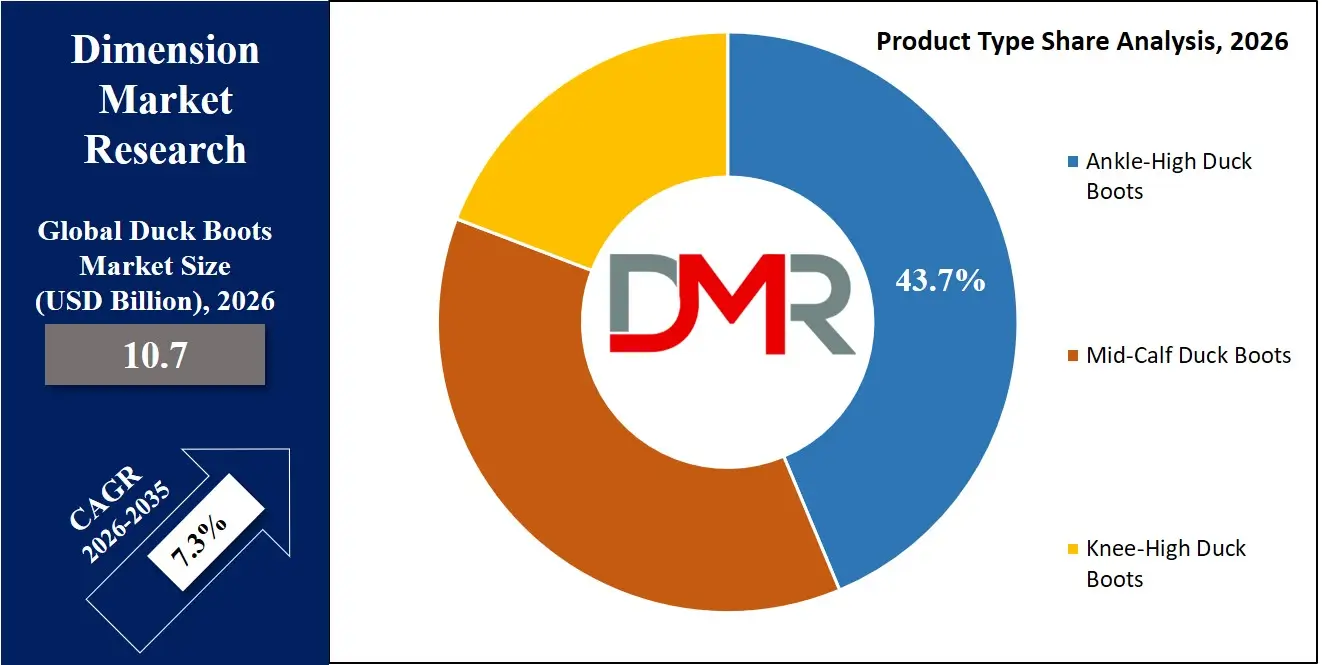
The classic ankle-high duck boot segment is projected to dominate the Global Duck Boots Market, accounting for the largest revenue share compared to mid-calf and knee-high styles. This dominance is primarily driven by the versatility of ankle-height boots suitable for both outdoor activities and casual daily wear. Consumers across hunting, farming, and urban segments require footwear that balances protection with mobility and style.
ℹ
To learn more about this report –
Download Your Free Sample Report Here
Modern ankle duck boots provide advanced capabilities such as waterproof rubber bottoms, full-grain leather uppers, removable insoles, and slip-resistant outsoles. These features significantly improve comfort during extended wear and protection in wet conditions. Brands prefer manufacturing classic silhouettes that offer customization options, multiple colorways, and heritage branding elements, enabling category expansion.
Additionally, the shift toward casualization of outdoor wear has increased reliance on ankle boots that transition seamlessly from trail to town. Mid-calf boots remain important for deep wading and extreme conditions but represent a smaller volume segment. As outdoor lifestyles blend with everyday fashion globally and consumers seek versatile footwear, the ankle-high product segment is expected to maintain its leadership position due to continuous design refinement and material innovation.
By Material Type Analysis
Rubber and leather combination is expected to dominate the material segment due to its proven performance, durability, and heritage authenticity. Consumers increasingly prefer traditional rubber-bottom, leather-upper construction because it offers the optimal balance of waterproofing, breathability, and aesthetic appeal. As heritage styles remain popular across multiple geographies, this material combination enables authentic brand positioning.
Rubber-leather construction allows traditional manufacturing techniques while supporting modern performance enhancements like Gore-Tex linings and Vibram soles. This is particularly valued by hunting and outdoor enthusiasts who require reliability in demanding conditions.
Another major advantage of rubber-leather combination is its ability to develop character with age, appealing to consumers seeking long-term ownership rather than disposable fashion. The premium pricing supported by quality materials further sustains this segment's market leadership. Although synthetic materials and all-rubber construction remain relevant for specific applications, their adoption is comparatively limited due to lower breathability and reduced heritage appeal.
By Price Range Analysis
Mid-range priced boots is projected to dominate the price segment due to optimal balance of quality, brand recognition, and affordability. Mass-market outdoor retailers, department stores, and specialty catalogs offer extensive mid-range selections that appeal to casual outdoor participants and daily wear consumers.
These brands prioritize durability, comfort, and style while maintaining accessible price points. Heritage associations require consistent quality standards, prompting established manufacturers to offer entry-level heritage styles within mid-range pricing. Additionally, mid-range brands often source from multiple countries, necessitating supply chains capable of balancing cost and quality.
Mid-range brands also adopt modern e-commerce strategies, social media marketing, and influencer partnerships. Their volume allows them to maintain broad distribution across retail channels. While premium and economy segments serve specific consumer groups, mid-range pricing generates the majority of market revenue and is expected to sustain its dominant position.
By Distribution Channel Analysis
Online retail (D2C and marketplaces) is forecasted to dominate the distribution segment, driven by changing consumer shopping habits and expanded digital offerings. With rising e-commerce penetration, footwear purchases increasingly move online, and brands rely heavily on owned websites and marketplace presences to reach consumers directly.
Established outdoor brands use D2C platforms to showcase full collections, offer customization, and build direct relationships. Marketplaces leverage extensive customer bases and fulfillment networks to enable brand discovery and convenient purchasing.
Online retail has become increasingly important as consumers prefer detailed product information, customer reviews, and easy returns. Direct websites and specialized outdoor retailers provide authoritative content and community engagement during research and purchase processes.
Although specialty outdoor stores and department stores remain important for try-on experiences and immediate purchase, online retail continues to dominate due to its convenience, broader selection, and competitive pricing. As digital commerce infrastructure expands globally, this segment will continue its leadership position.
By Application Analysis
Hunting is forecasted to dominate the application segment, driven by the specialized requirements of waterfowl and upland game hunting. With established hunting traditions in North America and Europe, hunters rely heavily on duck boots for stealth, warmth, and dryness in wetlands and fields.
Hunting organizations use specialized boots to maintain concealment, enable long static periods in cold water, and navigate challenging terrain. Conservation groups leverage waterproof and insulated designs to ensure hunter comfort and success during limited seasons.
Hunting applications have become increasingly important as waterfowl populations drive season lengths and bag limits requiring extended field time. Specialized duck boots provide critical performance for serious hunters willing to invest in premium gear.
Although farming and daily wear applications are growing, hunting remains the primary revenue driver. As hunting participation continues with effective wildlife management and tradition preservation, this segment will continue to dominate due to its direct functional requirements and passionate consumer base.
By End-User Analysis
Men is anticipated to dominate the end-user segment due to higher participation rates in hunting, fishing, and outdoor occupations. These activities traditionally require specialized footwear where duck boots originated and remain essential. Men's boot sales are driven by both functional requirements and the workwear aesthetic trend.
Men's duck boot purchasing remains popular because sizing, width options, and durability standards are well-established in manufacturing. It is extensively used by hunters, farmers, construction workers, and outdoor guides. Rugged styling strengthens appeal by adding masculine design elements beyond basic functionality.
Cultural associations in North American and European contexts link duck boots with traditional male outdoor activities, further driving adoption. As outdoor participation diversifies, men continue to represent the primary consumer base.
Although women's duck boot sales are growing rapidly due to fashion adoption and increased female outdoor participation, men's purchasing volume continues to dominate because of established market presence and activity patterns. Their sustained preference for functional outdoor footwear ensures continued leadership in this segment.
The Global Duck Boots Market Report is segmented on the basis of the following:
By Product Type
- Ankle-High Duck Boots
- Mid-Calf Duck Boots
- Knee-High Duck Boots
By Material Type
- Rubber and Leather Combination
- All-Rubber Construction
- Synthetic Materials
- Insulated/Lined Boots
By Price Range
- Economy
- Mid-Range
- Premium
By Distribution Channel
- Online Retail
- Specialty Outdoor Stores
- Department Stores & Mass Merchandisers
- Brand Outlets
By End-User
Impact of Artificial Intelligence in the Global Duck Boots Market
- AI for Trend Forecasting & Design Optimization: AI analyzes vast datasets of consumer preferences, search trends, and social media to identify emerging styles and color preferences, allowing brands to design boots with higher commercial success probability.
- AI-Driven Inventory Management: AI algorithms predict regional demand based on weather patterns, historical sales, and seasonal trends to optimize production quantities and distribution, reducing overstock and stockout situations.
- Virtual Try-On and Size Recommendation: AI-powered systems use computer vision and customer data to recommend accurate sizing across different brands and models, reducing returns and improving customer satisfaction in online channels.
- AI-Based Material Sourcing Optimization: AI analyzes raw material prices, supplier reliability, and logistics data to select the most cost-effective and sustainable sourcing pathways for rubber, leather, and components.
- Customer Sentiment Analysis for Product Improvement: AI systems aggregate and analyze product reviews and social media mentions to identify common praise or complaints about specific models, enabling continuous product refinement.
Global Duck Boots Market: Regional Analysis
Region with the Largest Revenue Share
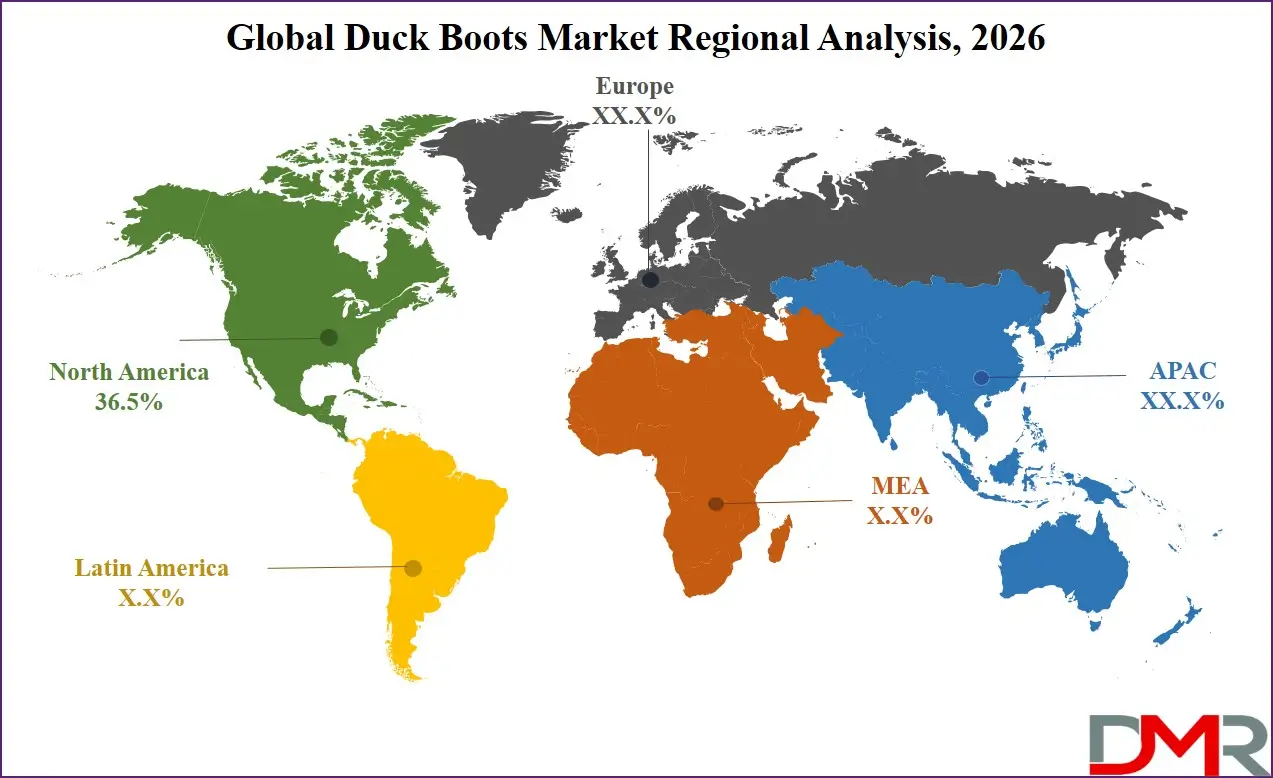
North America is projected to dominate the regional segment with the highest market share as it is anticipated to hold 36.5% of the total market revenue by the end of 2026, due to established hunting culture, strong heritage brands, and widespread adoption of outdoor recreation. The region is home to leading duck boot manufacturers and outdoor retailers, driving product innovation and market presence. Strong brand loyalty regarding heritage designs and proven performance compels consumers to invest in premium duck boots. High consumer awareness regarding quality and durability further strengthens demand.
ℹ
To learn more about this report –
Download Your Free Sample Report Here
The United States, in particular, accounts for the largest share within North America due to its extensive hunting participation and cold-weather regions. Although Asia Pacific is the fastest-growing region, North America continues to hold the largest revenue share due to established brand heritage and strong outdoor traditions.
Region with the Highest CAGR
Asia-Pacific holds the highest CAGR and is poised to achieve rapid market share growth due to its growing middle class, expanding outdoor recreation participation, and increasing Western fashion adoption. Countries like China, South Korea, and Japan are seeing rapid growth in camping, hiking, and outdoor lifestyle activities. South Korea's "Work-life balance" initiatives and similar trends across developed Asia are creating fertile ground for duck boot adoption. The region's style consciousness is being addressed through fashion collaborations, localized marketing, and partnerships between global heritage brands and regional distributors. This, combined with increasing disposable income and outdoor infrastructure investment, positions APAC as the fastest-growing market for duck boots.
By Region
North America
Europe
- Germany
- The U.K.
- France
- Italy
- Russia
- Spain
- Benelux
- Nordic
- Rest of Europe
Asia-Pacific
- China
- Japan
- South Korea
- India
- ANZ
- ASEAN
- Rest of Asia-Pacific
Latin America
- Brazil
- Mexico
- Argentina
- Colombia
- Rest of Latin America
Middle East & Africa
- Saudi Arabia
- UAE
- South Africa
- Israel
- Egypt
- Rest of MEA
Global Duck Boots Market: Competitive Landscape
The Global Duck Boots Market is moderately fragmented, featuring a mix of heritage outdoor brands, lifestyle footwear companies, and mass-market retailers. Leading players like L.L.Bean, The Original Muck Boot Company, and Bogs leverage their long-standing brand heritage and specialized manufacturing expertise to offer duck boots as core products. Pure-play outdoor innovators such as LaCrosse, Dryshod, and Hodgman are driving market dynamics with specialized, high-performance features and technical materials.
Lifestyle brands like Sperry, Sorel, and Timberland play a crucial role in expanding duck boots into fashion applications, while mass retailers such as Cabela's and Bass Pro Shops provide extensive distribution through retail networks. Regional manufacturers and private label producers are also active, forming partnerships with retailers to offer value-priced alternatives.
Some of the prominent players in the Global Duck Bots Market are:
- L.L.Bean
- Columbia Sportswear Company
- Wolverine World Wide
- The Timberland Company
- UGG (Deckers Brands)
- Hunter Boot Ltd.
- Sorel
- Kamik
- Bogs Footwear
- Sperry Top-Sider
- The North Face
- LaCrosse Footwear
- Ariat
- Northside
- Rocky Boots
- Merrell
- Red Wing Shoes
- Carhartt
- Xtratuf
- Crocs
- Other Key Players
Recent Developments in the Global Duck Boots Market
- November 2025: L.L.Bean introduced its "Heritage+" collection, using recycled materials and sustainable leathers to provide eco-conscious consumers with authentic duck boot styling and lifetime warranty coverage.
- October 2025: Bogs demonstrated its enhanced insulation technology at Outdoor Retailer Winter Market, highlighting lightweight warmth and waterproof construction for extreme cold conditions.
- September 2025: Wolverine Worldwide announced a multi-year agreement with a major hunting conservation organization to develop signature duck boot collections supporting wetland preservation efforts.
- August 2025: The Original Muck Boot Company completed the acquisition of a sustainable rubber processing facility to enhance its control over raw material sourcing and environmental compliance.
- July 2025: A Horizon Europe grant was awarded to a consortium developing bio-based waterproofing membranes for outdoor footwear, linking duck boot performance with next-generation sustainability goals.
- June 2025: Xtratuf partnered with a major Alaskan commercial fishing association to provide its slip-resistant deck boots, aiming to set new standards for safety in the commercial fishing industry.
Report Details
| Report Characteristics |
| Market Size (2026) |
USD 10.7 Bn |
| Forecast Value (2035) |
USD 20.2 Bn |
| CAGR (2026–2035) |
7.3% |
| The US Market Size (2026) |
USD 3.3 Bn |
| Historical Data |
2021 – 2025 |
| Forecast Data |
2027 – 2035 |
| Base Year |
2025 |
| Estimate Year |
2026 |
| Report Coverage |
Market Revenue Estimation, Market Dynamics, Competitive Landscape, Growth Factors and etc. |
| Segments Covered |
By Product Type (Ankle-High Duck Boots, Mid-Calf Duck Boots, Knee-High Duck Boots); By Material Type (Rubber and Leather Combination, All-Rubber Construction, Synthetic Materials, Insulated/Lined Boots); By Price Range (Economy, Mid-Range, Premium); By Distribution Channel (Online Retail, Specialty Outdoor Stores, Department Stores & Mass Merchandisers, Brand Outlets); By End-User (Men, Women, Kids) |
| Regional Coverage |
North America – The US and Canada; Europe – Germany, The UK, France, Russia, Spain, Italy, Benelux, Nordic, & Rest of Europe; Asia-Pacific – China, Japan, South Korea, India, ANZ, ASEAN, Rest of APAC; Latin America – Brazil, Mexico, Argentina, Colombia, Rest of Latin America; Middle East & Africa – Saudi Arabia, UAE, South Africa, Turkey, Egypt, Israel, & Rest of MEA |
| Prominent Players |
L.L.Bean, Columbia Sportswear Company, Wolverine World Wide, The Timberland Company, UGG (Deckers Brands), Hunter Boot Ltd., Sorel, Kamik, Bogs Footwear, Sperry Top-Sider, The North Face, LaCrosse Footwear, Ariat, Northside, Rocky Boots, Merrell, Red Wing Shoes, Carhartt, Xtratuf, Crocs, and Other Key Players |
| Purchase Options |
We have three licenses to opt for: Single User License (Limited to 1 user), Multi-User License (Up to 5 Users) and Corporate Use License (Unlimited User) along with free report customization equivalent to 0 analyst working days, 3 analysts working days and 5 analysts working days respectively. |
Frequently Asked Questions
How big is the Global Duck Boots Market?
▾ The Global Duck Boots Market size is estimated to have a value of USD 10.7 billion in 2026 and is expected to reach USD 20.2 billion by the end of 2035.
What is the growth rate in the Global Duck Boots Market?
▾ The market is growing at a CAGR of 7.3 percent over the forecasted period of 2026-2035.
What is the size of the US Duck Boots Market?
▾ The US Duck Boots Market is projected to be valued at USD 3.3 billion in 2026. It is expected to witness subsequent growth as it holds USD 6.0 billion in 2035 at a CAGR of 6.9%.
Which region accounted for the largest Global Duck Boots Market?
▾ North America is expected to have the largest market share in the Global Duck Boots Market with a share of about 36.5% in 2026.
Who are the key players in the Global Duck Boots Market?
▾ Some of the major key players in the Global Duck Boots Market are L.L.Bean Inc., The Original Muck Boot Company, Bogs Footwear, LaCrosse Footwear Inc., Sperry, Sorel, Timberland, and many others.