What is the Dyes and Pigments Market Size?
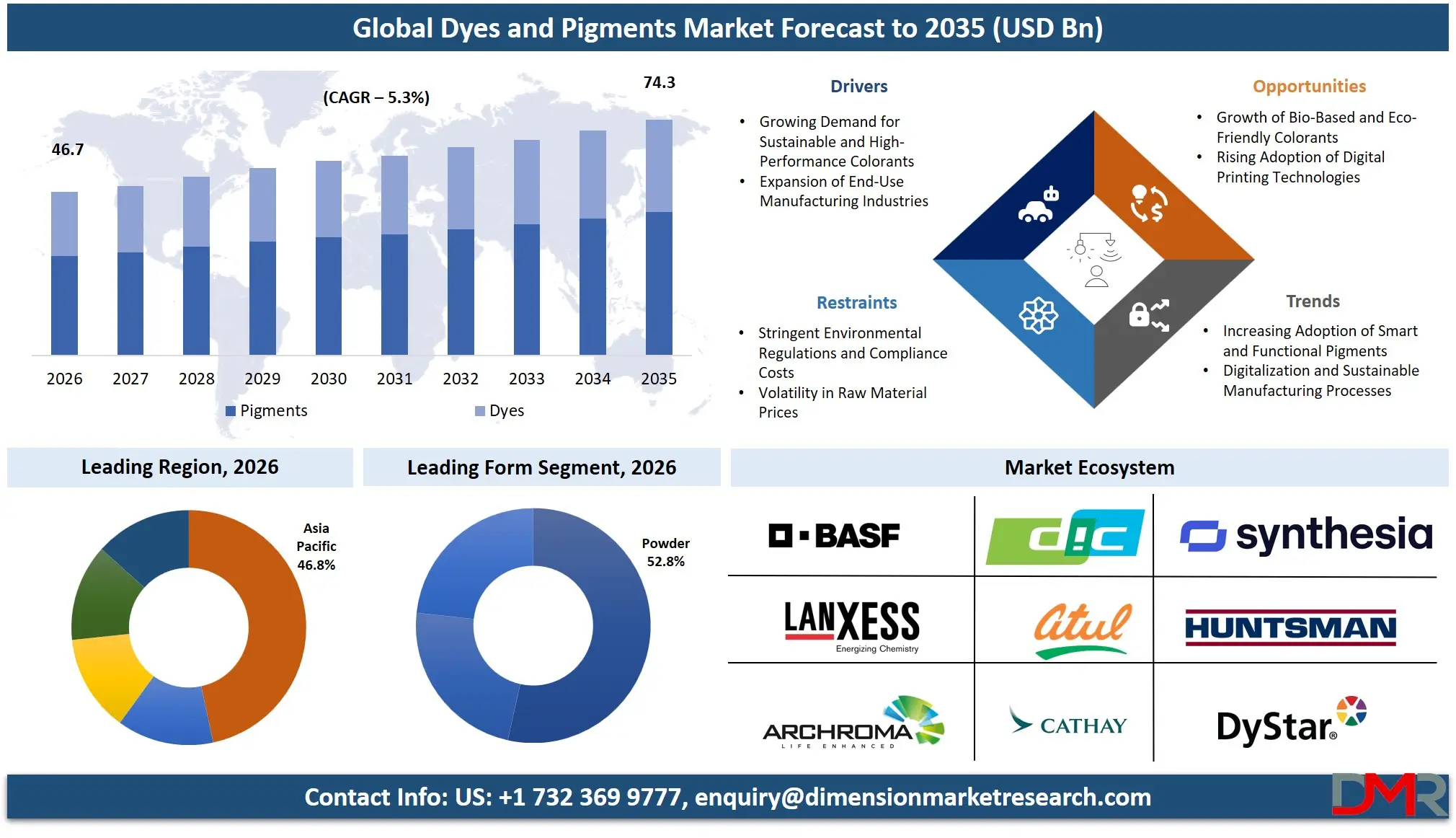
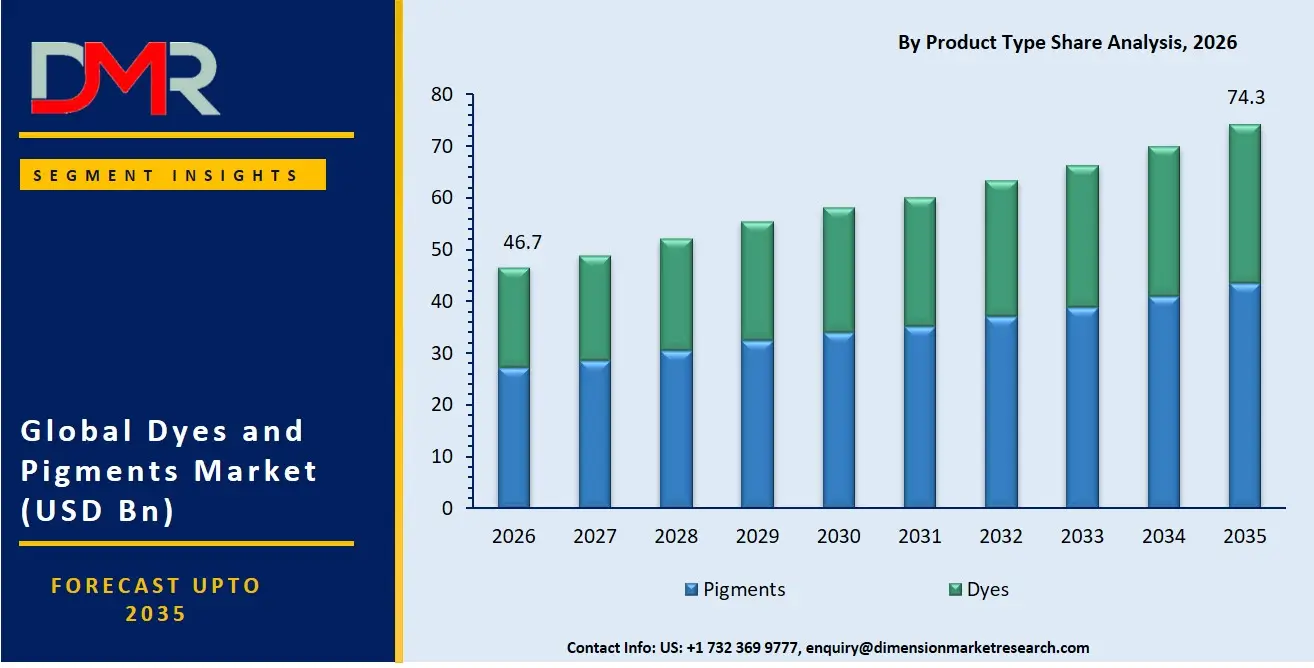
The Dyes and Pigments Market size is expected to be USD 46.7 billion in 2026 and increase at a compound annual growth rate of 5.3% to USD 74.3 billion in 2035 due to growing demand for sustainable and high-performance colorants.
ℹ
To learn more about this report –
Download Your Free Sample Report Here
The Dyes and Pigments Market comprises coloring materials used to impart color and functional properties to a wide range of products, including textiles, plastics, coatings, inks, paper, cosmetics, and construction materials. Dyes are soluble substances that chemically bond with substrates, while pigments are insoluble particles providing opacity, durability, and resistance to environmental factors. The market plays a vital role in manufacturing and industrial value chains by enabling product differentiation and performance enhancement. Growing demand for sustainable colorants, bio-based formulations, digital textile printing, high-performance pigments, and environmentally compliant manufacturing processes continues to reshape market growth worldwide.
The US Dyes and Pigments Market
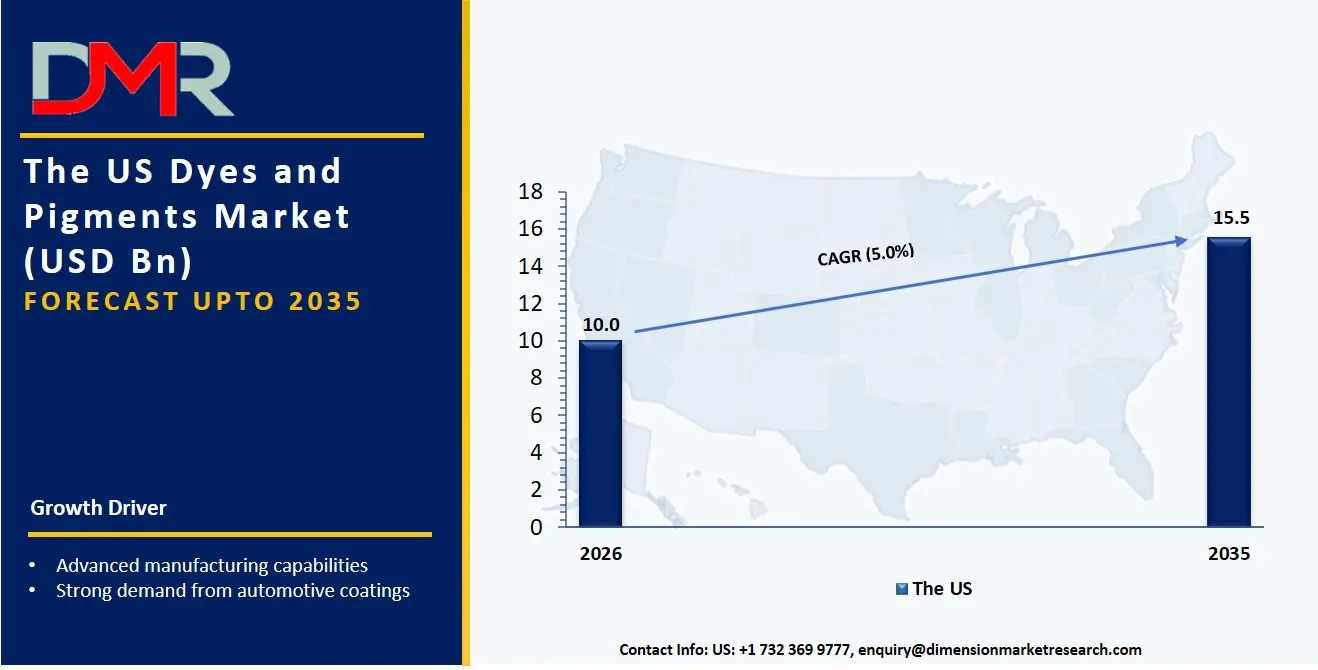
The US Dyes and Pigments Market size is estimated to be USD 10.0 billion in 2026 and is expected to increase at a CAGR of 5.0% over the forecast period.
ℹ
To learn more about this report –
Download Your Free Sample Report Here
The US Dyes and Pigments Market is supported by advanced manufacturing capabilities, strong demand from automotive coatings, packaging, construction, and textile applications, and continuous innovation in specialty chemicals. Increasing investments in sustainable pigments, low-VOC coatings, and environmentally compliant dye formulations encourage market expansion. Strict environmental regulations accelerate the transition toward eco-friendly production processes, while research activities and technological advancements strengthen the country's competitive position in high-value specialty pigments and industrial colorants.
Europe Dyes and Pigments Market
The Europe Dyes and Pigments Market size is estimated to be USD 8.4 billion in 2026 and is expected to increase at a CAGR of 5.1% over the forecast period.
Europe remains a significant market due to stringent environmental regulations and increasing emphasis on sustainable chemical production. Policies supporting circular economy initiatives and the European Green Deal encourage manufacturers to develop bio-based dyes, recyclable pigments, and environmentally safer production technologies. Demand from automotive coatings, packaging, printing inks, and premium textile industries supports market growth. Continuous investment in research, innovation, and advanced pigment technologies enables Europe to maintain leadership in specialty and high-performance colorant applications.
Japan Dyes and Pigments Market
The market size of Japan Dyes and Pigments will be USD 3.3 billion in 2026 and at a CAGR of 4.7% in the forecast period.
Japan's Dyes and Pigments Market benefits from advanced manufacturing, premium automotive production, electronics manufacturing, and sophisticated printing technologies. Demand for high-performance pigments, functional colorants, and specialty dyes continues to increase across industrial applications requiring superior durability and precision. Government support for sustainable manufacturing, combined with innovation in nanotechnology, digital printing, and environmentally friendly formulations, creates opportunities for premium products while encouraging continuous technological development throughout the domestic market.
Key Takeaways
- Market Size & Forecast: The Dyes and Pigments Market size is projected to reach USD 46.7 billion in 2026 and is anticipated to have a value of USD 74.3 billion in 2035.
- Growth Rate & Outlook: The Dyes and Pigments Market size is set to grow at a compound annual growth rate of 5.3% during the forecast period of 2026 to 2035.
- Primary Growth Drivers: Some of the major growth drivers in the market are Growing Demand for Sustainable and High-Performance Colorants, and more.
- Key Market Trends: Some of the major trends in the market are Integration of Increasing Adoption of Smart and Functional Pigments, and more.
- By Product Type: Pigments is anticipated to get the majority share of the Dyes and Pigments Market in 2026.
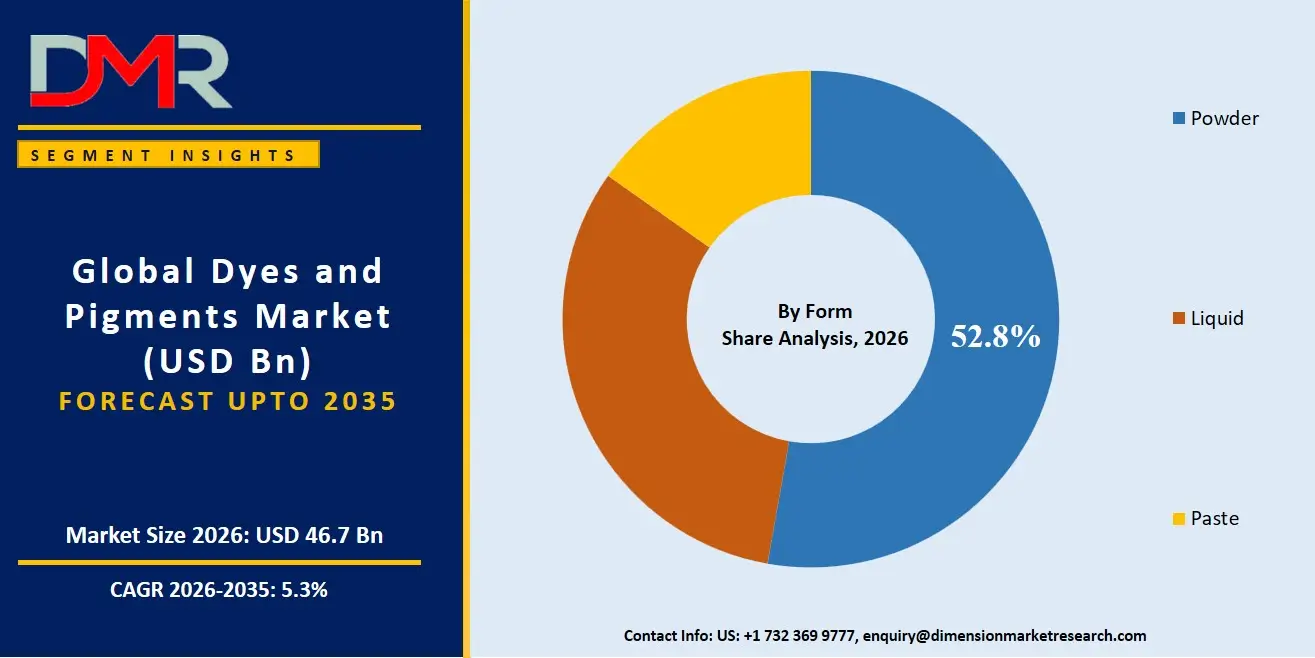
- By Form Type: Powders are expected to get the largest revenue share in 2026 in the Dyes and Pigments Market.
- Regional Leadership: Asia Pacific is set to lead the Dyes and Pigments Market with an estimated 46.8% share in 2026.
What is the Dyes and Pigments?
Dyes and pigments are coloring agents used to impart aesthetic appeal and functional characteristics to materials across numerous industries. Dyes dissolve in a medium and chemically bond with fibers or substrates, producing vibrant and durable coloration. Pigments remain insoluble and are dispersed within binders to provide color, opacity, ultraviolet resistance, and weather durability. They are extensively utilized in textiles, coatings, plastics, printing inks, paper, cosmetics, automotive finishes, and specialty industrial applications.
Use Cases
- Textile Coloration: Dyes are extensively utilized for coloring natural and synthetic fibers used in apparel, home furnishings, industrial fabrics, and technical textiles. Modern dye technologies improve color fastness, reduce water consumption, and enable digital textile printing, helping manufacturers meet evolving sustainability and quality standards.
- Paints and Protective Coatings: Pigments are essential components in decorative and industrial coatings, providing color consistency, opacity, UV resistance, corrosion protection, and enhanced durability. They are widely used in residential buildings, infrastructure projects, automotive coatings, marine applications, and industrial equipment requiring long-term weather resistance.
- Packaging and Printing Inks: Dyes and pigments are extensively incorporated into printing inks used for flexible packaging, labels, newspapers, commercial printing, and digital printing applications. High-performance pigments ensure superior print quality, vibrant colors, chemical resistance, and compatibility with advanced high-speed printing technologies.
- Plastics and Consumer Products: Pigments provide coloration for plastic packaging, household goods, electronic devices, toys, automotive components, and consumer appliances. Specialty pigments improve heat stability, UV protection, weather resistance, and product aesthetics while supporting customization across numerous industrial manufacturing applications.
How AI Is Transforming the Dyes and Pigments Market
Artificial intelligence is improving research, formulation development, manufacturing optimization, and quality assurance throughout the dyes and pigments industry. AI algorithms analyze large datasets to identify optimal chemical formulations, predict color performance, improve product consistency, and reduce development cycles. Predictive maintenance also minimizes equipment downtime while increasing production efficiency and lowering operating costs.
AI additionally enhances demand forecasting, supply chain optimization, inventory management, and customer customization capabilities. Computer vision systems automatically inspect color consistency and detect manufacturing defects with greater accuracy than conventional methods. Machine learning supports sustainable manufacturing by optimizing energy consumption, minimizing raw material waste, and accelerating the commercialization of environmentally friendly dye and pigment technologies.
Market Dynamic
Driving Factors in the Dyes and Pigments Market
Growing Demand for Sustainable and High-Performance Colorants
Increasing environmental awareness and stricter regulations regarding hazardous chemicals are driving manufacturers toward sustainable dye and pigment technologies. Industries increasingly prefer low-emission, heavy-metal-free, and bio-based colorants that comply with evolving environmental standards. Simultaneously, customer demand for durable, vibrant, and high-performance color solutions across textiles, coatings, plastics, and packaging continues to encourage innovation, making sustainability and performance major drivers of long-term market expansion.
Restraints in the Dyes and Pigments Market
Stringent Environmental Regulations and Compliance Costs
Manufacturers face increasing pressure to comply with environmental regulations governing wastewater discharge, hazardous chemical usage, emissions, and waste disposal. Compliance requires substantial investments in cleaner production technologies, wastewater treatment facilities, and regulatory certifications. These higher operational expenses particularly affect small and medium-sized manufacturers, reducing profitability and increasing barriers to market expansion in highly regulated regions.
Opportunities in the Dyes and Pigments Market
Growth of Bio-Based and Eco-Friendly Colorants
Increasing consumer preference for environmentally responsible products presents significant opportunities for bio-based dyes, natural pigments, and sustainable manufacturing technologies. Regulatory encouragement for green chemistry and circular economy initiatives further supports investment in renewable raw materials. Companies developing biodegradable, non-toxic, and low-carbon color solutions are well positioned to capture emerging demand across textiles, cosmetics, food packaging, and specialty applications.
Trends in the Dyes and Pigments Market
Increasing Adoption of Smart and Functional Pigments
Manufacturers are increasingly developing functional pigments offering properties beyond coloration, including infrared reflection, antimicrobial performance, conductivity, anti-counterfeiting capabilities, and self-cleaning characteristics. These advanced pigments support applications in automotive coatings, electronics, healthcare, construction materials, and security printing. Growing investment in multifunctional materials continues transforming the competitive landscape of specialty pigments.
Research Scope and Analysis
The research scope of the Dyes and Pigments Market covers product types, forms, applications, end-use industries, regional trends, market dynamics, competitive strategies, and technological developments. The analysis evaluates growth drivers, restraints, opportunities, and emerging trends influencing market expansion. It provides insights into industry performance, adoption patterns, and future growth prospects across global markets.
ℹ
To learn more about this report –
Download Your Free Sample Report Here
By Product Type Analysis
The Dyes and Pigments Market is segmented into dyes and pigments based on product type. Among these, pigments are expected to hold the leading market share of approximately 58.5% in 2026, supported by increasing demand from paints and coatings, plastics, automotive finishes, packaging, and construction applications. Pigments offer superior durability, opacity, weather resistance, and stability, making them preferred for industrial applications requiring long-lasting performance.
ℹ
To learn more about this report –
Download Your Free Sample Report Here
Within dyes, reactive dyes continue to maintain strong demand in textile applications due to their excellent color strength and compatibility with cotton fibers. However, specialty pigments represent the fastest-growing segment as industries increasingly require advanced solutions with properties such as UV resistance, heat stability, anti-corrosion performance, and enhanced sustainability. Growth in electric vehicles, digital printing, smart coatings, and high-performance materials is accelerating adoption of specialty pigment technologies.
By Form Analysis
Based on form, the Dyes and Pigments Market is categorized into powder, liquid, and paste forms. The powder segment is estimated to dominate with around 52.8% market share in 2026, driven by extensive usage in textile dyeing, plastics, coatings, and industrial manufacturing due to its longer shelf life, easier transportation, and higher concentration levels. Powder formulations remain popular among manufacturers requiring cost-effective storage and handling advantages. Meanwhile, liquid formulations are projected to experience the fastest growth due to increasing adoption in automated manufacturing systems, digital printing technologies, and applications requiring precise dosing and consistent dispersion. Liquid dyes and pigments provide improved processing efficiency, reduced dust generation, and easier integration into modern production lines. Rising demand for environmentally friendly and technologically advanced formulations is expected to further strengthen liquid product adoption across various industries.
By Application Analysis
The market is segmented into textiles, paints and coatings, printing inks, plastics, paper, leather, cosmetics, and other applications. The paints and coatings segment is projected to account for approximately 34.2% of the market share in 2026, making it the largest application segment due to rapid infrastructure development, automotive production, industrial coating requirements, and increasing demand for decorative finishes. Pigments are extensively used in coatings because of their ability to provide protection against corrosion, weather conditions, and ultraviolet radiation. The plastics application segment is expected to be the fastest-growing category, supported by rising consumption of colored plastic components in packaging, automotive interiors, electronics, and consumer goods. Growing demand for lightweight materials, recyclable plastics, and specialty polymer solutions is encouraging manufacturers to develop advanced pigment technologies specifically designed for plastic applications.
By End Use Industry Analysis
The Dyes and Pigments Market serves industries including textile, construction, automotive, packaging, consumer goods, electronics, healthcare, and others. The textile industry is expected to maintain the largest share of approximately 31.6% in 2026, driven by global apparel production, increasing fashion consumption, and continuous demand for vibrant and durable textile coloration. Reactive, disperse, and acid dyes remain widely utilized across natural and synthetic fiber processing. However, the automotive industry is anticipated to be the fastest-growing end-use segment due to increasing demand for premium vehicle finishes, electric vehicle coatings, lightweight components, and advanced color effects. Growth in automotive manufacturing, especially in emerging economies, is increasing demand for high-performance pigments offering durability, heat resistance, and aesthetic enhancement.
The Dyes and Pigments Market Report is segmented on the basis of the following:
By Product Type
- Dyes
- Reactive Dyes
- Disperse Dyes
- Acid Dyes
- Direct Dyes
- Vat Dyes
- Basic (Cationic) Dyes
- Sulfur Dyes
- Other Dyes
- Pigments
- Organic Pigments
- Inorganic Pigments
- Specialty Pigments
By Form
By Application
- Textiles
- Paints & Coatings
- Printing Inks
- Plastics
- Paper
- Leather
- Cosmetics
- Other Applications
By End-Use Industry
- Textile
- Construction
- Automotive
- Packaging
- Consumer Goods
- Electronics
- Healthcare
- Other End-Use Industries
Regional Analysis
Leading Region in the Dyes and Pigments Market
ℹ
To learn more about this report –
Download Your Free Sample Report Here
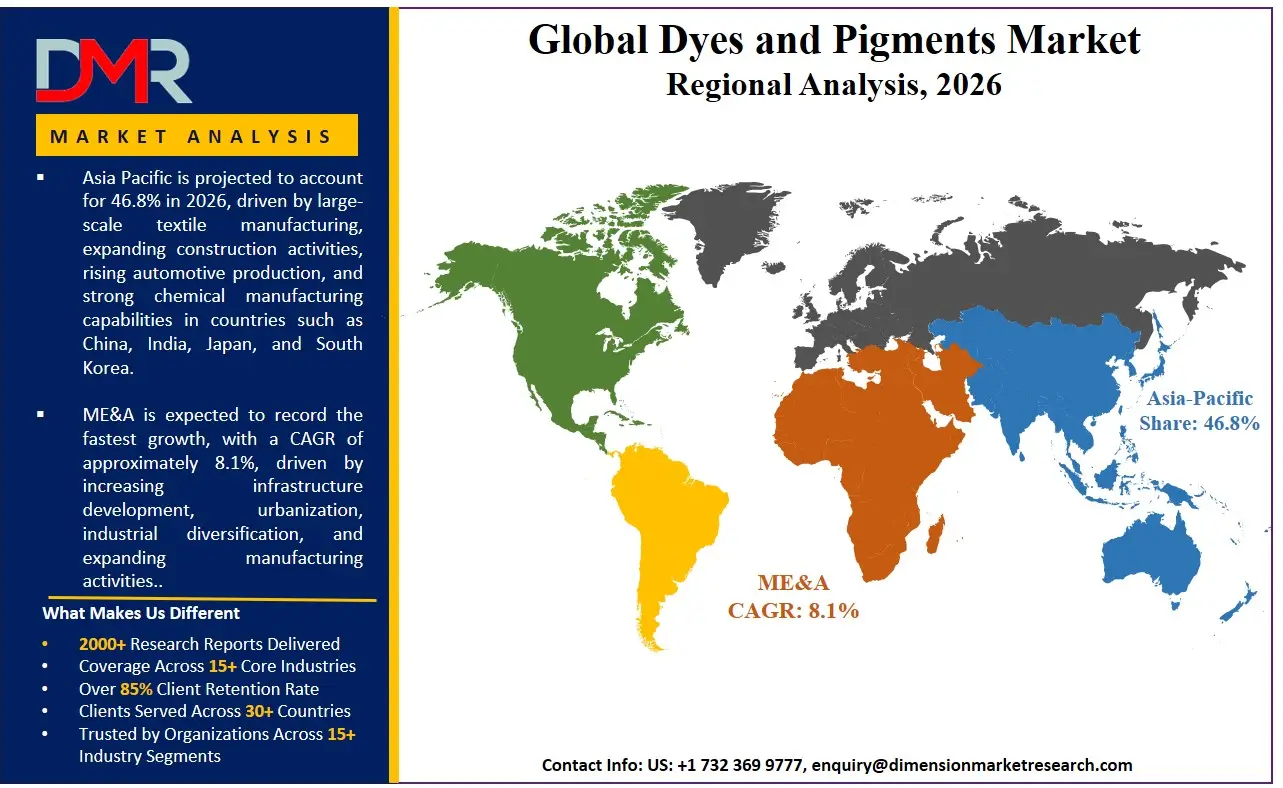
Asia-Pacific is expected to remain the dominant region in the Dyes and Pigments Market, accounting for an estimated 46.8% market share in 2026. The region's leadership is supported by large-scale textile manufacturing, expanding construction activities, rising automotive production, and strong chemical manufacturing capabilities in countries such as China, India, Japan, and South Korea. Availability of raw materials, cost-effective production facilities, and growing domestic consumption strengthen regional competitiveness. Government initiatives promoting industrial development and sustainable chemical production are encouraging manufacturers to adopt advanced technologies. The presence of major textile and manufacturing hubs, combined with increasing demand for packaging materials and consumer products, continues to reinforce Asia-Pacific's leading position in the global market.
Fastest Growing Region in the Dyes and Pigments Market
The Middle East and Africa region is projected to experience rapid growth in the Dyes and Pigments Market due to increasing infrastructure development, urbanization, industrial diversification, and expanding manufacturing activities. Investments in construction projects, automotive industries, packaging production, and consumer goods manufacturing are generating new demand for coatings, plastics, and specialty colorants. Government strategies focused on economic diversification beyond traditional energy sectors are encouraging industrial expansion and attracting chemical manufacturing investments. Rising population growth and improving consumer markets further support demand for colored products across textiles, packaging, and household applications. Additionally, growing adoption of sustainable technologies and environmentally compliant manufacturing practices is expected to create new opportunities for market participants operating in the region.
By Region
North America
Europe
- Germany
- The U.K.
- France
- Italy
- Russia
- Spain
- Benelux
- Nordic
- Rest of Europe
Asia-Pacific
- China
- Japan
- South Korea
- India
- ANZ
- ASEAN
- Rest of Asia-Pacific
Latin America
- Brazil
- Mexico
- Argentina
- Colombia
- Rest of Latin America
Middle East & Africa
- Saudi Arabia
- UAE
- South Africa
- Israel
- Egypt
- Rest of MEA
Competitive Landscape
The Dyes and Pigments Market is characterized by intense competition driven by product innovation, sustainability initiatives, technological advancements, and expansion into emerging markets. Companies are focusing on developing environmentally friendly formulations, specialty pigments, high-performance dyes, and customized solutions to strengthen their market positions. Competitive advantages are increasingly determined by research and development capabilities, manufacturing efficiency, regulatory compliance, and strong distribution networks. Market entry barriers remain high due to complex chemical production processes, environmental regulations, and the need for advanced technical expertise. Strategic collaborations, acquisitions, capacity expansions, and investments in green chemistry are becoming important approaches for companies seeking long-term growth and differentiation.
Some of the prominent players in the global Dyes and Pigments are:
- BASF SE
- Clariant AG
- DIC Corporation
- Sun Chemical Corporation
- Heubach Group
- Sudarshan Chemical Industries Limited
- LANXESS AG
- Atul Ltd.
- Kiri Industries Limited
- Archroma
- DyStar Group
- Huntsman Corporation
- Venator Materials PLC
- Tronox Holdings plc
- Kronos Worldwide, Inc.
- The Chemours Company
- Cathay Industries
- Toyo Ink SC Holdings Co., Ltd.
- Ferro Corporation
- Synthesia, a.s.
- Other Key Players
Recent Developments
- In July 2025, Saint-Gobain announced the acquisition of Interstar Materials Inc., strengthening its construction chemicals portfolio in North America. The acquisition expanded Saint-Gobain's presence in granular pigments used for decorative concrete, ready-mix concrete, precast materials, blocks, and paving applications. By integrating Interstar's pigment manufacturing expertise, Saint-Gobain enhanced its ability to provide specialized coloring solutions for construction markets.
- In June 2025, Sparxell partnered with Positive Materials to launch a commercially available plant-based, bio-inspired structural colour ink for textile applications. The innovation introduced a sustainable alternative to conventional synthetic dyes by utilizing plant-based pigment technology designed to reduce reliance on toxic chemicals, fossil-based materials, and mined minerals. The product targets fashion and textile manufacturers seeking environmentally responsible coloration solutions while maintaining performance standards.
- In March 2025, Sudarshan Chemical Industries completed the acquisition of Germany-based Heubach Group, strengthening its position as a global pigment manufacturer. The transaction combined Sudarshan's established pigment portfolio with Heubach's advanced technologies and international manufacturing capabilities. The acquisition expanded Sudarshan's global footprint across multiple regions and created a broader portfolio covering organic pigments, inorganic pigments, dispersions, and specialty solutions.
Report Details
| Report Characteristics |
| Market Size (2026) |
USD 46.7 Bn |
| Forecast Value (2035) |
USD 74.3 Bn |
| CAGR (2026–2035) |
5.3% |
| Historical Period |
2021 – 2025 |
| Forecast Period |
2027 – 2035 |
| Base Year |
2025 |
| Estimate Year |
2026 |
| Segments Covered |
By Product Type, By Form, By Application, By End-Use Industry |
| Regional Coverage |
North America – The US and Canada; Europe – Germany, The UK, France, Russia, Spain, Italy, Benelux, Nordic, & Rest of Europe; Asia-Pacific – China, Japan, South Korea, India, ANZ, ASEAN, Rest of APAC; Latin America – Brazil, Mexico, Argentina, Colombia, Rest of Latin America; Middle East & Africa – Saudi Arabia, UAE, South Africa, Turkey, Egypt, Israel, & Rest of MEA |
Frequently Asked Questions
How big is the Dyes and Pigments Market?
▾ The Dyes and Pigments Market size is expected to reach USD 46.7 billion by 2026 and is projected to reach USD 74.3 billion by the end of 2035.
What is the CAGR of the Dyes and Pigments Market from 2026 to 2035?
▾ The market is growing at a CAGR of 5.3 percent over the forecasted period.
What factors are driving the growth of the Dyes and Pigments Market?
▾ Growing Demand for Sustainable and High-Performance Colorants, and more are the factors driving the growth of the Dyes and Pigments Market.
What are the major trends in the Dyes and Pigments Market?
▾ Increasing Adoption of Smart and Functional Pigments, and more are some of the major trends in the market.
Who are the key players in the Dyes and Pigments Market?
▾ Some of the key players in the Dyes and Pigments Market include DIC, Lanxess, BASF, and more
How is the Dyes and Pigments Market segmented?
▾ The Dyes and Pigments Market is segmented by product type, form, application, end-use industry.
Which region held the largest share of the Dyes and Pigments Market in 2026?
▾ Asia Pacific is set to lead the Dyes and Pigments Market with an estimated 46.8% share in 2026.
Which region is expected to grow the fastest in the Dyes and Pigments Market?
▾ ME&A is the fastest-growing region in the Dyes and Pigments Market during the forecast period.