What is the Edge Management & Orchestration Platforms Market Size?
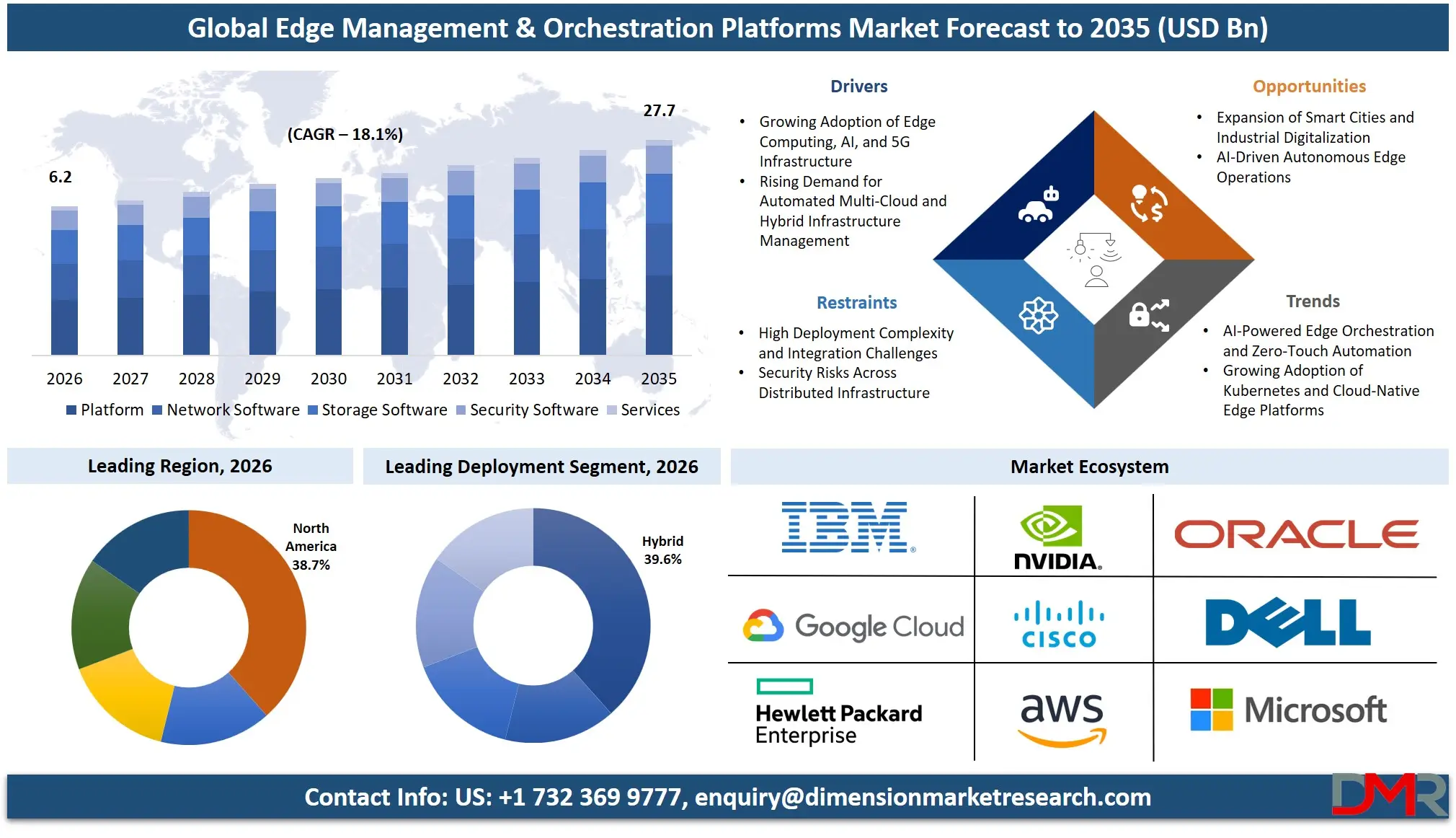
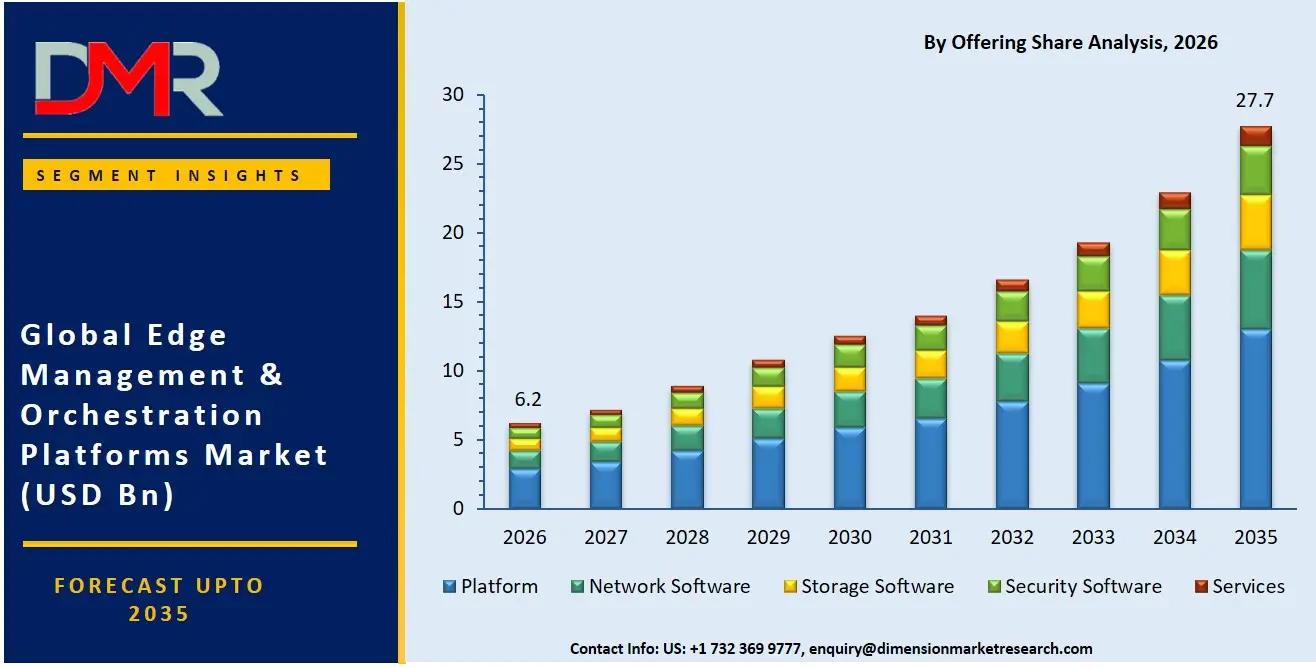
The Edge Management & Orchestration Platforms Market size is expected to be USD 6.2 billion in 2026 and increase at a compound annual growth rate of 18.1% to USD 27.7 billion in 2035 growing adoption of edge computing, AI, and 5G infrastructure.
ℹ
To learn more about this report –
Download Your Free Sample Report Here
Edge Management & Orchestration Platforms comprise software platforms and associated services that centrally manage, automate, monitor, and optimize distributed edge computing environments across multiple locations. These platforms coordinate edge infrastructure, workloads, applications, networking, security, and storage while ensuring seamless integration with cloud resources. Rising enterprise adoption of 5G, IoT, AI inference, and containerized applications is accelerating demand for intelligent orchestration capabilities. Organizations increasingly prioritize low-latency processing, automated lifecycle management, zero-trust security, and hybrid cloud interoperability, making edge orchestration a strategic technology for digital transformation and distributed enterprise operations. The market is expanding rapidly as enterprises modernize IT infrastructure and deploy AI-enabled edge ecosystems across manufacturing, telecommunications, healthcare, transportation, retail, and smart city environments. Increasing adoption of Kubernetes, software-defined networking, and AI-driven automation is reshaping platform capabilities, while demand for real-time analytics, operational resilience, and scalable multi-cloud management continues to strengthen long-term market growth.
The US Edge Management & Orchestration Platforms Market
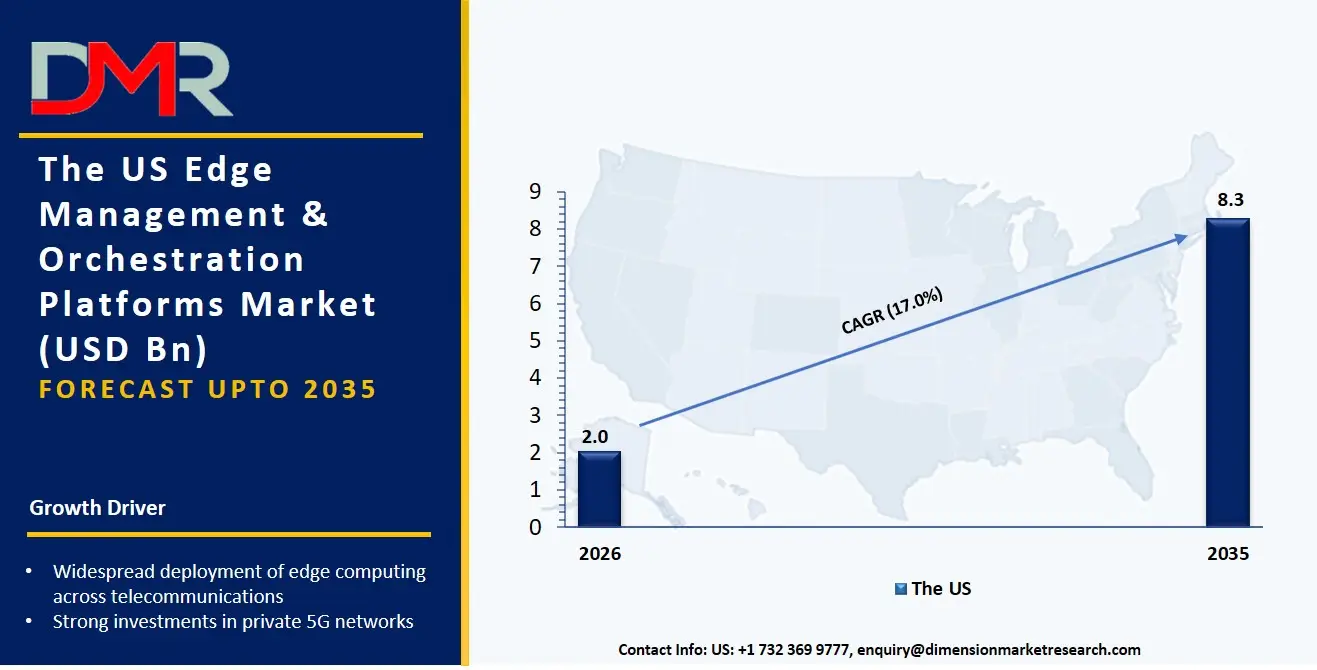
The US Edge Management & Orchestration Platforms Market size is estimated to be USD 2.8 billion in 2026 and is expected to increase at a CAGR of 4.3% over the forecast period.
ℹ
To learn more about this report –
Download Your Free Sample Report Here
The United States represents one of the most technologically advanced markets owing to widespread deployment of edge computing across telecommunications, manufacturing, healthcare, retail, and defense sectors. Strong investments in private 5G networks, AI-enabled automation, industrial IoT, and cloud-native infrastructure continue to stimulate demand. Enterprise digital transformation initiatives encourage organizations to adopt centralized orchestration platforms capable of managing thousands of distributed edge nodes. Government support for advanced semiconductor manufacturing, cybersecurity initiatives, and digital infrastructure modernization further strengthens market expansion, while technology vendors continuously invest in software innovation, AI-driven operations, and strategic ecosystem partnerships.
Europe Edge Management & Orchestration Platforms Market
The Europe Edge Management & Orchestration Platforms Market size is estimated to be USD 2.1 billion in 2026 and is expected to increase at a CAGR of 4.1% over the forecast period.
Europe demonstrates strong market momentum supported by increasing investments in industrial automation, digital manufacturing, and sustainable infrastructure. The European Green Deal encourages energy-efficient digital infrastructure, while regional data governance and cybersecurity regulations promote secure edge deployments. Telecommunications providers continue expanding 5G infrastructure that requires intelligent orchestration platforms for distributed applications. Manufacturing, automotive, utilities, and smart city projects remain leading adopters, supported by collaborative research initiatives and growing implementation of cloud-native technologies across both public and private sectors.
Japan Edge Management & Orchestration Platforms Market
The market size of Japan Edge Management & Orchestration Platforms will be USD 492 million in 2026 and at a CAGR of 4.0% in the forecast period.
Japan continues to strengthen its position through advanced manufacturing, robotics, smart factories, and highly connected industrial ecosystems. Increasing deployment of AI-powered production systems, autonomous logistics, and intelligent transportation solutions is accelerating edge infrastructure investments. Government initiatives supporting digital transformation, Industry 4.0, and next-generation communication technologies encourage enterprise adoption of orchestration platforms. Aging demographics further stimulate automation demand, while leading industrial organizations prioritize predictive maintenance, real-time analytics, and resilient distributed computing environments to improve operational efficiency and business continuity.
Key Takeaways
- Market Size & Forecast: The Edge Management & Orchestration Platforms Market size is projected to reach USD 6.2 billion in 2026 and is anticipated to have a value of USD 27.7 billion in 2035.
- Growth Rate & Outlook: The Edge Management & Orchestration Platforms Market size is set to grow at a compound annual growth rate of 18.1% during the forecast period of 2026 to 2035.
- Primary Growth Drivers: Some of the major growth drivers in the market are Growing Adoption of Edge Computing, AI, and 5G Infrastructure and more.
- Key Market Trends: Some of the major trends in the market are AI-Powered Edge Orchestration and Zero-Touch Automation, and more.
- By Deployment Mode Type: Hybrid segment is anticipated to get the majority share of the Edge Management & Orchestration Platforms Market in 2026.
- By Offering Type: Platforms are expected to get the largest revenue share in 2026 in the Edge Management & Orchestration Platforms Market.
- Regional Leadership: North America is set to lead the Edge Management & Orchestration Platforms Market with an estimated 38.7% share in 2026.
What is the Edge Management & Orchestration Platforms?
Edge Management & Orchestration Platforms are integrated software solutions that automate the deployment, provisioning, monitoring, governance, security, and lifecycle management of distributed edge computing resources. They coordinate applications, containers, virtual machines, networking, storage, and infrastructure across geographically dispersed edge locations while synchronizing workloads with centralized cloud environments to deliver low-latency performance, operational consistency, scalability, policy-based automation, and efficient utilization of computing resources.
Use Cases
- Smart Manufacturing: Manufacturers deploy edge orchestration platforms to manage thousands of industrial devices, robots, sensors, and production applications. These platforms automate software deployment, monitor equipment health, optimize workloads, and enable predictive maintenance while minimizing production downtime and ensuring secure operations across multiple facilities.
- Telecommunications Network Operations: Telecommunication providers utilize orchestration platforms to automate deployment of virtual network functions, manage distributed edge sites, support 5G network slicing, and deliver low-latency applications. Intelligent orchestration significantly improves service reliability, network scalability, and operational efficiency.
- Smart Retail Operations: Retail organizations leverage edge platforms to coordinate video analytics, digital signage, inventory monitoring, self-checkout systems, and customer analytics across multiple stores. Centralized management simplifies application updates while enabling real-time decision-making and personalized customer experiences.
- Healthcare Remote Monitoring: Healthcare providers use edge orchestration platforms to securely manage connected medical devices, diagnostic equipment, and patient monitoring applications. Local data processing reduces latency, enhances data privacy, improves clinical decision-making, and supports continuous healthcare delivery across hospitals and remote care facilities.
How AI Is Transforming the Edge Management & Orchestration Platforms Market
Artificial intelligence significantly enhances platform intelligence by automating workload placement, infrastructure monitoring, predictive maintenance, anomaly detection, and resource optimization. AI continuously analyzes operational data generated by distributed edge devices, enabling faster decisions and improving system resilience while minimizing service disruptions. Intelligent orchestration also simplifies lifecycle management across complex multi-cloud and hybrid environments.
AI further improves customer experience through autonomous network optimization, intelligent security monitoring, automated incident response, and predictive capacity planning. Advanced AIOps capabilities reduce operational costs, accelerate software deployment, improve infrastructure utilization, and enable enterprises to efficiently manage rapidly expanding edge ecosystems supporting AI inference, IoT, industrial automation, and next-generation digital services.
Market Dynamic
Driving Factors in the Edge Management & Orchestration Platforms Market
Growing Adoption of Edge Computing, AI, and 5G Infrastructure
Rapid expansion of edge computing infrastructure across enterprises is significantly driving market growth. Organizations increasingly deploy distributed computing resources to support AI inference, industrial IoT, autonomous systems, and latency-sensitive applications. The rollout of 5G networks further strengthens demand for intelligent orchestration platforms capable of automating workload placement, resource optimization, security management, and application lifecycle management. As enterprises modernize digital infrastructure, centralized orchestration becomes essential for maintaining operational consistency across geographically distributed environments.
Restraints in the Edge Management & Orchestration Platforms Market
High Deployment Complexity and Integration Challenges
Despite growing demand, implementation remains technically complex. Organizations often operate heterogeneous hardware, legacy applications, multiple cloud environments, and diverse networking architectures that complicate orchestration deployment. Integrating existing enterprise systems with modern edge platforms requires specialized expertise, extended implementation timelines, and substantial financial investment. These challenges can delay adoption, particularly among organizations with limited technical resources or constrained IT budgets.
Opportunities in the Edge Management & Orchestration Platforms Market
Expansion of Smart Cities and Industrial Digitalization
Governments and enterprises continue investing in smart cities, connected infrastructure, intelligent transportation, utilities, and Industry 4.0 initiatives. These large-scale deployments require centralized orchestration platforms capable of managing thousands of distributed edge devices and applications. Increasing digital infrastructure investments create significant opportunities for software vendors offering scalable, AI-enabled management solutions supporting complex operational environments.
Trends in the Edge Management & Orchestration Platforms Market
AI-Powered Edge Orchestration and Zero-Touch Automation
Modern platforms increasingly integrate AI algorithms to automate resource allocation, workload optimization, anomaly detection, predictive maintenance, and infrastructure management. Zero-touch provisioning enables organizations to deploy applications across thousands of distributed locations with minimal manual intervention. AI-assisted orchestration improves operational efficiency while reducing deployment time, maintenance costs, and service disruptions across edge ecosystems.
Research Scope and Analysis
The research scope analyzes the Edge Management & Orchestration Platforms Market by evaluating technology offerings, deployment models, workloads, applications, and industry adoption. The analysis examines market drivers, challenges, opportunities, regional trends, competitive strategies, and emerging technologies shaping edge infrastructure management. It provides insights into growth patterns, adoption trends, and future market potential.
ℹ
To learn more about this report –
Download Your Free Sample Report Here
By Offering Analysis
The Platforms segment is projected to remain the leading offering in the Edge Management & Orchestration Platforms Market, accounting for an estimated 46.8% market share in 2026. Its dominance is attributed to growing enterprise demand for centralized lifecycle management, workload orchestration, infrastructure automation, and AI-enabled operational visibility across distributed edge environments.
ℹ
To learn more about this report –
Download Your Free Sample Report Here
Organizations increasingly deploy integrated platform solutions to manage edge infrastructure, application orchestration, virtualization, Edge Ops, and Edge AIOps from a unified interface. The ability of platforms to simplify multi-site deployments, strengthen cybersecurity, and integrate seamlessly with hybrid and multi-cloud ecosystems further reinforces their leadership. Meanwhile, the Services segment is expected to register the fastest growth throughout the forecast period as enterprises seek consulting, deployment, integration, and managed services to overcome implementation complexity and accelerate digital transformation initiatives. Growing adoption among small and medium-sized enterprises, coupled with rising outsourcing of edge infrastructure management, will continue driving demand for professional and managed service providers.
By Deployment Analysis
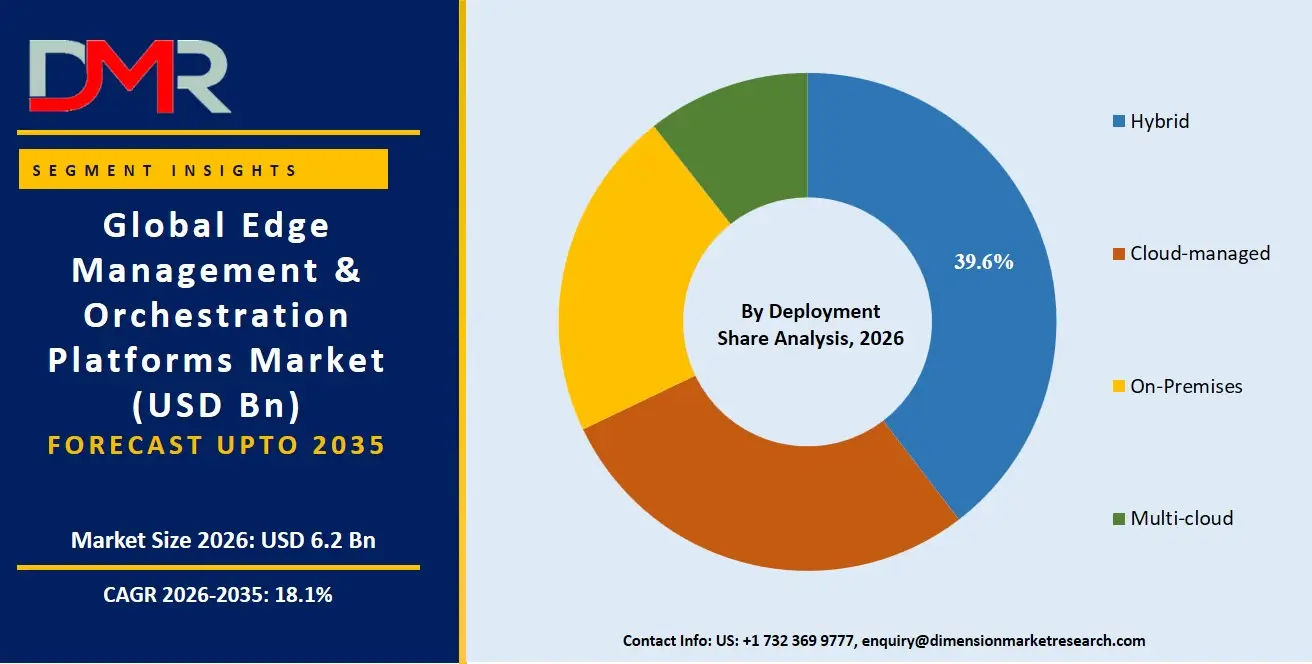
The Hybrid deployment segment is expected to lead the Edge Management & Orchestration Platforms Market with an estimated 39.4% market share in 2026. Enterprises increasingly prefer hybrid architectures because they combine the scalability of public cloud infrastructure with the security and control of on-premises systems. Hybrid deployment enables organizations to process latency-sensitive workloads locally while leveraging centralized cloud resources for analytics, storage, and orchestration. This flexibility supports regulatory compliance, improves operational resilience, and optimizes infrastructure utilization across geographically distributed environments. At the same time, the Multi-cloud segment is anticipated to witness the fastest growth as organizations diversify cloud providers to avoid vendor lock-in, improve disaster recovery capabilities, and optimize workload placement. Intelligent orchestration platforms capable of managing applications consistently across multiple cloud environments and edge locations are becoming increasingly valuable as enterprise digital ecosystems continue expanding.
By Workload Analysis
The IoT Processing segment is anticipated to dominate the Edge Management & Orchestration Platforms Market with an estimated 30.7% market share in 2026. Rapid deployment of connected sensors, industrial equipment, smart devices, and intelligent infrastructure generates massive volumes of real-time data that require localized processing and centralized orchestration. Edge platforms enable efficient device management, workload distribution, data filtering, and secure communications, making IoT processing the largest workload category. Industrial automation, smart utilities, logistics, and smart city initiatives continue supporting widespread adoption. Meanwhile, AI Inference is projected to be the fastest-growing workload segment as enterprises increasingly execute machine learning models directly at the edge to reduce latency, improve responsiveness, strengthen data privacy, and minimize cloud bandwidth consumption. The proliferation of generative AI applications and intelligent automation will further accelerate AI inference deployments during the forecast period.
By Application Analysis
The Network Optimization segment is expected to account for the largest share of the Edge Management & Orchestration Platforms Market, representing an estimated 22.6% market share in 2026. The segment's leadership is driven by the growing need to optimize bandwidth utilization, reduce latency, improve traffic routing, and maintain reliable connectivity across distributed enterprise networks. Organizations increasingly deploy orchestration platforms to automate network resource allocation, monitor network performance in real time, and ensure uninterrupted application delivery across edge environments. The rapid expansion of 5G infrastructure, software-defined networking (SDN), SD-WAN, and cloud-native architectures further supports segment growth. Meanwhile, the Predictive Maintenance segment is projected to register the fastest growth throughout the forecast period as manufacturers, utilities, and transportation companies increasingly leverage AI-powered analytics and edge computing to predict equipment failures, reduce operational downtime, optimize maintenance schedules, and improve asset reliability through continuous monitoring of industrial equipment.
By Industry Analysis
The Manufacturing segment is projected to dominate the Edge Management & Orchestration Platforms Market with an estimated 24.9% market share in 2026. Manufacturing organizations continue investing heavily in Industry 4.0 initiatives, industrial IoT, robotics, digital twins, machine vision, and smart factory automation, all of which require robust edge orchestration capabilities. Centralized management platforms help manufacturers coordinate distributed production facilities, automate software deployment, optimize production workflows, strengthen cybersecurity, and enable predictive maintenance. The increasing adoption of AI-enabled quality inspection and autonomous manufacturing systems further reinforces the segment's market leadership. At the same time, the Healthcare & Life Sciences segment is expected to emerge as the fastest-growing industry due to rising implementation of connected medical devices, remote patient monitoring, AI-assisted diagnostics, medical imaging analytics, and secure edge computing solutions that improve patient outcomes while ensuring regulatory compliance and protecting sensitive healthcare data.
The Edge Management & Orchestration Platforms Market Report is segmented on the basis of the following:
By Offering
- Platforms
- Edge Infrastructure Management
- Edge Orchestration
- Edge Virtualization
- Edge Application Management
- Edge Operations (Edge Ops)
- Edge AI Operations (Edge AIOps)
- Network Software
- SD-WAN
- SDN
- Network Orchestration
- Traffic Optimization
- Storage Software
- Software-defined Storage
- Data Replication
- Edge Data Management
- Security Software
- Zero Trust
- SASE
- Identity & Access Management
- Workload Protection
- Data Protection
- Services
- Professional Services
- Consulting
- Integration
- Deployment
- Managed Services
By Deployment
- Cloud-managed
- On-Premises
- Hybrid
- Multi-cloud
By Workload
- AI Inference
- IoT Processing
- Video Analytics
- Industrial Automation
- AR/VR
- Content Delivery
- Enterprise Application
- Edge Database
By Application
- Remote Infrastructure Management
- Application Deployment
- Network Optimization
- Asset Monitoring
- Predictive Maintenance
- Video Surveillance
- Manufacturing Automation
- Connected Vehicles
- Retail Store Operations
- Smart City Management
- Healthcare Remote Monitoring
By Industry
- Manufacturing
- Energy & Utilities
- Retail & Consumer Goods
- Healthcare & Life Sciences
- Transportation & Logistics
- Telecommunications
- BFSI
- Government & Defense
- Media & Entertainment
- IT & ITes
- Education
- Hospitality
Regional Analysis
Leading Region in the Edge Management & Orchestration Platforms Market
ℹ
To learn more about this report –
Download Your Free Sample Report Here
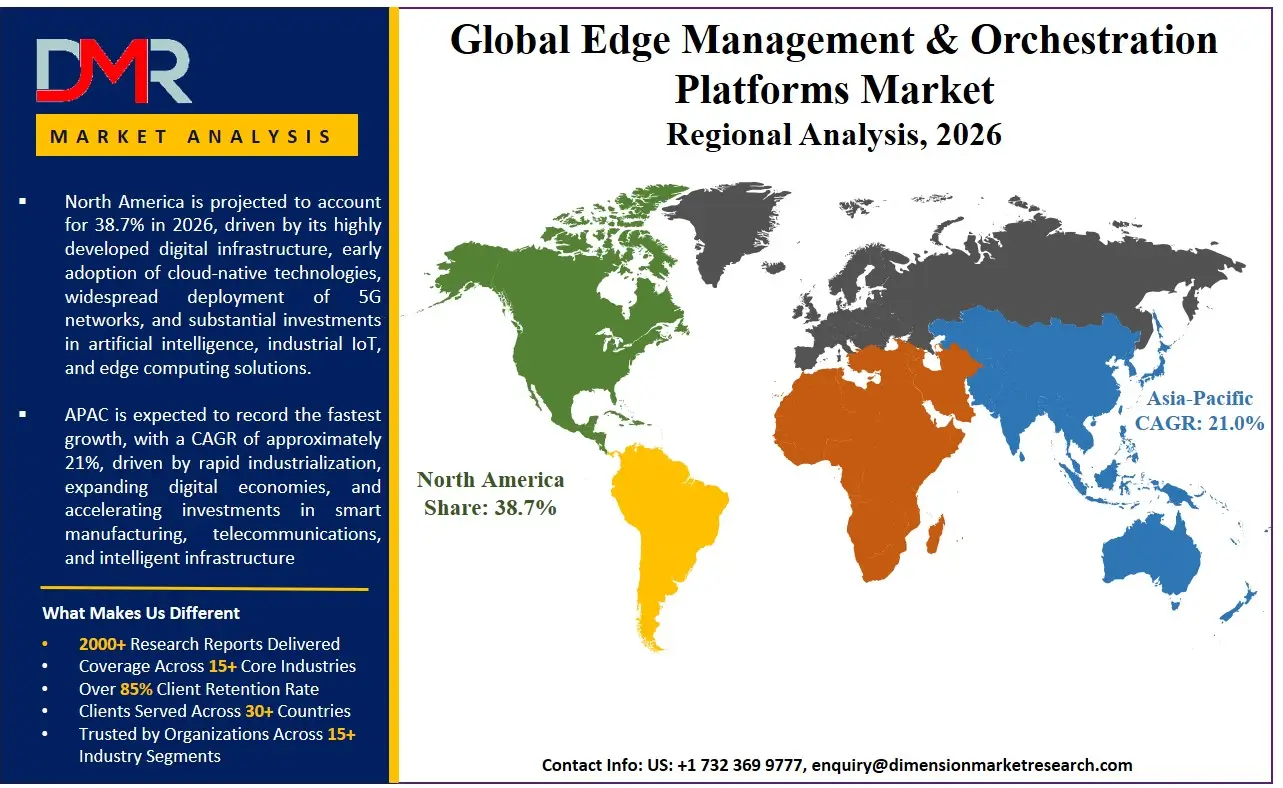
North America is expected to remain the leading regional market, accounting for an estimated 38.7% share of the global Edge Management & Orchestration Platforms Market in 2026. The region benefits from a highly developed digital infrastructure, early adoption of cloud-native technologies, widespread deployment of 5G networks, and substantial investments in artificial intelligence, industrial IoT, and edge computing solutions. Large enterprises across manufacturing, telecommunications, healthcare, retail, financial services, and defense continue accelerating digital transformation initiatives that require centralized edge orchestration platforms. Strong cybersecurity investments, mature cloud ecosystems, and continuous innovation in enterprise software further strengthen regional leadership. In addition, supportive government initiatives promoting advanced manufacturing, semiconductor production, critical infrastructure modernization, and digital resilience contribute to sustained demand for intelligent edge management solutions across both public and private sectors.
Fastest Growing Region in the Edge Management & Orchestration Platforms Market
The Asia-Pacific region is anticipated to record the fastest growth throughout the forecast period, supported by rapid industrialization, expanding digital economies, and accelerating investments in smart manufacturing, telecommunications, and intelligent infrastructure. Countries such as China, India, Japan, South Korea, Singapore, and Australia continue deploying large-scale 5G networks, industrial automation systems, and smart city projects that require advanced edge orchestration capabilities. Growing adoption of AI-powered applications, increasing enterprise cloud migration, and strong government initiatives promoting digital transformation are further accelerating regional demand. The expansion of manufacturing hubs, rising IoT device installations, improving internet connectivity, and increasing investments from technology providers create favorable conditions for sustained market growth. Small and medium-sized enterprises are also embracing cloud-managed edge platforms to enhance operational efficiency, improve scalability, and support next-generation digital services across diverse industries.
By Region
North America
Europe
- Germany
- The U.K.
- France
- Italy
- Russia
- Spain
- Benelux
- Nordic
- Rest of Europe
Asia-Pacific
- China
- Japan
- South Korea
- India
- ANZ
- ASEAN
- Rest of Asia-Pacific
Latin America
- Brazil
- Mexico
- Argentina
- Colombia
- Rest of Latin America
Middle East & Africa
- Saudi Arabia
- UAE
- South Africa
- Israel
- Egypt
- Rest of MEA
Competitive Landscape
The Edge Management & Orchestration Platforms Market is characterized by intense competition driven by continuous innovation, platform differentiation, and strategic ecosystem expansion. Market participants focus on strengthening AI-enabled automation, cloud-native orchestration, cybersecurity capabilities, and multi-cloud interoperability to enhance their competitive positioning. Significant investments in research and development, strategic technology partnerships, acquisitions, and product portfolio expansion remain central growth strategies. High technical expertise requirements, integration complexity, and established customer relationships create considerable entry barriers for new participants. Vendors also prioritize industry-specific solutions, subscription-based business models, managed services, and open architecture platforms to improve customer retention, expand recurring revenue streams, and address evolving enterprise requirements across increasingly distributed edge computing environments.
Some of the prominent players in the global Edge Management & Orchestration Platforms are:
- Microsoft
- Amazon Web Services
- Google Cloud
- IBM
- Oracle
- Dell Technologies
- Hewlett Packard Enterprise
- Cisco Systems
- Red Hat
- VMware (Broadcom-owned VMware business)
- NVIDIA
- Intel
- Broadcom
- Juniper Networks
- Arista Networks
- Ericsson
- Nokia
- Huawei
- Samsung Electronics
- Fujitsu
- Other Key Players
Recent Developments
- In June 2025, Hewlett Packard Enterprise (HPE) expanded its edge-to-cloud strategy by enhancing its private cloud and artificial intelligence capabilities to support distributed enterprise workloads. The company focused on simplifying infrastructure management across edge locations, private environments, and cloud platforms through automated operations and unified management frameworks. The developments supported organizations requiring secure deployment and orchestration of applications across geographically distributed environments, particularly in industries such as manufacturing, telecommunications, financial services, and healthcare. By integrating AI-driven operational intelligence with edge infrastructure management, HPE aimed to improve workload optimization, security monitoring, and infrastructure efficiency. This initiative demonstrates the growing importance of unified edge-to-cloud orchestration platforms in managing increasingly complex digital ecosystems.
- In May 2025, Red Hat announced enhancements across its hybrid cloud portfolio to strengthen AI deployment and management capabilities at the edge. The company expanded the integration of OpenShift AI with edge computing environments, enabling enterprises to deploy, manage, and scale artificial intelligence workloads closer to data sources. The updates focused on improving operational consistency across distributed infrastructures by supporting automated model deployment, lifecycle management, and secure edge application operations. These enhancements targeted industries including manufacturing, telecommunications, healthcare, and government sectors where real-time AI processing is becoming increasingly important. The development reflects the broader industry shift toward AI-driven edge orchestration platforms capable of managing complex distributed workloads efficiently.
- In March 2025, NVIDIA continued expanding its enterprise edge AI ecosystem by enhancing software capabilities designed for real-time artificial intelligence deployment across distributed environments. The company introduced improvements supporting AI application development, deployment automation, and management of accelerated computing infrastructure at the edge. These advancements enabled enterprises to utilize AI models for applications such as industrial automation, intelligent video analytics, robotics, and autonomous systems while reducing dependence on centralized cloud processing. The expansion emphasized improved interoperability between edge devices, AI software frameworks, and enterprise infrastructure management systems. NVIDIA's continued investment in AI-powered edge platforms highlights the increasing convergence of artificial intelligence, orchestration, and distributed computing as enterprises seek faster decision-making and operational efficiency.
Report Details
| Report Characteristics |
| Market Size (2026) |
USD 6.2 Bn |
| Forecast Value (2035) |
USD 27.7 Bn |
| CAGR (2026–2035) |
18.1% |
| Historical Period |
2021 – 2025 |
| Forecast Period |
2027 – 2035 |
| Base Year |
2025 |
| Estimate Year |
2026 |
| Segments Covered |
By Offering, By Deployment, By Workload, By Application, By Industry |
| Regional Coverage |
North America – The US and Canada; Europe – Germany, The UK, France, Russia, Spain, Italy, Benelux, Nordic, & Rest of Europe; Asia-Pacific – China, Japan, South Korea, India, ANZ, ASEAN, Rest of APAC; Latin America – Brazil, Mexico, Argentina, Colombia, Rest of Latin America; Middle East & Africa – Saudi Arabia, UAE, South Africa, Turkey, Egypt, Israel, & Rest of MEA |
Frequently Asked Questions
How big is the Edge Management & Orchestration Platforms Market?
▾ The Edge Management & Orchestration Platforms Market size is expected to reach USD 6.2 billion by 2026 and is projected to reach USD 27.7 billion by the end of 2035.
What is the CAGR of the Edge Management & Orchestration Platforms Market from 2026 to 2035?
▾ The market is growing at a CAGR of 18.1 percent over the forecasted period.
What factors are driving the growth of the Edge Management & Orchestration Platforms Market?
▾ Growing Adoption of Edge Computing, AI, and 5G Infrastructure, and more are the factors driving the growth of the Edge Management & Orchestration Platforms Market.
What are the major trends in the Edge Management & Orchestration Platforms Market?
▾ AI-Powered Edge Orchestration and Zero-Touch Automation, and more are some of the major trends in the market.
Who are the key players in the Edge Management & Orchestration Platforms Market?
▾ Some of the key players in the Edge Management & Orchestration Platforms Market include AWS, Dell, IBM, and more.
How is the Edge Management & Orchestration Platforms Market segmented?
▾ The Edge Management & Orchestration Platforms Market is segmented by offering, deployment, workload, application, industry.
Which region held the largest share of the Edge Management & Orchestration Platforms Market in 2026?
▾ North America is set to lead the Edge Management & Orchestration Platforms Market with an estimated 38.7% share in 2026.
Which region is expected to grow the fastest in the Edge Management & Orchestration Platforms Market?
▾ Asia Pacific is the fastest-growing region in the Edge Management & Orchestration Platforms Market during the forecast period.