Market Overview
The electric guitar pickup market covers electromagnetic transducers designed to convert string vibration into audio signal, spanning passive and active designs across single-coil and humbucker configurations. The market excludes acoustic guitar transducers, bass guitar pickups sold as standalone categories, and integrated pickup systems bundled within complete instrument assemblies sold as single SKUs. Manufacturers serve two distinct buyer pools: guitar brands procuring pickups as OEM components and individual players buying aftermarket upgrades.
Instrument-grade customization has become a core commercial lever. As reported by Guitar World, the Ruokangas pickup line offered 12 selectable faceplate, polepiece, and cover/frame-plating options in 2025, illustrating how boutique and mid-tier brands now compete on configurable specifications rather than price alone. Buyers who once accepted factory-installed pickups now expect specification-level control over output character and aesthetic finish.
Seymour Duncan's release of the Philip Sayce "Mother" Stratocaster Pickup Set in May 2025 marked the company's first signature set developed with the blues-rock guitarist, extending the signature-artist model into new genre territories. Artist-linked releases create short-cycle demand spikes that standard catalog products cannot replicate, pulling first-time aftermarket buyers into the replacement pickup category.
Market Snapshot
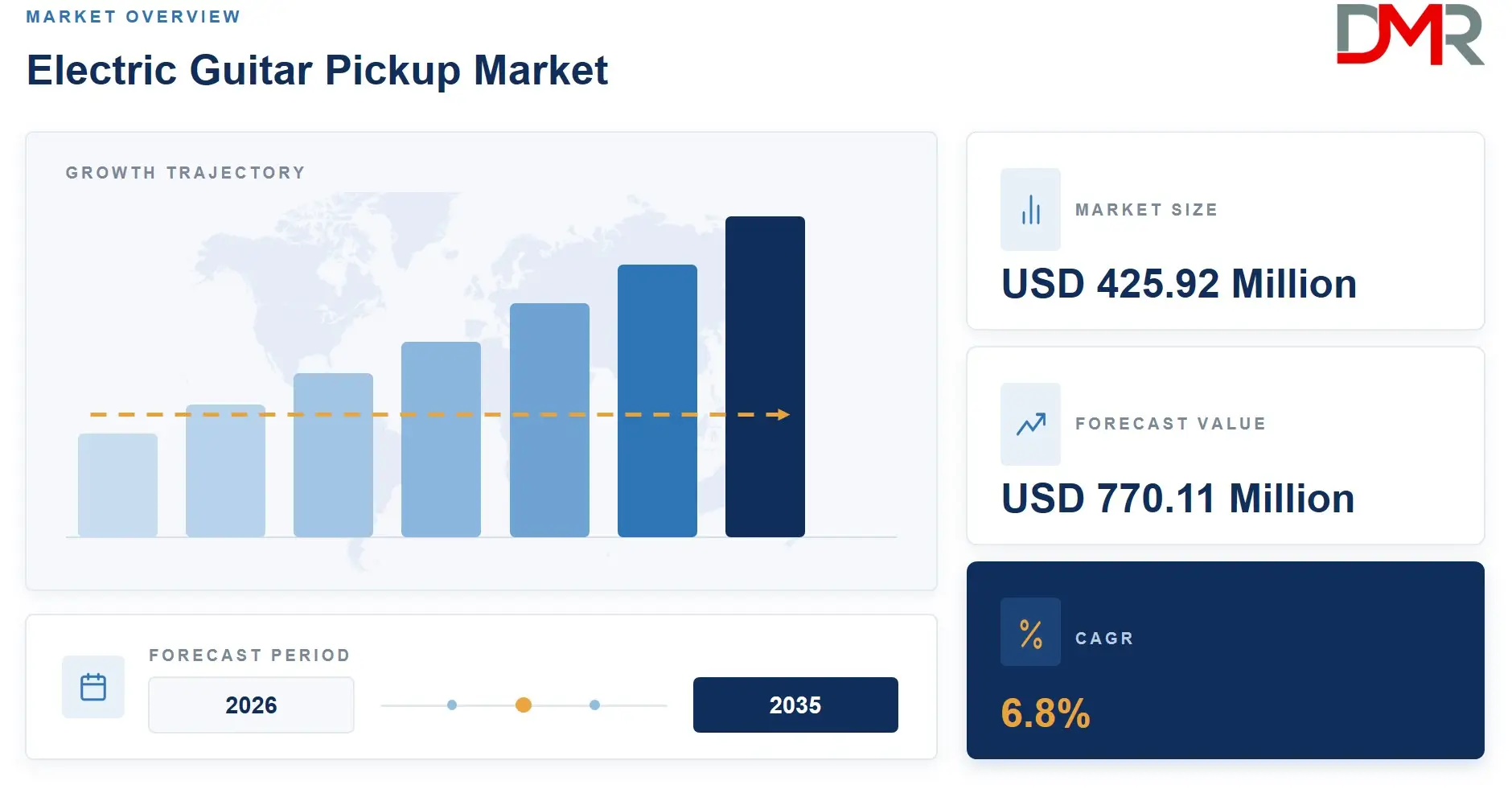
- The electric guitar pickup market size is USD 398.8 Million in 2025, reached USD 425.92 Million in 2026, and is projected to hit USD 770.11 Million by 2035 at a CAGR of 6.8%.
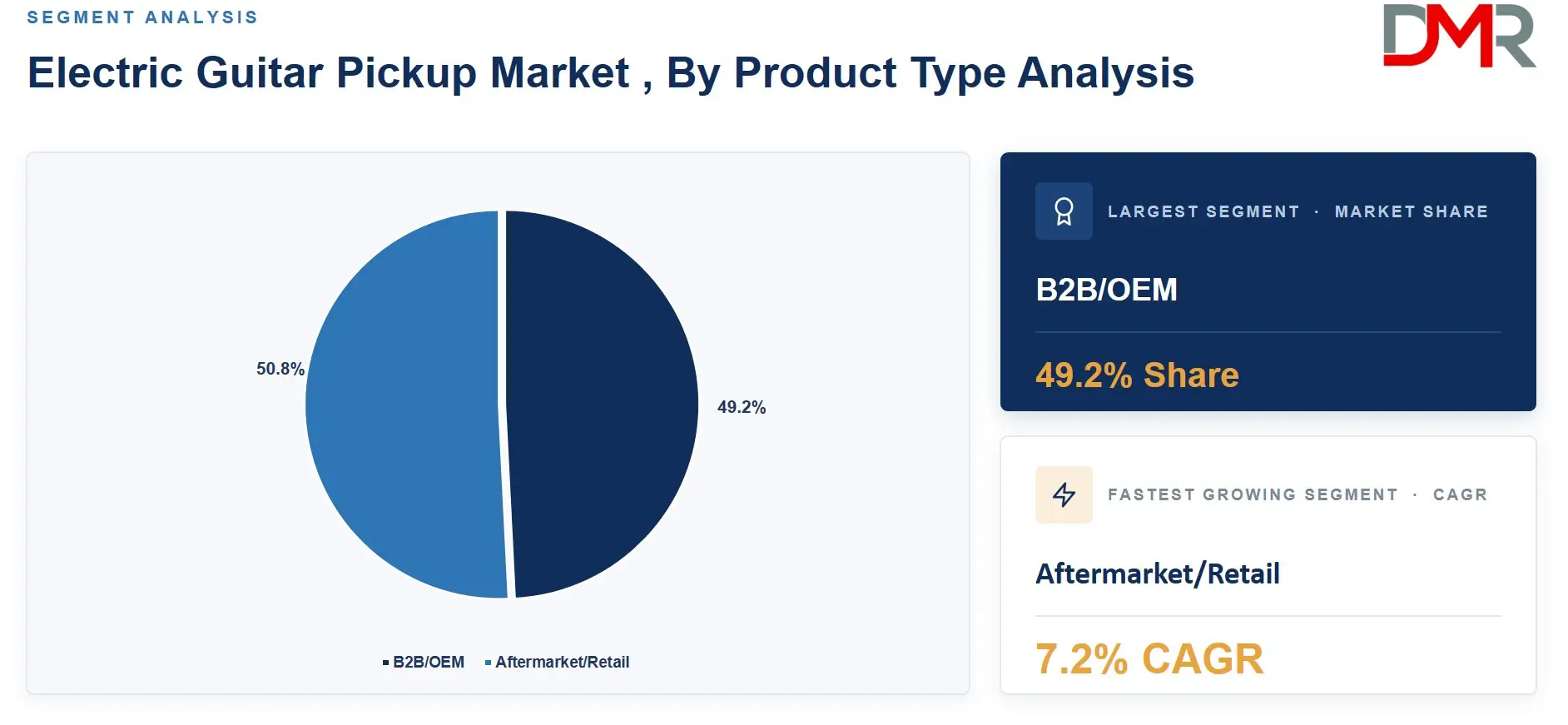
- By Product Type: B2B/OEM led with a 49.2% share in 2025.
- By Distribution Channel: Aftermarket/Retail led with a 81.9% share in 2025.
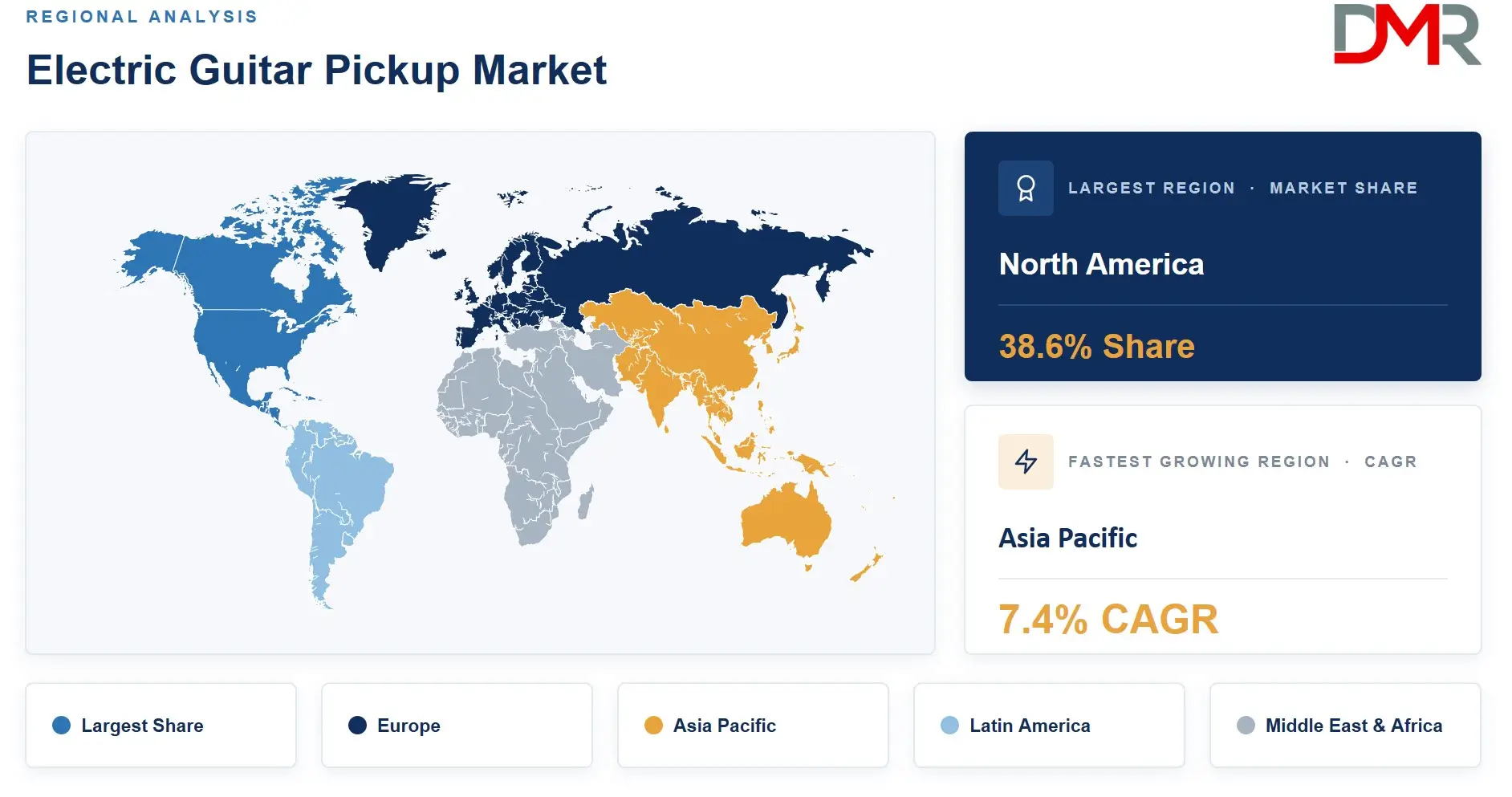
- By Region: North America led with a 38.6% share in 2025.
Market Size and Forecast
The Global Electric Guitar Pickup Market size is estimated at USD 425.92 Million in 2026 from USD 398.8 Million in 2025, and is projected to reach USD 770.11 Million by 2035, exhibiting a CAGR of 6.8% during the forecast period.
Growth across the historic period reflected sustained aftermarket replacement cycles and an expanding base of amateur and semi-professional players entering the market through online retail. Seymour Duncan's 2024 expansion across multiple guitar styles and genres confirmed that demand breadth, not just depth within established genres, is driving sustained catalog investment by the market's largest specialty players.
ℹ
To learn more about this report –
Download Your Free Sample Report Here
The forecast assumes continued bifurcation between mass-market OEM demand and premium aftermarket growth. Boutique-segment pricing power and artist-collaboration velocity support a faster-than-average premium-tier expansion rate, while OEM volumes track closely to global electric guitar unit shipments. Downside risk centers on discretionary consumer spending compression; upside scenarios require sustained content-creator-driven guitar adoption holding at current rates.
Product Type Analysis
B2B/OEM accounted for 49.2% of Product Type demand in 2025, the highest of any category.
OEM supply relationships lock pickup suppliers into multi-year specification agreements with guitar manufacturers, creating predictable volume but compressing margin. Passive Humbucker Pickups dominate the OEM mix within the B2B/OEM channel, reflecting guitar brands' preference for high-output, noise-resistant configurations at mid-range and premium price points. As reported by Guitar World, Bare Knuckle's PolyPaf uses a custom-wound, offset coil design built from 42 AWG plain-enamel wire, signaling that even OEM-adjacent boutique suppliers now differentiate on wire-gauge and winding geometry rather than output rating alone.
ℹ
To learn more about this report –
Download Your Free Sample Report Here
Aftermarket/Retail captures the remaining share and is the faster-growth channel. Players buying Aftermarket/Retail products prioritize tonal differentiation over cost, accepting premium price points for boutique-wound or artist-associated models. As per Lambertones, a standard Strat-style single-coil typically measures around 6 kΩ DC resistance, while a medium-output humbucker runs 7–10 kΩ, giving technically informed buyers a measurable specification baseline when selecting aftermarket upgrades. Active Humbucker Pickups lead aftermarket demand, driven by metal and hard-rock players seeking consistent high-gain output regardless of playing environment.
Distribution Channel Analysis
With an 81.9% share in 2026, Aftermarket/Retail outpaced all other Distribution Channel categories.
Aftermarket/Retail's dominance reflects a buyer base that overwhelmingly buys pickups as replacement or upgrade components, not as part of an instrument purchase. Online Sales have pulled consumer spending away from physical retail faster than most specialty music categories, with E-Commerce Platforms and Manufacturer-Owned Websites together capturing the bulk of Aftermarket/Retail volume. Manufacturer-owned digital channels give brands direct consumer data on upgrade preferences, enabling more accurate production runs for limited-edition and signature models.
Offline Sales within Aftermarket/Retail remain strategically relevant for first-time buyers who need in-store demonstration before committing to a pickup upgrade. Specialty Music Retailers carry outsized influence relative to their transaction volume, acting as recommendation engines for high-value boutique purchases. Manufacturer-Owned Stores serve a dual role as showrooms and brand experience centers, particularly for premium labels where tactile product interaction justifies higher per-unit prices.
Key Market Segments
By Product Type
- B2B/OEM
- Passive Humbucker Pickups
- Active Single-Coil Pickups
- Passive Single-Coil Pickups
- Active Humbucker Pickups
- Aftermarket/Retail
- Active Humbucker Pickups
- Passive Single-Coil Pickups
- Active Single-Coil Pickups
- Passive Humbucker Pickups
By Distribution Channel
- B2B/OEM
- Aftermarket/Retail
- Online Sales
- E-Commerce Platforms
- Manufacturer-Owned Websites
- Offline Sales
- Specialty Music Retailers
- Manufacturer-Owned Stores
- Department Stores
- Other Retail Outlets
Regional Analysis
North America led the regional segment with a 38.6% share in 2026.
North America's lead reflects both the region's concentration of major pickup manufacturers and the world's deepest installed base of electric guitar players. The United States houses the headquarters or primary production facilities of several of the market's largest specialty brands, giving North American suppliers shorter lead times and stronger retail relationships than competitors in other regions. Consumer spending on instrument accessories in the US has also proved more resilient to macro headwinds than in other discretionary categories.
ℹ
To learn more about this report –
Download Your Free Sample Report Here
Europe holds the second-largest share, supported by a mature player base in the UK and Germany and a strong boutique manufacturing culture. Asia Pacific is the fastest-growing region, driven by surging guitar adoption across South Korea, China, and India, where first-time players enter the aftermarket upgrade cycle within one to two years of initial instrument purchase. Latin America and Middle East & Africa remain nascent but show consistent annual gains aligned with broadening music education infrastructure.
Key Regions and Countries
North America
Europe
- Germany
- France
- The UK
- Spain
- Italy
- Rest of Europe
Asia Pacific
- China
- Japan
- South Korea
- India
- Australia
- Rest of APAC
Latin America
- Brazil
- Mexico
- Rest of Latin America
Middle East & Africa
- GCC
- South Africa
- Rest of MEA
Market Dynamics
Driver: Boutique Output Differentiation Expands Premium Pickup Demand
Specialty manufacturers are widening the measurable gap between pickup tiers, giving players a technically verifiable reason to upgrade. As reviewed by Guitar World, Bare Knuckle's Halcyon bridge humbucker measured 17.9 kΩ DC resistance in 2025, while the neck unit measured 7.9 kΩ. A spread of that magnitude between bridge and neck positions within one matched set is not achievable through standard production winding, and players who understand the specification are willing to pay boutique prices to access it.
DiMarzio reinforced this dynamic in 2025 by releasing the Super PAF Ceramic pickup, pairing a high-output ceramic magnet structure with a vintage PAF-style physical profile. Buyers who want modern gain but vintage aesthetics now have a commercially available solution, pulling a previously underserved overlap segment into the active aftermarket.
Restraint: Field-Level Quality Failures Erode Consumer Confidence
Pickup quality failures at the coil level create a reliability perception problem that disproportionately harms mid-tier brands. Data published by Lambertones confirms that a humbucker specified at approximately 7.5 kΩ but testing at approximately 3.75 kΩ in the field indicates a dead coil or short-to-ground fault. A buyer who encounters that failure on a factory-installed pickup is unlikely to stay within the same brand's aftermarket catalog for the replacement purchase.
Mid-tier brands face the sharpest exposure. Premium boutique makers absorb the cost of quality control in their price point. Mass-market OEM suppliers rely on volume tolerances that push field failure rates above boutique benchmarks. Mid-tier brands caught between those two extremes have limited margin to invest in tighter coil-winding inspection, leaving them vulnerable to negative word-of-mouth in online communities that now serve as the primary discovery channel for aftermarket upgrade decisions.
Opportunity: Configurable Pickup Architecture Unlocks New Buyer Segments
Guitar makers building proprietary pickup lines are creating a configurable product tier that sits between mass production and fully custom boutique. As reported by Guitar World, Ruokangas' VÄINÖ bridge humbucker was specified at 7.95 kΩ DC resistance in 2025, while the AINO neck humbucker measured 6.9 kΩ, a 1.05 kΩ spread that gives players a predictable tonal gradient across pickup positions. Both units use 4-conductor hookup wiring, enabling standard humbucking configurations and a range of alternative wiring schemes that expand the instrument's tonal palette without additional hardware cost.
The configurable physical specification model compounds this opportunity. A buyer who can select from 12 faceplate, polepiece, and cover-plating combinations is buying an instrument-grade component, not a commodity part. Suppliers who build modular specification menus into their product architecture can serve both OEM partners requiring brand-matched aesthetics and aftermarket buyers seeking visual and tonal personalization in a single product line.
Market Trends
Resistance-Mapped Winding Drives Spec-Informed Aftermarket Purchasing
Buyers are selecting pickups based on published DC resistance values rather than subjective tonal descriptions alone. Guitar World's 2025 reviews confirmed that Bare Knuckle's PolyPaf bridge humbucker measured 8.3 kΩ, while its neck counterpart measured 7.6 kΩ. Seymour Duncan responded to the shift toward verifiable spec buying by releasing the Jazzmaster Silencer in 2025, a noiseless pickup targeting a platform historically underserved by quantifiably specified aftermarket options. Vendors publishing resistance, wire gauge, and magnet type data in product listings now convert at higher rates in online channels where buyers compare specifications before purchase.
Market Competition Overview
The electric guitar pickup market is moderately fragmented at the volume tier and concentrated at the premium tier. A small number of specialty manufacturers hold dominant aftermarket share through long-established brand recognition, artist-endorsement networks, and catalog depth spanning hundreds of active SKUs. New entrants can compete in the boutique segment with small batch, hand-wound products, but face near-insurmountable catalog and distribution advantages when challenging established leaders at mass retail scale.
Hexaphonic and individual-string architectures represent the most technically differentiated competitive frontier. As reported by Guitar World, the Submarine Pickups Subsix system measured 2.4 kΩ DC resistance per channel in 2025, a specification tied to its individual-string pickup architecture rather than standard paired-coil output. Suppliers competing at this specification level are not directly competing with standard humbucker or single-coil producers. A separate competitive sub-market is forming around MIDI-compatible and polyphonic-output pickups, with distinct buyer profiles and price tolerance levels above the standard aftermarket average.
Company Profiles
Fender Musical Instruments Corporation operates across both OEM and aftermarket channels, with its in-house pickup development program giving it full vertical control from winding specification to retail positioning. In October 2025, Fender launched the American Pro Classic series featuring newly developed Coastline pickups, extending proprietary pickup technology into its professional guitar tier. The Coastline program signals Fender's intent to reduce aftermarket substitution by raising the specification quality of factory-installed pickups, a strategy that competes directly with the aftermarket upgrade market its own brand helped create.
Seymour Duncan sustains market position through unmatched artist-collaboration velocity and catalog breadth. The 2025 release of the Joe Bonamassa "Greenburst" Stratocaster Pickup Set through its Custom Shop extended the artist-signature model to a blues-oriented buyer segment that commands premium retail prices and high brand loyalty. Signature releases convert fan audiences directly into product buyers, a customer acquisition mechanism that standard catalog expansion cannot replicate at equivalent cost efficiency.
Key Players
- Yamaha Corporation
- Cort Guitars
- Gibson Brands, Inc.
- Michael Kelly Guitar Co.
- The ESP Guitar Company
- DEAN GUITARS
- Fender Musical Instruments Corporation
- Ibanez Guitars
- Epiphone
- Karl Höfner GmbH & Co. KG
Supply Chain and Value Chain Analysis
The electric guitar pickup supply chain originates with three distinct raw material streams: magnet alloys, copper wire, and bobbin materials. Alnico magnets, composed of aluminum, nickel, and cobalt, dominate the passive pickup segment, while ceramic magnets serve the high-output and cost-sensitive OEM tiers. Cobalt sourcing represents the sharpest upstream risk. Cobalt supply concentrates in a small number of producing countries, and price volatility in that commodity compresses margin predictability across the entire passive pickup manufacturer tier without warning.
Copper wire is the second critical upstream input. Industrial distributors serve high-volume OEMs with pure copper wire, while specialty alloys flow through technical retailers serving custom builders. Copper price volatility compresses margin predictability for wire drawers without backward integration into smelting or scrap recovery operations. Boutique manufacturers sourcing small-batch specialty wire face longer qualification timelines and thinner supplier competition than mass-production OEMs, creating a structural cost disadvantage at the wire procurement stage.
Maximum value in the chain is created at the coil-winding and specification stage, not at raw material sourcing. Hand-winding methods deliver an artisanal character, while machine-wound coils ensure consistency and efficiency across mass production runs. Boutique producers command price premiums precisely because hand-winding introduces intentional coil variation that automated processes cannot replicate. Polyurethane insulation systems are compressing the price premiums historically commanded by hand-wound specialty producers by enabling higher-speed automated winding without thermal degradation, pushing mid-tier manufacturers toward process investment to stay competitive.
Distribution splits the value chain into two structurally different flows. OEM pickups move directly from manufacturer to guitar brands under multi-year supply contracts, with margin determined at contract negotiation rather than at retail. Aftermarket pickups flow through specialty music retailers, manufacturer-owned direct channels, and e-commerce platforms, where brand equity and artist-association drive realized price above cost far more effectively than OEM agreements permit. Supply chain disruptions reported by manufacturers in the musical instrument industry have highlighted vulnerabilities in global raw material procurement, reinforcing a strategic shift among larger pickup brands toward regional supplier diversification and direct material sourcing where scale permits.
Recent Developments
- May 2026 — Seymour Duncan introduced the Ryan "Fluff" Bruce FLF Model Humbucker, a signature pickup developed with the guitarist and content creator, expanding its artist-collaboration program into the online guitar media audience.
- May 2026 — Seymour Duncan released the 50th Anniversary Duncan Custom Limited Edition Custom Shop Set, commemorating its Duncan Custom pickup legacy with a limited-edition configuration targeting collectors and premium buyers.
- March 2026 — Seymour Duncan introduced the 50th Anniversary JB/Jazz pickup set, featuring commemorative specifications and classic JB/Jazz tones as part of its anniversary product program.
- 2026 — EMG Pickups introduced limited-edition original-logo versions of its 81/85 and 81/60 pickup sets as part of a 50th-anniversary product program targeting long-standing users of its active pickup systems.
- 2026 — EMG Pickups released the James Hetfield "HET" JH Sandblasted Set with custom sandblasted stainless-steel covers, reinforcing its artist-signature strategy within the high-gain active pickup segment.
- 2024 — DiMarzio introduced the Halo Core, a streamlined version of the Andy Timmons Halo design, broadening the accessible price range for its signature-adjacent pickup portfolio.
- June 2024 — DiMarzio received a U.S. patent for a new Precision Bass pickup-cover shape developed with Billy Sheehan, extending its intellectual property position into bass-adjacent pickup hardware design.
Report Details
| Report Characteristics |
| Market Value (2025) |
USD 398.8 Million |
| Market Value (2026) |
USD 425.92 Million |
| Forecast Revenue (2035) |
USD 770.11 Million |
| CAGR (2026–2035) |
6.8% |
| Base Year for Estimation |
2025 |
| Historic Period |
2020 – 2024 |
| Forecast Period |
2026 – 2035 |
| Report Coverage |
Revenue Forecast, Market Dynamics, Competitive Landscape, Recent Developments |
| Segments Covered |
By Product Type (B2B/OEM, Aftermarket/Retail); By Distribution Channel (B2B/OEM, Aftermarket/Retail: Online Sales, Offline Sales) |
| Regional Analysis |
North America – US and Canada; Europe – Germany, France, The UK, Spain, Italy, and Rest of Europe; Asia Pacific – China, Japan, South Korea, India, Australia, and Rest of APAC; Latin America – Brazil, Mexico, and Rest of Latin America; Middle East & Africa – GCC, South Africa, and Rest of MEA |
| Competitive Landscape |
Yamaha Corporation, Cort Guitars, Gibson Brands Inc., Michael Kelly Guitar Co., The ESP Guitar Company, DEAN GUITARS, Fender Musical Instruments Corporation, Ibanez Guitars, Epiphone, Karl Höfner GmbH & Co. KG |
| Customization Scope |
Customization for segments and region or country level will be provided. Additional customization can be done based on requirements. |
| Purchase Options |
Three license options: Single User License, Multi-User License (Up to 5 Users), and Corporate Use License (Unlimited Users and Printable PDF) |
Frequently Asked Questions
What is the biggest investment opportunity in Electric Guitar Pickup Market ?
▾ Configurable boutique pickup lines that bridge the gap between mass OEM production and fully custom hand-wound products represent the clearest investment opportunity. Brands offering modular physical specifications alongside measurable electrical output data can command premium aftermarket pricing while serving OEM partners. The aftermarket upgrade segment is where most margin expansion is occurring.
Who are the top companies in Electric Guitar Pickup Market ?
▾ Fender Musical Instruments Corporation, Seymour Duncan, DiMarzio, EMG Pickups, and Bare Knuckle are among the most active players across both OEM supply and aftermarket retail. Fender competes through vertical integration of in-house pickup technology. Seymour Duncan and DiMarzio lead on catalog depth and artist-collaboration volume.
Which segment is growing fastest in Electric Guitar Pickup Market and why?
▾ The Aftermarket/Retail Distribution Channel, which held an 81.9% share in 2025, is driving above-average growth as players increasingly replace factory-installed pickups within the first two years of guitar ownership. Online channels have lowered the discovery and purchase barrier for first-time aftermarket buyers. Artist-signature releases accelerate the replacement cycle by creating urgent, genre-specific demand peaks.
Which region is growing fastest in Electric Guitar Pickup Market and why?
▾ Asia Pacific is the fastest-growing region, driven by first-time guitar adoption in South Korea, China, and India where players enter the aftermarket upgrade cycle quickly. Content-creator guitar culture is expanding the player base in these markets faster than any other region. North America holds a 38.6% share but is growing at a steadier, more mature rate.
What is the biggest challenge holding Electric Guitar Pickup Market back?
▾ Coil-level quality failures at mid-tier manufacturers erode consumer confidence at the segment most critical to volume growth. A buyer who encounters a factory pickup failure is a high-probability candidate for an aftermarket upgrade, but only if the replacement brand provides a verifiably better quality outcome. Mid-tier brands lacking rigorous winding inspection face both reputation and customer-retention risk.