What is the Global Electric Vehicle Charging Station Market Size?
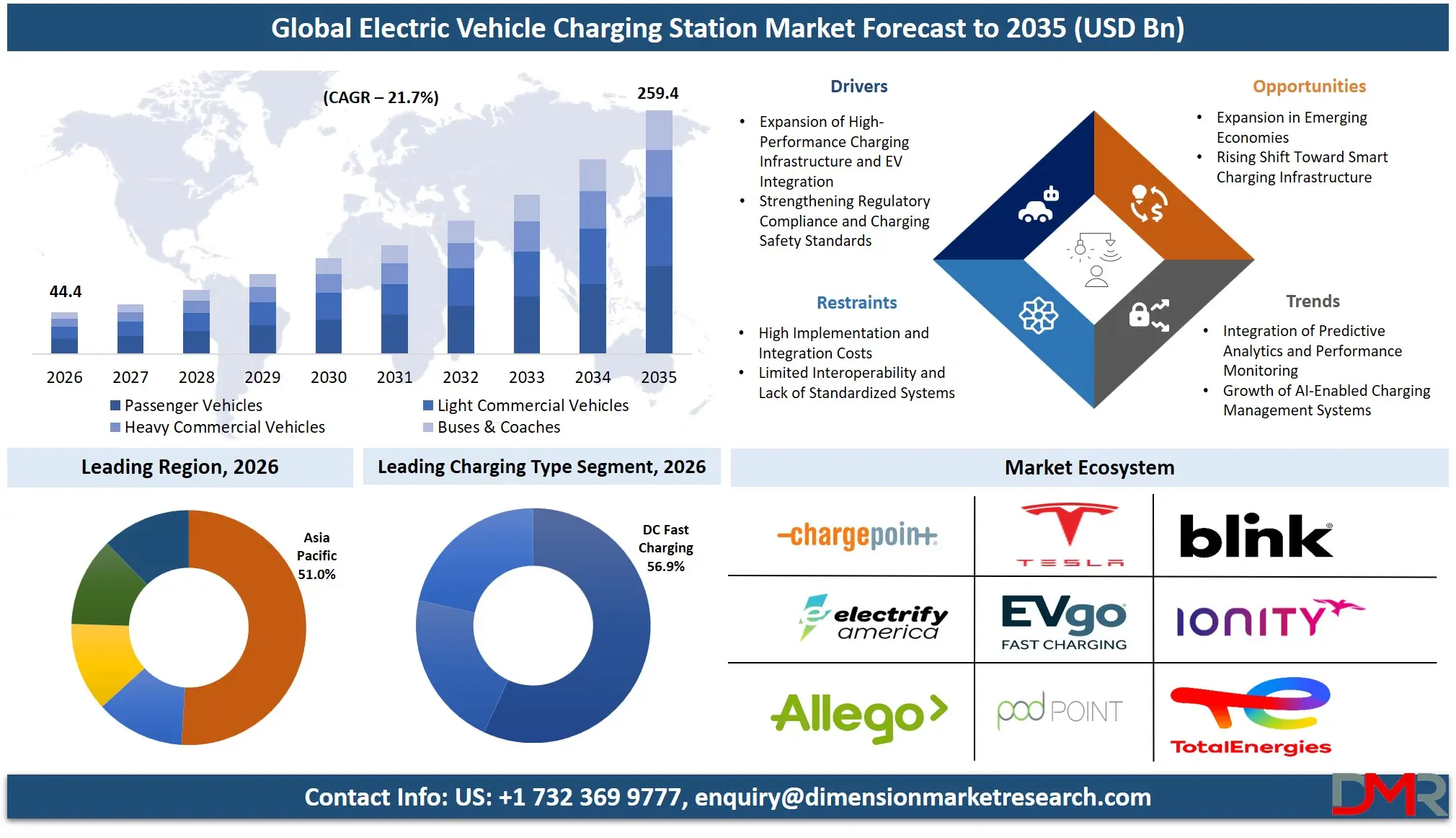
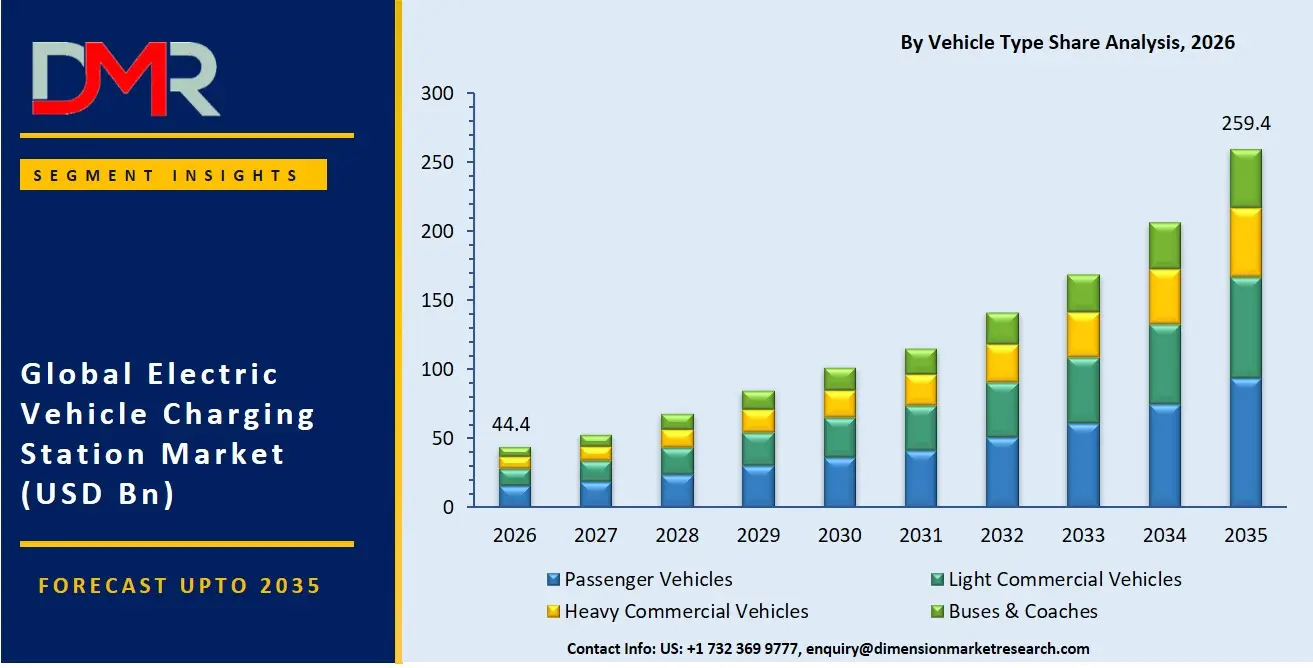
The Global Electric Vehicle Charging Station Market size is estimated at USD 44.4 billion in 2026 and is projected to reach USD 259.4 billion by 2035, exhibiting a CAGR of 21.7% during the forecast period, driven by rising EV adoption, expansion of public and private charging infrastructure, increasing deployment of fast-charging networks, and integration of smart grid and energy management systems.
ℹ
To learn more about this report –
Download Your Free Sample Report Here
The electric vehicle charging station market around the world is witnessing strong growth owing to the rising adoption of network monitoring systems and load balancing technology for power demand control; regulatory measures designed to ensure that the electric grid is stable, as well as charging infrastructure is standard; and rising investments into digital solutions used to monitor charging sessions and facilitate billing processes. Other drivers driving the global market forward include the better interoperability of chargers, innovations within the area of battery management coordination, and the development of high-capacity charging lanes. The growing trend of electrifying fleets of passenger and freight vehicles as well as supportive governmental policies, is also helping boost the market's growth.
ℹ
To learn more about this report –
Download Your Free Sample Report Here
The US Electric Vehicle Charging Station Market
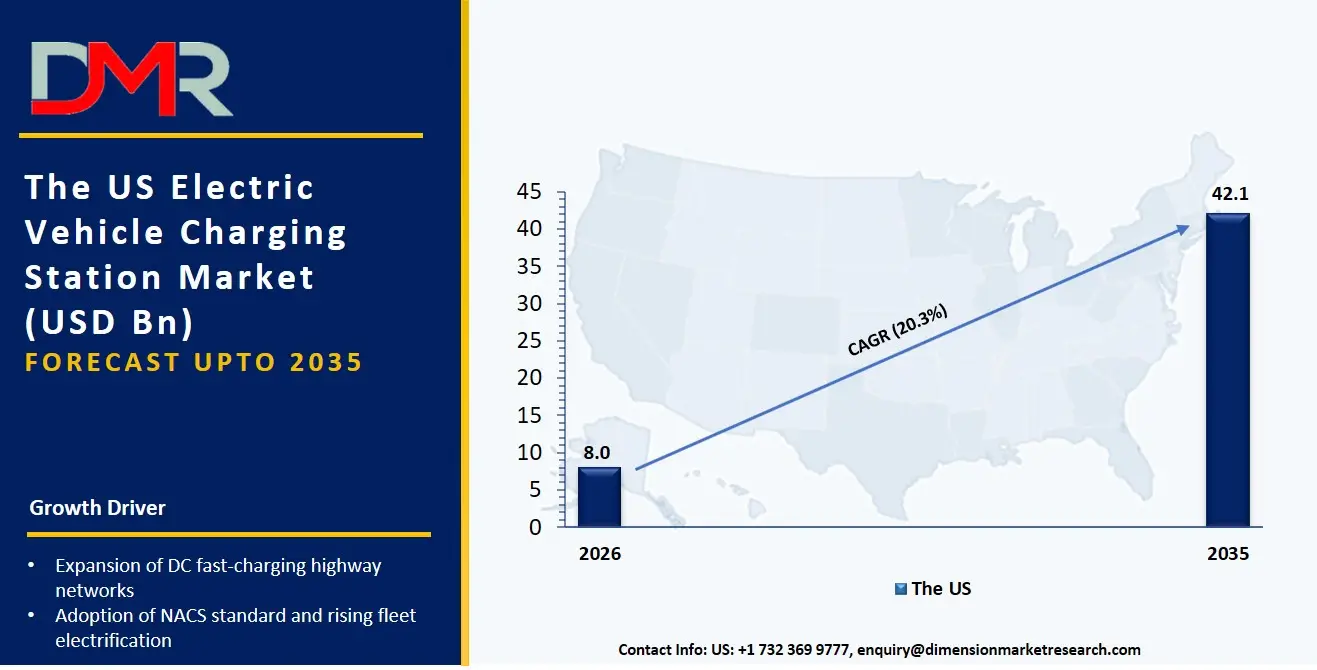
The US Electric Vehicle Charging Station Market is estimated to grow to USD 8.0 billion in 2026 with a compound annual growth rate of 20.3% during the forecast period.
The US market relies on efforts at the national and state levels aimed at advancing the development of infrastructure for electric vehicles through funding schemes for fast-charging along highways and urban areas. Growth is further aided by advancements in the use of grid-connected charging technologies, real-time monitoring of energy consumption, and uniform safety guidelines for charging infrastructure. Investment in electric vehicle infrastructure from the private sector has been growing in both residential and commercial settings. Interoperability, safety, and energy efficiency guidelines are among the factors influencing deployment.
ℹ
To learn more about this report –
Download Your Free Sample Report Here
Europe Electric Vehicle Charging Station Market
The European Electric Vehicle Charging Station Market is estimated to be valued at USD 10.7 billion in 2026, witnessing growth at a CAGR of 20.1%, during the forecast period.
The EU electric vehicle charging station market enjoys robust regulatory regimes like AFIR that encourages standardization of charging infrastructure among member countries. Market expansion is fueled by the growing use of high-power EV charging stations on motorways and urban areas and the growing number of investments in renewable energy integrated charging stations. Efforts are being made to promote cross-border compatibility and integrated payments for charging. Other key factors that are influencing the market include developments in technology for intelligent EV charging, better grid integration, and greater collaboration between private entities and governments.
Japan Electric Vehicle Charging Station Market
The Japan Electric Vehicle Charging Station Market is projected to be valued at USD 1.9 billion in 2026, progressing at a CAGR of 17.8%, during the period spanning from 2026 to 2035.
The Japanese EV charging stations industry is marked by significant governmental assistance provided for EV charging network development within the framework of the Green Growth Strategy and increasing efforts in creating a new generation of EV charging stations. The industry's development can be attributed to such aspects as growing popularity of fast- and ultra-fast charging networks, wide use of advanced EV charging management technologies, and integration with power grids. Improvement of existing EV charging networks along with their harmonization in terms of compatibility with different standards is fueling further market growth in Japan. The country also prioritizes efficiency of charging stations, reliability, and accessibility due to the joint efforts of utilities, automakers, and infrastructure companies.
Key Takeaways
- Market Size & Forecast: The Global Electric Vehicle Charging Station Market is estimated to be valued at USD 44.4 billion in 2026 and is expected to grow to USD 259.4 billion by 2035.
- Growth Rate & Outlook: The market is expected to witness growth at a compound annual growth rate of 21.7% in the forecast period.
- Primary Growth Drivers: The availability of new charging processing technologies that use real-time degradation detection, the need to speed up compliance results and improve success rates of charging data sharing, and more government investment in national secure EV infrastructure are key growth drivers.
- Key Market Trends: The real-time profiling of charger thermal stability risks, high-power connector handling, and the shift to AI-driven charging load platforms and automated charger inventory management are key market trends.
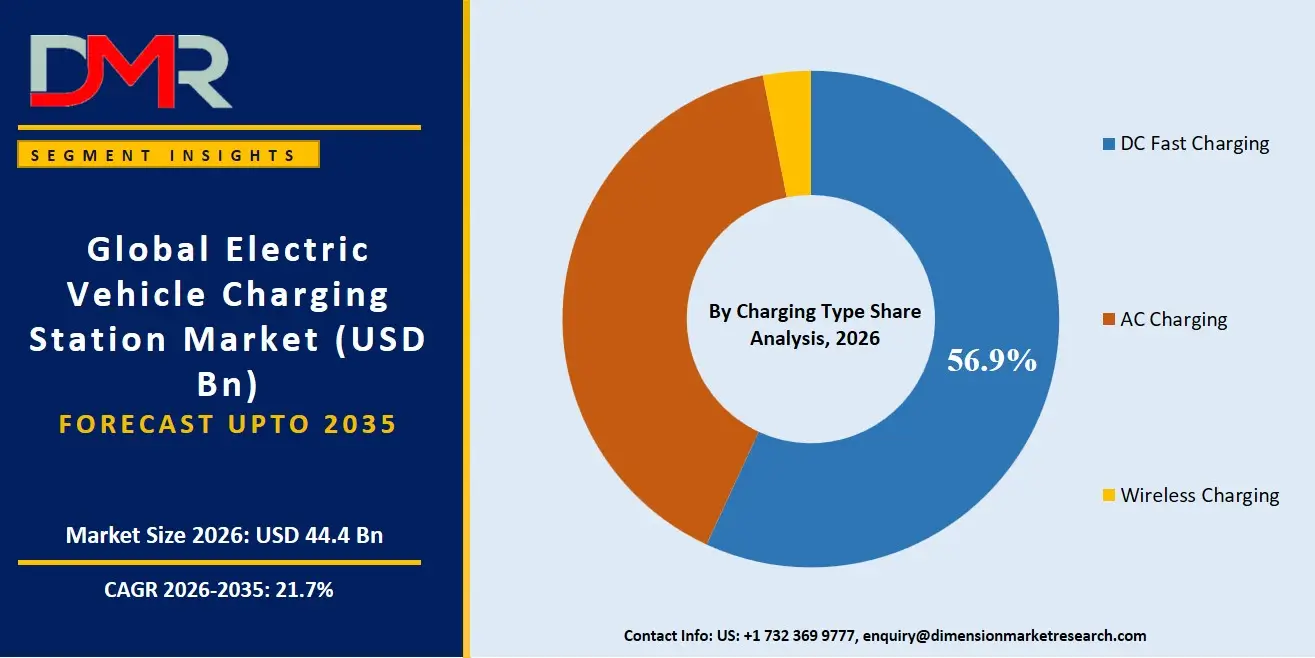
- By Charging Type: The DC Fast Charging segment is expected to take the largest revenue share in the global electric vehicle charging station market in 2026.
- By Charging Level: Level 3 charging is expected to take the largest revenue share in 2026 in the charging station market.
- By Installation: The Commercial & Public Charging segment is estimated to take the lead in 2026 with the largest share in the charging station market.
- Regional Leadership: Asia Pacific is estimated to take the lead in 2026 with 51.0% share in the charging station market.
What is an Electric Vehicle Charging Station?
An electric vehicle charging station refers to a combination of hardware and software systems that provide electric energy to EV owners, fleet operators, and related stakeholders, enabling safe and efficient vehicle charging. It includes AC charging pedestals, DC fast charging systems, and wireless charging pads. These systems use technologies such as charging session monitoring, power management software, and remote diagnostics to manage, track, and optimize charging operations. To improve charging reliability, manage power fluctuations, and support different vehicle requirements, charging stations are designed to ensure safe and efficient energy delivery across varied use cases.
Use Cases
- Grid Management & Load Balancing: An electric vehicle charging platform can contribute towards grid stability through its software-based ability to monitor and manage loads effectively, thus offering a more effective way of managing charging needs.
- Long-Term Charging Asset Management: Performance data about the charger over long periods of time, including variations in power quality and charger wear and tear, can be used to optimize maintenance and increase reliability.
- Fleet & High-Demand Charging Optimization: The charging infrastructure employs intelligent software and management controls to distribute the load efficiently, thus helping to ensure stable grid performance at peak periods.
- Government & Regulatory Infrastructure Support: The charging stations are used by governments to facilitate monitoring efforts in order to help formulate charging and safety standards.
How AI Is Transforming the Global Electric Vehicle Charging Station Market?
Artificial intelligence (AI) is increasingly being used in charging station systems to improve demand forecasting, detect irregular charging behavior, and monitor equipment performance. It helps operators identify potential issues early, improve charger uptime, and optimize energy distribution across networks. AI also supports faster analysis of charging data, making operations more efficient compared to traditional manual monitoring methods.
In addition, AI is aiding planning and development through better forecasting and helping to determine suitable locations for installing charging stations. Better demand forecasting is achieved, greater efficiency in operations ensured, and cost efficiencies created by automating repetitive activities. In essence, AI is ensuring that charging infrastructures become more reliable, efficient, and easy to manage through automation.
Market Dynamics
Key Drivers of the Global Electric Vehicle Charging Station Market
Expansion of High-Performance Charging Infrastructure and EV Integration
The market is growing with the rise of advanced charging stations for EV batteries, improved management of charging systems, and a closer connection between charger performance monitoring and EV integration. Charging station platforms provide real-time data that allows monitoring of power quality, helps detect issues early, and improves charging safety performance. This has improved operational efficiency and reduced errors and operating costs. At the same time, demand for more automated research and development is being supported by predictive analytics for assessing charger performance and reliability, as EV ecosystems become more digitized across deployment and operations.
Strengthening Regulatory Compliance and Charging Safety Standards
The importance of safety, stability, and regulation is becoming more prevalent within EV charging stations. Systems like the EU AFIR, UN ECE R100, UL 2202, as well as various national EV infrastructure policies, are advocating for the use of uniformity in EV charging standards along with better safety management. They are facilitating the need for better systems that continuously monitor the EV infrastructure and ensure proper safety monitoring. On the other hand, advancements in charging data transparency along with compliance management is leading to the growing requirement for better management systems.
Restraints in the Global Electric Vehicle Charging Station Market
High Implementation and Integration Costs
The development of electric vehicle charging infrastructure is capital-intensive in nature, with substantial investments needed for installation and integration processes. Apart from the initial investments in setting up such facilities, there are expenses that would be incurred by EV charging stations due to maintenance, upgrading, and compliance with changing standards. There may even be extra costs associated with connecting to an already established electricity grid and other related infrastructure. Financial considerations pose major barriers to the growth of this business model, which would be especially hard on smaller operators in this space. Additional expenses may come from the acquisition of suitable land and permitting delays.
Limited Interoperability and Lack of Standardized Systems
One of the biggest challenges faced by the industry of electric vehicle charging stations is related to the lack of interoperability within the charging networks, connectors, and protocols. There are many countries where the existing infrastructure consists of both outdated AC chargers as well as DC fast chargers. Such fragmentation affects the process of interoperability, limiting the ability of EV owners to access services from different charging networks and increasing the inefficiency of the entire infrastructure. Besides, there are currently no globally unified standards in the sphere of communication and payments. Lack of such standards creates an obstacle to data exchange, limiting the ability to enhance the performance of the entire network.
Growth Opportunities in the Global Electric Vehicle Charging Station Market
Expansion in Emerging Economies
The developing countries, including Brazil, Indonesia, Nigeria, the United Arab Emirates, and Vietnam, are starting to invest in EV mobility and EV charging infrastructure deployment. At present, these regions are in the early stage of adopting EV technology; however, there is ample scope for growth in the future due to various opportunities that come with the same. The governments in these countries are implementing favorable policies and programs to promote their development. Due to the absence of any old infrastructure in these regions, there is huge scope for deploying advanced charging stations. The trend of rising urbanization along with the growth in awareness regarding environmental protection will fuel the need for EV infrastructure further.
Rising Shift Toward Smart Charging Infrastructure
There is a significant trend in the market towards the installation of smart and connected charging infrastructure, which combines digital technology with energy management systems. Smart charging systems facilitate real-time monitoring, dynamic load balancing, and better coordination between vehicles, chargers, and grid managers. Such an approach helps manage energy consumption during high demand times and prevent grid overload. Besides, such solutions make it easier for managers to control the process of charging by using dashboard systems and other control systems. Given the growing popularity of EVs, it becomes crucial to develop efficient solutions to manage energy consumption and ensure cost-efficiency and scalability.
Global Electric Vehicle Charging Station Market Trends
Integration of Predictive Analytics and Performance Monitoring
Platforms for charging stations are increasingly utilizing predictive analysis along with performance measurement tools for improved reliability and efficiency. Predictive analysis aids charging station operators in the early detection of charger deterioration, optimization of maintenance, and prevention of breakdowns. With the help of usage data, power quality variations, and other factors, charging companies will be able to make more informed decisions regarding the management of their infrastructure. This will result in optimized use of assets and increased lifecycle of charging devices. Moreover, by using predictive analytics, it will become easier for companies to make decisions about where to install new charging stations.
Growth of AI-Enabled Charging Management Systems
AI has become a critical component in the development of current EV charging technologies since it enables timely decisions and effective management. The use of AI technology can help to balance the loads, forecast the demand for charging and enable network coordination at different charging stations. AI is useful in managing EV charging networks since it automates some operations that would require manual involvement. Moreover, AI facilitates effective management of interaction between EV charging stations and grids as it optimizes the energy flow during peak hours. AI can be used in scaling up EV charging infrastructures while ensuring efficiency and effectiveness in their operations.
Research Scope and Analysis
The global electric vehicle charging station market is witnessing strong growth driven by rising adoption of electric vehicles, fleet electrification, and increasing demand for high-safety and ultra-fast charging infrastructures. The market is segmented based on charging type, charging level, installation, vehicle type, and connector type.
ℹ
To learn more about this report –
Download Your Free Sample Report Here
By Charging Type Analysis
The DC Fast Charging segment is likely to continue dominating the market in 2026, accounting for approximately 58.7% of the global electric vehicle charging station market share. This is due to its key role in enabling ultra-fast energy transfer, a wide operating temperature range, and long-term cycling stability, and its usefulness in various charging settings where speed is needed. Within DC Fast Charging, the 150-350 kW sub-segment holds the largest share, driven by high deployment volumes, automated demand for stable power electronics, and compliance requirements. The AC Charging segment is driven by its key role in enabling residential and workplace charging with enhanced convenience and lower cost. These chargers support continuous overnight charging activity and standardized safety management across industries. Wireless Charging is also growing, offering improved user convenience and reduced cable wear, with static wireless gaining traction for fleet and robotaxi applications.
By Charging Level Analysis
The Level 3 segment is likely to continue holding the lead in 2026, accounting for approximately 52.1% of the global electric vehicle charging station market share, driven by strong demand for long-range EV travel, commercial fleet operations, and scalable charging across applications. This segment reflects the continued shift toward ultra-fast and high-power charging systems. The Level 2 segment is the second-largest, supported by workplace and destination charging, where cost-effectiveness and overnight charging remain critical. The Level 1 segment is also stable, driven by the need for low-cost, plug-and-play alternatives for plug-in hybrid vehicles.
By Installation Analysis
The Commercial & Public Charging segment is expected to dominate with around 64.3% market share in 2026, driven by their irreplaceable role in highway corridors, urban charging hubs, and retail destinations, enabling high utilization and network scalability. Commercial chargers support customized pricing plans because they can offer multiple levels of power tuning, capacity amounts, and yearly stability plans, delivering fast results while keeping charging data within secure network systems. The Fleet Charging segment is the second-largest, driven by demand for depot charging for electric delivery vans, trucks, and buses. The Residential Charging segment is the fastest-growing within Installation, witnessing strong growth with increasing needs for overnight convenience, load management integration, and smart home compatibility.
By Vehicle Type Analysis
The Passenger Vehicles segment is the largest vehicle type in 2026, accounting for 71.5% share, driven by the need for compliance with EV safety regulations, home and public charging optimization, thermal runaway prevention, and large-scale multi-party charging analytics. Automotive OEMs are adopting charging station platforms for visibility and control over their vehicle charging profiles. The Buses & Coaches segment is the second-largest, supported by municipal electrification mandates and zero-emission public transport commitments. Light Commercial Vehicles remains a steady segment driven by last-mile delivery electrification and operational cost savings, while Heavy Commercial Vehicles include long-haul trucking and specialty fleet operations.
By Connector Type Analysis
The CCS (CCS1 & CCS2 combined) segment is the largest connector type in 2026, accounting for approximately 44.6% share, driven by the need for standardized fast charging, automaker adoption across North America and Europe, and high-power compatibility up to 500 kW. Charging providers are adopting CCS platforms to optimize interoperability and ensure cross-network consistency. The NACS segment is the fastest-growing, supported by major OEM adoption, Tesla Supercharger network opening, and direct connector standardization agreements. GB/T represents the dominant standard in China, while CHAdeMO remains relevant for legacy Japanese EVs. Type 1 and Type 2 serve regional AC charging needs, and Pantograph Charging is growing for electric buses and commercial fleets requiring automated high-power top-up.
The Global Electric Vehicle Charging Station Market Report is segmented based on the following:
By Charging Type
- AC Charging
- DC Fast Charging
- Wireless Charging
By Charging Level
By Installation
- Residential Charging
- Commercial Public Charging
- Fleet Charging
By Vehicle Type
- Passenger Vehicles
- Light Commercial Vehicles
- Heavy Commercial Vehicles
- Buses & Coaches
By Connector Type
- CCS1
- CCS2
- NACS
- GB/T
- CHAdeMO
- Type 1
- Type 2
- Pantograph Charging
Regional Analysis
Largest Region in the Electric Vehicle Charging Station Market
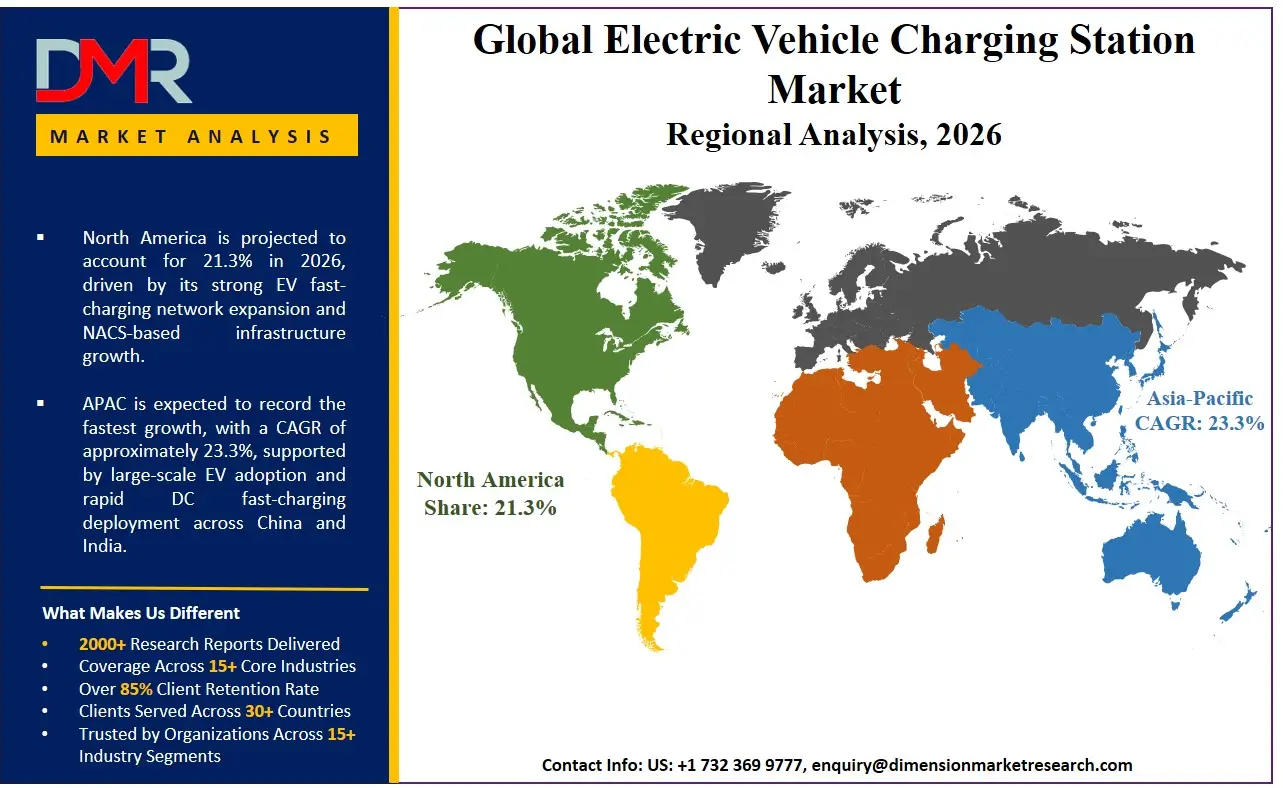
It is projected that the Asia-Pacific region will take the lead in the global electric vehicle charging station market, covering a market share of about 51.0% in the year 2026. The region's dominance is driven by the presence of the world's largest EV manufacturers, the highest concentration of public chargers in China and South Korea, rapid deployment of high-power DC fast charging systems, and vertically integrated power electronics supply chains. Asia-Pacific benefits from lower component and installation costs, strong government mandates for EV adoption (China's NEV policy, India's FAME scheme), and the highest regional production volume of EVs. The region is also home to major connector and charger manufacturers, enabling rapid iteration of ultra-fast and wireless charging technologies. Additionally, ongoing investments in pantograph charging for e-buses and battery-swapping stations further strengthen Asia-Pacific's leading position. The widespread adoption of advanced charging infrastructure for passenger EVs, commercial fleets, and public transport applications continues to reinforce the region's market leadership.
ℹ
To learn more about this report –
Download Your Free Sample Report Here
Fastest-Growing Region in the Electric Vehicle Charging Station Market
Asia-Pacific is also the fastest-growing region, supported by the world's most aggressive EV charging infrastructure targets, led by China's ultra-fast charging network expansion under its "New Infrastructure" initiative, India's FAME III scheme accelerating public charger deployment, and rapid urbanization driving demand for residential and fleet charging solutions across Southeast Asia. The region is witnessing unprecedented growth in megawatt charging systems for heavy commercial vehicles, wireless charging pilots for robotaxis in China, and pantograph charging for electric bus fleets in India and Indonesia. Asia-Pacific benefits from the highest annual installation rates of DC fast chargers, localized production of NACS and GB/T connectors, and declining hardware costs due to manufacturing scale. Moreover, rising corporate investments in battery-swapping stations and cross-border charging corridors are expected to keep Asia-Pacific's growth momentum as the highest CAGR region during the forecast period.
By Region
North America
Europe
- Germany
- The U.K.
- France
- Italy
- Russia
- Spain
- Benelux
- Nordic
- Rest of Europe
Asia-Pacific
- China
- Japan
- South Korea
- India
- ANZ
- ASEAN
- Rest of Asia-Pacific
Latin America
- Brazil
- Mexico
- Argentina
- Colombia
- Rest of Latin America
Middle East & Africa
- Saudi Arabia
- UAE
- South Africa
- Israel
- Egypt
- Rest of MEA
Competitive Landscape
The electric vehicle charging station market is highly competitive, with innovation and strategic partnerships shaping the competitive environment. To gain an advantage, companies and providers are focused on developing advanced charging solutions (such as AI-based load balancing, automated charging performance monitoring systems, and software platforms for charging network management), smart power quality analytics, and cloud-based charger performance monitoring. There are high barriers to entry due to significant capital requirements, regulatory approvals, specialized infrastructure expertise, and the need for integrated hardware and software systems.
Strategic approaches to increase market presence include partnerships with EV manufacturers, utilities, and infrastructure providers, mergers between charging software companies and hardware manufacturers, and long-term service agreements with commercial and government clients. Additionally, research and development in interoperability standards and flexible charging system designs are important for staying competitive and meeting the evolving requirements of the electric vehicle charging ecosystem.
Some of the prominent players in the Global Electric Vehicle Charging Station Market are:
- Tesla, Inc.
- ChargePoint Holdings, Inc.
- EVgo Services LLC
- Blink Charging Co.
- Electrify America LLC
- IONITY GmbH
- Allego N.V.
- Pod Point Group Holdings plc
- Shell plc
- BP p.l.c.
- TotalEnergies SE
- Enel SpA
- ENGIE SA
- ABB Ltd.
- Siemens Aktiengesellschaft
- Schneider Electric SE
- Delta Electronics, Inc.
- Tritium DCFC Limited
- Kempower Oyj
- Alfen N.V.
- Other Key Players
Recent Developments
- April 2026: Shell plc expanded its Shell Recharge network in Germany by commissioning 16 new ultra-fast charging locations across highways and urban retail corridors, with charging capacities of up to 300 kW per station, strengthening its integrated fuel-to-electric mobility transition strategy in Europe.
- April 2026: ChargePoint Holdings, Inc. launched "Express Solo," a next-generation standalone DC fast charger capable of delivering up to 600 kW of power to a single EV, marking one of the highest power-density mass-market charging systems globally and supporting scalable deployment across North America and Europe.
- February 2026: EVgo Services LLC reported continued expansion of its U.S. fast-charging network, adding significant new DC fast-charging capacity across highway and urban corridors, supported by increased utilization from ride-hailing fleets and adoption of Tesla's NACS connector standard across new installations.
- January 2026: Tesla, Inc. expanded deployment of its second "true" V4 Supercharging station in Taylorsville, Utah, further scaling its 500 kW ultra-fast charging architecture designed to support next-generation 800V EV platforms and increasing interoperability for non-Tesla EVs.
Report Details
| Report Characteristics |
| Market Size (2026) |
USD 44.4 Bn |
| Forecast Value (2035) |
USD 259.4 Bn |
| CAGR (2026–2035) |
21.7% |
| The US Market Size (2026) |
USD 8.0 Bn |
| Historical Period |
2021 – 2025 |
| Forecast Period |
2027 – 2035 |
| Base Year |
2025 |
| Estimated Year |
2026 |
| Segments Covered |
By Charging Type, By Charging Level, By Installation, By Vehicle Type, By Connector Type |
| Regional Coverage |
North America – The US and Canada; Europe – Germany, The UK, France, Russia, Spain, Italy, Benelux, Nordic, & Rest of Europe; Asia-Pacific – China, Japan, South Korea, India, ANZ, ASEAN, Rest of APAC; Latin America – Brazil, Mexico, Argentina, Colombia, Rest of Latin America; Middle East & Africa – Saudi Arabia, UAE, South Africa, Turkey, Egypt, Israel, & Rest of MEA |
Frequently Asked Questions
How big is the Global Electric Vehicle Charging Station Market?
▾ The Global Electric Vehicle Charging Station Market is estimated to be valued at USD 44.4 billion in 2026 and is expected to reach USD 259.4 billion by the end of 2035.
What is the CAGR of the Global Electric Vehicle Charging Station Market from 2026 to 2035?
▾ The market is growing at a CAGR of 21.7% over the forecasted period.
What factors are driving the growth of the Global Electric Vehicle Charging Station Market?
▾ The market is driven by advances in real-time charger degradation detection and automated safety enforcement, regulatory pressure to speed up EV infrastructure compliance results and reduce thermal runaway mistakes, and increased government investment in national safe EV infrastructure.
What are the major trends in the Global Electric Vehicle Charging Station Market?
▾ The key market trends include the adoption of real-time charger thermal stability tracking and power electronics analysis, along with a growing shift toward AI-driven charging load platforms and data-enabled charger inventory management systems.
Which region held the largest share of the Global Electric Vehicle Charging Station Market in 2026?
▾ Asia Pacific is expected to account for the largest market share in 2026, with a share of about 51.0%.
Which region is expected to grow the fastest in the Global Electric Vehicle Charging Station Market?
▾ Asia Pacific is the fastest-growing region in the market during the forecast period.
Who are the key players in the Global Electric Vehicle Charging Station Market?
▾ Some of the major key players in the Global Electric Vehicle Charging Station Market are Tesla Inc., BYD Company Ltd., ABB Ltd., Siemens AG, ChargePoint Holdings, Inc., Shell plc, EVgo Inc., and many others.
How is the Global Electric Vehicle Charging Station Market segmented?
▾ The market is segmented by charging type, charging level, installation, vehicle type, and connector type.