Global Electro-Sustainable Aviation Fuel Market Snapshot
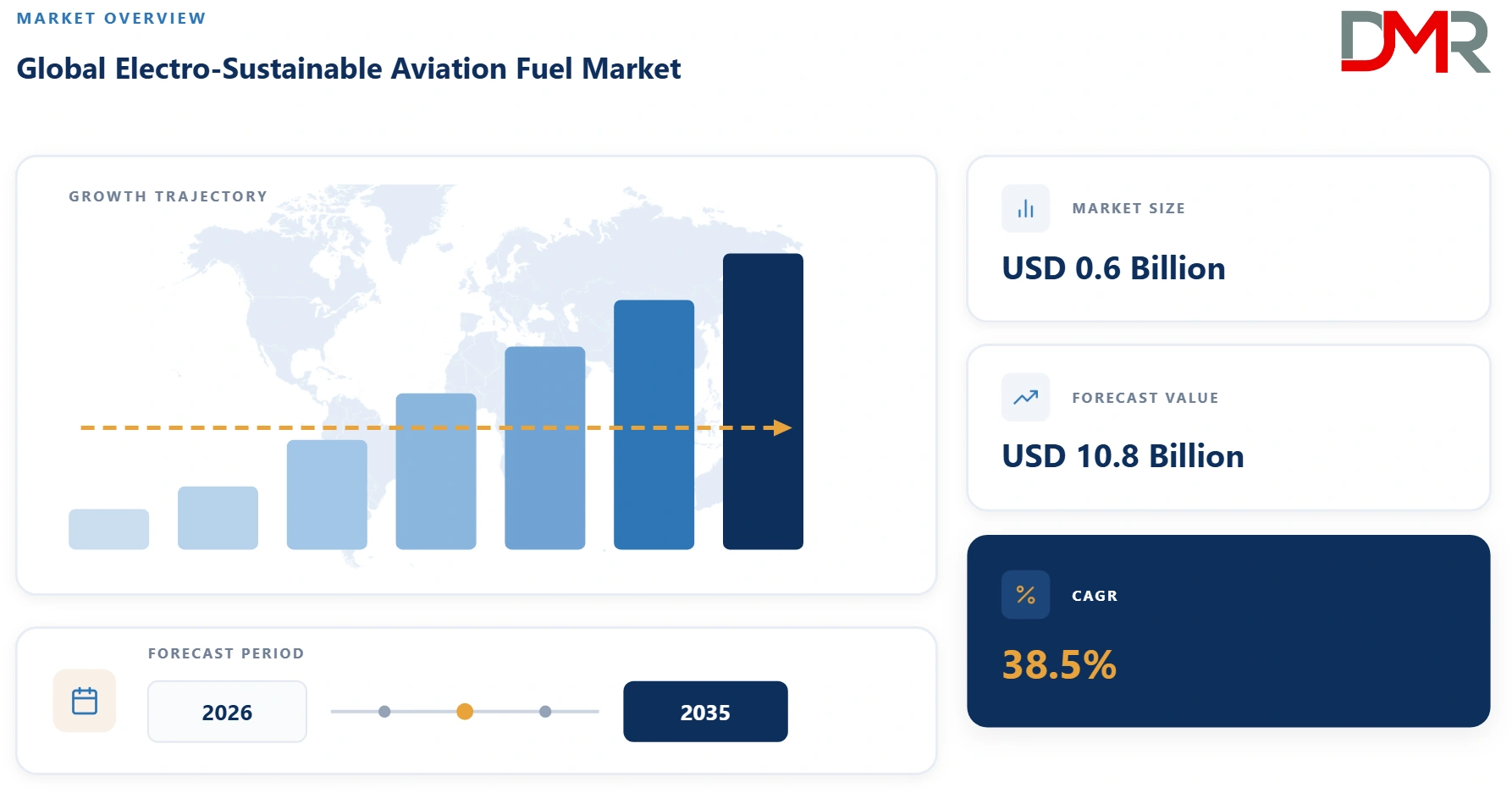
- Global Electro-Sustainable Aviation Fuel Market size in 2026 is: USD 0.6 Billion
- Global Electro-Sustainable Aviation Fuel Market size in 2035 is: USD 10.8 Billion
- Global CAGR from 2027 to 2035 is: 38.5%
- Fischer-Tropsch (FT) is the leading production pathway segment: 62.4%
- Wind is the leading renewable power source segment: 39.3%
- Industrial Point-Source CO₂ is the leading CO₂ source segment: 61.9%
- Alkaline is the leading electrolyzer technology segment: 45.4%
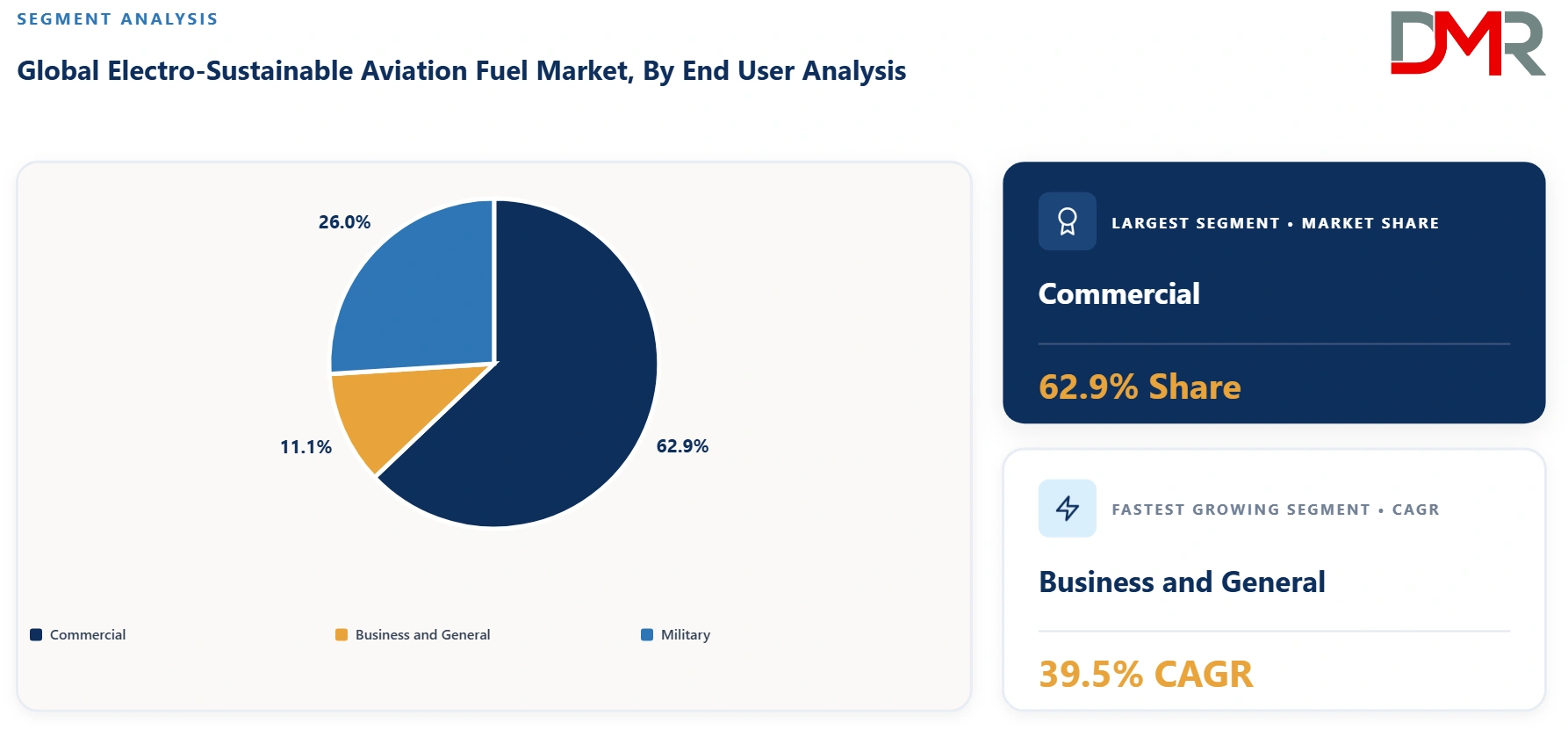
- Commercial is the leading end user segment: 62.9%
- Methanol-to-Jet (MtJ) is the fastest-growing production pathway segment: 38.9% CAGR
- Solar is the fastest-growing renewable power source segment: 39.1% CAGR
- Direct Air Capture CO₂ is the fastest-growing CO₂ source segment: 39.4% CAGR
- Proton Exchange Membrane (PEM) is the fastest-growing electrolyzer technology segment: 39.3% CAGR
- Business and General is the fastest-growing end-user segment: 39.5% CAGR
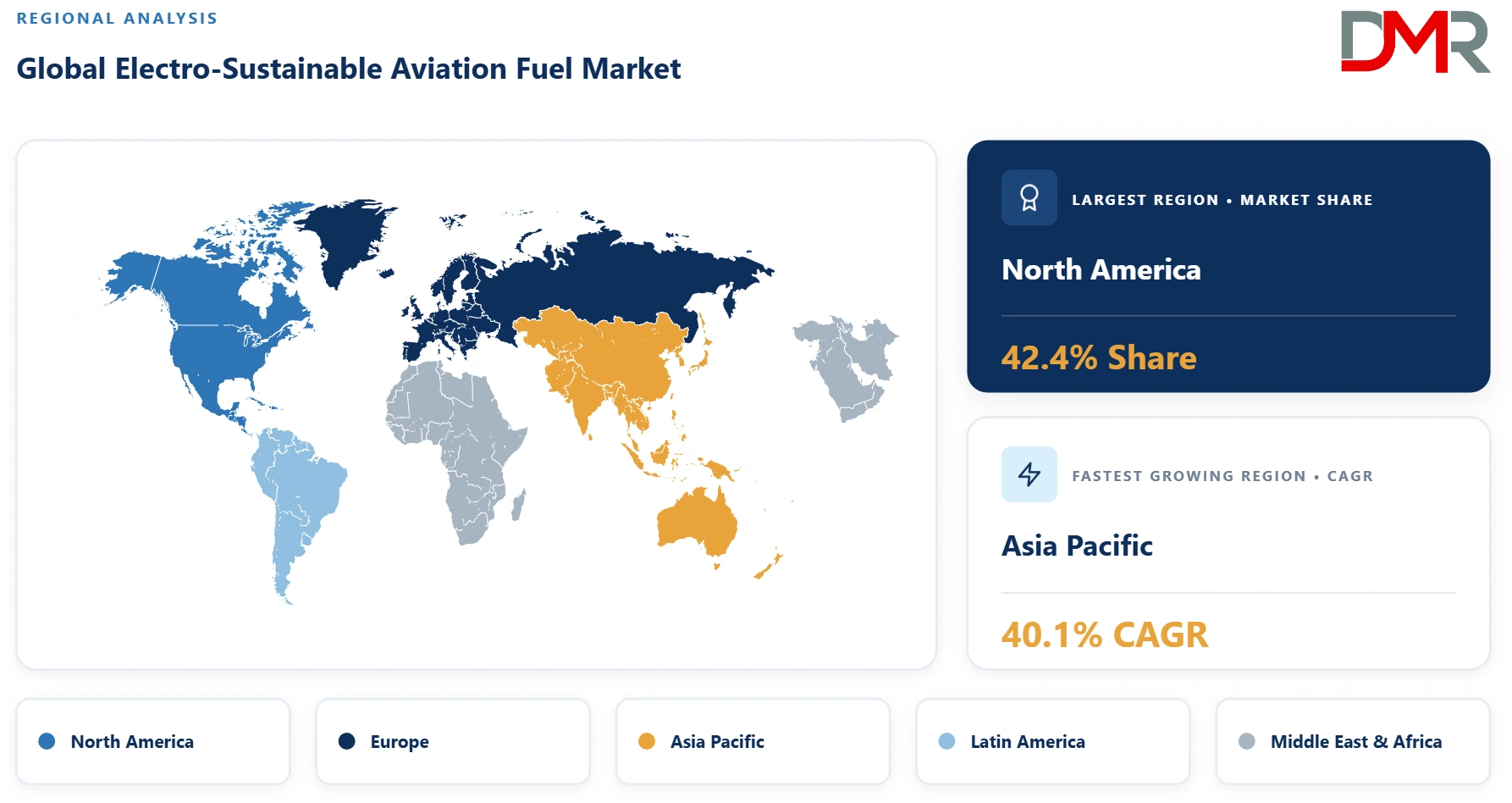
- North America is the leading region in 2026: 42.4%
- Asia Pacific is the expected fastest-growing region: 40.1% CAGR
What is the Global Electro-Sustainable Aviation Fuel Market? Global Electro-Sustainable Aviation Fuel Market Size.
The Global Electro-Sustainable Aviation Fuel Market size is valued at USD 0.6 Billion in 2026, and it is further anticipated to reach a market value of USD 10.8 Billion by 2035 at a CAGR of 38.5%.
ℹ
To learn more about this report –
Download Your Free Sample Report Here
The market for Global Electro-Sustainable Aviation Fuel is rapidly gaining steam with the efforts of the aviation sector to cut down carbon footprint and reliance on traditional fossil fuels for jet fuel. e-SAF is made via renewable energy sources, green hydrogen, and carbon dioxide by means of advanced processes of synthetic fuels. Market development factors include the aims of decarbonizing aviation, government policies, commitments from airlines, and the development of renewable energy infrastructure. However, the market faces several restraints, including high production costs, substantial infrastructure requirements, limited availability of renewable energy, and challenges in achieving cost competitiveness with conventional aviation fuels.
Use Cases
- Commercial Passenger Aviation: The e-SAF is applied in the commercial passenger aircraft for minimizing the carbon footprint for domestic and international flights. The airlines are permitted to mix the approved synthetic aviation fuel with conventional aviation fuels in their aircraft and use it under relevant standards for fuels. It helps in minimizing the greenhouse gas emissions throughout the lifecycle of the flights without making any changes in the aircraft.
- Cargo and Freight Aviation: Air cargo services make use of e-SAF to cut down the carbon emissions involved in the process of transporting goods on both domestic and international airways. Express delivery companies, logistics firms, and cargo airlines utilize sustainable aviation fuels in their efforts towards sustainability. The fact that air cargo services conduct regular long-haul flights and consume large quantities of fuel makes it possible for e-SAF to be an option to jet fuel.
- Business and Private Aviation: Synthetic fuel is used in the form of e-SAF by private and business aircraft to cut down the impact of flying for both corporate and personal purposes. Corporations that have made pledges towards their sustainability initiatives utilize synthetic aviation fuel in executive flying and private charter services. The use of e-SAF is one way to minimize carbon emissions across the life cycle of the fuel without compromising the engines and fuel systems of planes.
- Military and Government Aviation: e-SAF is being investigated by both military and government aviation as a possible substitute to lessen their reliance on traditional petroleum-derived aviation fuels. Approved mixes of synthetic fuel are used by government aircraft and military transports, among others. Use of e-SAF promotes sustainability goals within the public sector, expands fuel supply options, and promotes domestic synthetic fuel production.
-
Key Takeaways
- Market Growth: The Global Electro-Sustainable Aviation Fuel Market is anticipated to reach USD 10.8 Billion by 2035, starting from USD 0.6 Billion in 2026, at a CAGR of 38.5%. Various factors responsible for market growth include increasing aviation industry decarbonization efforts, rising demand for low-carbon aviation fuels, government emission-reduction regulations, growing airline sustainability commitments, and investments in renewable electricity, green hydrogen, and carbon capture technologies.
- Fischer-Tropsch (FT) Leads the Production Pathway Segment: Fischer-Tropsch (FT) dominates the production pathway segment by acquiring a market share of 62.4% in 2026. Its established synthetic fuel conversion process, ability to convert hydrogen and carbon monoxide into liquid hydrocarbons, and compatibility with aviation fuel production support its leading position. However, Methanol-to-Jet (MtJ) is projected to witness the highest growth rate at a CAGR of 38.9%.
- Wind Dominates the Renewable Power Source Segment: Wind accounts for 39.3% of the market share in 2026 owing to its ability to generate renewable electricity for green hydrogen production and synthetic fuel manufacturing. Increasing investments in wind energy infrastructure and large-scale renewable power projects support the growth of this segment. However, Solar is projected to witness the highest growth rate at a CAGR of 39.1%.
- Industrial Point-Source CO₂ Leads the CO₂ Source Segment: Industrial Point-Source CO₂ accounts for 61.9% of the market share in 2026 owing to the availability of concentrated carbon dioxide from industrial facilities, which supports its capture and utilization in synthetic aviation fuel production. Established industrial infrastructure and carbon capture initiatives further support this segment. However, Direct Air Capture CO₂ is anticipated to have the highest growth rate at a CAGR of 39.4%.
- Alkaline Dominates the Electrolyzer Technology Segment: Alkaline electrolyzer technology holds 45.4% of the market share in 2026 owing to its established technology, commercial availability, and suitability for large-scale hydrogen production. Its relatively mature operating systems and growing integration with renewable electricity projects support its leading position. However, Proton Exchange Membrane (PEM) is projected to witness the highest growth rate at a CAGR of 39.3%.
- Commercial Leads the End User Segment: Commercial aviation accounts for 62.9% of the market share in 2026 owing to high aviation fuel consumption, increasing passenger air traffic, and growing commitments from airlines to reduce carbon emissions. The adoption of sustainable aviation fuel and investments in cleaner aviation operations further support this segment. However, Business and General is anticipated to have the highest growth rate at a CAGR of 39.5%.
- North America to Dominate the Market: North America holds 42.4% of the market share in 2026 owing to strong investments in sustainable aviation fuel production, established aviation infrastructure, supportive government policies, and increasing participation from airlines and energy companies. Growing investments in renewable hydrogen production and carbon capture technologies further strengthen the region's market position.
- Growth Opportunities in Asia Pacific: Asia Pacific is estimated to witness the highest CAGR of 40.1% during the forecast period. Increasing aviation activities, expanding renewable energy capacity, government initiatives supporting aviation decarbonization, rising investments in green hydrogen production, and growing development of carbon capture infrastructure create significant growth opportunities for e-SAF manufacturers and technology providers.
How AI/Gen AI Is Transforming the Global Electro-Sustainable Aviation Fuel Market?
AI technology and Generative AI technology are impacting the Global Electro-Sustainable Aviation Fuel Market through increasing the efficiency of production, optimal consumption of energy, and minimizing the cost of production. Algorithms of AI analyze the availability of renewable electricity, the level of production of hydrogen, carbon dioxide supply, and the conditions of operation to optimize the process of production of e-SAF. Predictive maintenance of electrolyzers, carbon capturing devices, and fuel production devices is facilitated by machine learning algorithms. Gen AI helps researchers to develop better catalysts, evaluate different production methods, and conduct research on fuel production. Also, AI-based forecasting helps in managing renewable power availability and scheduling the production process. The use of AI for supply chain management, resource management, and production cost evaluation is also included in these technologies.
Key Drivers in the Global Electro-Sustainable Aviation Fuel Market
Increasing Aviation Industry Decarbonization Targets
The aviation sector is under mounting pressure for reducing the release of greenhouse gases and making sure that the long-term target of achieving net zero is met. The airline companies and aviation authorities are now paying attention towards alternative fuel in order to minimize the environmental burden associated with air transportation. e-SAF offers a solution to the problem by using renewables.
Government Policies and Regulatory Support
Governments and aviation regulatory agencies adopt policies and fuel mandates, as well as offer financial incentives, to promote the production of sustainable aviation fuel. Measures like those of the ReFuelEU Aviation program in the European Union have been put in place to push the adoption of sustainable aviation fuels and to encourage investment in sustainable fuel production technology. This kind of regulation will help in promoting the production of e-SAFs.
Restraints in the Global Electro-Sustainable Aviation Fuel Market
High Production and Manufacturing Costs
The cost of manufacturing e-SAF is rather high due to the cost of electricity production from renewable sources, generation of hydrogen, CO₂ capture, and the process of synthesizing the fuel itself. In terms of cost, e-SAF is much more expensive compared to regular aviation fuel produced from fossil sources, which poses certain financial difficulties for the use of the product.
Production Infrastructure Limited to Smaller Scale
The e-SAF sector has limited capabilities with regard to the construction of production facilities, the creation of appropriate equipment and facilities for the generation of hydrogen, carbon capture, and the conversion into fuels. The majority of the projects that are currently being developed and implemented are still in the early stages, limiting the capability to produce commercial quantities. The establishment of facilities on large scale involves complicated engineering processes.
Growth Opportunities in the Global Electro-Sustainable Aviation Fuel Market
Expansion of Renewable Hydrogen Production
More investments in green hydrogen production give numerous opportunities for e-SAFs manufacturers. The construction of large electrolyzer plants, renewable energy projects, and hydrogen infrastructure will ensure more possibilities for access to required production resources. Growth in capacity for green hydrogen production will be helpful in creating integrated production of e-SAFs, ensuring more opportunities for production resources and commercial production.
Development of Strategic Partnerships and Joint Ventures
The collaboration between companies working within aviation, renewables industry, technology firms, and fuel companies opens up possibilities to speed up the process of commercializing e-SAF. Collaborations help to manage investments, technology exchange, production of the fuel, financial backing for projects, and fuel supply agreements. The collaboration also enables the distribution of risks, building of capacities, and linking of fuel suppliers with airlines.
Trends in the Global Electro-Sustainable Aviation Fuel Market
Advancements in Electrolyzer and Fuel Synthesis Technologies
Efficiency of electrolysis, catalysis and fuel formation process is of growing importance for manufacturers. The progress achieved in technologies of Proton Exchange Membrane and Solid Oxide electrolysis can be used to increase efficiency of hydrogen production, while new catalysts allow achieving higher efficiency of fuel formation. Such advances are useful for increasing efficiency of e-SAF production plants.
Increasing Adoption of Direct Air Capture Technology
Direct Air Capture is getting popularity in being a means of acquiring carbon dioxide for the purpose of producing synthetic aviation fuel. This technology involves capturing CO₂ from the atmosphere and provides an option apart from depending only on carbon dioxide emissions from industries. The development in technologies involved in direct air capture allows its adoption in e-SAF production process.
Research Scope and Analysis
The Global Electro-Sustainable Aviation Fuel Market is segmented based on Production pathway into Fischer-Tropsch (FT), Methanol-to-Jet (MtJ), and Others, Renewable Power Source into Solar, Wind, Hybrid Renewable, and Others, CO₂ Source into Biogenic CO₂, Direct Air Capture CO₂, Industrial Point-Source CO₂, Electrolyzer Technology into Alkaline, Proton Exchange Membrane (PEM), Solid Oxide, and Others, End User into Commercial, Business and General, Military. Geographically, the market includes North America, Europe, Asia Pacific, Latin America, and the Middle East and Africa.
ℹ
To learn more about this report –
Download Your Free Sample Report Here
By Production Pathway Analysis
The Fischer-Tropsch (FT) production pathway segment holds the largest market share, accounting for 62.4% of the global market in 2026. Its dominance is attributed to its established synthetic fuel conversion process and suitability for producing aviation-grade hydrocarbons from hydrogen and carbon-based feedstocks. The Methanol-to-Jet (MtJ) segment is forecasted to experience the highest CAGR of 38.9% during 2027–2035.
By Renewable Power Source Analysis
The Wind segment holds the largest market share, accounting for 39.3% of the global market in 2026. Its dominance is supported by increasing investments in wind energy infrastructure and its ability to provide renewable electricity for green hydrogen production and synthetic fuel manufacturing. The Solar segment is forecasted to experience the highest CAGR of 39.1% during 2027–2035.
By CO₂ Source Analysis
The Industrial Point-Source CO₂ segment holds the largest market share, accounting for 61.9% of the global market in 2026. Its dominance is attributed to the availability of concentrated carbon dioxide from industrial facilities, supporting efficient carbon capture and utilization in synthetic aviation fuel production. The Direct Air Capture CO₂ segment is forecasted to experience the highest CAGR of 39.4% during 2027–2035.
By Electrolyzer Technology Analysis
The Alkaline electrolyzer technology segment holds the largest market share, accounting for 45.4% of the global market in 2026. Its dominance is supported by established commercial technology, relatively mature operating systems, and suitability for large-scale hydrogen production. The Proton Exchange Membrane (PEM) segment is forecasted to experience the highest CAGR of 39.3% during 2027–2035.
By End User Analysis
The Commercial segment holds the largest market share, accounting for 62.9% of the global market in 2026. Its dominance is attributed to high aviation fuel consumption, increasing passenger air traffic, and growing commitments from commercial airlines to reduce carbon emissions. The Business and General segment is forecasted to experience the highest CAGR of 39.5% during 2027–2035.
The Global Electro-Sustainable Aviation Fuel Market Report is segmented based on the following:
By Production Pathway
- Fischer-Tropsch (FT)
- Methanol-to-Jet (MtJ)
- Others
By Renewable Power Source
- Solar
- Wind
- Hybrid Renewable
- Others
By CO₂ Source
- Biogenic CO₂
- Direct Air Capture CO₂
- Industrial Point-Source CO₂
By Electrolyzer Technology
- Alkaline
- Proton Exchange Membrane (PEM)
- Solid Oxide
- Others
By End User
- Commercial
- Business and General
- Military
Regional Analysis
North America is the Leading Region in the Global Electro-Sustainable Aviation Fuel Market
North America holds a leading position in the Global Electro-Sustainable Aviation Fuel Market, as the market size of North America is USD 245.9 Million in 2026. The market size of North America will grow up to USD 4,726.3 Million in 2035, registering a CAGR of 38.9%. The regional dominance is attributed to increasing investments made for the development of sustainable aviation fuels, along with supportive government policies, well-developed aviation sector, and commitment of airlines towards emission reductions.
ℹ
To learn more about this report –
Download Your Free Sample Report Here
Asia Pacific is the Fastest-Growing Region in the Global Electro-Sustainable Aviation Fuel Market
In the forecasted period, between 2027 and 2035, the Asia Pacific region is projected to witness the fastest growth rate at 40.1%. Key factors contributing to growth in the region are the increase in air traffic, investment in renewable energy infrastructure, and increased government initiatives for aviation decarbonization. Growth in the region is also driven by developments in the capacity of production of green hydrogen and carbon capture technologies. There has also been an increased contribution by aviation players, energy players, and technology players to build the production plants for e-SAFs in the region.
The Europe Electro-Sustainable Aviation Fuel Market
Europe is considered to be an important market for Electro-Sustainable Aviation Fuel due to the presence of strict environmental rules, decarbonization promises, and investments in sustainable fuel technology. This area takes advantage of its well-developed aviation industry, presence of energy companies, and collaboration of airlines and renewable fuel manufacturers. Government programs that encourage low-carbon flights and construction of facilities for producing green hydrogen and capturing carbon also contribute to the growth of the market. Moreover, the desire to reduce reliance on fossil fuel becomes an important driver.
The Latin America Electro-Sustainable Aviation Fuel Market
Latin America is an emerging market for Electro-Sustainable Aviation Fuel because of the investments in renewables, high volume of aviation operations, and the rising demand for the production of sustainable fuels. Latin America has a lot of opportunities for solar and wind energy, which makes possible for the renewable electricity and green hydrogen to be produced easily. The awareness of the environment, decarbonization programs of the governments, and involvement of energy companies will favor market development. Besides that, the development of carbon capture technology and renewable fuel will enable the e-SAF production.
The Middle East and Africa Electro-Sustainable Aviation Fuel Market
Middle East and Africa constitute an emerging market for Electro-Sustainable Aviation Fuel owing to the growing investments in renewable energy projects, aviation infrastructures, and sustainable fuels. The region enjoys rich solar and wind energy sources, which provide the scope for generating renewable energy and producing green hydrogen. Increased interest among energy companies and aviation players in cutting down carbon emissions also plays a significant role in the emergence of the market. Moreover, government policies of diversification, growing carbon capture efforts, and collaborations also contribute to developing e-SAF production abilities in the region.
Major Country Analysis
United States Electro-Sustainable Aviation Fuel Market
U.S. Electro-Sustainable Aviation Fuel Market Size is USD 205.8 Million in 2026 and is expected to grow at 39.1% CAGR from 2027 to reach USD 4,003.1 Million in 2035. Market growth is driven by the nation's initiatives to develop alternative aviation fuel solutions and reduce the aviation sector's dependence on petroleum-based jet fuel. Other drivers of market growth include the presence of large energy firms, aviation network, and investments into renewable power generation. Growth in green hydrogen and carbon capture projects is also creating positive conditions for e-SAF manufacturing.
Japan Electro-Sustainable Aviation Fuel Market
Japan is one of the emerging markets for Electro-Sustainable Aviation Fuel, considering that there are several factors contributing to Japan’s effort to cut down on aviation emissions and improve energy security. The growth of investment in renewable energy, green hydrogen production, and carbon capture is opening doors for development of e-SAF. Moreover, the existing aviation industry and technological know-how in Japan make it feasible for research to be done on synthetic fuel production. Besides, cooperation between airlines, energy firms, and technology providers is contributing to development of more sustainable fuels.
Saudi Arabia Electro-Sustainable Aviation Fuel Market
Saudi Arabia presents itself as an emerging market for Electro-Sustainable Aviation Fuel owing to its rising attention towards the development of aviation industry, energy diversification, and carbon emission reduction. Its high investment potential coupled with increasing projects related to renewable energy provides a chance to produce electro-sustainable aviation fuel. Growing interest in green hydrogen technology, carbon capturing, and synthetic fuels is further contributing to the development of the market. Furthermore, development of airports infrastructure and cooperation of energy companies with aviation companies in terms of producing sustainable aviation fuel is being promoted.
Regulatory Landscape
The regulatory environment is significant in influencing the growth of the global Electro-Sustainable Aviation Fuel Market since there are efforts by various governments to lower the environmental emissions from aircraft and promote the use of sustainable fuels. This includes programs like ReFuelEU Aviation and various national targets for sustainable aviation fuel which increase the pressure on the airline industry to embrace lower-emissions options. Emphasis on lifecycle emission standards, certification, and fuel mixing creates room for e-SAF producers. However, variations in the regulations between different countries, long approval process, and uncertainties about future regulations can hinder the development of the projects.
Investment and White Space Analysis
There has been increased investment in the Electro-Sustainable Aviation Fuel Market due to exploration of opportunities for the production of synthetic fuels by energy corporations, aviation industry, and technology manufacturers. The primary investment focus is on renewable electricity generation, green hydrogen production, carbon capture, electrolyzer installation, and fuel synthesis plant. There is a lot of white space in areas where there is significant renewable energy but no facilities for e-SAF production. Synergy between airlines, energy companies, and technology suppliers can open avenues for building commercial scale production facilities and signing long-term fuel supply contracts. The high investment requirement, uncertain economics of production, and lack of operational facilities are some of the challenges in investment.
By Region
North America
Europe
- Germany
- France
- The U.K.
- Italy
- Spain
- Rest of Europe
Asia Pacific
- China
- Japan
- India
- Australia
- South Korea
- Rest of APAC
Latin America
- Mexico
- Brazil
- Rest of LATAM
Middle East and Africa
- Saudi Arabia
- The UAE
- South Africa
- Rest of MEA
Competitive Landscape
The competitive environment in the Global Electro-Sustainable Aviation Fuel Market is determined by energy firms, aviation fuel producers, technology providers, and upcoming e-SAF projects operators. These businesses have concentrated on the development of an efficient production process, acquiring renewable electricity and CO₂ resources, and making alliances with airline companies to cater for future fuel needs. Increasing competition is observed in green hydrogen manufacturing, electrolyzer systems, carbon capture technology, and large-scale synthetic fuel plants. At the same time, the significant cost of production, small commercial capability, and complex technology serve as entry barriers into the market.
Some of the prominent players in the Global Electro-Sustainable Aviation Fuel Market are:
- Twelve
- Infinium
- HIF Global
- Norsk e-Fuel
- INERATEC
- Synhelion
- Metafuels
- OXCCU
- CAPHENIA
- Arcadia eFuels
- Dimensional Energy
- Liquid Sun
- Zero Petroleum
- Carbon Recycling International
- AIR COMPANY
- Prometheus Fuels
- Elyse Energy
- RIC Energy
- H2V
- ENGIE
- Smartenergy
- Hy2gen
- Verso Energy
- Copenhagen Infrastructure Partners
- Solarig
- Masdar
- ACWA Power
- TotalEnergies SE
- OMV AG
- ORLEN S.A.
- European Energy A/S
- Carbonade
- Ceplus
- Dynelectro
- EC-Impact
- Elemental Clean Fuels
- Infiverde
- Syngas Dynamics
- Syntholene
- Sunfire
- Others
Recent Developments
- In September 2026, Verso Energy and Q8Aviation announced a strategic cooperation agreement for the long-term supply of e-SAF in Europe. Under the agreement, Verso Energy is expected to supply synthetic sustainable aviation fuel produced at its DEZiR project to Q8Aviation. According to the announcement, the agreement provides Verso Energy with long-term commercial visibility as the DEZiR project progresses towards its final investment stage.
- In August 2026, American Airlines and Infinium announced the first delivery of e-SAF to a commercial airport in the United States for use in a commercial passenger flight. The fuel was produced and blended at Infinium's Project Pathfinder facility in Corpus Christi, Texas, using waste CO₂ and renewable electricity. It was used on an American Airlines flight from Corpus Christi International Airport to Dallas Fort Worth International Airport.
Report Details
| Report Characteristics |
| Market Size (2026) |
USD 0.6 Bn |
| Forecast Value (2035) |
USD 10.8 Bn |
| CAGR (2027–2035) |
38.5% |
| The US Market Size (2026) |
USD 205.8 Mn |
| Historical Data |
2021 – 2025 |
| Forecast Data |
2027 – 2035 |
| Base Year |
2026 |
| Segments Covered |
By Production Pathway, By CO₂ Source, By Electrolyzer Technology, By Coverage, By End User |
| Regional Coverage |
North America – The US and Canada; Europe – Germany, France, The UK, Italy, Spain, Rest of Europe; Asia-Pacific – China, Japan, India, Australia, South Korea, Rest of APAC; Latin America – Mexico, Brazil, Colombia, Argentina, Rest of LATAM; Middle East & Africa – Saudi Arabia, The UAE, South Africa, Rest of MEA |
Frequently Asked Questions
How big is the Global Electro-Sustainable Aviation Fuel Market?
▾ The Global Electro-Sustainable Aviation Fuel Market is valued at USD 0.6 Billion in 2026 and is projected to reach approximately USD 10.8 Billion by 2035.
What is the CAGR of the Global Electro-Sustainable Aviation Fuel Market from 2027 to 2035?
▾ The Global Electro-Sustainable Aviation Fuel Market is anticipated to grow at a compound annual growth rate (CAGR) of 38.5% during the forecast period from 2027 to 2035.
What factors are driving the growth of the Global Electro-Sustainable Aviation Fuel Market?
▾ The growth of the Global Electro-Sustainable Aviation Fuel Market is driven by increasing aviation industry decarbonization targets, government regulations promoting sustainable aviation fuels, rising investments in green hydrogen and renewable energy, and growing airline commitments to reduce carbon emissions.
What are the major trends in the Global Electro-Sustainable Aviation Fuel Market?
▾ Major trends in the Global Electro-Sustainable Aviation Fuel Market include advancements in electrolyzer and fuel synthesis technologies, particularly PEM and Solid Oxide systems, to improve production efficiency, and increasing adoption of Direct Air Capture technology to obtain atmospheric CO2 for synthetic aviation fuel production.
Which region held the largest share of the Global Electro-Sustainable Aviation Fuel Market in 2026?
▾ North America holds the largest share of the Global Electro-Sustainable Aviation Fuel Market in 2026, accounting for approximately 42.4% of the total market.
Which region is expected to grow the fastest in the Global Electro-Sustainable Aviation Fuel Market?
▾ Asia Pacific is expected to be the fastest-growing regional market during the forecast period, registering a CAGR of 40.1%. The growth is supported by increasing government efforts to promote sustainable aviation fuels, rising investments in green hydrogen and Power-to-Liquid technologies, and growing focus on reducing carbon emissions from the aviation sector.
Who are the key players in the Global Electro-Sustainable Aviation Fuel Market?
▾ The key players in the Global Electro-Sustainable Aviation Fuel Market include Twelve, Infinium, HIF Global, Norsk e-Fuel, INERATEC, Synhelion, Metafuels, OXCCU, CAPHENIA, Arcadia eFuels, Dimensional Energy, Carbon Recycling International, AIR COMPANY, Prometheus Fuels, Elyse Energy, RIC Energy, ENGIE, Hy2gen, Verso Energy, Copenhagen Infrastructure Partners, Masdar, ACWA Power, TotalEnergies SE, OMV AG, ORLEN S.A., European Energy A/S, and Sunfire.
How is the Global Electro-Sustainable Aviation Fuel Market segmented?
▾ The Global Electro-Sustainable Aviation Fuel Market is segmented based on Production pathway into Fischer-Tropsch (FT), Methanol-to-Jet (MtJ), and Others, Renewable Power Source into Solar, Wind, Hybrid Renewable, and Others, CO2 Source into Biogenic CO2, Direct Air Capture CO2, Industrial Point-Source CO2, Electrolyzer Technology into Alkaline, Proton Exchange Membrane (PEM), Solid Oxide, and Others, End User into Commercial, Business and General, Military. Geographically, the market includes North America, Europe, Asia Pacific, Latin America, and the Middle East and Africa.