Global Electromagnetic Simulation Software Market Snapshot
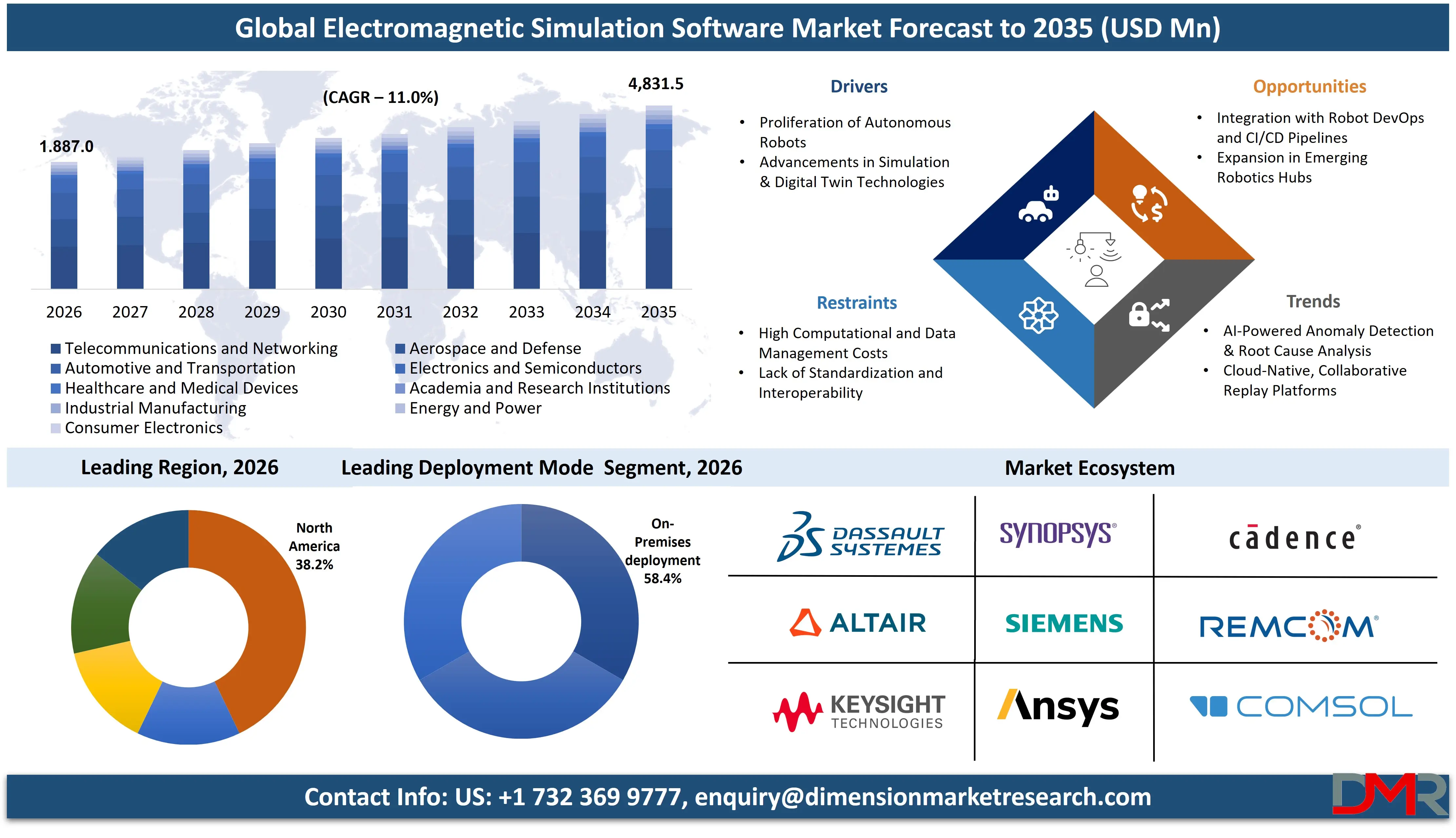
- Market Size in 2026: USD 1,887.0 Million
- Market Size in 2035: USD 4,831.5 Million
- Global CAGR (2026-2035): 11.0%
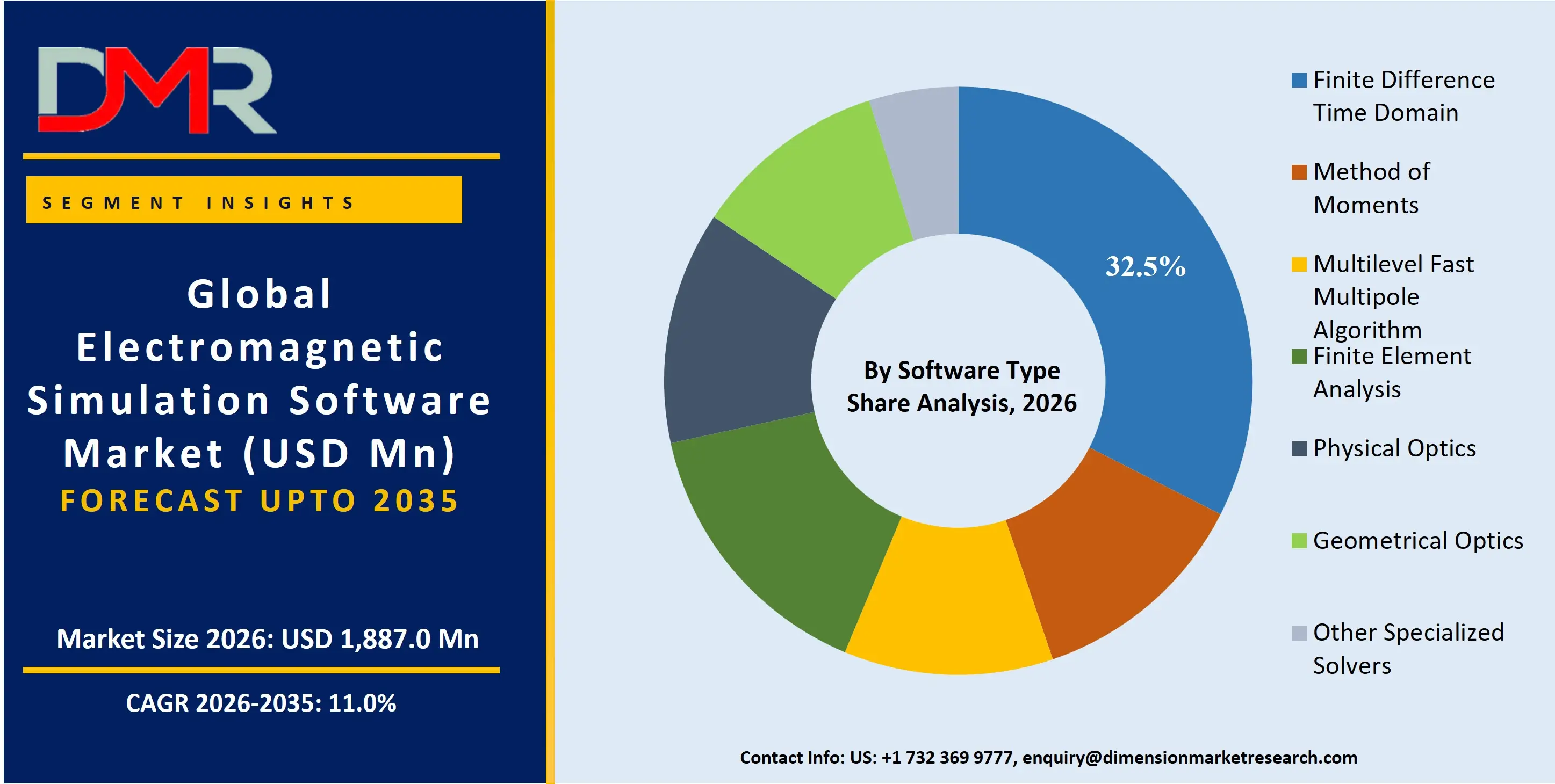
- Finite Element Analysis is the leading software type segment in 2026: 32.5%
- On-Premises is the leading deployment mode segment in 2026: 58.4%
- Antenna Design and Analysis is the leading application segment in 2026: 28.1%
- Telecommunications and Networking is the leading end-user industry segment in 2026: 24.7%
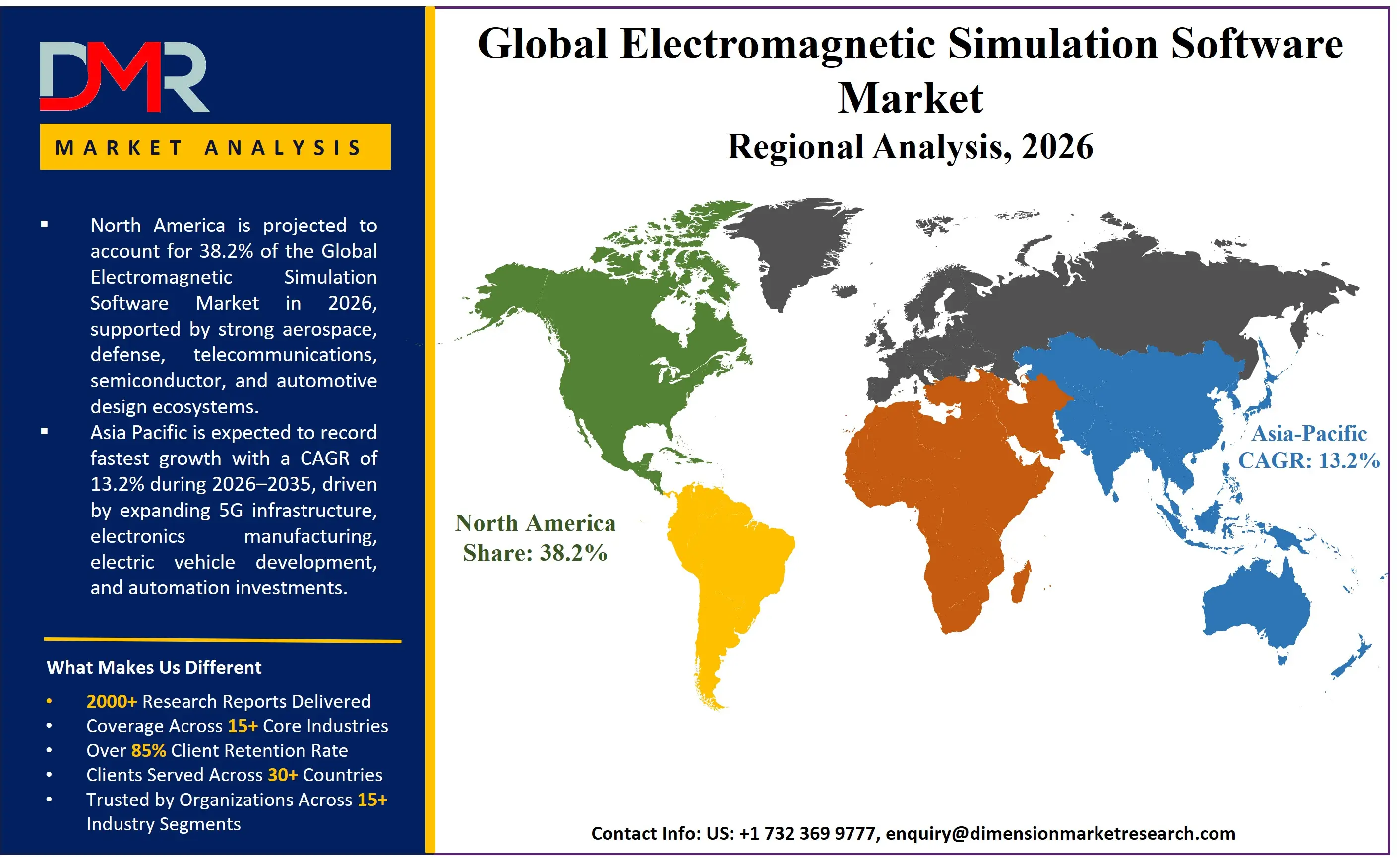
- North America is the leading region in 2026: 38.2%
What is the Global Electromagnetic Simulation Software and its Market Size?
The Global Electromagnetic Simulation Software Market is projected to be valued at USD 1,887.0 million in 2026 and is forecast to reach USD 4,831.5 million by 2035, expanding at a robust CAGR of 11.0%.
ℹ
To learn more about this report –
Download Your Free Sample Report Here
Growth is being propelled by the relentless complexity of 5G mmWave and MIMO antenna systems, the proliferation of advanced driver-assistance systems (ADAS) and autonomous vehicle radar, stringent compliance mandates for electromagnetic interference (EMI) and compatibility (EMC), and the rise of system-on-chip and advanced packaging designs that require multi-physics co-simulation to prevent signal degradation and crosstalk failures. Electromagnetic Simulation Software is a specialized computer-aided engineering (CAE) discipline that enables engineers to model, analyze, and predict the propagation, radiation, scattering, and coupling of electromagnetic fields across complex structures and materials.
Use Cases
- Virtual Antenna Prototyping for 5G and Satellite Constellations: RF engineers utilize full-wave solvers to design and optimize phased array antennas and beamforming networks, virtually validating impedance bandwidth, gain, and radiation patterns across a wide frequency spectrum before committing to high-cost physical chamber testing.
- Automotive Radar and ADAS Sensor Integration: Automotive Tier-1 suppliers simulate radar module performance, including radome material effects and bumper integration, to ensure reliable object detection and minimal signal attenuation across the 77 GHz band, critical for autonomous driving sensor fusion.
- High-Speed Digital and Signal Integrity Analysis: PCB and IC package designers use hybrid solvers to characterize insertion loss, return loss, and near-end/far-end crosstalk in high-speed differential pairs and SerDes channels, ensuring clean eye diagrams for 400G+ Ethernet and PCIe Gen 6/7 compliance.
- Electromagnetic Compatibility Pre-Compliance Testing: Compliance engineers virtually assess conducted and radiated emissions from power converters, medical devices, and consumer electronics to identify EMC design flaws early, reducing expensive iterations at anechoic chambers and accelerating global regulatory certification.
- Biomedical Device and MRI Coil Design: Researchers model the distribution of specific absorption rate (SAR) in human tissue phantoms and optimize the magnetic flux density of phased-array MRI receive coils, ensuring both patient safety and high signal-to-noise ratio imaging.
Key Takeaways
- Market Size: The Global Electromagnetic Simulation Software Market is projected to be valued at USD 1,887.0 million in 2026 and reach USD 4,831.5 million by 2035, expanding at a CAGR of 11.0%.
- Growth Outlook: Market expansion is underpinned by the systemic shift toward "virtual twin" design validation, the escalating frequency of electronic systems, and the unwinding of Moore's Law, which necessitates advanced simulation for heterogenous integration and 3D-IC packaging.
- Primary Growth Drivers: The design complexity of wideband antenna systems, the necessity to pass stringent automotive and aerospace EMC standards, the adoption of multifunction RF front-ends, and the imperative to eliminate late-stage signal integrity respins are accelerating global investment in high-performance CEM tools.
- By Software Type Analysis: Finite Element Analysis (FEA) is projected to lead the software segment with a 32.5% share in 2026, driven by its unparalleled ability to model complex 3D geometries, inhomogeneous materials, and enclosed structures critical for connector and waveguide design.
- By Deployment Mode Analysis: On-Premises deployment is expected to dominate with a 58.4% share in 2026, supported by the need to secure proprietary defense and semiconductor intellectual property and to tightly integrate simulation workflows with on-prem high-performance computing clusters.
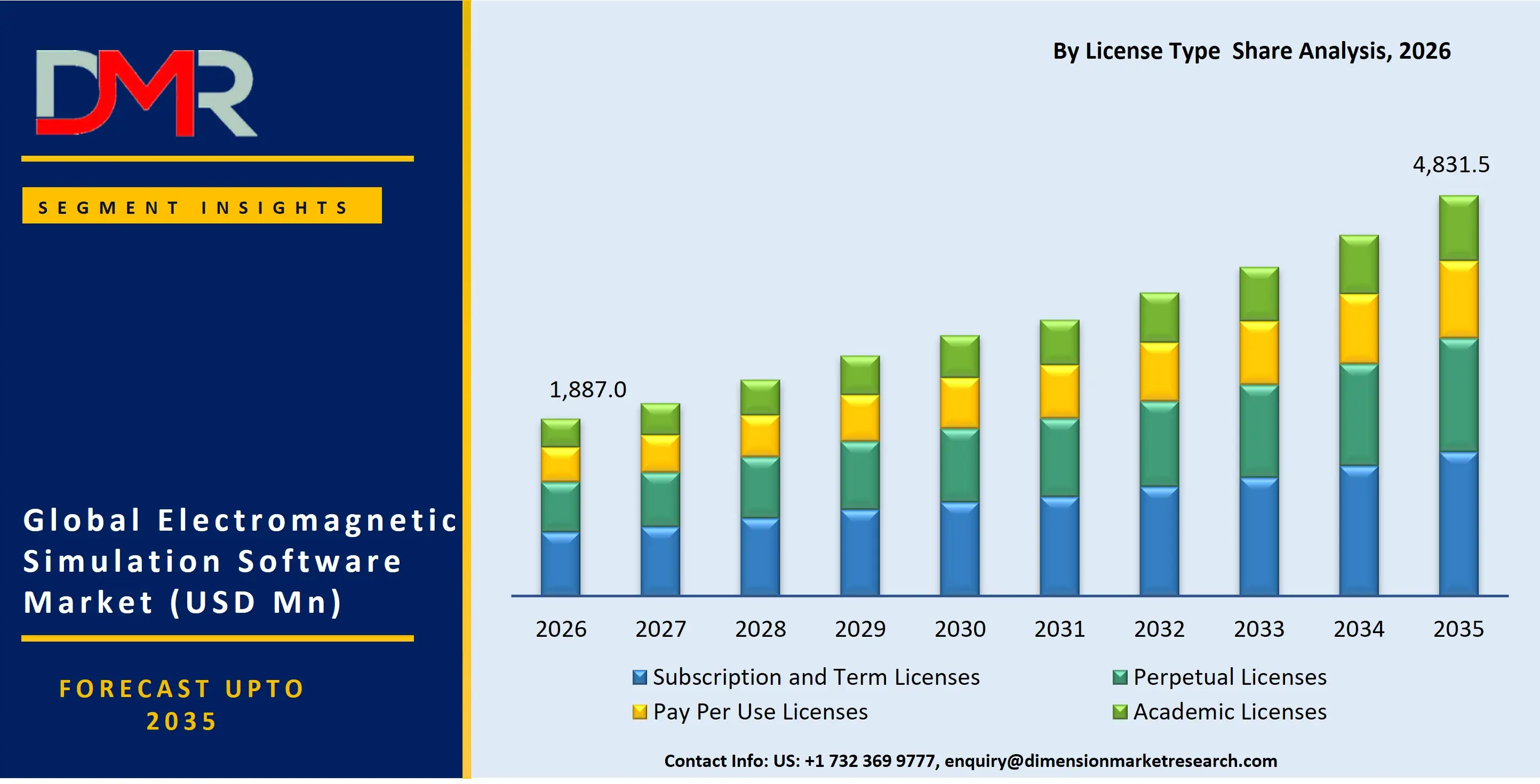
- By License Type Analysis: Subscription and Term Licenses are the fastest-growing segment, as enterprises shift from capital-intensive perpetual models to flexible operating expenditure structures that provide access to continuous solver updates and scalable cloud compute credits.
- By Application Analysis: Antenna Design and Analysis is anticipated to dominate with a 28.1% share in 2026, fueled by the massive engineering effort required to integrate multi-band antennas into increasingly crowded, thin-profile mobile and IoT device form factors.
- By End-User Industry Analysis: Telecommunications and Networking is projected to lead with a 24.7% share in 2026, driven by large-scale 5G infrastructure rollouts, Open RAN virtual cell site optimization, and satcom ground terminal development.
How AI/Gen AI is Transforming the Electromagnetic Simulation Software Market?
Artificial intelligence is fundamentally transforming CEM by introducing physics-informed deep learning surrogates that accelerate parameter sweeps and optimization loops by orders of magnitude. Instead of sequentially solving Maxwell's equations for every geometric perturbation, an AI model trained on prior full-wave simulation data can instantaneously predict antenna radiation patterns or filter transmission coefficients. Generative AI is also being embedded in the design workflow, where a natural language prompt can generate a parameterized 3D model of a waveguide filter or a metasurface unit cell within a simulator's native environment, drastically compressing the conceptual design phase.
The most disruptive potential lies in agentic AI workflows for autonomous design closure. Here, an optimization agent actively steers a multi-physics solver engine adjusting antenna element spacing, matching network topology, and material properties to simultaneously meet conflicting target specifications for gain, bandwidth, and SAR. The AI manages the iterative design-of-experiments and surrogate model refinement with minimal human intervention. However, the reliability of these virtual prototypes depends on high-fidelity training data validated against vector network analyzer measurements and anechoic chamber results, ensuring that AI-driven predictions do not diverge from physical reality due to biased or sparse synthetic datasets.
Key Drivers in the Global Electromagnetic Simulation Software Market
Design Complexity of Next-Generation Wireless Systems
The rollout of 5G-Advanced and the research into 6G sub-THz communication introduce extreme design challenges that cannot be solved through empirical methods. The tight integration of massive MIMO antenna arrays directly onto a chip package (Antenna-in-Package) requires full-wave 3D electromagnetic simulation that accounts for simultaneous coupling, beam-steering coverage degradation, and thermal-electromagnetic co-design. Without simulation, ensuring a stable impedance match and effective isotropic radiated power (EIRP) across a wide scan angle in a power amplifier-integrated module is impossible, making CEM software a mandatory design verification gate.
Stringent Electromagnetic Compliance and Safety Standards
Global regulatory bodies, including the FCC, ETSI, and IEC, are imposing stricter limits on radiated spurious emissions, conducted immunity, and human exposure. For electric vehicles with high-voltage traction inverters, failing an ISO 11452-4 bulk current injection test late in the development cycle can cause a catastrophic product launch delay. This forces automotive and medical device manufacturers to adopt virtual EMC compliance workflows, simulating emission spectrums and electric field distributions early and often, shifting left from physical prototype testing to virtual standards compliance.
Restraints in the Global Electromagnetic Simulation Software Market
Extremely High Computational Cost and Simulation Expertise Barrier
Accurate full-wave simulation of electrically large structures like a complete aircraft for lightning strike indirect effects or a full PCB for a server motherboard requires immense meshing that can overwhelm even top-tier high-performance computing clusters. This forces engineers to make compromising geometric simplifications that can invalidate simulation fidelity. Furthermore, the tooling demands a rare, deeply technical user who understands CEM algorithm selection, boundary condition physics, and mesh convergence criteria. A poorly conditioned mesh or an ill-chosen solver like asymptotic over full-wave for a resonant structure will produce a deceptively converged but physically incorrect result, creating a steep proficiency barrier that restrains broader enterprise adoption.
Growth Opportunities in the Global Electromagnetic Simulation Software Market
Multi-Physics Digital Twins for Autonomous Sensor Systems
A significant growth opportunity lies in developing tightly integrated multi-physics workflows that fuse electromagnetic, thermal, and mechanical solvers into a single digital twin for autonomous sensor pods. A roof-mounted LiDAR and radar unit on an autonomous car simultaneously absorbs solar heat, vibrates mechanically, and must maintain unfailing RF link integrity. Simulating the electro-thermal-mechanical co-dependencies such as thermal expansion of an antenna substrate altering its resonant frequency and detuning the array creates high-value, closed-loop analysis capabilities that no single-physics vendor can currently address seamlessly, unlocking new high-ASP solution bundles.
Specialized EDA-CEM Co-Simulation for 3D Heterogeneous Integration
The semiconductor industry's pivot toward 3D-IC and chiplet architectures creates a white space for tightly coupled Electronic Design Automation (EDA) and CEM co-simulation. Extracting accurate S-parameter models for hybrid bonding interconnects and interposers operating at multi-gigabit data rates requires solving for parasitic inductance and capacitance across multiple silicon interposer layers. Vendors who can offer a seamless, automated "extract and simulate" loop between layout tools and 3D full-wave solvers validating signal integrity across a 3D stack will capture critical design verification budgets in the advanced node semiconductor sector.
Trends in the Global Electromagnetic Simulation Software Market
Convergence of Schematic and 3D Electromagnetic Analysis
The market is witnessing a deep convergence of RF circuit/system-level simulators with 3D full-wave electromagnetic solvers. Instead of a disconnected workflow where an antenna's S-parameter file is statically imported into a system simulator, dynamic co-simulation allows a power amplifier's nonlinear harmonic load-pull analysis to be performed directly with the full-wave coupled antenna impedance. This harmonized "RF proxy" flow enables designers to trace the root cause of spectral regrowth or EVM degradation directly to a physical antenna mismatch, closing the loop between circuit and field physics.
Adoption of Cloud-Native Meshing and Solver Acceleration
A forward-looking trend is the shift from on-premises HPC dependency to elastic, cloud-native simulation platforms that decouple meshing and solving into containerized microservices. This enables a "simulation-as-a-platform" model where a design team can burst a parametric sweep of an automotive radar's radome reflection across thousands of cloud-based GPUs in minutes. The move to GPU-native solvers for finite-difference time-domain (FDTD) applications exploiting massive parallelization is drastically reducing the solve time for time-domain reflectance (TDR) and SAR analysis, making interactive design tuning on full-product models a reality for the first time.
Research Scope and Analysis
The Global Electromagnetic Simulation Software Market is segmented by software type, deployment mode, license type, application, and end-user industry. Software types include specialized computational electromagnetic solvers. The study evaluates deployment preferences across on-premises, cloud, and hybrid models, analyzes license purchasing trends, and assesses critical applications from antenna analysis to power electronics across diverse end-user verticals.
ℹ
To learn more about this report –
Download Your Free Sample Report Here
By Software Type Analysis
Finite Element Analysis (FEA) is poised to dominate the software type segment with a 32.5% market share in 2026, underpinned by its unmatched geometric flexibility for modeling complex, curvilinear structures with anisotropic materials, making it the method of choice for connector, waveguide, and motor electromagnetic interference analysis. The Finite Difference Time Domain (FDTD) method is projected to record a strong CAGR, driven by its inherent ability to produce wideband results from a single time-domain simulation, which is essential for broadband antenna characterization, specific absorption rate studies, and ground-penetrating radar applications. The Multilevel Fast Multipole Algorithm (MLFMA) is critical for solving electrically very large structures like a full warship's radar cross-section (RCS), where iterative physical optics approximations fail to capture creeping wave and cavity return effects.
By Deployment Mode Analysis
On-Premises deployment is expected to maintain a commanding 58.4% share in 2026, dictated by the defense, aerospace, and foundry sectors' uncompromising requirement to isolate classified antenna radiation data and proprietary semiconductor process design kits within a secure, air-gapped network infrastructure. Cloud-Based deployment is anticipated to expand at the highest CAGR, enabled by new FEA and FDTD solver microservices optimized for GPU-accelerated instances that offer near-linear scaling for parametric design sweeps of massive MIMO panels. Hybrid deployment is gaining traction in global enterprises, where designers interact with a local client for geometry modeling but schedule batch solves to a secure, managed cloud HPC queue, balancing interactive design latency with elastic peak compute demand for advanced driver assistance system validation.
By License Type Analysis
Subscription and Term Licenses are poised to be the dominant and fastest-growing segment, as organizations migrate from rigid, depreciating perpetual assets to flexible OpEx models that bundle updated solvers, hotfixes, and cloud compute credits into an annual contract. This model democratizes access for SMEs who cannot afford a multi-year upfront perpetual commitment.
ℹ
To learn more about this report –
Download Your Free Sample Report Here
Perpetual Licenses retain a significant base among aerospace primes and defense contractors with rigid, federally compliant procurement processes and multi-decade product sustainment obligations requiring a locked, static tool version. Pay-Per-Use Licenses are emerging as a critical enabler for EMC compliance test houses and academic spin-outs, allowing them to access high-end cluster solving for a specific radiated emissions analysis without any annual commitment.
By Application Analysis
Antenna Design and Analysis is projected to lead the market with a 28.1% share in 2026, driven by the non-negotiable requirement to simulate embedded antenna performance accounting for detuning by bezels, metal frames, and human tissue loading in handsets and wearables. Electromagnetic Compatibility (EMC) and Electromagnetic Interference (EMI) is the second-highest application segment, fueled by the costly consequences of failing CISPR 25 or FCC Part 15 radiated emissions tests on motor drives and switch-mode power supplies. High-Speed PCB and Interconnect Design is forecast to grow rapidly, as 224G PAM4 SerDes links in AI accelerator boards require full-wave 3D extraction of via stubs, connector footprints, and package bumps to precisely minimize impedance discontinuities that close the eye diagram.
By End-User Industry Analysis
Telecommunications and Networking is anticipated to dominate with a 24.7% share in 2026, propelled by massive R&D investment in active antenna units for O-RAN radio units and a new class of satellite user terminals for low-earth orbit constellations. Aerospace and Defense holds the second-largest share, underpinned by the strategic imperative of simulating low-observable airframe scattering, predicting electromagnetic pulse (EMP) coupling into avionics bays, and assuring co-site interference immunity between high-power jammers and sensitive SIGINT receivers on board an electronic warfare platform. Automotive and Transportation is projected to register the highest CAGR, driven by the electrification of the powertrain requiring full-vehicle motor EMI simulation and the sensor fusion challenge of placing multiple radars and lidars behind a single, metal-flake aesthetic fascia without compromising sensor fidelity.
The Global Electromagnetic Simulation Software Market Report is segmented on the basis of the following:
By Software Type
- Finite Difference Time Domain
- Method of Moments
- Multilevel Fast Multipole Algorithm
- Finite Element Analysis
- Physical Optics
- Geometrical Optics
- Other Specialized Solvers
By Deployment Mode
- On Premises
- Cloud Based
- Hybrid
By License Type
- Subscription and Term Licenses
- Perpetual Licenses
- Pay Per Use Licenses
- Academic Licenses
By Application
- Antenna Design and Analysis
- Mobile Devices
- Automotive Radar
- Biomedicine
- Wireless Communication
- Electromagnetic Compatibility and Electromagnetic Interference
- High Speed PCB and Interconnect Design
- Power Electronics Design
By End User Industry
- Telecommunications and Networking
- Aerospace and Defense
- Automotive and Transportation
- Electronics and Semiconductors
- Healthcare and Medical Devices
- Academia and Research Institutions
- Industrial Manufacturing
- Energy and Power
- Consumer Electronics
Regional Analysis
North America is the Leading Region in the Global Electromagnetic Simulation Software Market
North America is poised to dominate the global market with an estimated 38.2% revenue share in 2026, representing a value of USD 720.8 million. The region's preeminence is anchored by a powerful innovation triad: a massive Department of Defense (DoD) investment in electromagnetic spectrum dominance platforms, the headquarters of global semiconductor and EDA leaders driving chiplet-based AI accelerator design, and a dense ecosystem of commercial satellite operators.
ℹ
To learn more about this report –
Download Your Free Sample Report Here
The development of digital phased arrays, high-altitude platform station beamforming, and the most advanced GPU-accelerated cloud infrastructure for simulation solidify its position as the central R&D hub for next-generation computational electromagnetic applications.
Asia Pacific is the Fastest-Growing Region in the Electromagnetic Simulation Software Market
Asia Pacific is projected to register the fastest CAGR of 13.2% through 2035, catalyzed by its position as the world's manufacturing heartland for consumer electronics, 5G base station equipment, and electric vehicle powertrains. China's push for GaN-based radar modules, South Korea's leadership in sub-6 GHz and mmWave smartphone antenna-in-package design, and Taiwan's advanced semiconductor packaging foundries are driving insatiable demand for EMC pre-compliance and signal integrity simulation. Massive government-funded 6G research initiatives and the rapid digitization of automotive supply chains in India and ASEAN for DC-DC converter EMI filtering further fuel specialized tool adoption.
The Europe Electromagnetic Simulation Software Market
The Europe Electromagnetic Simulation Software Market represents the second-largest regional market, distinguished by its formidable automotive engineering heritage and world-leading satellite navigation and earth observation programs. The market is estimated to be valued at USD 465.0 million in 2026 and is further anticipated to reach USD 1,190.0 million by 2035 at a CAGR of 11.0%. European OEMs and Tier-1 suppliers are at the vanguard of simulating electric vehicle traction inverter emissions and high-speed automotive SerDes backbone EMI. The region's stringent adherence to CISPR, ETSI, and ISO electromagnetic compatibility standards, combined with deep investment in advanced phased array radar for next-generation fighter platforms, ensures consistent demand for high-fidelity asymptotic and full-wave hybrid solvers that can manage electrically large, conformal airborne structures.
Latin America Electromagnetic Simulation Software Market
The Latin America market is expanding gradually, driven by the modernization of mobile telecommunications networks for 5G FR1 deployment and the establishment of electronics manufacturing hubs in Brazil and Mexico. The market is estimated at USD 95.0 million in 2026 and is projected to reach USD 240.0 million by 2035. Local subsidiaries of global automotive and appliance manufacturers are increasingly required to perform localized EMC pre-compliance simulation to meet both national and export regulatory standards. The market is predominantly served through globally recognized simulation platforms, with specialized academic licenses and cloud-based subscriptions becoming critical for bridging the digital design gap in emerging design consultancies.
Middle East and Africa Electromagnetic Simulation Software Market
The Middle East and Africa market is developing alongside ambitious sovereign satellite communication programs and the digitization of smart urban infrastructure. Saudi Arabia and the UAE are investing in indigenous satellite payload design and ground station terminal verification, creating demand for antenna array and radome simulation. In the defense sector, simulation is crucial for integrating electronic warfare and radar systems onto naval and airborne platforms. The market is characterized by a strong preference for established solver suites that combine radar cross-section modeling with dynamic co-site interference analysis, often integrated into the secure HPC environments of national defense labs.
Major Countries Analysis
The US Electromagnetic Simulation Software Market
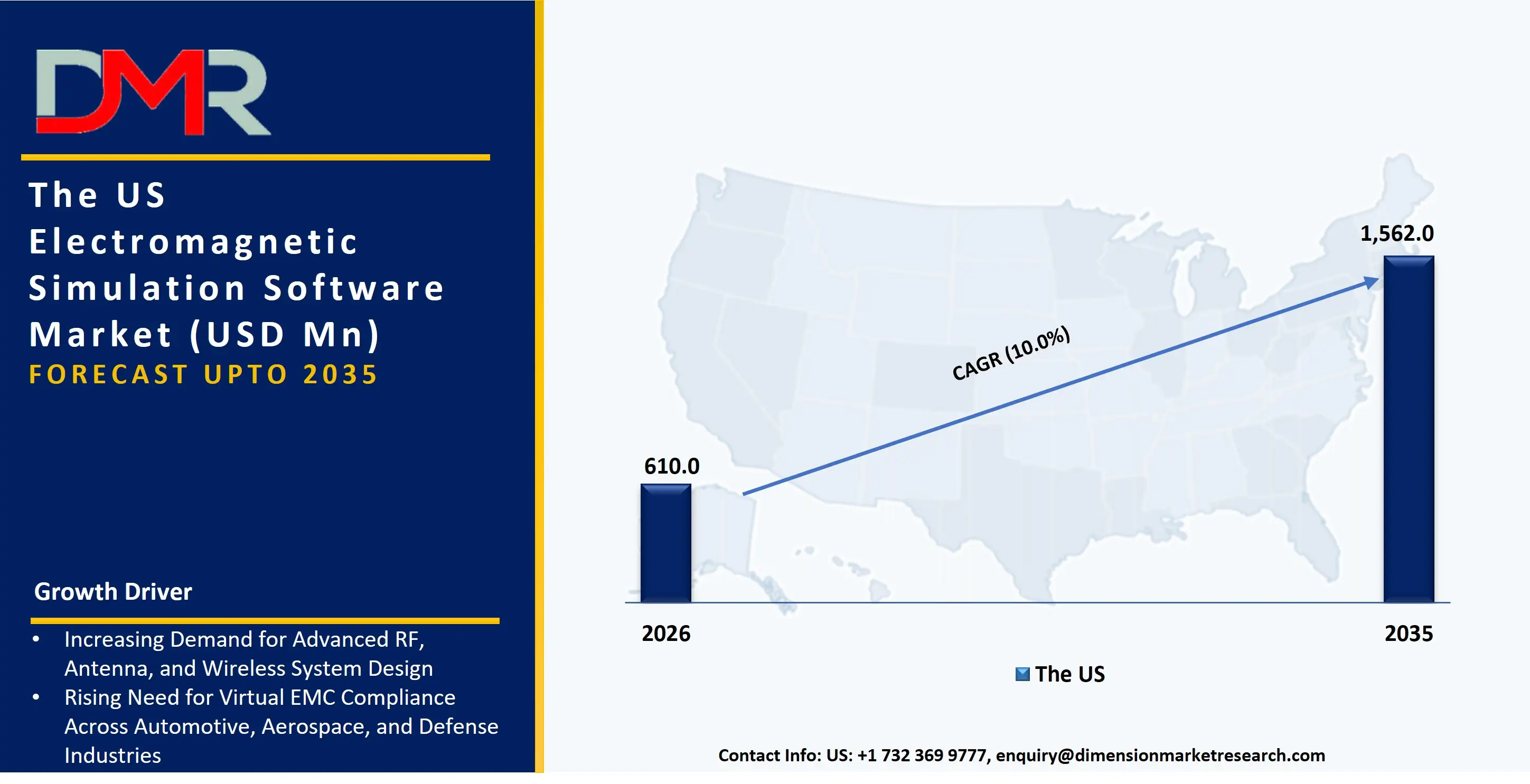
The US market is projected to be valued at USD 610.0 million in 2026 and is expected to reach USD 1,562.0 million by 2035, registering a CAGR of approximately 11.0%. This trajectory reflects the U.S.'s strategic priority to maintain spectral superiority.
ℹ
To learn more about this report –
Download Your Free Sample Report Here
Growth is fueled by the DoD's Electromagnetic Spectrum Operations (EMSO) strategy, which mandates robust co-site interference modeling for multi-function RF payloads on next-gen bombers and destroyers. The commercial driver is the Silicon Valley-led development of RFICs for millimeter-wave 5G repeaters and Wi-Fi 7/8 mesh systems, where on-wafer electromagnetic extraction and antenna-in-package co-design are non-negotiable for first-pass silicon success.
Japan Electromagnetic Simulation Software Market
The Japan market is valued at USD 150.0 million in 2026 and is forecast to reach USD 376.0 million by 2035, expanding at a CAGR of 10.8%. Market development is heavily influenced by Japan's leadership in precision automotive components, industrial robotics, and high-reliability power modules. Local manufacturers of SiC and GaN traction inverters are driving intensive simulation to mitigate the high dv/dt noise sources that cause low-frequency radiated emissions. Furthermore, Japan's participation in the ALMA telescope and other sub-mm wave scientific instruments demands cutting-edge corrugated horn and quasi-optical network simulation, sustaining a niche but high-value solver market.
Germany Electromagnetic Simulation Software Market
The market is uniquely propelled by the intersection of high-performance automotive engineering and industrial automation. Companies like the Fraunhofer Institute and major German automotive OEMs are pioneering the simulation of full-vehicle electromagnetic immunity, analyzing the bulk current injection effect across a complex wiring harness from 1 MHz to 400 MHz. The country's leadership in industrial power electronics, like converter-fed motor drives for factory robots, creates extensive demand for tooling that can accurately model laminated iron core losses alongside radiated magnetic field leakage.
Regulatory Landscape
The regulatory landscape is a direct technical catalyst for market adoption. Global CISPR 25 and CISPR 32 standards mandate that automotive and multimedia equipment pass radiated and conducted emissions limits, which necessitates a robust in-silico EMC design and pre-screening workflow to avoid failing costly chamber tests. The FCC's Part 15 and Part 18 rules govern intentional and unintentional radiator limits, forcing consumer and industrial device makers to simulate both co-located antenna performance and electromagnetic leakage. For medical devices, the IEC 60601-1-2 standard dictates immunity and emissions requirements that demand rigorous FDTD simulation of electric field distributions near patient-coupled circuits. These frameworks directly translate into a non-negotiable CAD-embedded simulation process, moving compliance from a prototype test failure into a continuous, virtual design rule check.
Investment and White Space Analysis
The strongest investment opportunities lie in cloud-native, GPU-accelerated solver platforms that treat meshing and solving as an elastic SaaS infrastructure, not a legacy workstation tool. A significant white space exists in seamless EDA-CEM co-simulation flows for 3D-IC thermal and electromagnetic signoff, bridging the gap between Ansys, Clarity, and traditional IC layout tools. Providers can differentiate through AI-based surrogate solvers that deliver near-instantaneous parametric predictions for standard filter and waveguide geometries. Emerging growth areas include automated multi-physics digital twins for EV powertrains that simulate both bearing currents and radiated magnetic fields, and specialized anisotropic material modeling for flexible on-body antennas for consumer augmented reality glasses and medical wearables.
By Region
North America
Europe
- Germany
- The U.K.
- France
- Italy
- Russia
- Spain
- Benelux
- Nordic
- Rest of Europe
Asia-Pacific
- China
- Japan
- South Korea
- India
- ANZ
- ASEAN
- Rest of Asia-Pacific
Latin America
- Brazil
- Mexico
- Argentina
- Colombia
- Rest of Latin America
Middle East & Africa
- Saudi Arabia
- UAE
- South Africa
- Israel
- Egypt
- Rest of MEA
Competitive Landscape
The Global Electromagnetic Simulation Software Market features an intense rivalry between physics-driven high-fidelity suite providers and EDA-integrated platform giants. At the elite tier, Ansys (with HFSS) and Dassault Systèmes (CST Studio Suite) compete on the exhaustive breadth of their full-wave, asymptotic, and hybrid solver portfolios, underpinned by decades of proprietary meshing technology and high-power computing optimization. Keysight PathWave ADS and EMPro, along with Cadence Clarity, compete by embedding CEM directly into the RFIC, MMIC, and advanced packaging design flow, offering a golden "simulate-as-you-design" workflow for III-V semiconductor and silicon photonics foundries. Altair Feko differentiates on its seamless integration of MoM, MLFMA, and PO/RL-GO for ultra-large electrical structures. Strategic differentiation is shifting from raw solve speed to a holistic "simulation process and data management" platform that captures expert knowledge, automates design-of-experiments, and deploys AI-models trained on proprietary measurement-correlated simulation data.
Some of the prominent players in the Global Electromagnetic Simulation Software Market are:
- Synopsys
- Ansys
- Dassault Systèmes
- Altair Engineering
- Keysight Technologies
- Siemens Digital Industries Software
- Cadence Design Systems
- COMSOL
- Remcom
- Hexagon
- Zuken
- ESI Group
- EMWorks
- Sim4Life
- JSOL Corporation
- CEDRAT
- JCMwave
- Sonnet Software
- AWR Corporation
- AET
- ESI ITI
- INTEGRATED Engineering Software
- Computer Simulation Technology
- Applied Wave Research
- OPAL RT Technologies
- SimScale
- EMCoS
- Rocscience
- Sigrity
- OptiFDTD
- Other Key Players
Recent Developments
- In July 2025, Dassault Systèmes released CST Studio Suite 2025 SP4, continuing enhancements for its electromagnetic simulation portfolio. CST Studio Suite enables high frequency and low frequency analysis, including antenna, EMC, cable harness, PCB, and multiphysics simulation applications.
- In November 2025, Keysight Technologies released ADS 2025 for RF and microwave design, adding capabilities for 3D heterogeneous integration design, integrated multi domain simulation, Python based automation, and AI and machine learning enabled engineering workflows. These upgrades strengthen RF, microwave, and advanced semiconductor design validation.
- In February 2025, Ansys introduced Ansys Electronics Desktop 2025 R1, expanding its integrated electronics simulation environment with updates across HFSS, HFSS 3D Layout, SIwave, Maxwell, Q3D Extractor, Circuit, and EMIT. The release supports more connected electromagnetic, signal integrity, power integrity, and electronic system design workflows.
Report Details
| Report Characteristics |
| Market Size (2026) |
USD 1,887.0 Mn |
| Forecast Value (2035) |
USD 4,831.5 Mn |
| CAGR (2026–2035) |
11.0% |
| The US Market Size (2026) |
USD 610.0 Mn |
| Historical Data |
2021 – 2025 |
| Forecast Data |
2027 – 2035 |
| Base Year |
2025 |
| Estimate Year |
2026 |
| Segments Covered |
By Software Type, By Deployment Mode, By License Type, By Application, and By End User Industry |
| Regional Coverage |
North America – The US and Canada; Europe – Germany, The UK, France, Russia, Spain, Italy, Benelux, Nordic, & Rest of Europe; Asia-Pacific – China, Japan, South Korea, India, ANZ, ASEAN, Rest of APAC; Latin America – Brazil, Mexico, Argentina, Colombia, Rest of Latin America; Middle East & Africa – Saudi Arabia, UAE, South Africa, Turkey, Egypt, Israel, & Rest of MEA |
Frequently Asked Questions
How big is the Global Electromagnetic Simulation Software Market?
▾ The market was valued at USD 1,700.0 million in 2025 and is projected to reach USD 4,831.5 million by 2035, driven by the design complexity of 5G/6G antennas, ADAS sensors, and high-speed digital interconnects.
What is the CAGR of the Global Electromagnetic Simulation Software Market from 2026 to 2035?
▾ The market is projected to expand at a robust CAGR of 11.0% during the 2026-2035 forecast period.
What factors are driving the growth of the Electromagnetic Simulation Software Market?
▾ Growth is driven by stringent EMC/EMI regulatory mandates, the challenge of simulating massive MIMO and phased array antenna systems, the shift to semiconductor advanced packaging requiring 3D full-wave extraction, and the rise of virtual prototyping to replace physical chamber testing.
What are the major trends in the Global Electromagnetic Simulation Software Market ?
▾ Major trends include the convergence of RF circuit and 3D electromagnetic co-simulation, the adoption of GPU-accelerated cloud-native solvers, the emergence of AI/ML-based parametric surrogate models for real-time tuning, and a focus on multi-physics digital twins for autonomous sensor systems.
Which region held the largest market share in 2026 in Global Electromagnetic Simulation Software Market ?
▾ North America is expected to lead with a 38.2% share in 2026, driven by its dominant defense electronics sector, leading-edge semiconductor R&D, and major satellite/telecom OEMs.
Which region is expected to grow the fastest in Global Electromagnetic Simulation Software Market ?
▾ Asia Pacific is expected to record the fastest growth at a 13.2% CAGR, fueled by its role as the global manufacturing hub for wireless, automotive, and consumer electronics.
Who are the key players in the Global Electromagnetic Simulation Software Market?
▾ Key participants include Ansys, Dassault Systèmes (CST), Keysight Technologies, Altair (Feko), Cadence Design Systems, Siemens EDA, MathWorks, and Remcom.
How is the Electromagnetic Simulation Software Market segmented?
▾ The market is segmented by software type, deployment mode, license type, application, and end-user industry, with regional analysis covering North America, Europe, Asia Pacific, Latin America, and the Middle East & Africa.