Electronic Grade Sulfuric Acid Market Snapshot
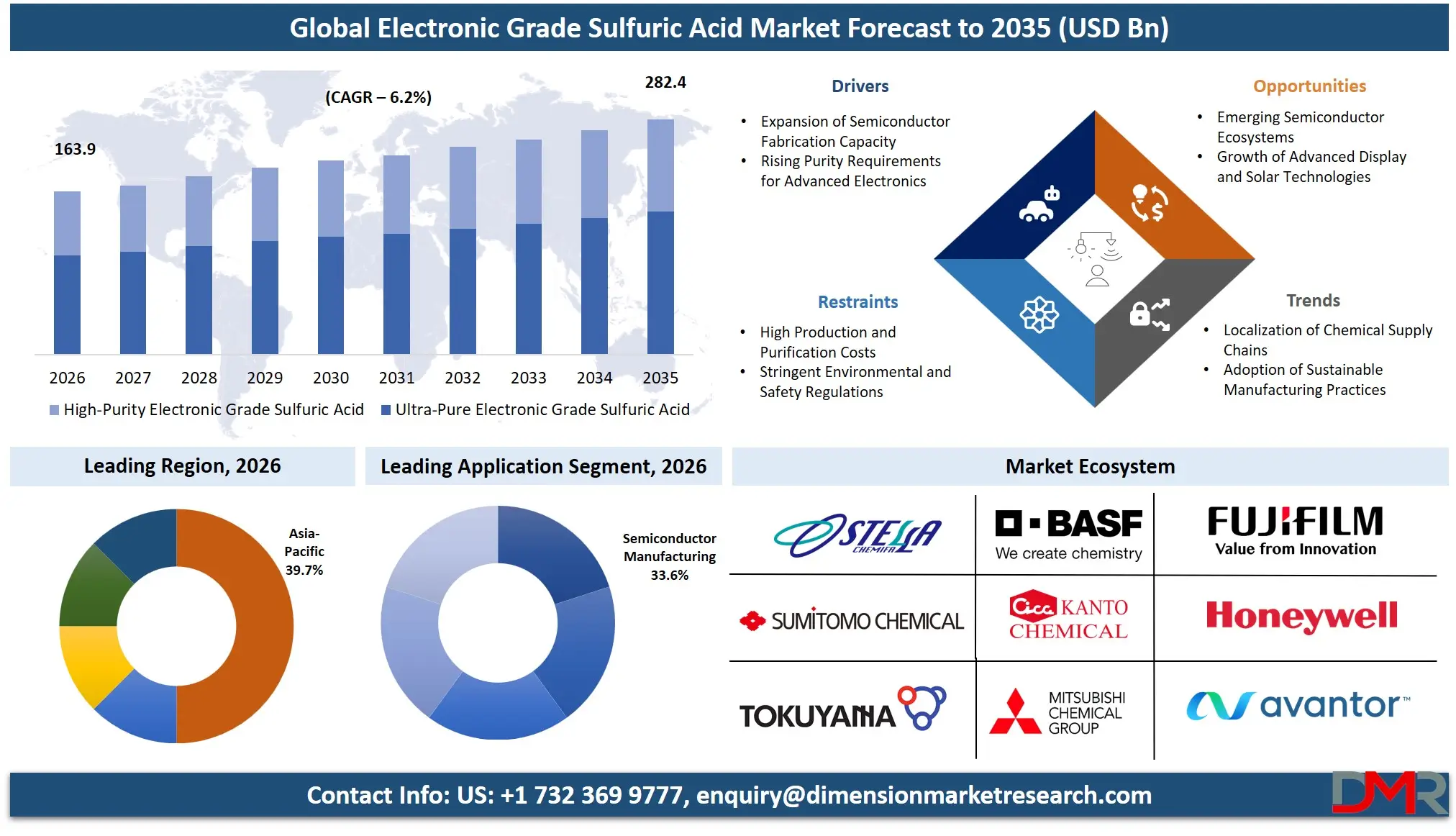
- Market Value: The global Electronic Grade Sulfuric Acid market is expected to reach USD 282.4 billion by 2035 from USD 163.9 billion in 2026, at a CAGR of 6.2%.
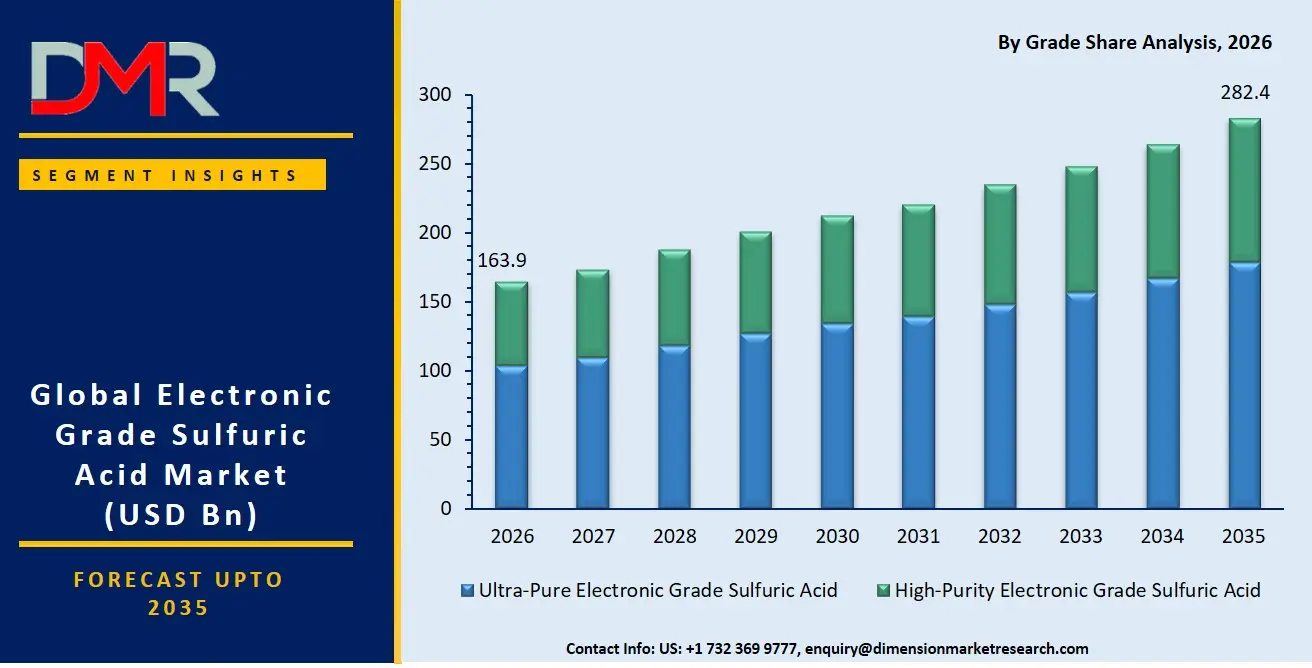
- By Grade Segment Analysis: Ultra-Pure Electronic Grade Sulfuric Acid dominated the market with the largest revenue share in 2026.
- By Distribution Channel Analysis: Direct Sales led the distribution channel segment with the largest market share in 2026.
- By Application Segment Analysis: Semiconductor Manufacturing dominated applications with the largest revenue share in 2026.
- By End User Segment Analysis: Semiconductor Foundries led the end-user segment with the largest market share in 2026.
- Regional Analysis: Asia Pacific led the global Electronic Grade Sulfuric Acid market with a 39.1% revenue share in 2026.
- Major Players: BASF SE, Kanto Chemical, Stella Chemifa, Mitsubishi Chemical, Sumitomo Chemical, Tokuyama, Entegris and Others.
What is the Electronic Grade Sulfuric Acid Market and its Market Size?
The Global Electronic Grade Sulfuric Acid Market size is projected to be valued at USD 163.9 billion in 2026 and is projected to reach USD 282.4 billion by 2035, expanding at a steady CAGR of 6.2% during the forecast period. The growth of the market is supported by rising semiconductor manufacturing, wafer fabrication capacity, advanced packaging, display production, and photovoltaic applications. Electronic grade sulfuric acid, also called high purity or ultra pure sulfuric acid, is widely used for wafer cleaning, photoresist stripping, etching, and surface preparation where extremely low contamination levels are required.
ℹ
To learn more about this report –
Download Your Free Sample Report Here
The electronic grade sulfuric acid market demand is driven by the semiconductor production intensity. Smaller process nodes, 3D device architectures, advanced memory, and increasingly complex fabrication processes require tighter impurity control and consistent chemical quality. These requirements are strengthening demand for semiconductor chemicals capable of meeting parts-per-billion and parts-per-trillion contamination specifications.
What is the Electronic Grade Sulfuric Acid?
Electronic Grade Sulfuric Acid is a highly specialized, ultra-high-purity chemical used as a critical process material in the manufacturing of semiconductor wafers, ICs, and other electronic components. These services, unlike industrial-grade acid production, are related to achieving and maintaining parts-per-trillion levels of metallic contamination. This involves expert consulting on purification technologies to establish a strategic quality roadmap, direct sales and supply chain management to deliver the chemical without degradation, and specialty distribution to ensure that acid can be safely integrated with the existing on-site chemical delivery systems. With 90% of advanced fabs running high-volume manufacturing, professional, high-purity chemical supply is needed to achieve defect-free wafer yields and process stability, making chemical investments translate into tangible manufacturing excellence, as opposed to mere commodity supply.
Use Cases
-
Semiconductor Wafer Cleaning: Electronic grade sulfuric acid is extensively used in semiconductor cleaning processes to remove organic residues, particles, photoresist, and contaminants from silicon wafer surfaces. Its high purity supports tighter process control and helps semiconductor foundries maintain wafer yield as device geometries become smaller.
-
Photoresist Stripping: Semiconductor manufacturers use ultra pure sulfuric acid in wet chemical processes for effective photoresist removal after lithography. Advanced logic, memory, and integrated circuit production require reliable stripping performance without introducing metallic contamination that may affect subsequent fabrication stages.
-
Advanced Semiconductor Etching: High purity sulfuric acid supports controlled etching and surface preparation during semiconductor manufacturing. The application becomes increasingly important in complex chip structures where contamination control, chemical consistency, and surface quality influence device reliability and manufacturing economics.
-
Photovoltaic Cell Processing: Solar cell manufacturers use high purity sulfuric acid during wafer cleaning, surface treatment, and selected texturing processes. Growing photovoltaic manufacturing capacity creates an additional demand stream for electronic chemicals beyond conventional integrated circuit and semiconductor applications.
-
Display and MEMS Manufacturing: Flat panel display, sensor, and MEMS manufacturers use electronic grade acids for precision cleaning and surface processing. High purity chemical inputs help control particles and ionic contaminants across sensitive substrates used in OLED displays, sensors, microelectronics, and other electronic components.
How AI is Transforming the Electronic Grade Sulfuric Acid Market
AI is fundamentally reshaping the electronic grade sulfuric acid market by accelerating the development of purification processes and enhancing real-time quality assurance. In ultra-pure grade qualification, AI-based analytical tools can automatically analyze trace metal detection data from ICP-MS, identifying nascent contamination trends and predicting required maintenance for distillation units, thereby minimizing manual testing and supply risks. Meanwhile, AI-powered features in direct sales and distribution allow chemical suppliers to better manage customer fab consumption patterns by analyzing wafer start rates and bath life, predicting future usage, and suggesting optimized delivery schedules to prevent chemical aging and ensure just-in-time manufacturing support.
Quality control and supply chain resilience projects are also revolving around AI. In the area of consulting services, intelligent compliance-monitoring agents are used to continuously monitor the purity of chemical batches across multi-site supply chains, identifying statistical deviations, trace impurity spikes, and lot-to-lot variance to keep shipments in line with SEMI Grade 1 to 4 standards. Moreover, generative AI assistants are complementing new fab startup consulting by simulating chemical delivery system dynamics and modeling total cost of ownership for on-site vs. off-site purification, giving stakeholders a visualization of the supply chain and purity economics before committing capital.
Key Drivers in the Electronic Grade Sulfuric Acid Market
Expansion of Semiconductor Manufacturing Capacity
Rising investment in semiconductor fabrication is a major driver of electronic grade sulfuric acid market growth. New logic, memory, foundry, and advanced packaging capacity increases consumption of semiconductor wet chemicals used repeatedly throughout wafer processing. Sulfuric acid is particularly important for wafer cleaning and photoresist stripping. As manufacturers move toward smaller process nodes and more complex device structures, chemical purity and contamination control become increasingly important, supporting demand for ultra high purity grades.
Increasing Demand for High Purity Semiconductor Chemicals
Advanced semiconductor devices are increasingly sensitive to particles and trace metallic impurities. This is raising demand for high purity chemicals with strict batch consistency and contamination specifications. Logic chips, 3D NAND, DRAM, advanced packaging, and other semiconductor applications require reliable cleaning performance to protect manufacturing yield. The shift toward smaller geometries therefore supports both electronic grade sulfuric acid consumption and investment in purification, analytical testing, storage, and contamination-controlled chemical delivery systems.
Restraints in the Electronic Grade Sulfuric Acid Market
High Purification and Production Costs
Producing ultra pure sulfuric acid requires specialized purification equipment, high-grade materials, contamination-controlled facilities, advanced analytical testing, and rigorous quality management. These requirements increase capital and operating costs compared with conventional industrial sulfuric acid. Packaging, transportation, storage, and point-of-use handling also require careful controls. The high cost of qualifying production capacity can limit new market entry and make long-term customer qualification an important barrier for smaller electronic chemical manufacturers.
Strict Safety and Environmental Requirements
Sulfuric acid is highly corrosive and requires strict controls during production, transportation, storage, use, and waste treatment. Electronic grade suppliers must combine chemical safety requirements with demanding semiconductor purity standards. Environmental permits, worker protection, waste management, chemical recycling, and transportation regulations can increase operating costs and extend facility development schedules. These requirements may constrain rapid capacity expansion, particularly in markets where specialized infrastructure for high purity chemical handling remains limited.
Growth Opportunities in the Electronic Grade Sulfuric Acid Market
Emerging Semiconductor Manufacturing Hubs
The geographic expansion of semiconductor manufacturing creates significant opportunities for electronic grade sulfuric acid suppliers. New fabs require reliable access to semiconductor chemicals, local storage, technical services, and contamination-controlled delivery infrastructure. Suppliers that locate purification and distribution capacity near semiconductor clusters can reduce transportation risk and improve responsiveness. Expansion of semiconductor ecosystems in the US, Europe, India, Southeast Asia, and established Asian manufacturing centers can therefore create long-term demand and new supplier qualification opportunities.
Advanced Displays and Photovoltaic Manufacturing
Applications beyond conventional chip fabrication offer an additional market growth opportunity. High-resolution displays, MEMS, sensors, advanced electronic components, and photovoltaic cells require controlled surface cleaning and chemical processing. Continued investment in OLED, microdisplay, solar cell, and sensor manufacturing expands the addressable demand for high purity sulfuric acid. Suppliers capable of tailoring purity specifications, packaging, delivery, and technical support to different manufacturing processes can diversify their semiconductor-focused customer base.
Trends in the Electronic Grade Sulfuric Acid Market
Localization of Semiconductor Chemical Supply Chains
Semiconductor manufacturers are placing greater emphasis on resilient and geographically diversified supply chains. Electronic grade sulfuric acid manufacturers are consequently evaluating production, purification, and storage capacity closer to major wafer fabrication clusters. Local supply can shorten transportation routes, improve inventory visibility, and reduce exposure to logistics disruptions. This trend is strengthening direct supplier relationships and long-term supply agreements while making regional production capacity an increasingly important factor in the competitive landscape.
Shift Toward Ultra High Purity Chemical Grades
The semiconductor industry's transition toward smaller nodes and more complex device architectures is increasing demand for ultra high purity sulfuric acid. Market requirements increasingly focus on extremely low metallic impurities, low particle counts, traceability, and consistent batch performance. Public market research also identifies high and ultra-high purity grades as central to semiconductor wafer cleaning and etching applications. This trend encourages electronic chemical companies to invest in improved purification technologies, analytical capabilities, and contamination-controlled distribution.
Research Scope and Analysis
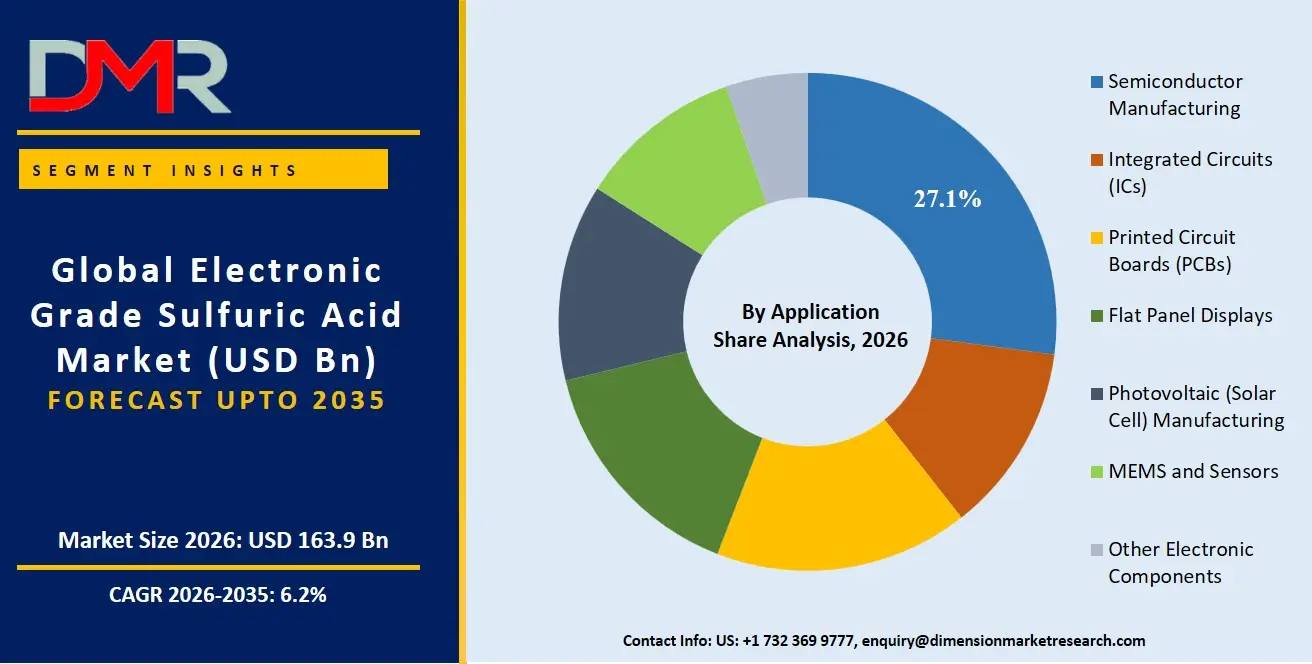
The global electronic grade sulfuric acid market is segmented by grade into ultra-pure electronic grade sulfuric acid and high-purity electronic grade sulfuric acid. Distribution channels include direct sales and specialty distributors. Applications encompass semiconductor manufacturing, integrated circuits, printed circuit boards, flat panel displays, photovoltaics, MEMS and sensors, and other electronic components. End users comprise semiconductor foundries, integrated device manufacturers, display manufacturers, solar cell manufacturers, and electronics component manufacturers.
ℹ
To learn more about this report –
Download Your Free Sample Report Here
By Application
Semiconductor manufacturing is projected to be the leading application because sulfuric acid is indispensable for wafer cleaning, photoresist stripping, and surface preparation throughout chip production. The rapid expansion of computing, artificial intelligence, consumer electronics, and automotive electronics has significantly increased wafer output worldwide. Modern fabrication plants consume large quantities of ultra-high-purity chemicals to achieve stringent yield and performance targets. Continuous investment in new fabs and process-node advancements further reinforces demand from this application. Since semiconductor production represents the most chemically intensive and highest-value use of electronic grade sulfuric acid, it consistently accounts for the largest share of global consumption.
By Distribution Channel
Direct sales is poised to dominate as electronic grade sulfuric acid is a mission-critical input requiring assured purity, traceability, and dependable logistics. Major semiconductor and display manufacturers typically establish long-term supply agreements directly with producers to guarantee uninterrupted deliveries and tailored specifications. Direct relationships facilitate technical support, quality audits, and coordinated inventory management, all of which are essential for high-volume fabrication facilities. In addition, direct sourcing minimizes handling steps that could introduce contamination, preserving product integrity. The strategic nature of the material and the need for close collaboration between suppliers and end users therefore make direct sales the preferred and largest distribution channel globally.
By End User
Semiconductor foundries is expected to dominate the end-user landscape owing to their immense production volumes and central role in manufacturing chips for numerous fabless companies. These facilities operate around the clock and require substantial quantities of ultra-pure process chemicals to sustain high yields and meet exacting quality standards. The ongoing construction of new foundries and expansion of existing plants, particularly in Asia-Pacific, further strengthens their purchasing power. Foundries also tend to adopt the latest process technologies first, increasing the intensity of chemical usage per wafer. Their scale and technological sophistication firmly establish semiconductor foundries as the leading end-user segment in the market.
By Grade
Ultra-pure electronic grade sulfuric acid is poised to dominate because advanced semiconductor fabrication requires impurity concentrations at extremely low levels to prevent defects and maintain high wafer yields. Leading-edge integrated circuits, memory devices, and logic chips employ highly sensitive cleaning and etching processes that can tolerate only trace contaminants.
ℹ
To learn more about this report –
Download Your Free Sample Report Here
As chip geometries continue to shrink and manufacturers adopt more complex process nodes, demand for the highest purity grades rises correspondingly. The segment also benefits from stringent quality standards imposed by foundries and integrated device manufacturers, which prioritize consistent performance and process reliability. Consequently, ultra-pure grades command the largest share of consumption and value within the global market.
The Global Electronic Grade Sulfuric Acid Market Report is segmented on the basis of the following:
By Grade
- Ultra-Pure Electronic Grade Sulfuric Acid
- High-Purity Electronic Grade Sulfuric Acid
By Distribution Channel
- Direct Sales
- Distributors and Specialty Chemical Suppliers
By Application
- Semiconductor Manufacturing
- Integrated Circuits (ICs)
- Printed Circuit Boards (PCBs)
- Flat Panel Displays
- Photovoltaic (Solar Cell) Manufacturing
- MEMS and Sensors
- Other Electronic Components
By End User
- Semiconductor Foundries
- Integrated Device Manufacturers (IDMs)
- Display Manufacturers
- Solar Cell Manufacturers
- Electronics Component Manufacturers
Regional Analysis
Asia-Pacific is the Leading Region in the Electronic Grade Sulfuric Acid Market
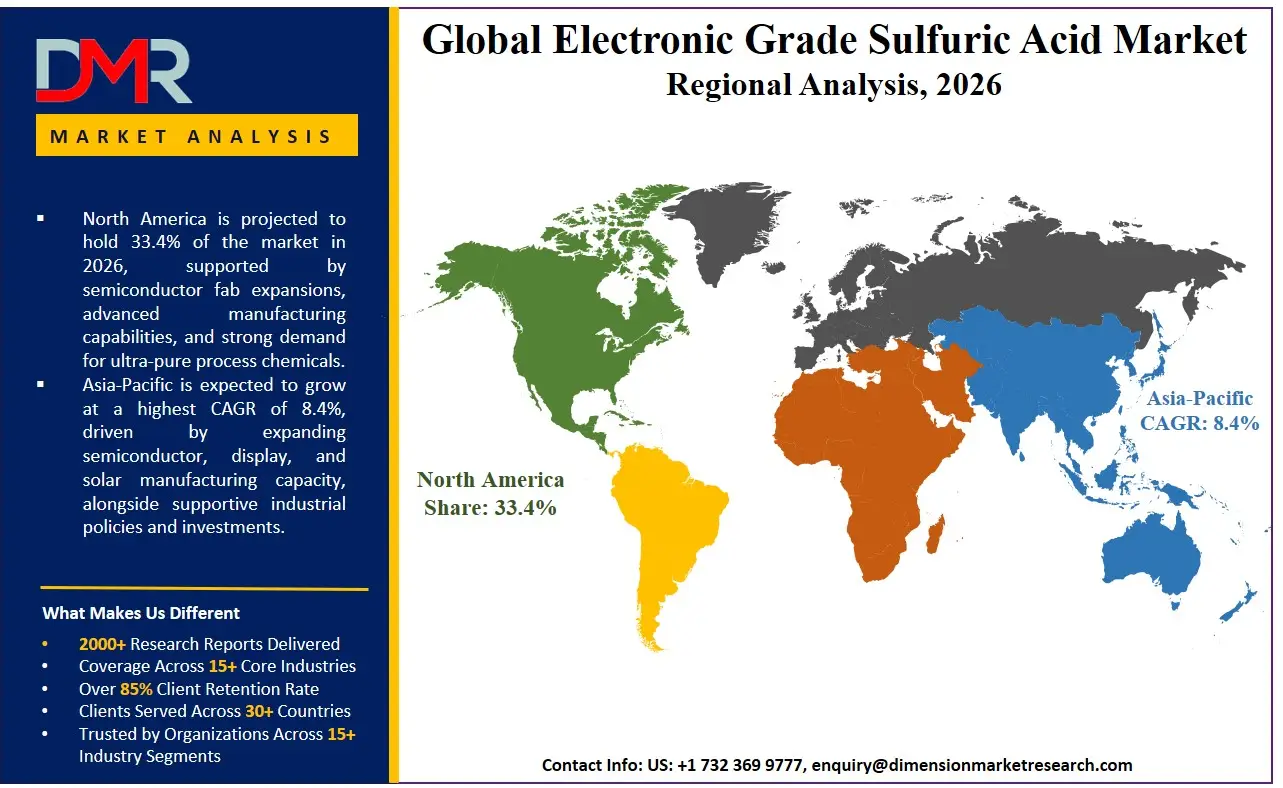
Asia-Pacific is poised to dominate the global electronic grade sulfuric acid market, holding a 39.1% of the share in 2026, due to its unparalleled concentration of semiconductor foundries, IDMs, and display manufacturers. The region, led by Taiwan, South Korea, and China, has the highest share in electronic grade sulfuric acid consumption because of the massive scale of advanced node chip fabrication and the expansive build-out of photovoltaic cell capacity. The area has an established ecosystem of global chemical conglomerates, local high-purity specialists, and a rich pool of process engineers. Manufacturing investment in 3D NAND, DRAM, and the overall transition to gate-all-around transistor structures contribute to the continued demand for ultra-pure grades, with a direct sales model tightly integrated into fab chemical management systems. Moreover, aggressive government subsidy programs perpetually finance new mega-fab construction projects that require expert chemical supply partners to achieve immediate high-yield ramp-ups.
Fastest-Growing Regional Market
Asia-Pacific is expected to be the fastest-growing regional market for electronic grade sulfuric acid, driven by sustained investments in semiconductor, display, and photovoltaic manufacturing. China, South Korea, Taiwan, India, and emerging Southeast Asian economies are expanding fabrication and component production capacities to meet rising global demand for advanced electronics. Supportive industrial policies, incentives for domestic chip production, and increasing adoption of next-generation technologies are accelerating the need for ultra-pure process chemicals. The region also benefits from a well-established supply chain, a skilled workforce, and the presence of major chemical suppliers that provide localized production and direct sales services. These advantages position Asia-Pacific for robust and sustained market growth throughout the forecast period.
By Region
North America
Europe
- Germany
- The U.K.
- France
- Italy
- Russia
- Spain
- Benelux
- Nordic
- Rest of Europe
Asia-Pacific
- China
- Japan
- South Korea
- India
- ANZ
- ASEAN
- Rest of Asia-Pacific
Latin America
- Brazil
- Mexico
- Argentina
- Colombia
- Rest of Latin America
Middle East & Africa
- Saudi Arabia
- UAE
- South Africa
- Israel
- Egypt
- Rest of MEA
ℹ
To learn more about this report –
Download Your Free Sample Report Here
Major Countries Analysis
US Electronic Grade Sulfuric Acid Market
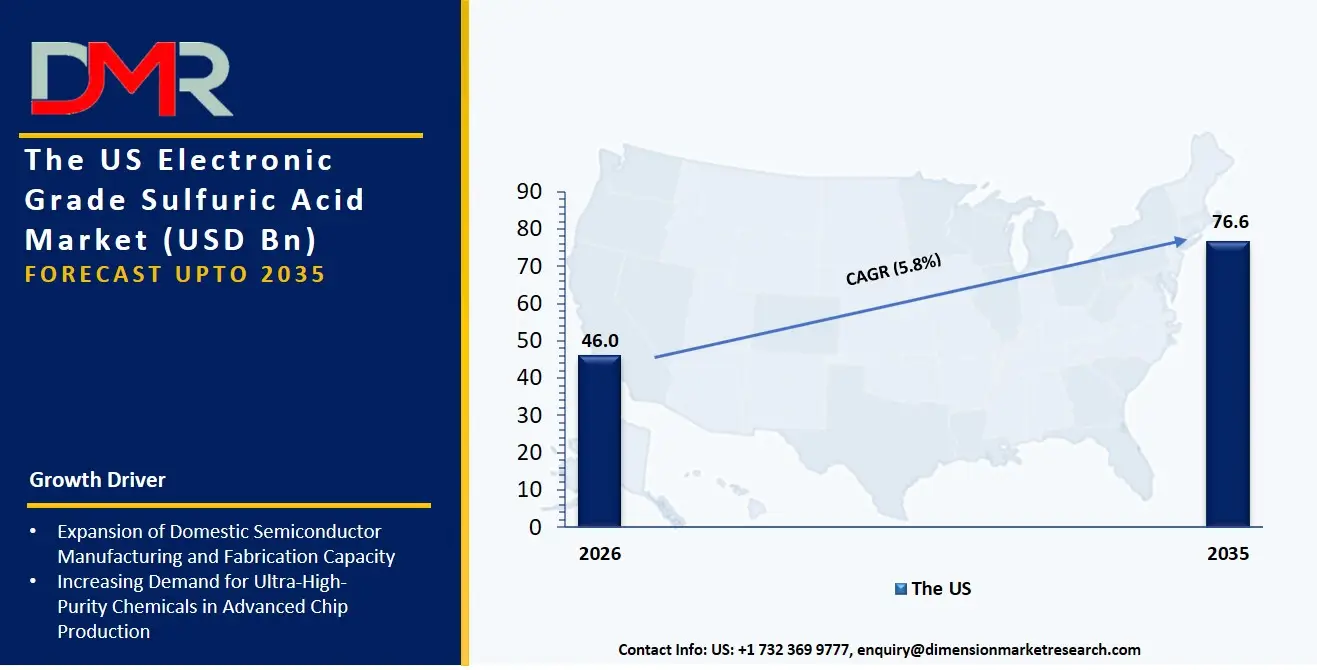
The US Electronic Grade Sulfuric Acid Market is projected to reach USD 53.1 billion in 2026, growing at a compound annual growth rate of 5.8% over its forecast period, culminating in a value of USD 88.3 billion by 2035.
The US remains a strategically vital market for electronic grade sulfuric acid, underpinned by the CHIPS Act-driven resurgence of domestic semiconductor manufacturing and the construction of leading-edge foundries. The market has been typified by high demand for ultra-pure grades, as organizations focus on sub-5nm node fabrication that requires parts-per-trillion (ppt) level purity to prevent wafer defects. Besides, the reshoring of advanced packaging and IC substrate production is producing a parallel need in direct sales channels to manage the highly sensitive logistics of high-purity chemical distribution to secure fab sites.
Europe Electronic Grade Sulfuric Acid Market
The Europe Electronic Grade Sulfuric Acid Market is estimated to be valued at USD 28.4 billion in 2026 and is further anticipated to reach USD 46.5 billion by 2035, growing at a CAGR of 5.6%. The European market is uniquely shaped by its leadership in automotive-grade semiconductors, power electronics, and micro-electromechanical systems (MEMS). This specialization drives a critical need for High-Purity Electronic Grade Sulfuric Acid tailored for silicon carbide (SiC) and gallium nitride (GaN) wafer processing, which are essential for electric vehicle (EV) inverters and industrial motor drives. In addition, the region's focus on sustainable manufacturing is pushing the adoption of advanced chemical recycling and reclamation systems within fabs. This trend is compelling specialty chemical suppliers in the distribution channel to provide not just virgin acids, but also closed-loop purification services that reduce chemical waste without compromising the ultra-pure quality required for flat panel display and sensor fabrication.
ℹ
To learn more about this report –
Download Your Free Sample Report Here
Japan Electronic Grade Sulfuric Acid Market
The Japan Electronic Grade Sulfuric Acid Market is projected to hold a value of USD 3.8 billion in 2026 at a CAGR of 5.6%. Japan's market is distinguished by its deep-rooted materials science expertise and the presence of leading-edge chemical conglomerates that supply the global electronics value chain. Domestic demand is heavily concentrated in the manufacturing of advanced photoresists, specialty films, and cleaning solutions for Integrated Circuits (ICs), where local fabs are engaged in a strategic push towards 2nm and beyond process nodes. There is also a pronounced focus on the Direct Sales channel model, where chemical manufacturers engage in deep co-engineering partnerships with Semiconductor Foundries. This collaboration is critical for developing customized acid formulations that minimize surface roughness and particle defects on next-generation silicon wafers, securing Japan's position as a critical hub for electronic material innovation.
Competitive Landscape
The competitive environment of the global electronic grade sulfuric acid market has become highly dynamic, characterized by a heterogeneous array of multinational chemical giants, specialist Asian high-purity suppliers, and the on-site chemical service divisions of industrial gas companies. The key to success lies in profound strategic alliances with leading semiconductor foundries and IDMs, as these co-development partnerships open necessary qualification windows and align production capacity with advanced node requirements. The movement towards market consolidation is rapidly progressing, with traditional commodity chemical players acquiring boutique ultra-pure specialists to secure their technical purification know-how and existing fab qualification status. Proprietary intellectual property, including energy-efficient distillation processes and part-per-quadrillion analytical metrology, is becoming a more critical basis of competitive differentiation than simple production scale or low-cost feedstock access.
Some of the prominent players in the Electronic Grade Sulfuric Acid Market are:
- BASF SE
- KMG Electronic Chemicals
- Kanto Chemical Co., Inc.
- Stella Chemifa Corporation
- Mitsubishi Chemical Group Corporation
- Sumitomo Chemical Co., Ltd.
- Tokuyama Corporation
- Avantor, Inc.
- Honeywell International Inc.
- FUJIFILM Holdings Corporation
- Merck KGaA
- Entegris, Inc.
- Soulbrain Co., Ltd.
- OCI Company Ltd.
- Linde plc
- Moses Lake Industries, Inc.
- The Chemours Company
- Dongwoo Fine-Chem Co., Ltd.
- Grupa Azoty S.A.
- LSB Industries, Inc.
- Other Key Players
Recent Developments
- February 2026: BASF reported that construction of its Ludwigshafen semiconductor-grade sulfuric acid facility was underway, reinforcing regional supply-chain resilience for European chipmakers.
- August 2025: Entegris unveiled plans for an additional US technology center and R&D investment, further strengthening its advanced-purity and semiconductor materials capabilities that support high-purity process chemistries.
- April 2025: BASF announced the construction of a new semiconductor-grade sulfuric acid plant at Ludwigshafen, Germany, to supply the growing European semiconductor industry with ultra-pure chemicals.
Report Details
| Report Characteristics |
| Market Size (2026) |
USD 163.9 Bn |
| Forecast Value (2035) |
USD 282.4 Bn |
| CAGR (2026-2035) |
6.2% |
| The US Market Size (2026) |
USD 46.0 Bn |
| Historical Data |
2021 – 2025 |
| Forecast Data |
2027 – 2035 |
| Base Year |
2025 |
| Estimate Year |
2026 |
| Segments Covered |
By Grade, By Distribution Channel, By Application, By End User |
| Regional Coverage |
North America – The US and Canada; Europe – Germany, The UK, France, Russia, Spain, Italy, Benelux, Nordic, & Rest of Europe; Asia-Pacific – China, Japan, South Korea, India, ANZ, ASEAN, Rest of APAC; Latin America – Brazil, Mexico, Argentina, Colombia, Rest of Latin America; Middle East & Africa – Saudi Arabia, UAE, South Africa, Turkey, Egypt, Israel, & Rest of MEA |
Frequently Asked Questions
What is the current size of the Electronic Grade Sulfuric Acid Market?
▾ The Electronic Grade Sulfuric Acid Market is valued at USD 163.9 billion in 2026 and may reach USD 282.4 billion by 2035.
What is the growth rate of the Electronic Grade Sulfuric Acid Market?
▾ The Electronic Grade Sulfuric Acid Market is projected to grow at a CAGR of 6.2% during the forecast period 2026-2035.
Which region dominates the global Electronic Grade Sulfuric Acid Market?
▾ Asia Pacific leads the global Electronic Grade Sulfuric Acid Market with a 39.1% revenue share in 2026.
What factors are driving the growth of the Electronic Grade Sulfuric Acid Market?
▾ Semiconductor fab expansion and rising demand for ultra-pure chemicals drive Electronic Grade Sulfuric Acid Market growth.
What are the major challenges restraining the Electronic Grade Sulfuric Acid Market?
▾ High purification costs and strict safety regulations restrain the Electronic Grade Sulfuric Acid Market growth.
Which segment holds the largest share of the Electronic Grade Sulfuric Acid Market?
▾ Ultra-Pure Electronic Grade Sulfuric Acid leads the market due to growing demand from advanced semiconductor fabrication.
Who are the leading companies in the global Electronic Grade Sulfuric Acid Market?
▾ BASF SE, KMG Electronic Chemicals, Kanto Chemical, Stella Chemifa, Mitsubishi Chemical, Sumitomo Chemical, Tokuyama, Avantor, Honeywell, FUJIFILM, Merck KGaA, Entegris, Soulbrain, OCI, Linde, Moses Lake Industries, Chemours, Dongwoo Fine-Chem, Grupa Azoty, and LSB Industries are leading companies in the Electronic Grade Sulfuric Acid Market.
How is AI influencing the Electronic Grade Sulfuric Acid Market?
▾ AI supports the Electronic Grade Sulfuric Acid Market through purity monitoring, predictive maintenance, and supply forecasting.
What are the future opportunities and trends in the Electronic Grade Sulfuric Acid Market?
▾ Localized supply chains and advanced semiconductor fabs create opportunities in the Electronic Grade Sulfuric Acid Market.