What is the Embedded Insurance Market Size?
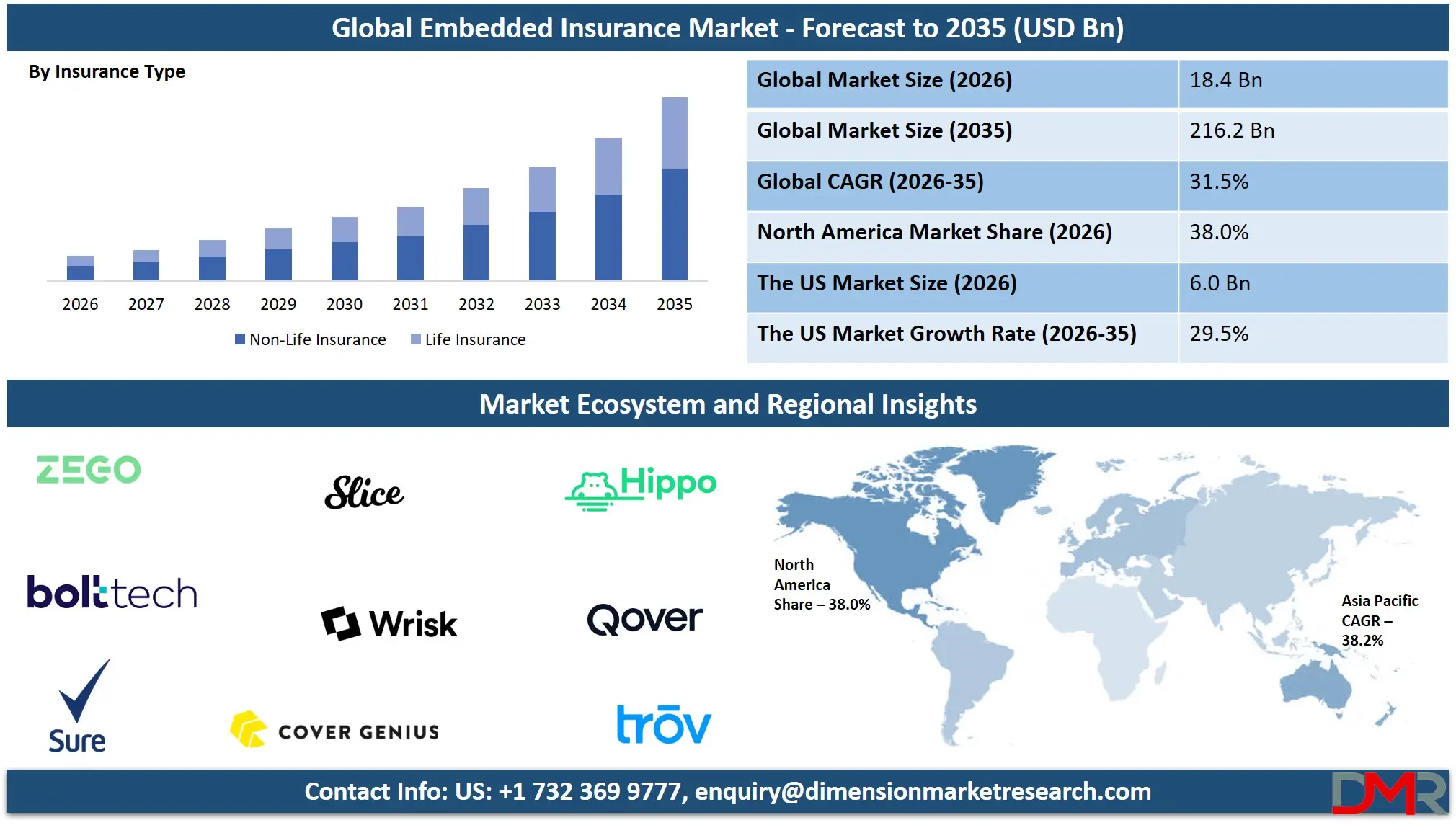
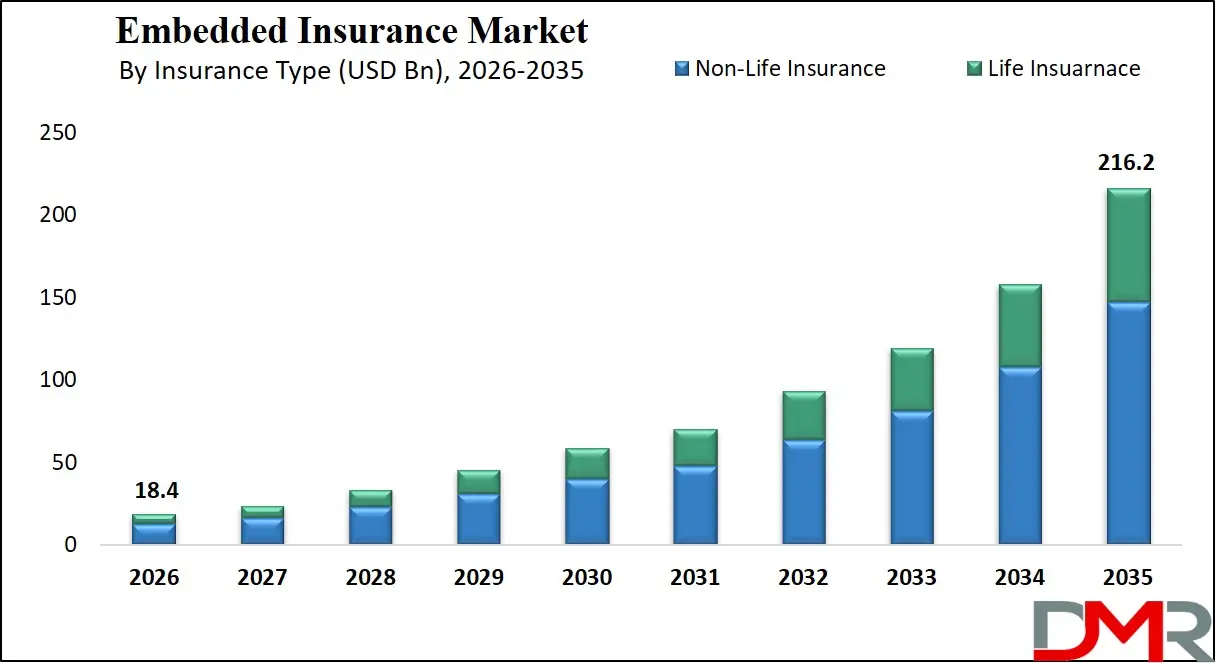
The Embedded Insurance Market size is expected to be USD 18.4 billion in 2026 and increase at a compound annual growth rate of 31.5% to USD 216.2 billion in 2035 due to rapid growth in digital ecosystems within the sectors of e-commerce, fintech, and mobility.
ℹ
To learn more about this report –
Download Your Free Sample Report Here
The Embedded Insurance industry is growing at a fast pace because insurance products are now being offered through various digital channels to customers, allowing them to purchase their policies at one go without any hassle. This growth is mainly due to increased digitization, ecosystem-driven APIs, and collaboration between insurance companies and non-insurance sectors such as e-commerce, mobility, and fintech. The demand for convenience and personalized insurance services is changing the existing insurance industry. Moreover, the support from regulations in favor of digital finance and new innovations in InsurTech is adding to its popularity.
ℹ
To learn more about this report –
Download Your Free Sample Report Here
The US Embedded Insurance Market
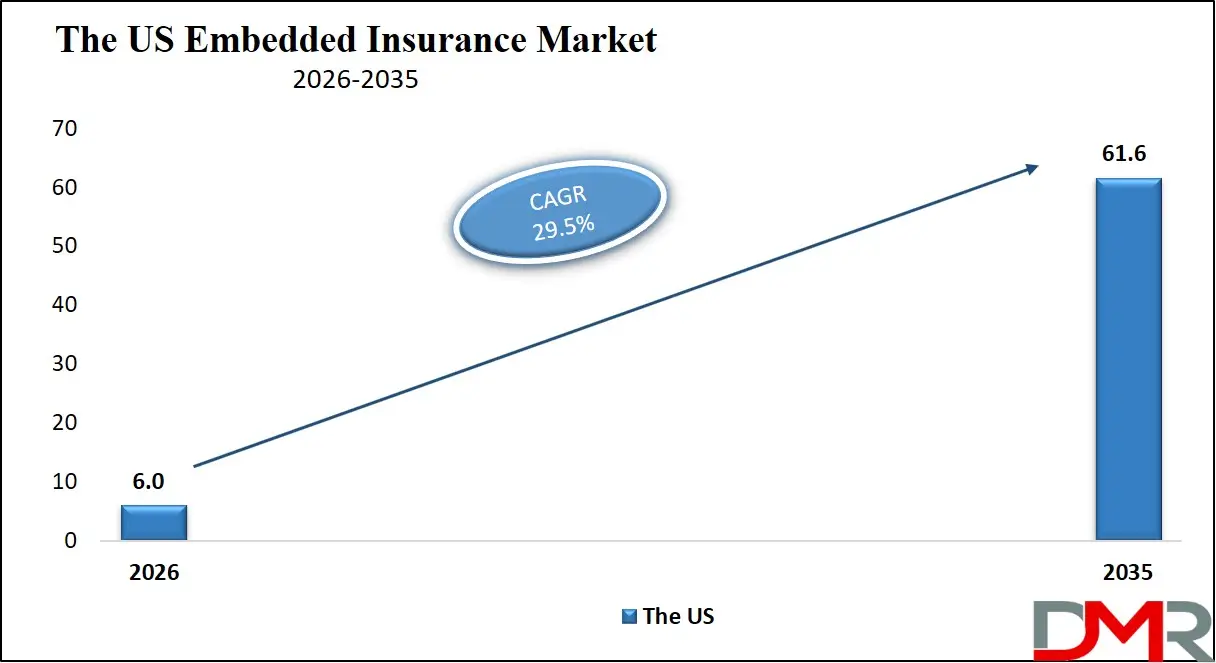
The US Embedded Insurance Market size is estimated to be USD 6.0 billion in 2026 and is expected to increase at a CAGR of 29.5% over the forecast period.
ℹ
To learn more about this report –
Download Your Free Sample Report Here
The US insurance market has achieved a high level of sophistication, thanks to innovations in InsurTech, extensive digitalization, and investment from venture capitalists. There have been moves among the leading technological and financial companies to incorporate insurance solutions into their business models. Regulations are in place to foster innovation and maintain compliance, while the collaboration between existing insurance companies and startup organizations expedites the creation of innovative products.
Europe Embedded Insurance Market
The Europe Embedded Insurance Market size is estimated to be USD 4.0 billion in 2026 and at a CAGR of 30.2% over the forecast period.
The integrated insurance market of Europe is characterized by the influence of the European Green Deal and other regulatory policies, along with stringent consumer protection legislation. Sustainability and digitalization are the core principles that define financial services in the region, prompting insurers to adopt innovations sustainably. The adoption rate for this technology is high in travel, automotive, and e-commerce industries. Open banking solutions, as well as PSD2 policies, help achieve interoperability between platforms.
Japan Embedded Insurance Market
The market size of Japan Embedded Insurance will be USD 736 million in 2026 and at a CAGR of 31.1% in the forecast period.
Japan's market is developing at a steady pace, facilitated by technological advancements in its infrastructure and the adoption of digital technologies. The country's urban population and demographic changes favor the production of embedded products linked to health and life. Digital service and fintech innovations being promoted by the government create incentives for insurance companies to collaborate with tech companies. Nevertheless, cultural barriers and complicated regulations present certain difficulties.
Key Takeaways
- Market Size & Forecast: The Embedded Insurance Market size is projected to reach USD 18.4 billion in 2026 and is anticipated to have a value of USD 216.2 billion in 2035.
- Growth Rate & Outlook: The Embedded Insurance Market size is set to grow at a compound annual growth rate of 31.5% during the forecast period of 2026 to 2035.
- Primary Growth Drivers: Some of the major growth drivers in the market include digital ecosystem expansion, demand for personalized and on-demand coverage, and more.
- Key Market Trends: Some of the major trends in the market are rise of API-driven insurance platforms, growth of insur-tech partnerships, and more.
- By Distribution Channel: The digital channel segment is anticipated to get the majority share of the Embedded Insurance market in 2026.
- By Insurance Type: The non-life insurance segment is expected to get the largest revenue share in 2026 in the Embedded Insurance market.
- By Business Model: The B2B2C segment is expected to get the largest revenue share in 2026 in the Embedded Insurance market.
- Regional Leadership: North America is set to lead the Embedded Insurance market with an estimated 38.0% share in 2026.
What is the Embedded Insurance?
Embedded Insurance is the process of offering insurance products and services through non-insurance mediums or platforms. In this way, consumers can get insurance coverage such as travel insurance, health insurance, or product protection while buying any good or service. Embedded insurance uses application programming interfaces, data analysis, and digital platforms to provide customers with personalized insurance products according to their needs. Through embedded insurance, there is no need for the separate purchase process of insurance products, which makes it more convenient for the customers.
Use Cases
- E-commerce Protection: Customers purchasing electronics or goods receive instant insurance offers at checkout, covering damage, theft, or extended warranties, enhancing trust and boosting conversions.
- Travel Insurance Integration: Travel booking platforms embed insurance options, providing real-time coverage for cancellations, delays, or medical emergencies, improving user convenience.
- Mobility & Ride-sharing Coverage: Ride-hailing apps integrate insurance for drivers and passengers, ensuring safety and compliance while streamlining claims processes.
- Fintech & Lending Protection: Digital lending platforms embed credit insurance, safeguarding borrowers and lenders against defaults, improving financial inclusion and risk mitigation.
How AI Is Transforming the Embedded Insurance Market?
AI is revolutionizing the field of embedded insurance in terms of delivering real-time underwriting, fraud detection, and even personalized policy suggestions. Through AI-powered analysis of risks, embedded insurers are able to come up with accurate risk assessment models and offer personalized premium plans depending on the behavior of users.
AI is also useful in the claims process since it speeds it up and reduces operational costs. Virtual agents and chatbots make it possible for insurers to communicate with customers instantly, while predictive analytics helps insurers understand the preferences of their customers.
Market Dynamic
Driving Factors in the Embedded Insurance Market
Digital Ecosystem Expansion
Rapid growth in digital ecosystems within the sectors of e-commerce, fintech, and mobility is one of the key factors leading to the development of the embedded insurance industry. This can be facilitated by the use of APIs and cloud technology to integrate insurance services into consumer journeys. Companies continue to rely on ecosystem approaches to better engage customers, whereas insurers enjoy wider distribution opportunities.
Demand for Personalized and On-Demand Coverage
Consumers today are demanding personalized insurance services which cater to their requirements. Embedded insurance is using analytical tools such as AI to provide personalized policies on the spot. The need for flexible and convenient service has pushed insurance companies to be innovative, providing customers with micro-duration and usage-based insurance services.
Restraints in the Embedded Insurance Market
Regulatory and Compliance Challenges
Embedded insurance encounters challenges due to the complexity of compliance with various regulatory frameworks in distinct geographical regions. There is likely to be resistance to integration from various aspects related to the implementation of insurance rules and regulations, data protection rules, and international policies.
Limited Consumer Awareness
Even though embedded insurance is advantageous in many ways, one of its weaknesses is that consumers do not have much knowledge about the concept of embedded insurance. It can be said that there is not enough information available for users regarding the advantages that embedded insurance provides.
Opportunities in the Embedded Insurance Market
Expansion in Emerging Markets
The developing countries provide growth prospects owing to rising internet usage and digitization of finance. Embedded insurance can fill the protection gaps through cost-effective and convenient insurance products. Collaboration between insurance companies and digital players in areas such as Asia-Pacific and Latin America is anticipated to create new sources of income.
Integration with IoT and Smart Devices
The merging of embedded insurance with the Internet of Things devices has opened up new opportunities for risk evaluation and dynamic pricing. Data collected from smart homes, smart cars, and wearables are leveraged by insurance firms to offer proactive insurance services, creating unique insurance solutions through the process.
Trends in the Embedded Insurance Market
Rise of API-Driven Insurance Platforms
API-enabled design approaches are now gaining prominence in embedded insurance solutions, facilitating smooth integration among various platforms. Modularity is being embraced by insurers for effective interaction with external service providers. This approach increases scalability, enables rapid product development, and allows firms to deliver insurance solutions within a larger services portfolio.
Growth of InsurTech Partnerships
Collaboration between traditional insurance companies and emerging InsurTech start-ups has brought new dynamics to the insurance sector. The collaborations blend technology-driven efficiency with industry know-how, fueling innovations in areas such as product creation, sales, and service provision.
Research Scope and Analysis
By Insurance Type Analysis
Non-life insurance takes the majority share in the embedded insurance industry and is projected to hold about 68% of the market in 2026. This trend is attributed to the high relevance of non-life insurance in industries like e-commerce, travel, and automobiles. Products like protection services, travel insurance, and car insurance can easily be incorporated into the sales process, which boosts uptake. Non-life insurance offers the insurer advantages through faster policy processing and simple claims procedures. Life insurance is the fastest-growing sector, driven by increased digital literacy and the need for ease of accessing policies. Advances in micro-life insurance, subscription-based policies, and embedded finance are expected to fuel growth in emerging nations.
By Embedding Model Analysis
The opt-in model is the leading segment with the largest market share estimated to be at 46% in 2026 due to the inclusion of insurance coverage in the transaction that enables transparency and regulation. Opt-in models are preferred by companies due to their efficiency in balancing customer consent and conversion. On the one hand, they foster customer confidence and transparency, while on the other hand, they provide a platform for cross-selling insurance services. The embedded or built-in model is gaining popularity due to fast growth as insurance becomes integral to the transaction of products/services. It improves customer experience through automation and reduces friction, thus increasing insurance coverage.
By Business Model Analysis
The B2B2C model is set to have the largest market share of about 52% in 2026 because it provides the opportunity to work together with digital platforms, which can interact directly with consumers. This model has an advantage of scalability, wider coverage, and effective distribution because the insurers use the customers base of their partners. It is also easy for insurers to collect more data and offer personalized products with this model. The B2C sector grows quickly due to the fast development of digital platforms that provide direct interactions with end customers via embedded insurance products in applications and ecosystems. The growing digital awareness of customers and high availability of smartphones contribute to this trend. Also, the B2B sector is becoming more innovative.
By Distribution Channel Analysis
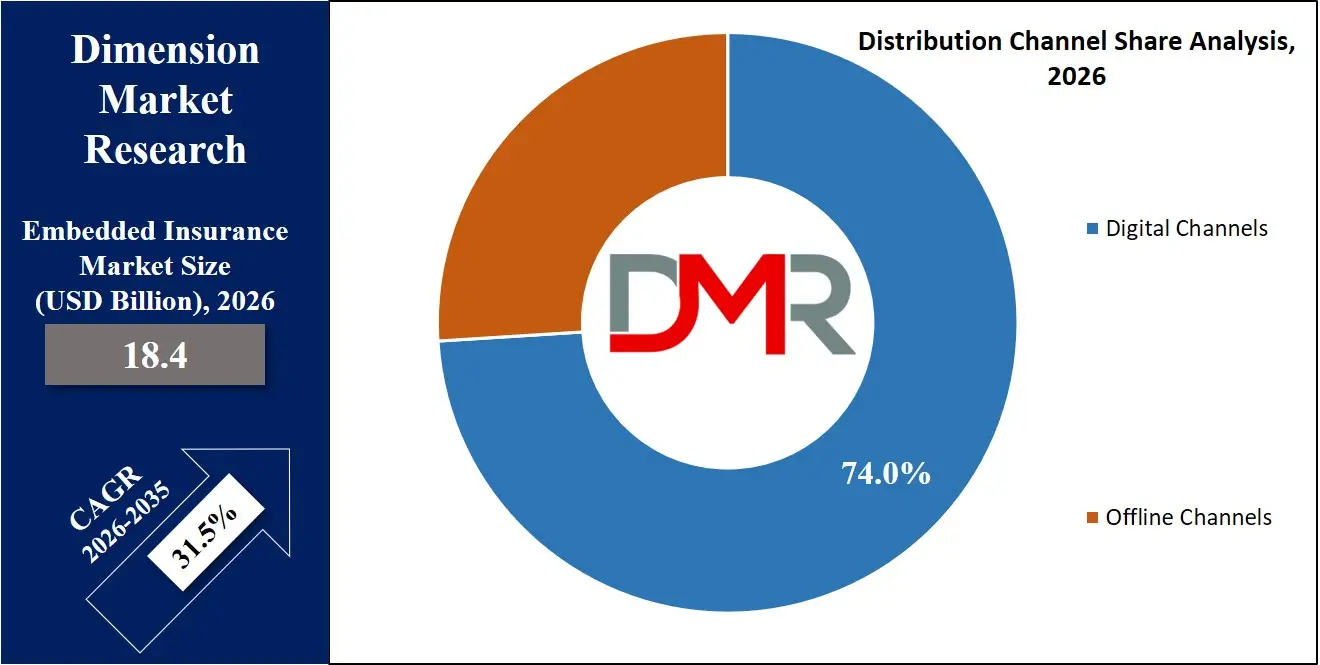
Digital communication is projected to hold a share of about 74% in 2026, owing to the increase in use of apps, online services, and APIs. The convenience provided by digital connectivity and instantaneous policy issuance and claims processing is expected to be a major driving factor. There is a growing use of an API-first approach by companies to incorporate insurance seamlessly in customer operations.
ℹ
To learn more about this report –
Download Your Free Sample Report Here
In terms of digital communication, APIs and SDKs will see the highest growth rates since they provide flexibility in integrating insurance in different platforms ranging from fintech applications to e-commerce sites and mobility services.
By Industry Vertical Analysis
The highest market share as an industry vertical belongs to e-commerce and retail, holding a 34% share in 2026. Insurance products have become popular because more and more online platforms are combining their insurance services with their product offers, thereby taking advantage of high transactions, customer engagement, and trust. In addition, retailers will gain advantages through customer loyalty and other sources of income. The second-fastest growing segment is the automotive and mobility market. Ride sharing, connected vehicles, and usage-based insurance are expected to drive growth in this area. Furthermore, insurance products in the travel and hospitality industry and consumer electronics markets are witnessing rapid growth.
By End User Analysis
The segment of individuals comprises the maximum percentage share of about 61% in 2026, since embedded insurance mainly caters to the end customers via digitization. Accessibility, affordability, and relevancy at the time of purchase make embedded insurance very compelling for individuals. Individuals enjoy easier selection of policies and faster claims settlement. SMEs stand out as the highest-growth segment by making use of embedded insurance as a means of ensuring their security. Rising digitalization trends among SMEs and the requirement of low-cost insurance are boosting the market growth for embedded insurance.
The Embedded Insurance Market Report is segmented on the basis of the following:
By Insurance Type
- Life Insurance
- Non-Life Insurance
- Property & Casualty
- Health
- Travel
- Automotive
- Cyber
By Embedding Model
- Intrinsic (Built-in)
- Opt-Out
- Opt-In
By Business Model
By Distribution Channel
- Digital Channels
- Mobile Apps
- Web Platforms
- APIs / SDKs
- Offline Channels
By Industry Vertical
- E-commerce & Retail
- Travel & Hospitality
- Automotive & Mobility
- BFSI (Banking, Financial Services & Insurance)
- Healthcare
- Consumer Electronics
- Real Estate
- Logistics & Gig Economy
By End User
- Individuals
- SMEs
- Enterprises
Regional Analysis
Leading Region in the Embedded Insurance Market
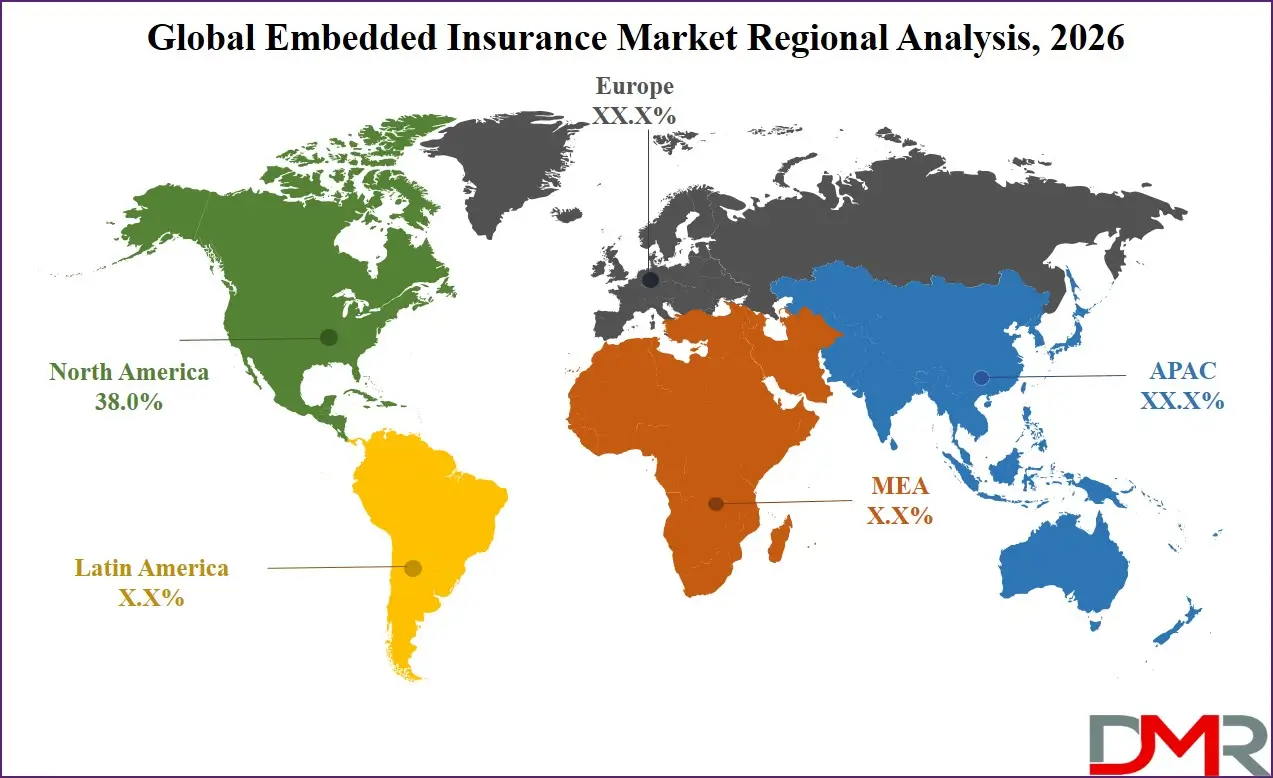
North America is the dominating region that commands a market share of about 38% in 2026. The reason behind its leading position can be attributed to the presence of highly developed digital infrastructures, efficient InsurTech ecosystems, and extensive consumer use of digital services. Well-known players in the insurance industry along with technology firms ensure steady innovations and collaborations in the region. In addition, favorable regulations for innovation help drive the market ahead while protecting consumers. Moreover, abundance in the supply of data and analytics allows for more customized insurance solutions. The inclusion of embedded insurance in areas such as finance technology, e-commerce, and mobility helps consolidate the region's dominance.
ℹ
To learn more about this report –
Download Your Free Sample Report Here
Fastest Growing Region in the Embedded Insurance Market
The Asia-Pacific region is the fastest growing region due to its fast digitalization, evolving fintech ecosystem, and widespread use of smartphones. Authorities in nations such as India and China are encouraging the use of digital financial services using favorable policy frameworks and infrastructure creation. This region has huge potential since its sizable population and untapped insurance markets offer lucrative opportunities for insurance companies and platform developers. Moreover, the emergence of super-app ecosystems and digital payment systems is boosting the uptake of embedded insurance. Consumer education combined with the need for affordable insurance solutions has also contributed to the growth of this sector. Insurance companies and local startups are actively establishing collaborations in the region.
By Region
North America
Europe
- Germany
- The U.K.
- France
- Italy
- Russia
- Spain
- Benelux
- Nordic
- Rest of Europe
Asia-Pacific
- China
- Japan
- South Korea
- India
- ANZ
- ASEAN
- Rest of Asia-Pacific
Latin America
- Brazil
- Mexico
- Argentina
- Colombia
- Rest of Latin America
Middle East & Africa
- Saudi Arabia
- UAE
- South Africa
- Israel
- Egypt
- Rest of MEA
Competitive Landscape
Competitive pressure within the embedded insurance industry is high because of innovations, collaboration, and technology adoption. The emphasis in this sector is on API integration, collaboration, and adoption of InsurTech services to outperform competitors. High barriers to entry into the industry are attributed to technology and regulation. Ongoing research and development and customer-oriented products are some of the ways firms can increase market share.
Some of the prominent players in the global Embedded Insurance are:
- Cover Genius
- bolttech
- Qover
- Slice Labs
- Trov
- Sure
- Wrisk
- Element Insurance
- Bsurance
- Companjon
- Lemonade
- Root Insurance
- Next Insurance
- Hippo
- Zego
- Wefox
- BIMA
- Getsafe
- Cuvva
- Hokodo
- Other Key Players
Recent Developments
- In April 2026, Guidewire Software launched ProNavigator, an AI assistant integrated into InsuranceSuite and InsuranceNow via its Palisades release. It helps Property and Casualty (P&C) insurers enhance decision-making, speed up implementation, and deliver role-specific insights. With secure, governed access, audit trails, and human oversight, ProNavigator ensures reliable, context-aware guidance while reducing maintenance effort and accelerating time to value.
- In March 2026, Securian Financial introduced FlexTech™, a technology platform that enables affinity groups like lenders and financial institutions to embed protection products into digital journeys. Built with Walnut, it uses APIs and modular architecture for fast, scalable integration, initially supporting payment protection products and enhancing customer-centric, in-flow coverage experiences.
- In November 2025, Chubb has launched an AI-powered optimization engine within Chubb Studio, unveiled at the Singapore FinTech Festival. The solution uses proprietary AI to deliver personalized insurance at the point of sale, helping partners boost engagement and loyalty while enabling consumers to access tailored, seamless protection within trusted digital platforms and everyday experiences.
Report Details
| Report Characteristics |
| Market Size (2026) |
USD 18.4 Bn |
| Forecast Value (2035) |
USD 216.2 Bn |
| CAGR (2026–2035) |
31.5% |
| Historical Period |
2021 – 2025 |
| Forecast Period |
2027 – 2035 |
| Base Year |
2025 |
| Estimate Year |
2026 |
| Segments Covered |
By Insurance Type (Life Insurance, Non-Life Insurance), By Embedding Model (Intrinsic (Built-in), Opt-Out, Opt-In), By Business Model (B2B2C, B2B, B2C), By Distribution Channel (Digital Channels, Offline Channels), By Industry Vertical (E-commerce & Retail, Travel & Hospitality, Automotive & Mobility, BFSI (Banking, Financial Services & Insurance), Healthcare, Consumer Electronics, Real Estate, Logistics & Gig Economy), By End User (Individuals, SMEs, Enterprises) |
| Regional Coverage |
North America – The US and Canada; Europe – Germany, The UK, France, Russia, Spain, Italy, Benelux, Nordic, & Rest of Europe; Asia-Pacific – China, Japan, South Korea, India, ANZ, ASEAN, Rest of APAC; Latin America – Brazil, Mexico, Argentina, Colombia, Rest of Latin America; Middle East & Africa – Saudi Arabia, UAE, South Africa, Turkey, Egypt, Israel, & Rest of MEA |
Frequently Asked Questions
How big is the Embedded Insurance Market?
▾ The Embedded Insurance Market size is expected to reach USD 18.4 billion by 2026 and is projected to reach USD 216.2 billion by the end of 2035.
What is the CAGR of the Embedded Insurance Market from 2026 to 2035?
▾ The market is growing at a CAGR of 31.5 percent over the forecasted period.
What factors are driving the growth of the Embedded Insurance Market?
▾ Digital ecosystem expansion, demand for personalized and on-demand coverage, and more are the factors driving the growth of the Embedded Insurance Market.
What are the major trends in the Embedded Insurance Market?
▾ Rise of API-driven insurance platforms, growth of insur-tech partnerships, and more are some of the major trends in the market.
Who are the key players in the Embedded Insurance Market?
▾ Some of the key players in the Embedded Insurance Market include Trov, Sure, Slice Labs, and more
How is the Embedded Insurance Market segmented?
▾ The Embedded Insurance Market is segmented by insurance type, embedding model, business model, distribution channel, industry vertical, and end user.
Which region held the largest share of the Embedded Insurance Market in 2026?
▾ North America is set to lead the Embedded Insurance market with an estimated 38.0% share in 2026.
Which region is expected to grow the fastest in the Embedded Insurance Market?
▾ Asia-Pacific is the fastest-growing region in the Embedded Insurance market during the forecast period.