Embodied AI Market Snapshot
- Global Embodied AI Market Size in 2026: USD 3,285.7 million
- Global Embodied AI Market Size in 2035: USD 11,581.1 million
- Global CAGR from 2026 to 2035: 15.0%
- Robots are the leading Product segment in 2026: 41.4%
- Automation and Manufacturing is the leading End User segment in 2026: 27.5%
- Autonomous Systems is the fastest-growing Product segment: 17.9% CAGR
- Automotive is the fastest-growing End User segment: 19.8% CAGR
- North America is the leading Region in 2026: 42.4%
- Asia Pacific is the fastest-growing Region: 17.1% CAGR
What is the Global Embodied AI and its Market Size?
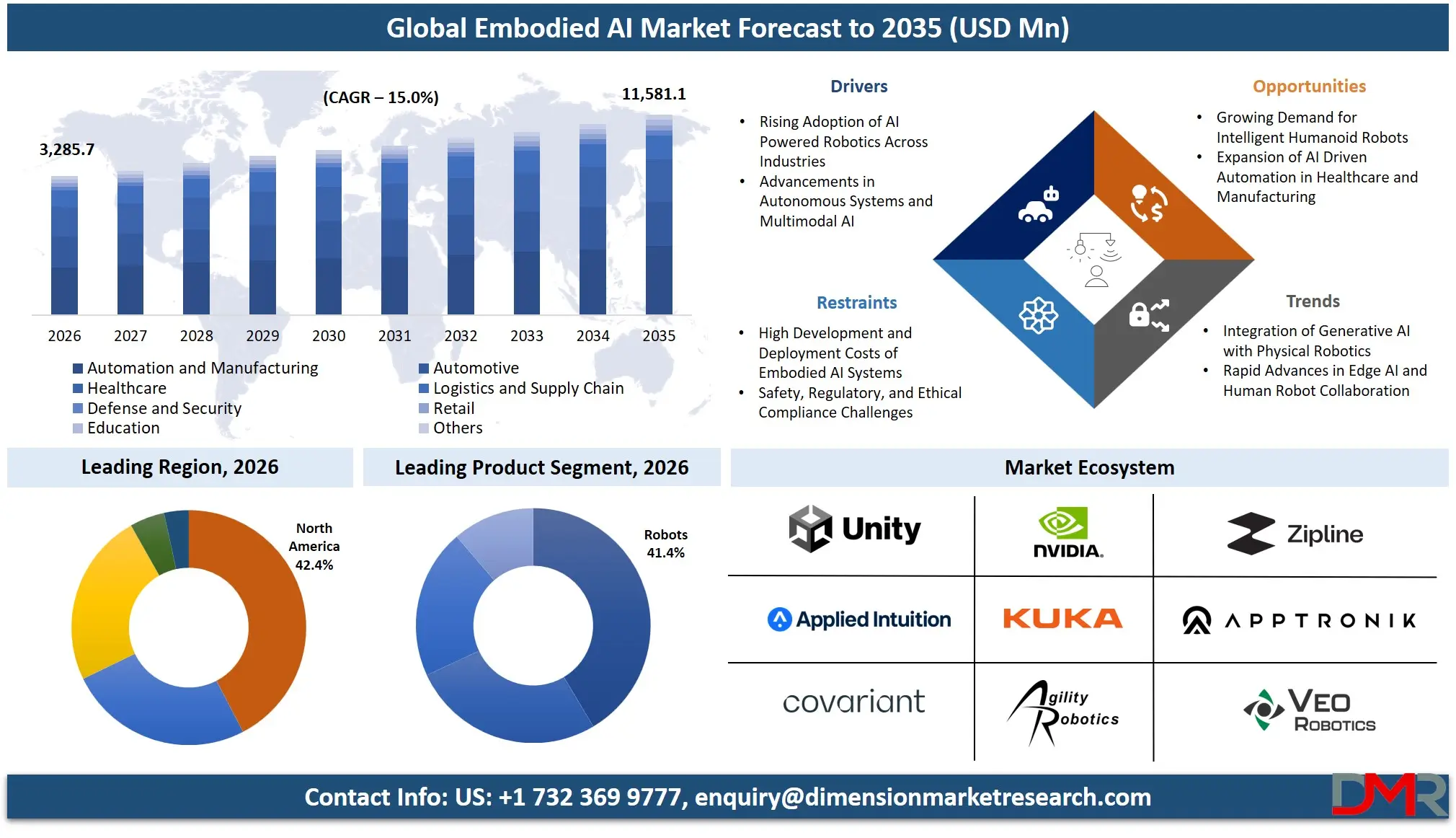
The Global Embodied AI Market size is projected to be valued at USD 3,285.7 million in 2026, and it is further anticipated to reach a market value of USD 11,581.1 million by 2035 at a CAGR of 15.0%.
ℹ
To learn more about this report –
Download Your Free Sample Report Here
Embodied AI refers to artificial intelligence integrated into physical systems that can perceive, understand, and interact with real-world environments. Unlike purely software-based AI, embodied AI combines intelligent algorithms with physical platforms such as robots, autonomous systems, exoskeletons, and smart devices. These systems use technologies such as computer vision, sensors, machine learning, reinforcement learning, and real-time decision-making to understand their surroundings and perform physical tasks with varying levels of autonomy. The market does not represent the total sales value of all industrial robots, autonomous vehicles, smart appliances, or other underlying physical hardware. Where products such as robots, exoskeletons, autonomous systems, and smart appliances are included in the segmentation, the analysis captures the embodied AI-related value associated with their intelligent capabilities rather than the entire hardware system value.
Use Cases
- Manufacturing and Industrial Automation: The use of intelligent robotics for the execution of manufacturing activities, such as assembling products, handling of materials, and processing of orders, has been seen widely in modern manufacturing. By using robotics, industries will be able to maximize productivity, decrease human error, increase accuracy, and minimize costs.
- Healthcare and Medical Robotics: Robots have started playing a very important role in healthcare by assisting surgeons and other healthcare professionals and providing assistance for diagnostic activities. The precision surgery offered by surgical robots helps in increasing efficiency in operations performed in hospitals.
- Logistics and Warehouse Operations: Automation is also making huge changes in logistics and warehouse operations by enhancing inventory management, order picking, sorting, and packaging. Such robots will help in order processing in a much more efficient manner along with reducing laborious work.
- Autonomous Transportation: Autonomous vehicles are equipped with advanced sensory and decision-making capabilities that make them self-sufficient enough to move around on their own without any human intervention. Self-driving cars have the potential of offering efficiency and safety in the process of transportation and logistics.
Key Takeaways
- Global Market Value: The global embodied AI market is projected to be valued at USD 3,285.7 million in 2026 and which is further anticipated to reach USD 11,581.1 million by 2035.
- Global Growth Rate: The global embodied AI market is expected to have a compound annual growth rate (CAGR) of 15.0% during the forecast period from 2026 to 2035.
- Technology Trends: The growing trend of advancements in robotics, machine learning, computer vision, and edge computing technologies is increasing the implementation of embodied artificial intelligence in manufacturing, health care, logistics, and mobility.
- Market Drivers: Increasing demand for automation in the industry, labor shortage, and operational efficiency and precision requirements are some of the drivers of the global embodied artificial intelligence market.
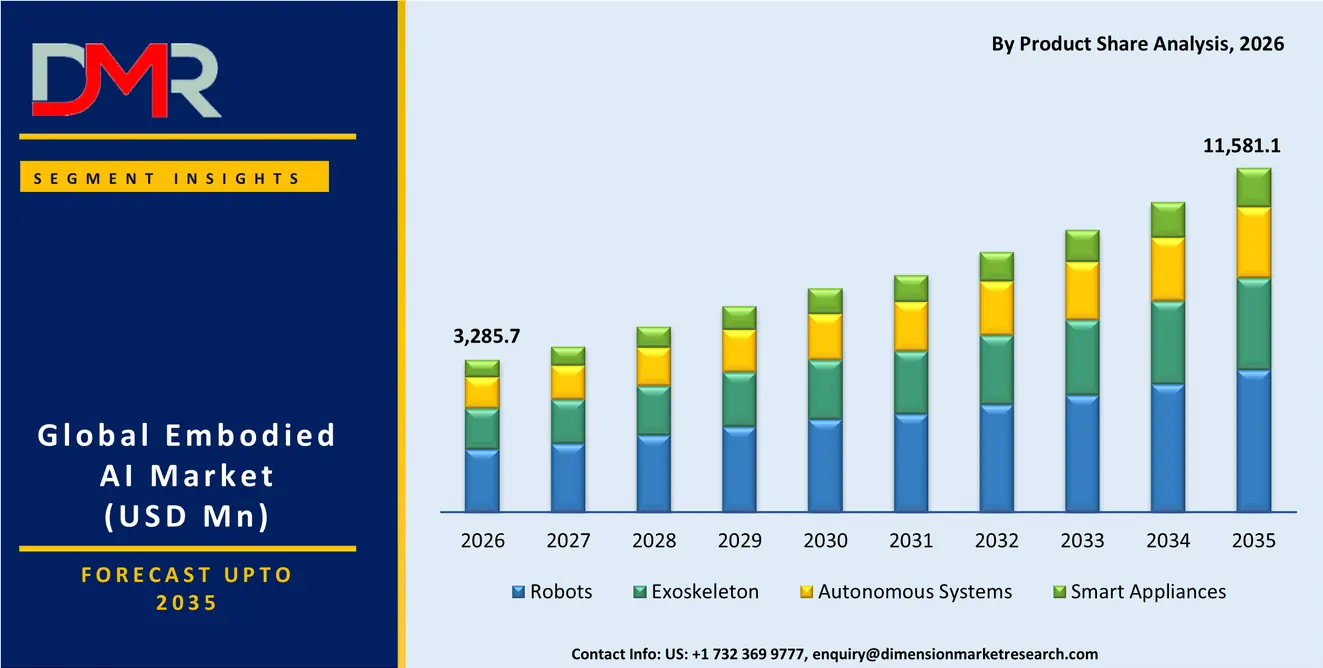
- Product Segment Analysis: The Robots segment is anticipated to be the largest product segment, having a market share of 41.4% by the end of 2026. Whereas the Autonomous Systems segment is expected to be the fastest-growing segment with a CAGR of 17.9% from 2026 to 2035.
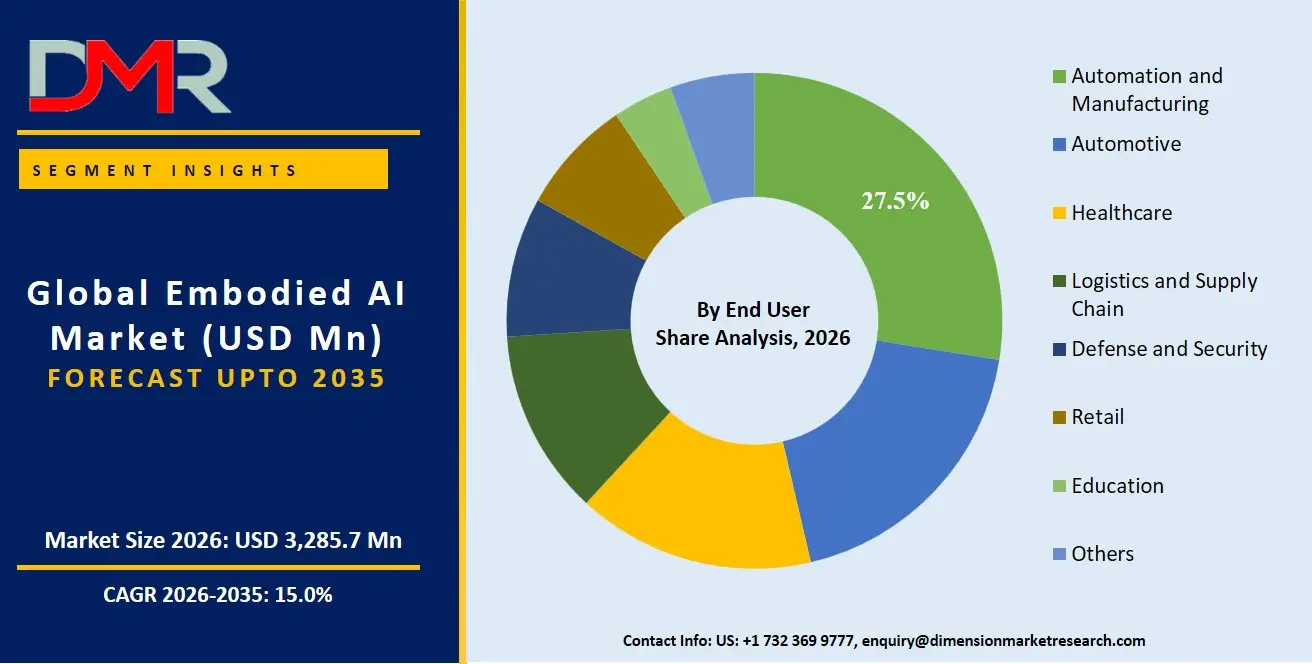
- End User Segment Analysis: Automation and Manufacturing is the major end-user segment, representing the highest market share of 27.5% in 2026, while the Automotive segment is projected to have the highest growth rate with a CAGR of 19.8% during the forecast period.
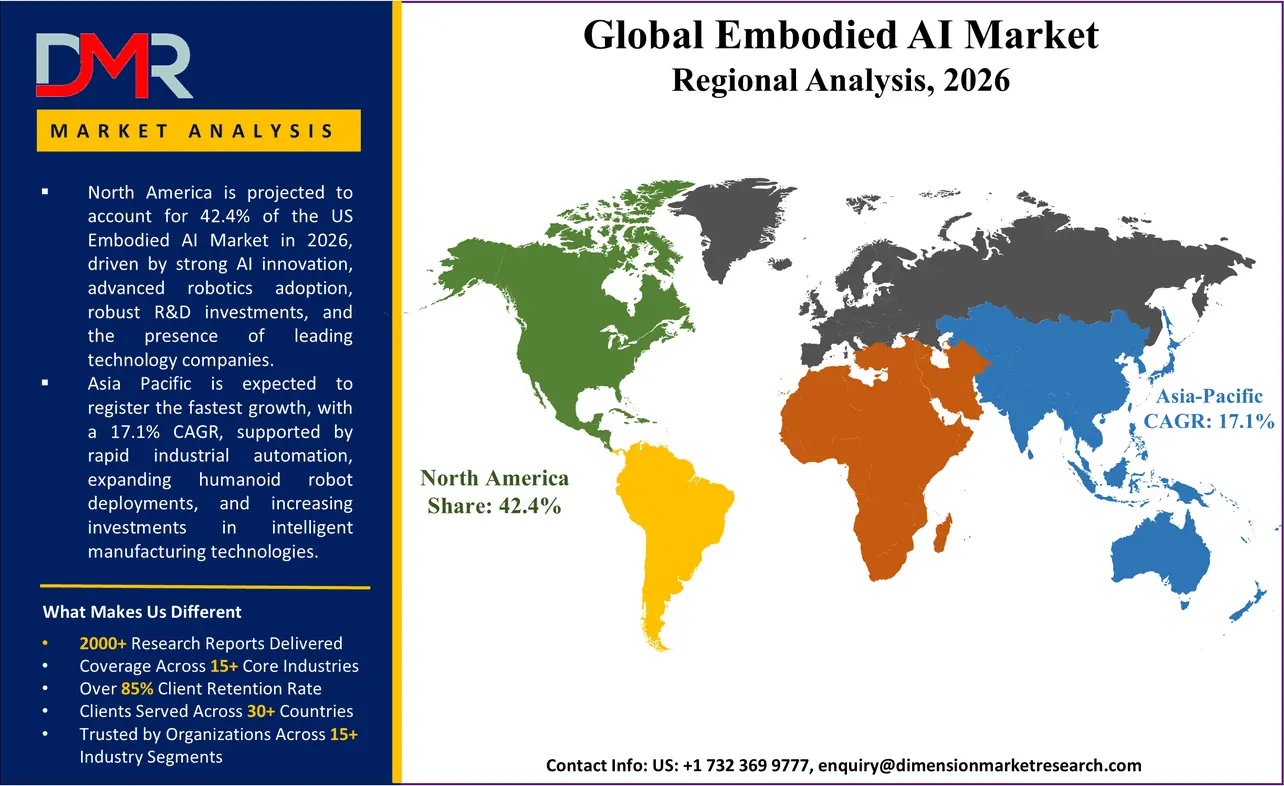
- Regional Analysis: The North America region is poised to hold the largest market share of 42.4% in the global market in 2026. While the Asia Pacific region is expected to be the fastest-growing region with a CAGR of 17.1% during the forecast period.
How AI/Gen AI is Transforming the Embodied AI Market?
Artificial Intelligence (AI) and Generative AI (GenAI) are facilitating rapid advances in the area of embodied AI through advanced capabilities such as perception, reasoning, learning, and interaction that help robots and other autonomous systems perform operations in an environment. With large language models and multimodal AI, robots are capable of understanding voice instructions as well as interpreting visual input. The use of GenAI also helps in making robots better trained through the use of simulation and synthetic data, thus minimizing the costs involved in development and improving adaptability. In the fields of manufacturing, healthcare, logistics, automotive, and other industries, intelligent systems are increasingly able to handle complex operations with little or no human intervention. Further enhancements are achieved through reinforcement learning, computer vision, and edge AI, among others.
Key Drivers in the Global Embodied AI Market
Increasing Demand for Industrial Automation
The increasing demand for industrial automation is a major driver of the embodied AI market. Manufacturing, logistics, warehousing, and other industrial sectors are deploying AI-enabled robots and autonomous systems to improve productivity, reduce repetitive manual work, increase operational precision, and optimize workflows. Embodied AI allows machines to perceive their surroundings, interpret real-time information, and adapt their actions according to changing operating conditions. The growing need to address labor shortages, improve workplace safety, and maintain consistent production quality is further supporting adoption. Continued investment in smart factories, warehouse automation, collaborative robots, and intelligent material-handling systems is therefore expected to strengthen demand for embodied AI technologies.
Growing Adoption of Autonomous Systems
The expanding adoption of autonomous systems across automotive, logistics, defense, manufacturing, and transportation is another major factor driving the embodied AI market. These systems combine artificial intelligence, computer vision, sensors, machine learning, and real-time decision-making technologies to interact with physical environments with limited human intervention. Autonomous vehicles, mobile robots, drones, and intelligent industrial machines are increasingly being developed to improve safety, productivity, navigation, and resource utilization. Improvements in AI computing, perception systems, edge processing, and sensor technologies are making autonomous platforms increasingly capable of performing complex physical tasks, supporting continued adoption of embodied AI solutions.
Restraints in the Global Embodied AI Market
Data Privacy and Regulatory Challenges
One of the major hindrances to the growth in the Embodied AI market is due to growing concern for data privacy and the stringent regulations governing the use of AI systems. Most AI-operated robots and systems require huge quantities of user data for effective execution. With the development of information technology, many concerns have cropped up about the collection, processing, transmission, and storage of this data, particularly in sensitive sectors such as health and finance. This has raised great concerns about data privacy. Stringent data protection laws, such as Europe's GDPR, restrict the actual deployment of AI solutions and hence pose a challenge for AI solution providers.
High Costs of Implementation
High initial development and implementation costs remain an important restraint on the adoption of embodied AI systems. Deploying intelligent robots and autonomous platforms can require substantial investment in robotic hardware, sensors, AI processors, software, integration, employee training, cybersecurity, and supporting infrastructure. These costs can be particularly challenging for small and medium-sized enterprises and organizations operating in price-sensitive industries. Complex implementation requirements and uncertain utilization levels can also extend the payback period and delay the return on investment. As a result, some organizations may adopt embodied AI gradually or prioritize applications where productivity, safety, labor savings, or operational improvements provide a clearer economic benefit.
Growth Opportunities in the Global Embodied AI Market
Expansion of Healthcare and Medical Robotics
Healthcare represents an important growth opportunity within the embodied AI market as AI-enabled robotics expands across surgical assistance, rehabilitation, mobility support, diagnostics, patient monitoring, and care delivery. Increasing healthcare automation requirements, aging populations, and advances in human-machine interaction are supporting adoption. Although Automotive is projected to be the fastest-growing end-user segment during the forecast period, healthcare is expected to remain an attractive application area due to the increasing deployment of intelligent robotic and assistive systems across clinical and rehabilitation environments.
Expansion of AI-Enabled Autonomous Mobility
The continued development of autonomous vehicles and intelligent mobility systems presents a substantial opportunity for embodied AI companies. Automotive manufacturers and technology developers are investing in AI systems capable of perception, navigation, planning, object recognition, and real-time decision-making. Embodied AI technologies can support autonomous passenger vehicles, delivery vehicles, warehouse transport systems, industrial mobility platforms, and other autonomous machines. As autonomous driving and advanced driver-assistance technologies become more sophisticated, demand is expected to increase for AI software, sensors, simulation platforms, computing systems, and intelligent control technologies. This creates opportunities for companies developing the perception and decision-making layers required for machines to interact safely with physical environments.
Trends in the Global Embodied AI Market
Increasing Adoption Across Industries
Embodied AI adoption is increasing across healthcare, manufacturing, automotive, logistics, retail, defense, and other industries. Organizations are applying intelligent physical systems across a wide range of applications, from supply chain automation and warehouse operations to AI-assisted healthcare and autonomous mobility. As companies seek to improve productivity, operational efficiency, safety, and workforce utilization, the integration of machine learning, computer vision, natural language processing, robotics, and autonomous control systems is gaining momentum.
Advances in AI and Robotics
Advances in artificial intelligence and robotics are continuously enhancing the capabilities of embodied AI systems. Developments in machine learning, deep learning, computer vision, reinforcement learning, sensor technologies, and AI processing are enabling robots to perform increasingly complex physical tasks with greater precision, speed, and adaptability. Current applications include industrial automation, autonomous navigation, inspection, material handling, and data collection. Continued improvements in robotic hardware, edge computing, AI processors, and intelligent control systems are expected to expand embodied AI adoption across a growing range of industries.
Research Scope and Analysis
The global embodied AI market is segmented by product into Robots, Exoskeletons, Autonomous Systems, and Smart Appliances. Within this study, revenue associated with these categories represents the embodied AI technology and intelligence layer integrated into or enabling these physical systems rather than the complete value of the underlying machines or vehicles.
ℹ
To learn more about this report –
Download Your Free Sample Report Here
By Product Analysis
Robots are projected to dominate the product segment in the embodied AI market as they will hold 41.4% of the total market share in 2026. The dominance is due to their highly widespread application and proven ability for operational efficiency enhancement. Robotics has taken center stage in the global embodied AI market with the growing momentum of autonomous robots across the manufacturing, healthcare, and logistics sectors.
ℹ
To learn more about this report –
Download Your Free Sample Report Here
While autonomous systems are poised to have the highest CAGR of 17.9% during the forecast period (2026-2035) in the product segment, as they are run by machines and systems using AI and without human interference, they can accomplish complex tasks and have thus proven necessary in those fields that rely on gaining advantages through cost savings and increased productivity.
By End User Analysis
Automation and manufacturing are expected to be the leading end-user segment in the embodied AI market, as it is poised to hold 27.5% of the market share by the end of 2026. Automation and manufacturing are dominating the end-user segment in the Embodied AI market due to their high dependency on efficiency, productivity, and cost-effectiveness. Autonomous robots and intelligent machines are a revolutionary solution for streamlining operations, minimizing human error, and enhancing precision in manufacturing processes. On the other hand, Automotive is projected to be the fastest-growing end-user segment, registering a CAGR of 19.8% during 2026-2035. Growth is primarily supported by increasing investment in autonomous driving, advanced driver-assistance systems, AI-based perception, real-time decision-making, sensor fusion, and intelligent mobility platforms. Automotive manufacturers and technology companies are increasingly integrating computer vision, machine learning, edge computing, and autonomous control systems to improve vehicle safety, navigation, operational intelligence, and driving automation.
The Global Embodied AI Market Report is segmented based on the following:
By Product
- Robots
- Humanoid Robots
- Mobile Robots
- Industrial Robots
- Service Robots
- Cobots (Collaborative Robots)
- Exoskeleton
- Autonomous Systems
- Smart Appliances
By End User
- Automation & Manufacturing
- Factory Automation
- Quality Control and Inspection
- Healthcare
- Robotic Surgery and Assistance
- Patient Care and Rehabilitation
- Medical Imaging and Diagnostics
- Automotive
- Autonomous Vehicles
- Driver Assistance Systems (ADAS)
- Logistics and Supply Chain
- Autonomous Delivery Systems
- Warehouse Automation
- Defense and Security
- Autonomous surveillance drones
- Search and Rescue Operations
- Autonomous Combat Systems
- Retail
- Customer Service Robots
- In-Store Robotics for Inventory Management
- Personalized Shopping Assistants
- Education
- Teaching Robots
- Interactive Learning Systems
- AI Tutors
- Others
Regional Analysis
North America is the Leading Region in the Global Embodied AI Market
The North American market is anticipated to be the leader of the global embodied AI market, as it is poised to take up 42.4% of the entire market share in 2026. This market domination is attributed to significant investment made in the field of artificial intelligence, robotics, and automation technology from big technology firms, in addition to a thriving industrial base in the region. Adoption of intelligent robotic technology in manufacturing, healthcare, logistics, and defense industries still remains high and helps drive the market growth.
ℹ
To learn more about this report –
Download Your Free Sample Report Here
Asia Pacific is the Fastest-Growing Region in the Global Embodied AI Market
The Asia Pacific region is anticipated to have the fastest-growing regional market at a compound annual growth rate of 17.1% over the forecast period of 2026 to 2035. Industrialization, automation in manufacturing plants, and high investment in artificial intelligence and robotics are boosting the growth of the regional market. Countries like China, Japan, South Korea, and India are investing substantially in smart manufacturing, robotics, and intelligent logistics solutions. Government initiatives towards digitization and Industry 4.0, along with the rising demand for labor-saving technology, are boosting the adoption of this technology in many sectors.
Europe Embodied AI Market
The Europe Embodied AI Market is estimated to reach approximately USD 716.3 million in 2026 and is projected to expand at a CAGR of around 14.0% during the forecast period, reaching approximately USD 2,329.3 million by 2035. Europe benefits from a well-established industrial automation ecosystem and strong adoption of robotics across automotive production, manufacturing, healthcare, logistics, and other industries. Germany, France, the UK, Italy, and other European economies continue to invest in intelligent manufacturing, autonomous systems, and advanced robotics. Digital transformation initiatives, Industry 4.0 programs, industrial labor requirements, and continued investment in AI research are expected to support market expansion.
Latin America Embodied AI Market
The Latin America Embodied AI Market is estimated at approximately USD 177.4 million in 2026 and is projected to grow at a CAGR of around 14.0% through 2035, reaching approximately USD 577.0 million. Market development is being supported by increasing industrial automation, modernization of logistics infrastructure, and gradual adoption of AI-enabled robotics across manufacturing, agriculture, warehousing, healthcare, and other industries. Brazil and Mexico are expected to remain the major contributors to regional demand due to their comparatively large manufacturing bases and growing investment in digital technologies. Increasing awareness of productivity-enhancing automation is expected to further support embodied AI adoption.
Middle East and Africa (MEA) Embodied AI Market
The Middle East and Africa Embodied AI Market is estimated to reach approximately USD 190.6 million in 2026 and is projected to expand at a CAGR of around 16.0% through 2035, reaching approximately USD 726.0 million. Market growth is supported by investment in smart cities, logistics automation, advanced manufacturing, healthcare technology, autonomous systems, and digital transformation programs. Saudi Arabia and the UAE are emerging as important markets due to national programs focused on artificial intelligence, automation, and economic diversification. In Africa, adoption remains comparatively early-stage, although robotics and intelligent automation are gaining attention in mining, industrial operations, logistics, and infrastructure development.
Major Countries Analysis
United States Embodied AI Market
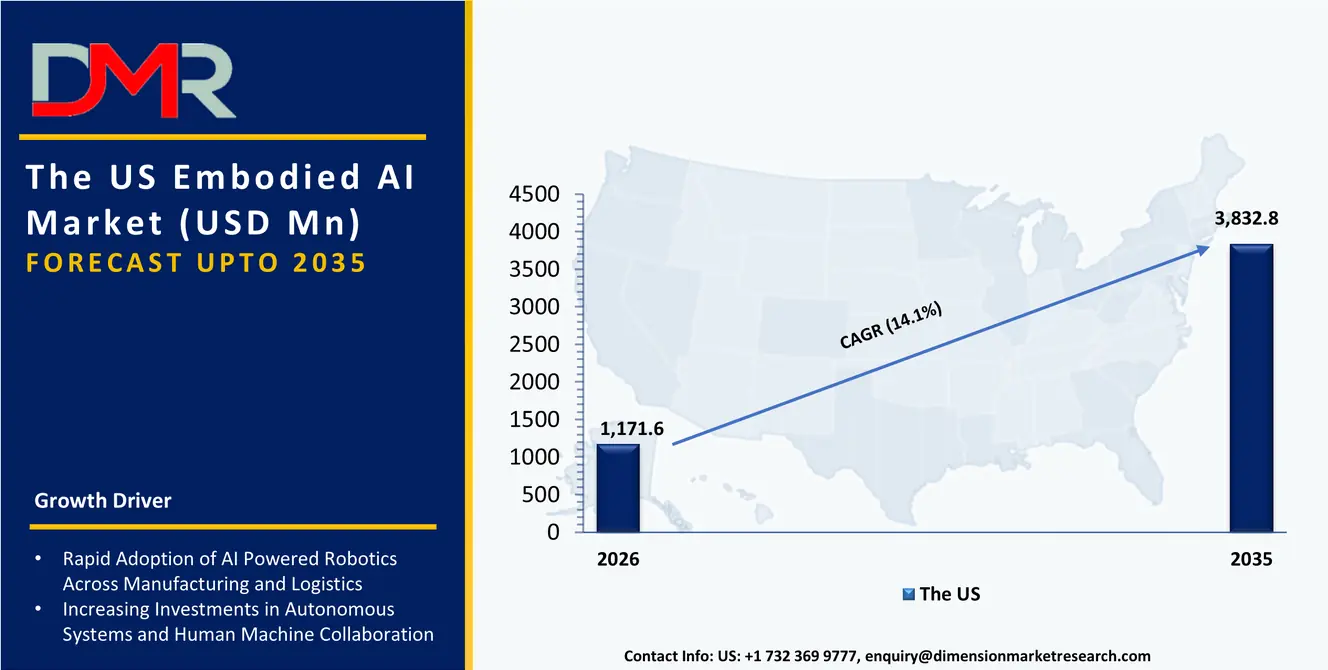
The US Embodied AI Market is projected to be valued at USD 1,171.6 million in 2026. It is expected to witness subsequent growth in the upcoming period, reaching USD 3,832.8 million in 2035 at a CAGR of 14.1%. The US-embodied AI market is at the forefront of technological developments and innovations. Robotics and AI technologies have hit many industries, including manufacturing, healthcare, and logistics, accelerating recent years of growth in the embodied AI systems market. In addition, autonomous vehicles and industrial robots have found increased adoption in the US in recent times, an indication of rising demand for automation and operational efficiency.
ℹ
To learn more about this report –
Download Your Free Sample Report Here
Japan Embodied AI Market
Japan represents one of the important embodied AI markets within Asia Pacific due to its advanced robotics industry, established manufacturing ecosystem, and growing need for labor-saving technologies. The country's aging population and workforce constraints are supporting investment in service robots, industrial automation, healthcare robotics, logistics systems, and intelligent mobility solutions. Japanese manufacturers are also integrating artificial intelligence, computer vision, advanced sensing, and autonomous control technologies into industrial and service robotics. Demand is expected to expand as embodied AI systems become increasingly capable of performing complex physical tasks alongside human workers.
Saudi Arabia Embodied AI Market
Saudi Arabia is emerging as an important embodied AI market in the Middle East as investment increases in artificial intelligence, smart infrastructure, logistics automation, industrial robotics, autonomous mobility, and intelligent healthcare systems. Vision 2030-related digital transformation and economic diversification initiatives are encouraging public and private organizations to adopt advanced automation technologies. Smart-city development, logistics expansion, industrial modernization, and increasing investment in AI infrastructure are expected to create opportunities for embodied AI applications. The country's developing technology ecosystem may also support growing demand for autonomous robots, intelligent transportation systems, and AI-enabled industrial solutions.
Regulatory Landscape
The embodied AI market operates under an ever-changing set of laws that govern AI ethics, robot safety, cybersecurity, data protection, and autonomy of systems. AI governance systems are being developed in governments all over North America, Europe, and Asia Pacific that stress the need for transparency, accountability, human supervision, and responsible utilization of AI technology. The international safety standards for collaborative robots, autonomous vehicles, and medical robots keep impacting product design and market entry.
Investment and White Space Analysis
Increasing levels of investment in robotics, generative AI, computer vision, and autonomous systems are contributing to innovation within the embodied AI ecosystem. Venture capital, technology organizations, and governments are investing in intelligent robots of the next generation to be used in various sectors, such as manufacturing, health care, logistics, retail, and transportation. There is immense potential for innovations in areas like AI-powered service robots, elderly care robots, automated warehouses, agricultural robots, smart infrastructures, and autonomous systems based on edge AI. Developing nations present many opportunities as well.
By Region
North America
Europe
- Germany
- France
- The U.K.
- Italy
- Spain
- Rest of Europe
Asia-Pacific
- China
- Japan
- India
- Australia
- South Korea
- Rest of APAC
Latin America
- Mexico
- Brazil
- Argentina
- Colombia
- Rest of LATAM
Middle East & Africa
- Saudi Arabia
- The UAE
- South Africa
- Rest of MEA
Competitive Landscape
The global embodied AI market includes robotics manufacturers, artificial intelligence developers, autonomous-system companies, industrial automation providers, and specialized physical-AI technology companies. Leading participants are investing in humanoid robots, autonomous mobile robots, industrial robotics, foundation models for robotics, computer vision, simulation, intelligent control, and AI-enabled mobility. Companies such as Boston Dynamics, Figure AI, Tesla, Apptronik, Agility Robotics, Unitree Robotics, and UBTECH Robotics are advancing humanoid and general-purpose robotic platforms, while NVIDIA, Google DeepMind, Physical Intelligence, and other AI developers are expanding technologies that support perception, reasoning, simulation, and robotic learning. Healthcare-oriented companies such as Ekso Bionics and Lifeward contribute to the development of intelligent exoskeleton and rehabilitation solutions. The competitive environment is expected to remain innovation-intensive as companies combine artificial intelligence with increasingly capable physical systems.
Some of the prominent players in the Global Embodied AI Market are:
- Figure AI
- Applied Intuition
- 1X Technologies
- NEURA Robotics
- Agile Robots
- UBTECH Robotics
- Physical Intelligence
- Unitree Robotics
- Apptronik
- Boston Dynamics
- Fourier Intelligence
- Galbot
- Agility Robotics
- Honda
- Exotec
- FieldAI
- Tesla
- Geek+
- Palladyne AI Corp.
- Skild AI
- Dexterity
- LimX Dynamics
- Pudu Robotics
- Locus Robotics
- EngineAI
- Dobot
- Gecko Robotics
- Rokae Robotics
- Keenon Robotics
- Ekso Bionics
- Lifeward Ltd.
- Amazon Robotics
- FarmWise
- Zipline
- Avidbots
- NVIDIA
- Google DeepMind
- Symbotic
- Unity Technologies
- KUKA
- Other Key Players
Recent Developments
- January 2026: Boston Dynamics unveiled the production version of its electric Atlas humanoid robot and began manufacturing the platform, with initial 2026 deployments planned for Hyundai Motor Group and Google DeepMind.
- April 2026: Figure reported that its BotQ facility had produced more than 350 Figure 03 humanoid robots and demonstrated a manufacturing cycle time of approximately one robot per hour as the company continued to scale production.
- January 2026: Tesla reported that preparations were underway for the first production line for its next-generation Optimus humanoid robot. The company stated that its Gen 3 design is intended for mass production and that production is planned to begin before the end of 2026, highlighting continued investment in scaling general-purpose humanoid robotics.
- July 2026: Boston Dynamics' electric Atlas continued deployments to Hyundai's RMAC facility and Google DeepMind, with the company confirming its entire 2026 production run was fully committed, leaving no additional units available for new customers this year.
Report Details
| Report Characteristics |
| Market Size (2026) |
USD 3,285.7 Mn |
| Forecast Value (2035) |
USD 11,581.1 Mn |
| CAGR (2026–2035) |
15.0% |
| The US Market Size (2026) |
USD 1,171.6 Mn |
| Historical Data |
2021 – 2025 |
| Forecast Data |
2026 – 2035 |
| Base Year |
2025 |
| Estimate Year |
2026 |
| Segments Covered |
By Product, and By End User |
| Regional Coverage |
North America – The US and Canada; Europe – Germany, France, The UK, Italy, Spain, Rest of Europe; Asia-Pacific – China, Japan, India, Australia, South Korea, Rest of APAC; Latin America – Mexico, Brazil, Colombia, Argentina, Rest of LATAM; Middle East & Africa – Saudi Arabia, The UAE, South Africa, Rest of MEA |
Frequently Asked Questions
How big is the Embodied AI Market?
▾ The global embodied AI market is projected to be valued at USD 3,285.7 million in 2026 and is expected to reach USD 11,581.1 million by 2035.
What is the CAGR of the Embodied AI Market from 2026 to 2035?
▾ The global embodied AI market is anticipated to grow at a compound annual growth rate (CAGR) of 15.0% during the forecast period from 2026 to 2035.
What factors are driving the growth of the Embodied AI Market?
▾ The market is driven by increasing demand for industrial automation, rapid advancements in artificial intelligence and robotics, growing adoption of autonomous systems, rising investments in AI research and development, and expanding applications across manufacturing, healthcare, logistics, automotive, and retail sectors.
What are the major trends in the Embodied AI Market?
▾ Key market trends include the increasing adoption of embodied AI across multiple industries, advancements in robotics, computer vision, reinforcement learning, edge AI, generative AI, and the integration of intelligent automation into manufacturing, logistics, and healthcare operations.
Which region held the largest share of the Embodied AI Market in 2026?
▾ North America is poised to hold the largest share of the global embodied AI market in 2026, accounting for 42.4% of the total market.
Which region is expected to grow the fastest in the Embodied AI Market?
▾ Asia Pacific is projected to be the fastest-growing regional market during the forecast period, registering a CAGR of 17.1%.
Who are the key players in the Embodied AI Market?
▾ Major companies operating in the market include Figure AI, Applied Intuition, 1X Technologies, NEURA Robotics, Agile Robots, UBTECH Robotics, Physical Intelligence, Unitree Robotics, Apptronik, World Labs, Fourier Intelligence, Galbot, Agility Robotics, Rokae Robotics, Keenon Robotics, Dyna Robotics, Genesis AI, Covariant, FarmWise, Zipline, Avidbots, NVIDIA, Scale AI, Veo Robotics, Unity Technologies, KUKA, and other key players.
How is the Embodied AI Market segmented?
▾ The market is segmented by Product into Robots, Exoskeletons, Autonomous Systems, and Smart Appliances. By End User, it is segmented into Automation & Manufacturing, Healthcare, Automotive, Logistics & Supply Chain, Defense & Security, Retail, Education, and Others. Geographically, the market is analyzed across North America, Europe, Asia Pacific, Latin America, and the Middle East & Africa.