Market Overview
The Emotion Detection and Recognition market covers hardware and software systems that identify, classify, and interpret human emotional states using biometric, acoustic, visual, and behavioral signals. The market spans facial expression recognition cameras, EEG and galvanic-skin-response sensors, eye-tracking devices, voice and speech analytics engines, and AI-powered platforms that integrate these modalities into real-time decision systems. The market excludes general-purpose surveillance cameras and unimodal biometric identification products where emotion interpretation is not the primary function.
EDR sits at the intersection of affective computing, behavioral AI, and human-machine interaction. Buyers range from hospitals and automotive OEMs to retail chains, governments, and media companies, each pulling the technology toward different use cases and data requirements. As reported by the OECD, 20.2% of firms reported using AI in 2025, up from 14.2% in 2024, a trajectory that directly expands the enterprise base capable of deploying and integrating emotion analytics at scale.
AI reshapes EDR at the model and infrastructure levels simultaneously. Smaller, faster models now run emotion inference at the edge, reducing latency and removing dependence on cloud connectivity for real-time applications such as driver monitoring and in-hospital patient observation. Vendors that embed AI natively into their platforms gain a structural cost and speed advantage over those offering standalone hardware or rules-based software.
Key Takeaways
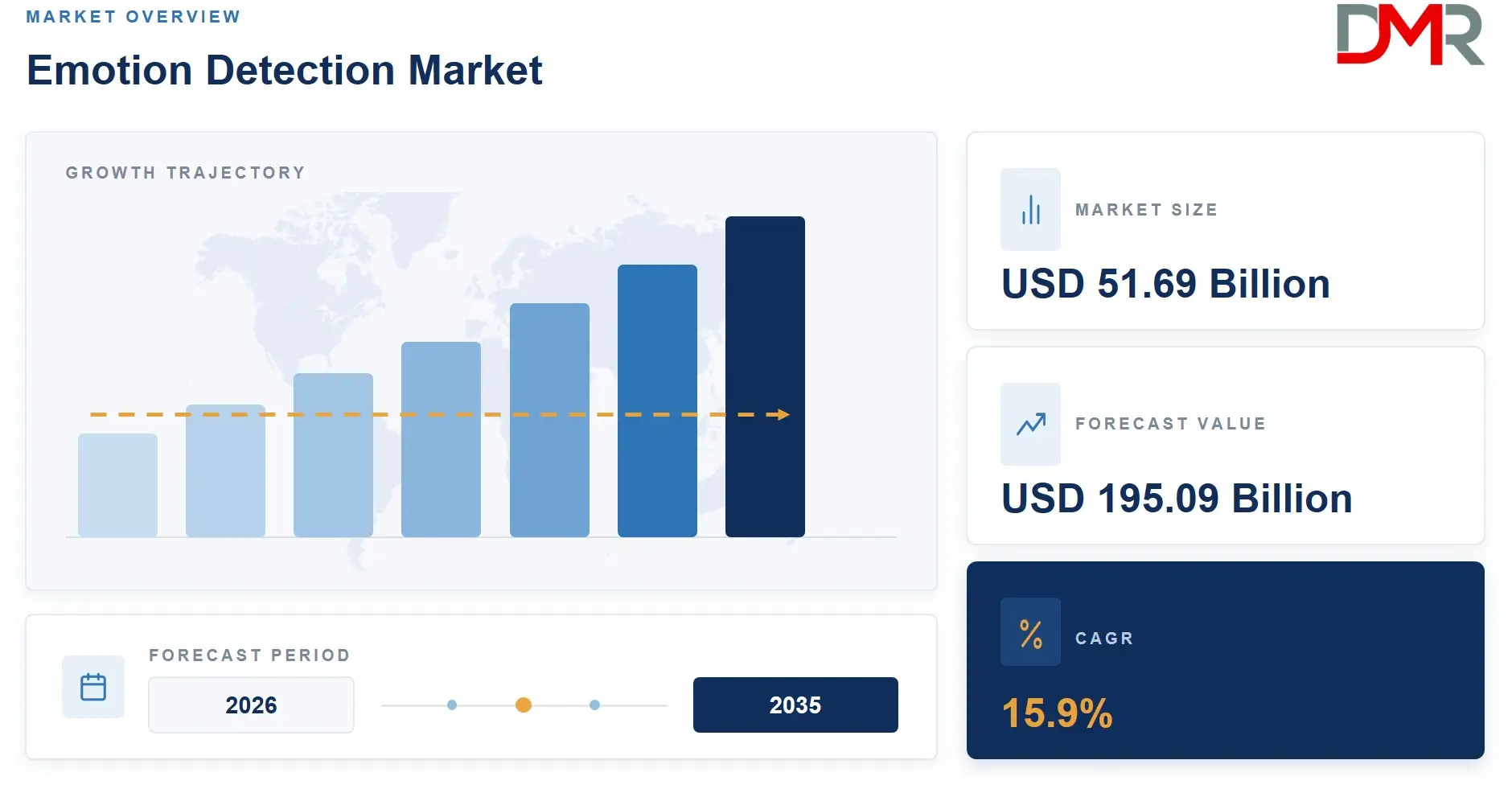
- The market size is USD 51.69 Billion in 2026, and is projected to hit USD 195.09 Billion by 2035 at a CAGR of 15.9%.
- By Component: Hardware led the largest category with a 56.6% share in 2025.
- By Software Tool / Modality: Facial Expression and Emotion Recognition led with a 39.9% share in 2025.
- By Technology: Machine Learning led with a 43.5% share in 2025.
- By Application: Customer Experience Management led with a 30.8% share in 2025.
- By End User: Government Agencies led with a 34.9% share in 2025.
- By Deployment Model: Cloud led as the largest category in 2025.
- By Region: North America led with a 36.8% share, valued at USD 16.41 Billion, in 2025.
- AI model miniaturization and falling inference costs are enabling EDR deployment in edge environments that were previously cost-prohibitive, opening new verticals in automotive and healthcare.
Market Size and Forecast
The Global Emotion Detection and Recognition Market size is estimated at USD 51.69 Billion in 2026, and is projected to reach USD 195.09 Billion by 2035, exhibiting a CAGR of 15.9% during the forecast period.
ℹ
To learn more about this report –
Download Your Free Sample Report Here
Historical growth in EDR reflects two converging forces: the maturation of deep-learning vision models and the proliferation of edge-capable hardware at falling unit costs. Between 2020 and 2024, enterprise pilot programs in retail and automotive converted into production deployments, creating a recurring revenue base that stabilizes vendor income and raises switching costs. The forecast assumes continued model performance improvements, expanding regulatory acceptance of emotion analytics in healthcare and transport safety, and rising enterprise AI budgets across North America and Asia Pacific.
Microsoft announced approximately $80 billion of fiscal-2025 investment in AI-enabled data centers worldwide, a capital commitment that expands the cloud infrastructure upon which many EDR software platforms depend for training, storage, and real-time inference at scale. Downside risk to the forecast centers on regulatory restriction in the European Union and tightening data-privacy standards that could limit facial and biometric data collection in key verticals. Upside risk exists if automotive OEMs accelerate driver-monitoring mandates ahead of regulatory deadlines, pulling forward procurement cycles by 12 to 18 months.
Component Analysis
Hardware accounted for 56.6% of component demand in 2025, the highest of any category.
.webp)
ℹ
To learn more about this report –
Download Your Free Sample Report Here
Hardware's majority position reflects the physical infrastructure required before any emotion analytics software can function. Cameras, sensors, and IoT-enabled devices represent capital expenditure decisions, and buyers in healthcare, automotive, and government tend to procure hardware on multi-year refresh cycles, creating predictable revenue floors for suppliers. The sub-segment includes 2D and 3D cameras, infrared and RGB imaging units, EEG and galvanic-skin-response sensors, eye-tracking arrays, and wearable biometric devices.
Software now captures a smaller share but grows faster, driven by AI-powered emotion analytics platforms, sentiment and NLP engines, facial expression APIs, and behavioral analytics tools. Buyers increasingly license software separately from hardware, a shift that compresses hardware average selling prices while expanding software margins. Vendors who sell hardware alongside proprietary software lock-in ecosystems that resist displacement from open-source alternatives.
Software Tool / Modality Analysis
Facial Expression and Emotion Recognition captured 39.9% of the Software Tool / Modality segment in 2025, ahead of all rivals.
Facial recognition dominates because camera-based systems offer the lowest sensor integration cost and the broadest existing infrastructure base, from retail checkout cameras to vehicle cabins. The modality benefits from decades of academic research and large labeled datasets that continue improving model accuracy without proportional cost increases. NHTSA recorded 39,254 deaths in U.S. motor vehicle crashes in 2024, a statistic that reinforces the safety case for always-on facial monitoring in driver assistance systems.
Speech and voice recognition ranks second, gaining share in call-center customer experience and telehealth platforms where camera access is limited or culturally restricted. Gesture and posture recognition and bio-sensing tools remain nascent but command premium pricing in clinical and research settings where multi-modal fusion raises diagnostic confidence.
Technology Analysis
With a 43.5% share in 2025, Machine Learning outpaced all other Technology categories.
Machine learning leads because it underpins every other modality in Emotion Detection Market , from computer vision classifiers that parse facial micro-expressions to NLP models that extract sentiment from speech. The share reflects architectural reality: no competitive emotion recognition product ships today without an ML core. Buyers selecting platforms implicitly select the underlying ML stack, making model accuracy, inference speed, and retraining frequency the real purchase criteria.
Natural Language Processing gains traction in customer experience and marketing analytics where text and voice data volumes exceed video. Computer vision and 3D modeling serve high-security and clinical applications where spatial accuracy justifies higher cost. Bio-sensor technology remains the smallest category by revenue but carries the highest data richness per interaction, an attribute that healthcare providers and clinical researchers increasingly prioritize over camera-only solutions.
Application Analysis
Customer Experience Management led the Application segment with a 30.8% share in 2025.
Customer experience commands the largest application share because ROI is measurable and immediate. Retailers, contact centers, and e-commerce platforms can directly correlate emotion signals with purchase behavior, churn probability, and service escalation rates, producing business cases that clear procurement hurdles faster than in regulated verticals. The application integrates directly into CRM and marketing automation workflows, reducing implementation friction for enterprise buyers.
Healthcare and medical diagnostics is the fastest-growing application, pulled by pain assessment, neurological disorder screening, and mental health monitoring use cases. Law enforcement and surveillance captures steady government procurement, while automotive driver monitoring accelerates as regulatory mandates expand. Marketing and advertising analytics completes the set, with brands using emotional response data to optimize creative content before campaign launch.
End User Analysis
Government Agencies accounted for 34.9% of End User demand in 2025, the highest of any category.
Government agencies lead end-user demand because public-safety procurement operates at scale, with single national contracts covering thousands of deployment units across border control, law enforcement, and critical infrastructure monitoring. Budget cycles are longer but more predictable than commercial verticals, giving vendors stable backlog visibility. Healthcare providers rank second, driven by clinical decision-support and remote patient monitoring programs.
Retail and e-commerce, automotive and transportation, media and entertainment, BFSI, education, IT, and transportation and logistics collectively represent the commercial base. Retail and BFSI show the most active vendor competition, with multiple platform providers competing on price and integration capability. Education remains a contested end-user segment, with regulatory pushback in several jurisdictions limiting classroom emotion surveillance deployments.
Deployment Model Analysis
Cloud led the Deployment Model segment as the largest category in 2025.
Cloud deployment dominates because it reduces upfront hardware investment and accelerates time-to-value for enterprise buyers running emotion analytics at scale. Multi-tenant architectures allow vendors to share model training costs across customers, compressing pricing for high-volume tiers. Edge and on-premises deployment grows fastest, driven by latency-critical applications in automotive driver monitoring and healthcare where real-time response cannot tolerate cloud round-trip delays or data-sovereignty constraints.
Key Market Segments
By Component
- Hardware
- Cameras (2D/3D, Infrared, RGB)
- Sensors (EEG, GSR, Eye Tracking, Wearables)
- IoT Enabled Devices
-
Software
- AI-powered Emotion Analytics Platform
- Sentiment Analysis & NLP Engines
- Facial Expression Recognition APIs & SDKs
- Behavioral Analytics Software
By Software Tool / Modality
- Facial Expression and Emotion Recognition
- Speech and Voice Recognition
- Gesture and Posture Recognition
- Bio-Sensing Software Tools
By Technology
- Machine Learning
- Natural Language Processing
- Computer Vision and 3D Modeling
- Bio-Sensors Technology
By Application
- Customer Experience Management
- Healthcare and Medical Diagnostics
- Law Enforcement Surveillance and Monitoring
- Automotive Driver Monitoring
- Marketing and Advertising Analytics
By End User
- Government Agencies
- Healthcare Providers
- Retail and E-Commerce
- Automotive and Transportation
- Media and Entertainment
- BFSI
- Education
- IT
- Transportation and Logistics
By Deployment Model
- Cloud
- Edge and On-Premises
Regional Analysis
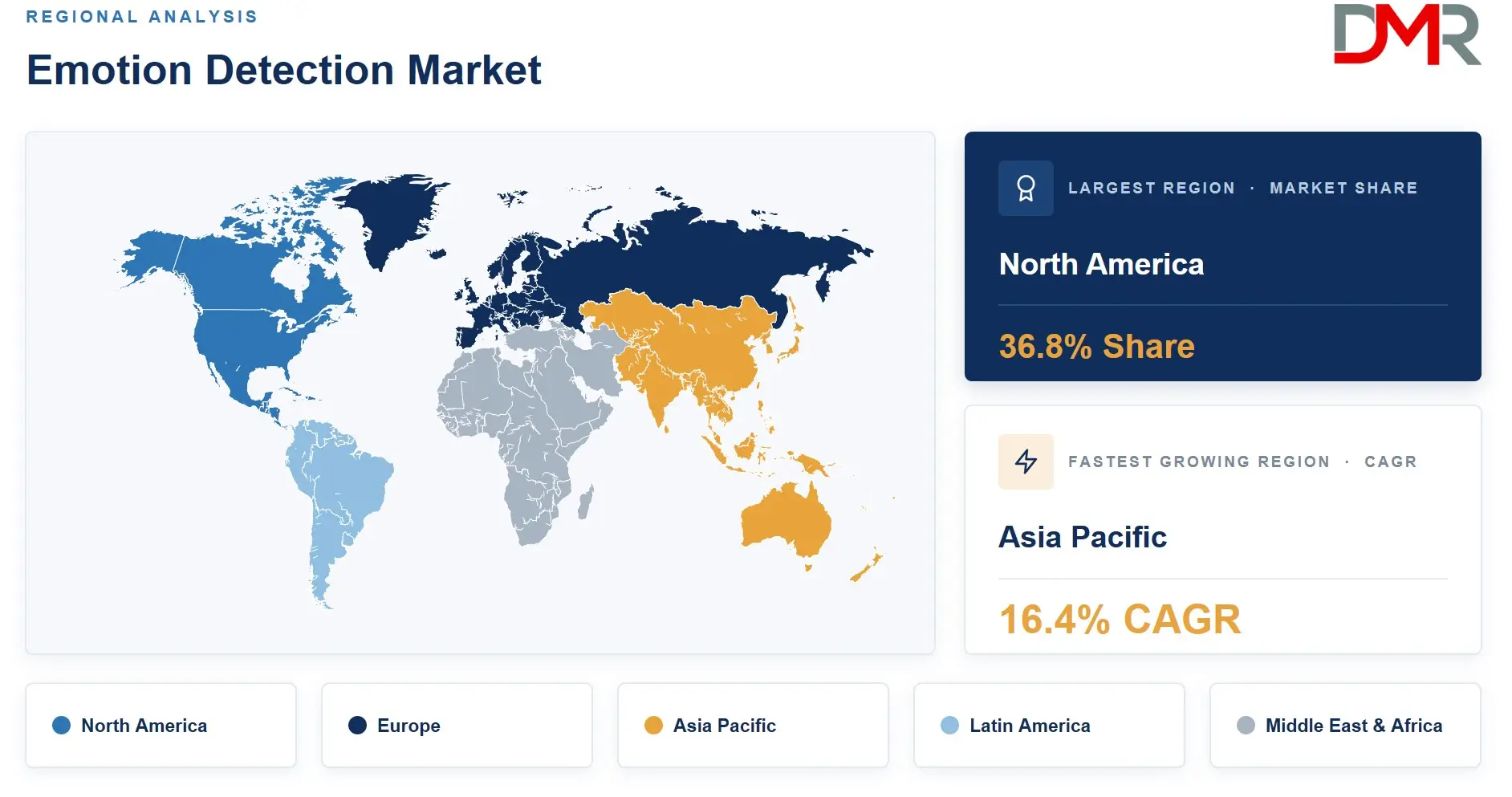
North America led the Emotion Detection and Recognition market with a 36.8% share, valued at USD 16.41 Billion, in 2025.
ℹ
To learn more about this report –
Download Your Free Sample Report Here
North America
North America's leadership rests on three structural advantages: the deepest enterprise AI adoption base, the largest concentration of EDR platform vendors, and the most active regulatory testing environment for autonomous vehicle and healthcare AI applications. U.S. private AI investment reached $109.1 billion in 2024, nearly 12 times China's $9.3 billion, as reported by Stanford HAI, a capital gap that keeps North American vendors ahead on model development and platform feature velocity. Federal programs supporting driver safety and healthcare AI further sustain procurement pipelines.
Europe
Europe presents a bifurcated landscape. Western European markets, particularly Germany and the UK, hold mature automotive and healthcare sectors with active EDR adoption in driver monitoring and clinical AI. Regulatory pressure from the EU AI Act creates friction for high-risk biometric applications, but simultaneously raises the barrier for non-compliant foreign entrants. Vendors that invest in privacy-by-design architectures now gain durable competitive positioning across the EU single market.
Asia Pacific
Asia Pacific is the fastest-growing region, anchored by Chinese government procurement, Japanese automotive OEM demand, and South Korean consumer electronics integration. Stanford HAI data confirms U.S. institutions produced 40 notable AI models in 2024 versus China's 15 and Europe's 3, yet China's domestic EDR vendor ecosystem remains extensive and state-backed. East Asia's share of firms investing in digital solutions rose from 13% to 54% between 2020 and 2022, as reported by the World Bank, reflecting an enterprise digital maturity shift that accelerates EDR adoption in customer experience and surveillance verticals.
Latin America
Latin America remains an emerging market for EDR. Brazil and Mexico represent the primary entry points, driven by retail customer analytics and public safety programs in urban centers. Connectivity gaps slow deployment: over 90% of people in high-income countries were online in 2022 versus roughly one in four in low-income countries, according to World Bank data, a disparity that limits cloud-based EDR reach in less-developed Latin American markets.
Middle East and Africa
GCC countries lead Middle East and Africa adoption, with government-funded smart city programs and airport security deployments providing concentrated procurement. Sub-Saharan Africa lags significantly due to infrastructure constraints. Investment from sovereign wealth funds in UAE and Saudi Arabia creates funded demand for biometric and EDR applications in transport hubs and public venues.
Key Regions and Countries
North America
Europe
- Germany
- France
- The UK
- Spain
- Italy
- Rest of Europe
Asia Pacific
- China
- Japan
- South Korea
- India
- Australia
- Rest of APAC
Latin America
- Brazil
- Mexico
- Rest of Latin America
Middle East & Africa
- GCC
- South Africa
- Rest of MEA
Macroeconomic Impact
WHO data shows global road-traffic deaths totaled approximately 1.2 million in 2021, down 5% from 1.25 million in 2010, yet the absolute toll sustains government pressure for technology-led safety interventions. EDR-based driver monitoring systems sit directly in the procurement path for transport ministries and automotive regulators, particularly as road-safety targets tighten toward 2030 goals. Rising healthcare costs globally also strengthen the fiscal argument for AI-assisted diagnostic tools that reduce clinician workload and diagnostic error rates.
World trade in goods and commercial services increased 8% to $34.89 trillion in 2025, as reported by WTO, signaling broad economic activity that supports enterprise IT spending and accelerates corporate investment in customer analytics platforms that rely on EDR. Global merchandise trade growth of 2.4% in 2025, per WTO forecasts, reflects a stable demand environment for technology procurement. Emerging-market currency volatility and U.S.-China trade tensions represent offsetting risks that could delay capital expenditure on hardware-intensive EDR deployments.
Market Dynamics
Driver: AI Adoption and Safety Mandates Expand EDR Procurement
Enterprise AI adoption is the primary structural driver for EDR platforms. Stanford HAI reports the share of organizations reporting AI use rose to 78% in 2024 from 55% in 2023, a 23-percentage-point jump that directly expands the buyer base for emotion analytics integrated into CRM, HR, and customer engagement workflows. Vendors with API-first architectures captured this wave faster than those requiring proprietary hardware installations.
Road-safety data creates a parallel public-sector driver of equal force. NHTSA recorded 3,208 deaths in U.S. crashes involving distracted drivers in 2024, and a further 644 from drowsy-driving incidents. WHO estimates 1.19 million global road-traffic deaths occur annually. These figures drive regulatory mandates for driver monitoring systems across North America, Europe, and increasingly Asia Pacific, converting safety compliance into a near-certain procurement pipeline for automotive EDR suppliers. Microsoft's $30 billion UK AI infrastructure commitment in September 2025 signals sustained hyperscaler investment that enlarges the cloud foundation for EDR platform deployment globally.
Global private investment in generative AI reached $33.9 billion in 2024, up 18.7% from 2023, as reported by Stanford HAI. GenAI advances accelerate emotion model training cycles and expand the accuracy ceiling for speech and facial recognition, compressing the development timeline between research breakthrough and commercial product.
Restraint: Connectivity Gaps and Cost Barriers Slow Emerging-Market Penetration
Over 2 billion people remained offline in 2025, per World Bank data, a connectivity deficit that directly restricts cloud-based EDR adoption across South Asia, Sub-Saharan Africa, and parts of Latin America. Emotion analytics platforms that depend on continuous cloud inference cannot function reliably where bandwidth is intermittent or absent. Edge deployment addresses this partially but introduces higher upfront hardware costs that emerging-market buyers cannot easily absorb.
Among micro firms in lower-income countries, the share investing in digital solutions increased from only 10% in April 2020 to 20% by December 2022, per World Bank research. The doubling is notable, but the absolute level remains low. Small and mid-size enterprises in lower-income markets represent a large theoretical buyer pool for commercial EDR applications, yet limited IT budgets and absence of internal integration expertise keep conversion rates well below those seen in North American enterprise markets.
Opportunity: Automotive Safety Mandates and Counter-Impairment Monitoring
NHTSA data shows 11,904 alcohol-impaired driving deaths in the United States in 2024 alone. Regulators across the EU and U.S. are advancing mandates that will require in-vehicle impairment detection systems on new vehicles, a requirement that maps directly to EDR bio-sensing and facial monitoring technology. Each new-vehicle model year creates a captive, mandatory adoption event rather than a discretionary purchase decision, structurally different from the customer experience or marketing analytics verticals.
The opportunity extends beyond alcohol detection to fatigue, distraction, and emotional state monitoring in commercial fleet management, where insurers and logistics operators can directly price risk based on real-time driver data. Fleet operators managing thousands of vehicles represent high-value, multi-year contracts that reward vendors with proven accuracy and regulatory certification track records.
Porter's Five Forces
WHO's global road-traffic mortality rate of 15 deaths per 100,000 population in 2021 illustrates the scale of public-sector demand that shapes Emotion Detection Market 's competitive structure. New entry faces high barriers: accuracy thresholds for safety-critical applications require large labeled datasets, domain expertise, and compliance certification that take years to accumulate. Hardware suppliers hold moderate bargaining power because camera and sensor components are increasingly commoditized, though specialized EEG and eye-tracking components retain supplier leverage in niche clinical and defense verticals. Buyers in enterprise customer experience hold strong bargaining power due to the availability of multiple competing platforms and the portability of emotion analytics APIs. Government buyers hold moderate power, constrained by lengthy procurement cycles and high switching costs once systems are embedded in national infrastructure. Substitutes are limited for multi-modal biometric emotion fusion, though unimodal tools (pure NLP or pure computer vision) can partially replace integrated platforms for buyers with narrower use cases. Competitive rivalry among software platform vendors is intense, particularly in the customer experience and marketing analytics segments where differentiation is primarily on model accuracy, integration breadth, and price per API call.
AI and Gen AI Impact
The shrinking size of high-performance AI models is the single most consequential structural shift for EDR deployment economics. Stanford HAI data shows the smallest model scoring above 60% on MMLU fell from 540 billion parameters in 2022 to 3.8 billion parameters in 2024, a 142-fold reduction. Smaller models run on edge hardware inside vehicle cabins, hospital rooms, and retail environments without cloud connectivity, eliminating the latency and data-sovereignty constraints that previously blocked deployment in real-time safety and clinical applications. Early movers who embedded edge-capable emotion models in 2024 and 2025 have already converted latency advantage into customer lock-in.
Generative AI contributes to EDR through synthetic data generation. Vendors use generative models to create labeled training datasets covering rare emotional states and underrepresented demographic groups, reducing the bias and coverage gaps that have historically limited regulatory acceptance of facial emotion recognition systems. Vendors that lag on synthetic augmentation risk producing models that fail disproportionately on non-Western demographic groups, a liability in regulated healthcare and law enforcement deployments.
Market Trends
Multi-Modal Fusion and Enterprise AI Integration Accelerate Platform Consolidation
Stanford HAI reports the share of respondents using generative AI in at least one business function rose from 33% in 2023 to 71% in 2024. EDR vendors respond to this shift by embedding emotion analytics directly into CRM, HR, and workforce productivity platforms rather than selling standalone tools. Multi-modal fusion, combining facial, voice, biometric, and behavioral signals, becomes the competitive baseline as single-modality tools commoditize. Platform vendors who consolidate multiple modalities under one API surface and one pricing tier gain procurement preference from enterprise buyers who want to reduce vendor count rather than expand it.
Market Competition Overview
The EDR market is moderately fragmented at the platform level but increasingly consolidated at the infrastructure layer. A small group of hyperscaler-affiliated vendors controls the cloud compute, storage, and API gateway infrastructure that most EDR software platforms depend on, giving infrastructure providers indirect leverage over platform pricing and latency. Specialized pure-play emotion AI vendors compete aggressively on model accuracy and vertical-specific features in automotive, healthcare, and retail, but face persistent pressure from hyperscalers expanding their own AI APIs into emotion analytics territory.
Global IT-services employment grew 7% annually in 2025, per World Bank data, signaling an expanding talent pool that reduces human capital barriers for new entrants building emotion analytics engineering teams. Mid-size vendors with regulatory certifications in automotive safety or medical device software hold defensible niches that generalist platforms cannot easily replicate. Market share shifts fastest in customer experience and marketing analytics, where buyers switch platforms on annual contract cycles and price competition is most intense.
Pricing Analysis
Pricing in the EDR market follows a modality and deployment split. Hardware commands one-time capital expenditure pricing with multi-year maintenance contracts attached, while software prices on per-API-call, per-seat, or per-stream subscription models. Stanford HAI data shows the cost of querying a model with GPT-3.5-equivalent performance fell from $20 per million tokens in November 2022 to $0.07 per million tokens by October 2024, a more-than-280-fold decline. This collapse in inference economics has forced emotion analytics API vendors to reduce per-call pricing aggressively or risk losing volume buyers to cheaper general-purpose AI APIs with emotion classification layers.
Market leaders offset pricing pressure by bundling hardware, software, and managed services into outcome-based contracts that price on results such as emotion detection accuracy rates or driver alert response times, rather than on raw API consumption. Challengers compete primarily on unit price in customer experience and marketing verticals, where buyers are price-elastic and switching costs are low.
Company Profiles
Microsoft Corporation participates in the EDR market through Azure AI services, including computer vision, speech recognition, sentiment analysis, and custom model training infrastructure that underpin many third-party EDR platforms. Microsoft Cloud revenue reached $168.9 billion in fiscal 2025, up 23%, and total company revenue reached $281.724 billion, up 15%, as reported in the company's Form 10-K filed with the SEC. Microsoft employed approximately 228,000 full-time employees as of June 30, 2025, providing the engineering depth to maintain and expand AI API services at hyperscale. The company's strategic position in EDR rests on infrastructure ubiquity rather than vertical emotion analytics specialization, making it the default cloud backbone for enterprise EDR deployments that require global data residency options and enterprise security certifications.
Google LLC (Alphabet) operates through Google Cloud and its Vertex AI platform, offering pre-built vision, speech, and natural language APIs that developers integrate into EDR products. Alphabet's annual revenue exceeded $400 billion for the first time in 2025, with Q4 2025 revenue reaching $113.8 billion, up 18% year over year, per SEC filings. Alphabet employed 190,820 people as of December 31, 2025. IBM Corporation generated $62.753 billion in total revenue in 2024 and reported software revenue of $27.085 billion, up 8.3%, demonstrating the growing contribution of AI and analytics software to its mix. IBM's first-nine-months 2025 revenue reached $47.849 billion. A Massachusetts AI Hub initiative in May 2025 received a $31 million state grant alongside exploration of a partnership with IBM and Red Hat for a startup accelerator, positioning IBM as an active participant in the emerging AI ecosystem that feeds downstream EDR development.
Key Players
- SmartEye (Affectiva)
- Microsoft Corporation
- Google LLC (Alphabet)
- IBM Corporation
- Amazon Web Services
- Apple Inc.
- Tobii AB
- Realeyes
- Visage Technologies
- EMOTIV
- Noldus Information Technology BV
- NVISO SA
- Eyeris Technologies
- Entropik Technologies
- Uniphore Technologies
- Kairos Inc.
- Cogito Corporation
- Hume AI
- Sentiance NV
- CIPIA Vision
Supply Chain and Value Chain Analysis
The EDR value chain begins at semiconductor and optics manufacturing, where camera sensors, EEG electrode arrays, and microprocessors are produced primarily in East Asia. Component manufacturers supply system integrators who assemble hardware platforms for vertical markets. Platform software vendors sit in the middle layer, training models on proprietary and licensed datasets and packaging inference capabilities into APIs, SDKs, and enterprise deployments. Maximum value concentration sits at the software and model layer, where gross margins run substantially higher than hardware assembly. End users in automotive, healthcare, and government receive fully integrated solutions from either pure-play EDR vendors or from system integrators who bundle EDR modules into larger automation or safety platforms. Supply chain risk concentrates at the semiconductor layer, where geopolitical restrictions on advanced chip exports can constrain availability of the high-performance inference processors required for edge deployment.
Regulatory Landscape
AI-related incidents reached 233 in 2024, a 56.4% increase from 2023, per Stanford HAI, a trend that accelerated regulatory responses across major jurisdictions. The EU AI Act classifies real-time biometric identification and emotion recognition in public spaces as high-risk or prohibited uses, depending on context, creating compliance obligations that increase development and certification costs for European deployments. Healthcare emotion analytics tools face medical device software regulations in the EU, U.S. FDA guidance on AI-based clinical decision support, and equivalent frameworks in Japan and South Korea.
U.S. state-level AI-related laws rose from 49 in 2023 to 131 in 2024, as reported by Stanford HAI, signaling fragmented sub-federal regulation that creates compliance complexity for vendors operating across multiple states. Automotive EDR for driver monitoring benefits from the most favorable regulatory environment, with NHTSA and Euro NCAP programs actively encouraging or mandating adoption rather than restricting it, creating a compliant procurement pathway that accelerates commercial deployment.
Investment and White Space Analysis
VC investments in AI firms globally reached $258.7 billion in 2025, representing 61% of all global venture-capital investment, per OECD data. A significant portion of this capital flows into foundational AI model development, but specialized EDR startups in automotive safety, clinical diagnostics, and enterprise customer analytics attract dedicated vertical-AI funding pools. The largest white space sits at the intersection of multi-modal fusion and regulatory-compliant healthcare emotion diagnostics, where no single vendor has achieved dominant market share or FDA-cleared product status at commercial scale.
Large firms in lower-income countries investing in digital solutions rose from 20% in April 2020 to 60% by December 2022, per World Bank research, indicating an emerging enterprise buyer class across Asia and Africa that EDR vendors have not yet fully penetrated. Edge-deployable, low-bandwidth EDR products targeting retail and logistics in these markets represent an underserved segment where first-mover advantage remains available. Vendors who price for lower-income enterprise budgets and optimize for intermittent connectivity will access a buyer pool largely invisible to hyperscaler-dependent platforms.
Recent Developments
- January 2025: Microsoft Corporation announced a $3 billion investment in Indian cloud and AI infrastructure over two years, alongside a target to train 10 million people in AI skills over five years.
- May 2025: Google LLC announced an additional $7 billion investment in Iowa for cloud and AI infrastructure and workforce development within two years.
- July 2025: Google LLC announced more than $25 billion for data-center and AI infrastructure across PJM-region U.S. states over two years.
- August 2025: Google LLC announced an additional $9 billion investment in Virginia cloud and AI infrastructure through 2026.
- October 2025: Google LLC announced an approximately $15 billion investment in an India AI hub during 2026 to 2030.
- November 2025: Google LLC announced a $40 billion investment in Texas through 2027 to build cloud and AI infrastructure, including new campuses in Armstrong and Haskell Counties.
- December 2025: Microsoft Corporation announced a $17.5 billion India commitment over 2026 to 2029 for cloud and AI infrastructure, skills, and operations.
- April 2026: Microsoft Corporation announced a $10 billion investment in Japan over 2026 to 2029 for AI infrastructure, cybersecurity, and workforce initiatives, including training more than one million people by 2030.
- April 2026: Microsoft Corporation announced an A$25 billion investment in Australian AI infrastructure, cybersecurity, and skills through 2029.
- June 2026: IBM Corporation announced an AI learning pathway supporting a mission to upskill 10 million UK workers with AI skills by 2030.
Report Details
| Report Characteristics |
| Market Value (2026) |
USD 51.69 Billion |
| Forecast Revenue (2035) |
USD 195.09 Billion |
| CAGR (2026–2035) |
15.9% |
| Historical Data |
2020 – 2024 |
| Forecast Data |
2026 – 2035 |
| Base Year |
2025 |
| Estimate Year |
2026 |
| Report Coverage |
Revenue Forecast, Market Dynamics, Competitive Landscape, Recent Developments |
| Segments Covered |
By Component (Hardware, Software); By Software Tool / Modality (Facial Expression and Emotion Recognition, Speech and Voice Recognition, Gesture and Posture Recognition, Bio-Sensing Software Tools); By Technology (Machine Learning, Natural Language Processing, Computer Vision and 3D Modeling, Bio-Sensors Technology); By Application (Customer Experience Management, Healthcare and Medical Diagnostics, Law Enforcement Surveillance and Monitoring, Automotive Driver Monitoring, Marketing and Advertising Analytics); By End User (Government Agencies, Healthcare Providers, Retail and E-Commerce, Automotive and Transportation, Media and Entertainment, BFSI, Education, IT, Transportation and Logistics); By Deployment Model (Cloud, Edge and On-Premises) |
| Regional Coverage |
North America – US, Canada; Europe – Germany, France, UK, Spain, Italy, Rest of Europe; Asia-Pacific – China, Japan, South Korea, India, Australia, Rest of APAC; Latin America – Brazil, Mexico, Rest of Latin America; Middle East & Africa – GCC, South Africa, Rest of MEA |
| Prominent Players |
SmartEye (Affectiva), Microsoft Corporation, Google LLC (Alphabet), IBM Corporation, Amazon Web Services, Apple Inc., Tobii AB, Realeyes, Visage Technologies, EMOTIV, Noldus Information Technology BV, NVISO SA, Eyeris Technologies, Entropik Technologies, Uniphore Technologies, Kairos Inc., Cogito Corporation, Hume AI, Sentiance NV, CIPIA Vision, and Other Key Players |
| Customization Scope |
Customization for segments and region or country level will be provided. Additional customization can be done based on requirements. |
| Purchase Options |
Three license options: Single User License, Multi-User License (Up to 5 Users), and Corporate Use License (Unlimited Users and Printable PDF) |
Frequently Asked Questions
What is the biggest investment opportunity in the Emotion Detection and Recognition market?
▾ The largest opportunity lies at the intersection of automotive safety mandates and multi-modal driver monitoring. Regulatory requirements for impairment and distraction detection across North America and Europe convert discretionary purchase decisions into compliance-driven procurement events, creating captive demand at each new vehicle model year. Vendors with safety-certified, edge-deployable emotion detection systems are best positioned to capture this pipeline.
Who are the top companies in the Emotion Detection and Recognition market?
▾ Leading companies include SmartEye (Affectiva), Microsoft Corporation, Google LLC (Alphabet), IBM Corporation, Amazon Web Services, Apple Inc., Tobii AB, Realeyes, Visage Technologies, EMOTIV, Noldus Information Technology BV, NVISO SA, Eyeris Technologies, Entropik Technologies, Uniphore Technologies, Kairos Inc., Cogito Corporation, Hume AI, Sentiance NV, and CIPIA Vision. The market spans pure-play emotion AI specialists and hyperscaler-affiliated platform vendors serving distinct buyer segments.
Which segment is growing fastest in the Emotion Detection and Recognition market and why?
▾ Healthcare and medical diagnostics is the fastest-growing application segment, driven by pain assessment, neurological disorder screening, and AI-assisted mental health monitoring use cases that address clinician shortages and diagnostic accuracy gaps. Edge-capable emotion models now enable real-time patient observation in hospital wards and remote monitoring environments without requiring continuous cloud connectivity, lowering the deployment barrier for health systems operating under constrained IT budgets.
Which region is growing fastest in the Emotion Detection and Recognition market and why?
▾ Asia Pacific is the fastest-growing region, supported by Chinese government EDR procurement, Japanese automotive OEM integration programs, and South Korean consumer electronics adoption. East Asia's share of firms investing in digital solutions surged from 13% to 54% between 2020 and 2022, per World Bank data, indicating an enterprise readiness shift that is converting into active EDR procurement across customer experience, surveillance, and automotive verticals.
What is the biggest challenge holding Emotion Detection Market back?
▾ Regulatory fragmentation across jurisdictions is the most significant structural barrier. The EU AI Act restricts or prohibits real-time biometric emotion recognition in public spaces, U.S. state-level AI laws multiplied from 49 to 131 between 2023 and 2024, and healthcare regulators impose separate compliance frameworks in each major market. Vendors must allocate substantial resources to jurisdiction-specific certification rather than product development, extending time-to-market and raising entry costs for smaller innovators.