What is the Energy Storage Systems Market Size?
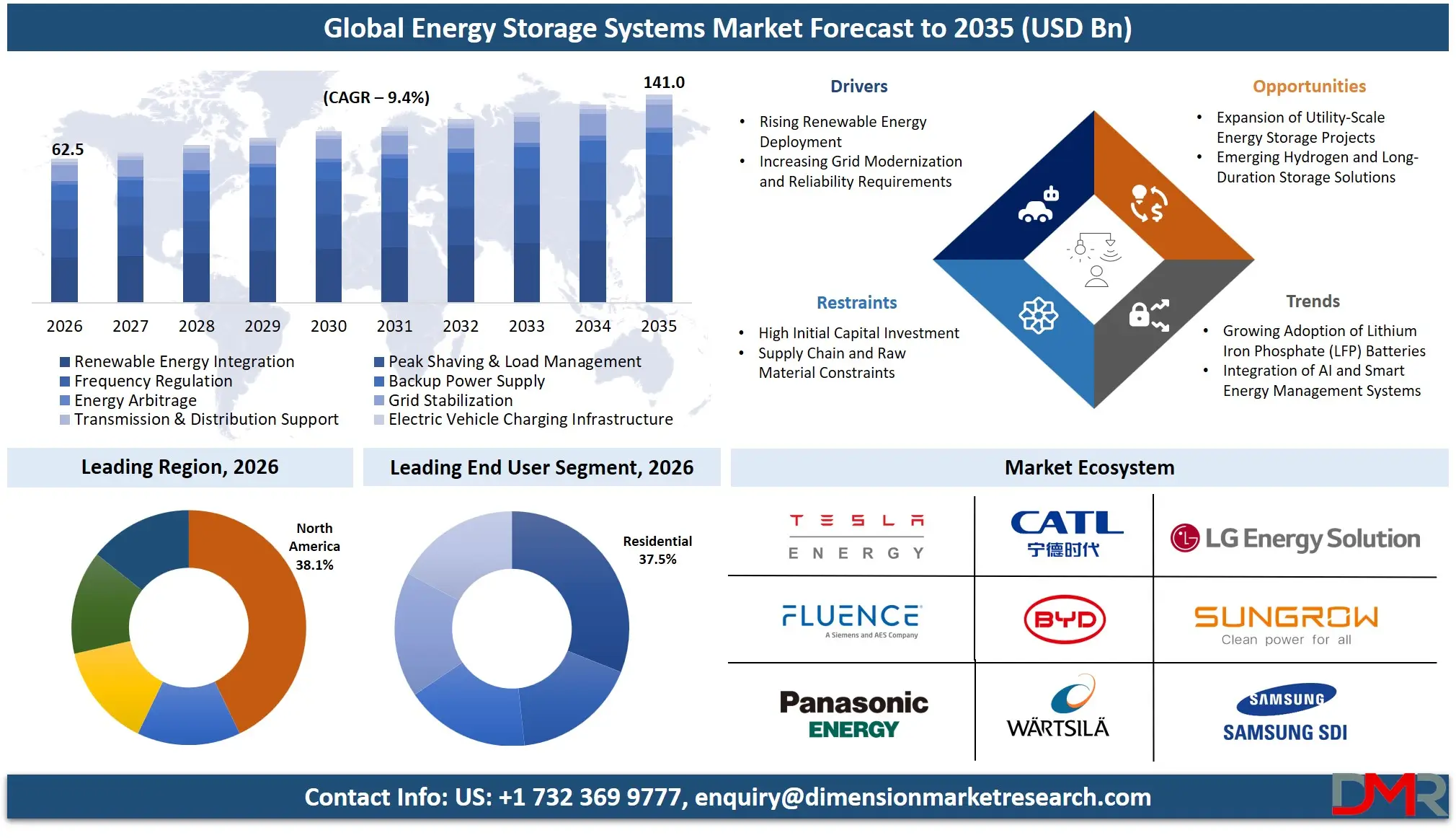
The Global Energy Storage Systems Market is expected to reach a value of USD 62.5 billion in 2026, and it is further anticipated to reach USD 141.0 billion by 2035, growing at a CAGR of 9.4% during the forecast period.
ℹ
To learn more about this report –
Download Your Free Sample Report Here
There is an extensive growth trend in the market for energy storage systems caused by the worldwide need to reduce carbon emissions from the energy sector and the introduction of intermittent renewable energy into the grid system. This market covers a wide variety of technologies used to store energy in order to consume it in the future, such as electrochemical batteries, mechanical energy, and thermal energy storage. Modern grid requirements, the development of the infrastructure for EVs, and increased energy resilience are the main factors behind this growing need for better energy storage systems. Main users of these technologies include utilities, C&I companies, and end consumers lithium-ion battery energy storage systems continue to dominate because of their cost-competitive and versatile features.
The US Energy Storage Systems Market
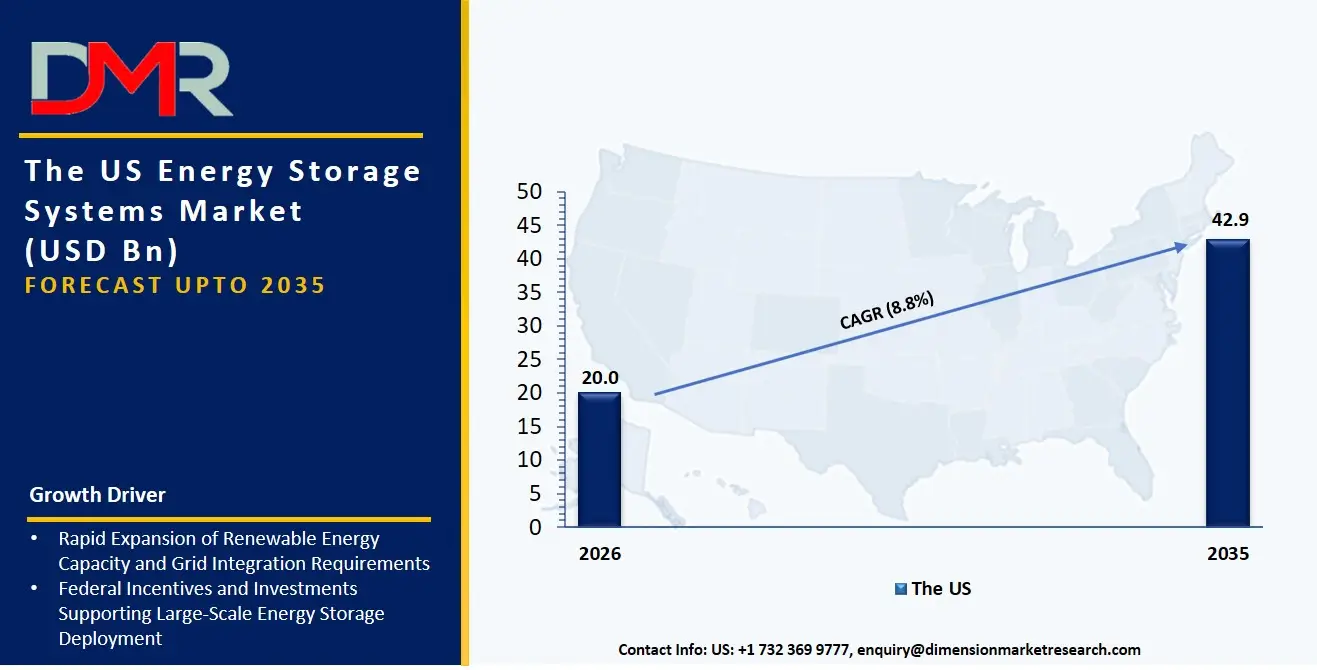
The US Energy Storage Systems Market is projected to reach USD 20.0 billion in 2026, at a compound annual growth rate of 8.8% over its forecast period, culminating in a value of USD 42.9 billion by 2035. The US remains the biggest and most developed market for energy storage technology due to the push towards clean energy at the state level and the development of solar and wind farms at utility scale.
ℹ
To learn more about this report –
Download Your Free Sample Report Here
The market has seen a high level of demand for grid balancing and T&D support through the deployment of large-scale BESS by ISOs and utilities to deal with congestion and delay expensive grid investments. Moreover, the ITC introduced by the IRA for stand-alone energy storage systems is fueling the same growth on the consumer side through C&I companies' energy arbitrage practices.
The Europe Energy Storage Systems Market
The Europe Energy Storage Systems Market is estimated to be valued at USD 18.6 billion in 2026 and is further anticipated to reach USD 41.3 billion by 2035 at a CAGR of 9.2%. The policy environment, which includes EU Green Deal and REPowerEU policy, plays a vital role in shaping the European market as well as influencing the need for frequency regulation and renewable energy generation. Rapidly growing energy storage project development in the region is also being witnessed with German and UK utilities trying to manage the intermittency of North Sea offshore wind farms using utility BESS. Moreover, efforts towards the creation of a pan-Europe hydrogen backbone system have been putting pressure on energy companies to develop a dedicated hydrogen energy storage system and CAES.
The Japan Energy Storage Systems Market
The Japan Energy Storage Systems Market is projected to be valued at USD 3.1 billion in 2026. It is further expected to witness robust growth at a CAGR of 8.6%. Japan's market is different, as there is a desire within the country for energy independence owing to its vulnerability to earthquakes and the decline of traditional nuclear power stations. The majority of the deployed capacity is comprised of battery storage behind the meter and grid scale pumped hydro, as the large conglomerates and regional electric companies install advanced sodium-ion batteries and flow batteries as a secondary source of power. Moreover, there is an essential requirement to integrate with energy management systems (EMS), as there is a niche in advanced power electronics and software defined energy storage bridging between VPP and legacy grid infrastructures.
Key Takeaways
- Market Size & Forecast: The Global Energy Storage Systems market is estimated to have a valuation of USD 62.5 billion in 2026 and will grow exponentially up to a value of USD 141.0 billion in 2035 due to two primary factors like decarbonization goals on a global scale and compulsory enhancement of aged transmission and distribution grids.
- Growth Rate & Outlook: Global market growth is expected at a CAGR of 9.4%, due to essential unpredictability in renewable energy curtailment and growing challenges in dealing with bidirectional power flows and grid-forming inverters.
- Primary Growth Drivers: They include an overall shift towards distributed energy resources (DERs) compared to conventional fossil fuel power generation plants, the necessity of frequency response services that can help with maintaining grid inertia, and increased installation of EV chargers that require special peak shaving and load management capacities.
- Key Market Trends: Major trends include the development of long-duration energy storage (LDES) technologies (iron-air and flow batteries, etc.), usage of AI technology in energy trading and energy arbitrage systems to improve battery dispatching, and development of solid-state and sodium-ion battery systems for increased security and safety.
- By Technology Analysis: Lithium-Ion BESS is going to be the major volume player owing to its energy density and existing manufacturing capabilities. Nevertheless, flow batteries and hydrogen energy storage are going to become essential due to their need to provide intra-day and seasonal long-duration storage with energy storage decoupled from power rating.
- By Application Analysis: Renewable energy integration and grid stabilization are going to be the most important applications owing to tough grid interconnection codes. Electric vehicle charging infrastructure is the fastest-growing application area because of the necessity to build fast charging corridors with proper behind-the-meter storage capacity to avoid expensive demand charges on distribution grids.
- Regional Leadership: North America is expected to be a market leader with 38.1% of market share in 2026 due to its highly developed technological environment as well as regulatory push towards deployment of utility-scale battery installations.
What is the Energy Storage Systems?
The Energy Storage System refers to the technologies that are capable of storing electricity or thermal energy in order to use them later in the future; therefore, it is the flexibility resource across the full value chain of electricity. In contrast with the conventional production facilities, which generate electricity when there is demand, energy storage technologies allow one to separate generation from consumption. It includes Battery Energy Storage Systems for fast frequency response and backup power generation, Pumped Hydro Storage for bulk, long-term energy storage, and Thermal Energy Storage Systems for the electrification of industrial processes. Since 90% of the added grid-scale renewable energy capacity will be equipped with energy storage, it is necessary to have professional engineering, procurement, and construction services in order to ensure safety and round-trip efficiency of investments.
Use Cases
- Translocation of Utility-Scale Solar in Southwest US: Investor-owned power companies leverage co-located Lithium Iron Phosphate (LFP) battery energy storage systems in gigawatt-hour capacities to conduct energy arbitrage by storing cheap solar energy generated midday and deploying it in the evening during net load peaks, thus effectively ironing out the duck curve.
- Microgrid Resilience in Healthcare: Medical centers install grid/standalone hybrid energy storage systems incorporating lithium-ion batteries and supercapacitors for providing uninterrupted energy supply for life-supporting equipment, allowing for millisecond ride-through of outages in adherence to NFPA 111 regulations.
- Long-Term Energy Storage for Island Grids: Isolated island grids implement flow batteries and hydrogen energy storage to replace diesel generators, storing surplus wind energy and using it in multi-day calm periods and achieving energy sovereignty through reduction of expensive fuel imports.
- EV Fleet Depot Charging: Public service entities implement below 100 kWh to 1 MWh capacity of customer-owned battery energy storage systems along with smart charging software to reduce stress on the grid from simultaneously charging large fleets of electric vehicles.
How AI is Transforming the Energy Storage Systems Market?
The impact of AI in the energy storage field is manifested in the speeding up of the optimization of battery dispatch and prolongation of operational life spans. In case of energy arbitrage and participation in wholesale markets, AI-enabled forecasters are capable of analyzing LMP data and renewable energy production patterns and optimizing net revenue stacking while minimizing unneeded cycling that leads to degradation. AI features integrated into battery management systems enable the analysis of the battery state-of-health and state-of-charge, detect thermal runaway preconditions, and offer charging curves in order to strengthen asset management techniques.
Also, the grid resiliency and VPP aggregation initiatives revolve around AI technologies. Regarding the distributed storage aggregation initiative, intelligent coordination algorithms are used to continuously coordinate thousands of behind-the-meter residential batteries, recognize the signs of stress in the grid, and dispatch energy to reduce the stress in distribution transformers. In addition, generative AI copilots are used in system design and EPC consultancy in order to simulate electrochemical performance and forecast the wholesale market situation for the visualizing of investment risks.
Market Dynamics
Key Drivers in the Global Energy Storage Systems Market
Rising Renewable Energy Deployment
The swift growth in the availability of renewable energy sources including solar and wind energy plays an important role in driving the energy storage system market around the world. The nature of generation of renewable energy is variable, resulting in inconsistencies in the supply of power which poses difficulties for grid stability. Energy storage systems play a key role in overcoming these issues, where surplus energy is stored when generation is high and is released when there is low generation. Various governments around the world are working on clean energy targets and carbon reduction plans, leading to large installation of renewable energies requiring energy storage.
Increasing Grid Modernization and Reliability Requirements
Electrical grids around the globe are becoming modernized in order to meet increasing electricity demand, distributed power generation, and digitization of infrastructure. The role of energy storage technologies is extremely important when it comes to improving the reliability of power grids through providing assistance for frequency regulation, voltage support, and peak load management. More and more utilities utilize energy storage technologies in order to decrease transmission congestion and enhance their resistance to any kinds of outages. In addition, there is an increase in electrification of transport, industry, and households which puts additional strain on existing infrastructure of power grids.
Restraints in the Global Energy Storage Systems Market
High Initial Capital Investment
Despite the technological advancements that have been achieved, the huge initial expenditure related to energy storage technology is one of the biggest market barriers. The huge cost incurred in setting up batteries, pumped hydro energy storage, and hydrogen storage is too expensive for many firms and developing countries. In addition to the problem of financing such projects, other factors such as project approvals and uncertainty about return on investments make matters even more difficult. Government subsidies may help reduce some costs; however, the cost factor remains the biggest barrier to the adoption of energy storage technologies.
Supply Chain and Raw Material Constraints
The energy storage business is heavily dependent on critical materials including lithium, cobalt, nickel, and graphite that are highly prone to interruptions in the supply chain and volatile prices. Rising demands for batteries both from the energy storage market and electric vehicles have put pressure on manufacturers to compete for the availability of the materials. Geopolitical disputes, shortage in mining activities, and supply in some regions pose challenges and lead to pricing issues for manufacturers. In addition, environmental issues surrounding resource extraction have increased regulatory pressures. This has constrained the growth in the market.
Growth Opportunities in the Global Energy Storage Systems Market
Expansion of Utility-Scale Energy Storage Projects
The rising adoption of utility-scale renewable energy initiatives provides many business opportunities for the energy storage systems market. There is a heavy investment by utilities into storage systems that can store massive quantities of energy to increase the flexibility of the grid system, and to balance the generation of electricity through solar and wind sources. The rising demand for reliable energy supplies and the positive influence of the government regulations and incentive schemes is rapidly developing such initiatives all over the world. Thanks to advanced technologies and reduced costs of the systems, utility-scale storage systems are becoming profitable investments.
Emerging Hydrogen and Long-Duration Storage Solutions
Storage systems for long durations, especially hydrogen-based systems, present huge growth opportunities for the future. With an increase in the use of renewable energy, storage systems are needed to provide electricity for a longer duration. The storage of hydrogen can help make use of the excess energy from renewables to produce hydrogen and use it later as per requirement. Investments in hydrogen and other measures for decarbonizing are making rapid development of technologies possible. Moreover, the development of flow batteries, compressed air storage, and thermal storage is opening up new avenues.
Trends in the Global Energy Storage Systems Market
Growing Adoption of Lithium Iron Phosphate (LFP) Batteries
Lithium Iron Phosphate batteries are one of the most popular trends in the energy storage systems market around the world. Lithium iron phosphate batteries provide superior safety, extended cycle life, and better thermal stability compared to any other lithium-ion batteries. They require less use of costly metals such as cobalt. This also provides them an economic edge along with supply chain stability. The utility companies and commercial energy storage system developers tend to favor LFP batteries in major projects because of their robustness and efficiency. The consistent advancements in the production process are adding to the popularity of the LFP trend.
Integration of Artificial Intelligence and Smart Energy Management
Intelligent energy storage technologies such as artificial intelligence and enhanced energy management software programs are currently becoming common components of energy storage devices to enhance their efficiency and performance. AI-based software allows analyzing the current situation and making predictions about the energy needs of particular facilities. This leads to higher efficiencies of storage assets, lower costs for their operation, and better overall performance of the grid. Energy utilities are using the benefits of digital technologies to get maximum profit from their investment and provide better service to customers.
Research Scope and Analysis
The Global Energy Storage Systems Market is segmented by technology into battery energy storage systems (including lithium-ion, lead-acid, sodium-ion, flow, and nickel-based batteries), pumped hydro, CAES, flywheels, thermal, hydrogen, and supercapacitors. It is further categorized by connection type, energy capacity, ownership model, application, and end user, covering residential, commercial, industrial, utility, transportation, and government sectors.
ℹ
To learn more about this report –
Download Your Free Sample Report Here
By Technology Analysis
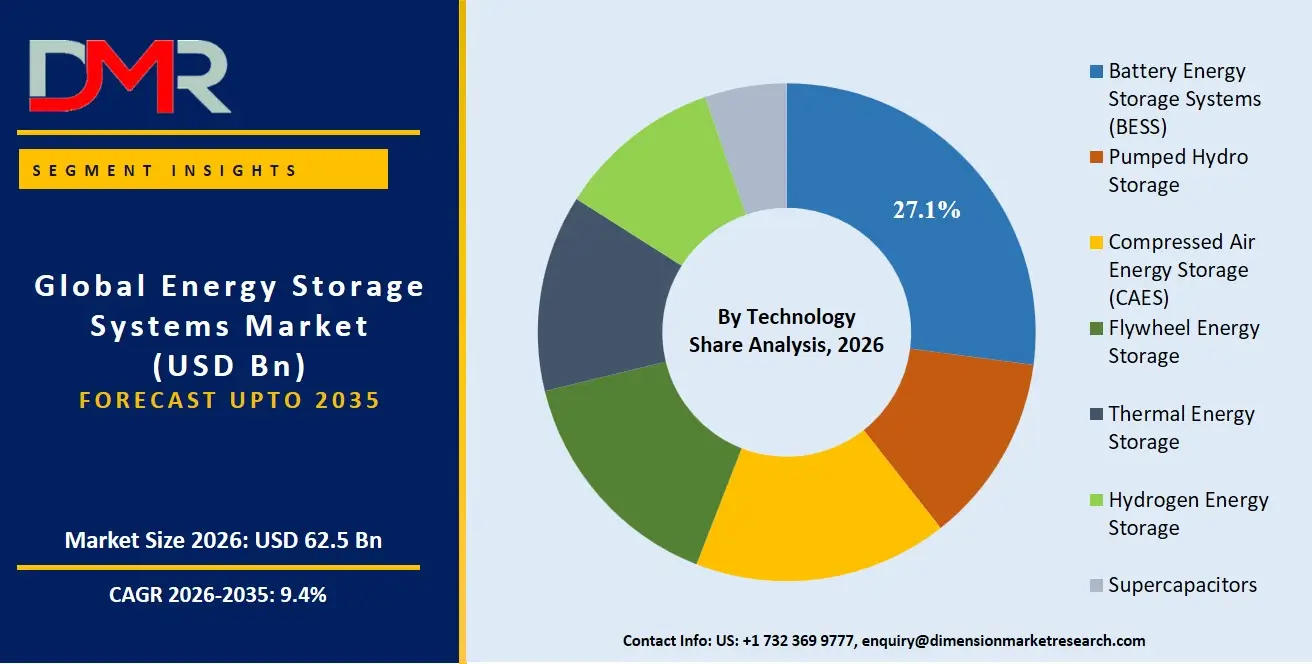
The Battery Energy Storage System is predicted to dominate the energy storage systems market owing to its flexibility and scalability along with fast installation capacity. Compared to all the other storage methods, BESS has taken the biggest share in the market owing to its effective contribution towards renewable energy storage, power stability, and handling of peak loads. With the decline in the cost of batteries, especially that of lithium-ion batteries, there has been a rise in their demand in the utility, commercial, and residential segments. The governments around the world are making huge investments in battery storage systems to achieve decarbonization and growth in renewable energy generation.
By Connection Type Analysis
It is expected that the on-grid energy storage system will become prevalent in the market since most of the energy storage systems used are directly integrated into electricity grids. Such storage systems are useful for stabilizing the electricity grid system, integrating renewable sources of energy, managing peak demand, and power quality improvement. With the emergence of solar and wind sources of energy, there has been an increased need for such grid-connected storage systems. Battery plants, pumped hydro plants, and energy storage systems controlled by utility companies are mostly installed in the electricity grid systems. With electricity grids being the main power distributors across the world, on-grid systems will continue dominating the market.
By Energy Capacity Analysis
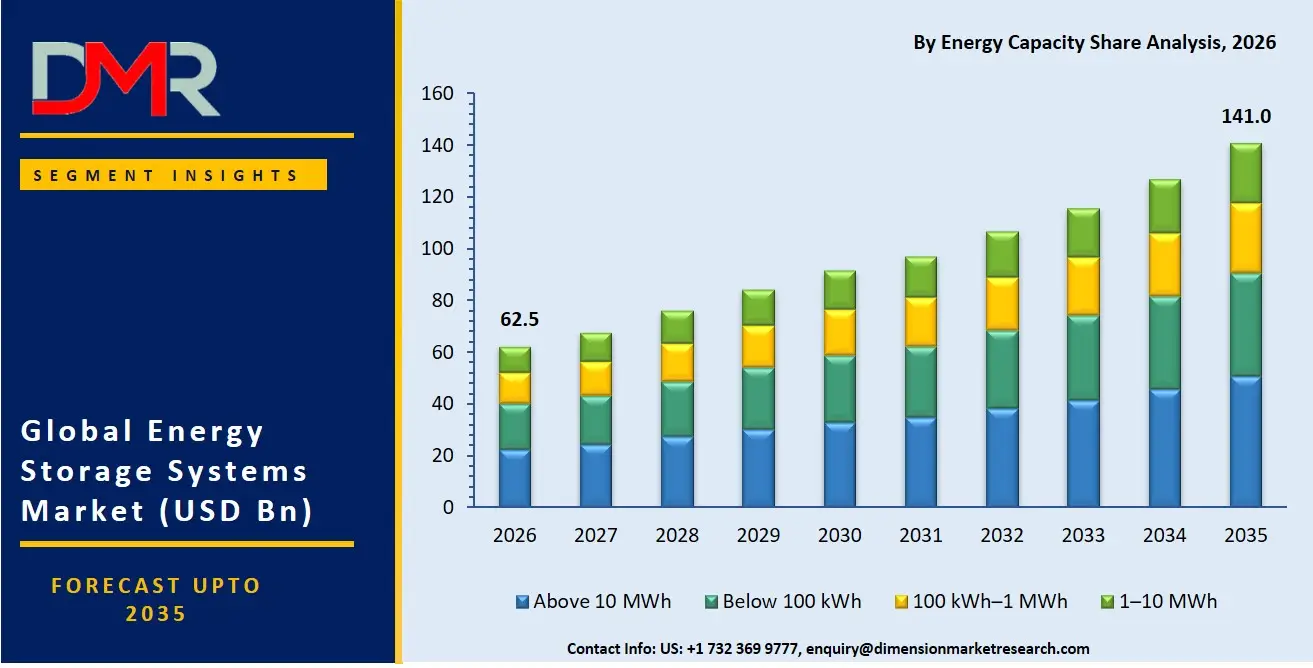
The above 10 MWh category is poised to dominate the energy storage systems market due to rising investments in utility scale and grid scale energy storage projects. High capacity energy storage systems are needed for balancing renewable energy production, ensuring grid stability and efficient functioning of electric power transmission grids.
ℹ
To learn more about this report –
Download Your Free Sample Report Here
Multi-megawatt energy storage systems are increasingly used by utilities to solve problems of intermittency related to solar and wind energy. The preference for higher capacities is explained by their flexibility and cost-effectiveness. The growth in the number of renewable energy integration projects around the world has resulted in significant development of the aforementioned segment. Energy storage systems with capacity higher than 10 MWh constitute the biggest part of the market.
By Ownership Model Analysis
Utility-owned energy storage systems is poised to dominate the ownership model segment because utilities are responsible for maintaining grid reliability and electricity supply stability. These organizations possess the financial resources and infrastructure needed to develop large-scale storage projects. Utility-owned systems support frequency regulation, peak demand management, renewable integration, and transmission optimization. Many governments encourage utility investment in energy storage through supportive regulations and incentive programs. Furthermore, utilities can achieve economies of scale that lower operational costs and maximize system utilization. As the majority of large-scale storage installations are deployed and managed by utility companies, this ownership model maintains the largest market share globally and is expected to remain dominant.
By Application Analysis
Renewable energy integration is poised to dominate the application segment because energy storage plays a critical role in addressing the intermittency of solar and wind power generation. As countries increase renewable energy capacity to meet sustainability goals, storage systems are becoming essential for balancing supply and demand. Energy storage enables excess electricity generated during peak production periods to be stored and used when renewable output declines. Governments, utilities, and private developers are investing heavily in storage projects specifically designed to support renewable deployment. The rapid expansion of clean energy infrastructure worldwide continues to strengthen this application segment, making renewable energy integration the largest and most influential use case for energy storage systems.
By End User Analysis
Utilities is anticipated to dominate the end-user segment because they are the primary operators and investors in large-scale energy storage infrastructure. Utility companies utilize storage systems to enhance grid reliability, integrate renewable energy sources, manage peak electricity demand, and improve transmission efficiency. The increasing adoption of renewable energy generation has significantly expanded utility demand for advanced storage technologies. Large-scale battery installations and pumped hydro facilities are predominantly owned or operated by utility organizations. Their substantial capital resources enable investment in high-capacity storage projects that smaller end users cannot typically support. As a result, utilities account for the largest share of energy storage deployments and continue to drive overall market growth globally.
The Global Energy Storage Systems Market Report is segmented on the basis of the following:
By Technology
- Battery Energy Storage Systems (BESS)
- Lithium-Ion Batteries
- Lithium cobalt oxide (LCO)
- Lithium iron phosphate (LFP)
- Lithium Nickel Cobalt Aluminum Oxide (NCA)
- Lithium Manganese Oxide (LMO)
- Lithium Titanate
- Lithium Nickel Manganese Cobalt (LMC)
- Lead-Acid Batteries
- Sodium-Ion Batteries
- Flow Batteries
- Nickel-Based Batteries
- Pumped Hydro Storage
- Compressed Air Energy Storage (CAES)
- Flywheel Energy Storage
- Thermal Energy Storage
- Hydrogen Energy Storage
- Supercapacitors
By Connection Type
- On-Grid Energy Storage Systems
- Off-Grid Energy Storage Systems
By Energy Capacity
- Above 10 MWh
- Below 100 kWh
- 100 kWh–1 MWh
- 1–10 MWh
By Ownership Model
- Utility-Owned Systems
- Customer-Owned Systems
- Third-Party Owned Systems
By Application
- Renewable Energy Integration
- Peak Shaving & Load Management
- Frequency Regulation
- Backup Power Supply
- Energy Arbitrage
- Grid Stabilization
- Transmission & Distribution Support
- Electric Vehicle Charging Infrastructure
By End User
- Residential
- Commercial & Industrial
- Utilities
- Transportation
- Government & Defense
Regional Analysis
Leading Region by Market Share
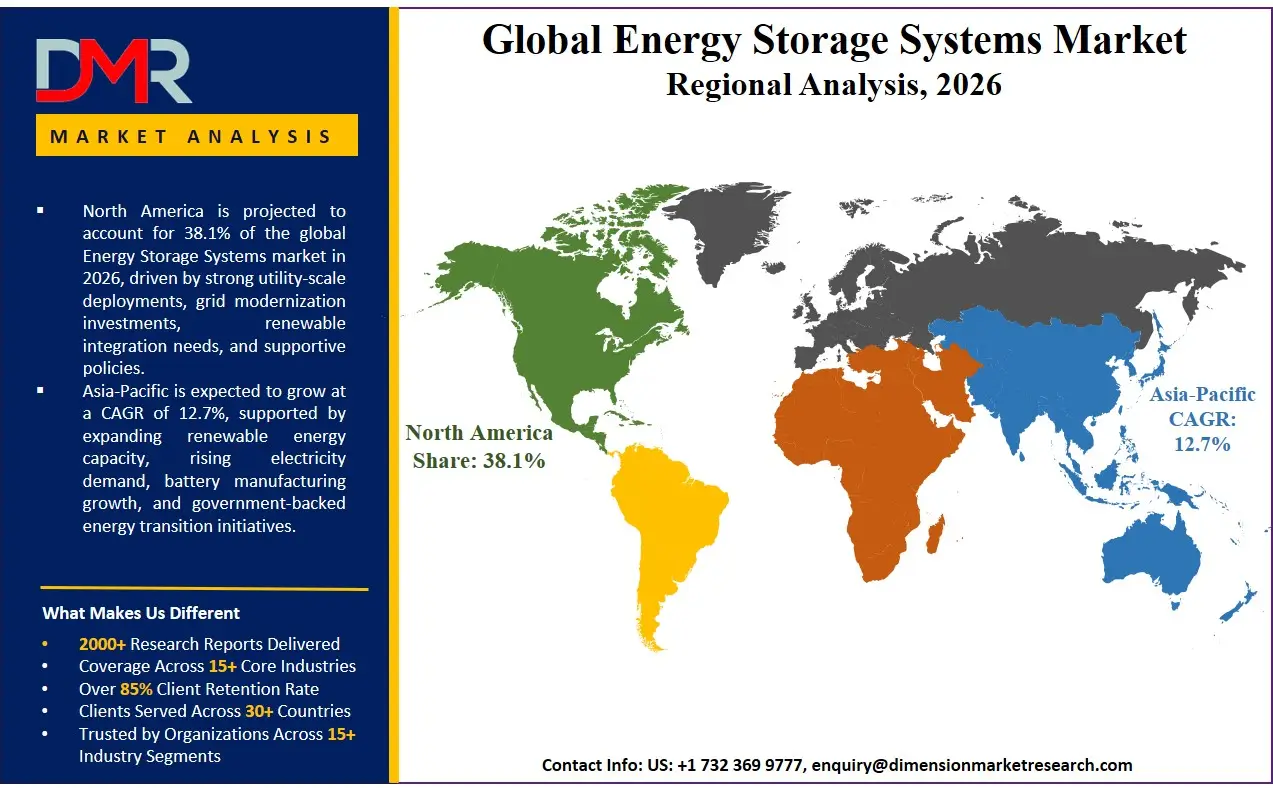
North America is poised to dominate the global energy storage systems market as it is projected to hold 38.1% of the market share by the end of 2026. The United States, which dominates North America, has the highest share in the energy storage market because of the unmatched concentration of venture capital funding for clean tech and the aggressive decarbonization mandates of state governments like California and New York. The area has an established ecosystem of global EPC contractors, specialized power electronics firms, and a rich pool of power systems engineers. Enterprise investment in AI-driven grid edge intelligence, advanced inverter controls, and the overall retirement of coal-fired steam turbines contribute to the continued demand for utility-scale BESS and long-duration storage, along with continuous O&M analytics. Moreover, a robust tax equity financing climate persistently funds upcoming independent storage developers that need expert systems integration to achieve expeditious revenue generation and UL certification.
ℹ
To learn more about this report –
Download Your Free Sample Report Here
Fastest-Growing Regional Market
Asia-Pacific is expected to be the most rapidly expanding energy storage market, driven by the government-led sweeping renewable energy deployment targets in China, India, Australia, and Southeast Asia. The fast-paced economic growth, the rise of an energy-hungry industrial base, and the dynamic expansion of the electric two-wheeler and three-wheeler market are compelling state-owned grid companies and commercial developers to discard inefficient coal assets. Grid stabilization and frequency regulation systems are in high demand to help these large networks head in the direction of high-voltage direct current (HVDC) transmission corridors and high-VRE penetration operating models. There is also a severe shortage of qualified power systems and battery safety talent in the region, and it is necessary to outsource EPC and integration services to implement, commission, and provide remote monitoring to cover the skills gap and enable faster investments in massive solar-plus-storage parks.
By Region
North America
Europe
- Germany
- The U.K.
- France
- Italy
- Russia
- Spain
- Benelux
- Nordic
- Rest of Europe
Asia-Pacific
- China
- Japan
- South Korea
- India
- ANZ
- ASEAN
- Rest of Asia-Pacific
Latin America
- Brazil
- Mexico
- Argentina
- Colombia
- Rest of Latin America
Middle East & Africa
- Saudi Arabia
- UAE
- South Africa
- Israel
- Egypt
- Rest of MEA
Competitive Landscape
The competitive environment of the global energy storage systems market has become highly dynamic, with a heterogeneous array of vertically integrated battery manufacturers, multinational power technology conglomerates, and specialized BESS integrators. The key to success will be profound strategic alliances with cell manufacturers like CATL or BYD, as well as power electronics giants, because they open the necessary supply chain visibility and early access to next-generation cell chemistry capabilities. The movement towards vertical integration is rapidly progressing, with traditional automotive OEMs acquiring BMS software and system integration firms to stay afloat in the stationary storage space. Proprietary intellectual property, including advanced state-of-charge estimation models and modular DC-block architecture, is becoming a more important basis of competitive differentiation than just raw cell cost arbitrage or generic turnkey EPC approaches.
Some of the prominent players in the Global Energy Storage Systems Market are:
- Tesla Energy
- BYD Company Limited
- Contemporary Amperex Technology Co., Limited (CATL)
- LG Energy Solution
- Samsung SDI
- Panasonic Energy
- Fluence Energy
- Sungrow Power Supply Co., Ltd.
- Wärtsilä Energy Storage
- Hitachi Energy
- GE Vernova
- Schneider Electric
- ABB Ltd.
- Siemens Energy
- Bloom Energy
- Enphase Energy
- Saft Groupe S.A.
- Powin LLC
- EOS Energy Enterprises
- NextEra Energy Resources
- Other Key Players
Recent Developments
- January 2026: Tesla Energy announced a major expansion of its Megapack production capacity in Lathrop, California, to reduce the backlog for its utility-owned systems and provide scaled manufacturing expertise for Lithium Iron Phosphate (LFP) grid stabilization applications.
- November 2025: Fluence Energy strengthened its digital ecosystem by acquiring a specialized AI firm to enhance its bidding optimization and frequency regulation software, aiming to support C&I customers in maximizing energy arbitrage returns in volatile ISO markets.
- October 2025: Wärtsilä launched a next-generation flow battery pilot program focusing on long-duration renewable energy integration, to support the complex requirements of island nations and remote mining operations seeking to displace thermal baseload with 100% clean energy.
Report Details
| Report Characteristics |
| Market Size (2026) |
USD 62.5 Bn |
| Forecast Value (2035) |
USD 141.0 Bn |
| CAGR (2026–2035) |
9.4% |
| The US Market Size (2026) |
USD 20.0 Bn |
| Historical Data |
2021 – 2025 |
| Forecast Data |
2027 – 2035 |
| Base Year |
2025 |
| Estimate Year |
2026 |
| Segments Covered |
By Technology, By Connection Type, By Energy Capacity, By Ownership Model, By Application, and By End User |
| Regional Coverage |
North America – The US and Canada; Europe – Germany, The UK, France, Russia, Spain, Italy, Benelux, Nordic, & Rest of Europe; Asia-Pacific – China, Japan, South Korea, India, ANZ, ASEAN, Rest of APAC; Latin America – Brazil, Mexico, Argentina, Colombia, Rest of Latin America; Middle East & Africa – Saudi Arabia, UAE, South Africa, Turkey, Egypt, Israel, & Rest of MEA |
Frequently Asked Questions
How big is the Global Energy Storage Systems Market?
▾ The Global Energy Storage Systems market is poised to be valued at USD 62.5 billion in 2026 and is projected to reach USD 141.0 billion by 2035, driven by the universal need for grid flexibility and the integration of intermittent renewable power sources.
What is the CAGR of the Global Energy Storage Systems Market from 2026 to 2035?
▾ The market is expected to grow at a CAGR of 9.4% from 2026 to 2035, reflecting the accelerating penetration of VRE and the persistent shortage of long-duration, cost-effective storage technologies.
What factors are driving the growth of the Global Energy Storage Systems Market?
▾ Key drivers include the global push to phase out coal, the imperative to manage peak demand spikes, the complexity of stabilizing bidirectional DER-heavy grids, and the surge in demand for backup power supply amid evolving climate resilience needs.
Which region held the largest share of the Energy Storage Systems Market in 2026?
▾ North America, specifically the United States, is projected to hold a 38.1% market share in 2026, driven by a mature project financing ecosystem and aggressive utility investment in grid-scale Battery Energy Storage Systems (BESS) and AI-driven dispatch capabilities.
Which region is expected to grow the fastest in the Energy Storage Systems Market?
▾ The Asia-Pacific region is expected to grow the fastest, fueled by rapid renewable energy integration in China, India, and Australia, where grid stabilization and transmission support are critical for transitioning large state-owned grids to clean energy operations.
What are the major trends in the Global Energy Storage Systems Market?
▾ Major trends include the integration of AI into battery management and energy trading, the rise of solid-state and sodium-ion chemistries, the demand for co-located solar-plus-storage solutions, and the focus on safety performance within complex containerized BESS environments.
Who are the key players in the Global Energy Storage Systems Market?
▾ Key players include vertically integrated energy giants like Tesla Energy, CATL, and BYD, as well as dedicated system integrators like Fluence Energy and Wärtsilä, alongside power technology incumbents like ABB and Siemens Energy.
How is the Global Energy Storage Systems Market segmented?
▾ The market is segmented by Technology, Connection Type, Energy Capacity, Ownership Model, Application, and End User.