Global Engineering Research & Development Service Market Snapshot
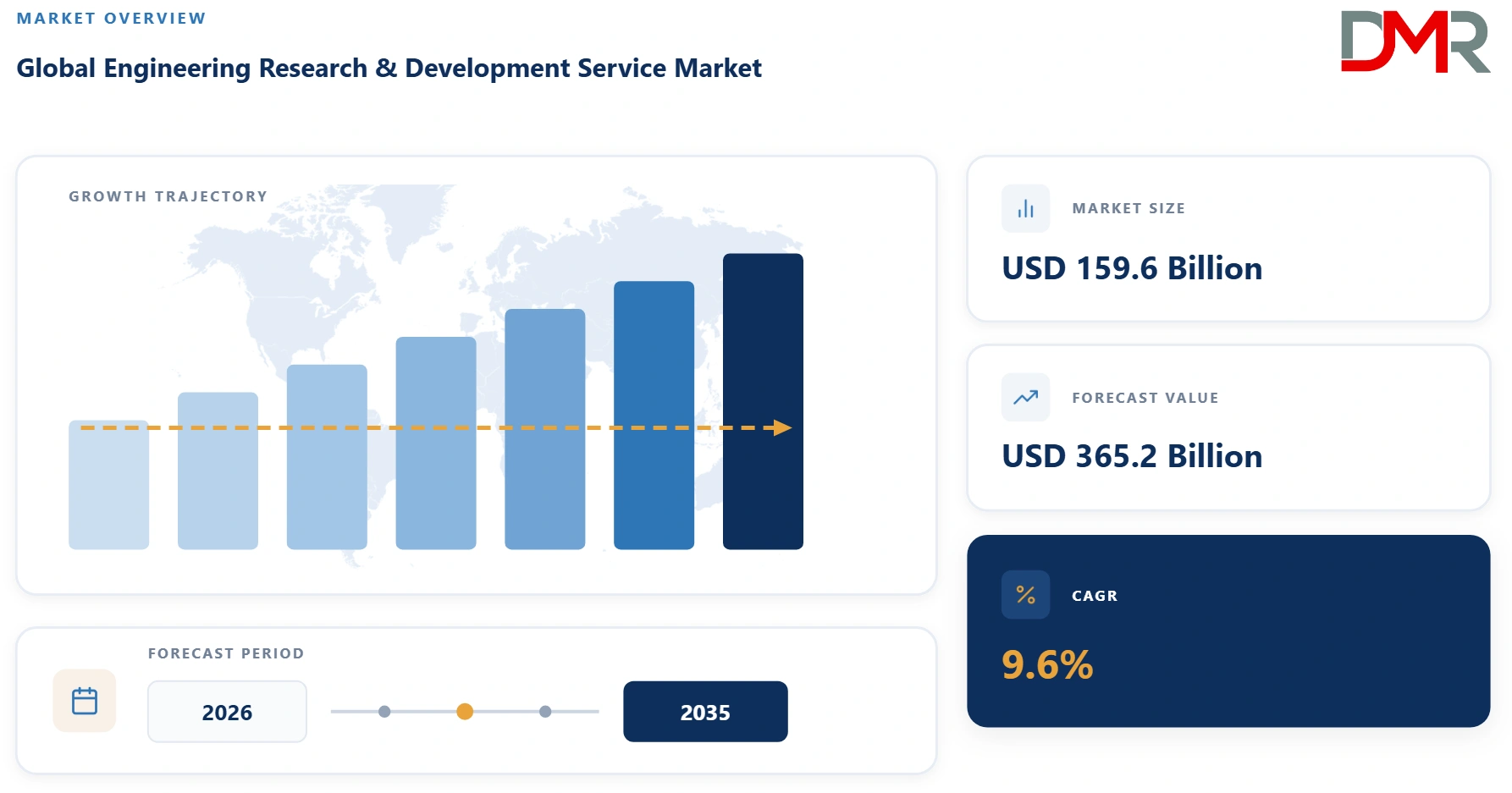
- Market Size in 2026: USD 159.6 Billion
- Market Size in 2035: USD 365.2 Billion
- Global CAGR, 2026–2035: 9.6%
- Leading Service Type: Product Engineering Services, 27.0%
- Leading Engineering Discipline: Software & Embedded Engineering, 24.0%
- Leading End-Use Industry: Automotive & Transportation, 24.5%
- Fastest-Growing Segment: Software & Embedded Engineering, 11.8% CAGR
- Leading Region in 2026: North America, 30.5%
What is the Global Engineering Research & Development Service and its Market Size?
Engineering Research & Development (ER&D) services comprise specialized external engineering capabilities used by organizations to research, design, develop, prototype, test, validate, optimize and sustain products, systems and industrial processes. The market spans mechanical and electrical engineering, embedded software, product engineering, simulation, digital engineering, systems integration, testing, certification support and engineering consulting.
ℹ
To learn more about this report –
Download Your Free Sample Report Here
The global Engineering R&D Service Market is estimated at USD 159.6 billion in 2026 and is projected to reach approximately USD 365.2 billion by 2035, representing a 9.6% CAGR.
Growth is being supported by rising product complexity, electrification, software-defined products, semiconductor development, industrial automation, aerospace modernization and increasing pressure to shorten development cycles. Companies are increasingly using external engineering partners to access scarce technical talent, reduce development costs, scale specialized capabilities and accelerate commercialization. AI-assisted engineering is becoming an additional structural catalyst, allowing providers to automate portions of simulation, software development, documentation, testing and design optimization.
Use Cases
- Product Design & Development: Develop new physical and digital products from requirements through detailed engineering and production readiness.
- Embedded Software Engineering: Build firmware, real-time software, control systems and connected-device applications for complex products.
- Prototype & Validation: Create prototypes and execute simulation, hardware-in-loop, functional, reliability and performance testing.
- Digital Engineering: Apply digital twins, model-based systems engineering, cloud simulation and AI to accelerate engineering workflows.
- Sustaining Engineering: Optimize existing products, address component obsolescence, resolve defects and support regulatory changes.
- Engineering Consulting: Provide technical strategy, architecture, technology selection, certification and transformation guidance.
Key Takeaways
- Market Size: Global ER&D services are estimated at USD 159.6 billion in 2026, reaching USD 365.2 billion by 2035.
- Growth: The market is expected to expand at approximately 9.6% CAGR through 2035.
- Growth Drivers: Product complexity, EV development, semiconductor innovation, aerospace modernization, Industry 4.0 and engineering talent shortages are the principal growth engines.
- Segment Dominance: Product Engineering Services leads by service type, while Software & Embedded Engineering is the largest engineering discipline.
- Fastest Growth: Software & Embedded Engineering is expected to expand at approximately 11.8% CAGR, driven by software-defined products, AI and connected systems.
- Regional Leadership: North America remains the largest regional market, while Asia-Pacific is expected to post the fastest growth as India, China and Southeast Asia expand engineering delivery ecosystems.
How AI/Gen AI is Transforming the Engineering Research & Development Service Market?
Artificial intelligence is shifting ER&D from labor-intensive engineering execution toward AI-augmented engineering. Providers are embedding generative AI, machine learning and agentic workflows into requirements analysis, code generation, design optimization, simulation, test-case creation, technical documentation and engineering knowledge management. Digital twins and AI-assisted simulation are also enabling engineers to evaluate more design alternatives before physical prototyping.
The primary benefits are shorter development cycles, higher engineer productivity, automated documentation, improved defect detection and lower engineering cost per development iteration. AI can also make previously uneconomical engineering activities viable by rapidly exploring large design spaces and automating repetitive validation tasks.
Key Drivers in the Global Engineering Research & Development Service Market
Increasing Product Complexity and Software-Defined Engineering
Modern products increasingly combine mechanical systems, electronics, software, connectivity, sensors, cybersecurity and cloud infrastructure. Automobiles, industrial equipment, medical devices and aerospace platforms therefore require multidisciplinary engineering teams rather than isolated mechanical or electrical specialists. External ER&D providers are benefiting because clients can obtain these capabilities without permanently expanding internal engineering organizations.
Shortage of Specialized Engineering Talent
Engineering organizations increasingly face shortages in AI, embedded software, semiconductor design, systems engineering, cybersecurity, functional safety and advanced simulation. At the same time, demand for these skills is expanding faster than many companies can recruit and train internally. This encourages OEMs and technology companies to use external engineering partners as flexible extensions of their R&D organizations.
Restraints in the Global Engineering Research & Development Service Market
Intellectual Property, Cybersecurity and Data-Sovereignty Risks
ER&D projects often involve proprietary product architectures, source code, engineering drawings, simulation models, manufacturing processes and unreleased product specifications. Outsourcing creates risks involving IP leakage, unauthorized access, cross-border data transfer and ownership of jointly developed technology. These concerns are especially significant in aerospace, defense, semiconductor, automotive and healthcare applications.
Growth Opportunities in the Global Engineering Research & Development Service Market
AI-Augmented Engineering and Engineering Intelligence
The largest structural opportunity is the conversion of traditional engineering workflows into AI-enabled processes. Providers can develop proprietary engineering copilots, agentic systems, AI-assisted simulation platforms and domain-specific models that automate repetitive activities while keeping engineers responsible for high-value decisions. The opportunity extends beyond coding. AI can assist requirements engineering, failure-mode analysis, test generation, technical documentation, design-space exploration and engineering knowledge retrieval. LTTS's 2026 partnership with Anthropic and its AI-enabled engineering platforms provide an example of providers positioning around this emerging category.
Emerging-Market Engineering Delivery Centers
Asia-Pacific, particularly India, China and Southeast Asia, offers strong expansion potential because of engineering talent availability, industrialization and growing multinational R&D centers. India's ER&D ecosystem is already substantial and continues to attract global engineering programs. Providers can also build hybrid delivery models combining local engineering teams with offshore specialists. This approach gives customers proximity for product definition and customer interaction while maintaining cost-efficient execution for simulation, software development, testing and documentation.
Trends in the Global Engineering Research & Development Service Market
From Engineering Outsourcing to Engineering Partnership
Customers are increasingly shifting from transactional project contracts toward strategic, multi-year relationships covering multiple stages of the product lifecycle. Providers are expected to contribute domain knowledge, reusable IP, platforms and innovation rather than simply supply engineering manpower.
Digital Twins and Model-Based Engineering
Digital twins, model-based systems engineering, cloud simulation and virtual validation are becoming foundational technologies. These tools enable engineering organizations to identify design issues earlier and reduce the number of physical prototype iterations. LTTS and Assai Software's 2026 partnership specifically targets digital-twin-enabled engineering for energy and utilities.
Research Scope and Analysis
The market is segmented by Service Type, Engineering Discipline, Development Stage, Engagement Model, Enterprise Size and End-Use Industry. The analysis emphasizes externally delivered engineering work across the product-development lifecycle and excludes general IT services without substantive engineering content.
ℹ
To learn more about this report –
Download Your Free Sample Report Here
By Service Type Analysis
Product Engineering Services is estimated to be the dominant service category in 2026, accounting for approximately 27.0% of global revenue. Its leadership reflects strong demand from automotive, electronics, industrial equipment and consumer-product companies seeking external support across requirements, architecture, mechanical/electrical design, embedded systems and product lifecycle management. Testing & Certification Support Services is expected to be the fastest-growing sub-segment at approximately 10.8% CAGR, driven by rising functional-safety, cybersecurity, regulatory and autonomous-system validation requirements. Engineering Design & Development Services, with an estimated 22.0% share, remains the second-largest category because design work represents a core component of nearly every engineering program. Prototyping and validation also benefit from increased use of simulation and additive manufacturing, while consulting services are expanding as customers adopt MBSE, digital twins and AI-enabled engineering strategies.
By Engineering Discipline Analysis
Software & Embedded Engineering leads the discipline segmentation with approximately 24.0% share in 2026, reflecting the software-defined transformation of vehicles, industrial equipment, consumer electronics and connected devices. It is also the fastest-growing discipline at approximately 11.8% CAGR, supported by embedded AI, edge computing, cybersecurity, cloud connectivity and autonomous systems. Mechanical Engineering, representing around 21.5%, remains the second-largest category because physical product design continues to underpin automotive, aerospace, machinery and industrial manufacturing. Electrical and electronics engineering represents another major revenue pool as semiconductor content, power electronics and electrification increase. Civil & structural and chemical & process engineering remain important in infrastructure, energy and industrial applications, while industrial/manufacturing engineering is gaining momentum from smart factories, robotics and automation.
By Development Stage Analysis
Design & Development is estimated to hold the largest share at approximately 29.0% in 2026, because customers frequently outsource detailed design, engineering architecture, embedded development and systems engineering after establishing product requirements internally. Testing & Validation is expected to be the fastest-growing stage at around 10.9% CAGR, reflecting increasing product complexity and regulatory requirements. Prototyping, with approximately 17.0% share, ranks second among the major development stages as companies use rapid prototyping, simulation and additive manufacturing to shorten development cycles. Concept and feasibility services remain strategically important for early technology decisions, while product optimization and sustaining engineering generate recurring revenue after launch through redesign, localization, cost reduction, component replacement and software updates.
By Engagement Model Analysis
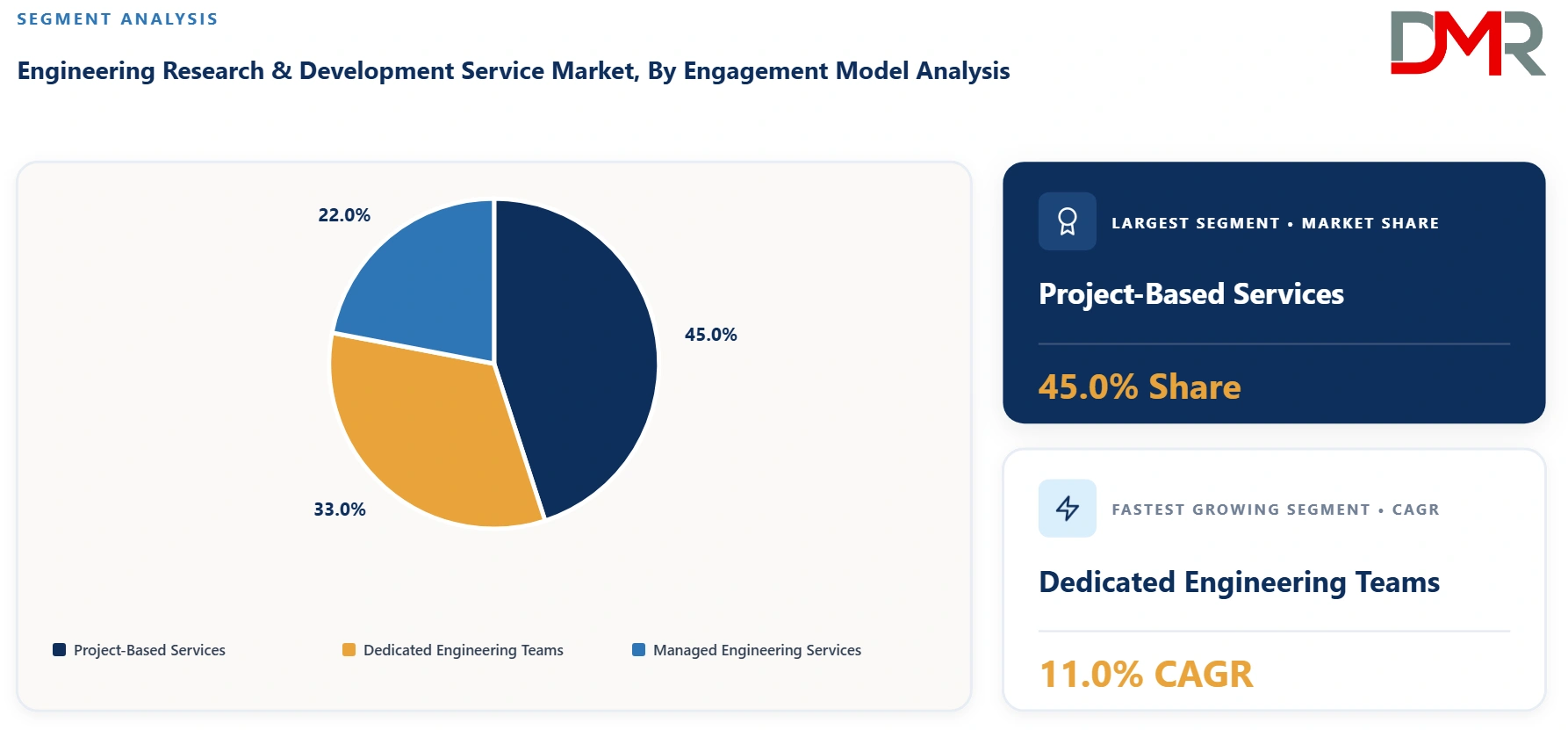
Project-Based Services represents approximately 45.0% of 2026 revenue, remaining the most widely used engagement structure because companies frequently commission specific design, testing, prototyping or development programs. Dedicated Engineering Teams are expected to be the fastest-growing model at approximately 11.0% CAGR, as customers increasingly seek scalable extensions of internal R&D organizations. Managed Engineering Services, representing roughly 22.0%, are also expanding as large enterprises consolidate suppliers and outsource complete engineering processes. Dedicated teams provide better continuity, domain knowledge and IP familiarity than short-term contractors, while managed services can provide outcome-based accountability. The market is therefore gradually moving from task-based outsourcing toward longer-term partnerships with shared engineering roadmaps, reusable platforms and integrated delivery organizations.
By Enterprise Size Analysis
Large Enterprises account for approximately 76% of 2026 market revenue, reflecting their substantial R&D budgets and extensive product portfolios. However, SMEs are expected to grow faster at approximately 11.2% CAGR, because cloud engineering tools, outsourced prototyping and flexible engineering teams are reducing the capital required to develop sophisticated products. Startups increasingly use external ER&D firms to obtain specialized semiconductor, embedded, mechanical, certification and testing capabilities without building large permanent engineering organizations.
By End Use Industry Analysis
Automotive & Transportation leads with an estimated 24.5% market share in 2026, supported by EV platforms, ADAS, software-defined vehicles, battery engineering and connected mobility. Electronics & Semiconductor is among the fastest-growing industries, driven by AI hardware, advanced packaging, edge computing and increasing electronics content. Aerospace & defense remains a high-value market because of complex certification and long development programs. Industrial manufacturing is expanding through Industry 4.0, robotics and digital twins. Healthcare and medical devices benefit from connected devices and regulatory engineering, while energy and utilities require engineering support for grid modernization, renewable energy, storage and industrial decarbonization. Telecommunications, consumer goods, construction and chemicals provide additional diversified demand.
The Global Engineering Research & Development Service Market Report is segmented on the basis of the following:
By Service Type
- Product Engineering Services
- Process Engineering Services
- Engineering Design & Development Services
- Prototyping & Validation Services
- Testing & Certification Support Services
- Engineering Consulting Services
By Engineering Discipline
- Mechanical Engineering
- Electrical & Electronics Engineering
- Software & Embedded Engineering
- Civil & Structural Engineering
- Chemical & Process Engineering
- Industrial & Manufacturing Engineering
By Development Stage
- Concept & Feasibility
- Design & Development
- Prototyping
- Testing & Validation
- Product Optimization & Sustaining Engineering
By Engagement Model
- Project-Based Services
- Dedicated Engineering Teams
- Managed Engineering Services
By Enterprise Size
- Large Enterprises
- Small & Medium Enterprises
By End-Use Industry
- Automotive & Transportation
- Aerospace & Defense
- Industrial Manufacturing
- Electronics & Semiconductor
- Energy & Utilities
- Healthcare & Medical Devices
- Telecommunications
- Consumer Goods
- Construction & Infrastructure
- Chemicals & Materials
Regional Analysis
North America is the Leading Region in the Global Engineering Research & Development Service Market
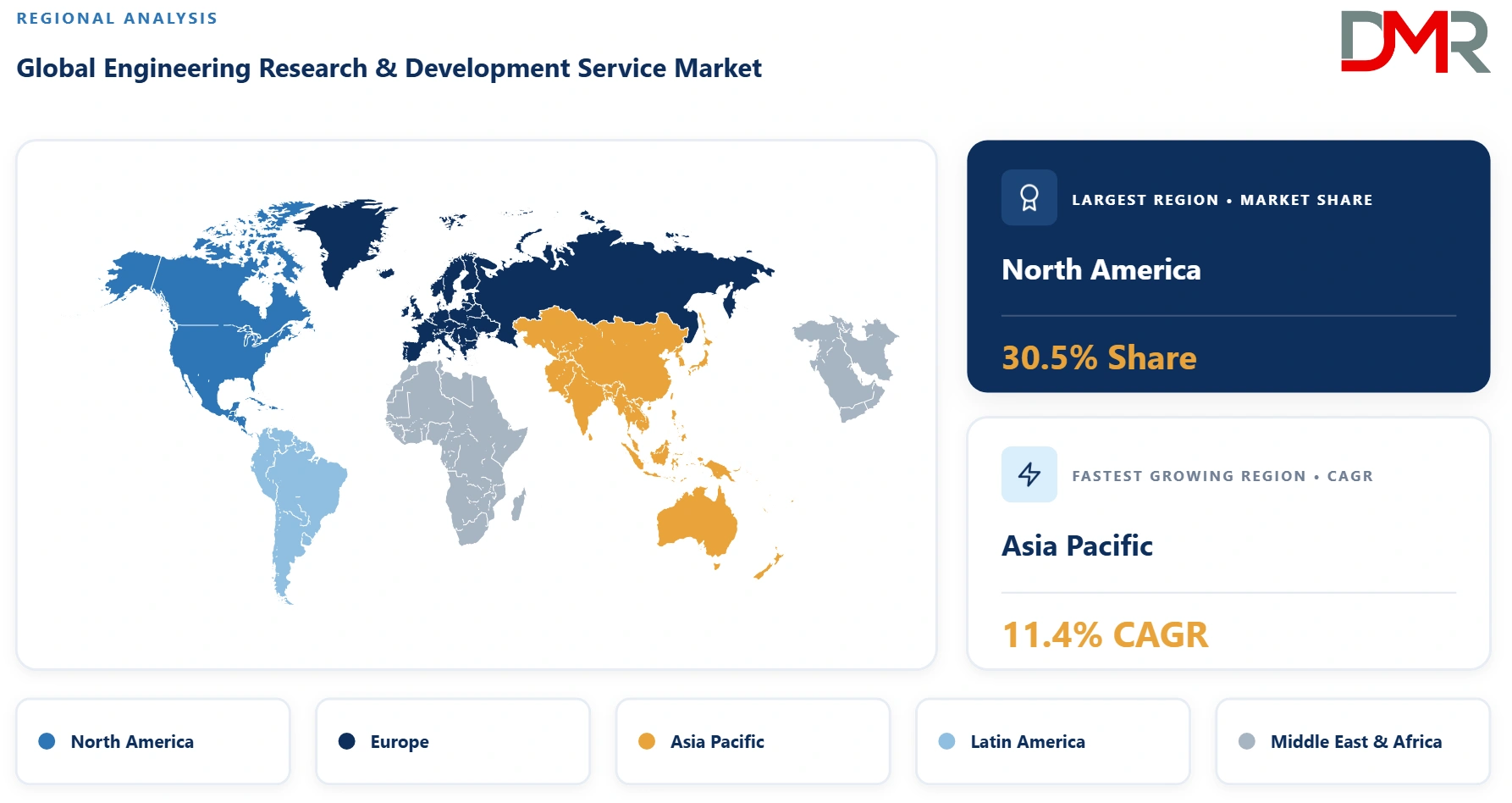
North America is expected to remain the leading regional market, accounting for approximately 30.5% of global ER&D services revenue in 2026, equivalent to roughly USD 48.7 billion. The region benefits from a high concentration of automotive, aerospace, semiconductor, healthcare, technology and industrial companies with substantial engineering budgets. The United States also has significant demand for specialized engineering talent in AI, semiconductor development, cloud-connected products, defense systems and autonomous technologies. High labor costs encourage selective outsourcing, while proximity requirements keep substantial engineering activity onshore or nearshore. Recent North American ER&D estimates also indicate strong growth, with one market study placing the region's broader ER&D services market at USD 1.09 trillion in 2025, although that broader definition is not directly comparable with this report's narrower external-services definition.
ℹ
To learn more about this report –
Download Your Free Sample Report Here
Asia Pacific is the Fastest-Growing Region in the Global Engineering Research & Development Service Market
Asia-Pacific is projected to be the fastest-growing regional market, with an estimated 11.4% CAGR through 2035. Growth is driven by India, China, Japan, South Korea and Southeast Asia, where manufacturing ecosystems, engineering talent, semiconductor investment, EV production and multinational R&D centers are expanding. India is particularly important as an offshore and global engineering-delivery hub.
The Europe Engineering Research & Development Service Market
Europe's market is estimated at USD 39.4 billion in 2026 and projected to reach approximately USD 83.8 billion by 2035, representing a 8.7% CAGR. Automotive, aerospace, industrial automation, energy, medical technology and semiconductor engineering are the principal demand centers. Germany remains especially important because of its automotive and industrial engineering base. European clients are also accelerating engineering work related to electrification, sustainability, digital twins and functional safety. Regulatory complexity is simultaneously creating demand for compliance engineering and validation services.
Latin America Engineering Research & Development Service Market
Latin America is estimated at approximately USD 10.8 billion in 2026 and is projected to reach USD 22.0 billion by 2035, representing roughly 8.2% CAGR. Brazil and Mexico account for most regional demand. Automotive manufacturing, aerospace, industrial equipment, energy and telecommunications are important markets. Nearshore engineering delivery for North American companies represents an additional opportunity, particularly in Mexico, where automotive and electronics manufacturing ecosystems provide access to regional engineering programs.
MEA Engineering Research & Development Service Market
The Middle East & Africa market is estimated at USD 7.7 billion in 2026, reaching approximately USD 15.6 billion by 2035 at an estimated 8.1% CAGR. Saudi Arabia and the UAE are the principal growth centers. Demand is being driven by smart-city programs, energy diversification, industrial localization, infrastructure modernization, aerospace, defense and digital transformation. Engineering opportunities are increasingly shifting toward renewable energy, hydrogen, advanced manufacturing, autonomous systems and large infrastructure projects.
Major Countries Analysis
United States Engineering Research & Development Service Market
The United States market is estimated at USD 42.0 billion in 2026 and is projected to reach USD 88.9 billion by 2035, representing approximately 8.7% CAGR. Demand is concentrated in aerospace & defense, semiconductors, automotive, healthcare, industrial technology and software-defined products. AI-assisted engineering, digital twins, autonomous systems and advanced semiconductor development are major technology priorities.
Japan Engineering Research & Development Service Market
Japan is estimated at approximately USD 9.8 billion in 2026, rising to USD 22.2 billion by 2035 at an estimated 9.5% CAGR. Automotive remains the largest engineering application, with additional demand from robotics, industrial automation, electronics and semiconductor equipment. Aging engineering workforces and the transition toward software-defined mobility are encouraging Japanese manufacturers to expand external engineering partnerships.
Saudi Arabia Engineering Research & Development Service Market
Saudi Arabia's market is estimated at approximately USD 1.6 billion in 2026, increasing to around USD 3.9 billion by 2035 at a 10.4% CAGR. Growth is linked to Vision 2030, industrial diversification, smart infrastructure, renewable energy, advanced manufacturing, defense localization and digital transformation. Engineering providers supporting energy, construction, mobility and industrial projects are positioned to benefit from increasing localization and technology-transfer requirements.
Regulatory Landscape
ER&D services are governed by a combination of product-specific regulations, engineering standards, data-protection requirements, export controls and industry certification frameworks. Automotive programs commonly require alignment with ISO 26262 functional-safety requirements, while aerospace software development relies heavily on DO-178C and associated standards. Industrial safety programs commonly reference IEC 61508. In Europe, the EU AI Act is becoming increasingly relevant to AI-enabled engineering tools and AI embedded in regulated products; major AI Act rules began applying from 2 August 2026, with further high-risk provisions scheduled through 2027–2028. Data protection, cybersecurity, IP ownership and cross-border data-transfer rules further affect global delivery models.
Investment and White Space Analysis
The strongest investment opportunities lie in AI-enabled engineering platforms, semiconductor engineering, EV/battery development, aerospace software, digital twins, cybersecurity engineering and functional-safety validation. Providers can differentiate through proprietary engineering IP rather than labor arbitrage alone. Asia-Pacific offers substantial white space for specialized engineering delivery centers, particularly in India and Southeast Asia. Other underserved areas include AI validation for safety-critical products, sustainable-material engineering, hydrogen infrastructure, energy-storage engineering and engineering data platforms. Recent industry activity indicates that leading providers are already moving toward these opportunities: LTTS is expanding Engineering Intelligence through AI partnerships and digital-twin initiatives, while ALTEN is using acquisitions to deepen future-mobility capabilities.
By Region
North America
Europe
- Germany
- France
- The U.K.
- Italy
- Spain
- Rest of Europe
Asia-Pacific
- China
- Japan
- India
- Australia
- South Korea
- Rest of APAC
Latin America
- Mexico
- Brazil
- Rest of LATAM
Middle East & Africa
- Saudi Arabia
- The UAE
- South Africa
- Rest of MEA
Competitive Landscape
The global Engineering R&D Service Market is moderately fragmented, with large diversified technology companies competing alongside specialized engineering firms and regional engineering specialists. Major competitors include Tata Technologies, L&T Technology Services, KPIT Technologies, HCLTech, Capgemini Engineering, Wipro, Infosys, Akkodis, ALTEN, Cyient, Siemens and other domain-focused providers. Recent industry research identifies many of these firms among the leading participants. Competition is increasingly based on engineering domain expertise, proprietary IP, AI platforms, industry certifications, delivery scale and the ability to provide end-to-end product lifecycle support. M&A, strategic technology partnerships and geographic expansion remain important growth strategies. Providers are also moving toward multi-year engagements and dedicated engineering centers to increase account stickiness.
Some of the prominent players in the Global Engineering Research & Development Service Market are:
- Accenture
- Tata Consultancy Services (TCS)
- Capgemini Engineering
- HCLTech
- Infosys
- Wipro
- Cognizant
- Tech Mahindra
- L&T Technology Services (LTTS)
- Quest Global
- ALTEN Group
- EPAM Systems
- Cyient
- Tata Technologies
- KPIT Technologies
- GlobalLogic
- LTIMindtree
- Persistent Systems
- Akkodis
- Luxoft
- IBM
- DXC Technology
- NTT DATA
- Bertrandt
- IAV
- Assystem
- FEV Group
- Harman International
- Siemens
- Robert Bosch
- ABB
- Honeywell
- NEC Corporation
- Hitachi
- Mitsubishi Electric
- Panasonic
- Tata Elxsi
- UST
- Cyient DLM
- Mphasis
- Other Key Players
Recent Developments
- July 2026: L&T Technology Services and Anthropic (LTTS) announced a partnership to integrate Claude models across engineering processes and its Engineering Intelligence platforms, targeting faster product and software development and more automated engineering workflows.
- June 2026: ALTEN India announced the acquisition of Ielektron Technologies Engineering, strengthening capabilities in ADAS, EV powertrains, battery-management systems, connected vehicles, embedded engineering and future mobility.
- June 2026: HCLTech joined Microsoft's Discovery Platform ecosystem to support AI-driven scientific and engineering R&D spanning semiconductor design, materials science, clean energy and other advanced research workflows.
- May 2026: L&T Technology Services and Emerson announced a strategic global cooperation positioning LTTS as a system integrator and technology-development partner around Emerson's NI test platform across industrial, transportation, semiconductor and aerospace applications.
- May 2026: &T Technology Services partnered with Assai Software to develop digital-twin and engineering-information solutions for European energy and utilities customers, combining engineering capabilities with engineering document-management technology.
- January 2026: L&T Technology Services secured a multi-year engineering and R&D engagement from a global automotive OEM covering software, connectivity, digital engineering, verification, cloud integration and cybersecurity across multiple vehicle technology domains.
Report Details
| Report Characteristics |
| Market Size (2026) |
USD 159.6 Bn |
| Forecast Value (2035) |
USD 365.2 Bn |
| CAGR (2026–2035) |
9.6% |
| The US Market Size (2026) |
USD 42.0 Bn |
| Historical Data |
2021 – 2025 |
| Forecast Data |
2026 – 2035 |
| Base Year |
2025 |
| Segments Covered |
By Service Type, By Engineering Discipline, By Development Stage, By Engagement Model, By Enterprise Size, By End-Use Industry |
| Regional Coverage |
North America – The US and Canada; Europe – Germany, France, The UK, Italy, Spain, Rest of Europe; Asia-Pacific – China, Japan, India, Australia, South Korea, Rest of APAC; Latin America – Mexico, Brazil, Colombia, Argentina, Rest of LATAM; Middle East & Africa – Saudi Arabia, The UAE, South Africa, Rest of MEA |
Frequently Asked Questions
What is the size of the global Engineering Research & Development Service Market in 2026?
▾ The global Engineering Research & Development Service Market is estimated at approximately USD 159.6 billion in 2026.
What will the Engineering Research & Development Service Market size reach by 2035?
▾ The Engineering Research & Development Service Market is projected to reach approximately USD 365.2 billion by 2035, driven by increasing demand for outsourced engineering capabilities.
What is the CAGR of the Engineering Research & Development Service Market?
▾ The Engineering Research & Development Service Market is expected to expand at approximately 9.6% CAGR from 2026 to 2035.
What are the key growth drivers of the Engineering Research & Development Service Market?
▾ The major drivers of the Engineering Research & Development Service Market include product complexity, software-defined products, EV development, semiconductor innovation, AI adoption and engineering talent shortages.
Which segment dominates the Engineering Research & Development Service Market?
▾ Product Engineering Services dominates the Engineering Research & Development Service Market, while Software & Embedded Engineering represents the leading engineering discipline.
Which region leads the Engineering Research & Development Service Market?
▾ North America leads the Engineering Research & Development Service Market, accounting for approximately 30.5% of global market revenue in 2026.
Which region is expected to grow fastest in the Engineering Research & Development Service Market?
▾ Asia-Pacific is projected to be the fastest-growing region in the Engineering Research & Development Service Market, with an estimated 11.4% CAGR through 2035.
Who are the key players in the Engineering Research & Development Service Market?
▾ Major players in the Engineering Research & Development Service Market include Tata Technologies, LTTS, KPIT, HCLTech, Capgemini Engineering, ALTEN, Akkodis, Infosys, Wipro, Cyient and Siemens.