What is the Global Epoxy Glass Market Size?
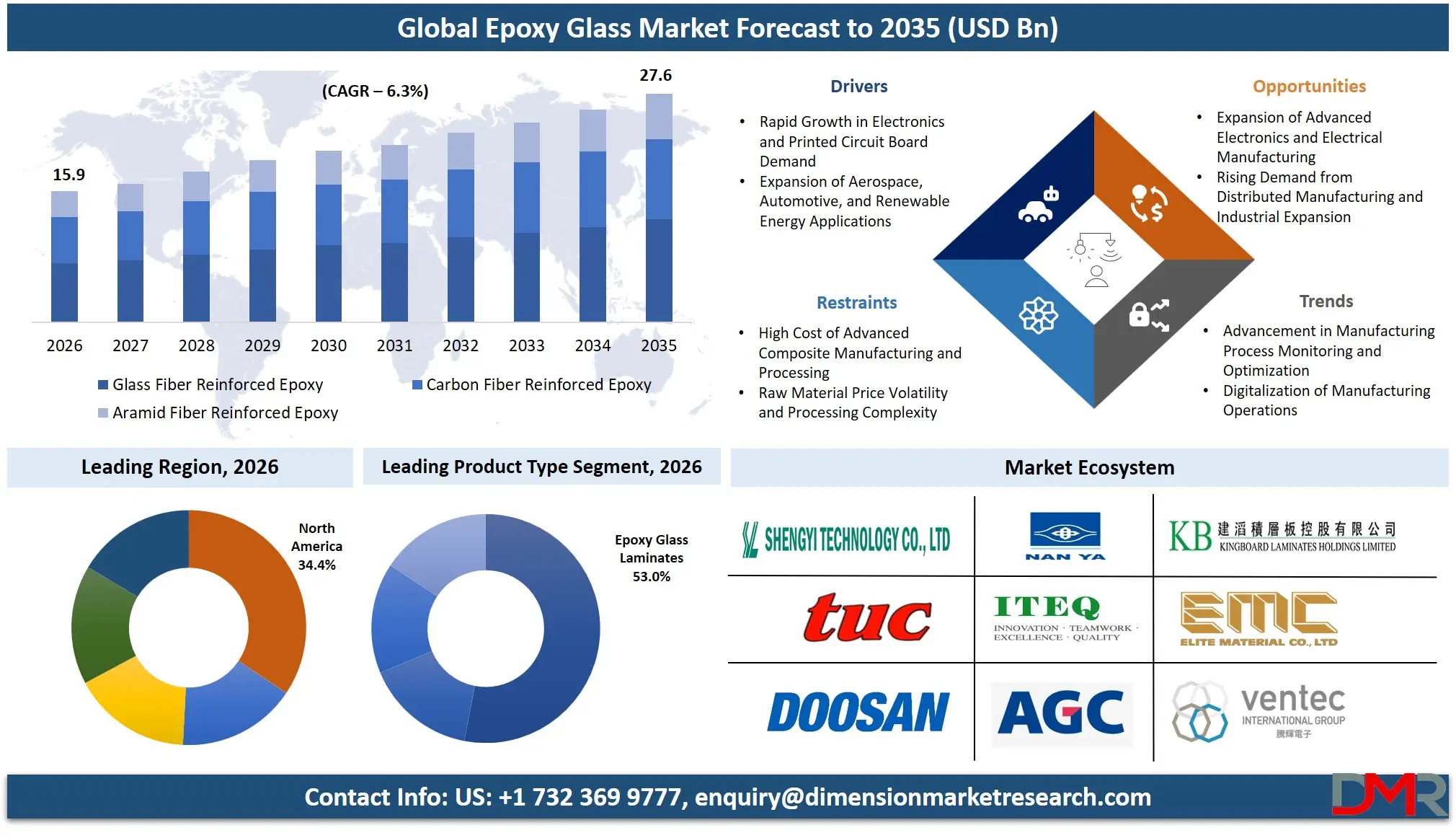
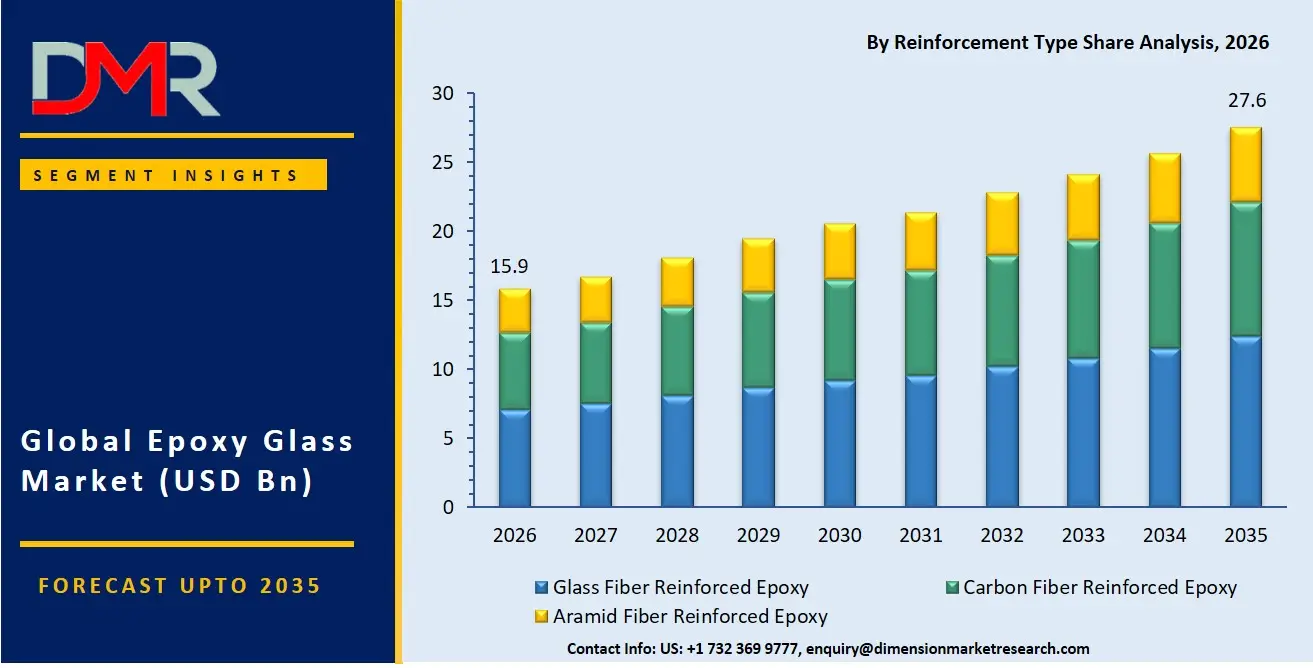
The Global Epoxy Glass Market size is estimated at USD 15.9 billion in 2026 and is projected to reach USD 27.6 billion by 2035, exhibiting a CAGR of 6.3% during the forecast period, driven by AI-optimized composite manufacturing, automation, and integrated performance testing workflows in electrical and structural component production.
ℹ
To learn more about this report –
Download Your Free Sample Report Here
The growth of the epoxy glass industry can be attributed to an increase in machine learning techniques for resin formulation optimization and thermal management, government mandates that minimize the likelihood of failure of electrical insulation systems and shorten the timeline for the development of high-reliability composite panels, and higher investment in automated composite production programs by private companies and governments.
Additional factors driving the growth include breakthroughs in real-time cure monitoring technologies, mechanical modeling and prediction, automated resin application, and high-throughput quality screening, among other developments in interoperability systems which facilitate epoxy glass integration in component manufacturing operations. Digital modernization in energy and industrial electronics companies has helped optimize laminate thickness design and improve process outcomes, including reduced time to production. Automation of the workflows, predictive processes, and artificial intelligence-enabled design-test-validate systems have accelerated adoption, and renewable energy national strategies have supported sustainability in composite manufacturing.
ℹ
To learn more about this report –
Download Your Free Sample Report Here
The US Epoxy Glass Market
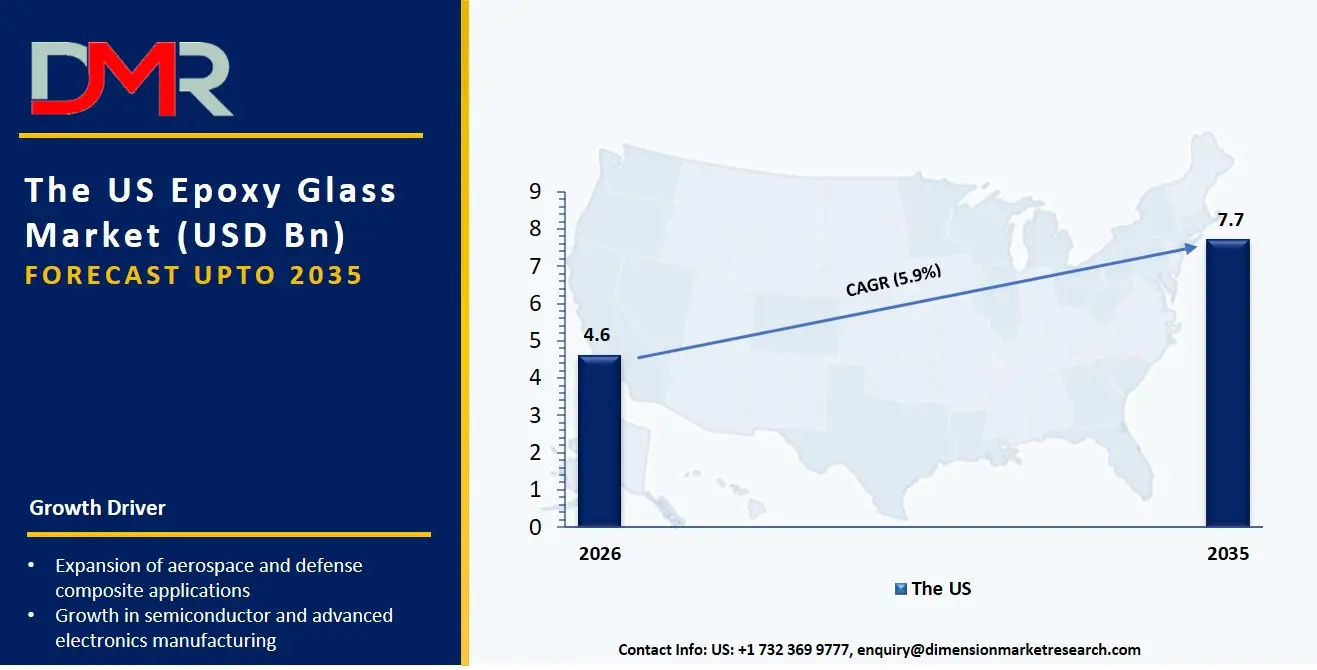
The US Epoxy Glass Market is estimated to grow to USD 4.6 billion in 2026 with a compound annual growth rate of 5.9% during the forecast period.
The US market is defined by the existence of significant federal funding schemes like the Advanced Composites Manufacturing Innovation Institute (IACMI), the US Department of Energy's advanced manufacturing programs, the NREL-led composite testing frameworks, all of which will help the development of the necessity of AI-driven resin engineering, real-time production telemetry of automated curing lines and robotic handling systems, and predictive quality software. Automated epoxy glass manufacturing systems remain to be more rapidly adopted in the region, and the US needs highly developed interoperability frameworks, integration of real-world evidence using digital manufacturing logs, and verifiable epoxy glass AI assurance. Also, service providers are being pressured by initiatives like the Inflation Reduction Act (IRA) and national AI in manufacturing strategies to create dedicated integration and deployment services to guarantee data interoperability, quality assurance, and compliance across a variety of electrical component manufacturing departments and academic research centers.
ℹ
To learn more about this report –
Download Your Free Sample Report Here
Europe Epoxy Glass Market
The European Epoxy Glass Market is estimated to be valued at USD 4.1 billion in 2026, witnessing growth at a CAGR of 6.6%, during the forecast period.
The epoxy glass market is mature in Europe, and it has a strong effect on the regulatory specifications and the regional policies including the EU Circular Economy Action Plan for composites, the European Composites Manufacturing Pilot Lines, and national digital industrial programs (e.g., the France-Composites Initiative and the German Industrie 4.0 strategy). Another area that countries are working towards is smart composite modularization in order to align research and production workload demands and interoperability of cross-border component manufacturing data supply chains. It is driven by advanced technologies, such as real-time mechanical design engines and high-reliability thermal stress scoring systems with an inbuilt predictive algorithm on the development of engineered resin systems. Adoption is facilitated by the use of public-private partnerships and harmonization of epoxy glass standards. Technologies like real-time computational workload balancing and smart contract-based data sharing are commonly practiced as research-centric programs, and Europe is a frontrunner in terms of the digital transformation of safe and efficient epoxy glass-enabled electrical manufacturing.
Japan Epoxy Glass Market
The Japan Epoxy Glass Market is projected to be valued at USD 934.0 million in 2026, progressing at a CAGR of 7.2%, during the period spanning from 2026 to 2035.
Japan boasts a mature epoxy glass market supported by high-performance automated resin coating systems, diagnostic integration technology, and a wide network of robotic composite processing AI innovations. Automation, precision, and process integrity are the priorities in the country and are achieved by predictive mechanical performance models and intelligent process management systems for resin curing. Growth is stimulated by government actions under the Green Growth Strategy and constant investment in digital composite manufacturing infrastructure. The high volume of PCB and electrical component R&D, industrial composite development for high-strength panels, and composite lab automation requires efficient AI for real-time evidence-based inference. The difficulties are high validation costs for new epoxy glass automation architectures and integration with legacy composite processing systems, yet the prospects are in exporting developed epoxy glass technologies to Asian and Pacific markets.
Key Takeaways
- Market Size & Forecast: The Global Epoxy Glass Market is estimated to be valued at USD 15.9 billion in 2026 and is expected to grow to USD 27.6 billion by 2035.
- Growth Rate & Outlook: The market is expected to witness growth at a compound annual growth rate of 6.3% in the forecast period.
- Primary Growth Drivers: Technological progress in machine learning-based engineering of resin systems for electrical components; regulatory requirements for faster component development and reduced failure rates; and industrial deployment of intelligent epoxy glass manufacturing platforms are some of the key drivers of growth in the market.
- Key Market Trends: The use of predictive mechanical outcome monitoring, real-time cure optimization, and transition to cloud-based composite production telemetry and fleet management systems are some of the primary market trends.
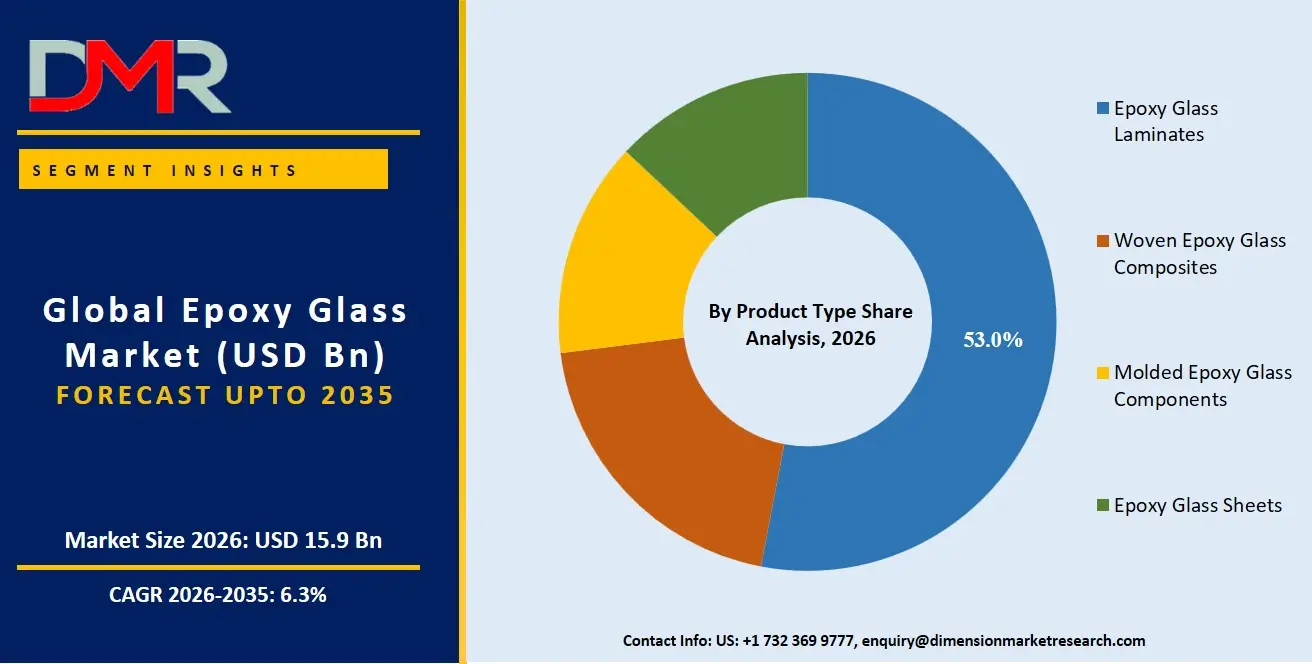
- By Product Type: The Epoxy Glass Laminates segment is anticipated to get the majority share of the epoxy glass market in 2026.
- By Reinforcement Type: The Glass Fiber Reinforced Epoxy segment is expected to occupy the largest revenue share in 2026 in the epoxy glass market.
- By Resin System: The Laminating Grade Resins segment (specifically for PCB and electrical insulation) is expected to get the largest revenue share in 2026 in the epoxy glass market.
- Regional Leadership: North America is predicted to dominate the market with an estimated 34.4% share in 2026.
What is an Epoxy Glass?
Epoxy Glass is a term that describes an engineered, ultra-strong composite material formed from the mixture of epoxy resin systems and glass fibers and is used for electrical components and printed circuit boards, industrial machinery, and transportation purposes. The use of automated technology such as mixing, curing oven, resin systems, and quality analysis helps assemble components fast, achieve mechanical accuracy, and speed up the development and manufacturing process of composites. Epoxy glass is gaining popularity in areas like electrical insulation, aerospace, automotive light weighting, and renewable energy due to its performance characteristics and environmental benefits.
Use Cases
- Composite Optimization for High-Performance PCBs: Epoxy glass manufacturers are capable of designing high-throughput resin configurations in real-time to discover an optimal dielectric strength composite for multilayer and HDI boards with latency on the order of weeks, saving orders of magnitude over time compared with manual mechanical screening.
- Thermal & Mechanical Pathway Optimization: Long-term field exposure and performance data, such as cumulative thermal cycling and load fatigue, are modeled to give process adjustment recommendations and keep safely managing production runs without interruption to ensure component stability and manufacturing confidence.
- Curing Line Monitoring & Control: Industrial deployments are employing machine learning and oven analytics to perform on-device real-time strength prediction, process anomaly detection, and automated heat adjustment with quantifiable and proven accuracy.
- Industrial Efficiency & Government Programs: More efficient epoxy glass manufacturing contributes to the success of electrical innovation, grid decarbonization, and smart component surveillance, facilitates national renewable energy adoption, contributes to deployment reliability, and helps implement policies, such as the composite governance policy and electrical manufacturing standards.
How AI Is Transforming the Global Epoxy Glass Market?
Artificial intelligence is revolutionizing the field of epoxy glass manufacturing, allowing predictive modeling of the likelihood of mechanical performance success, automatic detection of anomalies in curing data patterns, and optimization of resin parameters in a component-specific scenario. Oven-generated telemetry and mechanical measurement data can be processed using AI algorithms to identify any degradation or performance drift and optimize production outcomes at scale. This saves time, is verifiable and cheaper than manual data analysis.
Moreover, AI enhances quality assurance through offering adaptive computational event-based scheduling, anticipating workflow threats to mechanical accuracy, and intelligent prioritization of composite line health monitoring. It is also involved in reducing the cost of baseline testing and ongoing performance tracking, allowing electrical manufacturing IT operators to reduce the cost and physical footprint of on-prem test campaigns and improve the reliability of epoxy glass production workloads and their financial returns.
Market Dynamics
Key Drivers of the Global Epoxy Glass Market
Rapid Growth in Electronics and Printed Circuit Board Demand
The global epoxy glass market is driven by rising demand for epoxy glass laminates in printed circuit boards (PCBs), especially across consumer electronics, AI servers, telecommunications equipment, and semiconductor devices. Increasing miniaturization and performance requirements in electronic systems are boosting the adoption of high-frequency and high-thermal resistance materials. Epoxy glass substrates such as FR-4 are widely used due to their excellent electrical insulation, dimensional stability, and cost efficiency. The rapid expansion of data centers, 5G infrastructure, and advanced computing applications is further strengthening demand, making the electronics sector the primary growth engine for the global epoxy glass market.
Expansion of Aerospace, Automotive, and Renewable Energy Applications
The increasing use of lightweight and high-strength composite materials in aerospace, automotive, and renewable energy industries is significantly driving demand for epoxy glass products. In aerospace, epoxy glass composites are used in structural components and insulation systems due to their durability and thermal resistance. The automotive sector is adopting these materials to support electric vehicle lightweighting and improve energy efficiency. In renewable energy, epoxy glass is widely used in wind turbine blades and electrical insulation systems. Additionally, industrial machinery applications benefit from its corrosion resistance and mechanical strength, supporting broader adoption across high-performance engineering and infrastructure applications globally.
Restraints in the Global Epoxy Glass Market
High Cost of Advanced Composite Manufacturing and Processing
The epoxy glass market faces restraints due to the high cost of advanced manufacturing processes, including controlled curing, lamination, and reinforcement integration. These processes require specialized equipment, precise temperature control, and strict quality assurance systems, which significantly increase production expenses. Additionally, energy-intensive processing further adds to overall costs, limiting adoption in price-sensitive markets. Small and medium manufacturers often struggle to invest in required infrastructure, restricting market penetration. The complexity of achieving consistent mechanical and thermal performance across large-scale production batches also increases rejection rates and operational inefficiencies, acting as a key barrier to cost-effective and scalable epoxy glass production globally.
Raw Material Price Volatility and Processing Complexity
The epoxy glass market is constrained by volatility in raw material prices, particularly epoxy resins, glass fibers, and specialty chemical additives, which directly impact production costs and profit margins. Fluctuations in supply availability further create uncertainty for manufacturers. In addition, the technical complexity of ensuring uniform curing, proper fiber reinforcement, and defect-free lamination increases production challenges. Maintaining consistent thermal stability and mechanical strength across applications requires advanced process control and skilled labor. Limited standardization in manufacturing processes and dependence on specialized production infrastructure further restrict scalability, especially for new entrants and manufacturers operating in emerging and cost-sensitive markets.
Growth Opportunities in the Global Epoxy Glass Market
Expansion of Advanced Electronics and Electrical Manufacturing
Developing markets such as Brazil, Indonesia, Nigeria, the UAE, and Vietnam are investing in electrical infrastructure expansion and advanced manufacturing capabilities. These regions present strong growth potential due to increasing demand for epoxy glass laminates in printed circuit boards, electrical insulation systems, and industrial components. With limited legacy composite infrastructure, they offer opportunities for the deployment of modern epoxy glass materials in electronics and industrial applications.
Rising Demand from Distributed Manufacturing and Industrial Expansion
The increased requirement for epoxy glass materials is being driven by the expansion of distributed electronics manufacturing, regional supply chain diversification, and industrial automation growth. These factors are increasing demand for automated resin systems, curing-controlled laminates, and high-performance composite structures. This is creating new opportunities for epoxy glass adoption across industrial and electrical manufacturing ecosystems.
Global Epoxy Glass Market Trends
Advancement in Manufacturing Process Monitoring and Optimization
Epoxy glass production systems are increasingly supported by real-time process monitoring and data-driven optimization techniques. These systems improve curing efficiency, reduce defects in laminates and composites, and enhance production consistency. This shift is transforming epoxy glass manufacturing into a more controlled and quality-driven process environment.
Digitalization of Manufacturing Operations
Manufacturing facilities are increasingly adopting digital monitoring systems to improve visibility across production lines. These systems enable better process tracking, quality assurance, and operational efficiency in epoxy glass manufacturing. However, these technologies act as supporting enablers rather than direct demand drivers for the market.
Research Scope and Analysis
The global epoxy glass market is witnessing steady growth driven by increasing demand from electronics, aerospace, automotive, renewable energy, and industrial sectors. Rising adoption of lightweight, durable, and electrically insulating composite materials is supporting market expansion across diverse applications. The market is segmented based on product type, reinforcement type, resin system, application, and end-use industry.
ℹ
To learn more about this report –
Download Your Free Sample Report Here
By Product Type Analysis
The Epoxy Glass Laminates segment is expected to remain the largest in 2026, accounting for about 53.0% of the global epoxy glass market, driven by its dominant use in large-scale PCB and electrical insulation applications, seamless manufacturing integration, and flexibility across diverse industrial frameworks where real-time dielectric data and laminate ecosystem maturity are essential. Meanwhile, the Woven Epoxy Glass Composites segment is witnessing strong growth, driven by rising demand for high-strength structural components in R&D and production settings where real-time impact resistance and process reproducibility are critical. Adoption is further supported by workflow optimization, real-time efficiency improvements, and modular configurations that integrate multiple process logic types for improved workflow flexibility and operator satisfaction.
By Reinforcement Type Analysis
The Glass Fiber Reinforced Epoxy segment is expected to account for 62.7% share in 2026, as electrical manufacturers heavily rely on glass fiber structures for PCB substrates and enhanced mechanical durability. The segment is further supported by increasing deployment of lightweight composite sheets, anti-static coatings, and integrated weatherproofing platforms that enhance energy yield and operational efficiency across industrial and transportation applications. It is also among the fastest-growing segments in the epoxy glass market, driven by rapid adoption of high-strength laminate architectures and scalable composite lamination infrastructure.
By Resin System Analysis
The Laminating Grade Resins segment is expected to dominate with around 38.5% market share in 2026, driven by the critical need for high-dielectric-strength resin systems for multilayer PCBs and electrical insulation in composite manufacturing. Epoxy glass supports laminating scenarios due to its ability to provide consistent dielectric performance, delivering rapid curing while maintaining process data within production systems. The Low Viscosity Systems segment, while smaller, is witnessing strong growth, driven by specialized impregnation requirements where lower upfront costs and integration with existing substrate infrastructure are required. The Coating Grade Epoxy Systems segment has the fastest development due to emerging surface protection needs.
By Application Analysis
The Electrical Insulation Systems segment represents the largest application in 2026, accounting for 38.4% share, driven by large-scale projects requiring highly durable, high-dielectric-strength composites for maximum reliability and long-term safety. Printed Circuit Boards form the second-largest segment, utilizing high-purity epoxy glass laminates for signal integrity and thermal management. The fastest-growing area is Structural Components (specifically in aerospace and automotive), adopting epoxy glass for light-weighting and mechanical performance. Industrial Equipment & Protective Components are emerging for cost-effective composite deployment.
By End-Use Industry Analysis
The Electronics & Electrical Manufacturing segment represents the largest end-user in 2026, accounting for 44.6% share, driven by high-volume demand for epoxy glass in PCB assembly and insulation components for consumer electronics and industrial controls. The Automotive Industry forms the second-largest segment, utilizing epoxy glass for structural parts and battery enclosures in electric vehicles. The fastest-growing area is Renewable Energy, adopting epoxy glass for wind turbine components and solar panel frames. The Aerospace & Defense segment is emerging for high-performance composite structures in aircraft interiors and radomes.
The Global Epoxy Glass Market Report is segmented based on the following:
By Product Type
- Epoxy Glass Laminates
- Woven Epoxy Glass Composites
- Molded Epoxy Glass Components
- Epoxy Glass Sheets
By Reinforcement Type
- Glass Fiber Reinforced Epoxy
- Carbon Fiber Reinforced Epoxy
- Aramid Fiber Reinforced Epoxy
By Resin System
- General Purpose Epoxy Systems
- Laminating Grade Resins
- Low Viscosity Systems
- Medium Viscosity Systems
- High Viscosity Systems
- Coating Grade Epoxy Systems
By Application
- Electrical Insulation Systems
- Printed Circuit Boards
- Structural Components
- Industrial Equipment & Protective Components
- Transportation Systems
By End-Use Industry
- Electronics & Electrical Manufacturing
- Automotive Industry
- Aerospace & Defense
- Renewable Energy
- Marine Industry
- Construction & Infrastructure
- Industrial Machinery
Regional Analysis
Leading Region in the Epoxy Glass Market
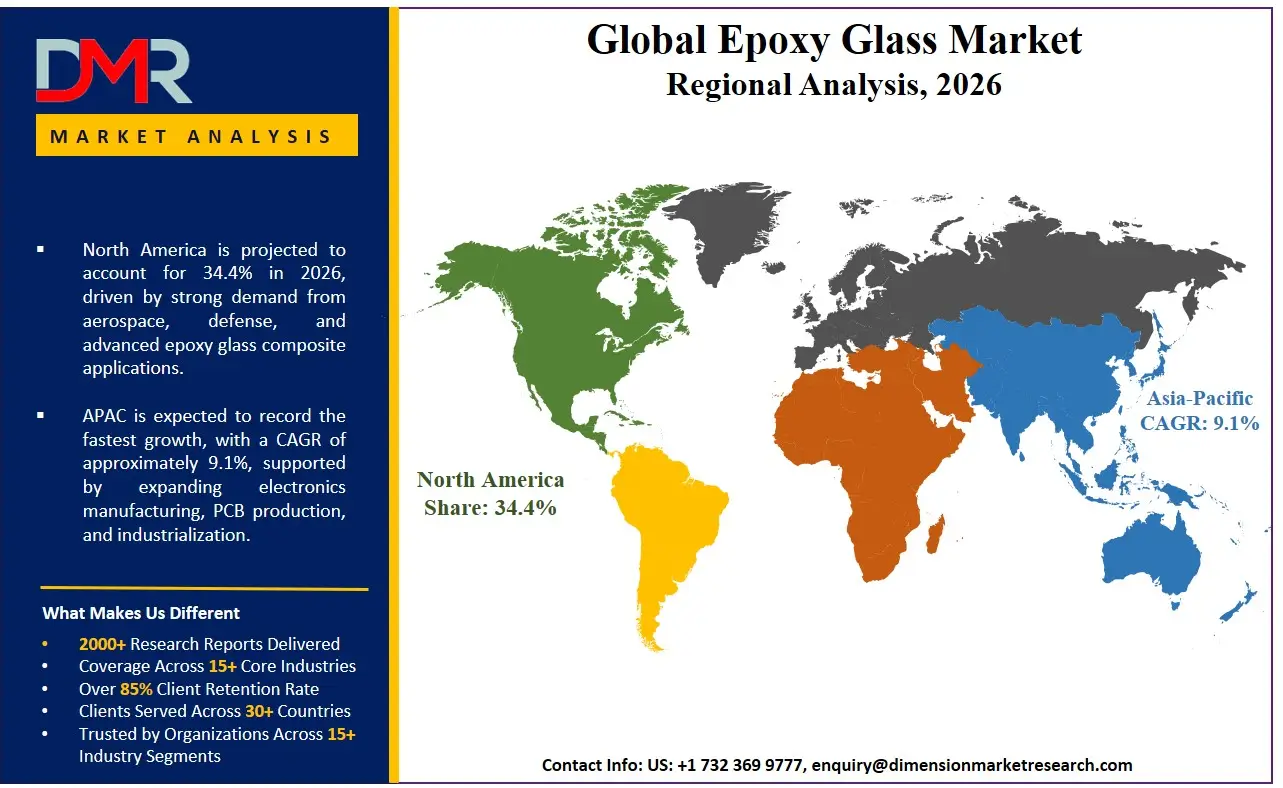
It is projected that North America will take the lead in the global epoxy glass market, covering a market share of about 34.4% in the year 2026. The region's dominance is driven by aggressive re-shoring of electronics manufacturing under the CHIPS and Science Act and Inflation Reduction Act (IRA), strong domestic content bonus incentives for US-made epoxy glass, increasing investments in new composite production facilities in the US and Mexico, and growing adoption of automated resin coating systems. The region benefits from well-established industrial composite manufacturing expertise for high-performance products, increasing commercial participation from domestic and foreign suppliers, and alignment with national energy security and defense roadmaps. Countries across the region are actively deploying new epoxy glass lines to reduce dependence on imports and strengthen domestic electrical infrastructure. Growing emphasis on advanced laminating technology and structured process logic development further accelerates market expansion in the region. Moreover, increasing federal tax credits and commercial electronics commitments are expected to sustain high growth momentum.
ℹ
To learn more about this report –
Download Your Free Sample Report Here
Fastest-Growing Region in the Epoxy Glass Market
Asia-Pacific is the fastest-growing region, supported by massive solar module and electronics production capacity concentrated in China, India, and Southeast Asia, strong government support through national solar missions and manufacturing subsidies, low-cost production advantages for laminates and woven composites, and the presence of key epoxy glass vendors and component manufacturers. The widespread adoption of advanced automation and high-throughput composite processing lines for utility-scale, residential, and industrial applications further strengthens Asia-Pacific's growth trajectory in the market. Additionally, continuous investments in expanding domestic composite manufacturing capacity and integrated supply chains are further reinforcing regional expansion.
By Region
North America
Europe
- Germany
- The U.K.
- France
- Italy
- Russia
- Spain
- Benelux
- Nordic
- Rest of Europe
Asia-Pacific
- China
- Japan
- South Korea
- India
- ANZ
- ASEAN
- Rest of Asia-Pacific
Latin America
- Brazil
- Mexico
- Argentina
- Colombia
- Rest of Latin America
Middle East & Africa
- Saudi Arabia
- UAE
- South Africa
- Israel
- Egypt
- Rest of MEA
Competitive Landscape
The epoxy glass market is highly competitive, with product innovation, manufacturing capabilities, and strategic partnerships shaping the competitive environment. To strengthen their market position, companies are focused on developing high-performance laminates, advanced composite materials, and specialty epoxy systems with enhanced thermal, mechanical, and electrical properties. High barriers to entry stem from capital-intensive manufacturing facilities, specialized materials engineering expertise, stringent quality requirements, and established customer relationships across the electronics, aerospace, automotive, and industrial sectors.
Strategic initiatives include capacity expansions, product portfolio enhancements, partnerships with PCB manufacturers and industrial component suppliers, and long-term supply agreements with key end users. Continuous investment in research and development remains essential for improving material performance and maintaining competitiveness in rapidly evolving application markets.
Some of the prominent players in the Global Epoxy Glass Market are:
- Shengyi Technology Co., Ltd.
- Kingboard Laminates Holdings Limited
- Nan Ya Plastics Corporation
- ITEQ Corporation
- Taiwan Union Technology Corporation
- Elite Material Co., Ltd.
- Doosan Corporation Electro-Materials
- Ventec International Group Co., Ltd.
- Panasonic Holdings Corporation
- AGC Inc.
- Chang Chun Group
- GDM International Technology Ltd.
- Olin Corporation
- Westlake Corporation
- Hexion Inc.
- Huntsman Corporation
- Kukdo Chemical Co., Ltd.
- Hexcel Corporation
- Owens Corning
- China Jushi Co., Ltd.
- Other Key Players
Recent Developments
- May 2026: Nan Ya Plastics Corporation strengthened its position in high-end electronics supply chains by expanding advanced IC substrate and PCB-related production capacity, targeting AI servers, GPUs, and high-speed computing applications, thereby reinforcing its downstream demand for epoxy-based copper clad laminates and electronic materials.
- March 2026: Kingboard Laminates Holdings Limited strengthened its copper clad laminate (CCL) production footprint by expanding high-performance rigid laminate capacity to support rising demand from AI servers, telecommunications infrastructure, and advanced computing applications, reinforcing its position as a leading global FR-4 substrate supplier.
- February 2026: Westlake Corporation expanded its epoxy business distribution network in India through an enhanced partnership with Brenntag, strengthening supply of epoxy resin systems across coatings, adhesives, and construction markets, improving regional availability of epoxy-based materials used in composite and industrial applications.
Report Details
| Report Characteristics |
| Market Size (2026) |
USD 15.9 Bn |
| Forecast Value (2035) |
USD 27.6 Bn |
| CAGR (2026–2035) |
6.3% |
| The US Market Size (2026) |
USD 4.6 Bn |
| Historical Period |
2021 – 2025 |
| Forecast Period |
2027 – 2035 |
| Base Year |
2025 |
| Estimated Year |
2026 |
| Segments Covered |
By Product Type, By Reinforcement Type, By Resin System, By Application, By End-Use Industry |
| Regional Coverage |
North America – The US and Canada; Europe – Germany, The UK, France, Russia, Spain, Italy, Benelux, Nordic, & Rest of Europe; Asia-Pacific – China, Japan, South Korea, India, ANZ, ASEAN, Rest of APAC; Latin America – Brazil, Mexico, Argentina, Colombia, Rest of Latin America; Middle East & Africa – Saudi Arabia, UAE, South Africa, Turkey, Egypt, Israel, & Rest of MEA |
Frequently Asked Questions
How big is the Global Epoxy Glass Market?
▾ The Global Epoxy Glass Market is estimated to be valued at USD 15.9 billion in 2026 and is expected to reach USD 27.6 billion by the end of 2035.
What is the CAGR of the Global Epoxy Glass Market from 2026 to 2035?
▾ The market is growing at a CAGR of 6.3% over the forecasted period.
What factors are driving the growth of the Global Epoxy Glass Market?
▾ The market is driven by advances in epoxy resin formulation and composite engineering, increasing demand for electrical insulation and printed circuit board materials, regulatory emphasis on product quality and manufacturing efficiency, and growing investments in aerospace, electronics, renewable energy, and industrial infrastructure.
What are the major trends in the Global Epoxy Glass Market?
▾ The key market trends include the adoption of advanced manufacturing process monitoring and real-time cure control, along with a growing shift toward high-performance epoxy glass materials with enhanced thermal and mechanical properties and improved production efficiency.
Which region held the largest share of the Global Epoxy Glass Market in 2026?
▾ North America is expected to account for the largest market share in 2026, with a share of about 34.4%.
Which region is expected to grow the fastest in the Global Epoxy Glass Market?
▾ Asia Pacific is the fastest-growing region in the market during the forecast period.
Who are the key players in the Global Epoxy Glass Market?
▾ Some of the major key players in the Global Epoxy Glass Market are Kingboard Laminates Holdings Limited, Taiwan Union Technology Corporation, Panasonic Corporation, Hexcel Corporation, Ventec International Group Co., Ltd., and many others.
How is the Global Epoxy Glass Market segmented?
▾ The market is segmented by product type, reinforcement type, resin system, application, and end-use industry.