Market Snapshot
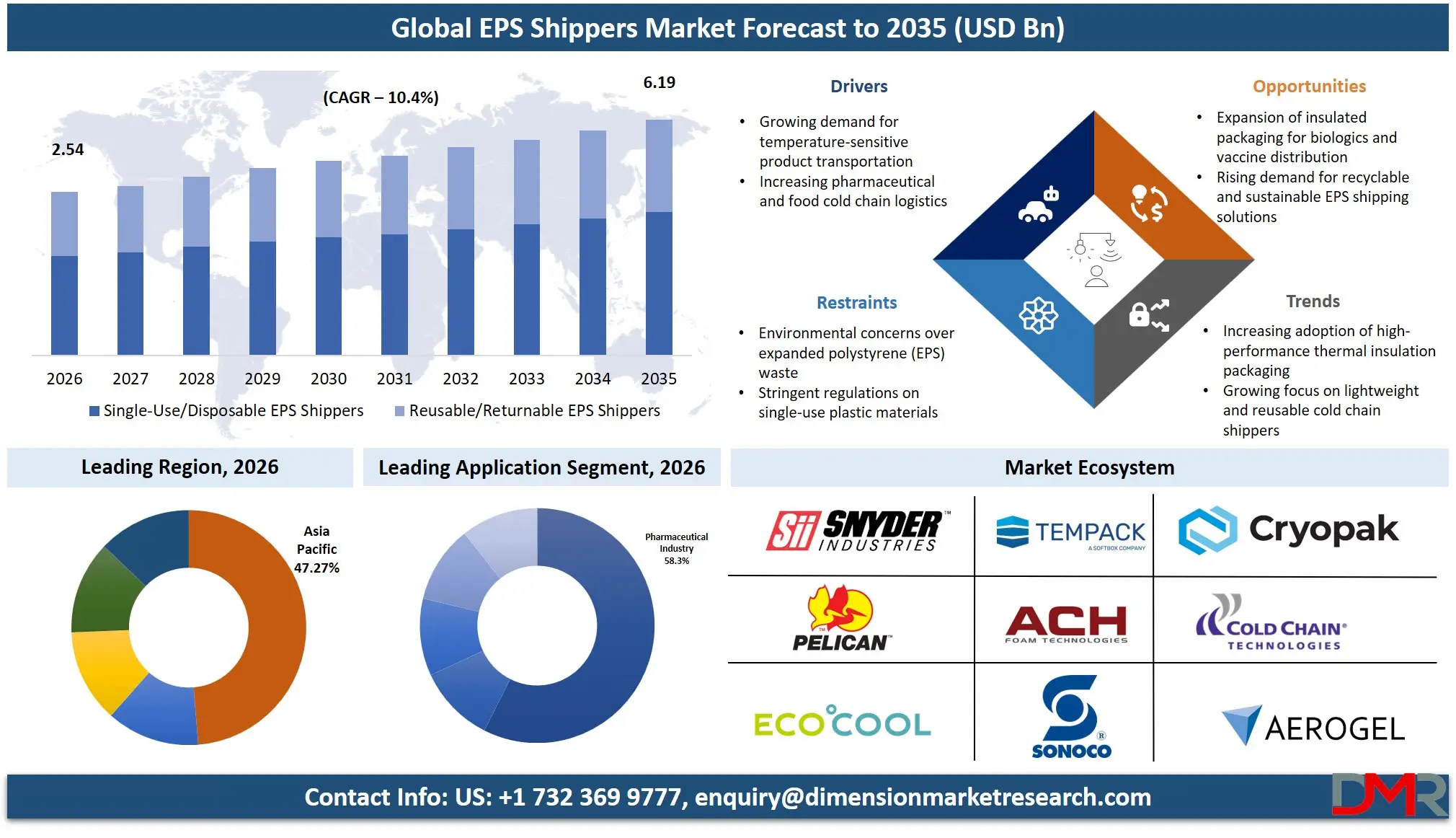
- The global EPS Shippers Market was valued at USD 2.3 billion in 2025, is estimated at USD 2.54 billion in 2026, and is projected to reach USD 6.19 billion by 2035, growing at a CAGR of 10.4%.
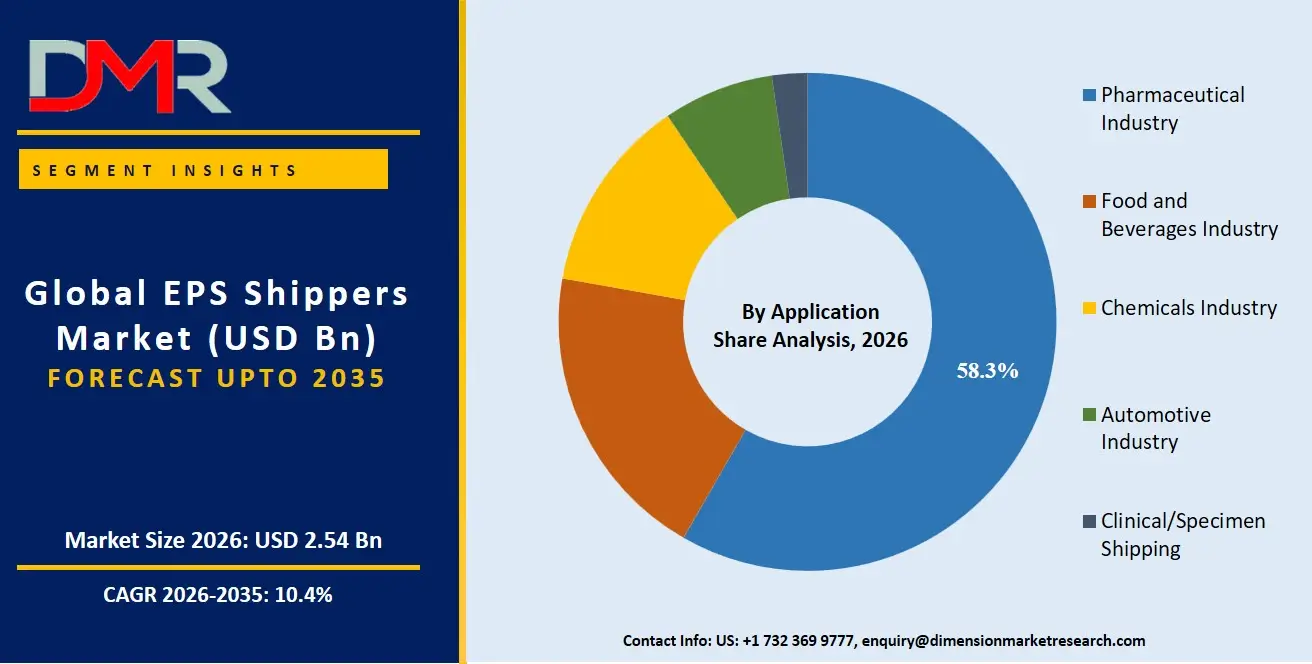
- By application, the Pharmaceutical Industry dominated the market with a share of 58.3% in 2026.
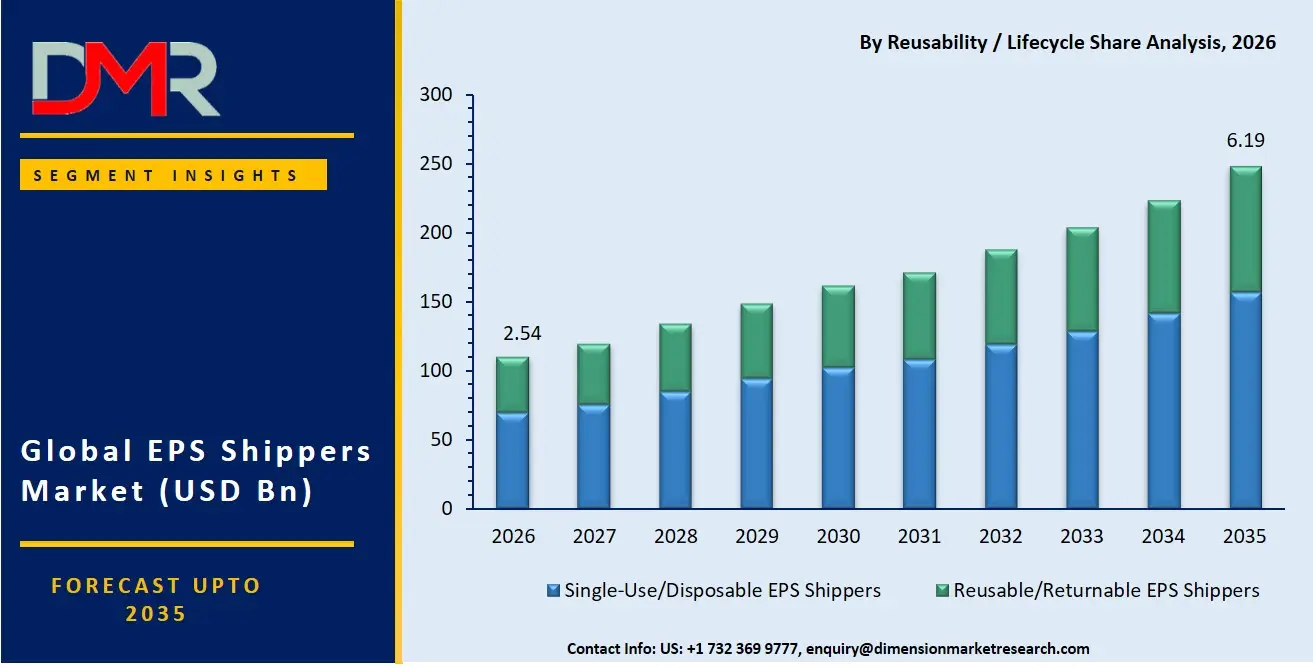
- By reusability/lifecycle, Single-Use/Disposable EPS Shippers led the market, accounting for 72.6% of total revenue in 2026.
- By type, the 512 Inch³ segment held the leading position in 2026.
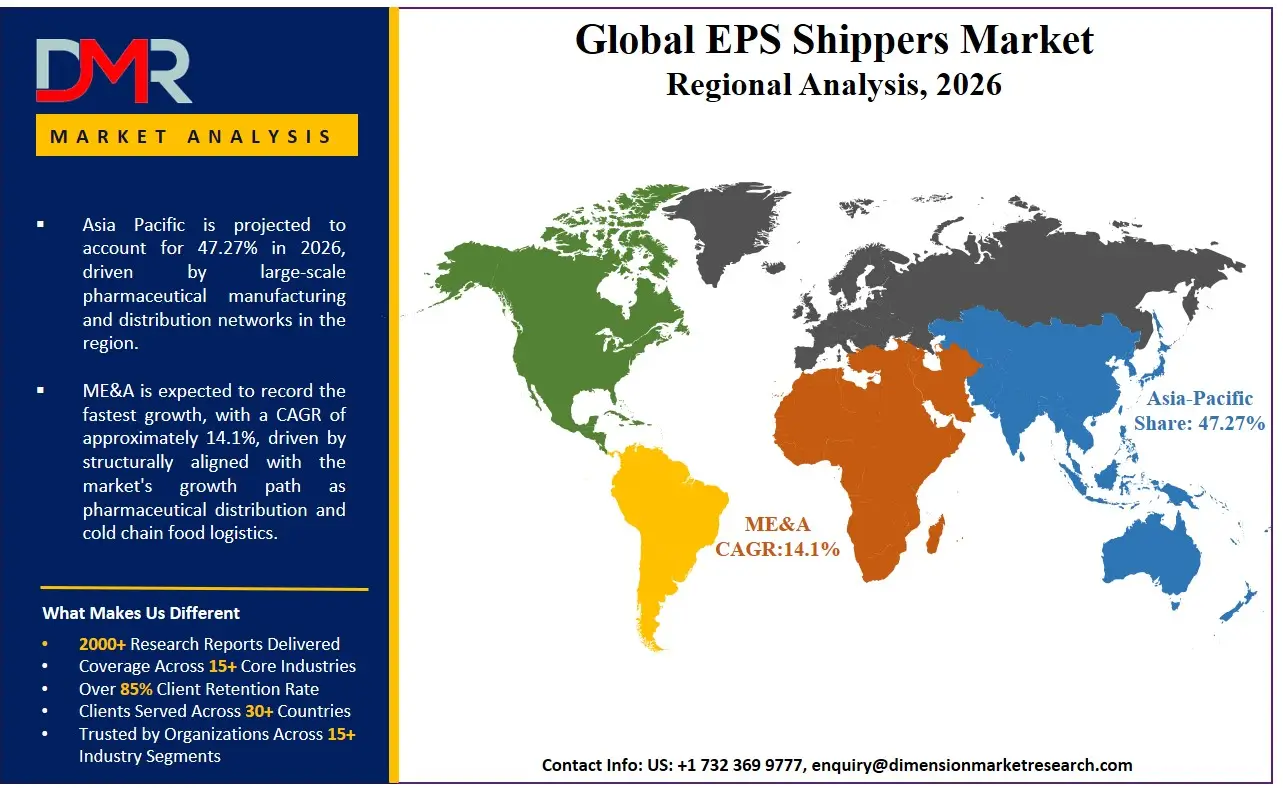
- Regionally, Asia-Pacific emerged as the largest market with a share of 47.27% in 2026.
Market Overview
The Global EPS Shippers Market covers expanded polystyrene-based insulated packaging units used to transport temperature-sensitive goods across pharmaceutical, food and beverage, chemical, automotive, and clinical specimen applications. Three primary volume formats define the product range: 512 Inch³, 1,000 Inch³, and 1,728 Inch³, in both single-use disposable and reusable returnable configurations. Paper-based, vacuum-insulated pallet shippers, and non-EPS cold chain formats are excluded from EPS Shippers Market scope.
ℹ
To learn more about this report –
Download Your Free Sample Report Here
EPS shippers sit within the broader cold chain packaging industry, where product integrity across the full shipment lifecycle carries commercial and regulatory consequences. Pharmaceutical manufacturers, food exporters, and clinical diagnostics networks all depend on passive thermal protection that meets validated performance standards. That dependency creates non-discretionary demand that does not compress easily under buyer cost pressure, which is why the market was valued at USD 2.3 Billion in 2025 despite growing regulatory scrutiny on single-use formats.
End-of-life management has moved from a peripheral concern to a central commercial variable. Based on data from the EUMEPS Fishbox LCA Final Report, production of a single-use EPS box accounts for 49% of total lifecycle impact when delivering 1 kg of chilled fish. That concentration of impact at the production stage means the sustainability debate around EPS shippers is not simply about disposal. Buyers who understand the full lifecycle increasingly demand supplier-level evidence across both thermal performance and post-use material recovery.
Market Size and Forecast
The Global EPS Shippers Market size is estimated at USD 2.54 Billion in 2026 from USD 2.3 Billion in 2025, and is projected to reach USD 6.19 Billion by 2035, exhibiting a CAGR of 10.4% during the forecast period.
Pharmaceutical cold chain compliance requirements form the structural backbone of this forecast. The 10.4% annual growth rate sustained over a decade reflects a shift toward compliance-grade thermal packaging in markets where shipment failure generates regulatory liability, not merely product loss. Buyers in this segment do not make format decisions on price. Format changes require validated performance testing, which anchors EPS shipper volumes inside multi-year pharmaceutical procurement cycles and suppresses demand volatility even as alternative formats compete on sustainability grounds.
Volume scale at the operational level clarifies the commercial stakes. A 2026 systematic review published via ScienceDirect found that a single EPS-based chilled food transport operation uses approximately 300 g of EPS per shipment and generates roughly 1 ton of EPS waste per week. At that output volume, end-of-life credential gaps translate directly into procurement risk for vendors unable to offer take-back or recycled-content alternatives. Providers who solve the post-use problem without compromising thermal performance capture the portion of the forecast growth that regulatory friction currently holds in check.
Application Analysis
The Pharmaceutical Industry led the Application segment with a 58.3% share in 2026.
ℹ
To learn more about this report –
Download Your Free Sample Report Here
Pharmaceutical buyers do not select EPS shippers through conventional cost-benefit evaluation. Biologic drugs, vaccines, and clinical specimens require packaging that passes documented thermal validation protocols, and EPS has an established certification record in that role. A procurement switch requires a validated alternative, which means competitors must absorb the cost and time of full qualification testing before displacing an incumbent format. That barrier converts pharmaceutical demand into structurally locked baseline volume through multi-year supply agreements.
Food and Beverages represents the second-largest demand pool, covering premium perishables and last-mile cold delivery. Chemicals and Automotive segments add incremental volume from temperature-sensitive fluids and components where excursion damage creates liability exposure. Clinical and Specimen Shipping is the fastest-formalizing category as distributed diagnostics networks scale sample collection points beyond central laboratories. None of these segments currently approaches pharmaceutical dominance in share terms, but each adds compounding volume to the overall demand base.
Reusability / Lifecycle Analysis
With a 72.6% share in 2026, Single-Use/Disposable EPS Shippers outpaced all other reusability categories.
ℹ
To learn more about this report –
Download Your Free Sample Report Here
Reverse supply chain infrastructure is the core constraint limiting reusable format adoption. Pharmaceutical distributors, food retailers, and clinical networks do not operate return logistics at the scale required to make reusable EPS formats economically viable across most shipping corridors. Single-use formats eliminate that dependency entirely, which is the primary reason they retain majority share despite sustained pressure from packaging waste regulations.
Reusable/Returnable EPS Shippers are growing in closed-loop environments with fixed routes and reliable return collection. The EUMEPS Fishbox LCA Final Report provides a precise threshold, reusable polypropylene alternatives only outperform single-use EPS on aggregated environmental indicators when each unit reaches 20 or more reuse cycles. Below that cycle count, single-use EPS remains competitive on combined performance and environmental metrics. That constraint limits the reusable segment's addressable base to high-frequency, closed-network operators, a structurally smaller subset of the total market than sustainability advocates typically assume.
Type Analysis
The 512 Inch³ format captured the leading position across Type categories in 2026, ahead of all rivals.
The 512 Inch³ format aligns directly with individual patient dose shipment specifications used across specialty pharma, home infusion, and direct-to-patient distribution channels. All three of those channels have expanded substantially as healthcare delivery shifts outside the hospital setting. Buyers in these channels require pre-validated shipper formats, and the 512 Inch³ configuration has the longest established certification history in that role.
The 1,000 Inch³ and 1,728 Inch³ formats serve institutional and bulk distribution, covering hospital pharmacy replenishment, laboratory specimen batch transport, and food service cold chain. Volume requirements in these use cases are set by shipment content specifications rather than buyer discretion, which makes these formats resistant to substitution. All three Type formats benefit from the pharmaceutical compliance tailwind, but the 512 Inch³ format captures the fastest-growing end use as direct-to-patient logistics infrastructure scales across North America and Asia-Pacific.
Key Market Segments
By Application
- Pharmaceutical Industry
- Food and Beverages Industry
- Chemicals Industry
- Automotive Industry
- Clinical/Specimen Shipping
By Reusability / Lifecycle
- Single-Use/Disposable EPS Shippers
- Reusable/Returnable EPS Shippers
By Type
- 512 Inch³
- 1000 Inch³
- 1728 Inch³
Regional Analysis
Asia-Pacific held a dominant position in 2026, commanding a 47.27% share of the Global EPS Shippers Market.
ℹ
To learn more about this report –
Download Your Free Sample Report Here
China, India, Japan, and South Korea each operate large-scale pharmaceutical manufacturing and distribution networks that require validated thermal packaging at both production and last-mile delivery stages. E-commerce food delivery and premium perishable export volumes in these markets add incremental shipper demand on top of institutional pharmaceutical volumes. No other region combines pharmaceutical production scale, cold chain logistics expansion, and food export growth at comparable velocity, which is why Asia-Pacific holds nearly half of global demand.
North America holds the next-largest share, anchored by mature pharmaceutical distribution and tightening food safety compliance. As reported by Aquapak's EPS sustainability brief, over 600 EPS drop-off locations operate across North America, providing a recycling infrastructure foundation that reduces the regulatory friction limiting single-use format adoption elsewhere. Europe faces the most acute pressure on single-use plastics, creating a near-term headwind for conventional formats alongside a demand signal for biodegradable and recycled-content alternatives. Latin America and Middle East and Africa represent smaller current volumes but are structurally aligned with the market's growth path as pharmaceutical distribution and cold chain food logistics formalize in those regions.
Key Regions and Countries
North America
Europe
- Germany
- France
- The UK
- Spain
- Italy
- Rest of Europe
Asia Pacific
- China
- Japan
- South Korea
- India
- Australia
- Rest of APAC
Latin America
- Brazil
- Mexico
- Rest of Latin America
Middle East & Africa
- GCC
- South Africa
- Rest of MEA
Market Dynamics
Pharmaceutical Compliance Locks In Baseline Demand
Pharmaceutical buyers do not switch thermal packaging formats without completing validated performance testing on any proposed alternative. That qualification requirement takes months, carries cost, and introduces supply chain risk that procurement teams are reluctant to accept without a compelling regulatory or cost-savings mandate. The result is a structural demand floor for EPS shippers that protects volumes even when alternative formats compete aggressively on price or sustainability claims.
UPS Healthcare's January 2025 acquisition of Frigo-Trans and BPL to strengthen European temperature-controlled pharmaceutical logistics illustrates how seriously major logistics operators are treating cold chain investment. Integrating shipper supply with transport execution creates a captive demand channel for validated EPS shipper formats used within those logistics networks, which reinforces volume stability for shipper manufacturers serving those accounts.
Recyclability Labeling Gap Erodes Enterprise Appeal
As reported by ThermoSafe's 2025 technical article, the U.S. FTC "Green Guides" require that at least 60% of consumers have access to suitable recycling programs before a packaging format can carry a recyclable label with the standard chasing arrows symbol. EPS shippers routed through drop-off take-back schemes rather than curbside collection cannot meet this threshold in most U.S. municipalities. For enterprise buyers whose ESG reporting requires verified recyclability claims on packaging inputs, that labeling gap creates a concrete procurement barrier that thermal performance data alone cannot resolve.
The same ThermoSafe source confirms that flexible PET-fiber liner alternatives, often positioned as recyclable EPS substitutes, show 0% curbside acceptance in many municipalities even though the base resin is technically recyclable. That finding levels the regulatory playing field between EPS and its primary alternatives in markets where curbside access drives recyclability labeling decisions. The friction is real on both sides, but EPS shippers carry the greater public perception liability, which is where procurement decisions diverge from lifecycle data.
Biodegradable EPS and Take-Back Networks Open New Revenue
ThermoSafe's 2025 technical data confirms that biodegradable EPS formulations achieve more than 90% biodegradation within 4 years under ASTM D5511 accelerated landfill protocols, with no reduction in thermal or structural performance during use. That performance profile removes the core objection procurement teams raise when EPS comes under sustainability review. Providers who can document ASTM D5511 biodegradation outcomes alongside cold chain validation data gain access to tender categories that conventional EPS suppliers currently cannot enter.
Altor Solutions reported in January 2026 that it had diverted over one million pounds of EPS from landfills in 2025 through its recycling programs and EmeraldPak recycled-content packaging line. That scale confirms that take-back and recycled-content programs have moved from pilot stage to commercial operation. Vendors who integrate verified post-use material recovery into their customer offering convert a regulatory liability into a retention tool and differentiate on procurement criteria that pure thermal-performance players cannot match.
Market Trends
Sustainability Credentials Entering Procurement Scoring Criteria
Thermal performance alone no longer closes tenders in pharmaceutical and food segments where buyer ESG commitments are documented and audited. Enterprise procurement teams now score packaging suppliers on combined thermal validation and post-use material recovery credentials. Biodegradable EPS formulations, take-back networks, and recycled-content products are all commercially live in the market today. Early movers who can present auditable end-of-life data alongside validated cold chain performance will win contracts that conventional EPS suppliers are losing on procurement scoring criteria alone.
Market Competition Overview
The EPS Shippers Market is moderately fragmented. No single provider holds a share large enough to set pricing unilaterally. Competition runs on validated thermal performance, format certification history, and, increasingly, documented sustainability credentials. Providers who have invested in take-back programs, recycled-content formulations, or biodegradable EPS variants are winning tender categories that pure thermal-performance players cannot access, which is reshaping competitive positioning faster than market share data alone reflects.
Acquisition activity signals a consolidation phase in motion. Altor Solutions acquired Lifoam Industries for USD 137 million in 2024, adding thermal shippers and gel packs across healthcare, commercial, and retail verticals in a single transaction. UPS Healthcare's acquisition of Frigo-Trans and BPL extended European temperature-controlled logistics coverage by combining shipper supply with transport execution. Smaller, single-format providers without scale in sustainability programs or logistics integration face growing vendor consolidation pressure as buyers reduce their approved supplier lists.
Company Profiles
Sonoco operates as a global packaging provider with a broad cold chain shipper portfolio spanning pharmaceutical, food, and industrial applications. Its scale across multiple packaging categories gives it procurement leverage and cross-selling access that smaller, EPS-only competitors cannot replicate. Sonoco's strategic risk is that a diversified portfolio requires development resources to be spread across competing priorities, which can delay responses to format-specific sustainability mandates that more focused competitors resolve faster.
Altor Solutions reported diverting over one million pounds of EPS from landfills in 2025 through recycling programs and its EmeraldPak recycled-content packaging line, a figure that signals genuine commercial-scale execution of a sustainability strategy rather than pilot-level activity. Cold Chain Technologies has built its position around pharmaceutical-grade validated shipper systems. Its February 2025 launch of the 1,600 L CCT Tower Elite pallet shipper with integrated vacuum insulated panels targets institutional pharmaceutical distributors where shipment value justifies premium insulation. Higher unit costs limit addressable volume to large enterprise accounts, which concentrates both the revenue upside and the customer concentration risk.
Key Players
- Sonoco
- ACH Foam Technologies
- Cold Chain Technologies
- Snyder Industries
- Pelican Products
- Tempack Packaging Solutions
- Cryopak Industries
- EcoCool
- American Aerogel
Supply Chain and Value Chain Analysis
The EPS shipper value chain runs from styrene monomer production through EPS bead manufacturing, shipper molding and assembly, distribution to end users, and post-use collection or disposal. Maximum value is created at the molding and validation stage, where format certification for pharmaceutical or food-contact compliance converts commodity EPS input into a specification-grade product that commands pricing power independent of raw material cost movements.
Raw material availability links directly to petrochemical supply chains, introducing input cost volatility that manufacturers cannot fully pass through in long-term pharmaceutical supply agreements. The most critical structural bottleneck sits at end-of-life. A 2026 ScienceDirect systematic review documented that a single EPS-based chilled food operation generates approximately 1 ton of EPS waste per week. At that volume, providers who own or contract the collection and recycling step convert a supply chain liability into a customer retention service and protect their position against alternative format substitution.
Regulatory Landscape
The U.S. FTC "Green Guides" requirement, as documented in ThermoSafe's 2025 technical article, establishes that at least 60% of consumers must have access to suitable recycling programs before a packaging format can carry a recyclable label. EPS shippers routed through drop-off take-back schemes rather than curbside collection cannot satisfy this threshold in most U.S. municipalities. Enterprise buyers whose ESG reporting requires verified recyclability claims on packaging inputs face a concrete procurement barrier that thermal performance data cannot override.
Biodegradable EPS formulations tested under ASTM D5511 protocols offer a separate compliance pathway, documented by ThermoSafe at greater than 90% biodegradation within 4 years. Providers who can present ASTM D5511 outcomes give buyers a defensible sustainability claim that sidesteps the recyclability labeling problem. Europe's regulatory posture on single-use plastics adds a second layer of pressure, reinforcing demand for biodegradable and recycled-content alternatives across the region's pharmaceutical and food cold chain buyers.
Investment and White Space Analysis
Capital is flowing toward cold chain integration over standalone shipper manufacturing. Altor Solutions paid USD 137 million for Lifoam Industries in 2024 to add thermal shippers and gel packs across multiple verticals. UPS Healthcare's acquisition of Frigo-Trans and BPL combined shipper supply with transport execution in European pharmaceutical cold chain. In January 2026, Tetra Pak allocated EUR 60 million for a Swedish pilot plant producing paper-based barriers with 48-hour thermal duration, signaling that large packaging groups are committing capital to formats that can challenge EPS on both thermal duration and sustainability procurement criteria.
The clearest white space sits at the intersection of validated pharmaceutical performance and auditable end-of-life credentials. Biodegradable EPS formats and recycled-content products are commercially live but not yet at full national scale across major markets. No provider has yet built a fully integrated take-back and recycled-content loop serving pharmaceutical buyers at national scale. The first to close that gap captures a procurement category that conventional EPS suppliers and alternative format players are both currently unable to serve completely.
Recent Developments
- January 2024: BASF announced an expansion of its European EPS production capacity by 100,000 metric tons to meet packaging and construction demand.
- March 2024: Dow Inc. and INEOS Styrolution formed a strategic collaboration to develop and commercialize new EPS products across packaging applications.
- May 2024: LyondellBasell completed the acquisition of A. Schulman, broadening its high-performance plastics portfolio relevant to advanced EPS applications.
- February 2025: Insulated Products Corporation launched a paper grocery bag engineered for two-hour quick-commerce fulfillment, signaling alternative format competition in last-mile cold delivery.
- May 2025: Tetra Pak UK invested GBP 1.4 million (approximately USD 1.82 million) in a recycling line to recover fiber from used insulated cartons, advancing material circularity for cold chain packaging.
Report Details
| Report Characteristics |
| Market Value (2025) |
USD 2.3 Billion |
| Market Value (2026) |
USD 2.54 Billion |
| Forecast Revenue (2035) |
USD 6.19 Billion |
| CAGR (2026–2035) |
10.4% |
| Base Year for Estimation |
2025 |
| Historic Period |
2020 – 2024 |
| Forecast Period |
2026 – 2035 |
| Report Coverage |
Revenue Forecast, Market Dynamics, Competitive Landscape, Recent Developments |
| Segments Covered |
By Application (Pharmaceutical Industry, Food and Beverages Industry, Chemicals Industry, Automotive Industry, Clinical/Specimen Shipping), By Reusability / Lifecycle (Single-Use/Disposable EPS Shippers, Reusable/Returnable EPS Shippers), By Type (512 Inch³, 1000 Inch³, 1728 Inch³) |
| Regional Analysis |
North America – US and Canada; Europe – Germany, France, The UK, Spain, Italy, and Rest of Europe; Asia Pacific – China, Japan, South Korea, India, Australia, and Rest of APAC; Latin America – Brazil, Mexico, and Rest of Latin America; Middle East & Africa – GCC, South Africa, and Rest of MEA |
| Competitive Landscape |
Sonoco, ACH Foam Technologies, Cold Chain Technologies, Snyder Industries, Pelican Products, Tempack Packaging Solutions, Cryopak Industries, EcoCool, American Aerogel |
| Customization Scope |
Customization for segments and region or country level will be provided. Additional customization can be done based on requirements. |
| Purchase Options |
Three license options: Single User License, Multi-User License (Up to 5 Users), Corporate Use License (Unlimited Users and Printable PDF). |
Frequently Asked Questions
What is the biggest investment opportunity in EPS Shippers Market?
▾ The highest-value opportunity sits at the intersection of pharmaceutical-grade thermal validation and auditable end-of-life credentials. No provider currently serves pharmaceutical buyers at national scale with a fully integrated take-back and recycled-content loop. The first to close that gap captures a procurement category that neither conventional EPS suppliers nor alternative format players can currently address completely.
Who are the top companies in EPS Shippers Market?
▾ Leading players include Sonoco, Cold Chain Technologies, ACH Foam Technologies, Pelican Products, Cryopak Industries, Tempack Packaging Solutions, Snyder Industries, EcoCool, and American Aerogel. Altor Solutions has also emerged as a significant force following its USD 137 million acquisition of Lifoam Industries in 2024.
Which segment is growing fastest in EPS Shippers Market and why?
▾ Clinical and Specimen Shipping is the fastest-formalizing application category, as distributed diagnostics networks expand sample collection beyond central laboratories. The 58.3% pharmaceutical application share confirms that compliance-driven verticals dominate EPS Shippers Market, and clinical specimen logistics is the category within that compliance bracket adding structural new demand at the fastest rate.
Which region is growing fastest in EPS Shippers Market and why?
▾ Asia-Pacific leads all regions with a 47.27% share in 2026 and retains the strongest growth trajectory through 2035. China, India, and South Korea are each scaling pharmaceutical manufacturing and cold chain distribution infrastructure simultaneously, generating compounding demand for validated thermal packaging at both production and last-mile delivery stages.
What is the biggest challenge holding EPS Shippers Market back?
▾ The single-use format's end-of-life position is the primary commercial friction point. With 72.6% of the market in disposable EPS and curbside recycling largely unavailable, enterprise buyers operating under ESG reporting mandates face a recyclability labeling gap that suppliers cannot resolve through thermal performance data alone. Until integrated take-back programs reach national scale, that gap will continue to slow adoption in sustainability-screened procurement processes.