Market Overview
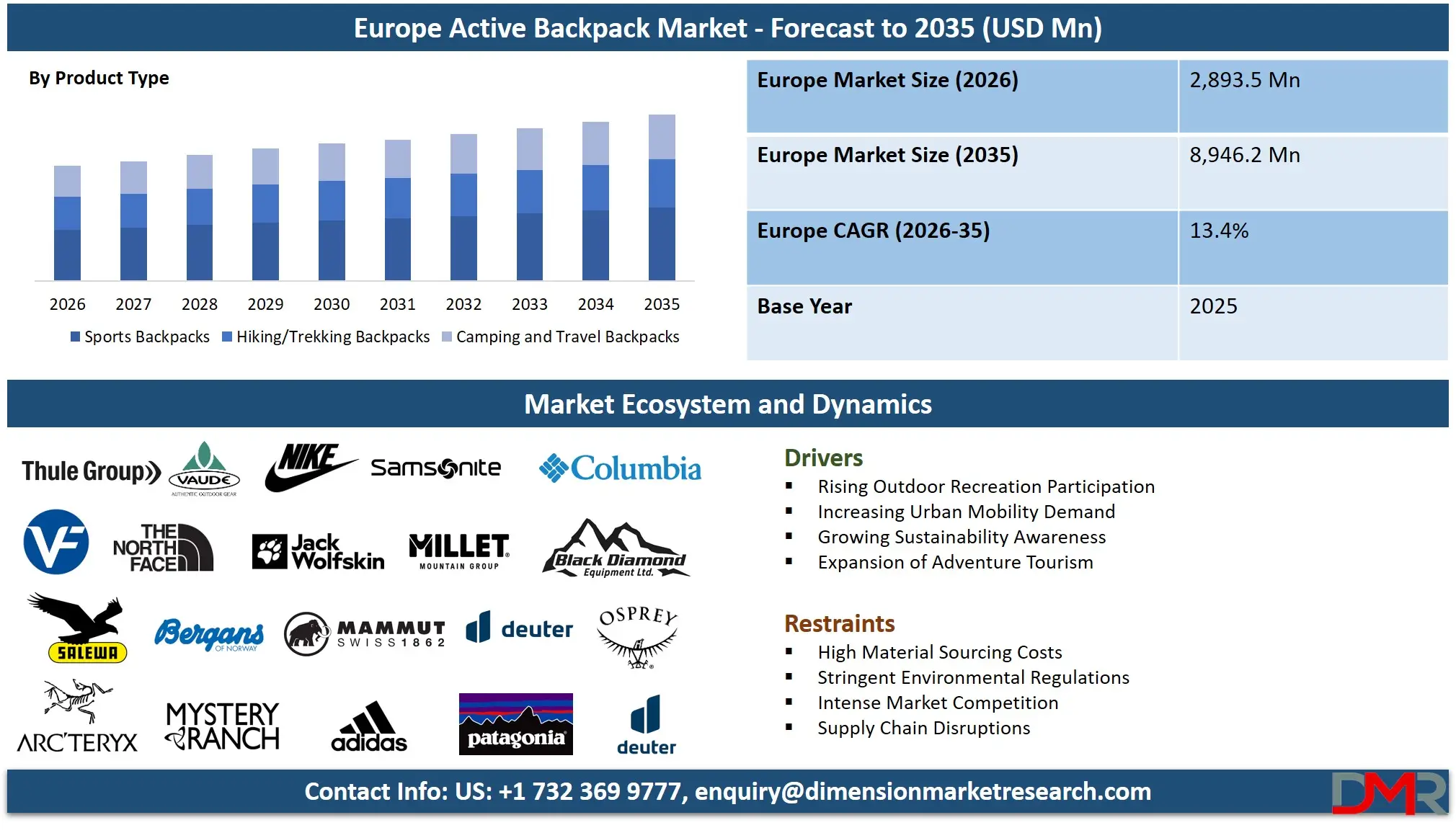
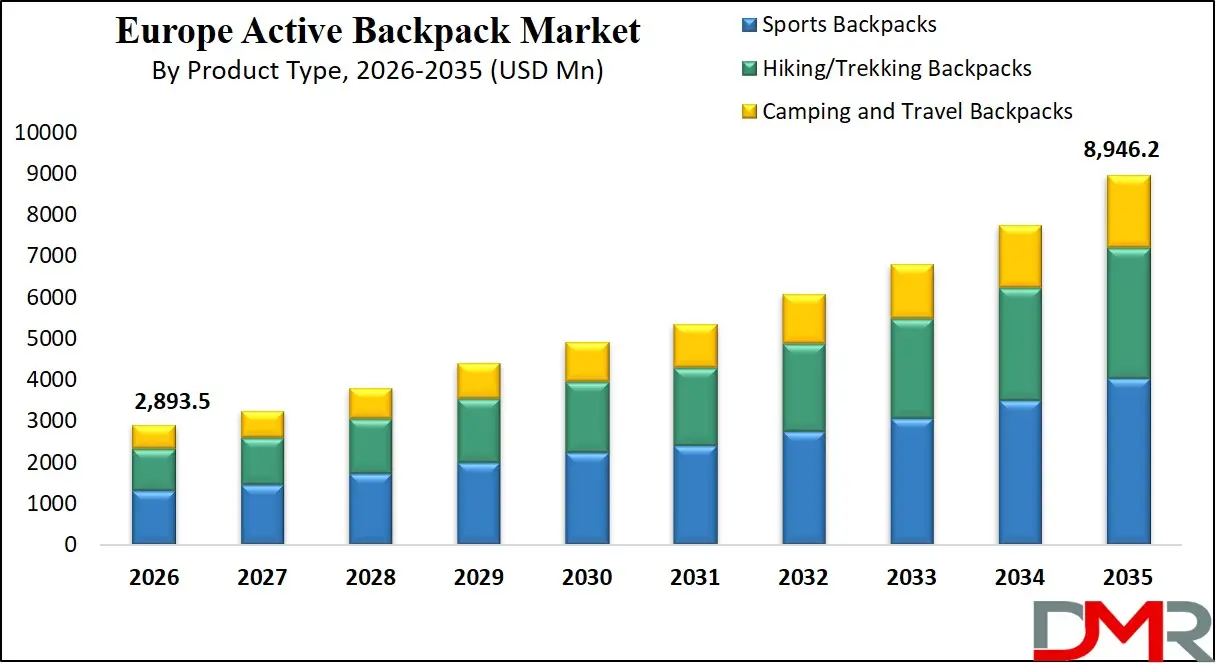
The Europe Active Backpack Market is projected to be valued at approximately USD 2,893.5 million in 2026 and is projected to reach around USD 8,946.2 million by 2035, growing at a CAGR of about 13.4% from 2026 to 2035.
ℹ
To learn more about this report –
Download Your Free Sample Report Here
The active backpack market is an important part of the economic and lifestyle development across Europe, driven by the region's strong emphasis on outdoor recreation, fitness culture, and sustainable tourism. Strategically positioned with diverse geographical landscapes ranging from the Alps to the Scandinavian wilderness, Europe occupies a privileged position in the global outdoor equipment sector. The sector covers a wide range of products, from lightweight sports backpacks to heavy-duty trekking packs and specialized travel gear, which are important in facilitating active lifestyles and supporting the growth of strategic sectors such as adventure tourism, fitness, and education. The European Union's commitment to promoting sustainable tourism and green mobility has resulted in substantial investment in outdoor infrastructure and eco-friendly product innovation, significantly transforming the backpack manufacturing landscape.
Over the last few years, the active backpack market of Europe has witnessed a strategic transition in adopting advanced materials and ergonomic designs like lightweight fabrics, weather-resistant coatings, and AI-driven fit customization. These technologies are making backpack operations more effective, developing better weight distribution, facilitating easier access to gear, and further helping in the optimization of carrying comfort. Also, with the rapid growth of outdoor recreation post-pandemic, the need for specialized backpacks for hiking, camping, and urban sports has accelerated the demand for companies to scale up their product lines. All these evolutions of technology and consumer preferences are likely to drive the sector's growth, signifying a good future outlook for the market.
Key trends currently evident within the active backpack arena in Europe are the digital transitions taking hold of retail operations by moving from traditional brick-and-mortar stores to agile-oriented e-commerce ecosystems. Aside from this, further integration of sustainable materials brings recycled fabrics and biodegradable components with reduced environmental impact along the value chain for better outputs of eco-efficiency. Furthermore, with the augmenting emphasis on circular economy in line with EU Green Deal, adaptation of sustainable manufacturing practices, such as closed-loop production and deployment of recycled polyester in backpack construction, is on the rise. Similarly, the rise in urban commuting has changed design strategies for backpacks as companies try to meet consumer expectations of multifunctional products that transition seamlessly from work to weekend adventures.
ℹ
To learn more about this report –
Download Your Free Sample Report Here
The market is consequently witnessing huge opportunities on the back of high investments by European governments in outdoor infrastructure development. Initiatives such as the construction of new hiking trails, national park facilities, and cycling networks are creating a robust recreational backbone to support regional and international tourism. Megaprojects like the European Green Deal illustrate the strategic importance of sustainable outdoor equipment in enabling Europe's ambitious environmental goals. The geographical diversity of the region enhances its potential to become a global hub for outdoor activities, offering unparalleled access to key recreational areas across mountains, forests, and coastlines. Further, the focus on smart technologies like wearable-compatible backpacks, solar-integrated charging systems, and anti-theft features provides companies with opportunities to gain a competitive edge by improving functionality and reducing user inconvenience.
Europe Active Backpack Market: Key Takeaways
- Market Value: The Europe Active Backpack Market size is estimated to have a value of USD 2,893.5 million in 2026 and is expected to reach USD 8,946.2 million by the end of 2035.
- By Product Type Segment Analysis: Hiking/Trekking Backpacks is anticipated to dominate this segment in this market as it will hold 43.4% of market share in 2026.
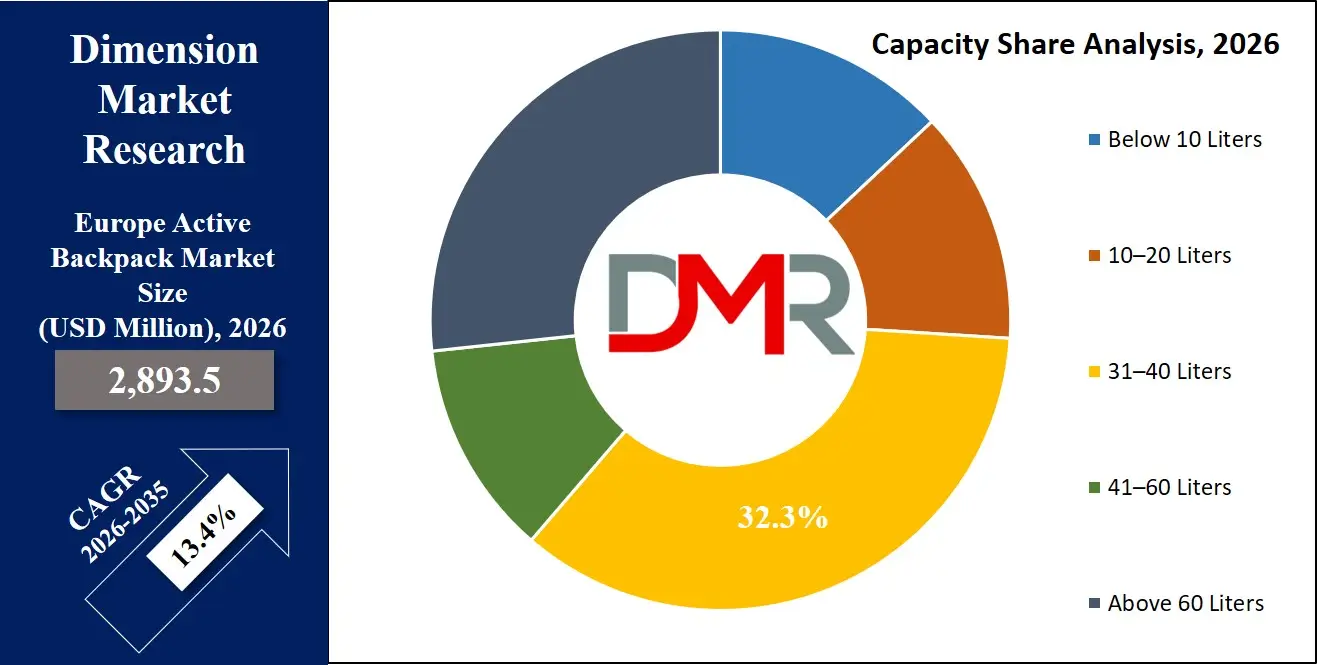
- By Capacity Segment Analysis: The 31–40 Liters capacity segment is projected to dominate the capacity segment in the Europe Active Backpack Market with the 32.3% of the market share in 2026.
- By Price Range Segment Analysis: The Mid-range ($35–$85) segment is anticipated to dominate the Europe active backpack market with major market share in 2026.
- By Distribution Channel Segment Analysis: E-commerce Platforms is projected to hold the leading position in the distribution channel segment of this market in 2026.
- Key Players: Some of the major key players in the Europe Active Backpack Market are Deuter, Jack Wolfskin, The North Face, Vaude, Osprey Europe, Mammut Sports Group, Salewa, Haglöfs, Bergans, Millet Mountain Group, Decathlon (Quechua), and many others.
- Market Growth Rate: The market is growing at a CAGR of 13.4 percent over the forecasted period.
Europe Active Backpack Market: Use Cases
- Mountain Hiking & Trekking: This is about specialized backpacks with ergonomic suspension systems, weather protection, and multiple compartments for carrying gear, food, and safety equipment during multi-day expeditions across alpine and forest terrain.
- Urban Commuting & Fitness: Active backpacks designed for daily commuters combining laptop compartments with gym gear storage, featuring breathable back panels and reflective elements for safety during cycling or walking in urban environments.
- School & University: Durable, comfortable backpacks with padded shoulder straps and organized compartments for students carrying heavy textbooks, laptops, and sports equipment across European educational institutions.
- Adventure Travel: Versatile travel backpacks with anti-theft features, compression straps, and convertible designs that function both as luggage for transportation and daypacks for exploration at destinations.
Europe Active Backpack Market: Stats & Facts
European Commission / Eurostat
- Over 60% of Europeans participate in physical or recreational activities at least once per month, supporting demand for outdoor gear such as backpacks and hiking equipment.
- The European Union has more than 130,000 sports clubs, providing infrastructure that supports outdoor and adventure activities.
- Europe hosts over 90,000 public recreational and cultural institutions, supporting community outdoor and leisure engagement.
- The HealthyLifestyle4All initiative launched by the European Commission promotes increased physical activity across EU member states.
European Hiking Federation (ERA)
- The European Hiking Federation includes over 60 member organizations across more than 30 European countries promoting hiking and trekking activities.
- ERA member organizations collectively represent around 2.5 million individual hiking members across Europe.
German Hiking Association (Deutscher Wanderverband)
- Germany has around 40 million people participating in hiking activities, making it one of Europe's largest outdoor recreation markets.
- Hiking equipment sales in Germany generate over USD 1.9 billion annually, reflecting strong demand for outdoor gear such as backpacks.
Swiss Hiking Trails / Swiss Federal Data
- Switzerland has about 2.7 million regular hikers, representing approximately 44% of the national population.
- Around 4 million residents aged 15 and older hike regularly in Switzerland.
- Nearly 80% of Switzerland's population uses the national hiking trail network occasionally or regularly.
- Switzerland maintains over 65,000 km of marked hiking trails across the country.
French Hiking Federation
- France has around 15 million regular hiking participants, supporting strong demand for outdoor equipment and backpacks.
- Average spending on hiking equipment in France is around USD 340 per person annually.
- Approximately 39% of hikers in France prefer hiking alone, increasing demand for personal outdoor gear.
- Around 9% of French hikers participate through clubs or organized associations.
Adventure Travel Trade Association / Tourism Bodies
- Europe accounts for about 35% of the global adventure tourism market, supporting outdoor gear demand.
- Approximately 80% of European adventure tour operators offer hiking-based experiences.
- European tourists represent about 60% of adventure travelers within Europe.
- Adventure tourism travelers in Europe spend around USD 380 per person per day on average.
Impact of Iran Conflict on Europe Active Backpack Market
- Supply Chain Disruptions: Regional instability disrupts oil-based raw material supply like nylon and polyester. Manufacturing delays and increased logistics costs impact Europe backpack production timelines and inventory availability.
- Raw Material Price Volatility: Geopolitical tensions cause fluctuations in crude oil prices, directly increasing costs for petroleum-based fabrics and components. Brands face margin pressure or must raise consumer prices.
- Shift in Travel Patterns: Conflict alters tourism flows in Middle East and neighboring regions. Reduced travel to affected areas decreases demand for travel backpacks while increasing need in safer alternative destinations.
- Manufacturing Relocation Pressures: Brands reconsider regional production dependence on unstable areas. Accelerated diversification of manufacturing bases to Southeast Asia and Eastern Europe increases operational complexity and costs.
Europe Active Backpack Market: Market Dynamic
Driving Factors in the Europe Active Backpack Market
EU Green Deal Sustainability Initiatives
Europe's commitment to becoming the first climate-neutral continent makes the active backpack industry one of the mainstays of sustainable manufacturing. Huge investments in sustainable production technologies and circular economy infrastructure have been driving growth. In addition, it also comprises eco-labeling requirements like the EU Ecolabel, which also attract environmentally conscious consumers. This helps strengthen the region's standing as a leading market for sustainable outdoor equipment globally.
Increasing Adventure Tourism
Europe is also developing tourism actively with its participation in cross-border initiatives such as the European Ramblers Association network, increasing the volumes of international visitors, which in turn are raising demand for high-quality trekking equipment. The expansion of the EU's network of long-distance walking paths (E-paths) and the development of better trail infrastructure are encouraging more outdoor activities. All these growth drivers increase the connectivity of the region for adventure tourism and ensure the prosperity of the active backpack sector.
Restraints in the Europe Active Backpack Market
High Raw Material Costs
Sustainable materials and technical textile production require higher capital investment, although government incentives are very supportive. Smaller manufacturers can hardly afford certified recycled fabrics, PFC-free coatings, or advanced ergonomic components. This may impede market growth and further widen the gap between large corporations and SMEs in access to premium materials.
Intense Competitive Landscape
The active backpack industry is facing a saturated market with numerous established players and new entrants competing for market share. While product differentiation is included in business strategies, the pace of innovation often leads to short product lifecycles. Normally, companies face pressure on profit margins due to competitive pricing. Getting over this restraint will involve considerable investments in brand building and customer loyalty programs.
Opportunities in the Europe Active Backpack Market
Integration of Smart Features
The adoption of technologies such as integrated solar panels, USB charging ports, and RFID-blocking compartments presents an excellent opportunity for product differentiation. Smart backpacks with GPS tracking for safety and Bluetooth connectivity for device pairing cut down user inconvenience, while ergonomic designs enhance carrying comfort. Startups and established firms alike are testing such integrations, which offers an excellent opportunity for technology providers and investors to reach the European active backpack market.
Expansion of Direct-to-Consumer Channels
With growing demand for personalized shopping experiences, direct-to-consumer (DTC) sales channels are developing at a very fast pace. There is also more inflow of investments into virtual fitting technologies and customization platforms. Additionally, digital innovation in Europe and changing consumer habits will further contribute to this segment and open doors for value-added service providers through innovative retail solution design.
Trends in the Europe Active Backpack Market
Sustainability and Circular Economy
The active backpack sector in Europe is also becoming a hub of sustainable innovation due to the initiatives laid down by EU Green Deal for integrating eco-friendly practices across all industries. Companies are leveraging materials such as recycled PET, bluesign-approved fabrics, and PFC-free coatings for reduced environmental footprint. For example, brands are implementing take-back programs where consumers can return used backpacks for recycling or refurbishment. These programs enhance brand loyalty, besides being in tune with global circular economy practices, and cement Europe's status as a regional sustainability leader.
Outdoor Recreation Boom Boosting Demand
This post-pandemic growth has produced high demand in Europe for the sector to implement specialized backpack solutions. Outdoor enthusiasts are increasingly seeking technical backpacks with hydration compatibility, integrated safety features, and lightweight construction for activities like thru-hiking and wild camping. The number of multi-day trekking routes has been on the rise; there is an increasing level of gear specialization, including the implementation of ultralight materials. As outdoor recreation is increasingly integral to European lifestyle, this trend is producing real investment in product innovation but also increasingly in digital platforms that then tie the retail experience together in one seamless interface for consumers.
Europe Active Backpack Market: Research Scope and Analysis
By Product Type Analysis
Sports backpacks is projected to dominate the Europe active backpack market due to their widespread use across daily activities such as school, gym workouts, commuting, and short outdoor trips. These backpacks are designed to be lightweight, durable, and versatile, making them suitable for both sports and casual use. Major sportswear brands such as Adidas, Nike, and Puma play a significant role in this segment by offering stylish and affordable backpacks targeted toward students and young consumers. Their strong distribution networks across Europe, including sporting goods stores, supermarkets, and online platforms, further strengthen their dominance. Additionally, these brands continuously introduce modern designs and functional features such as laptop compartments and ergonomic straps, increasing consumer adoption. The high demand for multipurpose backpacks for daily use makes sports backpacks the most dominant product type in the European market. The versatility of these backpacks allows them to transition seamlessly from school environments to weekend sports activities, appealing to a broad demographic ranging from teenagers to young professionals. Furthermore, sports backpacks benefit from frequent design updates that align with fashion trends, encouraging repeat purchases among style-conscious consumers. The integration of moisture-resistant materials and breathable back panels also enhances their functionality for athletic use, while maintaining aesthetic appeal for urban settings. With the growing emphasis on active lifestyles across Europe, sports backpacks continue to maintain their leading position by combining practicality, style, and accessibility at competitive price points.
By Capacity Analysis
Backpacks with a capacity of 31–40 liters are expected to dominate the European market because they are ideal for everyday activities such as day trips, commuting, cycling, and light hiking. This capacity offers the right balance between portability and storage space, making it highly popular among urban consumers and outdoor enthusiasts. Brands such as Fjällräven, Deuter, and Haglöfs have strong market presence in this segment by producing compact and durable daypacks designed for comfort and efficiency. These backpacks are widely used by students, travelers, and hikers for carrying essentials like water bottles, small gear, and electronics.
ℹ
To learn more about this report –
Download Your Free Sample Report Here
The growing popularity of short outdoor activities and urban commuting across Europe continues to support the dominance of this capacity range in the active backpack market. The compact size ensures ease of carrying on crowded public transportation while providing sufficient space for daily necessities, making them particularly appealing to city dwellers. Additionally, many 10–20 liter backpacks feature specialized compartments for laptops and tablets, catering to the needs of digital nomads and remote workers who require functional yet portable carrying solutions. The lightweight construction of these backpacks reduces physical strain during extended use, while thoughtful design elements such as padded shoulder straps and sternum straps enhance carrying comfort. As European consumers increasingly seek products that accommodate both work and leisure activities, the 10–20 liter capacity segment continues to thrive as the preferred choice for everyday versatility.
By Price Range Analysis
The mid-range price segment is poised to dominate the Europe active backpack market as it provides a balance between affordability and quality. Consumers in this category typically seek durable backpacks with reliable performance while remaining within a moderate price range. Brands such as Adidas, Eastpak, and Nike lead this segment by offering well-designed backpacks with practical features at accessible prices. These backpacks often include padded compartments, ergonomic designs, and durable materials that appeal to both students and outdoor users. The mid-range category also benefits from strong retail availability across sporting goods stores, department stores, and online platforms. Because most European consumers prioritize value for money when purchasing backpacks, this price segment continues to hold the largest share of the market. The mid-range segment effectively bridges the gap between basic budget options and premium technical packs, offering consumers enhanced durability and features without the substantial price premium associated with luxury outdoor brands. Manufacturers in this segment invest in quality materials such as reinforced stitching and water-resistant fabrics that extend product lifespan, appealing to environmentally conscious consumers who prioritize longevity. Furthermore, mid-range backpacks frequently incorporate design elements inspired by premium models, including organized internal compartments and ergonomic suspension systems, delivering superior user experience at accessible price points. The broad demographic appeal of mid-range backpacks, encompassing students, young professionals, and recreational outdoor enthusiasts, ensures sustained demand across diverse consumer groups throughout Europe.
By Distribution Channel Analysis
E-commerce platforms is anticipated to dominate the distribution channel in the Europe active backpack market due to the rapid growth of online retail and digital shopping behavior. Consumers increasingly prefer online platforms because they offer a wide variety of backpack brands, competitive pricing, and convenient home delivery. Major online retailers such as Amazon, Zalando, and Decathlon play a major role in driving online backpack sales across Europe. These platforms allow consumers to compare products, read reviews, and access promotional discounts easily. In addition, the growth of mobile commerce and improved logistics infrastructure has further strengthened online retail channels. As a result, e-commerce continues to capture a growing share of backpack sales in Europe, making it the dominant distribution channel in the market. The ability to access extensive product catalogs from both international brands and local European manufacturers provides consumers with unprecedented choice and the opportunity to discover niche outdoor brands that may not have physical retail presence in their region. Advanced filtering tools on e-commerce platforms enable shoppers to narrow down options based on specific criteria such as capacity, weight, material, and intended use, streamlining the purchasing decision process. The integration of customer review systems and detailed product specifications helps overcome the limitation of not being able to physically examine products before purchase. Furthermore, flexible return policies and virtual sizing guides have increased consumer confidence in online backpack purchases, accelerating the shift away from traditional brick-and-mortar retail channels across the European market.
The Europe Active Backpack Market Report is segmented on the basis of the following:
By Product Type
- Sports Backpacks
- Hiking/Trekking Backpacks
- Camping and Travel Backpacks
By Capacity
- Below 10 Liters
- 10–20 Liters
- 31–40 Liters
- 41–60 Liters
- Above 60 Liters
By Price Range
- Budget (Below <$35)
- Mid-range ($35–$85)
- Premium ($85–$145)
- Luxury (Above >$145)
By Distribution Channel
- E-commerce Platforms
- Specialty Outdoor Retail Stores
- Multi-brand Sports & Lifestyle Store
- Hypermarkets & Supermarkets
- Brand Exclusive Stores
Impact of Artificial Intelligence in the Europe Active Backpack Market
- AI-Driven Sustainable Design Optimization: European brands leverage AI to simulate material performance and minimize waste during product development. Machine learning algorithms analyze fabric durability and environmental impact, accelerating creation of eco-friendly backpacks compliant with EU sustainability regulations and circular economy goals.
- Predictive Trend Analytics for Fashion-Tech Integration: AI systems analyze social media, runway trends, and consumer data across Germany, France, and Nordic countries. This enables brands to predict "gorpcore" style evolution and integrate smart features like RFID protection and solar charging that appeal to style-conscious European consumers.
- Hyper-Personalized E-Commerce Recommendations: European online retailers deploy AI algorithms to analyze browsing behavior, past purchases, and local activity preferences. Customers receive tailored backpack suggestions for alpine hiking or urban commuting, significantly improving conversion rates on platforms like Zalando and brand D2C sites.
- Supply Chain Optimization for Cross-Border Distribution: AI-powered logistics platforms forecast demand across the EU's single market, optimizing inventory placement in regional warehouses. This ensures faster delivery times from Munich to Milan while reducing carbon footprint, aligning with Europe's stringent environmental regulations.
- Enhanced Customer Experience Through Virtual Fitting: Computer vision AI enables virtual backpack fitting on mobile apps, allowing consumers to visualize size, comfort, and style. This technology addresses the online shopping limitation of physical try-ons, reducing return rates and building trust in digital-first retail channels.
Europe Active Backpack Market: Regional Analysis
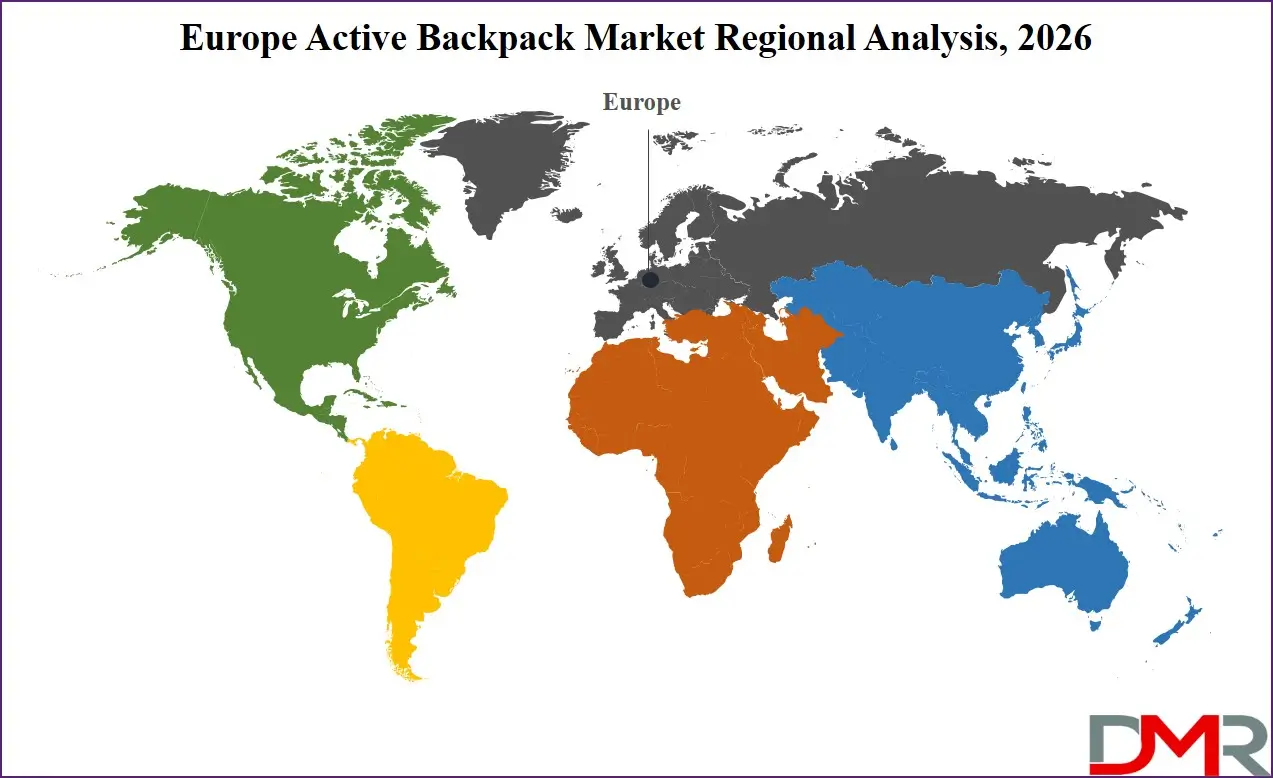
The Europe Active Backpack Market is a significant segment globally, with steady demand driven by growing outdoor and fitness lifestyles. Western Europe, particularly Germany, the United Kingdom, and France, leads the region. Germany dominates due to a strong hiking culture and well-established trail networks, with high consumer preference for durable outdoor gear. The UK market is growing through adventure tourism and lifestyle trends favoring active outdoor participation, while France is witnessing notable growth driven by increasing interest in recreational activities and outdoor experiences.
ℹ
To learn more about this report –
Download Your Free Sample Report Here
Among product types, sports backpacks are the most popular, while hiking and trekking backpacks are emerging as the fastest-growing sub-segment. This trend is supported by increasing participation in walking, hiking, cycling, and other fitness-related activities across the region. Consumer demand is also being shaped by preferences for ergonomic designs, lightweight materials, and functionality suitable for multiple activities.
Southern and Eastern Europe present emerging opportunities, with growth supported by expanding retail channels and rising consumer awareness about outdoor products. Sustainability trends are increasingly important, particularly in Western Europe, where eco-friendly materials and environmentally conscious production are influencing product development and purchase decisions.
Overall, Europe's active backpack market is characterized by strong cultural affinity for outdoor lifestyles, innovation in product design, and growing consumer interest in multifunctional and sustainable backpacks. These factors together create a balanced growth outlook across the region.
By Region
Europe
- Germany
- The U.K.
- France
- Italy
- Russia
- Spain
- Benelux
- Nordic
- Rest of Europe
Europe Active Backpack Market: Competitive Landscape
The competitive landscape is fueled by participation, both domestic and international, in the Europe Active Backpack Market, with dissimilar capabilities across design, manufacturing, and distribution. Major companies, therefore, strategize to develop advanced technologies such as sustainable materials, ergonomic designs, and smart features to enhance backpack functionality to better competitiveness. The leading players are Deuter, Jack Wolfskin, and The North Face in outdoor equipment, while in sustainable manufacturing, the leading players include Vaude and Patagonia. These companies leverage Europe's Green Deal initiatives by aligning their offerings with environmental priorities meant to attract eco-conscious consumers and improve circularity. It addresses both growing outdoor recreation and urban commuting sectors where these focus more on niche capabilities: lightweight construction and technical features, while specialty retailers have emerged, providing curated selections in product categories.
Mergers and partnerships are common strategies that allow companies to expand market presence and design capabilities. For instance, material science companies partnering with backpack manufacturers enhance product innovation and performance attributes. While the leading companies are competitive, innovation in the fields of sustainable production, smart integrations, and ergonomic design separates the leaders. These opportunities are likely to come along with an intense competitive landscape for both established players and new entrants, with strong EU support for developing sustainable industries.
Some of the prominent players in the Europe Active Backpack Market are:
- Deuter
- Jack Wolfskin
- The North Face
- Vaude
- Osprey Europe
- Mammut Sports Group
- Salewa
- Haglöfs
- Bergans
- Millet Mountain Group
- Decathlon (Quechua)
- Lowe Alpine
- Ferrino
- Camp
- Adidas
- Nike
- Puma
- Eastpak
- Fjällräven
- Patagonia
- Other Key Players
Recent Developments in the Europe Active Backpack Market
- October 2025: Deuter introduced a new line of hiking backpacks made entirely from recycled ocean plastics, featuring improved ventilation systems and adjustable torso lengths designed specifically for the European market.
- September 2025: Jack Wolfskin entered a strategic partnership with a prominent German textile innovator to integrate smart fabric technologies into its backpack collection, focusing on temperature regulation and moisture management for alpine conditions.
- August 2025: The European Outdoor Group launched a continent-wide sustainability certification program for backpacks, designed to improve supply chain transparency across critical product categories such as trekking and travel gear.
- November 2024: Vaude unveiled a blockchain-based solution to enhance traceability and sustainability verification in backpack manufacturing for European consumers. The solution facilitates seamless tracking of materials, ensuring the authenticity of eco-claims and enhancing consumer trust.
- July 2024: Osprey Europe launched an augmented reality fitting tool aimed at improving online purchasing decisions for backpack consumers. These solutions leverage mobile technology to visualize product fit and features, empowering consumers to make informed choices.
- April 2024: Decathlon expanded its Quechua backpack line with new ergonomic designs, increasing capacity for hiking and travel segments. This move supports the growing outdoor recreation demand and strengthens the company's position in European sports retail.
Report Details
| Report Characteristics |
| Market Size (2026) |
USD 2,893.5 Mn |
| Forecast Value (2035) |
USD 8,946.2 Mn |
| CAGR (2026–2035) |
13.4% |
| Historical Data |
2021 – 2025 |
| Forecast Data |
2027 – 2035 |
| Base Year |
2025 |
| Estimate Year |
2026 |
| Report Coverage |
Market Revenue Estimation, Market Dynamics, Competitive Landscape, Growth Factors and etc. |
| Segments Covered |
By Product Type (Sports Backpacks, Hiking/Trekking Backpacks, Camping and Travel Backpacks), By Capacity (Below 10 Liters, 10–20 Liters, 31–40 Liters, 41–60 Liters, Above 60 Liters), By Price Range (Budget [Below <$35], Mid-range [$35–$85], Premium [$85–$145], Luxury [Above >$145]), and By Distribution Channel (E-commerce Platforms, Specialty Outdoor Retail Stores, Multi-brand Sports & Lifestyle Store, Hypermarkets & Supermarkets, Brand Exclusive Stores) |
| Regional Coverage |
Europe – Germany, The UK, France, Russia, Spain, Italy, Benelux, Nordic, & Rest of Europe |
| Prominent Players |
Deuter, Jack Wolfskin, The North Face, Vaude, Osprey Europe, Mammut Sports Group, Salewa, Haglöfs, Bergans, Millet Mountain Group, Decathlon (Quechua), Lowe Alpine, Ferrino, Camp, Adidas, Nike, Puma, Eastpak, Fjällräven, Patagonia, and Other Key Players |
| Purchase Options |
We have three licenses to opt for: Single User License (Limited to 1 user), Multi-User License (Up to 5 Users) and Corporate Use License (Unlimited User) along with free report customization equivalent to 0 analyst working days, 3 analysts working days and 5 analysts working days respectively. |
Frequently Asked Questions
How big is the Europe Active Backpack Market?
▾ The Europe Active Backpack Market size is estimated to have a value of USD 2,893.5 million in 2026 and is expected to reach USD 8,946.2 million by the end of 2035.
Who are the key players in the Europe Active Backpack Market?
▾ Some of the major key players in the Europe Active Backpack Market are Deuter, Jack Wolfskin, The North Face, Vaude, Osprey Europe, Mammut Sports Group, Salewa, Haglöfs, Bergans, Millet Mountain Group, Decathlon (Quechua), and many others.
What is the growth rate in the Europe Active Backpack Market?
▾ The market is growing at a CAGR of 13.4 percent over the forecasted period.