Market Overview
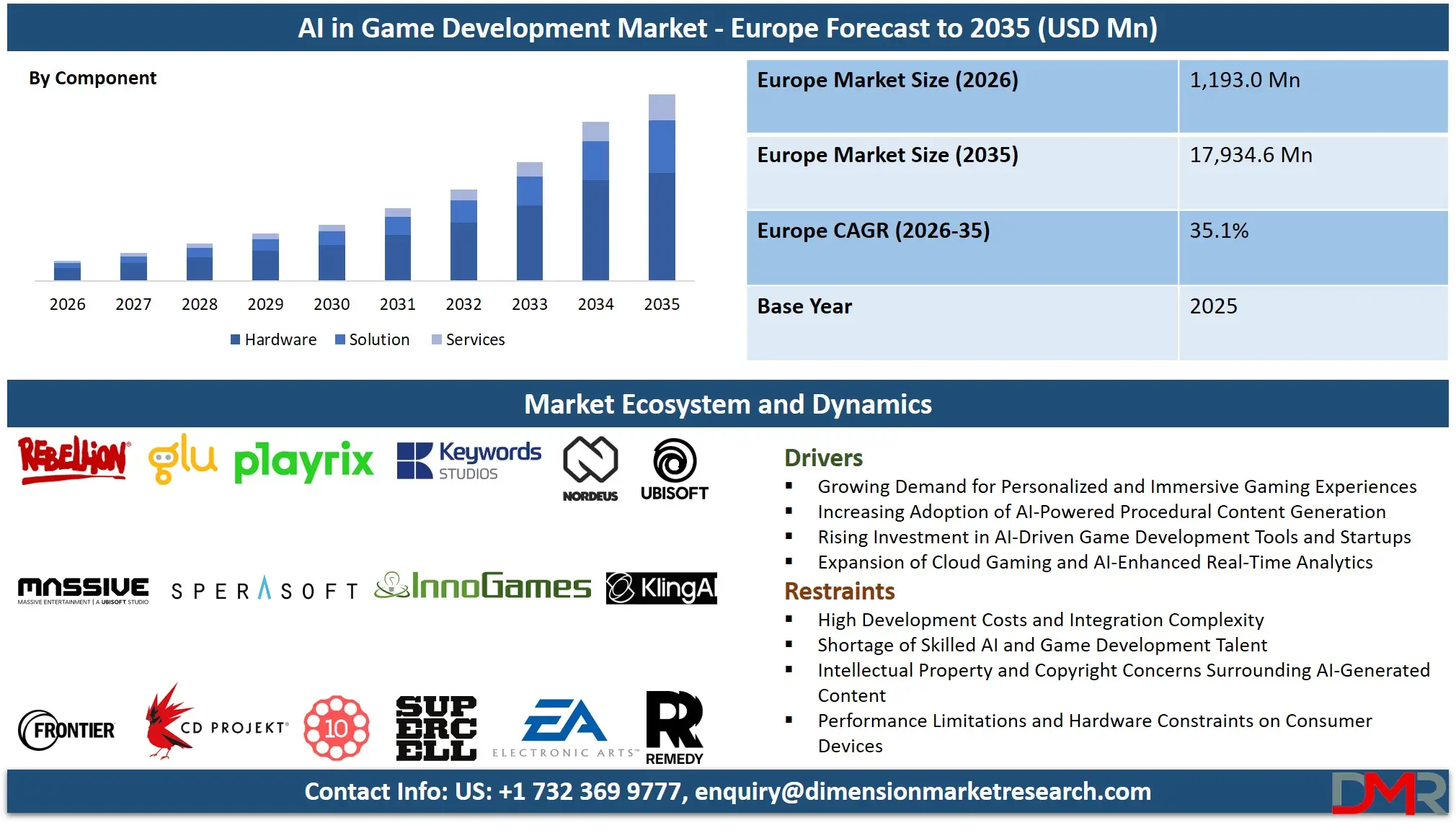
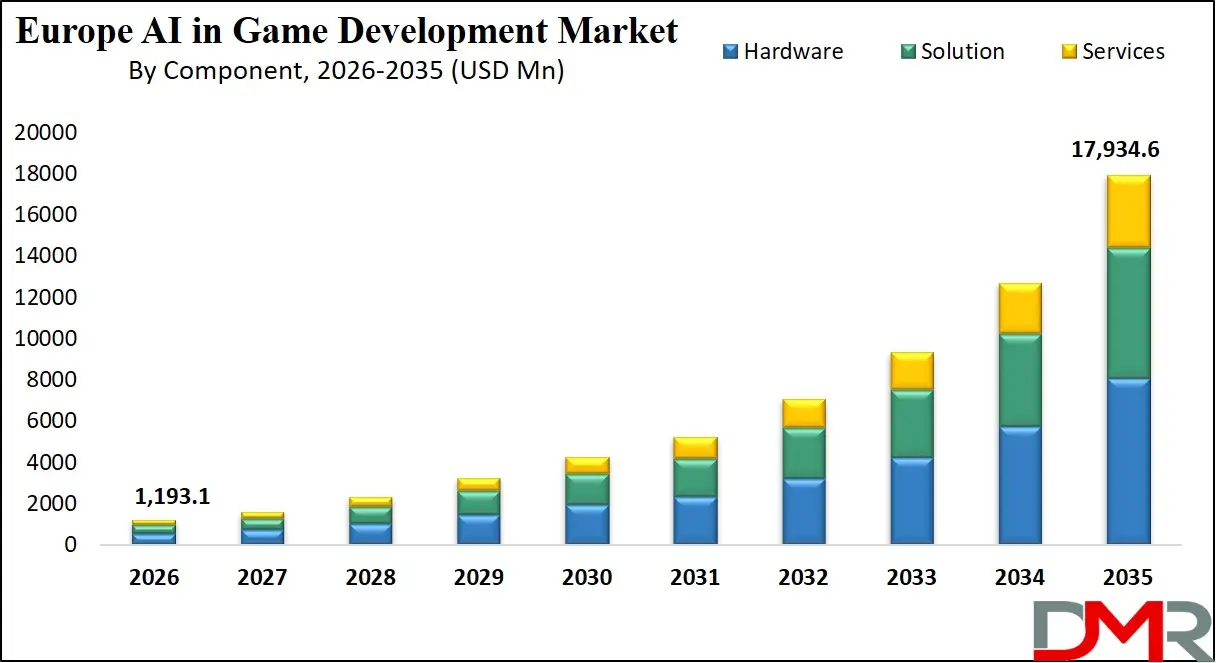
The Europe AI in game development market is projected to reach USD 1,193.0 million in 2026 and is expected to grow significantly to around USD 17,934.6 million by 2035, registering a robust CAGR of 35.1%. This rapid expansion reflects the increasing integration of artificial intelligence across the region's gaming and digital entertainment ecosystem, supported by Europe's strong foundation in innovation, creative industries, and advanced technology infrastructure.
ℹ
To learn more about this report –
Download Your Free Sample Report Here
Artificial intelligence is transforming game development by enhancing both production processes and player experiences. European developers are leveraging AI technologies such as machine learning, neural networks, and natural language processing to create more immersive, adaptive, and intelligent gaming environments. These tools enable features such as realistic non-player character behavior, procedural content generation, and automated testing, significantly reducing development time while improving quality and scalability.
A key driver of market growth is the rising demand for personalized and dynamic gaming experiences. AI-powered personalization engines analyze player behavior to tailor gameplay, increasing engagement and retention. Additionally, the growing popularity of cloud gaming, cross-platform ecosystems, and live-service models has intensified the need for AI-driven solutions capable of managing large-scale, continuously evolving game environments. Generative AI is also emerging as a transformative trend, allowing developers to rapidly design expansive and complex virtual worlds with reduced manual effort.
Europe's supportive policy environment further accelerates market growth. Initiatives such as the European Union's Digital Decade strategy, along with national funding programs, are fostering innovation in gaming and immersive technologies. The presence of major development hubs across the UK, Germany, France, and Sweden, along with a vibrant indie game development scene, is driving demand for scalable and accessible AI tools.
ℹ
To learn more about this report –
Download Your Free Sample Report Here
However, the market faces challenges, including the high cost of AI implementation and a shortage of skilled professionals specializing in AI and game design. Ethical concerns related to AI-generated content, data privacy, and regulatory fragmentation across countries also present hurdles. Despite these challenges, the outlook remains highly promising, as AI continues to redefine game development, enabling new creative possibilities and strengthening Europe's position in the global gaming industry.
Europe AI in Game Development Market: Key Takeaways
- Market Value: The Europe AI in Game Development Market size is estimated to have a value of USD 1,193.0 million in 2026 and is expected to reach USD 17,934.6 million by the end of 2035.
- By Component Segment Analysis: Solutions (AI software platforms and middleware) is anticipated to dominate this segment in the market as it will hold the largest market share in 2026.
- By Game Genre Segment Analysis: The Action and Adventure genre is projected to dominate the game genre segment in the Europe AI in Game Development Market with the highest market share in 2026.
- By Platform Segment Analysis: The mobile platform segment is anticipated to dominate the Europe AI in Game Development market with a major market share in 2026.
- By Application Segment Analysis: Intelligent Non-Player Characters (NPCs) is projected to hold the leading position in the application segment of this market in 2026.
- Key Players: Some of the major key players in the Europe AI in Game Development Market are Unity Technologies, Epic Games, NVIDIA Corporation, Ubisoft Entertainment, Crytek, Electronic Arts (EA), and many others.
- Market Growth Rate: The market is growing at a CAGR of 35.1 percent over the forecasted period.
Impact of Iran Conflict on the Europe AI in Game Development Market
- Disruption to Hardware Supply Chains and Pricing: The Iran conflict could exacerbate existing geopolitical tensions in the Middle East, potentially disrupting critical shipping routes such as the Strait of Hormuz. This may lead to delays and increased costs for semiconductor components, GPUs, and specialized AI hardware essential for game development studios across Europe. Higher hardware costs and supply uncertainty could slow down infrastructure upgrades and AI tool adoption, particularly for smaller studios with limited capital.
- Increased Energy Costs Affecting Cloud and Data Center Operations: Escalation in the conflict may drive up global energy prices, directly impacting the operational costs of cloud computing and data centers where AI training and deployment take place. European developers relying on cloud-based AI services for rendering, procedural generation, or automated testing could face higher expenses, potentially constraining budgets allocated for AI-driven innovation and expanding project timelines.
- Talent Mobility and Workforce Disruptions: Heightened geopolitical instability may affect the movement of skilled AI professionals and technical talent between Europe and the broader Middle East region. European game studios that rely on international talent pipelines could experience recruitment challenges or delays in securing specialized AI expertise. Additionally, increased travel restrictions or security concerns may disrupt collaborative research and development initiatives with partners in affected regions.
- Shifts in Investment and Market Confidence: Prolonged conflict and regional instability could lead to risk aversion among investors, potentially reducing venture capital flows into European AI-focused game development startups. While the European market remains resilient, sustained uncertainty may cause investors to delay funding decisions or prioritize safer asset classes, slowing the pace of early-stage innovation and the commercial deployment of emerging AI technologies in the gaming sector.
Europe AI in Game Development Market: Use Cases
- Intelligent NPC Behavior: AI-driven non-player characters that learn from player actions, adapt their strategies, and exhibit realistic, dynamic behaviors, enhancing immersion and replayability in single-player and multiplayer games.
- Procedural World Building: Generative AI algorithms used to create expansive, detailed game environments, levels, and assets, significantly reducing development time while enabling unique player experiences across playthroughs.
- Automated Testing and QA: Machine learning models deployed to simulate thousands of gameplay scenarios, identify bugs, and balance game mechanics, accelerating quality assurance processes and improving overall game stability.
- Player Experience Personalization: AI systems that analyze individual player behavior in real time to adjust difficulty, recommend content, and tailor in-game events, driving higher engagement and retention across live-service titles.
Europe AI in Game Development Market: Stats & Facts
European Commission (DG CONNECT) – Video Games Sector Study
- The EU video games market generated approximately USD 25.4 billion in revenue in 2022, reflecting the strong foundation for AI-driven game development.
- The sector includes around 5,000 game development and publishing studios across Europe.
- The industry employs approximately 74,000 professionals, highlighting growing demand for AI and technical expertise.
- More than 50% of the European population regularly plays video games, driving adoption of AI-powered gaming experiences.
European Parliament (EPRS – Video Games & Esports Briefing)
- The European gaming market was valued at approximately USD 25.2 billion in 2021, making it one of the fastest-growing creative industries.
- The sector directly employs over 90,000 people, indicating strong workforce expansion.
- Around 50% of Europeans identify as gamers, supporting demand for AI integration in games.
European Games Developer Federation (EGDF) & Video Games Europe
- EGDF represents more than 2,500 game development studios across 22 European countries, showcasing the region's broad development ecosystem.
- These studios collectively employ over 40,000 professionals, many working on AI-integrated development processes.
European Audiovisual Observatory (Council of Europe)
- The European video game industry is recognized as one of the most dynamic creative sectors, with increasing adoption of advanced technologies such as artificial intelligence.
National & Industry Ecosystem Data (Public Sources)
- Europe has approximately 5,500 game development studios, with a large share consisting of small and medium-sized enterprises driving innovation.
- The UK accounts for over 1,500 studios, making it one of the largest gaming hubs in Europe.
- France hosts more than 1,100 studios, reinforcing its strong position in the European gaming landscape.
Europe AI in Game Development Market: Market Dynamic
Driving Factors in the Europe AI in Game Development Market
Expanding European Gaming Industry
Europe represents one of the world's largest and most mature gaming markets, with a robust network of developers, publishers, and technology partners. The region's strong consumer base for both mobile and PC/console games creates sustained demand for innovation. As development budgets rise and production complexity increases, AI offers a scalable solution to maintain quality and efficiency. Government-backed initiatives aimed at fostering digital creativity further reinforce the market's growth trajectory.
Advancements in AI Hardware and Cloud Infrastructure
Continuous improvements in AI-specific hardware, such as GPUs and neural processing units, are lowering the barriers to implementing complex AI models in game development. Concurrently, the proliferation of cloud-based AI services enables developers to access scalable computing power without significant upfront investment. This democratization of AI capabilities allows smaller studios to compete with larger players, broadening the overall market base.
Restraints in the Europe AI in Game Development Market
High Implementation and Integration Costs
Despite the availability of cloud-based tools, integrating advanced AI systems into existing development pipelines requires significant financial and technical resources. Custom AI model development, data preparation, and middleware licensing can be prohibitive for small and medium-sized studios. This financial barrier may slow adoption among indie developers, limiting the overall reach of AI technologies across the European market.
Ethical and Regulatory Concerns
The use of AI in creative industries raises complex ethical questions around copyright, data usage, and potential displacement of human artists and writers. European regulatory frameworks, including the EU's Artificial Intelligence Act, are introducing compliance requirements that may impact how AI tools are developed and deployed. Studios must navigate these evolving regulations carefully, which can add layers of complexity and uncertainty to AI adoption strategies.
Opportunities in the Europe AI in Game Development Market
Integration of AI in AR/VR and Immersive Platforms
As augmented reality and virtual reality platforms gain traction in Europe, AI presents significant opportunities to enhance immersion through realistic spatial interactions, adaptive environments, and personalized user experiences. Developers who combine AI with immersive technologies can create next-generation experiences that blur the line between physical and digital worlds. Early adoption in this niche offers a competitive advantage and access to high-value market segments.
Expansion of AI-Driven Testing and Quality Assurance Services
The growing complexity of modern games creates a substantial market for specialized AI testing services. Automated testing solutions that leverage reinforcement learning and computer vision can dramatically reduce QA timelines while uncovering issues that traditional testing might miss. This creates opportunities for specialized service providers to partner with studios across Europe, particularly in regions with concentrated development activity.
Trends in the Europe AI in Game Development Market
Generative AI Revolutionizing Content Creation
The adoption of generative AI tools is transforming game development workflows across Europe, enabling studios to automate the creation of assets such as textures, animations, voiceovers, and dialogue. This trend significantly reduces production timelines and costs, allowing developers to focus on higher-level creative decisions. Major game engines are integrating generative AI plugins, making these capabilities more accessible to both AAA studios and independent developers. As a result, the volume and diversity of game content are expanding rapidly, meeting consumer demand for richer, more varied gaming experiences.
Rise of AI-Powered Live Operations
With the growing dominance of games-as-a-service models, developers are increasingly leveraging AI to manage live operations. Machine learning algorithms analyze player data to optimize in-game events, balance economies, and predict churn. This enables continuous engagement strategies that extend the lifecycle of games. European studios, particularly in mobile and multiplayer segments, are investing heavily in AI-driven analytics platforms to maintain competitive positioning in a crowded market.
Europe AI in Game Development Market: Research Scope and Analysis
By Component Analysis
Solutions (AI software platforms and middleware) is anticipated to dominate the component segment in this market, holding the largest market share in 2026. The dominance of solutions in the Europe AI in Game Development Market is driven by the widespread adoption of integrated AI tools that streamline development workflows and enhance creative capabilities. Game engines such as Unity and Unreal Engine have embedded AI-powered features that enable developers to implement advanced functionalities without building systems from scratch. These software solutions encompass everything from behavior tree editors and machine learning agents to procedural generation tools and AI-driven animation systems, making them indispensable for modern game production. European developers, known for their technical sophistication and emphasis on innovation, increasingly rely on these solutions to remain competitive in a rapidly evolving industry. The scalability of software platforms also allows studios to start with basic implementations and expand as their projects grow, lowering the entry barrier for smaller teams. Additionally, the growing ecosystem of specialized AI middleware providers in Europe offers tailored solutions for specific genres or platforms, further reinforcing the segment's leadership. As AI capabilities continue to evolve, the software layer remains the primary interface through which developers access and leverage these technologies.
By Game Genre Analysis
The Action and Adventure genre is projected to dominate the game genre segment in the Europe AI in Game Development Market with the highest market share in 2026. This genre's leadership is attributable to its inherent complexity and reliance on sophisticated AI systems to deliver engaging experiences. Action and adventure games typically feature expansive open worlds, complex enemy behaviors, dynamic storytelling, and intricate player interactions all of which require advanced AI implementation. European developers have long been pioneers in this genre, with studios across the region producing critically acclaimed titles that push the boundaries of what AI can achieve in gaming. The genre's popularity among European consumers ensures sustained investment from publishers, who allocate substantial budgets to AI-driven features such as realistic NPC behavior, adaptive difficulty systems, and cinematic presentation. Moreover, the convergence of action-adventure mechanics with live-service models creates ongoing demand for AI tools that support content updates and player engagement analytics. As the genre continues to evolve, incorporating elements from role-playing and immersive simulation, the complexity and sophistication of required AI solutions will only increase.
By Platform Analysis
The mobile platform segment is anticipated to dominate the Europe AI in Game Development market with a major market share in 2026. Mobile gaming represents the largest and most accessible segment of the European games market, with a diverse player base spanning all demographics. The sheer volume of mobile game releases creates intense competition, driving developers to leverage AI for personalization, retention optimization, and efficient content scaling. AI-powered recommendation systems, dynamic difficulty adjustment, and player behavior analytics have become essential tools for mobile studios seeking to maximize engagement and monetization. The lower hardware constraints of mobile devices have also led to innovations in lightweight AI models that deliver sophisticated functionality without compromising performance. European mobile game hubs, particularly in countries like Finland, Sweden, and Germany, are at the forefront of integrating AI into their development pipelines. Additionally, the prevalence of free-to-play and live-service models on mobile platforms necessitates continuous optimization, further cementing AI's role as a core component of mobile game development.
By Application Analysis
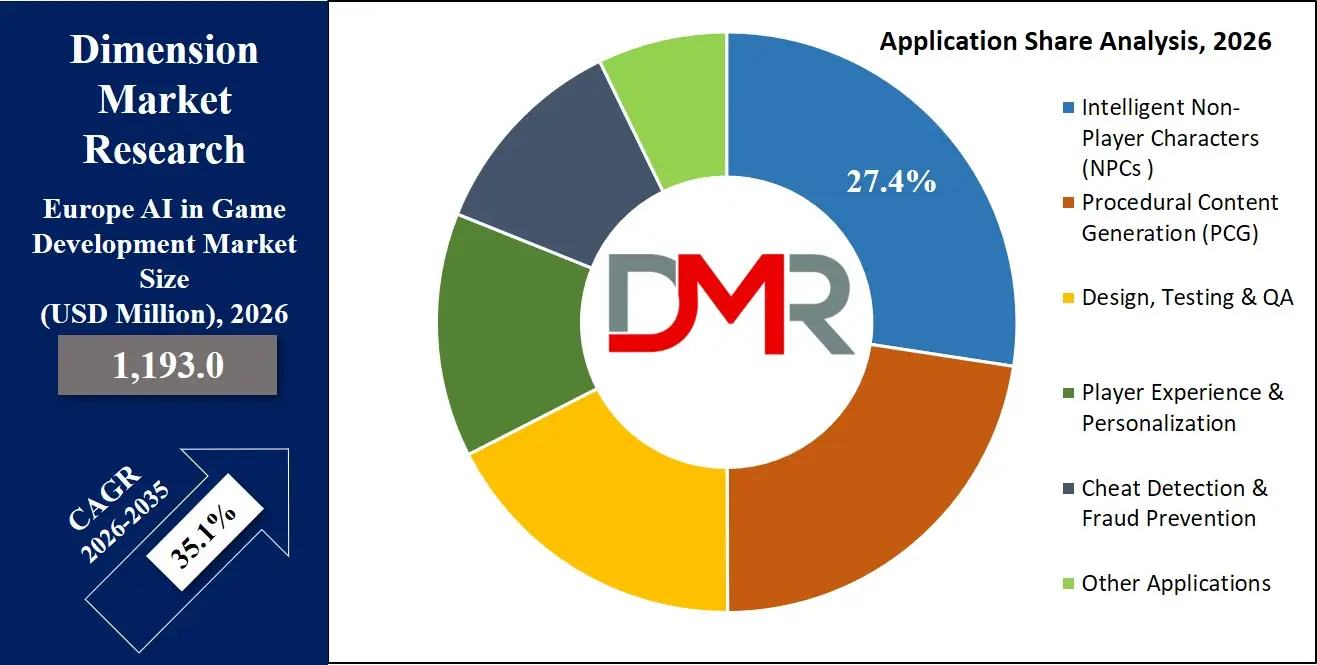
Intelligent Non-Player Characters (NPCs) is projected to hold the leading position in the application segment of this market in 2026. NPCs are fundamental to creating immersive game worlds, and European developers have consistently pushed the boundaries of what these characters can achieve through AI. From enemies that adapt to player strategies to companions with believable emotional responses, intelligent NPCs are a primary differentiator for premium gaming experiences.
ℹ
To learn more about this report –
Download Your Free Sample Report Here
The application encompasses behavior modeling, decision-making systems, natural language processing for dialogue, and learning algorithms that allow characters to evolve over time. As players increasingly expect deeper, more realistic interactions, the complexity of NPC AI systems continues to escalate. This application also benefits from advances in machine learning, which enable more nuanced character behaviors without requiring exhaustive manual scripting. European research institutions and game studios collaborate closely in this area, driving innovations that are subsequently adopted across the industry. The centrality of NPCs to core gameplay mechanics across multiple genres ensures this application's continued leadership throughout the forecast period.
The Europe AI in Game Development Market Report is segmented on the basis of the following:
By Component
- Hardware
- Solution
- Services
By Game Genre
- Action and Adventure
- Role-Playing Games (RPGs)
- Shooter (FPS/TPS)
- Simulation and Strategy
- Sports and Racing
- Other Games
By Platform
- Mobile
- PC
- Console
- AR/VR
- Cloud and Streaming Gaming
By Application
- Intelligent Non-Player Characters (NPCs)
- Procedural Content Generation (PCG)
- Design, Testing & QA
- Player Experience & Personalization
- Cheat Detection & Fraud Prevention
- Other Applications
Europe AI in Game Development Market: Regional Analysis
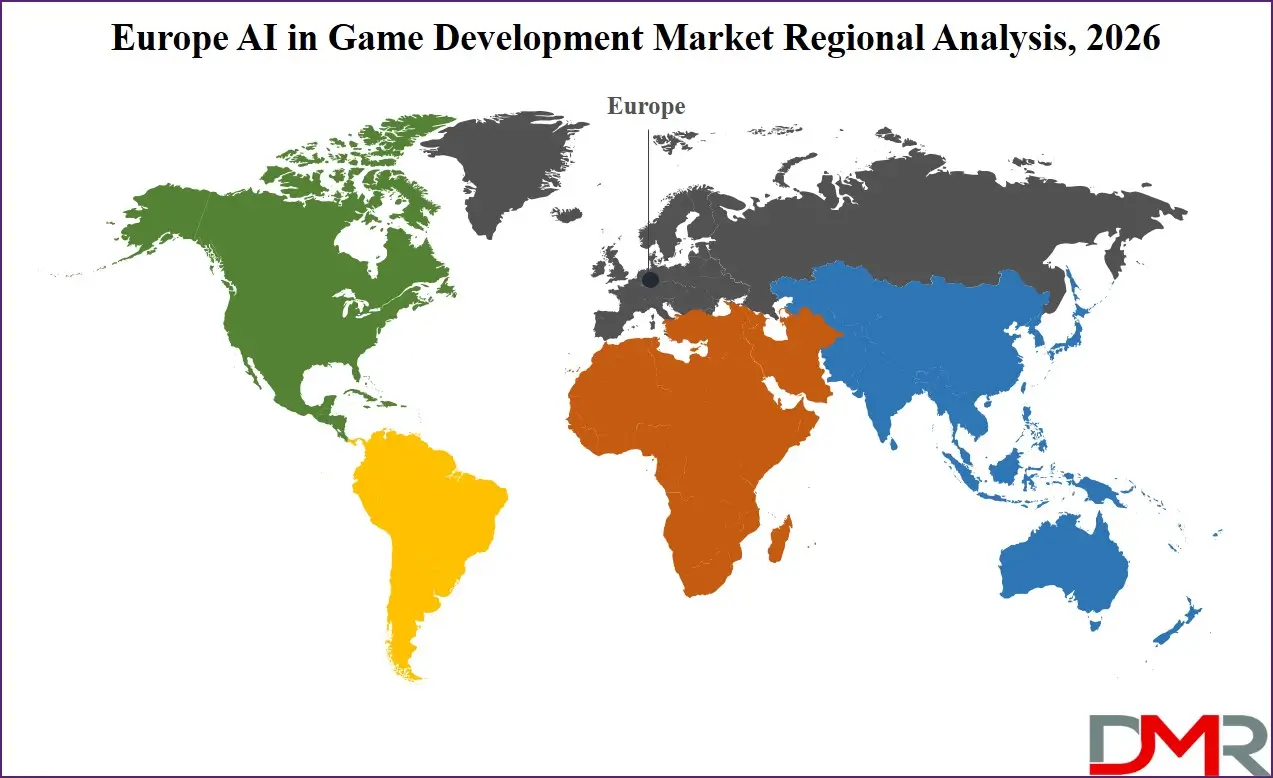
The Europe AI in game development market exhibits distinct regional dynamics, with Western Europe leading in terms of market share and technological maturity. The United Kingdom stands as a dominant force, supported by a robust gaming industry, world-class research institutions, and strong government backing for creative technologies. France and Germany follow closely, driven by major publishing houses and significant investment in AI-driven production pipelines.
Northern Europe, particularly Sweden, Finland, and Denmark, represents a concentrated hub of innovation, home to renowned mobile gaming studios and a thriving indie developer scene. These countries have rapidly adopted AI tools for procedural content generation, player analytics, and automated testing, leveraging their deep expertise in digital technology and favorable business environments.
Southern Europe, including Spain and Italy, is emerging as a growth region, with expanding development communities and increasing integration of AI into both mobile and console game production. Government incentives and EU-funded digital innovation programs are accelerating adoption across these markets.
Central and Eastern Europe, notably Poland and Romania, offer a competitive advantage through highly skilled technical talent and cost-effective development capabilities. Studios in these regions are increasingly utilizing AI for quality assurance, asset creation, and live operations management, positioning themselves as valuable partners in the European gaming ecosystem. Collectively, regional strengths across Europe create a diverse and resilient market landscape.
By Region
Europe
- Germany
- The U.K.
- France
- Italy
- Russia
- Spain
- Benelux
- Nordic
- Rest of Europe
Europe AI in Game Development Market: Competitive Landscape
The competitive landscape in the Europe AI in Game Development Market is characterized by a mix of global technology providers, major game publishers, and specialized AI middleware developers. Leading companies compete on the basis of technological sophistication, ease of integration, and the breadth of their offerings. Engine providers such as Unity Technologies and Epic Games dominate the software layer, embedding AI capabilities directly into platforms used by the vast majority of European developers. Hardware manufacturers like NVIDIA provide essential infrastructure through GPUs and AI development frameworks.
ℹ
To learn more about this report –
Download Your Free Sample Report Here
Major publishers including Ubisoft and Electronic Arts develop proprietary AI technologies to gain competitive advantages in their flagship franchises, often later commercializing these tools. The European market also features a robust ecosystem of specialized AI firms offering niche solutions for applications such as voice synthesis, animation generation, and automated testing. Mergers, acquisitions, and strategic partnerships are common as larger players seek to expand their AI capabilities. Government support for digital innovation and the presence of world-class technical talent across the region further intensify competition, benefiting end-users through continuous improvement in available tools and services.
Some of the prominent players in the Europe AI in Game Development Market are:
- Ubisoft
- CD Projekt
- Electronic Arts
- Remedy Entertainment
- Nordeus
- Keywords Studios
- King
- Supercell
- 10 Chambers Collective
- Playrix
- Glu Mobile
- Frontier Developments
- Sperasoft
- Ubisoft Massive
- Rebellion Developments
- InnoGames
- Wooga
- Socialpoint
- Gameloft
- Playtika
- Other Key Players
Recent Developments in the Europe AI in Game Development Market
- October 2025: Unity Technologies released a major update to its AI-powered development platform, introducing generative AI tools for real-time 3D asset creation and automated animation workflows, significantly reducing production time for European game studios.
- September 2025: NVIDIA announced a strategic partnership with several European gaming hubs to establish AI development centers focused on advancing neural rendering and intelligent NPC behaviors for next-generation game engines.
- August 2025: Ubisoft unveiled its proprietary AI-driven procedural generation system, designed to create expansive game environments with minimal manual input, demonstrating the technology at its annual developer conference in France.
- November 2024: Epic Games launched a cloud-based AI testing and quality assurance service for Unreal Engine developers, enabling automated gameplay testing across multiple hardware configurations and reducing QA cycles for European studios.
- July 2024: DeepMind collaborated with a leading European game publisher to implement advanced reinforcement learning models for non-player character behavior, resulting in more adaptive and challenging AI opponents in competitive multiplayer titles.
- April 2024: Crytek introduced new AI-based performance optimization tools within its game engine, allowing developers to automatically scale graphical fidelity and NPC complexity across different hardware platforms.
Report Details
| Report Characteristics |
| Market Size (2026) |
USD 1,193.0 Mn |
| Forecast Value (2035) |
USD 17,934.6 Mn |
| CAGR (2026–2035) |
35.1% |
| Historical Data |
2021 – 2025 |
| Forecast Data |
2027 – 2035 |
| Base Year |
2025 |
| Estimate Year |
2026 |
| Report Coverage |
Market Revenue Estimation, Market Dynamics, Competitive Landscape, Growth Factors and etc. |
| Segments Covered |
By Component (Hardware, Solution, and Services), By Game Genre (Action and Adventure, Role-playing games (RPGs), Shooter(FPS/TPS), Simulation and Strategy, Sports and Racing, and Other Games), By Platform (Mobile, PC, Console, AR/VR, and Cloud and Streaming Gaming), and By Application (Intelligent Non-Player Characters (NPCs), Procedural Content Generation (PCG), Design, Testing & QA, Player Experience & Personalization, Cheat Detection & Fraud Prevention, and Other Application) |
| Regional Coverage |
Europe – Germany, The UK, France, Russia, Spain, Italy, Benelux, Nordic, & Rest of Europe |
| Prominent Players |
Ubisoft, CD Projekt, Electronic Arts, Remedy Entertainment, Nordeus, Keywords Studios, King, Supercell, 10 Chambers Collective, Playrix, Glu Mobile, Frontier Developments, Sperasoft, Ubisoft Massive, Rebellion Developments, InnoGames, Wooga, Socialpoint, Gameloft, Playtika, and Other Key Players |
| Purchase Options |
We have three licenses to opt for: Single User License (Limited to 1 user), Multi-User License (Up to 5 Users) and Corporate Use License (Unlimited User) along with free report customization equivalent to 0 analyst working days, 3 analysts working days and 5 analysts working days respectively. |
Frequently Asked Questions
How big is the Europe AI in Game Development Market?
▾ The Europe AI in Game Development Market size is estimated to have a value of USD 1,193.0 million in 2026 and is expected to reach USD 17,934.6 million by the end of 2035.
Who are the key players in the Europe AI in Game Development Market?
▾ Some of the major key players in the Europe AI in Game Development Market are Unity Technologies, Epic Games, NVIDIA Corporation, Ubisoft Entertainment, Crytek, Electronic Arts (EA), and many others.
What is the growth rate in the Europe AI in Game Development Market?
▾ The market is growing at a CAGR of 35.1 percent over the forecasted period.