Market Overview
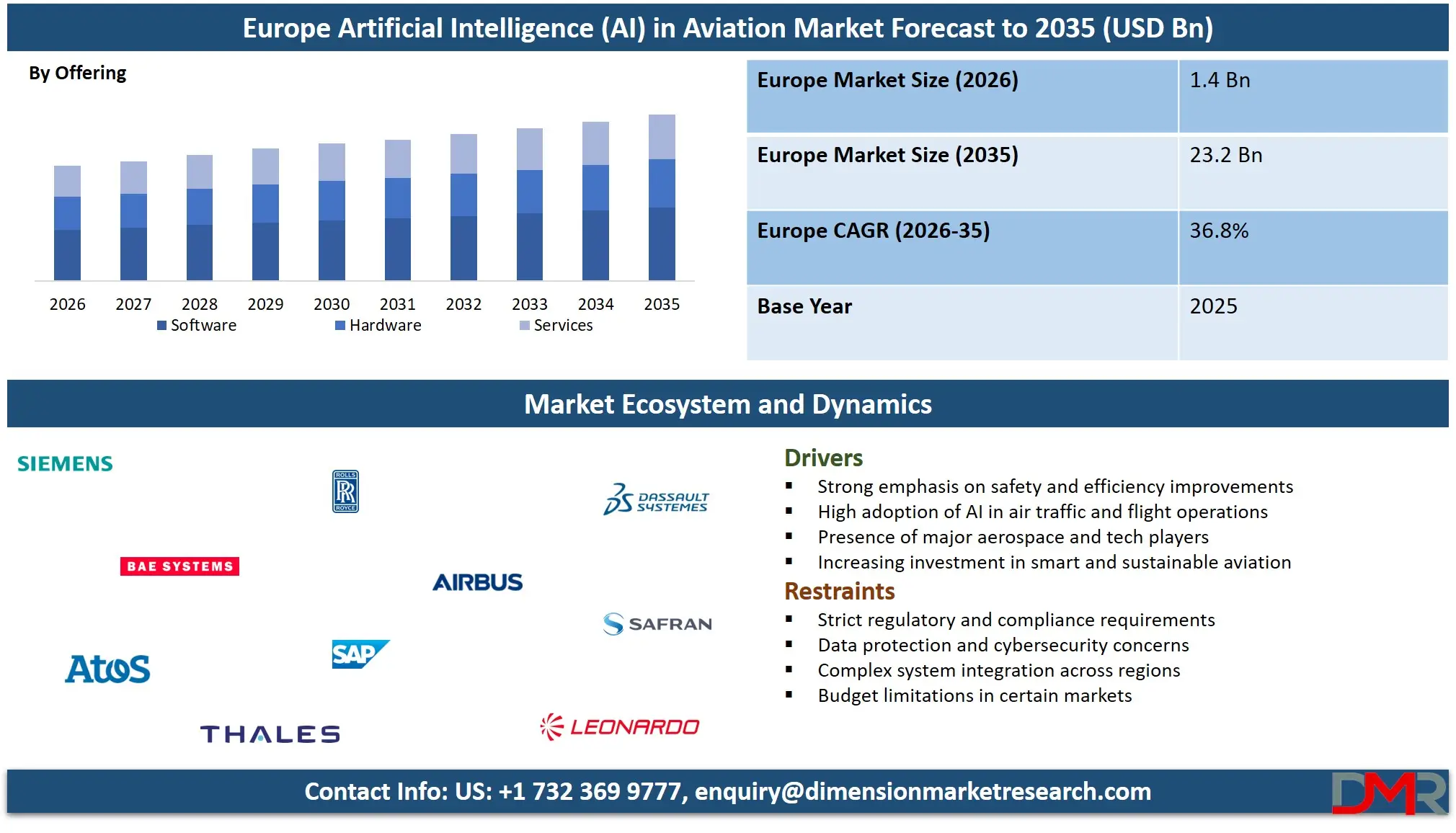
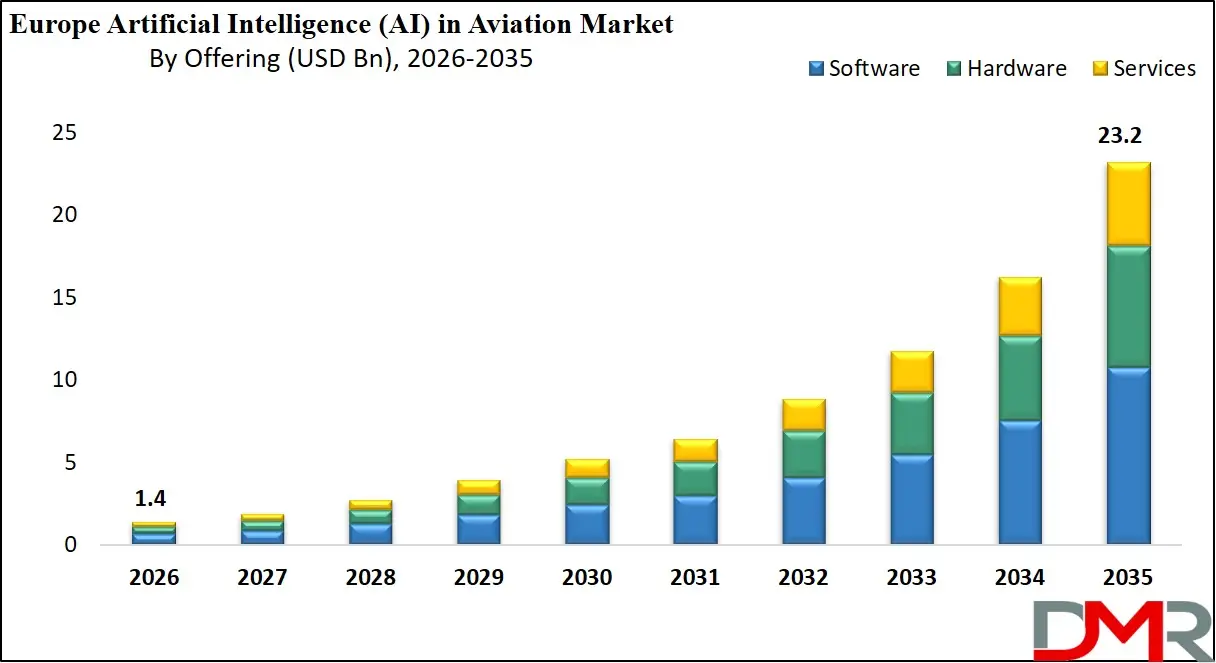
The Europe Artificial Intelligence (AI) in Aviation Market size is projected to reach USD 1.4 billion in 2026 and grow at a compound annual growth rate of 36.8 to reach a value of USD 23.2 billion in 2035.
ℹ
To learn more about this report –
Download Your Free Sample Report Here
Artificial intelligence in aviation refers to the integration of advanced computational algorithms, machine learning models, and data-driven systems into aviation operations, maintenance, air traffic management, and passenger services. It encompasses software platforms, hardware infrastructure, and analytics tools that enhance decision-making, safety, and operational efficiency.
This domain plays a critical role in modernizing aviation by enabling predictive maintenance, autonomous systems, and optimized flight operations. Increasing digital transformation, demand for real-time analytics, and sustainability goals are driving adoption, alongside growing investments in smart aviation ecosystems and intelligent airport infrastructure across the region.
ℹ
To learn more about this report –
Download Your Free Sample Report Here
Europe Artificial Intelligence (AI) in Aviation Market: Key Takeaways & Influencing Factors
- Market Growth: The Europe Artificial Intelligence (AI) in Aviation Market size is expected to grow by USD 21.4 billion, at a CAGR of 36.8%, during the forecasted period of 2027 to 2035.
- By Offering: The software segment is anticipated to get the majority share of the Europe Artificial Intelligence (AI) in Aviation market in 2026.
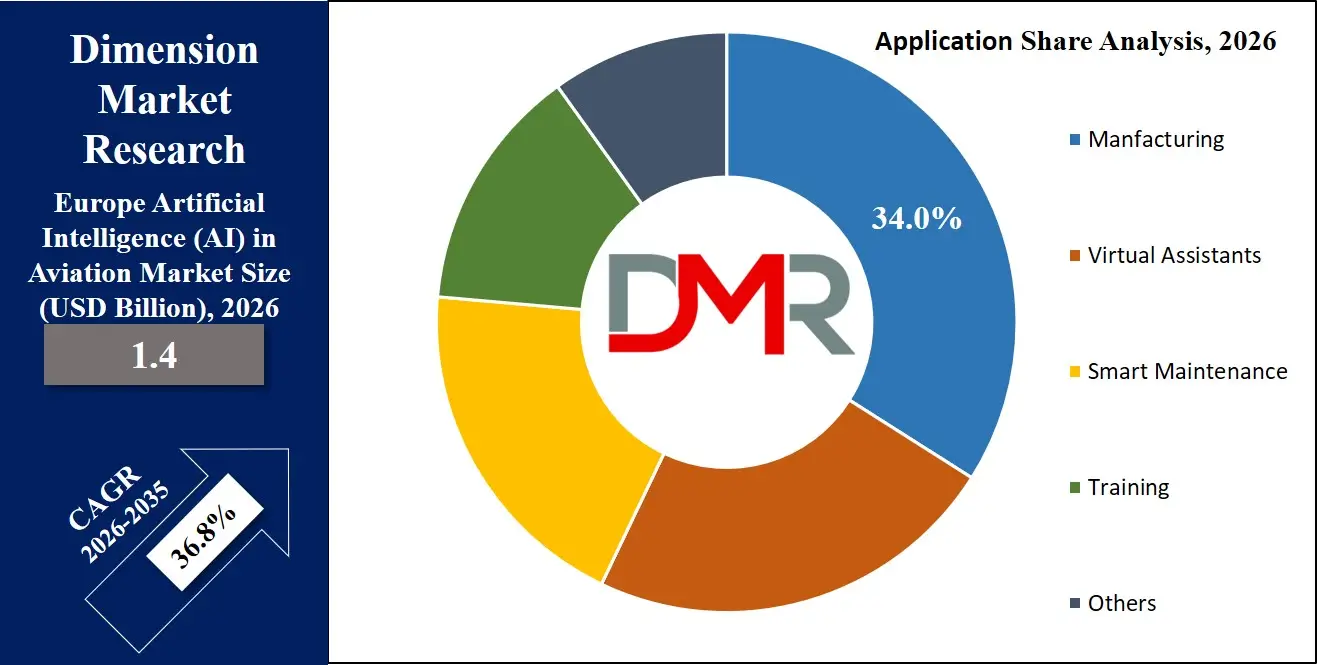
- By Application: The manufacturing segment is expected to get the largest revenue share in 2026 in the Europe Artificial Intelligence (AI) in Aviation market.
- Use Cases: Some of the use cases of Artificial Intelligence (AI) in Aviation include predictive maintenance, passenger experience enhancement, and more.
- European Commission reported in 2025 that over 65% of major European airports have adopted AI-based digital transformation initiatives to enhance operational efficiency.
- Eurocontrol stated in 2024 that AI-enabled air traffic management systems improved airspace capacity utilization by approximately 20% across key European corridors.
- International Air Transport Association (IATA) noted in 2025 that predictive maintenance powered by AI reduced aircraft maintenance costs by nearly 15% for European carriers.
- European Union Aviation Safety Agency (EASA) highlighted in 2026 that AI-driven safety systems contributed to a 10% improvement in incident detection and prevention mechanisms.
Europe Artificial Intelligence (AI) in Aviation Market: Use Cases:
- Predictive Maintenance: AI-driven analytics monitor aircraft systems in real time, identifying potential failures before they occur. This minimizes downtime, reduces maintenance costs, and enhances fleet reliability through proactive servicing strategies.
- Air Traffic Management Optimization: AI improves route planning, reduces congestion, and enhances fuel efficiency by analyzing flight patterns, weather data, and traffic loads to streamline airspace operations.
- Passenger Experience Enhancement: AI-powered virtual assistants, biometric systems, and personalized services improve customer engagement, reduce wait times, and deliver seamless travel experiences at airports.
- Autonomous Operations Support: AI assists in semi-autonomous flight systems and ground handling operations, improving safety, precision, and operational efficiency in complex aviation environments.
Market Dynamic
Driving Factors in the Europe Artificial Intelligence (AI) in Aviation Market
Rising Demand for Operational Efficiency and Cost Reduction
Airlines and airport operators are increasingly adopting AI technologies to optimize operations, reduce fuel consumption, and minimize delays. AI-driven analytics enable precise decision-making, improving scheduling, route planning, and maintenance cycles. These efficiencies translate into significant cost savings and improved profitability, making AI integration a strategic priority across the aviation ecosystem.
Government Support and Digital Aviation Initiatives
European governments and regulatory bodies are actively promoting digital transformation in aviation through funding programs, research initiatives, and policy frameworks. Investments in smart airports, sustainable aviation technologies, and AI innovation hubs are accelerating adoption. These initiatives foster collaboration between technology providers and aviation stakeholders, strengthening market growth and technological advancement.
Restraints in the Europe Artificial Intelligence (AI) in Aviation Market
High Implementation and Integration Costs
Deploying AI systems in aviation requires substantial investment in infrastructure, skilled workforce, and system integration. Legacy systems often need significant upgrades to support AI capabilities, increasing capital expenditure. These financial barriers can limit adoption, particularly among smaller airlines and regional airports with constrained budgets.
Data Privacy and Regulatory Challenges
Strict data protection regulations and safety compliance requirements in Europe pose challenges for AI deployment. Managing sensitive passenger and operational data while ensuring regulatory compliance adds complexity. Additionally, certification of AI systems for safety-critical aviation applications remains a lengthy and rigorous process, slowing implementation timelines.
Opportunities in the Europe Artificial Intelligence (AI) in Aviation Market
Expansion of Smart Airports and Digital Ecosystems
The development of smart airports presents significant growth opportunities for AI solutions. Integration of AI with IoT, biometrics, and automation technologies enables seamless operations and enhanced passenger experiences. Increasing investments in airport modernization across Europe are expected to drive demand for advanced AI systems.
Growth in Sustainable Aviation Solutions
AI plays a vital role in achieving sustainability goals by optimizing fuel consumption, reducing emissions, and improving resource utilization. As the aviation industry focuses on carbon neutrality, AI-driven innovations in flight operations and maintenance offer substantial opportunities for market expansion.
Trends in the Europe Artificial Intelligence (AI) in Aviation Market
Integration of AI with Advanced Analytics and IoT
The convergence of AI with big data analytics and IoT devices is transforming aviation operations. Real-time data collection and analysis enable predictive insights, enhancing decision-making across flight operations, maintenance, and passenger services. This trend is driving the development of highly connected and intelligent aviation ecosystems.
Adoption of Autonomous and Semi-Autonomous Systems
The aviation industry is witnessing increasing adoption of AI-powered autonomous technologies in flight operations and ground handling. These systems improve precision, reduce human error, and enhance safety. Continued advancements in AI algorithms and sensor technologies are accelerating this trend across the European market.
Impact of Iran War on Europe Artificial Intelligence (AI) in Aviation Market
The geopolitics of war in Iran also affects the airline industry through interrupted flight paths, higher costs of fuel, and security issues. This leads to the faster integration of AI systems for optimized flight paths and risks management. Airlines increasingly use AI technology in the face of unpredictable geopolitical situations.
Research Scope and Analysis
By Offering Analysis
The software industry constitutes the largest market share and it is anticipated to account for around 46% share by 2026 owing to the high adoption of AI technologies and applications for analytics, automation, and decision-making purposes. Airlines and airport organizations are inclined towards using software-based AI technologies for greater adaptability and scalability purposes. Services industry remains the most rapidly growing among the different sectors of AI technology, owing to the rising need for integration, customization, and service support offerings.
By Technology Analysis
The machine learning component holds a leading position in terms of market share in the technology segment and accounts for around 39% of the market share by 2026, owing to the fact that it helps predict maintenance needs and optimize routes and operations. The computer vision segment emerges as one of the fastest-growing segments of the industry due to the rising deployment of computer vision in surveillance and passenger handling.
By Equipment Analysis
The market of Coordinate Measuring Machines (CMM) will hold a substantial market size of about 28%, driven by the importance of precision measurements and quality control during aircraft manufacturing and servicing. The accuracy of these machines makes them very important in aviation industry operations. Optical Digitizers and Scanners (ODS) will be the fastest growing segment, fueled by the need for digital models and reverse engineering during inspection and maintenance processes in the aviation sector.
By Application Analysis
The manufacturing category is expected to take up 34% of the applications market in 2026 due to the widespread use of AI technologies in aircraft manufacturing, quality control, and logistics management.
ℹ
To learn more about this report –
Download Your Free Sample Report Here
The efficiency and cost-saving capabilities of AI make it a leader in the field. Smart maintenance is the most rapidly developing application area, which is supported by the increasing implementation of predictive analytics and condition monitoring solutions.
The Europe Artificial Intelligence (AI) in Aviation Market Report is segmented on the basis of the following:
By Offering
- Hardware
- Software
- Services
- Integration & Development
- Support & Maintenance
By Technology
- Machine Learning
- Deep Learning
- Supervised Learning
- Semi-supervised Learning
- Unsupervised Learning
- Reinforcement Learning
- Natural Language Processing
- Context Awareness Computing
- Computer Vision
By Equipment
- Autocollimator
- Profile Projector
- Measuring Microscope
- Optical Digitizers & Scanners (ODS)
- Co-ordinate Measuring Machine (CMM)
- Vision Measuring Machine (VMM)
By Application
- Virtual Assistants
- Smart Maintenance
- Manufacturing
- Training
- Others
Country Analysis
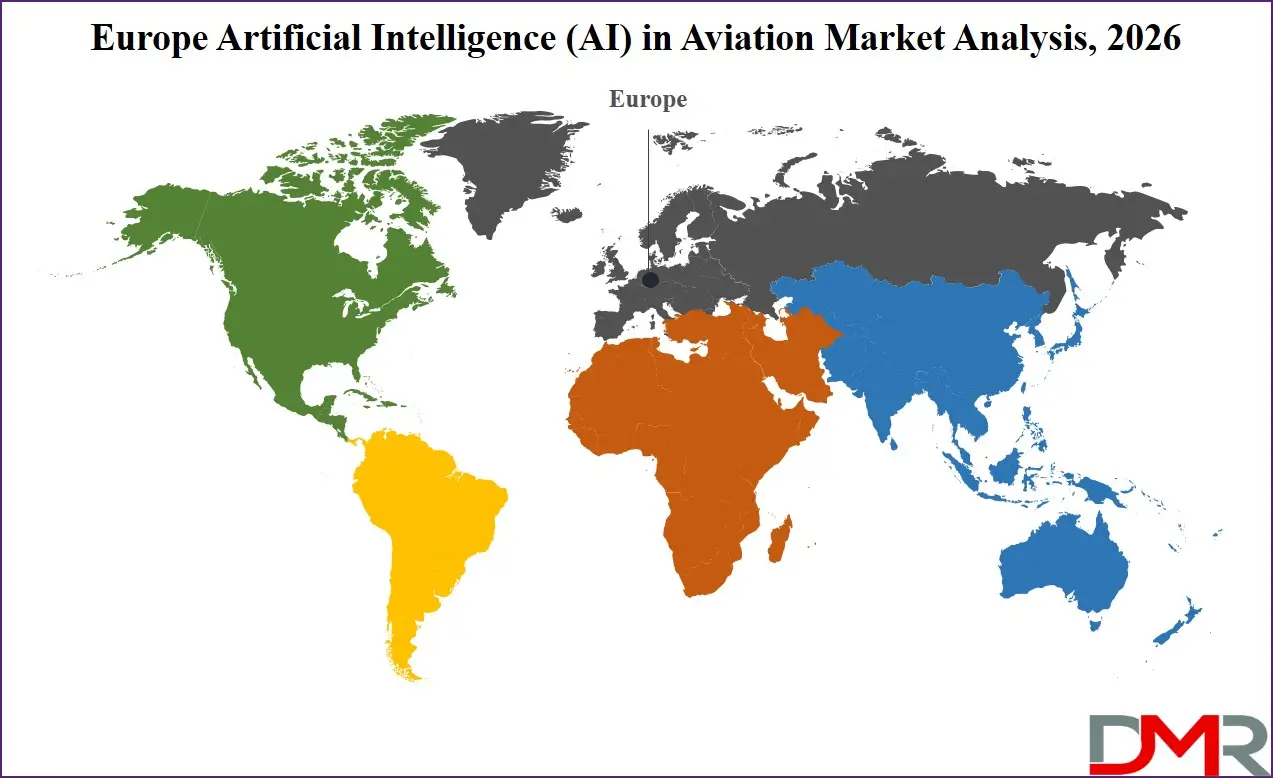
The AI technology of Europe in the aviation sector continues to grow gradually, thanks to the robust regulatory structure and the financial support from the European Union. Some of the leading countries adopting AI technology in aviation include Germany, UK, and France, who leverage their robust aerospace ecosystem. The growing number of passengers, sustainability objectives, operational efficiency, and digitization are some of the key factors that continue to propel AI in aviation.
ℹ
To learn more about this report –
Download Your Free Sample Report Here
By Country
- Germany
- The U.K.
- France
- Italy
- Russia
- Spain
- Benelux
- Nordic
- Rest of Europe
Competitive Landscape
In terms of the nature of competition within the Europe AI in Aviation Market, there exists stiff competition in the market due to constant innovation, high barrier to entry, and technical knowledge among others. Organizations adopt partnering approaches in addition to collaborations with the aviation industry as well as substantial investment in research and development to improve on AI. Competitive advantage in the market is established through superior analytics, scalability of the platform used, and adherence to regulation.
Some of the prominent players in the Europe Artificial Intelligence (AI) in Aviation are:
- Airbus SE
- Rolls-Royce Holdings plc
- Safran Group
- Thales Group
- BAE Systems
- Leonardo S.p.A.
- Dassault Aviation
- Siemens AG
- SAP SE
- Deutsche Lufthansa AG
- Air France-KLM
- Ryanair Holdings plc
- EasyJet plc
- Indra Sistemas
- Atos SE
- Capgemini SE
- QinetiQ
- Cobham Limited
- DeepMind
- Mistral A
- Other Key Players
Recent Developments
- In January 2026, Frankfurt Airport has become the first EU airport to fully deploy AI-powered security screening. All CT scanners in its terminals now use the Automatic Prohibited-Item Detection System (APIDS), developed with the German Federal Police and the EU. Integrating AI with Smiths Detection scanners, the system detects threats like weapons and explosives while allowing passengers to keep bags closed.
- In January 2026, Dassault Aviation and Harmattan AI announced a strategic partnership to advance AI-driven autonomy in combat aviation. Dassault is leading Harmattan AI's USD 200 million Series B round. Backed by defense contracts in France and the UK, the funding will support global expansion, new AI mission deployments, broader product development, and scaled manufacturing of advanced defense systems.
- In October 2025, Birmingham Airport announced a new tech-driven initiative, Connected Personal Experiences (CPE), to enhance passenger journeys through real-time, personalized updates. In its first phase, the airport will launch BABS, an AI-powered assistant developed with Hello Lamp Post, enabling travelers to receive guidance via smartphones and digital help points across terminals.
Report Details
| Report Characteristics |
| Market Size (2026) |
USD 1.4 Bn |
| Forecast Value (2035) |
USD 23.2 Bn |
| CAGR (2026–2035) |
36.8% |
| Historical Data |
2021 – 2025 |
| Forecast Data |
2027 – 2035 |
| Base Year |
2025 |
| Estimate Year |
2026 |
| Report Coverage |
Market Revenue Estimation, Market Dynamics, Competitive Landscape, Growth Factors and etc. |
| Segments Covered |
By Offering (Hardware, Software, Services), By Technology (Machine Learning, Natural Language Processing, Context Awareness Computing, Computer Vision), By Equipment (Autocollimator, Profile Projector, Measuring Microscope, Optical Digitizers & Scanners (ODS), Co-ordinate Measuring Machine (CMM), Vision Measuring Machine (VMM)), By Application (Virtual Assistants, Smart Maintenance, Manufacturing, Training, Others) |
| Regional Coverage |
Europe – Germany, The UK, France, Russia, Spain, Italy, Benelux, Nordic, & Rest of Europe |
| Prominent Players |
Airbus SE, Rolls-Royce Holdings plc, Safran Group, Thales Group, BAE Systems, Leonardo S.p.A., Dassault Aviation, Siemens AG, SAP SE, Deutsche Lufthansa AG, Air France-KLM, Ryanair Holdings plc, EasyJet plc, Indra Sistemas, Atos SE, Capgemini SE, QinetiQ, Cobham Limited, DeepMind, Mistral AI, and Other Key Players |
| Purchase Options |
We have three licenses to opt for: Single User License (Limited to 1 user), Multi-User License (Up to 5 Users) and Corporate Use License (Unlimited User) along with free report customization equivalent to 0 analyst working days, 3 analysts working days and 5 analysts working days respectively. |
Frequently Asked Questions
How big is the Europe Artificial Intelligence (AI) in Aviation Market?
▾ The Europe Artificial Intelligence (AI) in Aviation Market size is expected to reach USD 1.4 billion by 2026 and is projected to reach USD 23.2 billion by the end of 2035.
Who are the key players in the Europe Artificial Intelligence (AI) in Aviation Market?
▾ Some of the major key players in the Europe Artificial Intelligence (AI) in Aviation Market include SAP, Thales, Airbus, and others
What is the growth rate in the Europe Artificial Intelligence (AI) in Aviation Market?
▾ The market is growing at a CAGR of 36.8 percent over the forecasted period.